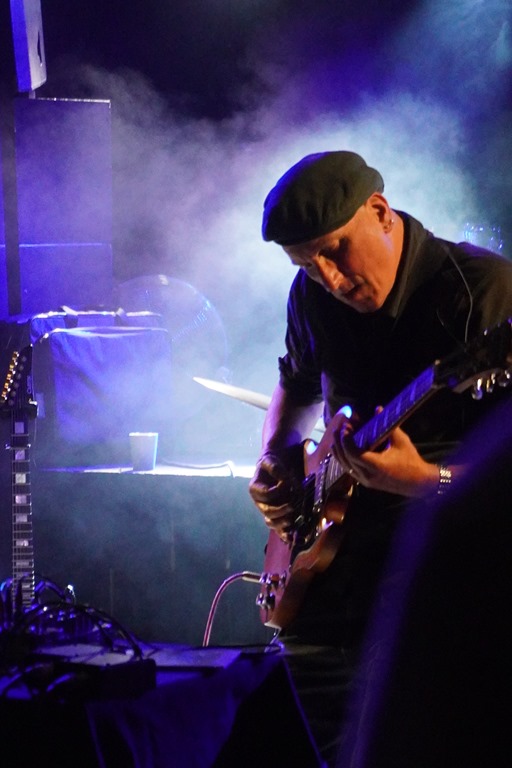
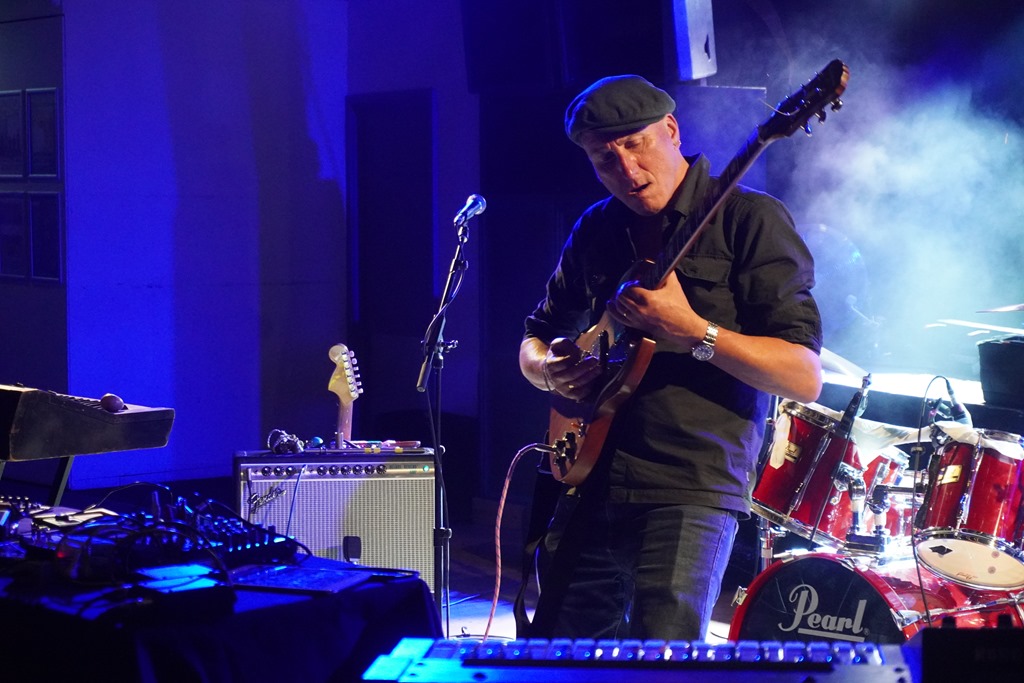
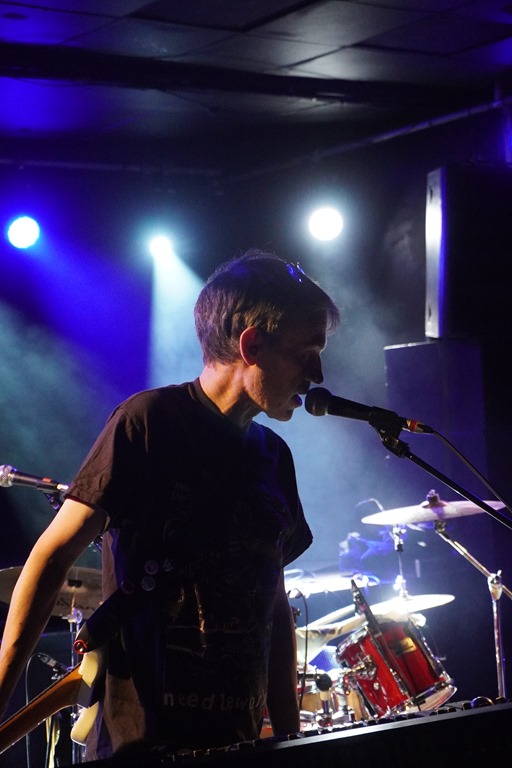
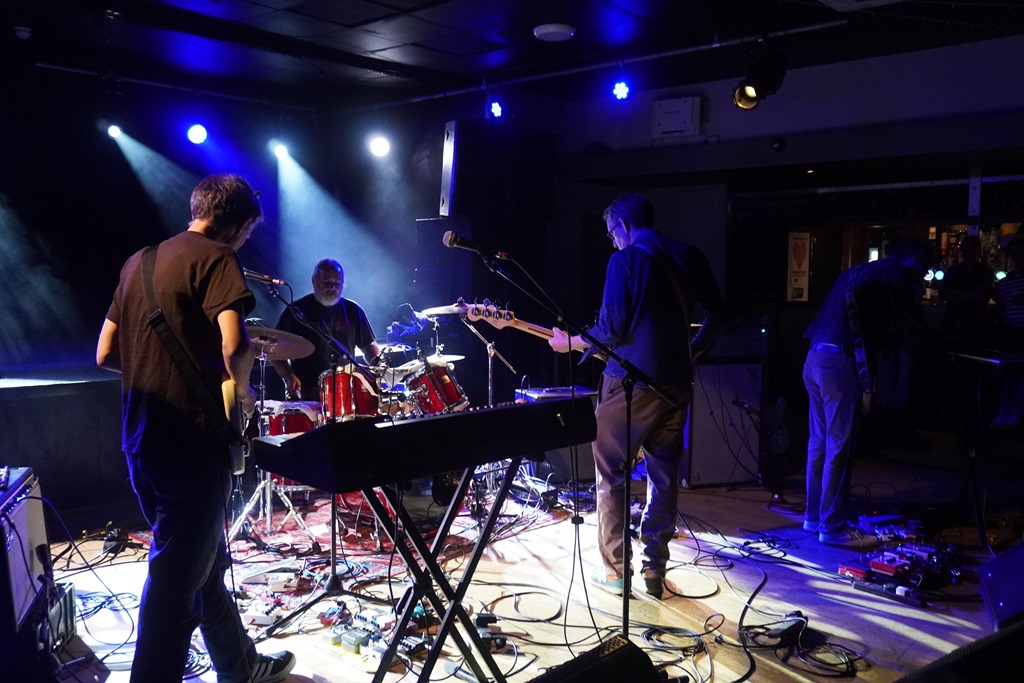
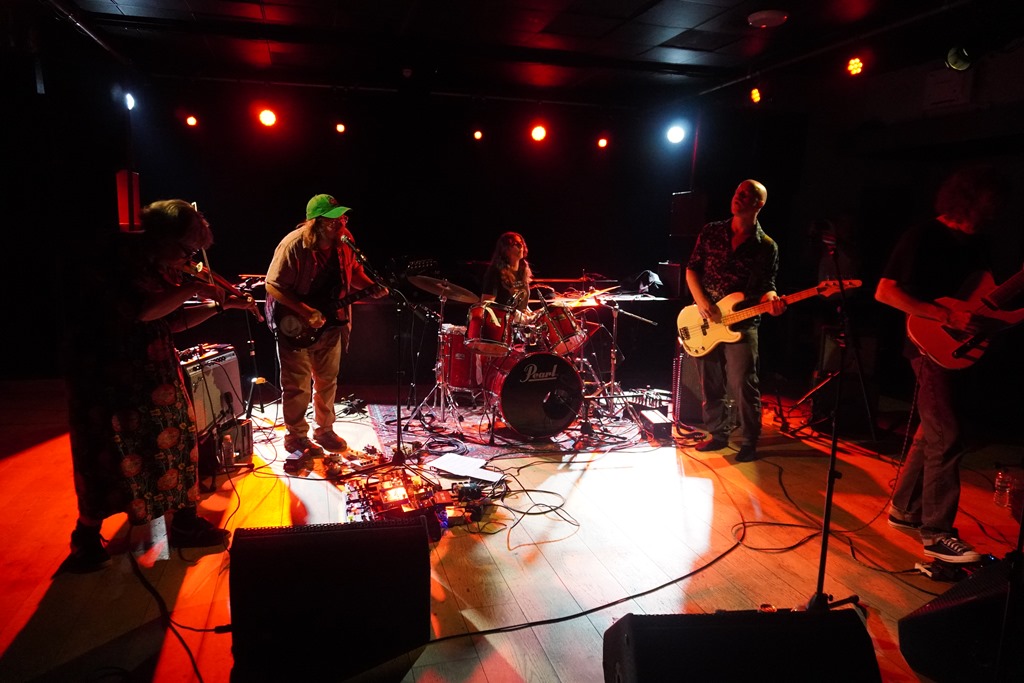
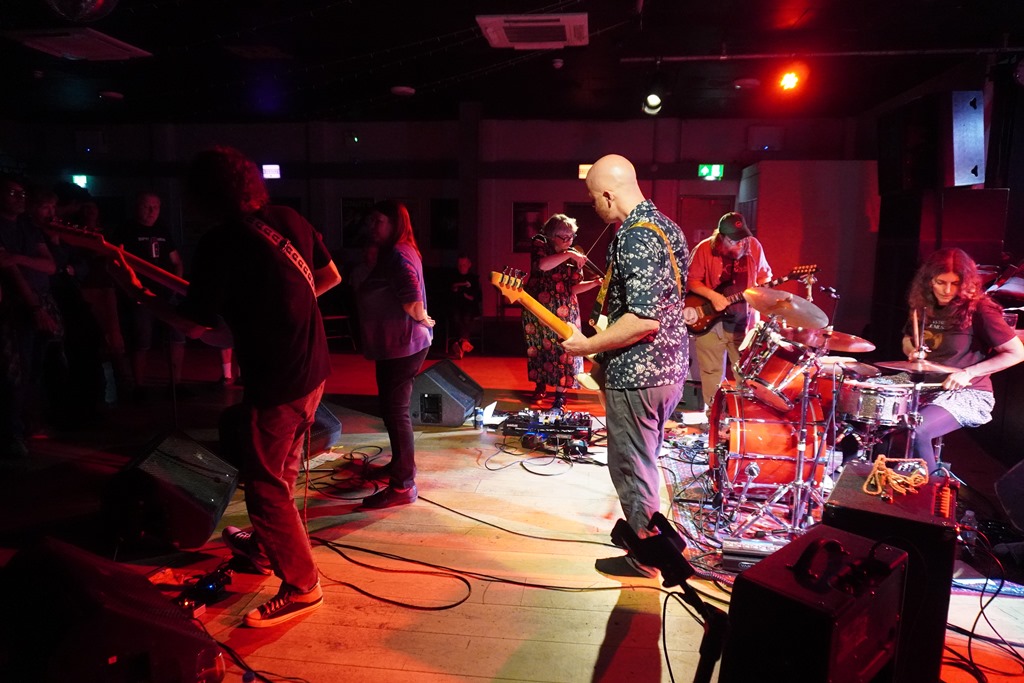
A couple of months ago (I’m putting it down to the successive heatwaves that the time seems to have simply evaporated this year), Dragged Up stopped off in York(on their way to Newcastle from Middlesbrough) to squeeze in a special set opening day two of a mini-festival. During their performance, we got a preview of what was then touted as being a future single in the form of ‘Rapunzel’.
And now, the world gets to hear the studio version, in all its five-minute glory, complete with some bold sax. While the accompanying video (a two-minute cut), courtesy of the band’s own Eva Gnatiuk (guitar and vocals) features a succession of folks dropping classic and influential albums and books like they’re nothing (I was particularly pained to see a copy of the Red Star issue of Suicide’s first album getting tossed, even though the cover looked a bit battered, rather less fussed about a Faces album getting the treatment, and wait! That’s Stuart Lee emerging from behind an Earl Scruggs LP!)
AA
Where was I? Oh yes. The music. ‘Rapunzel’ is a garage, punky romp of a tune, and the sax lends it a very (early) Psychedelic Furs / X-Ray Spex vibe (Germ-Free Adolescents also appears in the video). It may reference hair washing, but it’s bursting with lyrical tangents, and couldn’t be much further from the songs from Disney’s Tangled (a movie I’ve seen far too many time, on account of having celebration a daughter who was exactly the right age for Frozen and stuff when it was all the rage). But this ‘Rapunzel’ keeps on springing surprises: the ‘Dark Entries’ section that featured live remains intact around the three minute mark, and if the video seems to say ‘meh’ to influence, the music itself says otherwise, feeling like a n effervescent celebration of those predecessors, rather than a trashing. Regardless, the result is an uptempo, exuberant, scuzzy blast that’s bursting with energy and attitude. And it’s great.
It’s always the north, isn’t it? Sure, The Cure and Bauhaus and Siouxsie all originated down south, but it’s always been the North of England that’s been the true heartland of all things dark and gritty, and, well, goth. Reading – somewhat belatedly – Lol Tolhurst’s roundly-lauded tome on the topic, one thing that shines through is his being struck by the north / south divide, and how places like Manchester in the late 70s displayed a far more pronounced level of deprivation. It is, indeed, grim up north, and the reason that Leeds was the true spawning ground of the goth scene in the early 80s is in many ways self-evident.
History has a habit of repeating itself, and for all the talk of the ‘Northern Powerhouse’ a few years back, it’s still grim up north, and there are numerous parallels to the late 70s and early 80s when it comes to life in England post-Brexit.
machiner list among their influences Nine Inch Nails, New Order and Depeche Mode, and state that their objective is to ‘transform emotional vulnerability into something expansive and cinematic’. And they’re from Hartlepool in County Durham. While for some, County Durham will likely connote the cathedral, the university, and cobbled streets of the city itself, but beyond this, the once industrial county, where mining was its primary source of employment, there is a very different, and far less idyllic picture. And its in this context that we come to machiner, a band who balance elegance and a sense of the epic in what one might call the classical sense, with the dinge and deprivation of much of the region.
Over the course of the eight songs on motion waves, machiner weave some deftly-crafted slices of expansive, dreamy alternative rock, the soaring guitars interlaced with layers of synth, and while the results are neither overtly dark or heavy, there are undercurrents of brooding tension. And what’s more, the melodic, cinematic nature of the music makes for an accessible vehicle for altogether bleaker lyrics. Take these lines from ‘ivory skies’, for example:
low life in the hall outside my door
and a girl cries in the bedroom just below
last night I heard her head crack off the wall
then a silence like I’ve never heard before
well this is England…this is now
And sadly, this is life now. By way of a brief detour, but for necessary context, it’s a grim statistic that instances of domestic violence spike when there is international football being played. Womensaid quote research which found that cases of domestic abuse increased by 38% when England lost a match and 26% when they won or drew. The response of the Reform party – who run Durham County Council – was to post a video cheering England on to prevent domestic violence. This is England, and this is now. And these are shit times.
The seven-minute ‘dark age’ is a magnificently poised, almost prog-leaning composition, and the piano-led ‘the sound of disappearing’ rolls past on a soft drift which is not only gentle, but truly pretty. And herein we arrive at the essence of machiner: as much as they detail the grimy, gritty realities, they’re looking towards escape routes and better futures. motion waves is the sound of a way out of a thorny thicket. ‘iceburn’ in particular soars skywards, and the easy ‘cast me in amber’ – which again extends to almost six and a half minutes – brings a strong New Order vibe, and pairs it with some nagging electronica laced with heavy hints of shoegaze: in short, it’s perhaps the ultimate assimilation of the elements which make up the textured sonic amalgamation of machiner’s dynamic style.
‘ever over’, which reminds very much of Oceansize, brings things to a strong and solid conclusion, and it makes for a dextrous conclusion to a magnificent album, one which brims with texture, dynamic energy, and a sense of movement. Bold… and beautiful.
Just over a year ago, York had the fortune to host the first ever live show of Light of Eternity, the new band led – from the back – by drumming titan Paul Ferguson, founding member of Killing Joke, who can also boast Warrior Soul and Murder Inc on his resumé. And now, we also have the honour of being the end point of this year’s UK tour. Only a few days ago, they played the legendary punk festival that is Rebellion, and since that first performance in front of around 150 people, they’ve toured as the support for Ministry, too. We’ll come to just how much they’ve evolved since that debut shortly.
It’s not exactly rammed tonight, particularly early doors – and they are early doors, being at 6:30 and the first act on at 7 – probably because a fair few are still at Rebellion and Bloodstock only finished last night, and consequently, Dollface Reunion start their set to a very sparsely populated room. If they’re disappointed by this, they don’t show it. Having caught them in Leeds supporting Spear of Destiny in May my enthusiasm for seeing them again so soon was only middling. I was beginning to have flashbacks to the two to three-month spell in 2000 / 2001 when I saw Sona Fariq supporting pretty much every fucking band I went to see, not least of all twice in a week when I saw The Sisters of Mercy in Glasgow and then Nottingham. And they were abysmal every single fucking time. It turns out that I simply hadn’t been in the mood for Dollface Reunion when I saw them last time, and they likely suffered from having been squeezed on as late additions before Cheeks, who were nothing short of a revelation.
Dollface Reunion
Reassessing them tonight, I appreciated them a whole lot more. As the name suggests, they’re a reunited version of 90s alt rock act Dollface, and as such, their set is largely culled from their sole album release, 1995’s Giant. Their third song, ‘Rockstars’, which was a single back in ’94, bears a lead guitar line reminiscent of The Cult, and they most definitely rock. ‘Spaceship’ is announced as ‘a song about a spaceship’, and late on, ‘Metropolis’ storms home as a stomper that sit between New Model Army and The Levellers. Only much better than The Levellers.
On the eve of this brief tour, Light of Eternity announced the addition of James OZ Bowey on bass. This means that Fred Schreck no longer has to multitask with covering bass and vocal duties, and it does make a difference, not least of all visually. Instead of being rooted to the spot (not that there was space to move at The Fulford Arms: Ferguson’s kit pretty much occupied the whole stage), he’s got the freedom to move, not just about the stage, but with arm gestures – he’s actually pretty expressive on that front – making for a much more visual performance overall. I’d even go s far as to say that, liberated from the bass, he’s quite a compelling front man.
Light of Eternity
Bowey has found his groove straight away, and they are so tight, his thick bass sound underpinning Pauly Williams’ thick, churning riffs. The guitar sound is bright but dense. Predictably, the drumming is immense. And casting my mind back to that first show, Ferguson started the set a little loose, proving that even the most seasoned musicians sometimes need some time to bed into something new. This time around… everything is nailed down tight form the first beat. All the rehearsals in the world are no substitute for time spent on stage, and the benefit of the road miles these guys have put in this last year is evident from the off. It’s true that the Killing Joke comparisons will forever stay with them, not just on account of Ferguson, but Williams’ taut, compressed guitar sound – but Schreck’s vocals d bring something different, and the chug and churn is often closer to the sound of Murder Inc., and this is nowhere more perfectly evidenced than on ‘Worlds Collide’.
Light of Eternity
And to top it, they’ve managed to write some new material, too. Last time around, they played the twelve songs they had – the two EPs and a further EP’s worth – and were done. Tonight, we get new material, and launching the final third of the twelve song set, new song ‘Sycophant’ rocks particularly hard and they really seem to step thing up from hereon in.
The set list still only shows twelve songs, though, and expectations for an encore are slim – but they do indeed return, and kick off a three-song encore with a throbbing rendition of ‘Dark Hope’. They slow things with the atmospheric ‘Nebula’, and the fact that there are such solid cuts from the first two EPs that they can keep in reserve from a main set that fills an hour and a quarter is in itself impressive. They conclude with ‘Explode’ – which still sounds like a blend of Ministry’s ‘N.W.O’ and Therapy? circa 1994, in the best possible way – to my ears. It kicks ass, too.
Light of Eternity
Having seen Killing Joke in venues closer to 2,000 in capacity, and Murder Inc supporting The Sisters of Mercy at Birmingham NEC (a show which is featured on the second disc of the reissue of their eponymous album, under the title Locate, Subvert, Terminate), to witness this band at such close proximity – The Crescent has a capacity of 350) is nothing short of mind-blowing, and while writing up my (painfully sparse) notes, I learn that there are people in the audience who have travelled from Sweden for this. it’s not hard to understand why. These guys are living legends – but despite a major-league support slot, playing 1,500 capacity spaces, they’re still building things up from the bottom in grassroots venues. This is positively heroic. And as for tonight’s set… there simply aren’t enough superlatives.
I’ve written extensively on the topic of formats before, and having grown up in the 80s and 90s when the physical single was still a dominant format – in particular the 7” single, which could be purchased cheaply (and with wide availability on the high street from not just Our Price and HMV, but also Woolworths and WH Smith) for a quid or two, the whole experience of the A-side and B-side, or a double-A-side is scored into my psyche. Most digital singles now only contain one track, and while I get it, it’s just not the same – and nor is paying a tenner or more for a lathe-cut limited edition of twenty. It feels as if the market has split in directions which are diametric opposites, and neither is particularly satisfying.
The latest release from Hull’s Bug Facer manages a satisfactory compromise, in the current economic climate: a digital single release with two tracks for four quid. Because another thing that’s largely been forgotten is that the cost of production of a physical release is not all of the cost involved – in fact it’s only a fraction. A studio, an engineer, a producer, all cost. Rehearsal space. PR. And so on. All of these things are expenses involved in being a band and recording and releasing music. This is the reason that Spotify sickens me, and the culture whereby people believe music should be free blows my mind. Home taping didn’t kill music. Illegal sharing via Napster and Soulseek didn’t kill music. Legitimate corporate-driven platforms, however, really fucked things, especially for smaller artists. The industry co-conspired, and didn’t so much shoot itself in the foot as hug a landmine.
Imagine being buzzed about starting a new band and getting your music out there, and then the few hundred streams you get after some heavy plugging and a PR scoring a review or two and maybe a couple of radio plays, to receive absolutely nothing, while your fraction of a penny that actually goes to the artists rather than the platform has been dripped into the pool that’s divvied out between Ed Sheeran, Coldplay, and U2. So yes, £4 for a digital release in 2026 is probably fair – especially when it’s a proper two-song single which replicates the 7” experience of the A-side and B-side, and especially when both songs are killer.
And here, both songs are indeed killer. ‘Nuclear Bounty Hunter’ stars slow, with a tense build-up and an intimation of a riff, squirming its way to a thick, gnarly riff that’s halfway between raging punk and sludgy noise. Sling the Melvins together with Slaughter and the Dogs and you’re in the right domain. It’s heavy, hefty, rabid, and gloriously messy.
‘Beggar’s Last Words’ is an entirely different proposition: it’s nearly seven minutes long for a start, and sashays in with soft instrumentation over a waltz-time beat. It’s kinda hazy, kinda droney, deeply psychedelic, and very much of an experimental bent. In short, it couldn’t be more contrasting. The vocals, when they finally arrive, are heavily treated, warped, and woozy, and are half-submerged among the ever-rising cacophony which is building, and almost out of nowhere, we’re four minutes in and find ourselves in the midst of a sonic maelstrom. After this crescendo of chaos, everything gradually winds down, wheezing, wasted, to a slow fade.
The fact that this release showcases two vastly divergent styles is a strength. It’s a release that shows a band willing to take risks, to challenge themselves – and their listeners. It’s so easy – and tempting – for artists to create a template early in their careers and say with them. It works, the band and any PR they might have gets to tout them as X or Y, everyone knows what they’re going to get, they find their niche, find their audience, however small, until boredom sets in and / or fashion changes. It takes a different kind of band to eschew genre limitations, and particularly to go this far out on a limb with a single release. Bug Facer are that different kind of band, and their continued evolution is a joy to observe.
The Sunken Land – the musical vehicle for David Martin, York-based solo purveyor of ‘bedsit doomgaze’ – makes a fairly swift follow-up to The Woods at Dusk three-track EP, released in May, with a more expansive five tracker in the form of ‘sunstead’. There are no notes beyond the credits, meaning the music is left – or allowed – to speak for itself.
‘horizon fires’ makes for a strong start, and continues Martin’s assimilation of current and local geography events and events by way of inspiration. There have been countless wildfires around the UK in the last couple of months, many of which have failed to make national or even regional news. One can assume that this is largely on account that their number has made reporting impossible, meaning that only significant fires in national parks or those close to nuclear plants have warranted that level of coverage. But in and around York, there have been fires lit – intentionally – on an almost daily basis, in playparks and on local moorland, with one potentially endangering cattle and threatening to make its way toward a branch of Lidl to the south-west of the city. The entire country – and, indeed, most of mainland Europe, too – is a tinderbox, gripped by drought during one of – if not the –most prolonged hot / dry spells since records began. And people – mostly teens – are starting fires for fun. It’s a terrifying and bewildering state of affairs, and seeing smoke on the horizon is disconcerting. This first track layers soaring post-rock lead guitar lines over thick, distorted chords. At times – again – reminiscent of latter-day Earth, it’s a composition which explores tonal and textural contrasts, and builds tension as it does so.
‘tupla vs. egregore’ plunges straight into the heavy drone territory, the mesh of distortion and slow pace reminiscent to some extent of Sunn O))), but with strolling bass and some extended soloing that feel more as if it belongs in the domain of prog, it combines a host of disparate elements in quite unexpected ways – almost as unexpected as the abrupt ending. At just over fine minutes long, it’s by no means a short piece, but the impression is that it would have worked quite nicely extending over a full stretch of twenty minutes or so. The same is true of the six-minute title track, which swoops and soars and is all the while driven by a serrated drone of overdriven chords which hang for an eternity.
‘swedish death cleaning’ springs quite the surprise with a thudding riff that screams Mötörhead, which is in turn overlayed with the most flamboyant fretwork we’ve yet heard from The Sunken Land. It’s certainly the most raucous, and full-on rock piece in his catalogue, and unexpected as it is, it’s also well executed, and adheres to his principles of lo-fi recording and an absence of percussion, meaning it doesn’t feel entirely incongruous.
Across the EPs five cuts, sunstead demonstrates a marked expansion of The Sunken Land’s sound, and if the last of these, ‘noctilucence’ returns to more familiar territory, the overall feel of this set is one of greater confidence, and a determination to explore wider territory, and as such, marks the fulfilment of the promise of the works which preceded it. Given his rate of output – and evolution – the next six months could prove to be very interesting indeed.
Checking out the latest album by Jeffrey Alexander + The Heavy Lidders ahead of tonight’s show in York, I concluded that I would probably like it more if they all played in time and in the same key as one another. Heavy lids suddenly made sense as I found myself struggling to maintain focus or get into it. I concluded that I liked enough of the elements of their music, just not how they’re put together. Or not, if you catch my drift.
But I’m here first and foremost for the other acts, both of whom I feel somewhat embarrassed to have not seen previously. I have CDs by Astral Social Club, but the last time I saw Neil Campbell – described by Pitchfork as ‘one of the most important experimental musicians of the last 20 years’ – live was when Vibracathedral Orchestra played The Arches in Glasgow the Instal festival in November 2003, alongside Whitehouse, Merzbow, and The Boredoms. Meanwhile, NSC Sound Union is something of a York supergroup, featuring members of Soma Crew and Wharf Street Galaxy Band / Percy / Neuschlafen… sometimes if feels like there are more bands than there are musicians in York, although the same is true of Leeds, and no doubt the more underground aspects of the music scenes of most other cities. The more niche, the more tightly-knit the community, and while from some perspectives it might all seem a bit incestuous, you’ve only got a limited pool of musicians when it comes to stuff this niche.
Tonight, the artists are playing on the floor on front of the stage, which shrinks the space nicely for a more intimate vibe – and not for the first time, I’m reminded of The Brudenell circa 2005 before it really took off. Often, local acts in particular would play in front of the stage, and I have fond memories of seeing That Fucking Tank, and, I think, These Monsters play in front of the stage (not on the same bill), and Sly and the Family Drone playing across the entire room.
Astral Social Club bring a vast array of pedals. Stuttering, glitchy beats and ever-shifting tones start the set, which shifts and mutates gradually over the course of twenty-five minutes. At times, it’s quite Throbbing Gristle with the thudding beats and grinding synth. Heavily processed guitar sounds like chiming waves of synth. Layers build as the set progresses, and while the surface is comparatively tranquil, Neil is constantly on the move, always tweaking switches, performing pedal work, and there’s much busy fretwork. The analogy is that of a duck, I suppose, only we can see his feet pedalling frantically to stay afloat. At some point, the beats fade into a growing wall of shimmering, if disorientating, sound. Further on, throbbing bass ripples and swells into a black vortex. It’s a well-crafted and thoroughly immersive set, and I could have happily listened to it for a whole lot longer.
Astral Social Club
NSC Sound Union work in the domains of sample-soaked yawning dronescapes. At one pivotal point, the riff breaks into a sped-up take on ‘Bela Lugosi’s Dead’. It’s likely unintentional, but works well. During the third (?) track, singer / guitarist / keyboardist John Tuffen brings some Mark E Smith atonal synths blasts to the motorik throb. Jason Wilson finds a newfound level of restraint during this set, and manages to nail down some quite groovy foundations for their improvisational explorations, which are particularly robust and solid.
NSC Sound Union
Jeffrey Alexander and co seem to start the set while still setting up. A slow drone builds subtly, out if nothing. There’s electric violin through a mountain of pedals which creates a thick, droning wall of sound, but one quite different from that pushed forth by NSC Sound Union.
My first impression is that they’re better live than recorded, as the sounds all melt together into a liquid drift. There’s a strong sense of immersion, that this is droning psychedelic ambience you could be carried away upon. There’s still some wankery, like the flashy electronic thing on Jeffrey’s guitar that makes for some off-kilter synthy stuff. But there’s a lot happening, ad much to absorb. The celebrated Christina Carter spends the majority of the set off to the side, only venturing into the (limited) light occasionally to deliver her petrifying neo-classical / gothic wailings. The more subtle, atmospheric passages are, to my ears, the more successful, and certainly the more appealing. In contrast, some of the louder segments simply collapse into discord, Alexander’s guitar being the dominant outlier.
Jeffrey Alexander + the Heavy Lidders feat Christina Carter
Further in, things take freeform to another level, and everything seems to collapse into mayhem. A band whose members dwell across interstate and even international borders, they sound like they’re playing different songs and are oblivious to the rest of the players, or, indeed, the room. The last couple of songs of the set, which are lengthy, and a challenge – and not one all of the audience are willing to accept, as it thins out considerably. Can’t really blame them, either.
How do I know it’s Bandcamp Friday? Is it because I’ve received in the region of fifty emails by midday for new releases? Well, yes, there is that. But ultimately, it’s the fact that there’s a new release on Swedish microlabel dret skivor. This month’s is a radio-friendly unit shifter available to download and as a CD in a limited edition of two copies.
With uncharacteristically voluble notes accompanying it, we find the work described as ‘A chance meeting between winged and un-winged and captured hooded crow monologue.’ It would be impossible not to infer some element of reference to the 1979 debut album by Nurse With Wound, Chance Meeting on a Dissecting Table of a Sewing Machine and an Umbrella, which in turn was taken from Lautréamont’s The Songs of Maldoror, a work which sits within the broader oeuvre of Surrealism. All of this serves to present a comprehensible intertext given what dret skivor and its artists are all about – which, to boil it down to less academic terms, is ‘weird shit’.
Tejploopare add, ‘We thank our avian masters for the source material and Remo de Vico for his programming skills in creating the time-stretcher Loom that has been used in the creation of this piece’.
But if you’re expecting birdsong, or even something inspired by Hitchcock’s The Birds, think again. Gråkråka is just one fifteen-minute track which, regardless of its source material, manifests as one extended echo-heavy swirling drone, as much akin to the sound of a giant millstone grinding against another from the depths of a huge cavern, or the sound of a million bats taking flight from a cave with the audio slowed by maybe three hundred percent. Admittedly, I’ve never really listened to crows in conversation, and was unaware – or had forgotten – that they have the capacity to mimic the sounds of other birds, animals, and machinery’, according to learnbirdwatching.com. While the veracity of this is debatable, it is understood and accepted that crows are capable of advanced and highly sophisticated communication, using a range of techniques.
But let’s suspend disbelief for a moment and take on face value that gråkråka is simply the sound of crows, manipulated to a greater or lesser extent to forge a churning, whirring, multi-textural sonic experience. It’s not a drone per se, so much as a rumbling eddy, an endless whistle, and a slow grind, all at once, and these all shift around in tone and the level to which they sit to the fore over the track’s duration. At times, the upper buzzes and hums, the higher frequency fizz, makes my inner ears itchy, and make me feel a palpable relief that I don’t suffer tinnitus, but am coming to the opinion that perhaps a certain level of hearing loss may not be such a bad thing for the avoidance of sonic torture at certain frequencies. If only I hadn’t been so bloody sensible wearing earplugs to gigs this last twenty years, eh?
Gråkråka is not a work of harsh noise: it’s not even overtly noisy. But it is one of those aural explorations which is designed to inflict discomfort. And in that, it succeeds. By the mid-point, it’s attained a quire specific level of torturousness, and while it does pull back from this for a time, what replaces that scouring blast is a quivering ominous rumble, which again swells and replicates the sensation of some unseen fear growing closer: put another way, it’s the soundtrack to a nightmare, to a horror without words or boldly manifestation, simply a psychological attack which goes on, and on, twisting to a trebly roar akin to a demon rasping suicidal ideations into your ear during the final five minutes.
It’s not actually a criticism when I express the view that gråkråka feels like a long fifteen minutes. It’s not intended to be one of those soft ambient drifts where half an hour simply evaporates. Quite the opposite: this is an album that’s raison d’aitre is to seed discomfort and make you squirm from beginning to end. And it does.
Earlier this year, we received news that Belarus metal band Dymna Lotva were in some bother when some of their music videos were declared by a court in their home country to constitute ‘extremist materials’. As vocalist Katsiaryna “Nokt Aeon” Mankevich explained at the time, “This means that fans from our home country, who liked, reposted or commented on these videos in the past are now facing a real risk to disappear into a prison. The rule of law does not apply in Belarus. Just one like under a video that has only now been designated as ‘extremist material’ might mean time in jail”.
Having fled the country, they’ve continued to work, and work hard, and are now unveiling their fourth full-length album to the world, following a succession of killer singles, including ‘The Boat of Despair’ , featuring Aaron Stainthorpe, formerly of My Dying Bride.
AA
And now, on the eve of the new album’s release, Mankevich has been charged with ‘extremist activity’, ‘financing terrorism’, and three more criminal charges in her home country. The Investigative Committee of the Sovietsky District of Minsk officially opened a case against Mankevich, who lives in exile in Poland, in June. She has now been summoned to appear in the Minsk City Court for a hearing on August 14th.
Mankevich explains how this has come about, and remains defiant, writing ‘It is clearly connected to my participation in protests against the regime and to my support for Ukraine. To me, it feels even somewhat flattering that this regime is still keeping an eye on us six years after the protests and five years after I was forced to leave Belarus. This confirms that I am on the right path and also provides me with a strong motivation to keep going. Please do not worry about me. Poland has granted me international protection status because of such political persecution. As a result of this trial, Belarus could seize all my properties still remaining in the country. Well, spending my money on creating music turned out to be a great idea after all. And to the Investigative Committee of the Sovietsky District of Minsk I say: Kiss my extremist ass!’
Some say that politics has no place in music or the arts. Those people are ignoramuses. Even as far back as Shakespeare, art has been the vehicle by which political commentary – and dissent – has been disseminated, often via coded or allegorical means. And this context is essential in understanding the band, what they stand for, and why. And, within this context, the arrival of Vyraj is an achievement which is nothing short of phenomenal.
Dymna Lotva are staunch in their rebellious, dissident stance: as their bio states, ‘their name means “Swamp in Smoke”, which relates to the atrocities surrounding the burned villages of Paliessie, which has endured bloody massacres and brutal conflict in the past. Their lyrics are often based on Belarusian tales filled with accounts of sorrow gleaned from historical archives, folklore, and new horrors that are committed in their home country at the present’.
Black metal is clearly an appropriate medium for all of this, but they describe Vyraj as ‘a musical kaleidoscope’, a work which pushes far in myriad stylistic directions, and it’s not an album built around protest and anger, but an exploration of what they call ‘Belarusian ethno-astronomy,’ explaining that ‘in Slavonic legends, the starry sky is associated both with the afterlife and with journeys, which becomes closely intertwined with the musicians’ personal experience of forced emigration’.
The album itself delivers on everything it promises, and more. The first track, ‘Zory’ begins gently before sliding into an almost Swans-like hypnotic groove, before finally the black metal blast powers in. But there’s a twist: the demonic howls and thunderous drums are paired with a sense of expanse that offers hints of prog bombast and symphonic glory. incredibly, it not only works, but is a complete rush.
‘Veha’, which clocks in at over seven minutes, is a multi-faceted epic in every sense, with some dainty chiming notes offering a melodic delicacy which contrasts significantly with the blistering guitars and throat-ripping vocals, finally yielding to a softer closing passage which borders on the ambient.
The aforementioned ‘The Boat of Despair’, which bears one of only two titles in English, is a definite standout, not least of all because it represents such a stylistic shift, introducing hunts of post-metal alongside hints of Amenra, and offers so much emotional depth.
It’s the range and dynamics of Vyraj which make it such a gripping listen, as you find yourself wondering what the next twist or turn will be, and amidst the flaming fury, there are moments or transcendental beauty which are truly elevating. There are still plenty of rabid, raving black metal blastout passages on offer here, and when they go all out, Dymna Lotva really do go all out with face-melting ferocity. But ‘Niamah Darohi’, with its sweeping operatic vocal contrasting with a hellish howl, a rolling piano paired with shuddering rapidfire kick drum is exemplary of the album’s immense range and the remarkable vision when it comes not only to the songwriting, but its execution.
The closer, the eight-minute ‘Return My Coffin Home’ is the very definition of ‘epic’, and reminds us that this may be the only way they will ever return home, at least as long as the current regime is in place. That they have produced such a remarkably detailed, intricate, and impactful work against all the odds is testament to the artistic spirit. Long may it continue to represent the instinct for survival. Whatever happens next, with Vyraj, Dymna Lotva have determined their legacy as innovators within the sphere of black metal.
Having thoroughly enjoyed the churning racket of Leeds grindcore / sludge / infernal racket duo Pleb when they opened for Unsane at The Brudenell in April, the announcement of their debut EP being released on the esteemed Human Worth label came as excellent news. And even better news is that they absolutely deliver on the promise of the live show here.
The credits very much summarise the two players’ contributions, with D. Fraser providing ‘Guitar / Feedback Hell’, and S. Myles doing ‘Drums / Squawks / Grunts’.
This is one serious fucking racket, and it would be a massive letdown if it was anything else, with eight songs and a total run time of just over ten minutes. There’s no pissing about here, just squalls of feedback and rasping, rabid vocals barking away low in the mix amidst the churning dingy noise. But then, this was always going to be the case. Check their pedigree: between them, their CVs list Cattle, Grub Nap, Groak – luminaries of the Leeds DIY noise scene that’s been thriving in tiny pub venues and basements and rehearsal rooms and the like for an age. It’s a tight-knit, but incredibly welcoming scene that’s spawned countless bands all committed to making the most ferocious, ugly noise imaginable. And with Grease Trap, you don’t have to imagine it.
And despite being just the two of them, it sounds like a full band, the guitar signal split to provide grinding low end and raging feedback at the top simultaneously. The result is a devastating sonic blast that assaults the senses with all frequencies. But why Grease Trap? The band explain:
“A grease trap is a tank that folks stick under the sink in a place that deals with food, it’s supposed to stop clumps of food and fat from going down the drain. There was one down our gaff and we had to empty it when we first moved in and I’ve never smelt owt like it. Me and our lasses dad were boaking the whole time while carrying buckets of foul stinking water up and down the corridor to try and wash the bloody thing out. Feels like that’s where we’re at as a society at the moment, we had all this stuff in place to try and stop things from going wrong but everything is rotting from the inside out and it’s poisoning the water supply. Greed is absolute, hatred is being weaponised and apathy is apparently cool again somehow. These songs are about the world wide descent into Fascism, the dutty roz, that orange bastard, our entire generation not breeding cos we’re in a hostile environment, technology turning us inside out, our inability to face our own problems without decking it and a bunch of other fun stuff. It doesn’t offer any solutions but sometimes you need to scream into the abyss eh?”
Lacking a grease trap myself, and my house having been built circa 1890 and still connected to the original ceramic Victorian plumbing which connects to the (also Victorian) drain system, I’ve had to invest in a set of drain rods, which are subject to regular usage to unclog backups that threaten to plug my back yard. they seem to be caused predominantly by mini fatbergs congealed around masses of hair (which evidently aren’t mine). And I can confirm that the job is nothing short of rank, dragging out clods of stinking clumps of sludge. it still doesn’t stink as badly as Reform, though, or, judging by footage online, as much as Trump when he nods off and soils himself. Rotten politics, rotten behaviour, rotten intestines, it would seem.
This is all of the above compacted into the most intense sonic explosion. It distils the rage at the fetid state of Western culture and the sewer state of our politics, our media, social media and blasts with complete abandon, and titles like ‘CLODS OF SHIT AND BONE’, ‘THE BRUISES MEAN IT’S ON THE WAY OUT’ and ‘THE EYES MELT FIRST’ sound exactly as you’d expect. With Grease Trap, Pleb vent the rage in the rawest, most direct fashion. And it absolutely hits the spot.
Just the other day, I was contemplating – and discussing with my daughter – how practically every style and fashion had been recycled in the not so distant past, or was in otherwise back in vogue, with the exception of hair rock and spandex. But then I came to the new EP by Italian ‘alternative’ rock / industrial act Noir Addiction, and while it was predominantly a conglomeration of industrial and grunge, there were some strong hints of music from the time that settle forgot. I’d assumed it was a singular exception, but then I caught Greek act Dismiss just last week and noted how their hybrid of punk and hard rock invited comparisons to both Amyl and the Sniffers and Lita Ford, and now there’s the video which accompanies Blacklist Union’s latest single, ‘Madame Butterfly’, and the growing evidence is starting to suggest otherwise. Sonically, it’s very much steeped in 90s grunge, at least in the verses… but the choruses, and visually… we’ll return to this after we’ve unpacked the rest of it.
The accompanying notes provide few surprises by way of context, explaining how the takes its title ‘from Puccini’s Madama Butterfly’ but ‘is a world away from the opera’s tragic tale of unrequited love. Instead, it serves as a heartfelt love letter from frontman Tony West to Lorraine Lewis of Femme Fatale’.
Femme Fatale still stand as one of the definitive glam metal / hard rock bands of the period 1987-1990, and Lorraine Lewis was a classic rock pinup, who would also front Vixen between 2013 and 2025.
‘Madame Butterfly’ is the lead single from Blacklist Union’s forthcoming album, The Good, The Bad And The Notorious, due for release in spring 2027. The release follows the acclaimed single ‘Jackson’, Blacklist Union’s reimagining of the Johnny Cash and June Carter classic, which paired Tony West with – yes – Lorraine Lewis for a duet ‘blending outlaw country, punk attitude and rock ‘n’ roll swagger.’ Tony West must have been creaming his skinny jeans.
‘Madame Butterfly’ is unreconstituted, back-to-the-source, glammy hard rock, the likes of which we haven’t really seen in a long time. The fact that it does incorporate grunge elements indicates just how things have changed in the last thirty years, given that grunge was a rebellion against precisely this. But… different times. Pandemic. World war. Shit on shit. Somehow, lately, it feels easier to forgive.