Posts Tagged ‘Intense’

Christopher Nosnibor

Just over a year ago, York had the fortune to host the first ever live show of Light of Eternity, the new band led – from the back – by drumming titan Paul Ferguson, founding member of Killing Joke, who can also boast Warrior Soul and Murder Inc on his resumé. And now, we also have the honour of being the end point of this year’s UK tour. Only a few days ago, they played the legendary punk festival that is Rebellion, and since that first performance in front of around 150 people, they’ve toured as the support for Ministry, too. We’ll come to just how much they’ve evolved since that debut shortly.

It’s not exactly rammed tonight, particularly early doors – and they are early doors, being at 6:30l and the first act on at 7 – probably because a fair few are still at Rebellion and Bloodstock only finished last night, and consequently, Dollface Reunion start their set to a very sparsely populated room. If they’re disappointed by this, they don’t show it. Having caught them in Leeds supporting Spear of Destiny in May my enthusiasm for seeing them again so soon was only middling. I was beginning to have flashbacks to the two to three-month spell in 2000 / 2001 when I saw Sona Fariq supporting pretty much every fucking band I went to see, not least of all twice in a week when I saw The Sisters of Mercy in Glasgow and then Nottingham. And they were abysmal every single fucking time. It turns out that I simply hadn’t been in the mood for Dollface Reunion when I saw them last time, and they likely suffered from having been squeezed on as late additions before Cheeks, who were nothing short of a revelation.

DSC03905DSC03892DSC03909

Dollface Reunion

Reassessing them tonight, I appreciated them a whole lot more. As the name suggests, they’re a reunited version of 90s alt rock act Dollface, and as such, their set is largely culled from their sole album release, 1995’s Giant. Their third song, ‘Rockstars’, which was a single back in ’94, bears a lead guitar line reminiscent of The Cult, and they most definitely rock. ‘Spaceship’ is announced as ‘a song about a spaceship’, and late on, ‘Metropolis’ storms home as a stomper that sit between New Model Army and The Levellers. Only much better than The Levellers.

On the eve of this brief tour, Light of Eternity announced the addition of James OZ Bowey on bass. This means that Fred Schreck no longer has to multitask with covering bass and vocal duties, and it does make a difference, not least of all visually. Instead of being rooted to the spot (not that there was space to move at The Fulford Arms: Ferguson’s kit pretty much occupied the whole stage), he’s got the freedom to move, not just about the stage, but with arm gestures – he’s actually pretty expressive on that front – making for a much more visual performance overall. I’d even go s far as to say that, liberated from the bass, he’s quite a compelling front man.

DSC03922DSC03924

Light of Eternity

Bowey has found his groove straight away, and they are so tight, his thick bass sound underpinning Pauly Williams’ thick, churning riffs. The guitar sound is bright but dense. Predictably, the drumming is immense. And casting my mind back to that first show, Ferguson started the set a little loose, proving that even the most seasoned musicians sometimes need some time to bed into something new. This time around… everything is nailed down tight form the first beat. All the rehearsals in the world are no substitute for time spent on stage, and the benefit of the road miles these guys have put in this last year is evident from the off. It’s true that the Killing Joke comparisons will forever stay with them, not just on account of Ferguson, but Williams’ taut, compressed guitar sound – but Schreck’s vocals d bring something different, and the chug and churn is often closer to the sound of Murder Inc., and this is nowhere more perfectly evidenced than on ‘Worlds Collide’.

DSC03929DSC03979

Light of Eternity

And to top it, they’ve managed to write some new material, too. Last time around, they played the twelve songs they had – the two EPs and a further EP’s worth – and were done. Tonight, we get new material, and launching the final third of the twelve song set, new song ‘Sycophant’ rocks particularly hard and they really seem to step thing up from hereon in.

The set list still only shows twelve songs, though, and expectations for an encore are slim – but they do indeed return, and kick off a three-song encore with a throbbing rendition of ‘Dark Hope’. They slow things with the atmospheric ‘Nebula’, and the fact that there are such solid cuts from the first two EPs that they can keep in reserve from a main set that fills an hour and a quarter is in itself impressive. They conclude with ‘Explode’ – which still sounds like a blend of Ministry’s ‘N.W.O’ and Therapy? circa 1994, in the best possible way – to my ears. It kicks ass, too.

DSC03945DSC04022

Light of Eternity

Having seen Killing Joke in venues closer to 2,000 in capacity, and Murder Inc supporting The Sisters of Mercy at Birmingham NEC (a show which is featured on the second disc of the reissue of their eponymous album, under the title Locate, Subvert, Terminate), to witness this band at such close proximity – The Crescent has a capacity of 350) is nothing short of mind-blowing, and while writing up my (painfully sparse) notes, I learn that there are people in the audience who have travelled from Sweden for this. it’s not hard to understand why. These guys are living legends – but despite a major-league support slot, playing 1,500 capacity spaces, they’re still building things up from the bottom in grassroots venues. This is positively heroic. And as for tonight’s set… there simply aren’t enough superlatives.

Dret Skivor – 7th August 2026

Christopher Nosnibor

How do I know it’s Bandcamp Friday? Is it because I’ve received in the region of fifty emails by midday for new releases? Well, yes, there is that. But ultimately, it’s the fact that there’s a new release on Swedish microlabel dret skivor. This month’s is a radio-friendly unit shifter available to download and as a CD in a limited edition of two copies.

With uncharacteristically voluble notes accompanying it, we find the work described as ‘A chance meeting between winged and un-winged and captured hooded crow monologue.’ It would be impossible not to infer some element of reference to the 1979 debut album by Nurse With Wound, Chance Meeting on a Dissecting Table of a Sewing Machine and an Umbrella, which in turn was taken from Lautréamont’s The Songs of Maldoror, a work which sits within the broader oeuvre of Surrealism. All of this serves to present a comprehensible intertext given what dret skivor and its artists are all about – which, to boil it down to less academic terms, is ‘weird shit’.

Tejploopare add, ‘We thank our avian masters for the source material and Remo de Vico for his programming skills in creating the time-stretcher Loom that has been used in the creation of this piece’.

But if you’re expecting birdsong, or even something inspired by Hitchcock’s The Birds, think again. Gråkråka is just one fifteen-minute track which, regardless of its source material, manifests as one extended echo-heavy swirling drone, as much akin to the sound of a giant millstone grinding against another from the depths of a huge cavern, or the sound of a million bats taking flight from a cave with the audio slowed by maybe three hundred percent. Admittedly, I’ve never really listened to crows in conversation, and was unaware – or had forgotten – that they have the capacity to mimic the sounds of other birds, animals, and machinery’, according to learnbirdwatching.com. While the veracity of this is debatable, it is understood and accepted that crows are capable of advanced and highly sophisticated communication, using a range of techniques.

But let’s suspend disbelief for a moment and take on face value that gråkråka is simply the sound of crows, manipulated to a greater or lesser extent to forge a churning, whirring, multi-textural sonic experience. It’s not a drone per se, so much as a rumbling eddy, an endless whistle, and a slow grind, all at once, and these all shift around in tone and the level to which they sit to the fore over the track’s duration. At times, the upper buzzes and hums, the higher frequency fizz, makes my inner ears itchy, and make me feel a palpable relief that I don’t suffer tinnitus, but am coming to the opinion that perhaps a certain level of hearing loss may not be such a bad thing for the avoidance of sonic torture at certain frequencies. If only I hadn’t been so bloody sensible wearing earplugs to gigs this last twenty years, eh?

Gråkråka is not a work of harsh noise: it’s not even overtly noisy. But it is one of those aural explorations which is designed to inflict discomfort. And in that, it succeeds. By the mid-point, it’s attained a quire specific level of torturousness, and while it does pull back from this for a time, what replaces that scouring blast is a quivering ominous rumble, which again swells and replicates the sensation of some unseen fear growing closer: put another way, it’s the soundtrack to a nightmare, to a horror without words or boldly manifestation, simply a psychological attack which goes on, and on, twisting to a trebly roar akin to a demon rasping suicidal ideations into your ear during the final five minutes.

It’s not actually a criticism when I express the view that gråkråka feels like a long fifteen minutes. It’s not intended to be one of those soft ambient drifts where half an hour simply evaporates. Quite the opposite: this is an album that’s raison d’aitre is to seed discomfort and make you squirm from beginning to end. And it does.

AA

a2862934852_10

Evol Music Group – 26th June 2026

Christopher Nosnibor

Over on this side of the pond, in the UK, we have plenty to beef about, and more than enough to worry about, too. But while we see endless footage of war in Ukraine, Gaza, and the whole of the Middle East as the US and Iran wrestle their way through the most futile war, we’re in a petty sheltered place, and as much as we may reel in horror over news of the latest high school massacre and laugh at Donald Trump’s daily meltdowns, we do so from a position of relative safety. However hard we continue to lumber into a state of total surveillance, however emboldened the racists become thanks to the rising right, however rapidly our government are eroding our right to protest, favouring perpetrators of genocide over those who speak in opposition to it, there’s still no danger of some masked ICE psycho pulling your car over and demanding your papers before shooting you in the head. Our politicians may nearly all be slippery, deceptive careerists who accept ‘donations’ from individuals and companies with vested interests, but we’re not led by a demented narcissist who’s openly professed to being a wannabe dictator. In short, I don’t think we fully grasp what it’s like to live in America right now.

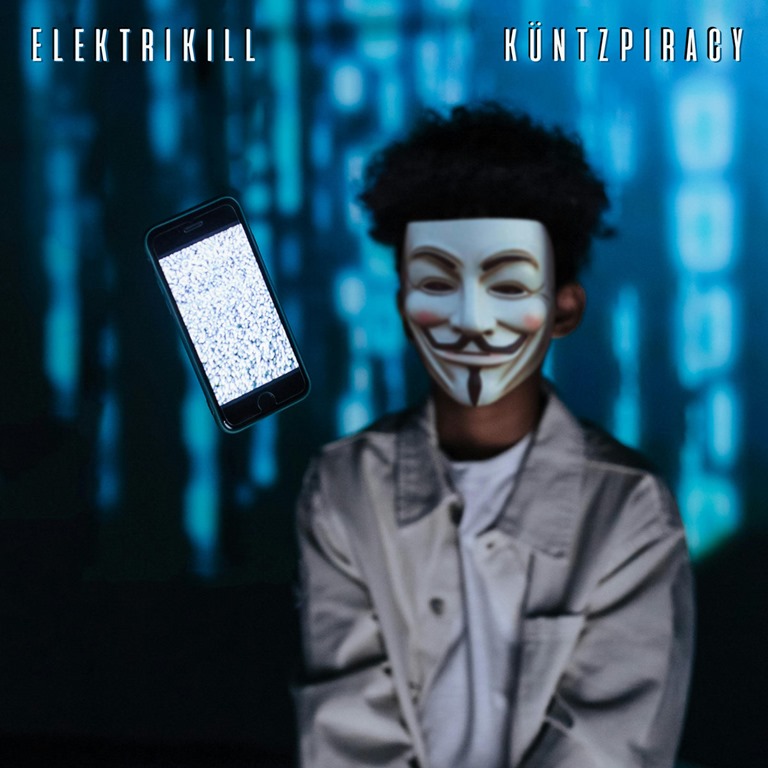
Elektrikill’s founder, Steve Vil, says of Küntzpiracy – a title that’s both a fairly lame pun and a bit of cliché, but gets a pass because America and an approximation of a Butthole Surfers reference – “Basically it’s my most political album touching on themes of government corruption and half of this country’s loss of humanity while claiming it’s all in the name of Jesus. That pisses me off. I also call out closeted government officials in ‘The Scream’. Look, guys, just be gay instead of crashing Grindr any time you meet in large groups. I do give the listener a break from the political stuff. ‘Vampire Blond’, for example, is about a vampire drag queen.”

There’s a fair bit to unpack here, and he makes a number of valid points. It’s not the whole of America. In fact, it’s a slender majority backing the MAGA madness. Unfortunately, they’ve voted to facilitate an insane power grab, meaning that while there are a fair few who aren’t happy with the direction things have been taking lately, tough shot: you could have seen it coming, so this is on you. And this also involves the most overtly racist, homophobic administration in memory – but as with anything which involves hypermasculinity, what the world outside sees is massive repressed gayness. Yeah, we’re looking at you, Andrew Tate, with your no-bollocks swimming trunks and purple satin blouse, and the culture you espouse. What utterly fucked-up times we live in.

‘Thrum’ makes for a dark, dense start to the album, throbbing bass dominating, the distorted monotone vocals low in the mix as extraneous squalls of electronic noise burst all around, and ‘S(t)imulation’ keeps things dark with some hefty tribal percussion battering away through a murky wall of sound – although the choruses break out with a genuine hook driven by a pumping beat and punchy snare. It’s like leaping from Coil to late 80s Ministry, but it works, and the aforementioned ‘Vampire Blond’ swings into classic electrogoth / technoindustrial territory, and I could chuck a raft of touchstones in here – and that’s no bad thing. they clearly know what they’re doing, and where they’re positioning themselves, and do it well.

‘The Scream’ is again a bit Ministry circa The Land of Rape and Honey, and perhaps a bit KMFDM, and more broadly, a bit Wax Trax! Hardly innovative, but the delivery is top-notch. The beats slam hard.

Landing at the album’s midpoint the piano-led ‘A Chill in the Air’ is both expansive and claustrophobic, and slowing the tempo to explore a more brooding atmospheric, it’s well placed, ahead of full-throttle rager ‘Monoshift’ which brings the industrial aggression pumped to the max. Indeed, the second half of the album is harder, faster, and the altogether synthier ‘My Salvation’ rhymes ‘my salvation’ with ‘masturbation’ in a style reminiscent of early Revolting Cocks.

Stylistically, Electrikill don’t really break any new ground, but Küntzpiracy is intense, angry, and relentless, the aggro and the tempo picking up noticeably in the second half, with ‘Manifesto’ delivering a power finish. With Küntzpiracy, Elektrikill bring the fury and bring the force – and the political ire. This is very much an album of the now, and it hits hard.

AA

a3444969996_10

Christopher Nosnibor

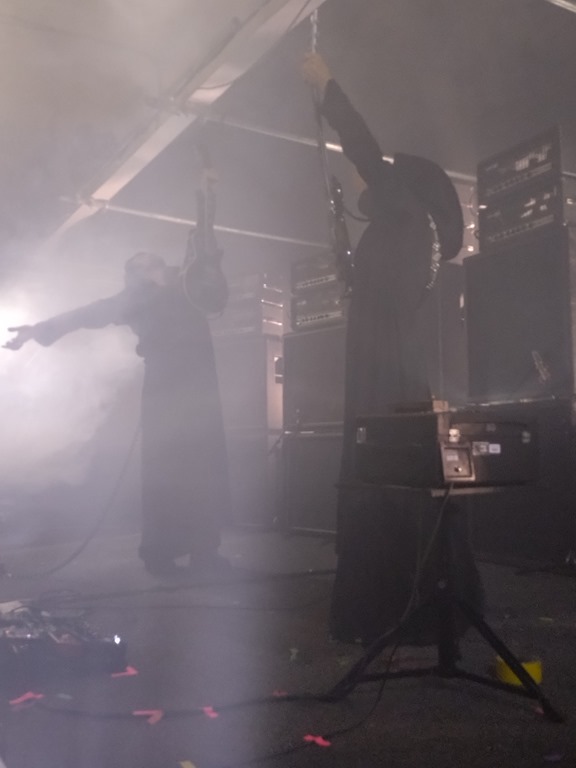
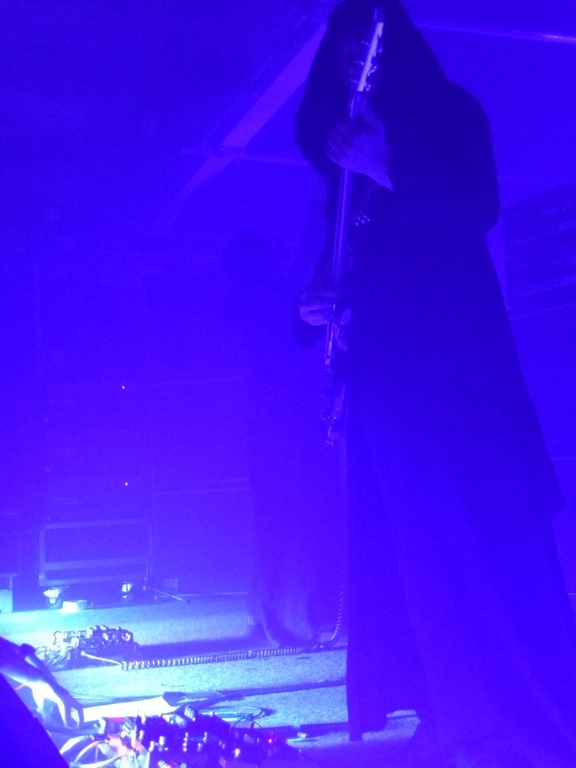
I can still smell the smoke on my clothes and skin. I can still taste the smoke. Not tobacco smoke, as used to be the case way back (although more recently than seems possible), but smoke machine smoke. Back in the 90s – and no doubt prior – gigs would often leave this lingering residue embedded within the senses. But some time, around the turn of the millennium, perhaps, there seemed to be a change in the formula of smoke used at most live events, in favour of something less dense and noxious, and which didn’t make you sweat so much, with most fog formulas now being advertised as being white, without ‘unpleasant odour’ and ‘leaving no oily residue’. Sunn O))) seem to have managed to hijack an entire tanker’s worth of the old vegetable oil-based stuff and pump it out at a rate of gallons per second during the entirely of their set, which, despite featuring (apparently) five tracks, has a colossal duration in the region of an hour and three quarters.

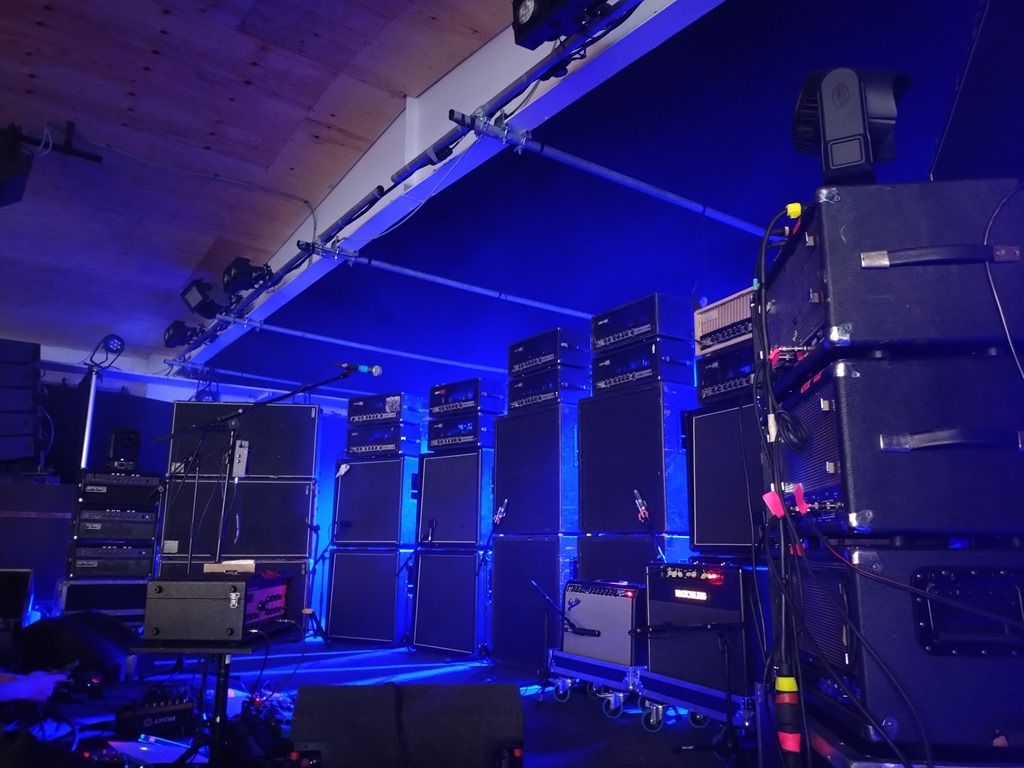
So much of the Sunn O))) experience is steeped in ritual and ceremony. From the hooded robes, the power of incense drifting in amongst the smoke from the machines, the wielding of the guitars as eternal drones ring in sustain from the amplifiers. Those amplifiers, vintage valve amps, stacked almost to the ceiling my towering monoliths, arranged in such a way as to resemble the interior of a prehistoric monument, bathed, before the show begins, in a celestial blue hue, inviting worship simply by their looming presence, even when silent.

20260701_193205

AA

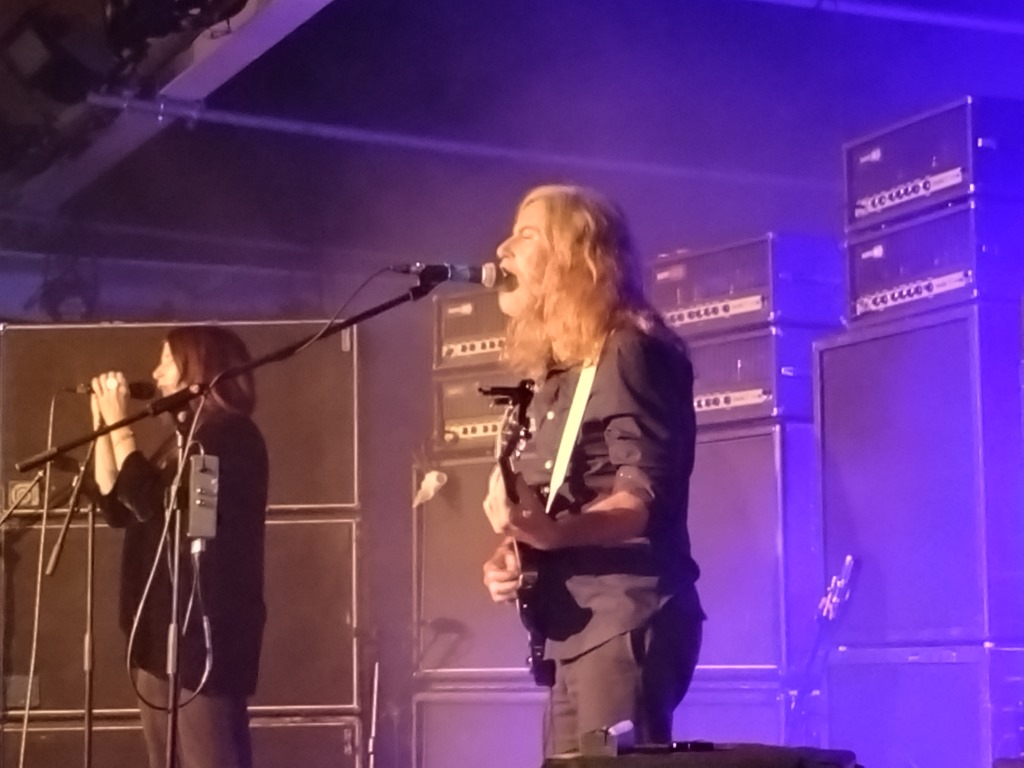
Black Mountain make for an interesting choice of support, and an appropriate contrast. Initially, they present as a quiet acoustic folk duo. There’s some chat at the side towards the toilets and bar, but the swelling audience is largely quiet and respectful in front of the stage. Their second song introduces drum machine and distortion on the guitar, and while the harmonious form doesn’t change, the texture very much does, with squalling desert rock overtones and bluesy strains and a dash of 70s rock filtering their way into the songs throughout the set, which is pleasant – not in the vague, not much of anything sense, but mellow and melodic and low-key. It’s a most enjoyable half hour which contrasts nicely with the earth-shattering experience which follows.

20260701_200112

Black Mountain

By way of an intro, they play all of the talk from between the songs from an entire live set by Venom, the progenitors of black metal (something Melvins did with their ‘Cowboy’ single, which was equally frustrating). It made for a long and twitchy eight minutes of suspense that felt like an eternity. But this is Sunn O))) all over. Their entire ethos seems to be based on the question of ‘how far can we actually push this?’ – and when they find what must surely be the absolute limit, they nudge it a bit further, and then further still. And as it played on, and on, the stage began to flood with smoke… and more, and more smoke, until it became completely impenetrable. Vertical LED beams along the front of the stage illuminate the smoke in such a way as to create a curtain which renders the stage itself invisible when viewed from the other side.

20260701_21550320260701_21130120260701_213357

Sunn O)))

Anderson and O’Malley are guided onstage with torches, and moments later the first chord strikes. Immediately, everything shudders. The very air quakes as I feel my flesh quiver and my ribs, my lungs tremble. Time immediately stalls. And something strange happens. Perhaps I enter something approximating a trance-like state. Whatever it is, I find myself utterly spellbound, and borderline hypnotised by the combination of the spectacle and the sound. It’s not zoning out, but zoning in, fixated on the tones and textures, and the way the two interact and interweave, catching glimpses of the band in the brief moments when the smog thins.

Stripped down to a two-piece, the volume is typically obliterative, but it’s clear they’re fully immersed in exploring the spaces between the notes, more subtle dynamics of the way certain frequencies resonate. The sound is remarkably clear, and while there are howling walls of feedback, the sonic spectrum is predominantly low-end, meaning that there’s no tinnitus-inducing harsh treble (at least not with earplugs, and everyone I see is suitably equipped), and as a consequence, it’s easier to simply bask in the huge throb which envelops every inch of your being. The first two tracks are run together as one continuous piece, a full hour in duration, and at this point, the smoke reaches a new peak of density. It’s beyond suffocating, you can’t see your own hand let alone the stage, from which emanates the most brutal howl of feedback yet. But there’s no checking your watch to puff that only twenty minutes have elapsed, and they’ve barely played three notes. Some people move further back to escape the full force of the backline, but the majority simply stand, transfixed. This is peak Sunn O))). As much as there’s a sense that they’re testing us, they’re also testing themselves, and revelling in the theatre of it all. It’s high art.

20260701_214503IMG_20260701_223302

More smoke blasts across the stage like a tidal wave. Everything is vibrating, from my nostrils to my buttocks. I’m amused to see people nearby attempting to film clips of the show, only for their phones to be completely submerged in billows of smoke – which are an analogue of the billowing rumble radiating from the stacks of speakers, and with the backline alone capable of filling the 1,000 capacity with that organ-bothering low-frequency drone, the fact they’re all in turn mic’d up only adds layers to this oceanic swell of sound. Anderson and O’Malley don’t so much strike chords as mildly stroke a string to set off another devastating avalanche of sound.

IMG_20260701_224203

Towards the end of the set, O’Malley lodges his guitar on top of a stack, wedged against the ceiling, before subsequently hanging it by the neck from a power cable above, and letting it swing from the rafters.

And just like that, it stops. The smoke clears, and the two men step forward and receive – humbly, and with gratitude – the most rapturous applause. Because for all of the theatre involved in creating the separation between band and audience, the obstinate absence of engagement, for the pain-threshold volume, the appreciation flows both ways. It’s a joyously respectful experience: no chat (as if!), no heckling, but a symbiotic exchange based on pure immersion in pure art. And tonight, we’ve witnessed an ascendency to a new pinnacle. Pure transcendence.

BIG|BRAVE, the Montréal/Berlin-based trio of guitarist/vocalist Robin Wattie, guitarist Mat Ball, and bassist Liam Andrews, have unveiled the mountainous single ‘an uttering of antipathy,’ taken from their forthcoming album in grief or in hope, out June 12th. The single’s gargantuan, sublime chords feel gravitational as they unfold in plumes of darkened feedback. Wattie’s voice emphasises a sense of isolation inside the fray with stark clarity and at times auto-tuned undulations, culminating in a powerful conclusion: “god only blames me / you only blame me.”

Mathieu comments, "This track was actually one we performed during the past year of touring. These are the chords and instrumentation we used for the live rendition of “chanson pour mon ombre”. Given our fondness for this live track, we decided to incorporate the chord progression into a new song for this record. After several challenging days in the studio, when it was time to structure and record the track, Liam, Robin and I recorded the entire song in a single take in the live room. This was a highly encouraging moment. The vocals (with subtle autotune) effectively brought the song together, making it one of my favourites on the record." About the autotune Robin enthuses, "I’ve ALWAYS wanted to try it. i’m glad we did."

AA

in grief or in hope marks a shift for BIG|BRAVE towards denser, guitar-oriented compositions. With longtime touring bassist Liam Andrews (MY DISCO, Aicher) joining guitarist/vocalist Robin Wattie and guitarist Mathieu Ball in the studio for the first time, the pieces are keenly layered with a rich tapestry of harmonics and tonal intricacies. Each piece is its own biome of distortions starkly contrasted with delicate, even tender, moments. The trio’s instinctual progressions are made more vivid through live recording, harnessing the gargantuan and storied sound of their performances. Within texturally maximalist loops and affected vocals, the pieces utilise the aesthetics of drone, electronic, and heavy music within a foundation of pop song form. Wattie writes: “I wanted to explore catchy, melodic phrasing weaved throughout the intensity of the instrumentation and drony chord changes. All that I could reflect on was grief and hope; death and life; cause and effect; shared experiences of being a human person.”

Together the trio deliver emotional momentum that vividly describes the complex and deep feelings of struggle, pain, and transcendence. in grief or in hope transmits that sense of humanity with every gesture.

BIG|BRAVE will begin their European tour in support of the album this week in the Netherlands, and will be embarking on an extensive North American tour with The Body this summer.

AA

unnamed1-990000079e04513c

Photo credit: Stacy Lee

Makeshift Swahili – 11th March 2026

Christopher Nosnibor

Leeds’ Mass Hallunication’s thing is short, fast, noisy hardcore noise. This eponymous three-track EP is their debut release proper, following a digital-only self-released demo, which clearly laid the groundwork and set the template for this (right down to the fact that the three songs, despite being different songs, have the same durations of 1:19, 0:56, and 1:12, which is a remarkable coincidence).

And so it is that Mass Hallucination clocks in with a total run time of three minutes and twenty-seven seconds, and while it would be misleading to say that it’s more polished than the demo, the sound quality and the mix is better. Beyond that, this is savage, brutal, raw, rage triple-distilled and bottled fresh, rough and unaged at 100% proof.

‘Lacerated’ raises the curtain in a wail of feedback and a bowel-bothering bass which strolls in tentatively, before everything goes off in a flurry of unbridled violence. Centred around a cyclical riff, it’s a dirty gnarly assault delivered with a skin-shredding ferocity. Each track starts and ends in screeds of feedback, and the whole EP runs as a continuous piece, segued by the scream, the songs themselves blasting out in frenetic fits.

The lyrics are chewed, gargled, and spat, the words themselves lost in translation but the sentiments as clear as anything, everything coalescing to conjure a purgatorial purging, everything louder than everything else, a relentless roar of the most primal anger. Ugly and uncompromising, Mass Hallucination is pure catharsis, and a definitive statement.

AA

AA

a3068304326_10

13th March 2026

Christopher Nosnibor

Polevaulter are very much a band of the times. The cost of living and the fact bands make no money has driven a marked shift towards duos and power trios, and notably electronic music and drum machines have become popular again. The less kit you’ve got, the easier it is to rehearse at home or in a small space, there’s less to the logistics of getting a smaller number of people with minimal gear around (hell, the logistics of getting people in the same place at the same time around work and family and all that shit), and any fees and proceeds from merch are split fewer ways. Necessity and invention, and all that. And notably, there’s a lot of angry electro-led noise coming out of the north. Benefits are clearly up there in representing this thing, which isn’t anything like a movement, any more than the emerging goth scene in the 80s was a movement, but an artistic current, a zeitgeist. But we also have the likes of The Sick Man of Europe, Machine Mafia, and Polevaulter. These guys are something of the exception, in that they’re a shade dancier, but given the buzzing bass fury and relentless rage in the vocals, they’re never going to trouble any regular townie nightclubs, let alone any charts or Radio 1 Dance.

On the new EP, Polevaulter frontman Jon Franz said, “’Descending’ is our most cohesive and controlled EP, and also the most raw and direct. We wanted to reach people immediately, give them something to quickly digest and then say exactly what we wanted to say. The vocals start quick in each song. It progresses down through the EP into an anxious rave, the themes about being lied to all your lives and believing what you are told coming from power down to the working people. It’s our darkest and danciest EP I think.”

And so it is that with Descending, Polevaulter deliver four ultra-taut and super-succinct slabs of electro-led abrasion. ‘The Cursor is a Fly’ makes for a comparatively gentle introduction, before the grinding ‘Dogtrack’.the woozy, bulbous subsonic bass is pure dance, but the snarling, disaffected vocal is punk to the core, Franz wheezing ‘Just trying to buy a house, now let me have it… dogtrack… gamble… run down… dogtrack… going round and round and round…’ It’s bleak and hypnotic and bleak and hypnotic and… you get the picture.

‘Manifest’ mines a dark dance groove with a vocal that’s bordering on spoken word, and calls to mind the short-lived and criminally underrated York band Viewer, the technoindie collaboration between the late cult techo legend Tim Wright and vocalist AB Johnson. In other words, it’s a well-balanced hybrid, where thumping beats and techno synths collide with a vocal that draws influence from Jarvis Cocker and Mark E. Smith. ‘I’m going down with the ship’, Franz announced against a clattering backdrop of snashing metallic snare drum detonations and rapidly-shifting synth gyrations.

The final track, ‘Soothsayer’, is the EP’s longest, and a sparse, haunting intro paved the way for a dark, reverb-heavy electrogoth groove with hushed, hypnotic vocals over an almost subliminal bass groove cut through with a heartbeat kick drum and smashing snare and builds to a tense, suffocating climax.

These are dark times, and it is definitively grim up north. Polevaulter provide a soundtrack to this, while countering bleak nihilism with some almost euphoric dance synths. Descending offers escapism in the same space as the darkest pessimism. The conflicts and contradictions are navigated successfully, though. Polevaulter have taken a massive leap here, and really gone beyond their previous works.

AA

AA

Polevaulter

Glasgow-based post-metal collective Void of Light have unveiled the new video for ‘Mirrorings,’ the lead single from their forthcoming debut full-length album Asymmetries, set to be released on April 3 via Ripcord Records.

Clocking in at a towering ten minutes, ‘Mirrorings’ first premiered at Decibel Magazine, who praised the track saying: “Clocking in at 10 minutes, ‘Mirrorings’ offers a pretty solid introduction to these gloomy Glaswegians, a dynamic epic that shifts from pummeling sludge to melodic shoegaze-inspired dynamism.”

AA

The band had this to say about the new album and new song: “Asymmetries is the culmination of two years of hard work and exploration. Across the album’s five tracks, we set out to shape our own sound within a well-established scene, creating something that genuinely feels like ours. The closing track, ‘Mirrorings,’ brings the album’s introspective themes into a final, defining moment and represents what we feel is our strongest offering so far.”

Void of Light are a six-piece post-metal force built on contrast. Brutal yet deeply atmospheric, their sound fuses crushing riffs and thunderous drumming with melodic leads and carefully layered arrangements. Rooted in post-metal’s foundations but shaped by a wider spectrum of influences, the band carve out a sound that feels vast and aggressive, yet intricate and finely balanced through a keen sense of dynamics.

Following the release of their self-titled EP in 2022 and the two-track EP Enshroud in 2023, Void of Light completed a short UK tour and quickly established themselves as a powerful live presence across local venues and festivals. Renowned for their formidable performances, the band deliver an imposing wall of sound that is both overwhelming and precisely measured, drawing audiences into an intense, captivating experience.

On Asymmetries, Void of Light turn inward. Exploring themes of perspective, reflection, and internal conflict, the album charts a journey of reconciliation between the masks of the past and the truths of the present. 

To celebrate the release, Void of Light will perform their album release show on April 3rd at The Flying Duck in Glasgow with support coming from Codespeaker & Obsidian Sand.

AA

09099a46-7335-e61a-22e1-559fee39d577

No words… Just watch, and listen…

AA

OIF

The Twilight Sad seem to be one of those bands that remain niche and somewhat divisive. But those who are into them are really into them, and with good reason. They’ve been long championed by Robert Smith and have access to a huge, huge audience following epic tours supporting The Cure, but they obstinately refuse to tone down their overt Scottishness, and they stubbornly refuse to bend to any kind of commercial leanings, or to cheer the fuck up. They’re also one of the most emotionally intense bands around: their live shows are quite simply something else.

‘Designed to Lose’ is the second single from their next album, and simultaneously harks back to the blistering welter of noise that was their second album No One Can Ever Know, while pushing forward on the trajectory of their last album, It Won/t Be Like This All The Time, which was both glorious and harrowing as fuck.

It Won/t Be Like This All The Time was released in 2019, so it’s been a long wait for new material. Oh, but this is worth it. The Twilight Sad aren’t a band to rush-release something sub-par, and ‘Designed to Lose’ is classic Sad on first listen, and just gives more with each play.

AA

610853967_18551797819034050_433013541538668716_n