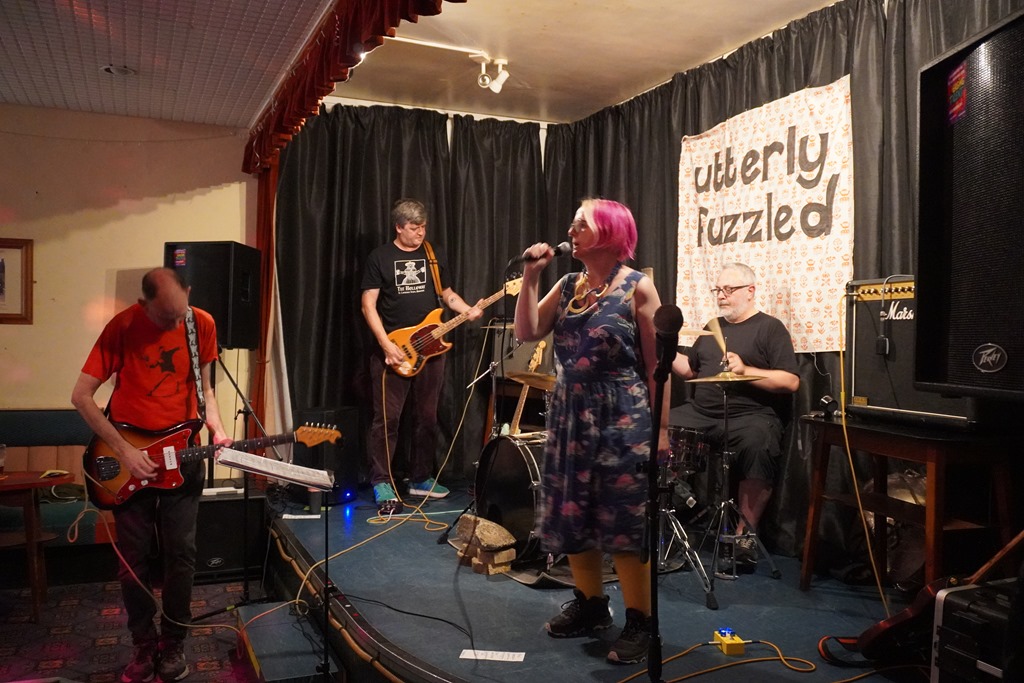
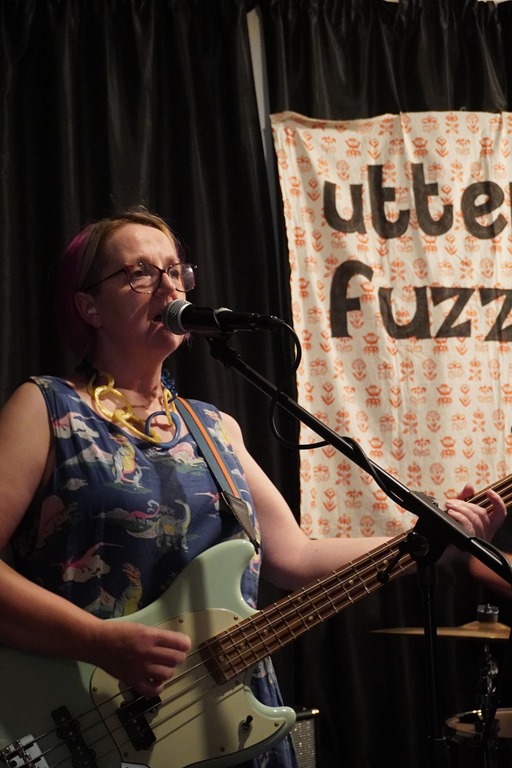
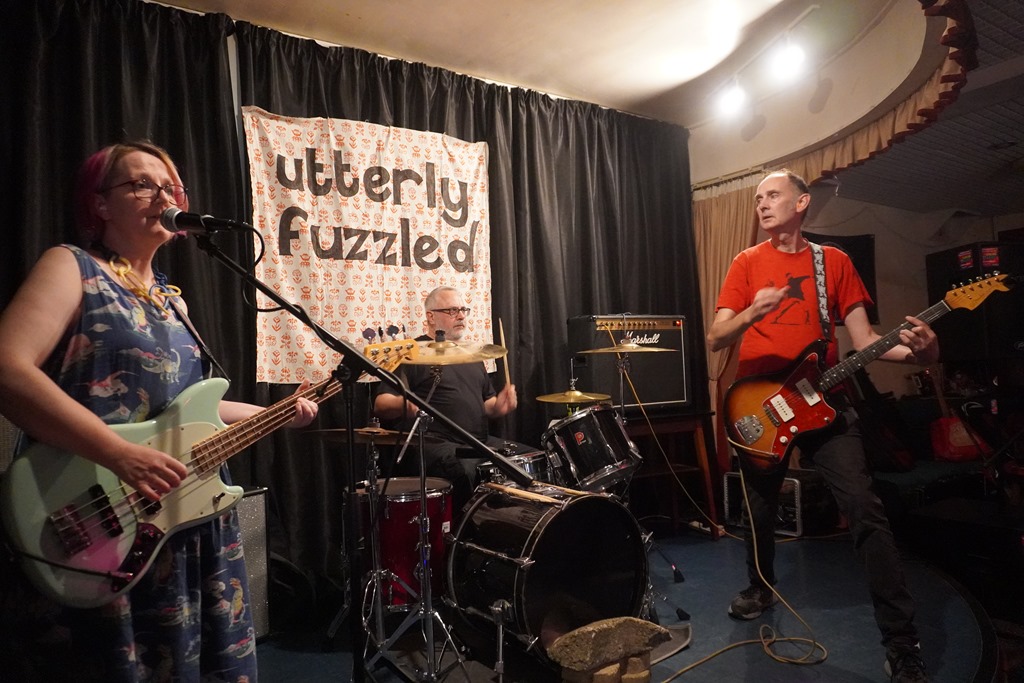
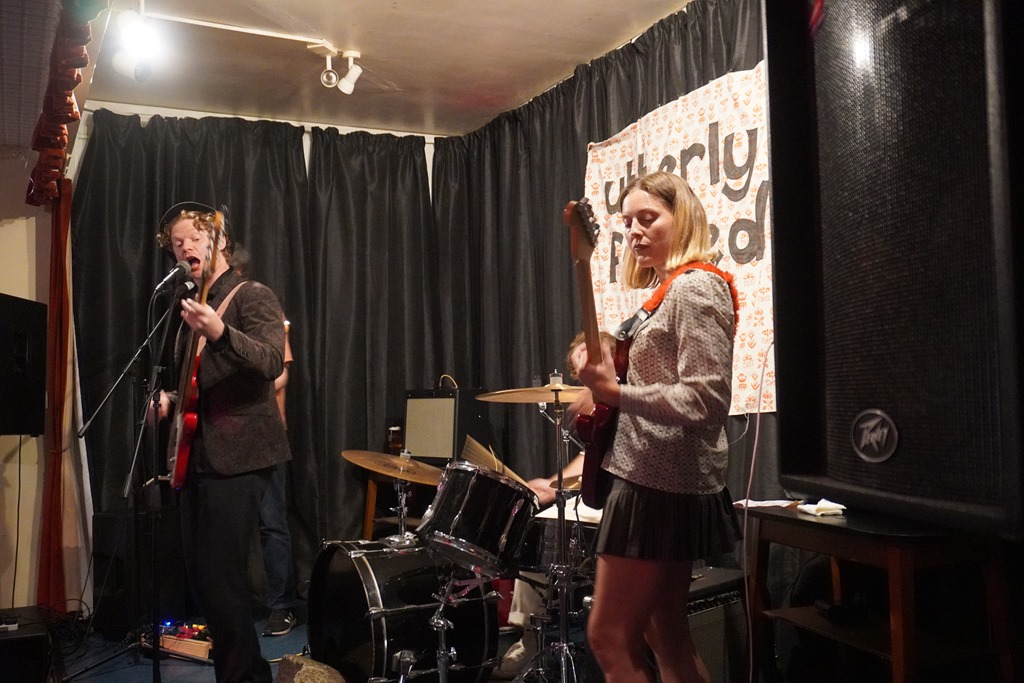
Posts Tagged ‘Post-Punk’

Christopher Nosnibor

By the early 80s, the power of punk had mostly petered out. We were very much in the post-punk era, and most of the first wave of punk acts had called it a day or slunk into obscurity. And yet The Damned, whose debut, ‘New Rose’ was the first single by a British punk band, released their most commercially successful album in 1982 in the form of Strawberries, and their continued success through the 80s was largely attributable to their ongoing evolution, leaning into the gothic – and even the overtly goth – style. It was Strawberries which saw Roman Jugg join their ever-expanding family tree to contribute keyboard solos, and when Captain Sensible left the band a couple of years later, Roman stepped into the role of guitarist. So the pitch that they’re ‘playing songs from the back catalogue as they were originally meant to be performed’ might sound like quite a claim, but since the set does predominantly focus on songs from Phantasmagoria and Anything, which Jugg was involved in writing, he’s certainly got grounds. As for older songs, well he toured with the band long enough to be considered an authority.

Considering Gary Numan is playing the Peace Hall just up the road in Halifax tonight, there’s a respectable turnout, and deservedly so. The question of the impact of these large outdoor summer gigs in addition to festivals and their impact on regular gigs, particularly for those at smaller, and specifically grass roots venues may be one to debate in more detail separately, but so far this year it does feel as if the effect may be tipping towards the negative. These events seem to be as much social as musical, everyone plastering their social media with blurry pica and wobbly videos with shit audio to prove that they were there – that they’d forked out £60 to stand a mile from the stage and listen to people chat while slopping exorbitantly-priced crap lager over their own trainers. And fine, each to their own of course, but there’s no trickle-down here, and they’re not a gateway to grassroots events when people I know would often attend the small-venue gigs can’t make it because they’re either at one of these big gigs, or are tired / skint as a result of having been to one – or three. And again, is a £60 gig six times better than a £10 gig? Obviously it’s impossible to quantify, but I think it’s fair to say there’s a point at which the experience grows incrementally less enjoyable as the scale of the show increases. Somewhat ironically, The Damned, still fronted by Dave Vanian, and with Paul Gray on bass and Rat Scabies behind the kit, are playing at both The Peace Hall and Scarborough Open Air Theatre this summer, the latte as support to American rock supergroup Hollywood Vampires (Alice Coooper and Johnny Depp, with Aerosmith’s Joe Perry), which sounds nothing short of hellish. It highlights just how much the nostalgia market has changed the nature of things: I saw The Damned in the middle of the afternoon at Guilfest circa 2003, and they didn’t even sell out the 200-capacity Fibbers in York in 2005 or 2006. They were great, mind you, but felt like they were a band that worked best in a space with a low ceiling and where the front row is within spitting distance, literally.

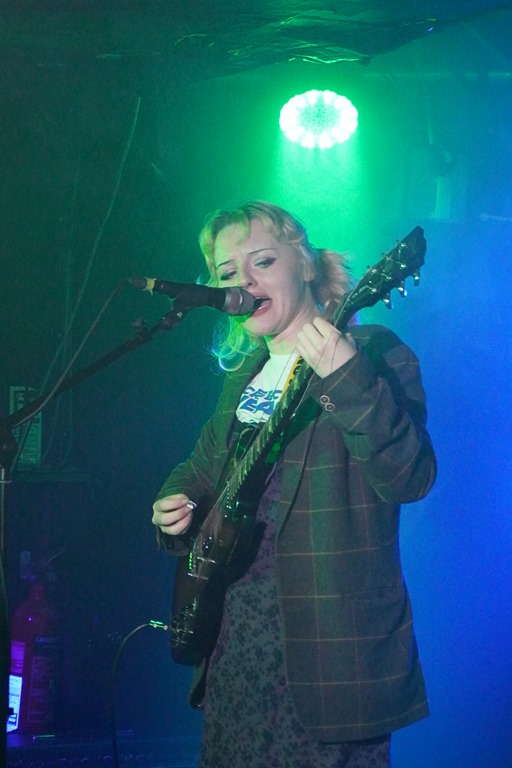
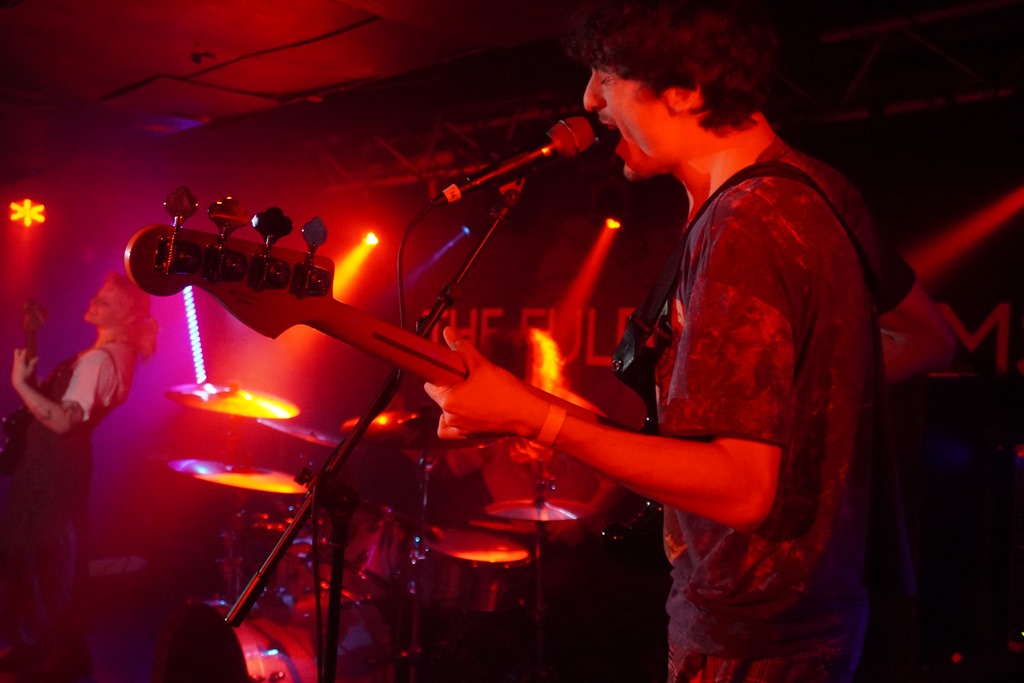
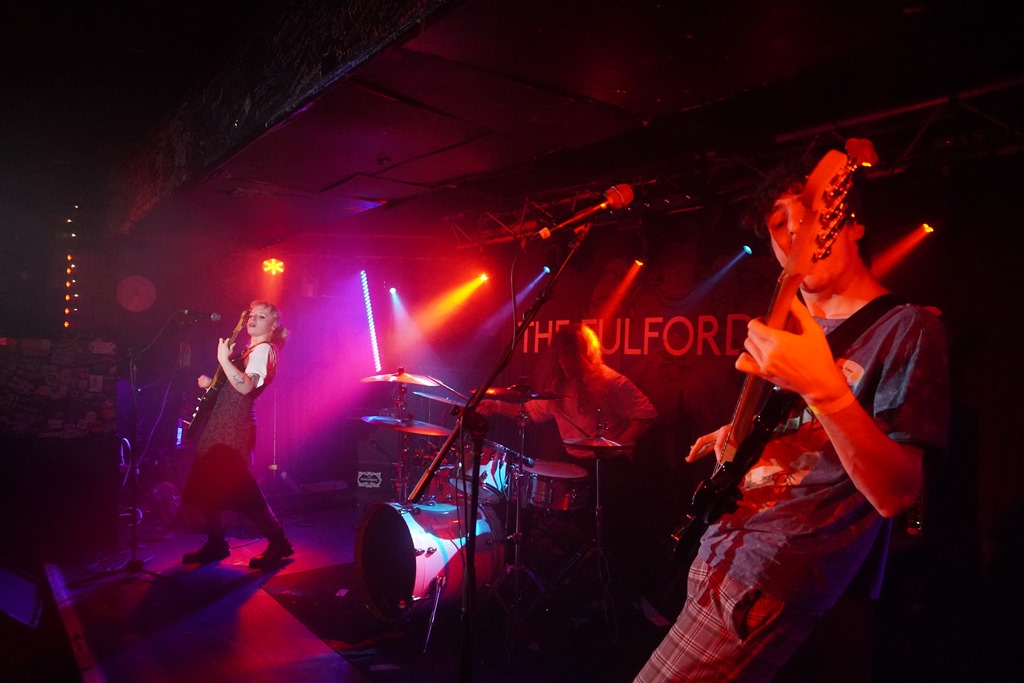
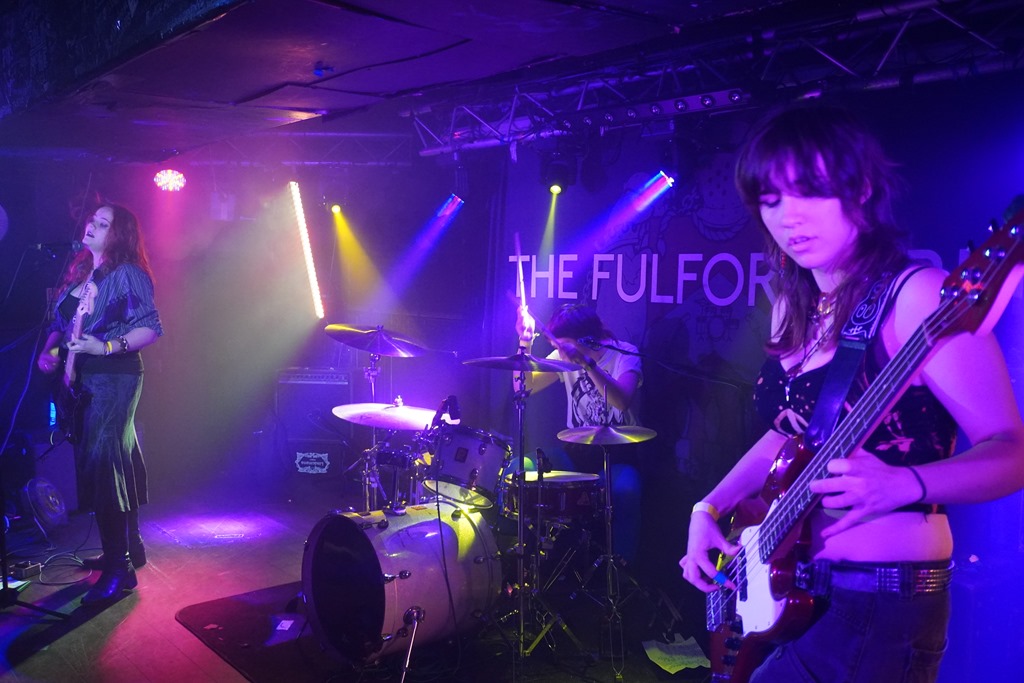
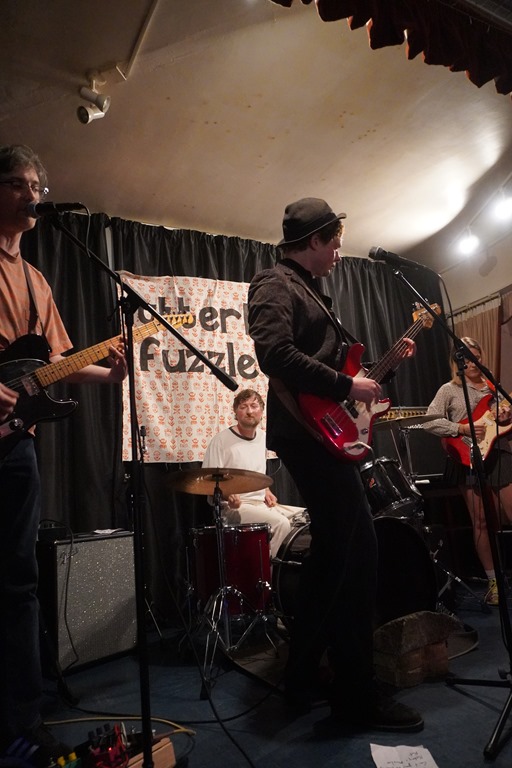
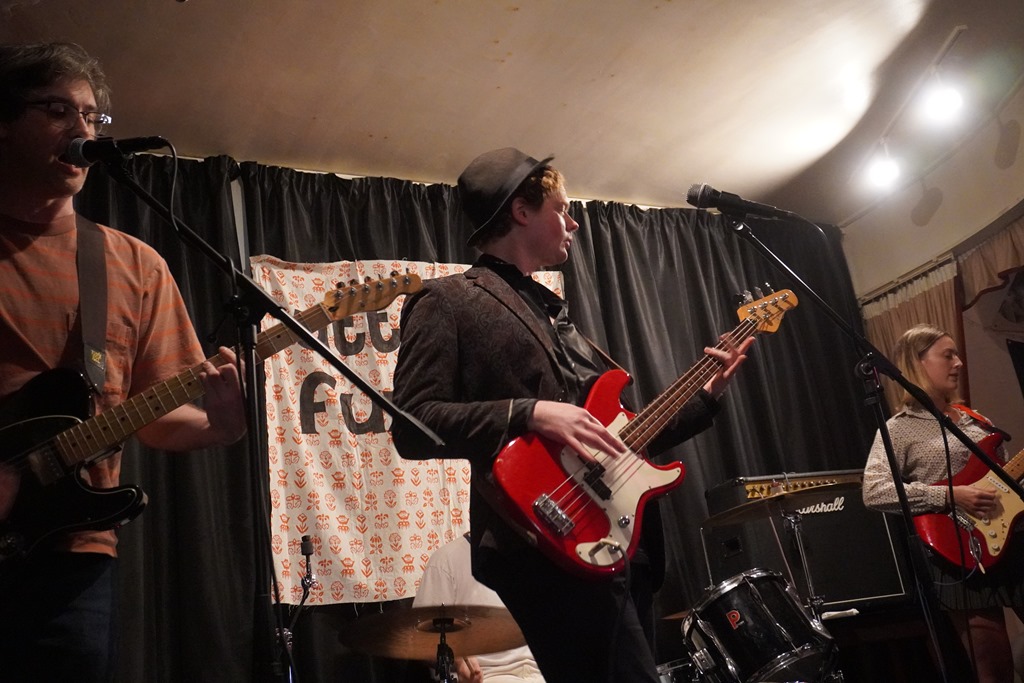
Boggis Fringe are up first. Having risen from the ashes of dark post-punk combo Fatherfigures in 2024, following the death of their guitarist, Boggis Fringe straddle the space between old-school punks playing old-school punk, and some quite taut post-punk action. Tonight, the power trio are once again expanded to a four-piece, with the addition of Erin on second guitar, who also provides backing vocals and covers drumming duties for a few songs in the middle of the set. As we soon learn, this is because drummer Chris is still recovering from a knee injury, and isn’t yet back to strength to manage the entirety of the set. Add to the instrument swapping some guitar cut outs (pesky pedals and leads), the feel is a shade chaotic, but it in no way detracts, and if anything, makes it feel more authentically punk. Singer Doug plays like he hates his guitar even more than life itself, and gets bonus points for the most audaciously bad wordplay joke I’ve heard in a while.

DSC03483DSC03475

Boggis Fringe

I was rather underwhelmed the last time I saw Moose Knuckle in York at the back end of 2024. They felt sluggish and low-energy, and worst of all, entitled, as if they believed the audience should put in more work, despite their own apparent lack of effort. It seems I caught them on an off night. They really give it some on this hometown outing, powering through nine songs on half an hour. New song ‘Hard to Kill’, which lands mid-set, has strong hints of The Ramones. Their cover of The Prodigy’s ‘Breathe’ (mistitled on the setlist as Breath) is still the best thing in the set, mind, and of the originals, the squelchy funk rage of ‘Old Flame’ is a clear standout, although another new song, a grungy beast that’s called ‘Do It On My Own’ is a close second.

DSC03521DSC03552DSC03540

Moose Knuckle

Roman Jugg has assembled quite a band for this latest tour centered around the songs he wrote while with The Damned in the 80s, notably absorbing garage duo Dave and Fi Dukale, aka The Tuppenny Bunters (interchangeably) on drums, keyboards, and vocals. They’ve been on my radar for a while, and although this doesn’t strictly qualify as seeing them as such, it does still sort of count as a twofer. Pat MacNamara is rocking turnups worthy of Kirk Brandon and sideburns that would impress Neil Young, and does a mean bass face throughout the set. Meanwhile Roman himself and guitarist Paul Bedford keep things low-key and keep the focus on the songs, which they bang out with admirable proficiency.

DSC03600DSC03616DSC03675

Roman Jugg Band

The setlist is superb, and apart from ‘Elouise’ not featuring, is more or less a selection of my favourite Damned songs. ‘I Just Can’t be Happy Today’ drops fourth in a rammed set. ‘Edward the Bear’ goes down a storm before they’re back to plundering from Strawberries.

Dave and Fiona switch drums and keyboards for a bit, and they blast through a high-octane rendition of ‘Ignite’. Their styles are quite different, with Fiona bringing more swing and a fluid stroke that contrasts with Dave’s method, and this shift gives the set a certain dynamic. ‘Grimly Fiendish’ – probably the first song by The Damned I heard growing up still sounds ace – as if The Kinks had penned a cabaret goth tune. Dark but poppy and great fun. As the set moves into its final stages around the hour mark, they kick it up a couple of gears and raid the early singles for blistering takes on ‘Smash it Up’ and ‘Neat Neat Neat’. There’s barely a minute’s pause, during which only half the band actually vacate the stage before they encore with a hundred-mile-an hour ‘New Rose’ which delivers a final injection of adrenaline for the night.

Sod your social media ‘I was there’ big-names-in-massive-venues shows: this is still, and will forever be, what live music is really about.

22nd July 2026

Christopher Nosnibor

‘At Last, I Found You’ arrives as a standalone single to bookend the releases from their album, F.I.V.E. (Fear Increases Violent Emotions), released in January, ahead of a two-month tour of Europe, including some UK venues that are some way off the beaten track (which is a bummer for those on the regular circuit stop-offs, but a boon for those in neglected places like Whitchurch and Morecambe. The song was written during the F.I.V.E. sessions but intentionally held back until listeners had time to fully absorb the album, before emerging as its final companion piece, and it says something of the standard of material – as well as the level of confidence in said material – when a band are comfortable leaving what they know to be one of their strongest cuts off the main release.

But, as guitarist and bandleader Fabrizio Giampietro explains, “‘At Last, I Found You’ was always the most immediate and instinctive song we wrote during the F.I.V.E. sessions. We deliberately left it off the album because we wanted listeners to experience that record’s emotional arc without this song becoming its centre of gravity. Six months later, it

felt like the right moment to finally share it.” There’s a logic to this: so many albums are dominated by THE single, and in the age of streaming, where people tend to play tracks rather than albums (apparently – I personally shun streaming as a medium, and make a point of listening to vinyl and CD albums in full, from end to end, both when reviewing and also while cooking) it’s a decent strategy to encourage – by any means – listeners to focus on the body of work that is the album, over individual tracks.

‘At Last, I Found You’ is an obvious single cut, being a classic slice of dark synth pop with a distinctly European feel, and in drawing comparisons with early A-Ha I’m paying a strong compliment (I will forever maintain that the darker currents in their music are severely underappreciated, and songs like ‘I’ve Been Losing You’ and ‘Manhattan Skyline’ have ben wrongly eclipsed by ‘Take On Me’, because the Internet and compilation album compilers have a tendency to reduce acts with many, many hits down to one song to be endlessly repeated… don’t believe me? Duran Duran’s ‘The Reflex’ spent six weeks at number one in the UK, but you could be forgiven for thinking that ‘Rio’ was their only hit, and likewise that The Cult only had ‘She Sells Sanctuary’ as a charting single. We can learn from this just how history gets twisted, not primarily by the dissemination of false information, but by omission. Of course, I’ve digressed – that’s what I do, and I also strongly believe that the narrative of real life isn’t to be found in the main thread, but in the digressions. It’s not about the career or the landmark events, it’s about the weird detours and the dirt that falls between the cracks along the way, the stuff you don’t even notice while you’re looking at the next thing, the goals.

‘At Last, I Found You’ is dark but positive: Massimo Ciampani’s baritone vocal  leaps upwards for the soaring choruses. An insistent beat and throbbing bass drive the song, which draws together elements of 80s synth pop, 90s goth and contemporary darkwave with a crisp precision.

What goes around certainly comes around: Christine Plays Viola formed in 2008, which was certainly a lull time for the popularity of goth and adjacent music. The present is another world, not just with heritage bands like Corpus Delicti and Red Lorry Yellow Lorry and The March Violets releasing new material and / or touring, but new acts like Mouth Ulcers and Just Mustard bursting onto the scene. These are exciting times, and ‘At Last, I Found You’ is an exciting release. And while I rarely give advice, I would strongly recommend checking out the album.

AA

AA

Progetto senza titolo - 1

Christopher Nosnibor

It’s been a while since I went to ‘bands in the bar’ kind of thing. Although the Horsemusic nights are essentially bands in a bar, it’s a large space and they play on a raised area at the far end of a rectangular room, meaning there’s a sense of separation (in addition to the handrail which runs across it). For many years, there would be acoustic soloists and duos – nearly always playing variations on the blues – in the corner of every other bar, and it was kinda fun for a while, but got a bit samey rather fast. Still, the point is that there’s something less formal about the ‘bands in a bar’ setting. The Golden Ball, consistently in the Good Beer Guide, is a community owned and run pub with multiple rooms (some more like nooks or snugs), where they host quizzes, spoken word and open mic nights and the like, plus decent size beer garden.

It might be Soma Crew lite tonight, paired down to minimal gear, with no cymbals and fewer pedals, but it’s still a lot of pedals, and by the time you’ve got a PA, amps and pedals for two guitarists and a bass, plus drum kit and another amp and mountain of electronic equipment for How Buildings Fail, plus a massive – and truly essential – thermostatically-controlled fan, seating, and space in general is very much at a premium. More than twenty people and it’s pretty cosy, to put it mildly.

David Mudie playing a solo Speedreaders set is the closest to truly stripped-back as it gets, with just him and a clean-sounding guitar and a couple of pedals. Played this way, it accentuates the sad, emotional nuisance of the downtempo slowcore songs, and he seems unusually relaxed and even borderline chatty by his standards.

DSC02994

Speedreaders

It sets the tone for the night: the intimacy of the space is a great unifier, and the warmth of the atmosphere isn’t just heatwave and humidity.

Simon – aka How Buildings Fail – seems genuinely quite overwhelmed by the positive response to his performance, each song received with enthusiastic applause. He soaked the small room with low end feedback as he drawled monologues reminiscent of The Fall – the first track in particular seems to lean on ‘Smile’, and the more uptempo (house) pieces rattle along, propelled by a primitive drum machine. Electronica with live guitar, it’s gloriously ramshackle and old-school in every way, from the scratchy guitar to the, we, scratchy electronics. And people are amazed. This is telling: he runs the York EMOM (Electronic Music Open Mic) night – it’s part of a now (inter)national network of events which gives a safe space for all the nerds and oddballs to perform (I say this in the most positive sense as a regular myself), and the York one in particular seems to cultivate a culture of experimentalism, left-field, ambient, noisy, and downright weird shit, and it’s brilliant. But it is a bubble, and maybe not all of the EMOM participants have the same potential beyond the bubble. But How Buildings Fail balances quirky post-punk with just enough catchiness to appeal to a broader audience, and to see how he’s received out in the wild is a joy for me, and clearly, a revelation for those unfamiliar, which is a fair few of those in tonight.

DSC03002DSC03006

How Buildings Fail

Soma Crew might well be the band I’ve seen and covered the most since I started out with Aural Aggravation a decade ago, and I’d seen them a fair few times before that, too. They are, definitively, mainstays of the scene, and have landed some high-profile support slots for visiting bands (notably The Fall at Fibbers in 2016) can be depended on for three things: 1) a different lineup nearly every time 2) drummer Nick wearing his Sin City Rockers T-shirt 3) they’ll always play counterintuitively and start with the most hesitant-sounding, ploddiest song on the setlist. It’s like a test, but also a warm-up as they feel their way towards the groove. It’s only after the drawling crawl that they strike their motorik stride, and once they do, they’re mining gold all the way to the finish. Chugging rhythm guitar, strolling bass, soaring lead and thudding minimal drums all settle in nicely. And then from nowhere, the sound erupts a few songs in. It’s not devastatingly loud, but in this confined space, the sound feels huge. On ‘Westworld’ they hold a single note – not even a chord – for about five minutes. Then the drums kick in and they hold it another eternity. It’s glorious. The band are looking relaxed and right in there, and I find myself completely immersed for a spell.

DSC03033DSC03044DSC03066

Soma Crew

And the thing is, it’s simply nice. It’s also more than that. There is a palpable sense of community here tonight, people stick around and chat afterwards, taking their time over pints purchased at last orders instead of the usual emptying minutes after the music finishes. Soma Crew probably rehearse in a bigger room than this, but it’s not about the numbers, it’s about the music, the vibe, the connection. None of the performers is new or up-and-coming, and won’t be offended by this observation. But there’s a further point here: so many of the up-and-comers find that life – work, mortgages, families – put paid to creative activity post-thirty. That all of tonight’s acts have remained artistically active is testament to a certain commitment to creativity. It may simply be stubbornness, but for that  stubbornness kudos is due, not only for keeping on, but keeping on doing good stuff. Better than good, in fact. Grassroots music events don’t come much more essential than this.

Cruel Nature Records – 31st July 2026

Christopher Nosnibor

It’s too hot. Granted, I make this complaint whenever it goes above 24C, but on day three – or maybe it’s day four or five or ten – of a 30-plus heatwave – the third heatwave of the year – I am absolutely dying. Typing is making me sweat like running a marathon. Hell, even thinking about typing is making me sweat like running a marathon. My brain is jelly.

The two bands have a side each on the vinyl, plus collaborative tracks closing each set.

I’ve devoted a fair quality of words effusing over the output of dour Derby dingemongers Pound Land, and as theirs is the second half of the album, I’ll focus first on the EMF who didn’t have any bouncy dance-driven indie hits in the 90s. Earh Mother Fucker formed in Ipswich – the hometown of the equally commercially-orientated Extreme Noise Terror – in 1988. Only unlike ENT, EMT (so close) didn’t record a bunch of Peel sessions, sign to Earache, or perform at The Brit Awards with The KLF before releasing a ridiculously rare collaborative single available only by mail order through Melody Maker or The NME. Again, so close.

Instead – and respect is due here – they’ve ploughed their own noise-rock furrow with a slow – very slow – flow of albums released on tape and CD-R. There was nearly a 20-year gap between Let Him Go Up (2001, CD-R) and It’s Shit (2020) and then another six years before the arrival of Do Not Resuscitate earlier this year. It seems they changed their mind, and are very much resuscitated, and two releases in a year is a real cause for celebration. Well, it is if you like Earth Mother Fucker.

There’s a sense that they don’t particularly want to be liked, and instead exist to test listeners with a uniquely English form of noise rock. Their solo cuts are scuzzy, grungy, abrasive and raw as it comes, but there are some sublime moments of melody, at least in the guitar department.

‘Happy Shopper’ powers in amidst a squall of angular guitars, landing primarily somewhere between The Fall and Sonic Youth. It’s a ramshackle racket, lo-fi grungy, gloriously unpolished. ‘Changeling’ does low-slung twisted country crossed with wonky noise and vocals – half-spoken, half-shouted, bridging Enablers and A Band of Susans. That’s a substantial gap to bridge, superficially, but Earth Mother Fucker span it with discordant, chaotic ease.

‘Puppy Fat’ is very much a spirit of 77 punk blast at heart, but twisted with a strong element of Krautrock as defined by its motorik beats, and almost veers into Fall-like Mancabilly. It also feels like the optimal summary of what EMF are about.

‘Second Aunt’, with Pound Land is a raucous maxed-out rendition of Eno’s ‘Third Uncle’, but based more on the Bauhaus cover than the original, and manifesting as a wild punky thrashabout.

Pound Land push things further still, ‘Liar’ being a rampant roar of disaffection. The bass is thick and booming, the production as gloriously primitive as the sax freak-out that runs all over it is wild. They lumber into even sludgier territory on ‘Janet’s Here’, a mangled mess of noise and snarling vocals atop that gut-churning bass giving it a hint of early PiL. ‘Feeling Sick’ lumbers and lurches in such a way it becomes a work of self-fulfilment, a musical manifestation of dire disgust and seething (self) loathing.

‘Shitoctacy’ sees Pound Land joined by Earth Mother Fucker, and is a true monster, with a collage of sped-up samples overlaid across some weirdy, warping drones before a ten-minute trudge begins, grimy bass and spewing vitriol atop the nastiest, most discordant racket, and from time to time there’s some pained sax from Jo Stone which wails in anguish over the whole heaving mess.

As split albums go, this one couldn’t have been better curated: it feels like the two bands – particularly with the collaborative works – are egging one another on to take the levels of grime and slime and nauseating churn up, notch by notch. The result is gritty, gruelling, and spectacularly visceral.

AA

cover

Christopher Nosnibor

The March Violets’ career path has followed an unusual trajectory – as is perhaps fitting for a band which always stood apart, even from the scene it helped create. A band who’d disbanded before I even discovered them, they’ve released more new material since their 2007 reunion than in the whole of their initial career. Rosie has survived throat cancer, which stalled post-reunion activity for a while, and co-founder Si Denbigh was forced to depart following a stroke some years ago. But they’re still here, and in their current three-piece iteration, they’re touring as hard now, almost forty-five years since their inception, as ever, and they’re very much an active, still-writing band.

But this current tour is an unashamed nostalgia fest, playing the entirety of their 1984 compilation Natural History, which gathered (most of) their early single releases, and which was given a reissue for Record Store Day this year – hence the ‘(Un)Natural History Tour’ with all of the songs, but not in the same order. Tonight is particularly special, being a homecoming show, and they’ve cued up some hotly-tipped support acts for the occasion.

Up first, Mouth Ulcers – who have been booked to support none other than The Mission for one of their four nights at The O2 Forum in Kentish Town, London, marking the 40th anniversary of God’s Own Medicine. Wayne Hussey recently described them as ‘definitely the real-deal and a band that are deservedly going places’. It’s hard to argue. The singer, Zak, looks a bit Nick Cave in a rather baggy suit with bootlace tie, and as a band, they cohere as well visually as they do sonically, serving up a set of A1 shoegaze goth. Brittle, atmospheric guitars interweave… and that bass! Bassist Jamie-Lee is static, almost mannequin like, and knocks out the most perfect metronomic groove in the vein of Craig Adams era Sisters with complete nonchalance. Propelled by some supremely crisp drumming, they’re an absolute rush, and a complete revelation.

DSC01950DSC01932

Mouth Ulcers

Heathen Apostles make for a mess obvious choice for the bill, but prove to be an inspired one. They described themselves as Western Gothic, or Gothic Western, and play lively and dramatic folk, which is at times dark, with a cracked old double bass with loads of gaffer tape and a fiddler who plays hard, gnashing his teeth when it gets intense. Guitarist Chopper Franklin has steel-toed boots with the metal on the outside, and Mather Louth (vocals / guitar / frame drum. Theirs is quite a long set, but they have hauled themselves all the way from LA, and the fact they’ve toured recently with Fields of the Nephilim speaks not only of their quality, but how they’ve been embraced by the UK goth scene.

“Fuck Donald Trump… We’re not that kind of a roots band,” Louth tells us. It’s a sign of the times that nearly every band over from the US feels the need to make clear that they don’t support the regime of the orange fascist, but it’s always reassuring to hear it.

DSC02037DSC01991DSC02040

Heathen Apostles

Protest song ‘No Peace’, which they say is being censored by online platforms – is a clear standout. ‘Without a Trace’ is introduced as a gothabilly hoedown, and it’s hard to resist the urge to get some air at this point, but I stick around, and ‘The Reckoning’ makes for a rousing finale. They’re not my kind of thing per se, but it’s hard to fault the energy and the showmanship.

The mighty March Violets are straight in with ‘Long Pig’, followed by ‘Religious as Hell’, which has only made the setlist a handful of times since 2007. To say it’s a joy to hear it is an understatement: as the first track off their first EP, it exemplifies The Violets’ most primitive, angular post-punk roots, with its stuttering drum machine and squalling guitar. ‘Hammer the Nail’ is one of only two later songs in the set, meaning we get to revisit a wealth of material which hasn’t been aired live in donkeys. ‘Radiant Boys’ hasn’t made the setlist for a couple of years, and ‘Undertow’ has barely made the cut in the last decade, but tonight, they sound fresh and punchy.

DSC02134DSC02160DSC02103

The March Violets

On stage, they’ve stripped the setup right back, the guitar and bass going straight into the PA via DI, meaning that not only are there no drums, but no amps, and there’s no smoke and the lighting is pretty straightforward, too. This bareness only heightens the sense of proximity, and there are some nice exchanges with the audience. It also means that with none of the usual distractions, I find I watch and listen more closely, and am reminded just how unconventional their song structures are, as well as how unique Tom Ashton’s approach to guitar playing is, not only with the use of harmonics, but also the way he navigates the fretboard. And as on last year’s tour, he looks to be so happy to be up there – and the same is true of the rest of the band, for that matter. Rosie is on top form, super-sprightly and in fine voice, and the sense of occasion – playing these early songs in the very place where it all started – isn’t lost on her.

The set closes with ‘Snake Dance’ – because there it simply has to – and they encore with ‘Walk into the Sun’, the only other post-Natural History song of the set. It’s a solid pop tune (that’s now fully forty years old), and a supremely upbeat way to finish the night. And a great night it was at that.

18th June 2026

Christopher Nosnibor

‘Death is following us’, Áron Siegler warns at the start of, and throughout ‘Last’, the new single from Southeast London act The Pixel Rain. Hungarian-born songwriter and project founder Siegler has spent the last three years evolving a sound which draws on industrial rock, post punk, synth-pop and electronic music, and now, in the run-up to the release of the debut album, A Sense of Danger, set for a September release, they serve up a tune that pitches the guitar up in the mix.

Of the song, Siegler says, “‘Last’ was born from my scorn for modern-day authority figures as I was picturing a world that these kinds of people are gonna leave behind. The song has a specific meaning for me as a Hungarian person but I always try to write lyrics universally, encouraging the audience to find their own stories in my songs”.

The timing of the release couldn’t be better, landing just a few short days before the resignation of UK Prime Minister Sir Kier Starmer, after less than two years in the position. The media – online, in print, and on TV – is frothing with speculation, of course, while much is also being made of his legacy. It’s remarkable how a leader so insipid could be so divisive – but certainly, under his leadership, the government has done no favours to the trans community, migrants, or those with disabilities, or civil liberties in general, particularly when it comes to protesting the genocide in Gaza, which he still maintains is simply Israel defending itself. What kind of world is he leaving behind? What of his predecessors, and what – just what? – of Trump?

Death is indeed following us – and it’s stalking us digitally, through social media, through AI. One might be forgiven for feeling paranoid.

The production of ‘Last’ forges a sonic density which encapsulates that inescapable tension. The band cite The Jesus and Mary Chain and The Horrors as sonic inspirations in addition to their usual electronic touchstones, and it may allude vaguely to Automatic in form, but I’d say it lands more in the domain of Interpol intersecting with Depeche Mode – although that’s by no means a bad thing. The guitars are mixed quite smooth and soaring, and the song is imbued with an anthemic feel, while propelled by an insistent beat, and the chorus is prominent and dominant. If the rest of the album matches this standard of songwriting, it’s destined for success.

AA

The Pixel Rain (Áron Siegler) by Evelina Klimova (Landscape 02) web

Áron Siegler by Evelina Kloimova

27th March 2026

Christopher Nosnibor

The two single cuts from this eponymous debut couldn’t have been much more different, with ‘No one home but me’ taking the form of an epic, fuzzed out stomper that straddled authentic post-punk and second- or third-wave goth, while ‘Just Begun’ ventured into more epic, emotive territory.

I was intrigued as to the extent to which they represented the album as a whole – while at the same time harbouring certain misgivings over the use of AI for the videos and graphics. It was immediately obvious that the lyrics on the lyric video for ‘No one home but me’ weren’t entirely accurate, and while visually striking, the vid for ‘Just Begun’ was a bit ‘off’, straying into the same territory as the comeback by SPK / SPKtR. I get the appeal, particularly for self-releasing artists with no budget who can’t afford to pay professionals to do artwork and make videos… The spirit of DIY was always to find a workaround, to make something crappy yourself and be proud of the often amateurish results, whether it was a record sleeve made with a pencil sketch and stencils or a video shot in the back alleys near your house. There’s the argument that no artists are losing out, since no artists would have been employed anyway, but as much as AI stuff looks slicker, at the same time, it’s also lacking in soul and in that respect looks no more pro than the self-made work that accepts individual limitations. And that’s before we consider the environmental impact.

It may sound like it, but I’m not judging Ryan Michalski here – he’s only doing what everyone else is doing, and musically, he’s doing a lot more than most, covering quite literally everything: voice, guitar, synth, bass, drum, programming. Apart from the intro and outro, which take the form of dark rumbling noise courtesy of Clint Listing, aka The Slumbering. And he does a decent job of it, too.

The pitch for Sinister Shadows is as a ‘Gothic Death Rocker meets Post Punk project .Think Bauhaus , The Mission, Sisters of Mercy meets Wire and Killing Joke’, and there’s plenty of all that in the mix – as well as something quite unique – and much of the appeal is in the homespun and raw nature of the recordings. The songs don’t so much end as simply cut off and slam into the next one – no fade-outs or full stops – and it’s kinda cool in its primitivism. Similarly, the sound and mixing is a bit more advanced than the four-track tape recoding of old, but not much, and again, this is integral to the sound. The guitars are gritty, the drums / drum machine crisp but often partially submerged bar the crack of the snare which cuts through the welter of thick distortion.

‘Kiss the Dead Gothic Girl’ is expansive, emotive, with the layers of synth often washed away by a tsunami of overdriven guitar. ‘Day go by’ very much showcases the same sound as ‘No one home but me’, Michalski’s baritone vocal bathed in reverb, low in the mix amidst a tumult of fuzz and a soaring lead line, as he intimates dark thoughts. ‘I’ll make you suffer / I’ll make you bleed…’ he croons menacingly.

The guitars dominate, and showcase a distinctive sound that suits the material well, and the album favours mid-pace brooding. As such, the variety comes not from variations in pace but mood. ‘Lost My Mind’ is sparse in its arrangement but dense in its sound, and it finds Michalski pouring anguish, sounding brittle and vulnerable amidst a deluge of distortion, through which cheap synths blip and bleep through on occasion. This is the prelude to ‘No one here but me’, a song that reminds me of how desperate I was for a few minutes with the house to myself during lockdown. Yes – I was waiting for no-one home but me. It also reminds me that you should be careful what you wish for. It’s a killer tune, six minutes of relentlessly grinding away at a maxed-out riff while Michalski growls amidst cavernous reverb about waiting like a disease. The album’s worthwhile just for this.

The last couple of ‘proper’ songs, ‘Waiting here alone’ and ‘Your Breath’ round the album off nicely: the former is particularly dark, dense and sludgy, and arguably the album’s most Killing Joke / late 90s goth moment, the latter brings a lighter sensation, before another abrupt cut, and we’re thrown into the dolorous doom of ‘Outro’.

Sinister Shadows is everything the singles promised – bold, dark, guitar-driven, textured, deep. Exciting. The videos and cover art do the album a disservice. Raw, immediate, driving, this is killer.

AA

a1086563873_10

Christopher Nosnibor

17th April 2026

The population of Waiheke Island, just off the coast of the north island of New Zealand can’t have a huge population (just shy of 10,000, apparently), and renowned for its scenic beaches and subtropical climate, it’s not an obvious spawning ground for bands making sharp-edged post-punk. Surely this ‘slice of Heaven’ is a perfect oasis of contentment? What could anyone have to gripe about?

Of course, that’s not how it works. The human brain doesn’t work like that. Everything is fucked, people are people, and paradise is a myth. So here we are with the debut EP from Trauma Party, who describe themselves as purveyors of ‘post-punk desert lullabies and sonic anthems for the downtrodden.’

The last few years has seen post-punk become a real catch-all for anything that’s a bit guitary with a bit of edge but isn’t punk or indie (I’m not even going to start on the way the use of ‘indie’ has changed since the 80s or even 90s), but for me, there’s a quite specific period which sits tightly around ’79-’81 or thereabouts which saw bands exploring and experimenting in ways we hadn’t heard before. So much punk was simply pub rock played fast with the amps cranked up to nine and a half, and while it was a vital stage in the evolution of modern music, what emerged in its immediate wake was far more interesting – darker, weirder, and considerably more sophisticated, by and large. Not just musically, either, but conceptually, lyrically, things got more nuanced. Consider the leap from the sneering nihilism of pub-rock posers The Sex Pistols to the technical prowess and astute sociopolitical observations of Gang of Four, and the distinction becomes clear.

The title of this EP sounds as much like a veiled threat as a promise of a treat, although a treat it certainly is if you like your sounds discordant and difficult. As they pitch it, these are songs ‘Soaked in vats of noise and shaped on dive bar stages over the last 15 months. Culled, remodelled, and forged in the grit and sweat of the Dirt Track rehearsal space, this E.P. is a juicy little nugget for your collection.’ Three of the four songs have been released previously but they’ve been tweaked and remixed for this release, which has a commendable consistency.

‘Are We in Heaven’ arrives on a wave of choppy guitars with multi-layered vocals. it’s stuttering, jarring, awkward, claustrophobic, with heavy hints of early 80s The Fall with a bit of Wire and a dash of noise rock thrown into the mix. It makes you feel kinda tense, a bit paranoid, even. In terms of that post-punk experimentalism, that kind of boundary-pushing, that more nuanced level of articulation, it hits the spot.

Offering a different shade of heaven, the guitar melody of ‘Speak to Me’ carries echoes of The Cure’s ‘Just Like Heaven’ and pairs it with some choppiness that alludes to Gang of Four, and, again Wire, and at a mere two minutes and seventeen seconds, it’s concise and catchy and speaks of political unrest.

AA

‘Roll Up (It’s the New Truth)’ slams things home hard in driving waltz-time and kicks up a visceral energy to conclude the EP. It packs four songs into twelve minutes, and a lot happens in this brief time. Boom. Job done.

AA

AA

cover

Criminal Records – 12th June 2026

Christopher Nosnibor

It’s a pretty bold move to open an album with a slow-paced and pretty bleak-sounding song which is more about dolorous atmosphere than chorus or hook. But then, Argonaut’s latest offering is pretty bold – albeit in an understated sort of a way. That likely sounds oxymoronic, so let me unpack it a bit.

After something of a purple patch, with the prolific spate of post-lockdown output which, over the course of a year and a bit and a new song each month saw the development of open-ended album Songs from the Black Hat (which ended up with a total of twenty tracks, with the inclusion of a couple of remixes), Argonaut were forced to make a change of pace. Life has a way of doing that – and events also resulted in a change of focus. The result is Interrupted – an album two years in the making, and by far the darkest and most introspective set of songs they’ve released. It’s not that the London DIY trio have always skirted darkness or introspection, but historically, it’s been balanced by lighter, poppier indie tunes. Now, though, they’ve embraced what one may call the therapeutic benefits of creativity, channelling – and coming to terms with – real-life issues and even trauma through those outlets.

As the accompanying notes lay things out quite plainly, Interrupted offers ‘Ten songs from the past year’s abyss, documenting breakdown, burnout, dementia, depression, memory, hope and healing’. This in itself is bold. Again and again, the conversation is ‘we need to talk about these things’, but the moment we do, there’s a sort of collective wince in society, on social media, among our friends even. We’re still not societally conditioned to deal with the difficult stuff. I can speak from experience here: following the loss of my wife at the age of 44, and finding myself as a single parent, I’ve had enough ‘well, I could be worse’ type responses to articulations of struggle to fill a book. And now, while witnessing the mental and physical decline of one of my parents, I’m finding a similar reluctance among friends to engage on a meaningful level on the subject.

Thankfully, there are always artists who are – not necessarily willing, but perhaps more compelled – to pour all of this into their work, perhaps because those in immediate proximity are found wonting when it comes to conversation, meaning that creative channels are the only channels available. The Twilight Sad’s latest album, The Long Goodbye is perhaps the most harrowing thing I’ve heard in years, but James Graham’s dealing with the loss of his mother to dementia through the songs is powerful beyond belief.

Interrupted, too, confronts real-life anguish. And so, after some digression, we return to that opening track. ‘We’re Not Hungry Anymore’ is a remarkable hybrid of jangly indie and post-grunge – the heavily chorused guitar carrying hints of Soundgarden’s ‘Black Hole Sun’, but mournful strings bring a different shade of melancholy, and Lorna’s vocal somehow manages to be cutesie and scared, giving vibes of Alison Shaw of Cranes. It culminates in a monumental crescendo.

Lead single ‘Leaves’ – which lands towards the end of the album – is similarly bleak, particularly Cure-esque and direct in its addressing emotional distress, here specifically on the topic of dementia. As Lorna writes on the single’s video, “I was thinking about the moon cycle and the new moon and wanted to incorporate that feeling into the music. The lyrics are about somebody who is getting older and their mind is starting to deteriorate. They can remember the past more than the present. I had the image of being lost in the woods and trapped inside their memories. It’s quite a personal song.”

AA

And in the personal lies the universal, the relatable. The last few times I’ve seen my mother, she’s talked mostly about her school days and her job. She’s 79, and has nothing much to talk about, and actually seems to recall very little, from any time since. She gets lost going to the village shop, despite having lived in the same village for a good twenty-five years. So yes, this resonates, and increasingly, friends – or friends of friends – tell of relatives – no longer just grandparents, but parents suffering a painful mental unravelling.

‘Hats Off’ lands in the region of Daisy Chainsaw remixed by The Cure, with a bassline that’s got the vibe of ‘Let’s Go to Bed’ while casting a nod to the niggly guitar bit in Prince’s ‘Kiss’ which fits with the post-punk pop funk vibe which goes some way to break the tension, and ‘I’m Not Getting Up After This’ is the perfect summary of a depressive episode, the encapsulation of both physical and mental exhaustion. ‘Sugarfree’ is one of the songs closest to what we’re familiar with from Argonaut, with Nathan’s gravelly, weary-sounding monotone providing a magnificent contrast to Lorna’s sweet, flighty tones, but something about it feels leaden, weighted – not in a lethargic way, but as if pulled by an emotional drag. ‘This Means Something, This is Important’, released a year ago while the album was still evolving, is another of the more upbeat, fizzy indie moments we’re used to, and ‘Unpredictable’ showcases their irrepressible pop penchant. The final track, ‘Rewind’ is heavy, Siouxsue and The Banshees gone sluge – it makes for a hard-hitting, climactic  finale.

AA

Interrupted is often dark, bleak, intense, and incredibly sad, but still packs its fair share of poppy punk tunes to provide some balance. It’s a difficult album, and rightly so. It’s not meant to be easy listening. It’s taut, its pop moments propelled by a thunking bass and motorik grooves. It’s also an album with many depths. It’s perhaps not an album we’d have expected from Argonaut, and it’s likely not an album they themselves expected, or would have wanted to make. But it’s emotionally honest, and that is bold. It’s also probably their strongest release yet.

AA

Argonaut, Interrupted Album_ Front

Sometimes London based three-piece Best Band’s band name genuinely angers people and they think that the band are being cocky and are exclaiming that they are the ‘best band’ ever created. However, the name came about after drummer Simon and guitarist Richard were inspired both personally and creatively with the goal to make the ‘best band’ that they possibly could.

The pair first met as members of improvised band ‘Improvisi’ and then they formed ‘Baffy’, a surreal band with a dada approach and a failed musical. Then came punk / free jazz band ‘Madchen 84’ and instrumental / experimental project ‘Stan Dingwater’. ‘Best Band’, however is the evolution of these previous incarnations, with the name being a triumphant marker of Simon and Richard’s journey to date.

“It was always a dream to do this- the ‘best band’ that we could make”, explains Simon. “After failing many times to try and find singers and band members for all the cool instrumentals Richard makes, eventually after some debating and persuasion, I just said, “Fuck it, I’ll sing and put poems to it”, which makes things easier for everyone. We are finally living our dream, with also Cai, who was the ONLY person to answer our advert for bassist”, he further adds.

With their drummer also being their singer, Best Band have an unconventional and chaotic presence, both live and in the studio. The three members also span three different generations: one being from Gen Z, one being a millennial and one being from Gen X. It’s an unlikely combination that somehow works awesomely and has given birth to two albums Life as a Baby (2024) and Go In Rooms (2025), with the third, The People’s Cub, now ready to be unveiled.

Musically, Best Band are influenced by post punk, disco and drone rock methods and emerge as an intoxicating blend of outsider pop / avant punk, groove rock, pub rock and weird pop which they themselves describe as ‘Zolo dada no-wave avant bogrock’. The tracks on the ‘The People’s Cub’ all have a looping bassline to make a sort of hypnotizing repetition, instead of conventional verse-chorus-verse changes, which the band find more interesting and fun to play. The People’s Cub himself is a quasi-political figure, with many of the tracks on the album involving creature characters. There’s a flea, a hedgehog, voles, owls, vultures and beasts.

Album opening track and first single, ‘Broken Coast’ is a scrappy blast of energy that is both strangely catchy and weirdly poetic in its own eccentric way. The track is about personal legacies, ideals, beliefs and opinions and humans wanting to be perceived / remembered in certain ways, then that being juxtaposed with not being able to get out of bed in the morning due to depression. The band use a flea as a metaphor for believing in an idea of who you are and how you’re perceived/remembered, and your integrity, beliefs and ideals. In the song, the flea is eventually killed as the band break free from living up to any imagined idea of themselves and the created self.

AA

Elsewhere on the album, ‘Boghouse’ is an ode to the lower ‘toilet venue’ end of the London music scene, describing all the little events, actions and intentions of any small rock band playing in Boghouses. It features wailing guitar solos all over the track, as a tongue-in-cheek homage to many of the bands Best Band have played with over the years on the circuit. The title track ‘The People’s Cub’ is an off kilter discordant yet cuddly political satire featuring the main character and mascot of the album. ‘The People’s Cub’ is an MP / Mayor but is also a little cub so he needs to stand on a tub to make speeches and he cuts the ribbon on new a village pub/cultural hub with his little furry stub.

Overall, the record is a bizarre and surreal journey through Best Band’s own disturbed inner psyche, set within erratic fuzzy rock styles that veer between 70s / 80s punk and 90s lo-fi indie worlds. With its offbeat themes of psychosis, unironic irony, modernity, depression, pathetic love, street nomadism, smelting, the afterlife, bus journeys, dread and defiance, ‘The People’s Cub’ is an excellently odd and candidly potent soundtrack to the times in which we all now live.

Catch Best Band playing the following shows in London:

27th May Dublin Castle, Camden

30th May Dash The Henge, Camberwell (early 3pm show)

17th June- Old Dispensary, Camberwell

AA

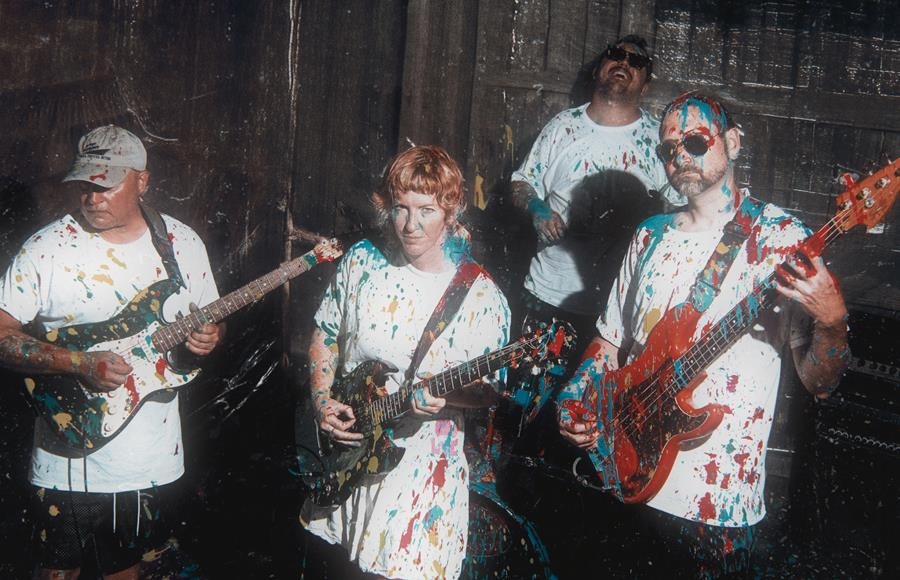
Best Band

Press shot by Claire C