Posts Tagged ‘Lo-Fi’

Label Obscura (Canada) / Warped Tracks (Scotland) – 5th August 2026

Christopher Nosnibor

A couple of months ago (I’m putting it down to the successive heatwaves that the time seems to have simply evaporated this year), Dragged Up stopped off in York (on their way to Newcastle from Middlesbrough) to squeeze in a special set opening day two of a mini-festival. During their performance, we got a preview of what was then touted as being a future single in the form of ‘Rapunzel’.

And now, the world gets to hear the studio version, in all its five-minute glory, complete with some bold sax. While the accompanying video (a two-minute cut), courtesy of the band’s own Eva Gnatiuk (guitar and vocals) features a succession of folks dropping classic and influential albums and books like they’re nothing (I was particularly pained to see a copy of the Red Star issue of Suicide’s first album getting tossed, even though the cover looked a bit battered, rather less fussed about a Faces album getting the treatment, and wait! That’s Stuart Lee emerging from behind an Earl Scruggs LP!)

AA

Where was I? Oh yes. The music. ‘Rapunzel’ is a garage, punky romp of a tune, and the sax lends it a very (early) Psychedelic Furs / X-Ray Spex vibe (Germ-Free Adolescents also appears in the video). It may reference hair washing, but it’s bursting with lyrical tangents, and couldn’t be much further from the songs from Disney’s Tangled (a movie I’ve seen far too many time, on account of having celebration a daughter who was exactly the right age for Frozen and stuff when it was all the rage). But this ‘Rapunzel’ keeps on springing surprises: the ‘Dark Entries’ section that featured live remains intact around the three minute mark, and if the video seems to say ‘meh’ to influence, the music itself says otherwise, feeling like a n effervescent celebration of those predecessors, rather than a trashing. Regardless, the result is an uptempo, exuberant, scuzzy blast that’s bursting with energy and attitude. And it’s great.

AA

a3385470597_10

Christopher Nosnibor

It’s been a while since I went to ‘bands in the bar’ kind of thing. Although the Horsemusic nights are essentially bands in a bar, it’s a large space and they play on a raised area at the far end of a rectangular room, meaning there’s a sense of separation (in addition to the handrail which runs across it). For many years, there would be acoustic soloists and duos – nearly always playing variations on the blues – in the corner of every other bar, and it was kinda fun for a while, but got a bit samey rather fast. Still, the point is that there’s something less formal about the ‘bands in a bar’ setting. The Golden Ball, consistently in the Good Beer Guide, is a community owned and run pub with multiple rooms (some more like nooks or snugs), where they host quizzes, spoken word and open mic nights and the like, plus decent size beer garden.

It might be Soma Crew lite tonight, paired down to minimal gear, with no cymbals and fewer pedals, but it’s still a lot of pedals, and by the time you’ve got a PA, amps and pedals for two guitarists and a bass, plus drum kit and another amp and mountain of electronic equipment for How Buildings Fail, plus a massive – and truly essential – thermostatically-controlled fan, seating, and space in general is very much at a premium. More than twenty people and it’s pretty cosy, to put it mildly.

David Mudie playing a solo Speedreaders set is the closest to truly stripped-back as it gets, with just him and a clean-sounding guitar and a couple of pedals. Played this way, it accentuates the sad, emotional nuisance of the downtempo slowcore songs, and he seems unusually relaxed and even borderline chatty by his standards.

DSC02994

Speedreaders

It sets the tone for the night: the intimacy of the space is a great unifier, and the warmth of the atmosphere isn’t just heatwave and humidity.

Simon – aka How Buildings Fail – seems genuinely quite overwhelmed by the positive response to his performance, each song received with enthusiastic applause. He soaked the small room with low end feedback as he drawled monologues reminiscent of The Fall – the first track in particular seems to lean on ‘Smile’, and the more uptempo (house) pieces rattle along, propelled by a primitive drum machine. Electronica with live guitar, it’s gloriously ramshackle and old-school in every way, from the scratchy guitar to the, we, scratchy electronics. And people are amazed. This is telling: he runs the York EMOM (Electronic Music Open Mic) night – it’s part of a now (inter)national network of events which gives a safe space for all the nerds and oddballs to perform (I say this in the most positive sense as a regular myself), and the York one in particular seems to cultivate a culture of experimentalism, left-field, ambient, noisy, and downright weird shit, and it’s brilliant. But it is a bubble, and maybe not all of the EMOM participants have the same potential beyond the bubble. But How Buildings Fail balances quirky post-punk with just enough catchiness to appeal to a broader audience, and to see how he’s received out in the wild is a joy for me, and clearly, a revelation for those unfamiliar, which is a fair few of those in tonight.

DSC03002DSC03006

How Buildings Fail

Soma Crew might well be the band I’ve seen and covered the most since I started out with Aural Aggravation a decade ago, and I’d seen them a fair few times before that, too. They are, definitively, mainstays of the scene, and have landed some high-profile support slots for visiting bands (notably The Fall at Fibbers in 2016) can be depended on for three things: 1) a different lineup nearly every time 2) drummer Nick wearing his Sin City Rockers T-shirt 3) they’ll always play counterintuitively and start with the most hesitant-sounding, ploddiest song on the setlist. It’s like a test, but also a warm-up as they feel their way towards the groove. It’s only after the drawling crawl that they strike their motorik stride, and once they do, they’re mining gold all the way to the finish. Chugging rhythm guitar, strolling bass, soaring lead and thudding minimal drums all settle in nicely. And then from nowhere, the sound erupts a few songs in. It’s not devastatingly loud, but in this confined space, the sound feels huge. On ‘Westworld’ they hold a single note – not even a chord – for about five minutes. Then the drums kick in and they hold it another eternity. It’s glorious. The band are looking relaxed and right in there, and I find myself completely immersed for a spell.

DSC03033DSC03044DSC03066

Soma Crew

And the thing is, it’s simply nice. It’s also more than that. There is a palpable sense of community here tonight, people stick around and chat afterwards, taking their time over pints purchased at last orders instead of the usual emptying minutes after the music finishes. Soma Crew probably rehearse in a bigger room than this, but it’s not about the numbers, it’s about the music, the vibe, the connection. None of the performers is new or up-and-coming, and won’t be offended by this observation. But there’s a further point here: so many of the up-and-comers find that life – work, mortgages, families – put paid to creative activity post-thirty. That all of tonight’s acts have remained artistically active is testament to a certain commitment to creativity. It may simply be stubbornness, but for that  stubbornness kudos is due, not only for keeping on, but keeping on doing good stuff. Better than good, in fact. Grassroots music events don’t come much more essential than this.
12th July 2026

Christopher Nosnibor

Anyone who says politics should be kept out of music is talking bollocks. An integral part of musical history is the music of protest, and of music which speaks of the times. While not necessarily protest-based, many dark moments of history are captured within traditional folk songs – long before the 60s gave us a whole new model for folk music as a vehicle for protest. Bob Dylan, Joan Baez, Pete Seeger, and Cat Stevens are just the first few names which come to mind as artists who picked up an acoustic guitar and used it to voice their anti-war sentiments, and it’s a mantel that’s been carried by many since, perhaps most prominently by Billy Bragg.

The arrival of punk brought a different kind of dissenting voice – one that was angry, nihilistic, and wasn’t so much anti-war as anti-everything, seeking to smash the system and stick it to the man. It shat the establishment up for a while, too, because it was brash, menacing, and felt violent, dangerous. This was Thatcher’s Britain: unemployment was up, there were strikes galore and discontent was more than rife. Of course, the major labels saw pound signs and signed punk bands left right and centre and before long, many acts were defanged by the wheels of capitalism in motion. And so the true punks stuck to, or remained resolutely, DIY, and while punk’s undergone a host of mutations since 1977, it still has both the sound and the vibe – particularly in the DIY scene – that positively yells ‘anti-establishment’. And this is, essentially, Craic Killers in a nutshell. The London-based Irish duo take certain cues from Kneecap, who, while having drawn heat from ‘the establishment’ are widely lauded for being not only outspoken, but sticking to their (metaphorical) guns in the face of litigation and more.

Before we get to the music, it’s worth taking a moment to consider the question of what constitutes ‘the establishment’ these days. Farage will tell you he and Reform and seeking to unsettle the status quo, to challenge the establishment and that they represent the man in the street who is fed up with not being represented by politicians in parliament. Bankrolled by tax-evading millionaires and billionaires whose funds reside off shore and who seek to siphon off even more wealth for their own personal gain, this is patent bullshit, and making those men on the street angry because they’ve been tricked to believe it’s the fault of immigrants that they’re poor and local services are shit is a massive con. The establishment does not exist to serve the regular worker. The establishment’s ethos is built on the foundations of the worst of capitalism, and this is why the establishment – both here in the UK, and particularly across the pond – is so hell-bent on dismissing any ideology that’s even remotely left (by which I mean, they hate welfare of any kind, particularly free healthcare, because ultimately, they don’t believe the poor deserve to live), and why they’re so desperate to crush dissent. It’s not because they believe protesters are terrorists, but because they hate to be exposed, and also can’t stand to see their absolute power and total authority challenged. There is much wrong with all of this, and more.

And Craic Killers are calling it out. All of it. As they tell it, ‘The new work goes in on the Epstein elite, MAGA bootlickers and major government failures such as the PSNI & TFL. Who Said I Was… matches the first EP’s intensity and themes of world collapse with a more refined sound.

It’s hard to argue any of that, really. Released last October, Who TF is Craic Killers? was a full-throttle blast of super-lo fi electropunk fury. Part of its appeal was the lack of production, rendering it the very quintessence of DIY. Cleaning up the sound is by no means selling out, especially when Who Said I Was… still sounds like it was recorded in a 4-track app on a smart phone. They rip into Andrew Tate and the ‘manosphere’, blast ICE, and tackle issues closer to home: certainly, the PSNI (Police Service of Northern Ireland) and their actions aren’t widely reported further afield, but as the sole note which accompanied the single release simply stated ‘All Peelers Are Bastards (and pedos)’. Trust in police is at a low eight now, for so many reasons, and the recent appearance of ‘ACAB’ graffitied under the bridge which carries the A64 over the River Ouse near where I live (alongside ‘Fuck Nazis’) is telling of the mood, I feel.

With the exception of ‘GIMMIE’ (released as a single in June), none of the six songs run over three minutes – but all of them are delivered with a ragged, riotous energy. By which I mean these guys are absolutely fucking fearless, and relentless in their intensity. ‘TFL’ may be slower and lower, but it’s dingy and abrasive, the vocals somewhere between hardcore punky shouting and really aggro rapping, while the closer, ‘Public Relations’ is unexpectedly catchy, but still as scuzzy as fuck.

It’s worth spending some time and a few listens to pick out the lyrics, but Who Said I Was… hits like a back-and-forth slap round the chops from the very first bar and keeps it going to the end. This is precisely what punk is about: impact, going in hard, no compromise. They don’t come much more punk than Craic Killers.

AA

Craic Killers Promo image 1

Sometimes London based three-piece Best Band’s band name genuinely angers people and they think that the band are being cocky and are exclaiming that they are the ‘best band’ ever created. However, the name came about after drummer Simon and guitarist Richard were inspired both personally and creatively with the goal to make the ‘best band’ that they possibly could.

The pair first met as members of improvised band ‘Improvisi’ and then they formed ‘Baffy’, a surreal band with a dada approach and a failed musical. Then came punk / free jazz band ‘Madchen 84’ and instrumental / experimental project ‘Stan Dingwater’. ‘Best Band’, however is the evolution of these previous incarnations, with the name being a triumphant marker of Simon and Richard’s journey to date.

“It was always a dream to do this- the ‘best band’ that we could make”, explains Simon. “After failing many times to try and find singers and band members for all the cool instrumentals Richard makes, eventually after some debating and persuasion, I just said, “Fuck it, I’ll sing and put poems to it”, which makes things easier for everyone. We are finally living our dream, with also Cai, who was the ONLY person to answer our advert for bassist”, he further adds.

With their drummer also being their singer, Best Band have an unconventional and chaotic presence, both live and in the studio. The three members also span three different generations: one being from Gen Z, one being a millennial and one being from Gen X. It’s an unlikely combination that somehow works awesomely and has given birth to two albums Life as a Baby (2024) and Go In Rooms (2025), with the third, The People’s Cub, now ready to be unveiled.

Musically, Best Band are influenced by post punk, disco and drone rock methods and emerge as an intoxicating blend of outsider pop / avant punk, groove rock, pub rock and weird pop which they themselves describe as ‘Zolo dada no-wave avant bogrock’. The tracks on the ‘The People’s Cub’ all have a looping bassline to make a sort of hypnotizing repetition, instead of conventional verse-chorus-verse changes, which the band find more interesting and fun to play. The People’s Cub himself is a quasi-political figure, with many of the tracks on the album involving creature characters. There’s a flea, a hedgehog, voles, owls, vultures and beasts.

Album opening track and first single, ‘Broken Coast’ is a scrappy blast of energy that is both strangely catchy and weirdly poetic in its own eccentric way. The track is about personal legacies, ideals, beliefs and opinions and humans wanting to be perceived / remembered in certain ways, then that being juxtaposed with not being able to get out of bed in the morning due to depression. The band use a flea as a metaphor for believing in an idea of who you are and how you’re perceived/remembered, and your integrity, beliefs and ideals. In the song, the flea is eventually killed as the band break free from living up to any imagined idea of themselves and the created self.

AA

Elsewhere on the album, ‘Boghouse’ is an ode to the lower ‘toilet venue’ end of the London music scene, describing all the little events, actions and intentions of any small rock band playing in Boghouses. It features wailing guitar solos all over the track, as a tongue-in-cheek homage to many of the bands Best Band have played with over the years on the circuit. The title track ‘The People’s Cub’ is an off kilter discordant yet cuddly political satire featuring the main character and mascot of the album. ‘The People’s Cub’ is an MP / Mayor but is also a little cub so he needs to stand on a tub to make speeches and he cuts the ribbon on new a village pub/cultural hub with his little furry stub.

Overall, the record is a bizarre and surreal journey through Best Band’s own disturbed inner psyche, set within erratic fuzzy rock styles that veer between 70s / 80s punk and 90s lo-fi indie worlds. With its offbeat themes of psychosis, unironic irony, modernity, depression, pathetic love, street nomadism, smelting, the afterlife, bus journeys, dread and defiance, ‘The People’s Cub’ is an excellently odd and candidly potent soundtrack to the times in which we all now live.

Catch Best Band playing the following shows in London:

27th May Dublin Castle, Camden

30th May Dash The Henge, Camberwell (early 3pm show)

17th June- Old Dispensary, Camberwell

AA

Best Band

Press shot by Claire C

skoghall rekordings – 18th March 2026

Christopher Nosnibor

Patience is supposedly a virtue… but then apparently, there’s no time like the present. And you’re supposed to strike while the iron’s hot. Clearly, Trump and his negotiators and so-called ‘Minister of War’ figured there was no time like the present even while negotiations with Iran were progressing nicely, with Iran offering substantial concessions around their nuclear programme.

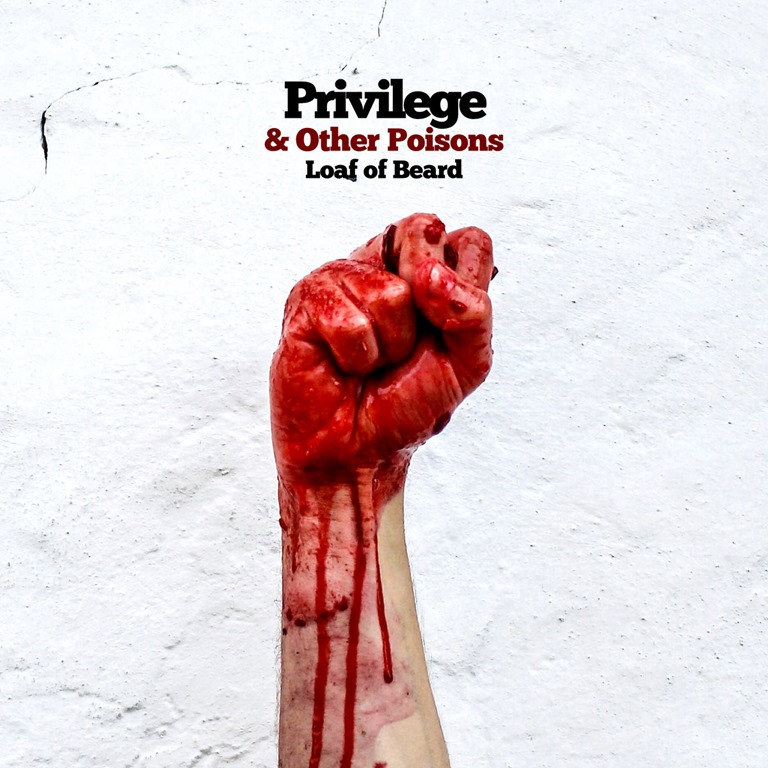
Loaf of Beard’s follow-up to 2023’s Dog had been scheduled for a couple of months’ time, but from nowhere, it’s been brought forward and landed yesterday. It’s not even a Friday, let alone a Bandcamp Friday! Still, after LoB material got an airing on a jaunt of the UK late last year, this might be considered an example of striking while the iron’s still a bit warm, and moreover, given the way things are going, there really is no time like the present inasmuch as we can’t guarantee there will even be a future. There is an urgency to making art right now, and putting it out there FAST isn’t so much about keeping it relevant – although that is a factor, since events are happening at such pace it’s nigh on impossible to keep up – but about processing all of this shit and conveying the intense and myriad mixed emotions these insane times engender.

As they write in the accompanying notes, ‘In these constantly changing and worrying times it is somewhat of a relief that certain artists go out of their way to document humanity’s descent into fucking stupidity and greed’.

Loaf of Beard – a duo consisting of Chisel and Rabies Beefburger tackle these serious matters with an element of humour, Chisel ranting and chanting in a distinctly north of England sprechgesang over uptempo lo-fi drum machines and scratchy electronica. There’s something uplifting about both the musical and lyrical simplicity. On ‘All Of This Lot Can Get Fucked’, Chisel reels off a list of politicians and other public figures, with a chanting refrain of ‘get fucked’. It’s simple but effective, and in a just world, they’d be playing to hundreds of people all singing the words back at them in a display of unity. But that’s not the world we live in, as they point out on ‘Shit Mic, No Fans’:

Some might say I’m the laziest rapper

I have to admit, that there’s none crapper

All the fucker MCs come along and diss me

I spit out rhymes, they just dismiss me

The irony is that this isn’t a million miles away from Sleaford Mods in many respects., and I suspect they’re aware of this fact. When you boil it down, it’s sweary sociopolitical rants with repetitive hooks delivered over minimal electronic backing. But while there is humour here, at times, Privilege and Other Poisons is unafraid to venture into dark territory, and this is nowhere more apparent than on ‘B.A.E’, where they call out the manufacturer of arms and ‘informational security’, whose share price has absolutely skyrocketed in recent years, since Russia invaded Ukraine and war has essentially spread around the globe, with the lugubrious refrain of ‘B.A.E and their profits of death’. And this is how the world works under capitalism. A small – very small – minority coin it in while everyone else’s lives crumble and tens of thousands of people – innocent civilians – are slaughtered because some cunts in suits who wield power beyond imagination are petulant pieces of shit who want global domination like in a stupid movie and think it’s a game.

Elsewhere, ‘Claptrap Fåntratt’ sounds like The Fall circa Light User Syndrome (which is severely underrated in the scheme of their oeuvre). ‘Freeze Peach’ goes full-throttle raging electro/punk thrashabout, with Chisel foaming at the mouth with the chorus of ‘take your fucking flags down dickhead’ before going all-out Beavis and Butthead. ‘I Feel Like a Twat’ serves up a slice of cheesy jazz-infused disco funk, and knowing its awfulness is conscious and intentional only raises the level of awkwardness. This is Loaf of Beard all over. They exist to make you feel uncomfortable – and they succeed. And I for one respect that.

Semi-ambient pastoral contemplations about wildlife and sightings of elk make for some welcome respite: it’s not healthy to be raging all the time, and however fucked the planet may be, nature is resilient. It’s us who need to become extinct.

AA

AA

a3330254764_10

Cruel Nature Records – 27th February 2026

Christopher Nosnibor

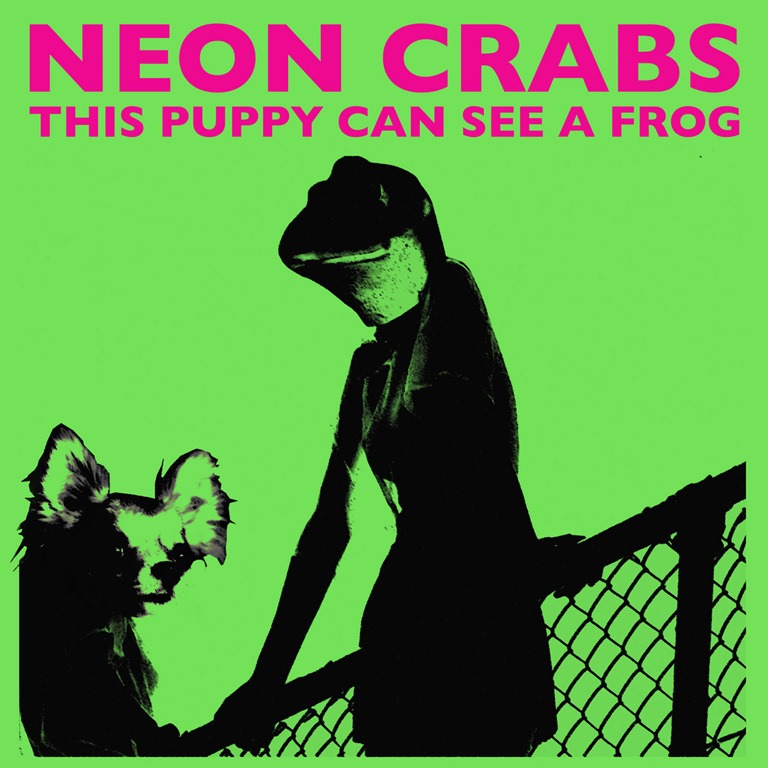
It’s a small world, as they say, especially if you live in York. As a city, it has more of a town feel, and round my way to the south of the city, it’s more like a village. It’s rare that I go for one of my daily walks or head to the local shops without seeing at least one person I know to nod or say hello to, and it’s nigh on never that I turn up at a gig where there aren’t people I know – mostly from previous gigs, and it’s a positive thing: there’s a palpable sense of community. So it’s more of a surprise that despite mutual friends, I’ve never encountered Andy Goz, or his band Neon Crabs, a transatlantic collaboration with Matt Nauseous of Dallas, Texas (I’m guessing those aren’t the names on their birth certificates), which has been operating since 2021. They made their debut last year with Make Things Better? on Half-Edge Records, followed by Drop It On Ya on Metal Postcard Records, with the cassette edition of This Puppy Can See A Frog representing their first physical release.

I’m going to guess that the colour scheme of the cover is no accident, a knowing reference to Big Black’s Songs About Fucking – although the material it houses is more in the vein of The Hammer Party.

It’s pitched as a collision between The Stooges, post-punk, and 90s noise rock, and as a fan of all three, I’m sold. The way in which they draw these elements together to conjure a sonic hybrid is inspired: here, we have the mechanoid, piston-pumping drum sound of Big Black paired with the scuzzed-out guitar fuzz of Metal Urbain. Just as The Stooges were punk years before punk was even a concept, and Metal Urbain and offshoot Dr Mix and The Remix (a huge influence on both Steve Albini and The Jesus and Mary Chain), so Neon Crabs launch themselves headlong into that space where acts were feeling their way around forms, styles, and technologies which seem primitive now, but where limitations led to innovations. This Puppy Can See A Frog has a raw energy, an underproduced, analogue feel with jagged guitars and some loose but dynamic playing.

The songs themselves are simple in both structure and chords – the guitars often straying away from chords to create texture rather than melody. The same is often true of the vocals, Matt swerving between semi-spoken word and drawling, occasionally singing but weaving around a tune rather than following it, in a style that’s perfectly suited to the frenzied maelstrom of discord which fizzes all around. ‘White Collar Witch’ is a messy collision between early Pavement and The Fall circa 1983, and is arguably Neon Crabs’ equivalent of ‘The Classical’.

‘Creature Violence’ adds free jazz to a murky mess amidst which Nauseous lives up to his name with what appears to be an extended riff on the ‘your mum’ insult with some scatological references as an added bonus. Or something. Maybe. The Fall comparisons stand on ‘Vicious Debasement’, a snarling, mess of layers spilling every whichway over a throbbing motorik backing – but then again, there’s a bit of the irreverent chaos of Trumans Water happening here, and a whole lot more.

Things seem to get darker, starker, and more desperate and ugly and experimental during the second half the album, dragging in dubby bass which seems to reference Bauhaus and squalling, scratchy guitar work with hints of Gang of Four and Wire abounds.

The simple act of titling a track ‘Lisa Kudrow’ evokes the spirit of 90s noise rock, the likes of Butthole Surfers and Tar and sure enough, that’s pretty much what you get, with added samples.

This Puppy Can See A Frog is a wild assimilation of sources, a rackitacious mess of noise heaped together as an album. It sounds like it could have been recorded in a dingy basement on an 8-track, or even a 4-track, in the space of a week – and is all the better for it, because it possesses an immediacy and energy that’s rare here in 2026.

AA

AA

a3663775174_10

27th November 2025

Christopher Nosnibor

Richard Rouka is… an unusual man. He’s existed around the Leeds scene since the emergence of the goth scene, and he documented it back in the day, in real time, but to describe his own musical output as ‘adjacent’ would be generous, to say the least. The mid-to-late eighties saw his label, Rouska, release a stack of stuff, predominantly by The Cassanda Complex and Dustdevils, bands with strong Leed connections.

His own works, released under the guise of WMTID aka Well Martin This Is Different! draws on the post-punk vibe of that period, but is predominantly primitive electropop with a distinctly bedroom / four-track vibe. WMTID has been a thing for over forty years, but Rouska’s output has skyrocketed in recent year.

One way of pitching it would be early Depeche Mode as performed by Young Marble Giants, but this wouldn’t really convey the ways in which these elements – played and tossed together in the most ramshackle of ways coalesce. But what it hopefully would convey was the fact that this is steeped in early eighties analogue experimentalism, the time when synths were breaking through as emerging technology and the Musician’s Union was shitting itself about how this would herald the death of ‘real’ music – particularly on account of the increasing popularity of drum machines, which they feared would end the need for drummers. Just as home taping didn’t kill music – and if anything it meant that music sharing exposed more people to new acts (I know I discovered countless new bands because people gave me mix tapes), so synths and drum machines broadened musical horizons instead.

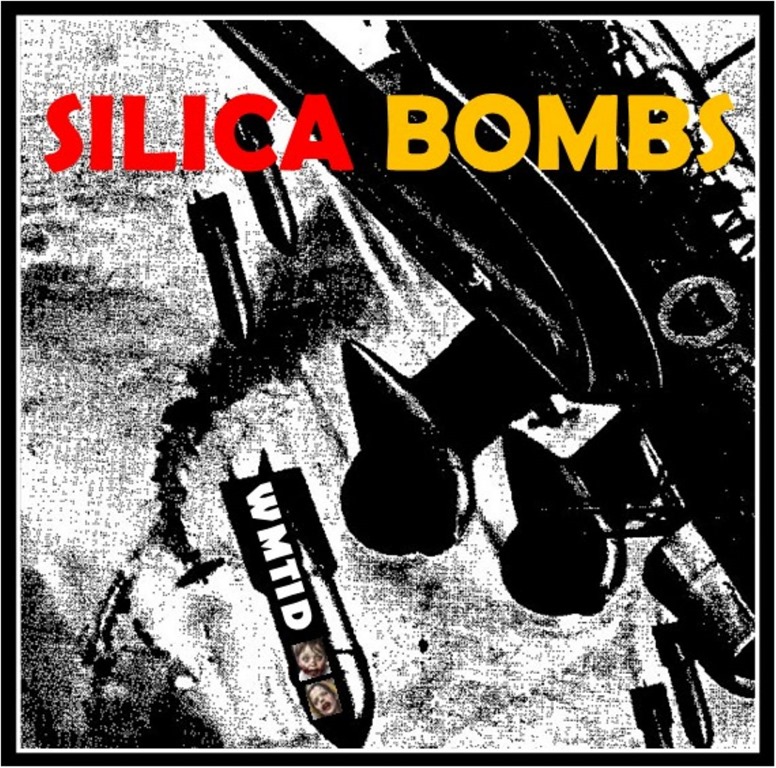
Silica Bombs revels in the primitive: ‘Fool Moon’ is simple, sparse, in its arrangement, synths quavering around a persistent piston-pushing drum machine beat. With its stark, minimal production, paired with a fairly flat, monotone vocal delivery, ‘If It Happened Anywhere Else’ very much channels the spirit of Joy Division. The bleak, synth-led ‘Walk With Me (Into the Sea) sounds like a demo for New Order’s Movement. And yes, the recording quality is pretty rough, and it very much captures the spirit and sound of the late 70s and early 80s.

It’s different, alright, but above all, it feels like a magnificent anachronism. The eighties revival had been ongoing for at least a decade now, and so many acts have sought to replicate the sound and feel they’ve largely failed. Maybe you needed to there. Maybe you need the right kit.

But the weird, trilling organ sound of ‘Good Mourning’ brings a dark weight and fizzed-put production which are incompatible with contemporised production values. ‘Crushing Bore; brings a certain humous to proceedings, while coming on like Cabaret Voltaire. ‘Opposites Attract’ brings some heavy drone which contrasts with the sing-song vocal melody, and in may ways this is typical of the way in which WMTID explore polarities with a shameless eighties naiveté. By this, I mean that the 80s was really the last decade of real innovation. The 90s were exciting, and that’s a fact – I was there – but the 80s witnessed the arrival of synths, of electronica, and marked a real turning point in the trajectory of music. And Silica Bombs doesn’t replicate that era so much as live there. With its thumping beats and swirling synth sound, ‘Rouge Planet’ has a strong club vibe. That vibe gets stronger and harder, with the pulsating groove of ‘Sweet Jesus’, which Rouska tells us ‘I’ve got a friend in Jesus’. Yeah. The Jesus and Mary Chain, perhaps. ‘Personal Jesus’ maybe. It drives hard fir a relentless five and a half minutes.

This is an album which wears its influences on its sleeve and shows no signs of shame in that. And why should it? Rouska is very much of that era and played a part. The fact that his musical output over the last few years is indicative of a person who doesn’t go for meetups with former colleagues. More than its predecessor, Finding the A.I. G-Spot, Silica Bombs feels significantly beat-orientated, and more hard-hitting. It’s retro, and its catchy. It’s retro and it’s weird in that it has no specific identity… it’s just what it is. And it’s a groove.

AA

AA

AA

a2195822840_10

Originally released digitally on 14th March, and recorded at Hermitage Works during November 2024, the four track EP will receive its first physical release and will be available via Bandcamp.

Mixed and mastered by Max Goulding and Nathan Ridley.

Track Listing

One Window Open

Polar

Unit

Void Request

a1695055066_10

Liner Notes (by Fred MG):

Bo Gritz have been at it for ten years now. Or do we mean five?

You see, while the trio of Benjamin Salt, Max Goulding and Finn Holland have been together since 2015, they are also one of those groups who have a significant fork in the road in their past, specifically the Coronavirus pandemic. Lockdown gave Bo Gritz the opportunity for a hard-ish reset, with the band using all that time as a chance to work new synthetic textures into the tried and tested combo of guitar/bass/drums/vocals. Coupled with them securing a new permanent practice space in South London, the Covid period ultimately led to the hair-raising noise-rock of Bo Gritz’s most recent LP, 2023’s Chroma.

On Prang, Bo Gritz continue to reap the benefits of their new era. This is a potent four-tracker, industrialised and bristling. From the single-note lurch that heralds first track ‘One Window Open’ to the last thwack of closer ‘Void Request’, Prang’s barely-shackled chaos makes for an unpredictable and arresting listen. It’s ambitious, grizzly and extremely hard not to fall for.

At the noisier end of rock, there’s a strong modern lineage of album openers which get all their mileage from a stomping single-note riff. To a list which includes Pissed Jeans’ ‘Waiting On My Horrible Warning’ and Death Grips’ ‘Giving Bad People Good Ideas’ we can now add ‘One Window Open’. The track sitting just below mid-tempo allows space in the beat with which Bo Gritz can gesture towards all manner of beat-based stylings, from mercurial junglism to broken-beat techno.

The stall set out, Prang’s other three joints also tow the line of order and bedlam. ‘Polar’ is screed with strange, almost-tuneful noise which sounds like a revving motorcycle fed through an ungodly array of outboard gear. Occupying a space between texture and melody, this sort-of-lead line increasingly becomes the centrepiece of the song as things go on. Something similar takes place on ‘Unit’, and this track’s nervous twitching also has one thinking of that instrumental version of ‘Breathe’ by The Prodigy which used to be on the soundtrack of one of the Wipeout games.

As with the instruments, so with the vocals. Across this EP, Holland assimilates a sense of barely-controlled chaos into both the lyrics and delivery. The way in which ‘Polar’ sets lurid imagery (‘they said his eyes were cut out’) against the straight-laced sloganeering of capital (‘business must only get better’) makes one think of Thom Yorke’s star-making era cut with a little of that Gilla Band hysteria. ‘Void Request’ – a joint with a hint of Leeds lifers Bilge Pump in its DNA – finds Holland barking stentorian code one minute, muttering in the background the next.

Times change, but humanity doesn’t. Whether Bo Gritz had been doing their thing for five, ten or fifty years, the feeling at the heart of Prang – the suppressed horror of contemporary civilisation, the ugliness lurking underneath the workaday – is one for the ages. It’s just that now, in Bo Gritz’s new phase, they’ve got the emotional and material tools to deliver their message with a viscerality which feels thrillingly contemporary.

Bearsuit Records – 5th September 2025

Christopher Nosnibor

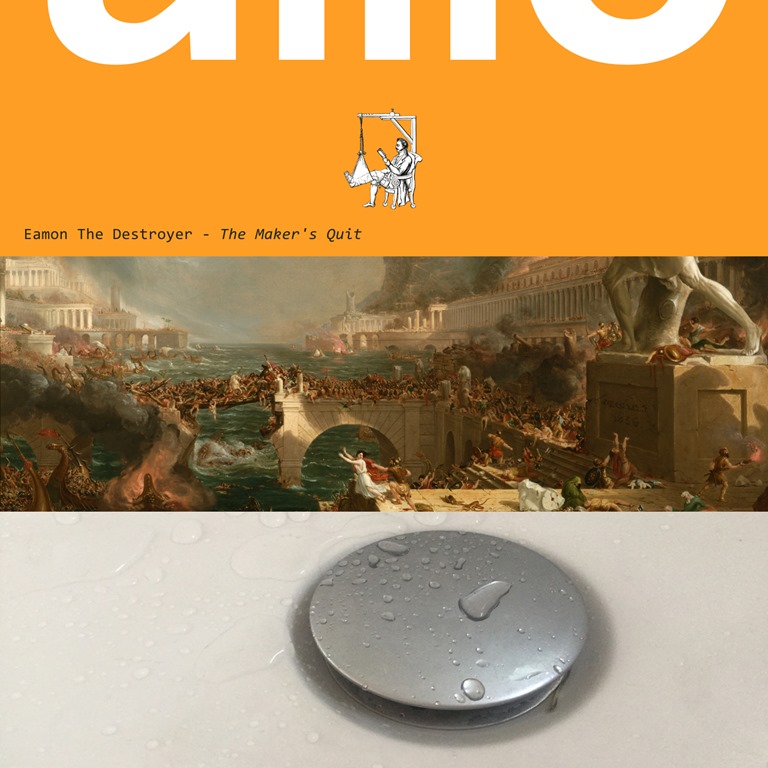
The thing with Eamon the Destroyer is that you never know what you’re going to get. The Maker’s Quit is different again from We’ll Be Piranhas, which in turn was quite unlike Small Blue Car (which remains a personal favourite, even if it does make me feel impossibly heavy on the inside). If We’ll be Piranhas marked a step forward in terms of experimentalism and optimism, The Maker’s Quit sees a greater emphasis on songwriting and structure – but don’t for a second think it’s in any way straightforward, and that the experimentalism has taken a back seat – it’s still very much a copilot here, and with the accent on the mentalism.

Here, the title track commences what is an incredibly varied set with a song that has the theatricality of Alex Harvey crossed with 1990s Leonard Cohen, before ‘Silverback’ confounds all expectation by bringing some shuffling funk-infused jazziness. In contrast to the fairly minimal arrangements common to previous ETD releases, this is pretty busy, then is settles into a mellow groove that’s almost loungey – bar the mid-section, which is rent with a protracted burst of extraneous sound. It’s almost as if he purposefully weaves around the line between genius and self-sabotage simply to tests us as listeners. There are some nice, light, poppy moments on here, and – albeit fleetingly – some captivating grooves. But it wouldn’t be Eamon the Destroyer without a huge helping of straight-up weird shit mashups, and The Maker’s Quit brings the lot, from frenzied jazz and post-grunge, wonky vaudeville waltzes and whistling, via electropop and slices of pan-culturally inspired melody.

More often than not, the verses and choruses are so contrasting as to seem to have been spliced from different songs – that’s when there are verses and choruses. ‘Three Wheels’ is a veritable patchwork, which compresses segments of what sounds like half a dozen songs into five minutes as it spins from grandiose heavy country dirgery by way of an intro, which even hints vaguely at recent Swans, before swerving into Europop with a hint of Sparks, through a off-kilter but gentle soundscaping that slides into laid-back salsa before winding up with a segment of jaunty indie rock. But rather than feel like an identity crisis, the effect is more that of a multi-faceted artist showing all his facets simultaneously. It’s hard to keep up, but one can only imagine what it must be like to live in his head.

The lyrics are equally fragmented, between stream of conscious and cut-ups, producing a Burroughsian, dream-like quality. This snippet from ‘The Maker’s Quit’ exemplary: ‘Saturn kid – spins and reels – in a city / Little Feet – lost in a wave – out to sea / A grandmother – nods – to a space in the crowd / Cap gun assassin – emerges – from a conjurers cloud…’ Beyond oceans and waves, it’s impossible to pin down any notion of themes or meanings. The images float up and fade out instantaneously.

‘The Ocean’ begins dramatically, a swelling, surging drone that halts abruptly, yielding to one of the most typically Eamon the Destroyer passages – lo-fi folktronica with a low croon reminiscent of Mark Lanegan, which slowly tilts its face upwards from scuffed boot-tips towards the sun…. and then all mayhem happens in a brief but explosive interlude, and your head’s suddenly spinning because wherethehellhasthiscomefrom? It’s this wild unpredictability and unapologetic perversity which is – strange to say – a substantial part of the appeal of Eamon the Destroyer.

When Eamon the Destroyer goes downtempo, as on the mournful, string-soaked introductory segment of ‘Captive’, you can actually feel your heart growing heavier by the bar, but then it twists onto some semi-ambient avant-jazz, and the sensation transitions to bewilderment.

The final track, ‘The Buffalo Sings’, is a twelve-minute behemoth is s slow, surging lo-fi electronic exploration. Face the strange? It embraces it, hard, then absorbs it by ghostly osmosis. If ever a song was less country, less ‘Buffalo’… maybe some of the western themed electrogoth songs by James Ray and the Performance are on a par on that score, but this wanders into a sonic desert without even a hat for protection from the punishing sun, and slowly, everything melts in the heat. Circuits bend and warp, and the weirdness rises like a heat haze… and it’s wonderful to be immersed in a work which celebrates creative freedom with no sense of constraint or obligation.

On reflection, with Eamon the Destroyer, you know exactly what you’re going to get: visionary hybridity, moments of aching sadness and fractured beauty, shards of melancholic memory , unbridled inventiveness and fevered creativity, and music like nothing anyone else is making. In a world where meaning seems to have all but evaporated and it’s increasingly difficult to make sense of any of it, The Maker’s Quit feels like a fitting soundtrack. It exists purely in its own space, and it’s the perfect space to escape to in these most dismal of times.

AA

Eamon-TD-3_Cover

Following the demise of Needlework, who we absolutely loved here at Aural Aggravation, front man Reuben Pugh has been keeping busy and keeping creative, with the swift emergence of lo-fi slacker country act Troutflies.

Ahead of an imminent debut album, The Dancing Years, they’ve dropped the song ‘Cross on a Hill’, which has hints of Pavement and Silver Jews, blended with the drawl of Mark E. Smith, and is accompanied by a video that matches the loose, low-budget feel of the song. We dig.

AA

531393817_122160077354381252_7463272933200659176_n