Archive for the ‘Reviews’ Category

Stratis Capta Records – 13th May 2026

Christopher Nosnibor

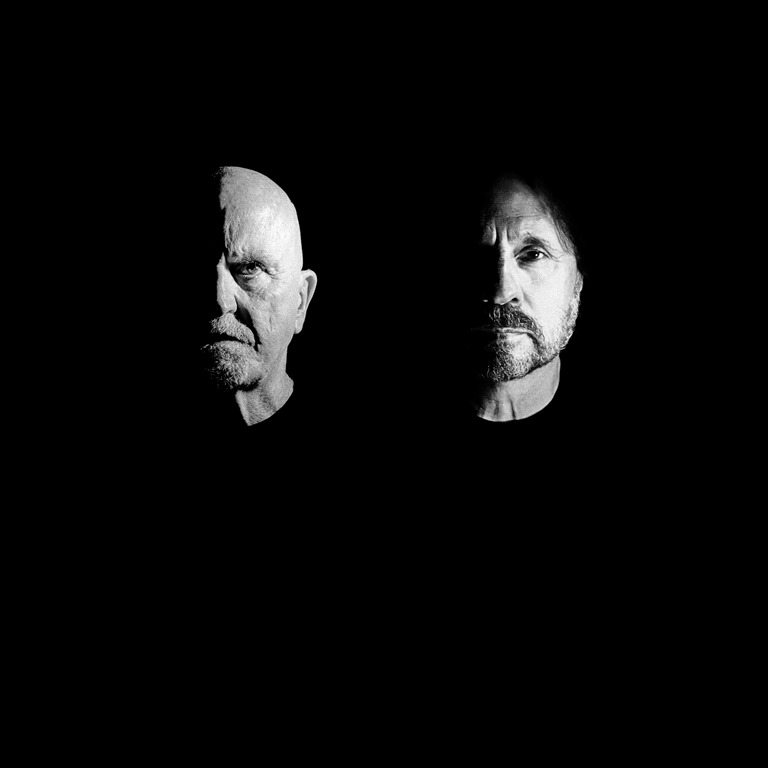
While gearing up for a second EP, San Francisco’s Octavian Winters give us the single ‘By the Stars’ – and while it’s quite the contrast from its predecessor, the adrenalized slice of post-punk that is ‘Elements of Air’, the distinctive key elements are still very much in evidence, not least of all the robust drumming, and the catchy shoegaze pop shades, which are keenly reminiscent of Curve.

The intro sets the tone for the song, introducing elements of light and shade, whereby a soft chiming guitar – wistful and ponderous – contrasts with a darker-sounding Cure-like chorus-soaked bass and rolling tom-led drums which arrive shortly after. Ria Aursjoen’s sweetly melodic vocals add a whole other dimension. From hereon in, the song swirls around amidst hazy atmospheres.

The song possesses a dreamy quality, and the structure is more a sequence of segments than a more conventional verse / chorus, which only accentuates the sense of the song being a journey, with a sense of flow and transition instead of feeling constrained. The effect is to lift the listener, not necessarily out of body, but momentarily out of time, and to another space, a space apart from the grounded world. And right now, when the (supposedly) grounded world is hard to deal with, these five minutes of uplifting separation are absolute bliss.

AA

Octavian Winters 2026 (photo by David Kruschke) 02

Photo by David Kruschke

5th June 2026

Christopher Nosnibor

I laugh, because the phrase ‘survival of the shittest’ was a phrase I used – a lot – in the late 90s, in my early years of being thrown into the corporate world after completing a degree in English literature. Back then, the belief still existed that a better education would lead to a better job, although in the three years between starting my degree and finishing it, a lot changed, and none of it for the good. ‘Graduate jobs’ stopped being a thing, meaning that it was a feat just to land a temp job doing data input work at an insurance company. It was fucking soul crushing, and Charles Bukowski’s Factotum became a book I came to relate to all too closely as I trudged my way through what felt like endless drudgery. And the managers, those who got promoted, those who did well? The common trait among them seemed to be that, when you boiled it down to the basics, they were all cunts. Backstabbers, self-promoters, overconfident wankers, twats with all the ambition but none of the skills… these bastards were killing it on the career ladder, while I sloughed away in a pit of despair. Scum floats, and all around me, it did. I wasn’t envious of their lives or their ‘careers’, but it was a gut-wrenching showcase of the shitshow that is capitalism and the greasy pole of corporate life: the survival of the shittest in sharp relief. This is now true of all aspects of life: as politics has become indistinguishable from business, and capitalism has taken over all aspects of existence, every bugger is using business-speak and striving to attain success not by means of hard work and talent, but by connivery and cuntishness. And it needs to be called out, and blocked wherever possible.

This new EP by GURT is nothing less than an absolute beast. With three tracks clocking in at ten and a half minutes, there’s no flab, no extravagant solos, no wanking about. They’re described as purveyors of ‘party doom’, but they’re a bit too uptempo to be doom and far too doomy to be party for most. Ultimately, their thing is a rabid racket, and at times, I’m reminded of the Leeds scene circa 2010 and shortly after, specifically around the emergence of crazed guitar noise acts like Pulled Apart by Horses and These Monsters. These were exciting times, particularly as it predated the need for professionalism to make it even onto a stage. Don’t get me wrong: these were great bands, but they were also wild, and things feel a lot more contained now.

GURT do not feel contained, GURT feel deranged, unhinged, rampant. ‘Live Nation, Dead Scene’ goes in all guns blazing, a rabid rager presumably targeted at the multinational ticket agency – operating what’s probably one of the biggest legal scams on the planet right now, with their exorbitant fees and dynamic pricing. The music industry has always sought to gouge every penny from fans while the artists themselves wallow at the bottom of the pile when it comes to benefiting from the proceeds, but Live Nation have hatched a whole new level of exploitatious robbery. They are literally – and yes, I do mean that – killing music for profit, and should be boycotted at all costs. I doubt this is a major issue for GURT.

The title track is a low-slung, sludgy, riff-driven roar, propelled by some ferocious drumming. The vocals are mangled to all hell, and it’s seriously gnarly.

Their cover of 2 Unlimited’s ‘No Limit’ simply shouldn’t work. It’s truly preposterous, audacious, and absurd. Metal covers of pop and dance tunes is old hat, predictable, corny… and yet they overcome all of this to conclude the EP with a ballsy, over-the-top take on a dance-pop song that’s as maligned as it was successful. This version’s not going to be making number one in a hundred countries around the world or filling dancefloors in perpetuity, but credit to GURT for the inspired choice. And now ‘party doom’ makes sense. Get on down, motherfuckers!

AA

AA

GURT_SOTS_Cover

17th April 2026

Christopher Nosnibor

Since emerging as The Sunken Land not so long ago, David Martin has focused on his consistent push forward, and his systematic output. One gets the impression that this is much more driven by a desire to render new sonic art, than the capitalist compulsion, now being pushed by streaming sites, to continuously create ‘content’. And for that, I say ‘good’: content creation as a goal in itself is as anathematic to art as AI itself: creation for the pleasure of the act, however, is an entirely different matter.

This, the third release by The Sunken Land – and the third in four months – is perhaps the most ambitious yet, making deeper explorations into texture, tone, and contrast.

Admirably, there is no information about this release: it’s left for the listener to unravel. And why shouldn’t it be? While it can be interesting to learn where there’s a specific back-story, motivation, meaning, or method which is vital to a work, more often than not, the endless explication given by some artists gets to be a drain after a while. It can also make the writing of a review feel somewhat futile, as if half the job’s already been done.

As the title perhaps suggests, there’s a sense of ephemerality to the three compositions on up close everything melts into air. The first, ‘scoria bricks’ is an eight-minute piece which overlays a heavy, pulsating drone, dense with distortion, with soft, comparatively clean notes, which at times sounds like Earth attempting to cover Fleetwood Mac’s ‘Albatross’. The contrasting parts, while distinctly separate, form a full-spectrum sonic flow, which is both immersive and strangely soothing.

Some cursory research, meanwhile, reveals that a scoria brick is a type of blue-grey brick made from slag, originally manufactured from the waste of the steelworks of Teesside, common across the North-East of England, and that ‘the word Scoria originally comes from Greek, meaning “Excrement”, but came to be used by the Romans for a kind of volcanic rock’. It’s more than I can manage to avoid making some reference to ‘shit bricks’ here. However, I also discovered that these are precisely the bricks, manufactured in the late nineteenth century, used in the back alleys in the part of York where I live, which, on a personal level, brought an additional dimension to listening back to the track, a sense of connection with a part of the local history I had hitherto been unaware of.

Arriving with a tearing detonation of a chord, ‘into air’ is again simultaneously heavy yet delicate, even light. The experience is perhaps evocative of waves crashing against rocks, and observing rainbows amidst the spray – something rare and special, and so fleeting and impermanent – barely even tangible, and completely without substance – that it hardly seems to exist at all. In a blink, the phenomena has passed, as if evaporated, quite literally ‘into air’.

The third and final piece, ‘white sike’, is both the briefest and the gentlest of the suite, and given the voyage of discovery inspired by ‘scoria bricks’, it’s perhaps most likely in some way connected to White Sike Wood, a forest some way west and a shade north of Harrogate, rather than the White Sike in Dumfries And Galloway. Its picked notes and slow movement is the sonic equivalent of dappled sun – rather than Sunn O))) – through leaves, and over its duration, a tranquillity descends.

AA

a3679715982_10

6th May 2026

Christopher Nosnibor

It’s been fully three years since we last heard from Lunar Twin, and 2023 seems like a long time in terms of the scheme of things. Aurora was a showcase of shimmering blissed-out melancholia. Yes, a contradiction in terms, but one that made sense, with rippling synths, as well as sweeping waves which hinted at Disintegration era Cure paired with elements of sparse electropop and the softer end of the dance spectrum. It was the sound of the beach, but also of the sun setting, and bringing with it a low ebb, a ponderous emptiness, Bryce Boudreau’s vocals evoking the spirit of Mark Lanegan over a shuffling desert electro backing. Before that, Ghost Moon Ritual explored recent bereavements, and plundered particularly bleak terrain.

‘Disappear into the earth’ doesn’t deviate a million miles from this template, and that’s all to the good. It’s a shade more uptempo than much of both Ghost Moon Ritual and Aurora, an undulating bass groove paired with a vintage electro beat reminiscent of The Human League.

But beneath the seeming optimism of the lyrics and the buoyant retro drum rolls – we’re talking circa ’83 pow pow pow pseudo toms here – there’s a certain sense of pessimism, a low-level gloom. As such, this is a song which presents a duality. It’s not quite the quintessential sex and death equation, but most definitely delves into the territory whereby optimism and pessimism, fatalism and euphoria collide at a crossroads that’s both literal and philosophical.

‘gonna lay right down it the dirt disappear in the earth we are forever when it rains when it’s dark the spirits in your heart, we can be anything that we can dream’, Boudreau sort of rasps, sort of rumbles, sort of croons: again, the delivery hangs in some sort of intersectional space.

‘Disappear into the earth’ is a deft slice of dark electropop which captures the vintage vibe to a rare extent, but goes far beyond that. The form and delivery is low-key, understated, but it lands, coming in below the radar and resonating in subtle ways. It’s a welcome return.

AA

a2154679112_10

Christopher Nosnibor

One measure of how much I’ve enjoyed a night is by volume the notes I’ve made. It’s not a hard and fast rule, but fewer notes tend to indicate that I’ve been too immersed in the performances – and likely being social in between – to write much. And so it is that I returned home tonight with a bunch of blurry photos and the grand total of fifty-four words.

Yes, for their one-year anniversary gig, Utterly Fuzzled have laid on a truly top-class lineup – and it’s drawn a deservedly significant crowd. And the gong is back! A feature of the early events, it’s a welcome return for this signature piece of instrumentation, which variously heralds the opening of a set, or otherwise

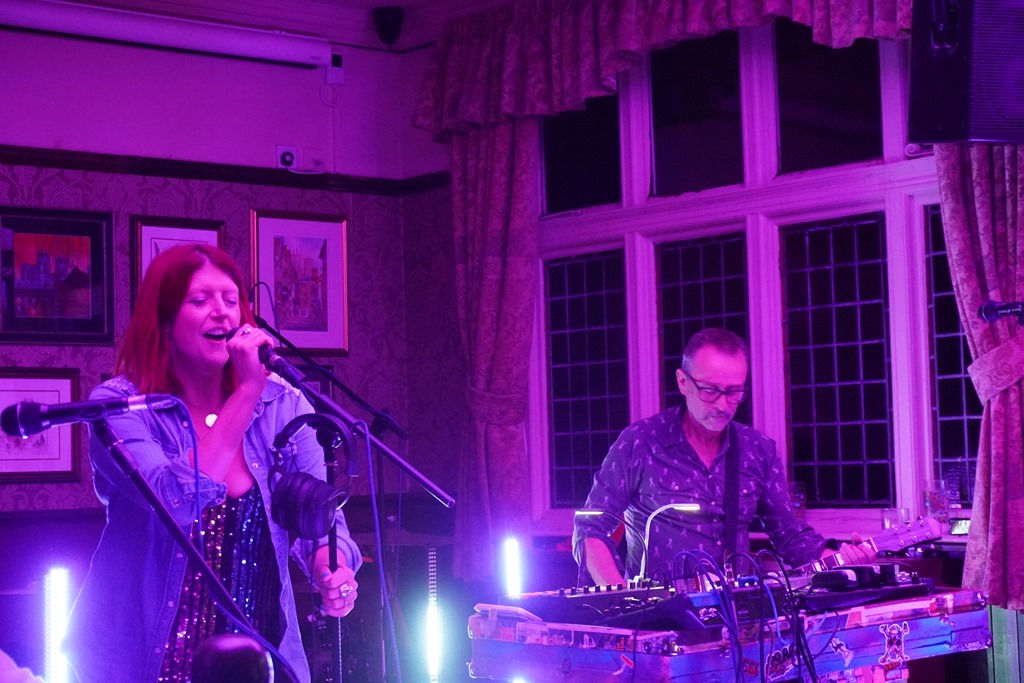
Sheffield’s Duck are making their Fuzzled debut, and showcase a northern post-punk style that emanates authenticity, due in no small part to their vintage drum machine and synths which define the sound. They had issues with their levels throughout the set, taking a song or two before the drum machine cut through some particularly murky, bassy guitar and the dominant synths, only to sink back beneath the waves two-thirds of the way through. But then the tide was in their favour, they were ace, with a crisp pop edge and some nice harmonies. In places, they reminded me of short-lived and criminally underrated goth-pop act Sunshot (whose guitarist, Toby Bricheno, is the brother of Tim Bricheno, formerly of All About Eve and The Sisters of Mercy).

DSC00026

Duck

It wouldn’t be an Utterly Fuzzled event without one of the various projects of the organisers on the bill, and tonight we get a – comparatively rare – outing from Chaffinch, which in terms of lineup is essentially Knitting Circle plus an additional guitarist. Sonically, they are somewhat different. Precisely what they sound like seems to be a topic for debate, with different people hearing different things, and with no recordings, it’s impossible to verify. To my ear, it’s a cocktail of mathy post-punk with some c.86 indie jangle and a dash of shoegaze, which is perhaps best summarised as ‘chaffinchous’ (there you go, Jamie, the royalties from the coinage are in the post).

DSC00054DSC00089

Chaffinch

The aforementioned additional guitarist is a towering presence – both physically and sonically, and requires a lot of space for his expressive playing, playing in front of the stage, trading angular chords with Pete Dale, while Jo knocks out chunky, solid basslines by way of balance. Considering they’re debuting some new and recently revised material, they manage to keep it tight, and by the end of the set, all bar drummer Marc are in front of the stage.

DSC00103

Chaffinch

Riff behemoths JUKU never disappoint, and tonight they’re fully pumped-up and giving 110%. They bring maximum riffs, and maximum rock ‘n’ roll, at maximum volume. On paper, comparatively primitive song structures, based around, repetitive chords hammered out hard is cool and all, but hardly a revelation. It’s not so much what they do, then, but how they do it: propelled by powerhouse percussion and blasting bass, the twin guitar assault forges a ferocious wall of sound. It’s not volume simply for its own sake, but with the function of rendering a visceral physicality to their performances. And they all play as if their instruments are plugged directly into the mains, with an electric, kinetic energy that positively crackles. Practically all of my photos of Dan Gott are unusable, his features blurred like a Francis Bacon portrait, and looking on, I feel as if my own face is melting in the face of the sheer sonic force tearing forth.

DSC00140DSC00124

JUKU

Any references likening the experience to being hit by a freight train, or a freewheeling juggernaut with failed brakes hitting terminal velocity as it screams downhill are entirely appropriate. But for all the noise, the three-way vocals and some deft detail within the guitar work demonstrates an attention to melody and nuance: they very much do have songs. ‘Out of Control’ is a straight-up grunger in the vein of Hole.

Irked were second from top of the bill at the first Utterly Fuzzled on 10th May last year (and with Crumbs and Slime City also featured, it’s possible to now look back and see just what a statement of intent this was). They’ve come quite some way in that time, having released their debut album, The Grievance at the start of the month, and won a high-profile fan in the form of none other than Simon le Bon. If they were phenomenal a year ago, they’re even better now. The formula is classic, vintage punk, with short, sharp songs focused on three-chord riffs played hard and very, very fast, with the lyrics hollered just and hard and just as fast. Irked do pissed off and angry, but they also do fun. Not only are they incredibly entertaining, but it’s clear they’re enjoying themselves, too: Helen may be endlessly pacing, lunging, clambering, in the crowd and in your face, but she’s equally prone to fits of giggles.

DSC00208DSC00191

Irked

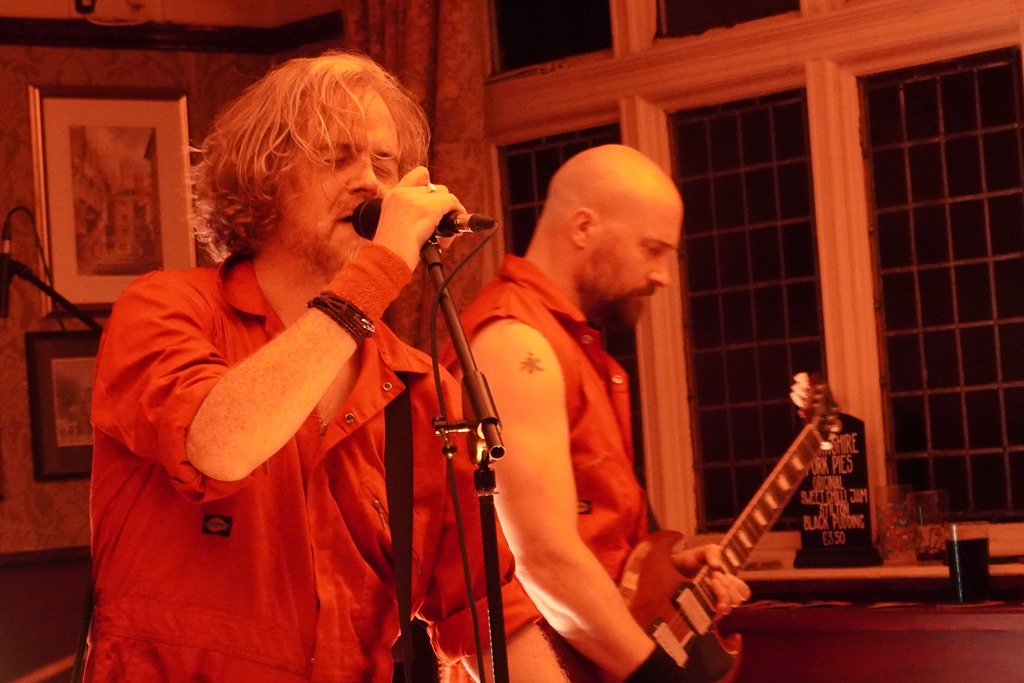
It’s guitarist Simon who delivers the chat and banter, griefing his bandmates in a good-natured way, and oftentimes absolutely hilarious, although ahead of the last couple of songs, he does pause to reflect on the state of the nation and the dire prospects we face in the wake of last week’s council elections, but taking the opportunity to praise the community spirit of nights like this. He’s absolutely right: what Utterly Fuzzled give us is more than great bands. There’s a warmth in the room (and not just because it’s packed and there’s no aircon): people come here and feel able to leave the bad shit at the door and see first-hand that there is good in the world. We need to not lose sight of this.

DSC00225

Irked

They close their blistering set with a quick one-two of ‘The Hardest Man in Billingham’ and debut single ‘Backstreets’, making for a ferocious finale to a fantastic night.

The buzz in the room as people draw breath and process what they’ve just witnessed is unmistakeable. Here’s looking to another year of Fuzzled brilliance.

1st May 2026

Christopher Nosnibor

Since debuting in 2017 under the break_fold moniker after some time away from music to concentrate his energy on the demands of adult life, Tim Hann has maintained a steady flow of output – not exactly a tempestuous spate, but with the release of an EP or an album every year or two, he’s built a respectable body of work. And over the course of these releases, the break_fold sound has evolved – again, not at rapid pace, whereby one release is a huge departure from its predecessor, but the music he’s making now has developed significantly when compared to the sparse glitchtronica of 07_07_15 – 13_04_16 and 27_05_17 – 21_01_18.

Hann continues to mine his memories and experiences for inspiration, serving to document his life through sonic abstractions, an aural memoir of sorts. The Tracker EP is a counterpart to its predecessor, The Planner EP, as he explains:

The Tracker EP is a reference to my Dad, who gave himself nicknames that others in the family then started using,” Tim explains. “‘Tracker’ is a reference to his persona when on holiday or away from work. If we were on holiday and were trying to find a place of interest, he’d be in Tracker mode. Planner is when my Dad was at work.”

Families are strange, but it’s only as one grows older, and when one takes a step back to reflect on formative experiences that it becomes apparent just how strange. As a child, you assume your family life, and your parents, are normal, and that every other household is the same, at least more or less. Over time, you come to consider the things some of your friends’ households do are weird. And they probably are. Mealtime rituals, Easter, Christmas traditions… but it’s likely not until later, after leaving home and starting your own family that you begin to analyse your own upbringing, and to compare the relationship you had with your parents growing up to the one you have with your own children.

I’m often startled by just how close to their parents a lot of my friends are, and how much time they spend with them. But then, they also stayed close to their parents geographically, living just a few streets away, with their parents providing child care and doing school runs several days a week. And that to me seems strange. I’ve no issues with my parents, but my main aspiration growing up was to attain independence and live my life in my own way.

As the accompanying notes add, ‘across the EP, break_fold ties together nods to family sayings, misheard phrases, and the small but defining details of growing up in the North East of England in the 1990s… for Hann, both Planner and Tracker serve as time capsules; deeply personal yet universally resonant snapshots of childhood, family dynamics and regional identity’.

In this context, the details matter. None of the inspiration is rendered explicit on Tracker: instead, what we get is a sonic articulation of all of this. And it works. You may not take away the intended interpretation, but that’s both the beauty and the downside of a project like this: it’s as much about the listener’s experience and input as the artist’s.

‘Pet’ amalgamates an almost club-friendly dance sound with a trawling, trudging grind of a foundation, while ‘Climbing Flowers’ pairs soft synth washes that hover between Krautrock, ambient, and prog, with flickering, fluttering beats, low in the mix, fading like memories around the midpoint. ‘Workie Ticket’ – a term I first learned on my thirtieth birthday in a pub in Conwy, Wales, where, having climbed Conwy mountain, I had a bowl of chips and a pint of Mordue Workie Ticket – brewed in North Shields. While the meaning and use of the phrase seems varied, it’s most definitely a North-East thing. There’s a trance-dance vibe to ‘Carrying On’, although the bass and overlaid guitar are more post-rock, and what we get, ultimately, is a hybrid.

The Tracker EP doesn’t sound confused as much as a work that’s deeply immersed in the process of processing, bringing together disparate elements in order to sift through an array of stuff. ‘This Concept of Sharing’ is upbeat, light, accessible, even danceable, but there’s a sense of something darker beneath the surface, and this emerges on the final track, ‘Every Penny’s a Prisoner’, which swerves and bends and twists and warps, but all along rides a pulsating groove pinned in place with a whipcrack snare.

It’s hard to place The Tracker EP. As much as its ambient, there are harder dance elements in the mix. But for all its surging buoyancy, there’s a tinge of sadness beneath, and the complex twist of inner conflict and uncertainty. On the surface, The Tracker EP sees break_fold bursting out in a bloom of elation, but there are currents beneath which are deep, and darker, perhaps revealing far more than is ever rendered explicit.

AA

AA

a2375357500_10

Christopher Nosnibor

Generally speaking, the role of the journalist is to tell the story while staying out of the picture, although Hunter S. Thompson redefined the role of the journalist when he invented gonzo. In the main, I try to remain in the shadows (quite literally), particularly when it comes to live reviews, but sometimes, there’s a narrative switch that simply could not have been anticipated that drags you into the story as a participant, rather than an observer.

“Last time we were here, we got called ‘shouty shit indie’”, says the main singer from Mince, four songs or so songs into their set. It’s true, that did happen, and I stand by that description, too. Given that the last time they were here was April last year, supporting Gans, it would seem it’s niggled them a bit. But, if you’re going to get up in front of people, don’t expect everyone to love it. At least it was no Dream Nails scenario.

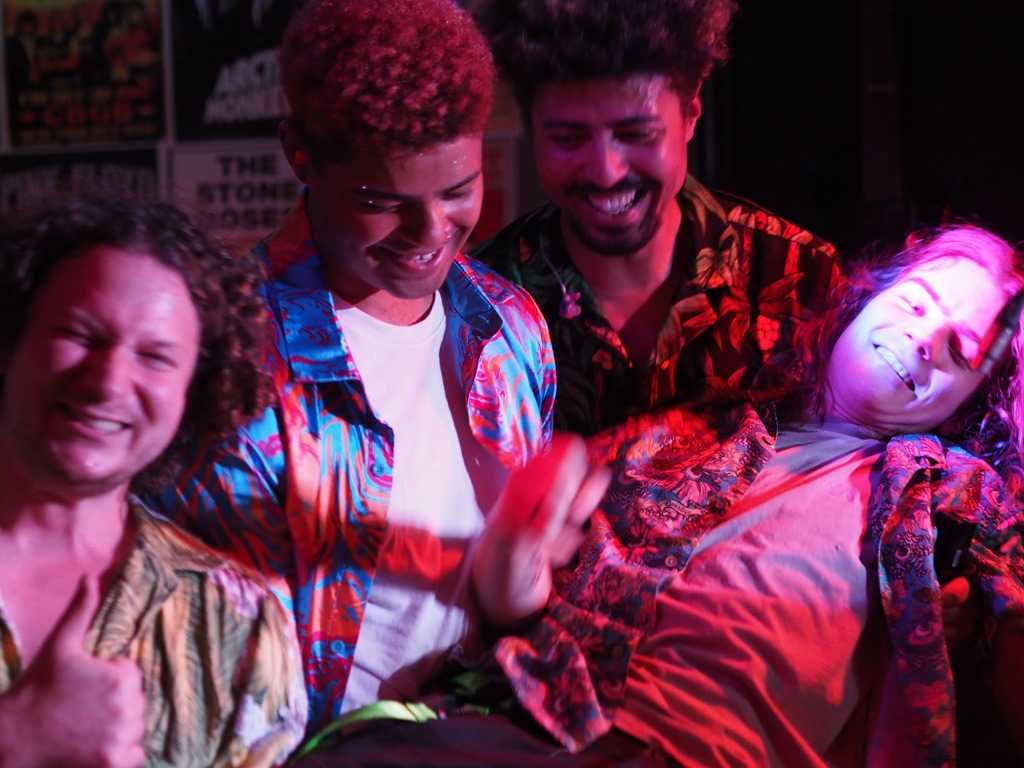
Before we move forward, let’s first go back, back, back. The reason I’m here is because The 113, from Leeds, have just released their second EP, The Hedonist, and it’s nothing short of explosive. The real test of a band is whether they can cut it live, though. So now they’re out on the road, grafting – not grifting – and York on a Wednesday night is always going to be a test for an up-and-coming band working to build their fanbase.

It’s not heaving, but there’s a respectable turnout, and first on are Disappear, who trade in jangly country-flavoured indie with a hint of shoegaze. They don’t use plectrums, and the singer / guitarist demonstrates some interesting playing technique. It doesn’t always hit the mark, and the same is true of the off-key approximation of singing. The drummer keeps having to get out from behind his kit to adjust the guy’s guitar pedals, too, which is just weird. They can play, but the songs are uninspired and uninspiring. Toward the end of the set there’s a song that sounds like The Wedding Present circa Bizarro, but again, it’s let down by the vocals. As a band, they aren’t terrible, but I can’t in all conscience say they were any good. The drummer – who is impressive – needs to be in a better band.

DSC09864DSC09883

Disappear

And so Mince inform the crowd – who are largely enthusiastic, in fairness – about the review of the last time they were here. I stand by that description, although in fairness, there’s a bit more to it than that: there’s some 60s psych in the mix, and plenty of energy to the performance, too. They have two vocalists – the first, with mop-top haircut, wigs out while playing guitar, while the second paces petulantly, swaggers, and gives it all that. But after maybe three songs, he mostly sits or squats at the back of the stage beside the drum kit, scratching his forehead with his mic and rubbing his face, looking knackered, and stays largely quiet. After coming hard out of the traps, it’s as if he’s out of energy and given up, while the rest of the band thrash on. It’s a bit odd, and oddest of all is that it’s an exact rerun of their previous show here, and on balance they’re better when he takes a back seat (literally).

DSC09899DSC09904

Mince

The 113 have built considerable momentum, and fast. Their debut EP, To Combat Regret was released just over a year ago, and The Hedonist continues that arc of nihilistic post-punk aggro delivered with visceral energy. How would it translate live, and how would they fill a headline slot? It turns out they’ve got a solid album’s worth of material, which comfortably fills an hour with no long-winded waffle. They don’t need to pause for political platforming, or pass sociopolitical comment, since it’s all there in the song, which they pack in tightly. And they do so it a nonchalant confidence, too: they’ve got their sound absolutely nailed, and it’s a thick, dense sound, and crisp drums cut through, punchy percussion played with perfect precision. Much of the guitar work is sculpted feedback, but there are steely chords overlaid with sinewy lead parts, and there are times when I’m reminded of Red Lorry Yellow Lorry, another of Leeds’ finest from when the city was the spawning ground of the goth scene that emerged from post punk.

DSC09971DSC09980DSC09933

The 113

They’re electric from start to finish, slamming in with ‘Leach’, and play with an urgency that’s impossible to manufacture. Each band member brings something specific, the towering bassist lurking in the background hammers out hefty grooves. The guitarist plays so hard he busts his A string four songs in, and because they’re not about to let up the momentum, takes another four songs to finally manage to replace it. They simply don’t pause for breath, they keep their heads down and blast them out. ‘When I Leave’ is a mid-set standout, and ‘Entertainment’ is nothing short of scorching. Set closer ‘Conscience’ is a lacerating blast and bang, that’s it, done. The 113 are a band who have got everything down – they hit hard, clinical, brutal, high impact. They’re already making inroads into Europe, and things will likely be quite different come this time next year…

Miasmah – 7th May 2026

Christopher Nosnibor

“What does a trip towards another world sound like? We’re about to find out. The master of tension, melancholy, and the deranged is back after a long period working in the worlds of theatre and cinema. Last seen on Miasmah with the grief stricken The Summoner, Kreng now returns with Wormhole, following closer in the footsteps of the cult classics L’Autopsie Phénoménale de Dieu and Grimoire.”

This is how we’re introduced to the first new album from Kreng in a decade, and Wormhole is appropriately titled. Immediately, the listener is drawn into a hinterland of suspense and ominous tension, a path beset by ever thickening trees and a creeping mist. You feel an urge to retreat, but as early as the second composition, the dark, jittery ‘Nachtzweet’, with dank creaking sounds and dissonant piano notes which are the pure quintessence of ‘eerie’, you find you’re incapable of turning back. The only way is forward, further into the forest – it doesn’t seem to be enchanted, but something isn’t right either: something is lurking, and it feels menacing, sinister, dangerous. Your heart’s in your mouth, and you’re no longer in control of your decisions and all you can do is creep onwards, down the wormhole, riven with trepidation.

It’s like the soundtrack to a film, but it’s hard to imagine that the visuals could be anywhere near as unsettling as this accompaniment. In the same way that films are rarely as scary as books, because films render and thus create boundaries when it comes to expressing The Terrible Thing, the monster, the ghost, the object of fear, the mind’s capacity to experience fear goes far beyond the visual. As such, a strong soundtrack has the capacity to heighten the fear factor of a movie. But the soundtrack alone, when the only visuals are those conjured in the mind’s eye… the scope is without boundaries. And these compositions distil the very essence of fear, of dread.

Many of the titles offer little by way of clues as to their meaning, or the scenes they would accompany if this were a film. ‘Cepheid’ is an American molecular diagnostics company, and what’s so scary about that? You may well ask. It also happens to be a pulsating star, which changes not only in brightness, but also diameter and temperature, too, which is in keeping with the space journey theme of the album’s title and other tracks, such as ‘Vacuum’.

The piano-led ‘Entropy’ is a soaring choral work, albeit one that elicits thoughts of death and afterlife. And if ‘To Yield’ is soothing, and allows the listener time and space to recover their breath and the heart to return to a more normal rate, the aforementioned ‘Vacuum’ is five and a half minutes of suffocating fear, and ‘Donker’ is an extended exercise in orientation-twisting, brain-bending torture.

In places conventionally ‘filmic’, with strings and piano taking the lead, there are extended passages of creeping dark ambience, the sonic origins of which are unclear, adding to the unease of the pieces – because so much fear stems from the unknown, the unseen, the inexplicable. Sounds of unknown and inexplicable origin are inherently disturbing: if you know that wail is from an owl, you can compartmentalise it, accept that it’s an owl, and move on. When you don’t know what that haunting sound it… it gives you the willies.

Wormhole is creepy, unsettling. It chills more than it thrills, and instils a deep discomfort. Close your eyes and breathe slowly. Feel the fear. Embrace it.

AA

AA

MIA063 front

Prophecy Productions – 8th May 2026

Christopher Nosnibor

I seem to be on something of an inadvertent black metal trip this bank holiday weekend, and, peculiarly, one devoted to black metal forged on this small island, for following my review of Hellripper’s Coronach – black metal that’s staunch in its Scottishness – we have Prophecy Productions pitching the new album from West Yorkshire (Leeds, of course, where else) act A Forest of Stars as being uniquely British in their branding.

It’s tempting to unpack the importance of national identities here, particularly at a time when ‘British’ identity – at home, far more than away – carries some toxic connotations, and the majority of Scots are keen to claim independence from the government of the United Kingdom – in short, to become dis-united, but this is such complex and boggy terrain that there simply isn’t the time or space, even if it were appropriate here. And so I will return to the seemingly flippant word selection concerning ‘British branding’, for while – as is a central trope of black metal – A Forest of Stars’ album titles are strewn with corpses, death, and decay (their debut was entitled, perhaps somewhat oxymoronically, The Corpse of Rebirth, while their last was called Grave Mounds and Grave Mistakes, which sounds probably more humorous in its punning wordplay than intended), Stack Overflow in Corpse Pile Interface sounds like corporate speak. If a there was multinational corporation that dominated the industry of funeral directors, Stack Overflow in Corpse Pile Interface could well be the title of a report for the executive committee. Or perhaps Pure Cremation have already written it and had that meeting concerning their strategy in the event of another pandemic, replete with an array of graphs and graphics, pie charts and flow charts, costings and projections. Because capitalism exploits everything there is to exploit.

As such, the language of capitalism sits very much at odds not only with a metal band, but a band so immersed in art and poetry, whose biography goes to significant effort to point out that ‘in his recitative mode, vocalist Curse is even reminiscent of electro poet Anne Clark – after a steady diet of prescription drugs and rusty nails. On the other hand, his singing voice evokes memories of a young Martin Walkyier. The impressive command of the English language by that great metal bard, his plentiful plays on words and subtle multi-layered meanings also have a place in the poetic lyrics of A FOREST OF STARS – yet in different, often far more neo-dadaist ways, in which tiny twists of spelling can have surprisingly dark effects’ (suggesting, at the same time, that the wordplay of Grave Mounds and Grave Mistakes was entirely intentional after all).

The regular release of the album contains six songs, the shortest of which is the opener, ‘Ascension of the Clowns’ at a hefty nine minutes, and with the last two stretching beyond the fifteen-minute mark. The deluxe edition adds three more tracks – by most standards, an additional EP, or even an album of bonus material.

‘Ascension of the Clowns’ is grand and theatrical: Curse brings the metal fury, but emotes and enunciates, his words not only audible but clear above the spacious guitar work – which, over the course of the album’s expansive compositions – are accompanied by an array of instruments from piano to violin, as well as acoustic guitar. There’s a strong orchestral leaning – not to mention folk elements – to incredibly ambitious work, and it’s hard to fault the musicianship or arrangements, although the instrumentation is often dialled down to accompany the vocals, rather than the elements merging to create a sonic whole.

There are obvious reasons for this: Stack Overflow in Corpse Pile Interface is as much like a musical as it is a metal album. Without wishing to sound in any way mocking, one can almost picture Curse lofting a skull and affecting his most dramatic Hamlet-inspired gushings as he proclaims in the most thespy rendition of anguish, “Shit of that shit! The enshitenment!” on ‘Street Level Vertigo’. Yes, he knows his words and wordplay, and clearly revels in the way words reverberate and resonate and rub against one another to conjure layers of meaning and heightened drama.

‘Mechanically Separated Logic’ references the processes of the meat industry, applied to the psychology of late capitalism, and while the instrumentation is subtlety detailed and softly picked for the most part, only bursting into cathedrals of sound in places, again, the vocals are pure theatre, bold, exaggerated, and it’s hard to know quite how to take it, to deduce how serious this preposterously excessive style is. But even assuming there is a knowingness, a joyful revelling in the absurdity of all of this, it feels more like a work to respected and admired rather than enjoyed. No, that’s not entirely accurate: it’s enjoyable, even entertaining, particularly with its folk flourishes and revelling in the excremental, but it’s enjoyable as a performance, rather than as a set of songs which resonate on an emotional level.

AA

AA

742374

Century Media – 27th March 2026

Christopher Nosnibor

Pentagram-shaped goat heads adorn Hellripper’s website and Bandcamp. “All hail the goat” is a band slogan of sorts, and is emblazoned on the body of the compact disc, which depicts a goat in an approximation of a lion rampant stance, thus combining James McBain’s strongly Scottish identity (the album comes in ‘Wild Thistle’ pink, ‘Saltaire’ blue, ;’Highland Mist’ grey and ‘Black Cuillin’ vinyl editions’ and Baphomet, adopted as something of a mascot within the black metal community since the dawn of the genre with Venom’s Black Metal in 1982, and Bathory’s genre-defining eponymous debut in ’84. there’s a giant goat forged from mist and cloud on the moody, mountainous cover art, too.

The ‘one-man black/speed metal band formed by Scottish musician James McBain in 2014’ has been crowned ‘Scotland’s King of the arcane mosh’ by Metal Hammer magazine, with a style which is very much rooted in 80s black metal, and, as the Hellripper website states, ‘heavily inspired by witchcraft and the supernatural, Hellripper is also deeply rooted in its Scottish origins, using the landscape and historical events as a backdrop for its lyrics and imagery’.

Coronach is Hellripper’s fourth full-length album, and features eight riff-ripping songs with a total run time of forty-four solo-centric minutes. The instant ‘Hunderprest’ powers in at a hundred miles an hour, McBain is straight in with the flamboyant fretwork, and some of it is just wildly excessive. ‘Less is more’ is not a motto Hellripper abide by. But the riffs themselves are killer, and she snarling, rasping vocals may be of the genre, but add to the gnarliness of the dark whirlwinds which blast through each and every song. The pace is relentlessly fast and furious and the style cohesive throughout.

That said, as much as I say that this is ‘of the genre’, Coronach does show ambition and awareness when it comes to composition and arrangement: ‘The Art of Resurrection’ starts with a delicate, atmospheric piano passage, while the title track includes Sir Walter Scott’s poem of the same title (Scott was Scottish) and bagpipes (of course).

‘Baobhan Sith (Waltz of the Damned)’, the first of the album’s two bona fide epics, with a span of six and a half minutes, rounds of the first half, and with the fancy fretwork reined in (a bit, at least) in favour of driving riffery, it’s a powerful, pounding beast of a tune, while the title track, which draws the curtain on the album, is a towering, monumental nine-minute monster which goes all-out anthemic and which flies the flag of tartan black metal with pride.

AA

a4067992884_10