Posts Tagged ‘low-key’

6th May 2026

Christopher Nosnibor

It’s been fully three years since we last heard from Lunar Twin, and 2023 seems like a long time in terms of the scheme of things. Aurora was a showcase of shimmering blissed-out melancholia. Yes, a contradiction in terms, but one that made sense, with rippling synths, as well as sweeping waves which hinted at Disintegration era Cure paired with elements of sparse electropop and the softer end of the dance spectrum. It was the sound of the beach, but also of the sun setting, and bringing with it a low ebb, a ponderous emptiness, Bryce Boudreau’s vocals evoking the spirit of Mark Lanegan over a shuffling desert electro backing. Before that, Ghost Moon Ritual explored recent bereavements, and plundered particularly bleak terrain.

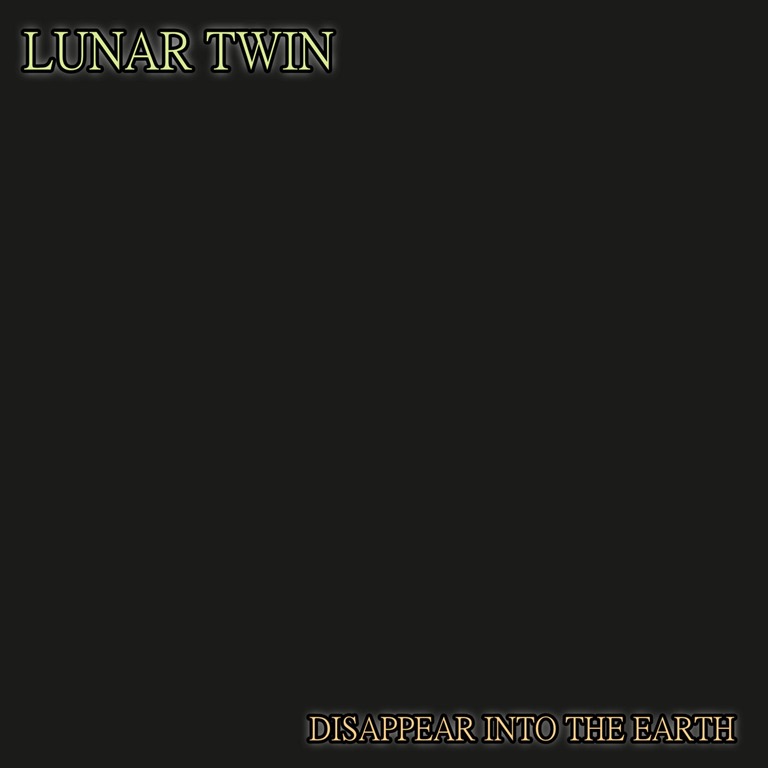
‘Disappear into the earth’ doesn’t deviate a million miles from this template, and that’s all to the good. It’s a shade more uptempo than much of both Ghost Moon Ritual and Aurora, an undulating bass groove paired with a vintage electro beat reminiscent of The Human League.

But beneath the seeming optimism of the lyrics and the buoyant retro drum rolls – we’re talking circa ’83 pow pow pow pseudo toms here – there’s a certain sense of pessimism, a low-level gloom. As such, this is a song which presents a duality. It’s not quite the quintessential sex and death equation, but most definitely delves into the territory whereby optimism and pessimism, fatalism and euphoria collide at a crossroads that’s both literal and philosophical.

‘gonna lay right down it the dirt disappear in the earth we are forever when it rains when it’s dark the spirits in your heart, we can be anything that we can dream’, Boudreau sort of rasps, sort of rumbles, sort of croons: again, the delivery hangs in some sort of intersectional space.

‘Disappear into the earth’ is a deft slice of dark electropop which captures the vintage vibe to a rare extent, but goes far beyond that. The form and delivery is low-key, understated, but it lands, coming in below the radar and resonating in subtle ways. It’s a welcome return.

AA
a2154679112_10

Bearsuit Records – 5th September 2025

Christopher Nosnibor

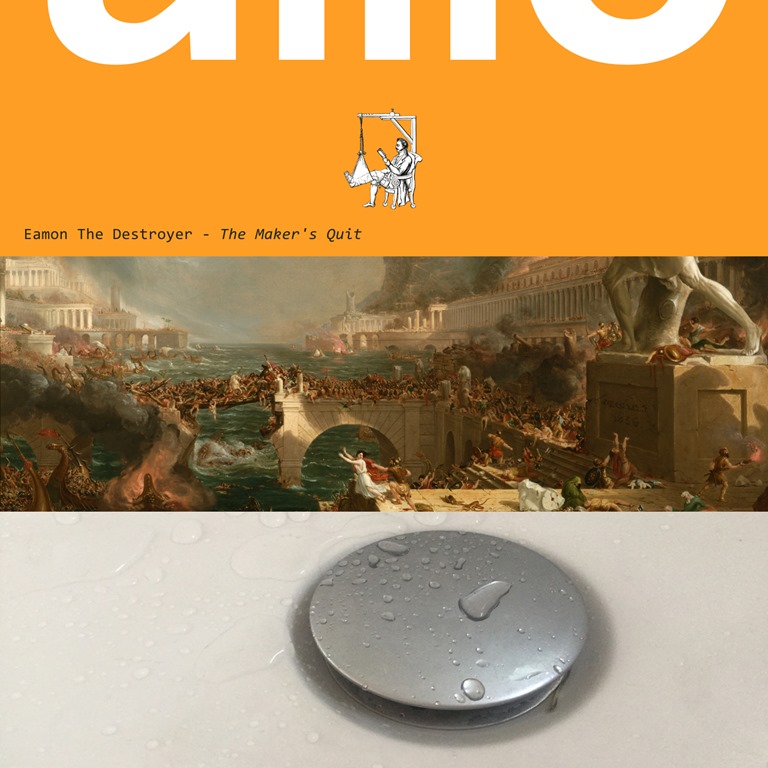
The thing with Eamon the Destroyer is that you never know what you’re going to get. The Maker’s Quit is different again from We’ll Be Piranhas, which in turn was quite unlike Small Blue Car (which remains a personal favourite, even if it does make me feel impossibly heavy on the inside). If We’ll be Piranhas marked a step forward in terms of experimentalism and optimism, The Maker’s Quit sees a greater emphasis on songwriting and structure – but don’t for a second think it’s in any way straightforward, and that the experimentalism has taken a back seat – it’s still very much a copilot here, and with the accent on the mentalism.

Here, the title track commences what is an incredibly varied set with a song that has the theatricality of Alex Harvey crossed with 1990s Leonard Cohen, before ‘Silverback’ confounds all expectation by bringing some shuffling funk-infused jazziness. In contrast to the fairly minimal arrangements common to previous ETD releases, this is pretty busy, then is settles into a mellow groove that’s almost loungey – bar the mid-section, which is rent with a protracted burst of extraneous sound. It’s almost as if he purposefully weaves around the line between genius and self-sabotage simply to tests us as listeners. There are some nice, light, poppy moments on here, and – albeit fleetingly – some captivating grooves. But it wouldn’t be Eamon the Destroyer without a huge helping of straight-up weird shit mashups, and The Maker’s Quit brings the lot, from frenzied jazz and post-grunge, wonky vaudeville waltzes and whistling, via electropop and slices of pan-culturally inspired melody.

More often than not, the verses and choruses are so contrasting as to seem to have been spliced from different songs – that’s when there are verses and choruses. ‘Three Wheels’ is a veritable patchwork, which compresses segments of what sounds like half a dozen songs into five minutes as it spins from grandiose heavy country dirgery by way of an intro, which even hints vaguely at recent Swans, before swerving into Europop with a hint of Sparks, through a off-kilter but gentle soundscaping that slides into laid-back salsa before winding up with a segment of jaunty indie rock. But rather than feel like an identity crisis, the effect is more that of a multi-faceted artist showing all his facets simultaneously. It’s hard to keep up, but one can only imagine what it must be like to live in his head.

The lyrics are equally fragmented, between stream of conscious and cut-ups, producing a Burroughsian, dream-like quality. This snippet from ‘The Maker’s Quit’ exemplary: ‘Saturn kid – spins and reels – in a city / Little Feet – lost in a wave – out to sea / A grandmother – nods – to a space in the crowd / Cap gun assassin – emerges – from a conjurers cloud…’ Beyond oceans and waves, it’s impossible to pin down any notion of themes or meanings. The images float up and fade out instantaneously.

‘The Ocean’ begins dramatically, a swelling, surging drone that halts abruptly, yielding to one of the most typically Eamon the Destroyer passages – lo-fi folktronica with a low croon reminiscent of Mark Lanegan, which slowly tilts its face upwards from scuffed boot-tips towards the sun…. and then all mayhem happens in a brief but explosive interlude, and your head’s suddenly spinning because wherethehellhasthiscomefrom? It’s this wild unpredictability and unapologetic perversity which is – strange to say – a substantial part of the appeal of Eamon the Destroyer.

When Eamon the Destroyer goes downtempo, as on the mournful, string-soaked introductory segment of ‘Captive’, you can actually feel your heart growing heavier by the bar, but then it twists onto some semi-ambient avant-jazz, and the sensation transitions to bewilderment.

The final track, ‘The Buffalo Sings’, is a twelve-minute behemoth is s slow, surging lo-fi electronic exploration. Face the strange? It embraces it, hard, then absorbs it by ghostly osmosis. If ever a song was less country, less ‘Buffalo’… maybe some of the western themed electrogoth songs by James Ray and the Performance are on a par on that score, but this wanders into a sonic desert without even a hat for protection from the punishing sun, and slowly, everything melts in the heat. Circuits bend and warp, and the weirdness rises like a heat haze… and it’s wonderful to be immersed in a work which celebrates creative freedom with no sense of constraint or obligation.

On reflection, with Eamon the Destroyer, you know exactly what you’re going to get: visionary hybridity, moments of aching sadness and fractured beauty, shards of melancholic memory , unbridled inventiveness and fevered creativity, and music like nothing anyone else is making. In a world where meaning seems to have all but evaporated and it’s increasingly difficult to make sense of any of it, The Maker’s Quit feels like a fitting soundtrack. It exists purely in its own space, and it’s the perfect space to escape to in these most dismal of times.

AA

Eamon-TD-3_Cover

Bearsuit Records – 31st January 2025

Christopher Nosnibor

It’s been a while since we’ve heard form Bearsuit Records, and from Eamon The Destroyer, too, with Harold Nono’s The Death of Barra slipping out quietly in October, and the last ETD release being the Alternate Piranhas EP last April. Ok, so it’s not so long in the scheme of things, but in recent months, while the world has spun into new realms of insanity, the wonderful wibbly weirdness this label specialises in has been sorely missed.

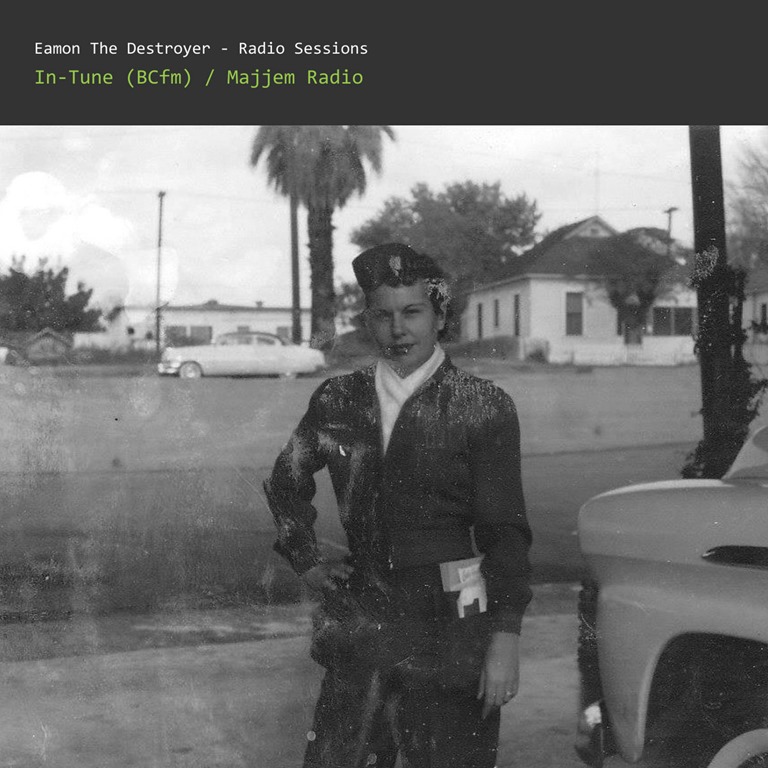
As the factual, functional title suggests, this release features tracks recorded for radio sessions, recorded for In-Tune (BCfm 93.2 FM), broadcast in September of 2024, and Majjem Radio, broadcast at the tail end of the year. And if another release with no new material seems like overkill, since the last ETD was a set of remixes from second album We’ll Be Piranhas, which came out in October 2023, then it’s pleasing to be able to report that, no, while this may well be something of a stop-gap release, it’s a worthy addition to the catalogue. It not only provides some insight into what one may call the ‘promo cycle’ of an album, particularly for a DIY act, but also casts a different light on the songs, being stripped-back acoustic guitar-based renditions of the songs – which are a 50/50 split of choice cuts from We’ll Be Piranhas and its predecessor, A Small Blue Car.

The original versions may be sparse and lo-fi in their production, but that production, and the prominence of droning, wheezing synths is what really defines them. That’s not to detract from the songwriting or performance at all, but the downtempo, downcast mood is heightened significantly by the execution, and that thick, hazy sound is integral to that.

However, hearing these songs played straight, as it were, is something of a revelation. The parts are essentially unchanged, but apart from a bit of reverb, and some vocal layering, these takes are more live-sounding, as could be performed by one man with a guitar and a pedalboard or synth with a few loops.

A far shorter rendition of ‘Underscoring the Blues’ still packs in the magnificent oddness that encapsulates everything that’s special about both Eamon and the whole Bearsuit aesthetic, suddenly spinning off from a sparse picked folksy guitar into a fantastical fairground of whirling, waltzing organ.

I’ve written previously that Eamon The Destroyer’s songs have a certain quality which casts a long, bleak shadow of lugubriousness over the soul, and how the effect is, for me, at least, similar to listening to Leonard Cohen’s Songs of Love and Hate. It’s an outstanding album, but it’s dark in a way which goes beyond the crushing lyrics of ‘Avalanche’, ‘Dress Rehearsal Rag’, and ‘Famous Blue Raincoat’. What I’m trying to articulate here is that there’s a special place for sad songs, songs which have a mood-altering effect, and this is Eamon The Destroyer’s strength. The lyrics are largely abstract and often difficult to decipher, but the feel is inescapable.

The ‘Avalanche’ on here, which first appeared on A Small Blue Car isn’t a cover of the Leonard Cohen song, but the stark atmosphere hits just as hard. It’s all about the minor chords, and the monotone croon. ETD adds layers of extraneous noise way down in the mix which adds tension to an already tense soundtrack.

Not because it sounds in any way similar, but ‘The Choirmaster’ calls to mind Chris Rea’s ‘On the Beach’ with its wistful tones and twisted hints of flamenco, and wraps the release with a vibe that’s almost uptempo, despite the heavy undercurrents of melancholy.

It’s the end of one of the longest, darkest, bleakest Januaries in living memory: we’ve been battered by storms, by global politics, by relentlessly traumatic news of war, of.. of… you name it. If you’re looking for a lift, steer clear of Eamon the Destroyer. But The Radio Sessions is nevertheless essential listening, showcasing the quality of the songwriting which lies beneath that fuzzing haze and reverb, and remember: it’s ok not to be ok.

AA

a4026067221_10