Posts Tagged ‘Cut-Ups’

Mortality Tables – 14th August 2026

Christopher Nosnibor

Ordinarily, I tend to pave the way to grappling with a release with some form of discursive preamble, but here, I feel it would detract from the work itself. Instead, I present the context for Metanoia: Music From Therapy directly from the accompanying notes, and without comment:

The first spark for Metanoia came from a simple plan to meet for a drink after a gig. Peter Fitzpatrick (Circuit3) and Mat Smith from the Mortality Tables imprint ended up talking about trauma, therapy, and the parts of ourselves we usually keep out of sight. That conversation led to a small, recorded experiment. From there the music began to take form, guided by fragments pulled from their notebooks.

Metanoia grew out of therapy and the slow process of letting difficult truths surface. Instead of singing those words, Fitzpatrick shaped them through analogue machines. The title refers to the deep shift that can follow self-reflection: a break, a reset, a way of living with more honesty.

A defining moment in the project was the opportunity to work with Vince Clarke, a long‑standing influence on Fitzpatrick’s music. They created an eleven-minute piece titled ‘The Hope’, named after the bar near Farringdon, London where that first conversation between Fitzpatrick and Smith happened. The collaboration feels like a dialogue across time: the artist Fitzpatrick once was, the one he is now, and the one emerging through this process.

Metanoia is not a linear or predictable account of trauma, breakdown, and recovery. Instead, it moves through a series of moments and memories that surfaced during therapy.

Vince Clarke crops up with remarkable frequency around Mortality Tables artists and releases, and his presence proves to be a positive one. There’s nothing here, or on other releases, which directly hints at Clarke’s celebrated electropop career

‘Cracked Eyes’ offers minimal, dulcimer-like tones, the notes fuzzy around the edges, as the backdrop to a skipping, fractured vocal loop which resembles to some extent one of William Burroughs’ tape experiments, the phrase, or phrases – muttered, mumbled – reverberates in fragments, overlapping, cutting in and out while played at different speeds, to quite unsettling effect.

A number of the pieces – in particular ‘Mood’, and ‘Where Are We Going?’ are comparatively brief interludes, and some of the instrumentals, such as ‘Imperfect’ are very much in the vein of Tangerine Dream or Mike Oldfield, built around sift, rippling notes and textured drones – flowing sounds of tranquillity, which don’t immediately evoke trauma or anguish. But of course, trauma and anguish aren’t necessarily endless stricken screaming, and therapy – the key to unlocking this album – can, for many, bring moments of peace and clarity amidst the painful psychological excavations.

‘Burnout’, on the other hand, it tense, the sound of a palpating heartbeat and panting breaths, albeit against an overtly uplifting electronic backdrop. This is something I personally find more relatable in some sense, and I suppose this is the leading point to observe when it comes to Metanoia: clearly, it comes from a deeply personal space, and some listeners will relate to some aspects more than others based on their own experiences. I know many people who have been through therapy, for a wide array of reasons, and with mixed experiences and outcomes. The trilling 70s synth sounds which course through the six-and-a-half minute ‘Shielding from the past’ seem to make sense, with their soft ambient cushioning, and despite their more sci-fi leanings that seem to tip a hat to Dr Who. Titles like ‘What If Everything Goes Right?’ take the listener through the difficult journey of self-doubt and catastrophising, before finally arriving at the eleven-minute finale, ‘The Hope’. And while there are undercurrents of doubt as articulated through darker shades, particularly at the start of the track, it does, ultimately, bloom into light.

Metanoia may be non-linear – and I understand this is often true of the journey through therapy, which can be riven with setbacks and periods of stasis – but it very much concludes with a piece which feels like the sun breaking on a new dawn, the curtains opening on a new chapter.

AA

a3727223469_10

Misanthropic Agenda – 4th September 2026

Christopher Nosnibor

As titles go, this is one of those which is closer to an explanatory essay than a mere title. My last encounter with Perverts In White Shirts was four years ago, on the release of Meaning What Exactly? The tracks were lengthy, but the album was short¸ at least competitively. In contrast, CULTurally appropriated songs and revisited memories is an absolute monster: making a departure from the four longform pieces on Meaning What Exactly? presents twenty-eight individual pieces which find Nathalie Dreier and Dave Phillips plunge into some particularly heavy territory, and not without personal weight, either. I shall quote from the accompanying notes:

Rooted in Nathalie’s isolated upbringing in the controversial Children of God cult, the album draws on fragments of this group’s music, alongside songs and texts from other fanatic movements and gurus. Working with this source material, the anarchic, tongue-in-cheek

Perverts in White Shirts transmogrify, decontextualize, and reimagine melodies and words previously steeped in ideology, isolation, and indoctrination.

Before I start, I would like you to consider the time investment that reviewing an album that’s some two hours long demands, particularly when the final track runs for nearly half an hour. And from the outset, it’s a challenging work. ‘Truth’ warps and twists, and while ‘Come to Mommmy’ is, on the surface, a work of slow, psychedelic folk, it soon becomes apparent that this is the sound of dysfunction, and as we’re carried on through the album, the warped weirdness of the CULTurally appropriated songs and revisited memories reveals itself.

They describe the album as ‘a two-hour cringe-pop journey of disarming, catchy tunes’.

It’s not. It is two hours long, but it’s more a hybrid of dark ambience, samplism, and William Burroughs-style audio cut-ups. And it’s a headfuck. No, it’s more than that. In places, it’s not just disorientating, but nausea-inducing. It sounds, and feels, deeply wrong, and no more so than when it’s at its poppiest, its mellowest, its most accessible. Something at the heart of this album is deeply disturbing, in the horror movie sense.

Shouting and chanting and heavy reverb collide with ominous, tingling electronica, and dolorous low-end bass drones which border on dungeon synth. ‘Love is the Only Weapon’ is exemplary, and deeply uncomfortable. ‘dedication to the tackling of the beast’ pitches a processed, almost robotic vocal, the words abrim with religious connotations, against a low rumbling electronic bass.

‘Never Forever’ is stark and sparse, almost dubby, a work of minimal dance even, but there are horror movie hints to the vocals which reverberate dissonantly, hauntingly, around the rattling beats and slow, exploratory bass, which resonates… and then out of nowhere, the half-minute long ‘The Answer’ explodes in an industrial blast which is nothing short of explosive. In contrast, ‘A Change’ is a low-tempo crawler that’s rich in atmosphere, and positively eerie, its whispered vocal bordering on the subliminal. Against this is the euphoric ‘Love’. But that euphoria feels like the result of manipulation, and not because of the power of the suggestion from the notes. Listening to the warping, wefting, twisting otherness of CULTurally appropriated songs and revisited memories is an uncomfortable experience, which has nothing to do with spirituality and everything to do with the fact that humans are fucking weird. Apart from in Pet Sematary, how many scary hauntings can you list from other species? Where are all the demonic cats, the spirit dogs and rabbits? Brion Gysin said that ‘man is a bad animal’, and it’s hard to argue.

Similarly, CULTurally appropriated songs and revisited memories is a horrible album. It trawls through terrain that’s unplotted, and doesn’t stop at the waymarkers where there are, well, anything. The duration is a slog. You crawl your way to the end and just want to lie down. Sure, it’s psychedelic, but mostly it’s torture.

AA

a0855731448_10

Dragon’s Eye Recordings – 23rd January 2026

Christopher Nosnibor

The facetious part of me reads the title of this as being a greeting to a pane of glass. I should probably get my coat after such a shameful revelation, but never mind. I’m here with my ears for this complex and detailed release, and will share the standard biographical info to provide much-needed context here:

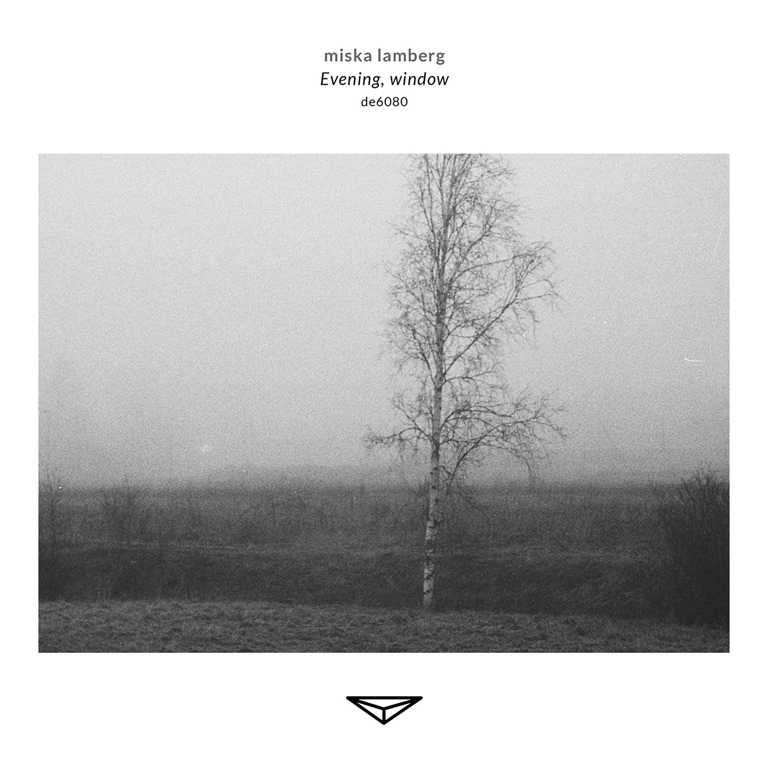
Evening, window is the debut full-length album by Helsinki-based sound artist and ambient composer miska lamberg. Working with intricate field recordings that gather the overlooked moments of daily life – rainfall, distant traffic, animal calls – lamberg threads these textures into compositions that ache with personal memory. On Evening, window, the familiar becomes spectral: fragments of sound blur into melody and mood, capturing the stark melancholy of Nordic winters and the soft violence of remembering.’

The album features some long pieces: four of the six compositions are over eight minutes in duration, and this allows the pieces the appropriate and necessary time to build.

It begins with a metallic clattering. Heavy rain on a tin roof? Perhaps. Then there is a rumble – possibly thunder – but chattering abstract voices and soft, gentle synths drift in a cinematic spatiality and an organ swell gradually comes to dominate as it drifts… Evening, window is a sonic diary of sorts, a compilation of recordings captured in everyday settings as she goes about her life. The nine-minute opener, ‘Half-memories absorb us’ is both immersive and transportative, provoking contemplation. In some respects, the title does more than speak for itself, and also speaks of the way our minds work. And how do our minds work, exactly? Erratically, unpredictably, leaping from one place to another. And we’re thinking one thing while looking at another.

From a certain perspective, Evening, window can be seen to operate within the same field as William Burroughs’ cut-ups, and in particular the tape experiments he made with Iain Sommerville, although the collaging of field recordings and various layers of sound aren’t nearly as extreme here, blending the field recordings and decontextualised samples with carefully-crafted layers of ambience, which maked for a rather more listenable experience. Different objectives through similar intentions, one might say.

There are some haunting, unsettling motifs which cycle through Evening, window: ‘Seeing only faces turned away’ is dark, and listening to the ghostly swathes of ambience which hang dark and heavy is uncomfortable, a repetitive chord sequence conjuring, if not outright fear, then a sense of tremulous trepidation and unease. While Evening, window is a work of lightness and air, it’s also a work of slow, dense weight.

There are children’s’ voices. There are supple strings. At times, the atmosphere is soothing, sedative, but more often than not, there are undercurrents of tension, befitting of a dystopian thriller. Some may consider this to be something of a disconnect from the concept of presenting, or representing, fragments from the everyday life of the artist. But life is strange; the world is strange, and scary.

‘I remember the day the world lost color’ is bleak, barren, conveying the murky gloom of a blanket of fog, while ‘Its monotony is unrelenting’ is the drudgery of life – at least some periods of it – summarised in four words. Anyone who has endured a crap job will likely be able to relate to the sense that life is slipping by while days evaporate trudging through eternal sameness and feeling a sense of helplessness and a loss of identity, a distancing from the self. The sound is muffled, and very little happens over the course of eight minutes of crafted stultification during which the chord sequence of ‘Seeing only faces turned away’ is reprised, only slower, more vague, somehow tireder-sounding. It’s the soundtrack to hauling your living corpse through another dead, empty day – and another, and another, and another.

Evening, window isn’t depressing as such, but it is not light or breezy, and the mood is low and melancholy. It’s a slow, gradually unfurling work which drags heavy on the heart, an album which radiates reflection and low mood. It’s a dose of stark and sad realism, and an album which speaks so far beyond words.

AA

a0509711029_10

r-ecords – 19th December 2025

Christopher Nosnibor

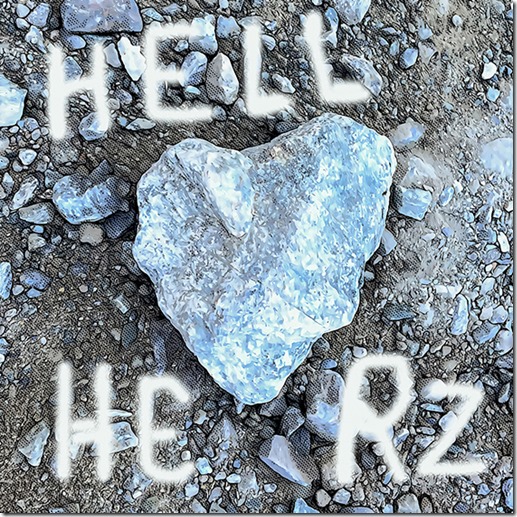
A crackle of static washes in and obfuscates the murky bass and beats which begin to emerge. It’s a strange experience, like listening to a tune while under water. Over time, this shifts: hypnotic beats with clicking, cracking snares and low, thwocking bass drum sounds cut through the curtain of hiss which hangs like heavy rain. And so it is that ‘Waiting for nothing’, the first of the three compositions on R. Schappert’s Hellherz EP. It’s an intriguing piece, layered and unpredictable and multi-faceted.

In context of his bio, which informs us that ‘Roland Schappert pursues border crossings in the form of an “organic digitality” oscillating between melos, sound and rhythm’.

The EP’s accompanying notes are somewhat winding, kind of cryptic: ‘Where do we put all the words that held us captive? We put them in a bottle post and send them out into the open sea. Back on land, there is fluttering in the space of spaces. Corners and edges crumble away in tumultuous layers. Let us take the time that the melos urges us to take, let us entrust him with our voice.

Sensually coded sequences of notes disrupt the free flow of our thoughts. Cranes hop and counter common notions of progress. Hopping instead of marching. Jumping instead of stomping. Up into the sky. From 3/4 to 4/4 time and back again. With hissing and quiet humming. Do we like it better up here? Where do we come from, where are we flying to for the winter? No more getting lost: Wrap your words. Our hearts are light.’

It appears that much of this is cultivated around the EP’s centrepiece, ‘Wrap your words’, the credits for which draw my attention in a way which imbues me with a certain unease:

Lyrics by R. Schappert

Vocals: revised AI voice

AI’s ubiquity is cause for concern in itself, and the reasons for this are a thesis in themselves. But specifically, given the way AI trains itself, voluntarily feeding it words to recycle and regurgitate feels like an abandonment of artistic ownership. When William Burrroughs cut up existing texts in order to form new ones, he questioned the notion that anyone ‘owned’ words, contending that the act of writing was simply the selection and manipulation of words in differing sequences. But this is not the same challenge of ownership and methods of creativity, because the application of AI serves to remove the artist from the process, partially or even wholly. Moreover, while AI is being used for military and medical purposes (and fears over where that may lead again are another thesis worth of debate at least), in the day-to-day, AI for the everyman seems to be about creative applications. Personally, I would rather AI did my admin and cleaned the oven in order to give me more time for creative pursuits. The idea that an artist would delegate any part of their creative work to AI is something which I find truly bewildering. Yes, there are skills we may lack, but the joy of art, in any medium – is learning those skills, or collaborating with other creatives to fill those skills gaps. There are real people with real skills, and working with them and learning from them is how we grow as artists.

So, AI voice? Why? Why not find a vocalist? Why not even apply autotune to a real vocal if that’s the desired effect? The warbling, autotuned-sounding digital vocalisations sound pretty naff, if truth be told, and add little to a tune which clops and thuds along with some retro synth sounds hovering vaguely around a beat which stutters along in soft focus. But as I listen, the whole AI vocal thing gnaws at me: has AI been utilised, uncredited, to the instrumentation too? What can we trust, what can we believe now?

The title track draws the EP to a close, with some brooding, quavering organ sounds and glitchy beats and more static, returning things full-circle before an abrupt end. It’s atmospheric, and a shade unsettling, too.

It may be brief, but there are many layers to this. As a whole, Hellherz provides much to ponder.

AA

(Click image to link to audio)

r-ecords 06 art

3rd October 2025

Christopher Nosnibor

Foldhead has been quiet on the output front of late, after something of a purple patch around lockdown, there was a lull, broken by Mirfield Pads in 2022, with only the ‘Single’ release with …(something) ruined since, and a live outing or two. This is the only kind of quiet you’ll get from Foldhead, mind you: the Yorkshire maker of mangled noise likes to turn it up and blast the frequencies – and tones.

If Mirfield Pads ventured towards mellower, more Tangerine Dream-like electronica, Paris Braille sees a return to the harsher territories more frequently wandered by Foldhead.

Paris Braille – the title likely a reference to two cut-up novels by the late Carl Weissner (who not only appeared in some collaborative / split works with Burroughs, including the seminal pamphlet So Who Owns Death TV?, but translated many of his novels for the German market), namely The Braille Film and Death in Paris – is a typically abrasive affair, with the title track being a nine-minute loop of noise which captures of the essence of the ‘derangement of the senses’ Brion Gysin strove to achieve with his multi-sensory performance pieces which extended the concept of the cut-ups to its logical extreme. The thunderous beat, when surrounded by and endless loop, becomes almost trance-like and strangely euphoric. It’s difficult to discern precisely what’s in the mix here: there may be voices, or it may simply be a tricky of the human ear – my human ear – in its quest to seek recognisable forms amidst the formless sonic churn, in the same way one finds the shapes of animals and faces in clouds. In the right context, say, as a remix on a Cabaret Voltaire EP (where it would be right at home, and the William Burroughs / cut-up connection is again relevant here), this would be hailed as an industrial dancefloor stomper – largely because that’s what it is. Intense, hypnotic, relentless, it’s a pulsating, shifting noise beast that slowly spins off its axis and out of control in a swelling surge of sound.

‘CW Loop’ unashamedly harks back to the tape experiments of Burroughs and Gysin from the late 50s and early 60s, which in turn were a huge influence in Throbbing Gristle, and in particular Genesis P-Orridge, who released a selection of archival recordings on the Nothing Here Now But the Recordings LP on Industrial Records in 1980. It is, quite simply, short vocal sample, heavily bathed in echo, looped, and overlayed with a churn of undulating noise.

The third and final track, ‘Film Death’ – the title echoing and mirroring that of the first – round the set off with a return to the thunderous, beat-driven sound of ‘Paris Braille’, this time with a squall of shrill feedback and full-spectrum static. The result is akin to Throbbing Gristle covering Matal Machine Music. In the world of Foldhead, this is absolutely mission accomplished.

AA

a3884873763_10

Bearsuit Records – 5th September 2025

Christopher Nosnibor

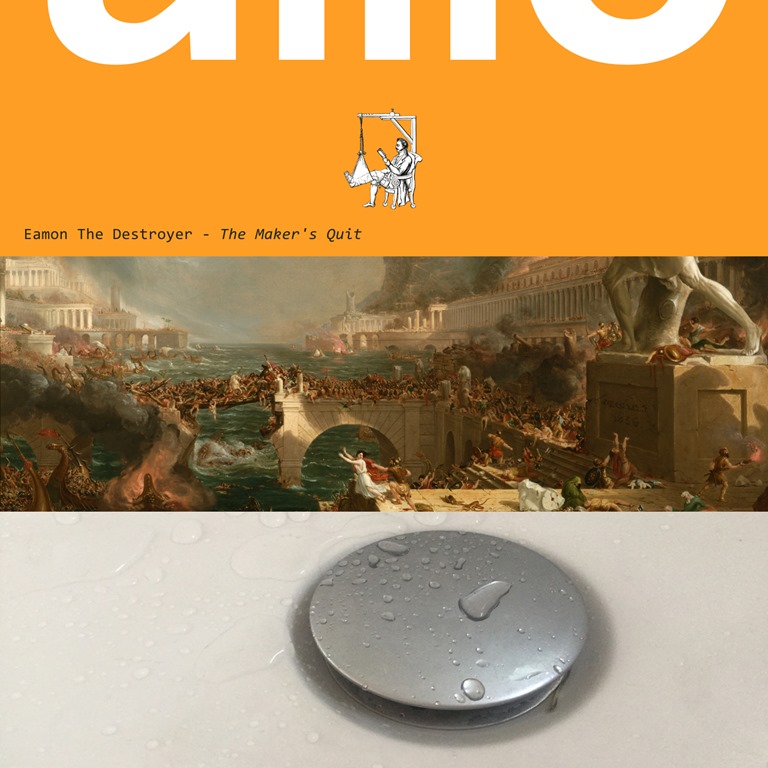
The thing with Eamon the Destroyer is that you never know what you’re going to get. The Maker’s Quit is different again from We’ll Be Piranhas, which in turn was quite unlike Small Blue Car (which remains a personal favourite, even if it does make me feel impossibly heavy on the inside). If We’ll be Piranhas marked a step forward in terms of experimentalism and optimism, The Maker’s Quit sees a greater emphasis on songwriting and structure – but don’t for a second think it’s in any way straightforward, and that the experimentalism has taken a back seat – it’s still very much a copilot here, and with the accent on the mentalism.

Here, the title track commences what is an incredibly varied set with a song that has the theatricality of Alex Harvey crossed with 1990s Leonard Cohen, before ‘Silverback’ confounds all expectation by bringing some shuffling funk-infused jazziness. In contrast to the fairly minimal arrangements common to previous ETD releases, this is pretty busy, then is settles into a mellow groove that’s almost loungey – bar the mid-section, which is rent with a protracted burst of extraneous sound. It’s almost as if he purposefully weaves around the line between genius and self-sabotage simply to tests us as listeners. There are some nice, light, poppy moments on here, and – albeit fleetingly – some captivating grooves. But it wouldn’t be Eamon the Destroyer without a huge helping of straight-up weird shit mashups, and The Maker’s Quit brings the lot, from frenzied jazz and post-grunge, wonky vaudeville waltzes and whistling, via electropop and slices of pan-culturally inspired melody.

More often than not, the verses and choruses are so contrasting as to seem to have been spliced from different songs – that’s when there are verses and choruses. ‘Three Wheels’ is a veritable patchwork, which compresses segments of what sounds like half a dozen songs into five minutes as it spins from grandiose heavy country dirgery by way of an intro, which even hints vaguely at recent Swans, before swerving into Europop with a hint of Sparks, through a off-kilter but gentle soundscaping that slides into laid-back salsa before winding up with a segment of jaunty indie rock. But rather than feel like an identity crisis, the effect is more that of a multi-faceted artist showing all his facets simultaneously. It’s hard to keep up, but one can only imagine what it must be like to live in his head.

The lyrics are equally fragmented, between stream of conscious and cut-ups, producing a Burroughsian, dream-like quality. This snippet from ‘The Maker’s Quit’ exemplary: ‘Saturn kid – spins and reels – in a city / Little Feet – lost in a wave – out to sea / A grandmother – nods – to a space in the crowd / Cap gun assassin – emerges – from a conjurers cloud…’ Beyond oceans and waves, it’s impossible to pin down any notion of themes or meanings. The images float up and fade out instantaneously.

‘The Ocean’ begins dramatically, a swelling, surging drone that halts abruptly, yielding to one of the most typically Eamon the Destroyer passages – lo-fi folktronica with a low croon reminiscent of Mark Lanegan, which slowly tilts its face upwards from scuffed boot-tips towards the sun…. and then all mayhem happens in a brief but explosive interlude, and your head’s suddenly spinning because wherethehellhasthiscomefrom? It’s this wild unpredictability and unapologetic perversity which is – strange to say – a substantial part of the appeal of Eamon the Destroyer.

When Eamon the Destroyer goes downtempo, as on the mournful, string-soaked introductory segment of ‘Captive’, you can actually feel your heart growing heavier by the bar, but then it twists onto some semi-ambient avant-jazz, and the sensation transitions to bewilderment.

The final track, ‘The Buffalo Sings’, is a twelve-minute behemoth is s slow, surging lo-fi electronic exploration. Face the strange? It embraces it, hard, then absorbs it by ghostly osmosis. If ever a song was less country, less ‘Buffalo’… maybe some of the western themed electrogoth songs by James Ray and the Performance are on a par on that score, but this wanders into a sonic desert without even a hat for protection from the punishing sun, and slowly, everything melts in the heat. Circuits bend and warp, and the weirdness rises like a heat haze… and it’s wonderful to be immersed in a work which celebrates creative freedom with no sense of constraint or obligation.

On reflection, with Eamon the Destroyer, you know exactly what you’re going to get: visionary hybridity, moments of aching sadness and fractured beauty, shards of melancholic memory , unbridled inventiveness and fevered creativity, and music like nothing anyone else is making. In a world where meaning seems to have all but evaporated and it’s increasingly difficult to make sense of any of it, The Maker’s Quit feels like a fitting soundtrack. It exists purely in its own space, and it’s the perfect space to escape to in these most dismal of times.

AA

Eamon-TD-3_Cover

Cruel Nature Records – 27 June 2025

Christopher Nosnibor

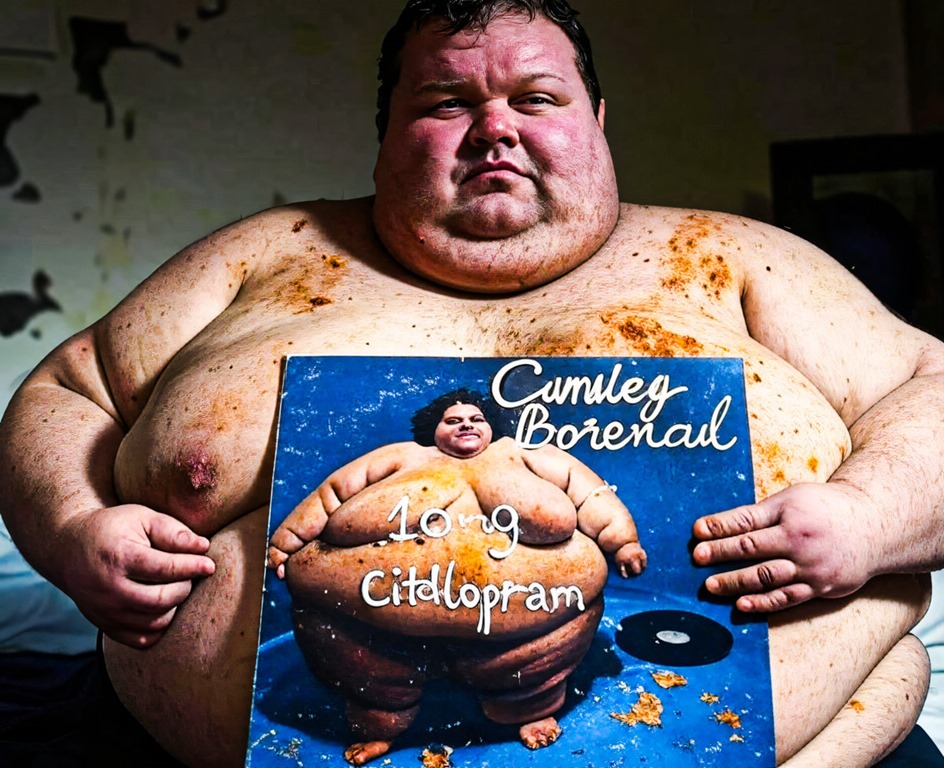
The cover within a cover artwork is only the first example of near infinite layers when it comes to this complex and inventive work from the truly demented experimentalist who records under the moniker of Cumsleg Borenail.

This latest effort promises ‘a collision of methods—part LLM-based sampling, part MPC assembly, part human lyrics—stitched together into something fluid and unpredictable. AI scavenges random prompts, returning garbled errors and fractured phrases, while voices and instruments drift in from nowhere, guided by no fixed direction. Each track begins as one idea and mutates into another, warping its original design into something unrecognizable yet strangely intentional.’

Oh, and it delivers on that promise, alright. This is truly a derangement of the senses, a collaged cut-up, an uncompromising mash-up, a smash-up, if you will, where absolutely nothing is off limit, and it all gets tossed, unceremoniously and indiscriminately, into the blender and churned up into a mess of the most mind-blowing chaos imaginable.

To provide a detailed analysis of this would be to unpick the threads in a way which would reduce the album to less than the sum of its parts. 10mg Citalopram works precisely because it’s an exercise in brain-pulping loop-heavy derangement.

‘You mean nothing me!’ a female voice repeats, and repeats, against a clattering, springing backdrop of twangs and poings throughout ‘You Mean Something To Me’. My head’s a shed by the time we’re midway through the second track, ‘Denizen Invocation Via Lunar Phase’ – because this is a work that goes off in all directions, all at once, and it’s really not pretty. It is, however, weird and frantic. It’s a mess of noise and samples and glitchy electronic samples and frantic breakbeats. Later in the album, there’s a companion piece of sorts, ‘Now I Know I Am Nothing Because You Said’.

AA

In some respects, I’m reminded of early Foetus, JG Thirlwell’s crazed tape loops and cacophonous noise bursts, and the way Cabaret Voltaire took the tape experiments conducted by William Burroughs and Brion Gysin and the ideas outlined in The Electronic Revolution as their starting point – but it’s also a bit Trout Mask Replica, in that it’s like listening to several songs being played at the same time, only it’s got bust-up techno beats exploding all over the shop and frankly, it’s impossible to know what the fuck’s going on most of the time. Too much, for sure. But that’s the point.

For context, Citalopram is a widely-prescribed antidepressant, described on the NHS website as ‘a medicine that can help treat depression and panic attacks’. This album, however, sounds more like a prolonged panic attack or all of the listed possible side-effects being experienced at once, while the numerous references to being ‘nothing’ appear to allude to the inner voice of low mood. Then again, there are other medical matters of an altogether different sort which provide the reference points for tracks like ‘Clostridium Difficile’ (a bacteria which causes diarrhoea) and ‘Snifflers, Nostril Pickers and Dribblers’. All of it is utterly batshit wonky and wildly arrhythmic, and certainly not for anyone who’s feeling tense or jittery or suffering from any kind of psychosis. For anyone else… proceed with caution. May have unwelcome and unpleasant side effects.

AA

a1363557647_10

Editions Mego – 21st February 2025

Christopher Nosnibor

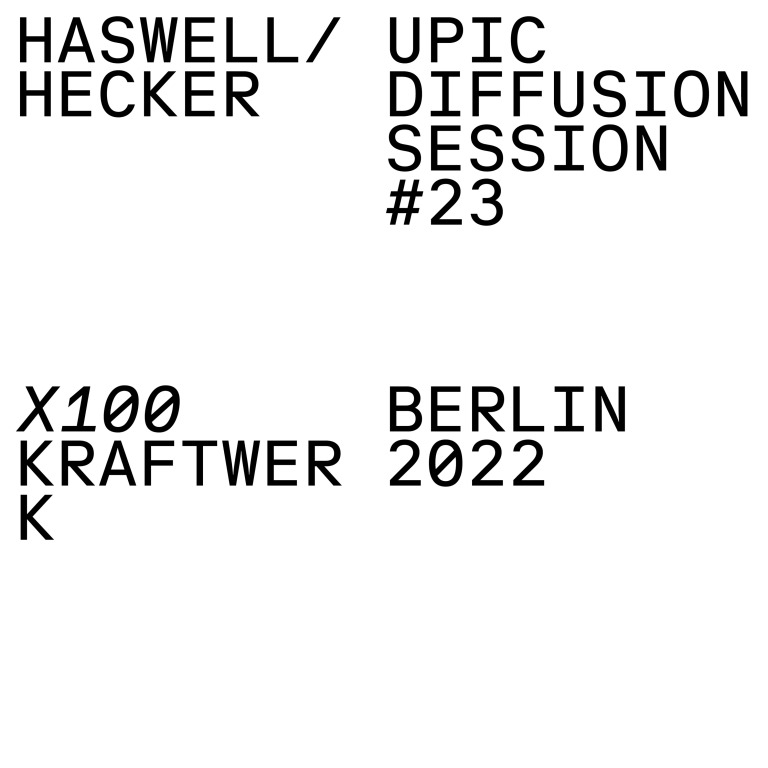
Russell Haswell and Florian Hecker are both prolific as solo artists, each with numerous collaborations with other artists to their respective credits, Haswell also having been a contributor to and touring member of Consumer Electronics. The UPIC Diffusion Sessions are a long-running collaborative project which began in the early 2000s, exploring Iannis Xenakis’ UPIC system as the sole instrument.

As the accompanying notes outline, ‘The UPIC is a computer music system that generates sound from visual input. The original intention of the system developed by Xenakis was to make a utopian tool for producing new sounds accessible to all, independent of formal training. One can locate footage of Xenakis and a group of children making drawings for the system in the 70’s.’ They continue, ‘The duo set off experimenting with a diverse array of hand-drawn images to feed the UPIC system including news photographs of disasters and atrocities, “food porn” through to depictions of the natural world and microscopic images of molecular structures (including ‘the blackest ever black’). The resulting eccentric audio from these images is claimed by the artists to heighten synaesthesia and is as mysterious as it is baffling.

I suppose the potential outputs for the UPIC are as infinite as the inputs, and this alone makes for a fascinating project, and the results here are, indeed, mysterious and baffling. The recording from this session is represented by a single track, just over half an hour in length.

Immediately, trilling oscillator tones rise in pitch – and keep rising, until you feel the pressure build inside your skull. There are glitching spasms of sound which flash across like subliminal messages. The pressure drops and the siren wails fade out, before scuttering blasts of seemingly random noise collage and intersect across one another, buzzing and fizzing, humming and thrumming… the forms move quickly, and shift from dark to light, hard to soft instantaneously. Shimmering sprays of abstract sound burst like fireworks, short interludes of harsh noise wall, microtonal bubbles and ZX Spectrum like babbles and bleeps all intersect or pass within mere seconds of one another. It is, very much, a sonic collage, the audio equivalent of William Burroughs’ cut-ups, an aural articulation of the simultaneity of experience of life in the world. Burroughs’ contention was that linear narrative is wholly inadequate when it comes to representing the real-world, real-time lived experience, whereby overheard conversations, snippets of TV and radio, and all the rest, not to mention our thoughts and internal monologues, overlap, and to present them sequentially is not true to life.

Leaping disjointedly from one fragment to the next at a bewilderingly rapid pace, listening to this is rather like the way the mind, and often conversations, skip from topic to topic without ever seeing any single train of thought to a defined conclusion, bouncing hither and thither in response to triggers and associations which often seem to bear no logic whatsoever.

There are thick, farting sounds, buzzes like giant hornets, choruses of angry bees, weird sonic mists and transcendental illuminations… of course, these are all conjured in the mind in response to these strange, sometimes otherworldly, sci-fi sounds, part BBC Radiophonic Workshop, part tinnitus and nightmare of imagination. Unpredictable isn’t even half of it as alien engines and spurs of 80s laser guns crossfire against earthworks, roaring jets, explosive robotics, skin-crawling doom drone, whispers and whistles, proto-industrial throbs…it’s a relentless blizzard of sound.

‘Experimental’ has become something of a catch-all for music that draws on eclectic elements or perhaps incorporates a certain randomness: this, however, is truly experimental, given that there is no way of knowing how the programme will interpret the input provided. And as much as the output involves oscillatory drones and the kind of synthy sounds associated with analogue, and with woozy, warping tape experiments, it evokes the drones of collapsing organs, wild sampling and everything else your brain could possibly conjure.

At once exhilarating and exhausting, UPIC Diffusion Session #23 is… an experience.

AA

eMego316V front

Futura Resistenza – 27th January 2025

Christopher Nosnibor

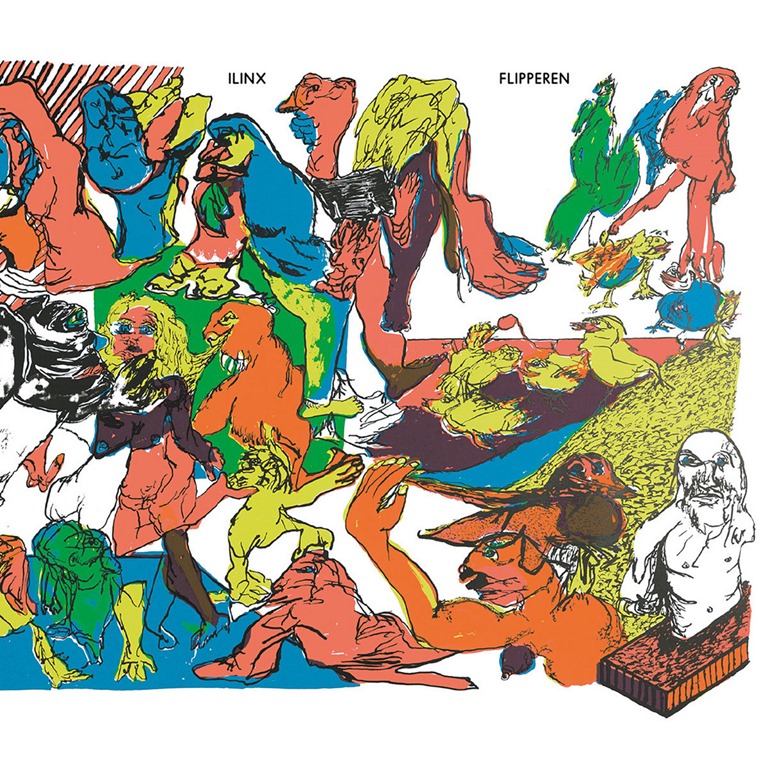
Some years ago (like about seventeen years ago), when I embarked on my reviewing journey proper, I was introduced to whacky experimental work and the world of microtonality. It was an absolute revelation. Just as, growing up in the 80s and raised on the Top 40 singles and Now That’s What I Call Music, discovering goth, alternative, John Peel, and Melody Maker completely changed my head, so did entering this new world. Onje thing that completely spun me was the way in which some artists extrapolated and academicized some pretty stupid or mundane stuff. This is a reasonable example. To quote: ‘Flipperen takes the randomness of pinball and turns it into music. Using recordings from old pinball machines, the music mixes chaos and structure, reflecting the Fluxus spirit of play and chance. It’s a wild ride through sound, where things don’t always make sense–but that’s the fun of it.’

Flipperen began as a lockdown / COVID project, of course. As they detail, ‘During the quiet and strange Covid days, Suzana Lașcu, Robert Kroos, and Reinier van Houdt began a recording project based on the soundbites of pinball machines. They visited the empty Dutch Pinball Museum in Rotterdam and captured field recordings of machines from the 1960s to the 1990s. From these, they selected 28 samples to serve as thematic starting points for what they called ‘game pieces,’ recorded in two sessions at Sonology Studios in The Hague. The recordings were then shaped into sound collages using cut-up techniques and probabilistic processes.’

These processes mean that the end product is a very long way removed from the actual sounds of metal balls pinging and rolling about inside a glass-covered case. Instead, landing between Brion Gysin and John Cage, we get a collection of weird and woozy fragmentary pieces – compositions would be something of a stretch – ranging from awkward ambience to crashing and banging that sounds like a prepared piano fitted with lump hammers. There’s playful, whimsical sighing and trilling, psychedelic trippery and some fairly straight jazz-flavoured piano in the mix. There’s Clangers-like whistling and clattering and clanking, pops and thuds, explosive industrial noise and frenzied country. There are moments which sound like someone grunting through a comb with greaseproof paper, others which sound like the strumming of an egg-slicer, others still which create the impression of a piano being dropped down a flight of stairs.

The final cut features twenty-six tracks, the majority of which are around a couple of minutes long, or even significantly shorter. But there are a couple which run to around six and a half minutes of uncoordinated chaos, and it’s a lot to take in.

The appeal from a sonic and experimental perspective is that ‘Pinball is a game that combines control and randomness—each action leads to an unpredictable result, and the outcome is always uncertain’, and as such, the patterns which provide the material for these pieces are erratic, unpredictable, and ultimately, not really patterns at all. And so it is that Flipperen shunts forwards and backwards, crackles and pops with zany snippets of this, that, and everything, conjuring a wild collage of disparate elements and all kinds of discord.

As much as pinball machines lie at the heart of Flipperen, it’s really a wide-ranging collage work with randomness at its heart. It’s fun, it’s fascinating, it’s brain-bending – and one might say it’s a work of Flipperen genius – but you definitely have to be in the mood for something quite this far out.

AA

a2489366009_10

5th July 2024

Christopher Nosnibor

Sometimes, I really do feel as if my brain is my enemy. Word association and wordplay are a particularly frequent and annoying curse. Oftentimes, I keep this to myself, but midway through listening to this, it struck me, completely at random, that Killzones isn’t a million miles away from Calzone, at least when written down. So why share this? A problem shared, and all that, for one. But as much as anything, I felt the urge to purge, or moreover to crack open the challenges that present themselves as part of the creative process. Writing – and finding something new and interesting to say – about music, day in, day out, is a challenge in itself, without other factors.

Seemingly, the recording of this EP proved rather less challenging for its makers, who came together and developed it swiftly and fluidly –although the same can’t be said for listening to it. That’s by no means a criticism. In a climate where the airwaves are jammed solid with anodyne sameness and slickly-produced beige sonic slop disguised as raw or edgy on account of some explicit content and some choice language that requires beeps or asterisks in the mainstream media, anything that does something different offers a welcome challenge in the way many pit themselves against the Great North Run or similar. We’ve grown accustomed to everything being delivered neatly-packaged and pre-digested, and feeling like following a recipe from Hello Fresh makes us a Michelin chef. Collectively, we’ve forgotten how to chew – meaning that this will either kick-start your metabolism or simply make you spew if you’re unaccustomed to anything that’s this high-fibre. Just look at that cover art. It’s dark, grainy, uncomfortable. It’s the perfect encapsulation of the music it accompanies.

Machine Mafia is quite the collaborative paring: Adam Stone of gritty northern grimsters Pound Land and Jase Kester of ever-evolving experimental noisemakers Omnibael / Omnibadger have come together to do something different. Very different.

As Jase explained to me, the EP features ‘no live instruments, leaning into the way dub reggae was so embraced by punk right in the early days.’ And there’s no question that it has both – simultaneously – the spaciousness of The Ruts (D.C) and the density of early PiL. It’s a formidable combination, that’s for sure.

The title track assembles sampled snippets as its foundation, drawing parallels with the collaging methods of Cabaret Voltaire and Throbbing Gristle, evolved from William Burroughs and Brion Gysin’s late-50s tape experiments – in turn a progression from the cut-ups on paper. Atop of this slice ‘n’ splice selection of political speeches and an almost subsonic, floor-shaking bass, Stone delivers a mumbling, drawling semi-spoken spiel. It’s like Sleaford Mods on Ketamine, a heavy trudge of ever-degenerating sound which eventually collapses to a low-end buzz and a crisp sample that makes the pair’s political position clear through antithesis.

On ‘Faces’, scrapes of discord, distortion, and a thudding beat half-submerged in the mix grinds out the opening before a dark, dense bass groove starts a gut-shaking growl. The drawling, atonal vocals, too, are distorted and low in the mix, and I’m reminded of some of the more obscure Ministry offshoots witch Chris Connelly – the vibe is dingy, sleazy industrial, a bit early Pigface, and sounds like it was recorded in a damp mould-stained basement on a salvaged reel-to-reel.

The songs get slower and heavier – and longer – as the EP progresses. ‘I Am Not You’ comes on as if Dr Mix and The Remix had done dub, while ‘Lecture 0.3B’ goes all out on transforming a simple spoken-word piece into a cut-up tape experimental headfuck with loops and delays and effects galore, all laced with crackles of distortion and sonic degradation fuzzing and fading the edges. It lands somewhere between the JAMS, Max Headroom, and Throbbing Gristle’s ‘Hamburger Lady’ – weird, unsettling, dystopian, with near-familiar elements twisted and recontextualised in an ugly mash-up collage work.

Conceptually, Killzones is far from new – but then, there’s no claim to innovation here, explicitly drawing a line from the past. But the kind of reference points and influences in evidence here are not the ones you find often, if ever – independently, perhaps, but the whole point of intertextuality as a method of creating is the nexus of divergent touchstones and the way in which they’re combined. With Killzones, Machine Mafia deliver a crash course in experimental music 1976-1994. It’s a mangled, messy cognitive assault. It’s knowingly, and purposefully, difficult, unpleasant, and a complete creative success.

AA

a0890048129_10