Posts Tagged ‘Kraftwerk’

Mortality Tables – 8th May 2026

Christopher Nosnibor

So much music, and only one pair of ears with which to listen to it… and similarly, one pair of hands to write about it. For years, I yearned – albeit half-jokingly – to clone myself, but now realise that doing so would likely only compound my problem, creating a situation where more availability would create more demand, and this would be very much a concession to the commodification of art – in all forms – whereby everything is considered merely ‘content’ and that a conveyor-belt churn of new content is the route to ‘engagement’. And this is absolutely fucking horrible. It’s dehumanising.

Shortly before I quit my dayjob as a complaints auditor for a multinational financial corporation earlier this year, we had been directed to use CoPilot to write our segments of the monthly report we produced to circulate amongst management. The directive was to get AI to write it, and then ‘sense check’ it against out audit results for the month. My colleagues were raring to go, and raced to embrace this: they didn’t enjoy writing up the monthly report on PowerPoint. I can’t say I loved it either, but I have degrees in English and had eight years’ experience in complaint auditing. The report was the one thing in the role where I had scope to not only flex my linguistic skills to pitch the tone of the report, but also to use my brain to analyse and comment on the otherwise fairly tick-box exercise of auditing. This is a circuitous route to my denouncing AI, and the reason why, when doubtless many ‘content creators’ would deploy AI to help crank out reviews at a far faster rate, I steadfastly refuse, and will always write my own reviews – albeit sometimes a bit rushed, a bit rambling, and with more typos than I’m anywhere near comfortable.

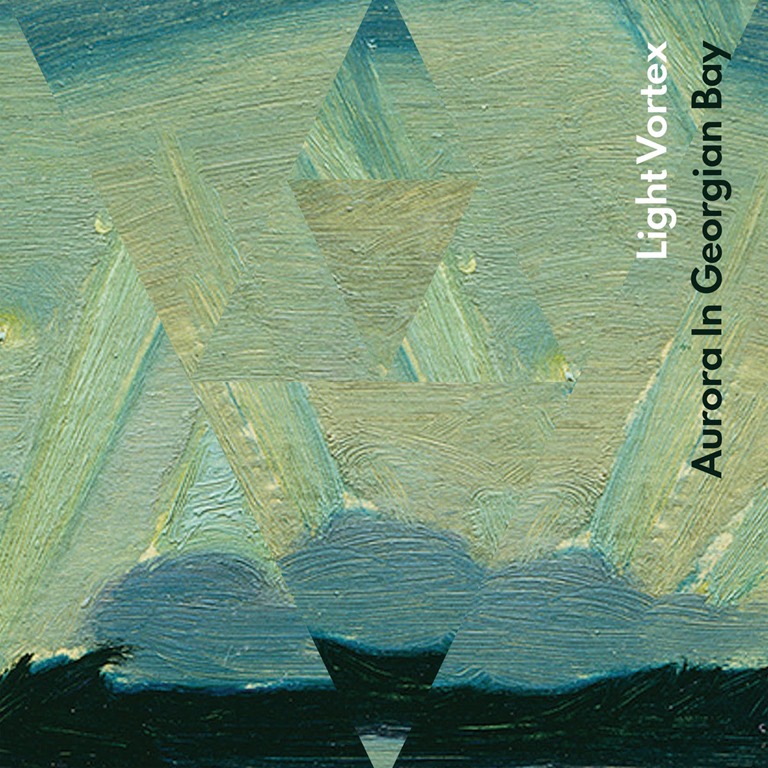
Reading the loner notes while listening to Aurora In Georgian Bay by Light Vortex reminds me precisely why this is.

The album’s title ‘was sourced from a 1931 painting by English-Canadian artist J.E.H. MacDonald (1873-1932)’, and we learn that ‘With thick and evocative brushstrokes, MacDonald’s painting depicted a view across Georgian Bay from Pointe au Baril in Ontario. Framed by wavering trees, the focal point of MacDonald’s painting was the phenomenon of fleeting, undulating shapes in the sky above the bay, illuminating the scene with an alien green-blue-grey hue.’

The notes go on to explain, ‘We hear a parallel to this in the eleven pieces of electronic music collated by Chris Moore on this album. Each track feels like it is vividly capturing the same refracted light that caught MacDonald’s attention, where sounds, sequences and subtle rhythms are encouraged to collide inquisitively with each other… Moore’s nuanced and detailed approach to electronic composition mirrors MacDonald’s abstraction of the natural world.’

These are connections of the type which can only be made by the human mind – instinctively, intuitively, by subconscious associations, by joining dots which exist through experience and knowledge. In short, life, in all of its organic richness, strangeness, and diversity.

To my eye, MacDonald’s painting evokes a soundscape that’s loose in structure and borders on ambience. Not so for Chris Moore on the strength of these compositions, which straddle the realms of early synth works in the vein of Kraftwerk and Tangerine Dream, and later – but still comparatively old-school in the timeline of music – electronic work from the 1970s, like Mike Oldfield’s Tubular Bells and Oxygene by Jean Michelle Jarre. In short, it’s emblematic of the juncture where wibbling analogue ambience evolves beyond experimentation centred around what the instruments could do. But of course, my response to this is based entirely on my personal experience and musical exposure. My knowledge is incomplete, and spontaneous. But it is my own.

This is also very much true of Moore’s compositions here. The man and the machine. The man manipulating the machine – and not vice versa, or the man replaced by the machine.

I very much get why there was – and remains – a fear of technological evolution, and why, in the 80s and 90s, Thee Musician’s Union were so opposed to drum machines: they felt the machines would render drummers obsolete. They didn’t, just as home taping didn’t kill music. Streaming, on the other hand, just may. And similarly, previous technological advances have been about the artist using the technology to create something new – whereas AI sidelines the artist to plagiarise from the entire history of creative work. To create is human: it’s the very essence of the human condition – to convey something through the process of creation, for fellow humans to respond to on an emotional level, a human level.

Aurora In Georgian Bay is far from emotionally direct: instead, what it conveys, obliquely, is a partially abstract sonic response to a partially abstract painterly work: both are deeply immersed in tone and texture, albeit in widely disparate media. It’s through such creative interaction and intermedia dialogues that we come to make sense of the world around us, and to make sense of ourselves, our thought processes. You simply cannot substitute or recreate that.

For the most part, Aurora In Georgian Bay is gentle, supple, rippling, and ultimately soothing. But it’s rich in nuance and detail and range. And it tells you nothing specific: it’s all there for you to decipher, to interpret, to project, to experience on a unique creative level. The door is open…

AA

AA
a0884084188_10

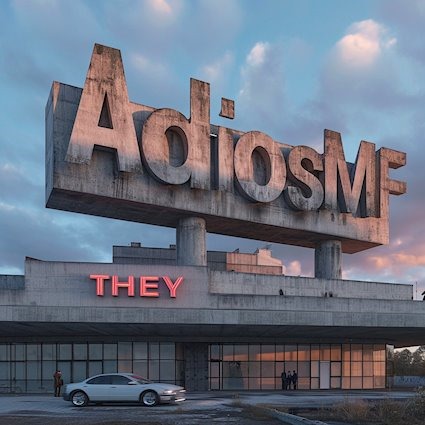
Adios MF is a musical collective spearheaded by Nathan Keeble carving fresh dark wave and electronica sound the underground of Sheffield. Their latest single, ‘They,’ was recorded between Brooklyn and Brixton, serves as a sonic manifesto of what’s to come. Their music defies categorisation, blending elements of post-punk, electronica, and avant-garde into a sonic tapestry that’s uniquely their own.

With sleek production by Nathan Saoudi and Richard Wilson yet coursing with enough detail and character to set it apart, with this impish 80s beat, sinewy guitars, metallic dapping keyboards, and sample loops, it forges a uniquely futuristic sound that’s at once both familiar and yet mirrors the churn of the cityscape.

With a sound that hints at the influence of acts like Human League, Depeche Mode, Kraftwerk and Molly Nilsson, the vocals are addictive and almost mechanical, driven with hooky melodic ticks that sink their nails into and won’t let go, and yet the lyrics reside with a disquiet at the creeping gentrification of urban redevelopment “They built a Starbucks on my street” and reference to shadowy figures who might take you away. It hints at a dark underbelly and Sci-fi dystopia where your every action is being watched.

ADIOS MF say “’They’ is a Kitsch byproduct of existence amid the constant churn of urban development and the persistent buzz of drilling. It was written as a tonic to the realisation that resistance is futile; you must simply acquiesce to the world of urbanism and let it carry you along on its unpredictable journey, set to a naughty 80s beat.”

We dig it here at Aural Aggro, and you can get your lugs round it here…

Unseen Worlds – 4th August 2023

Christopher Nosnibor

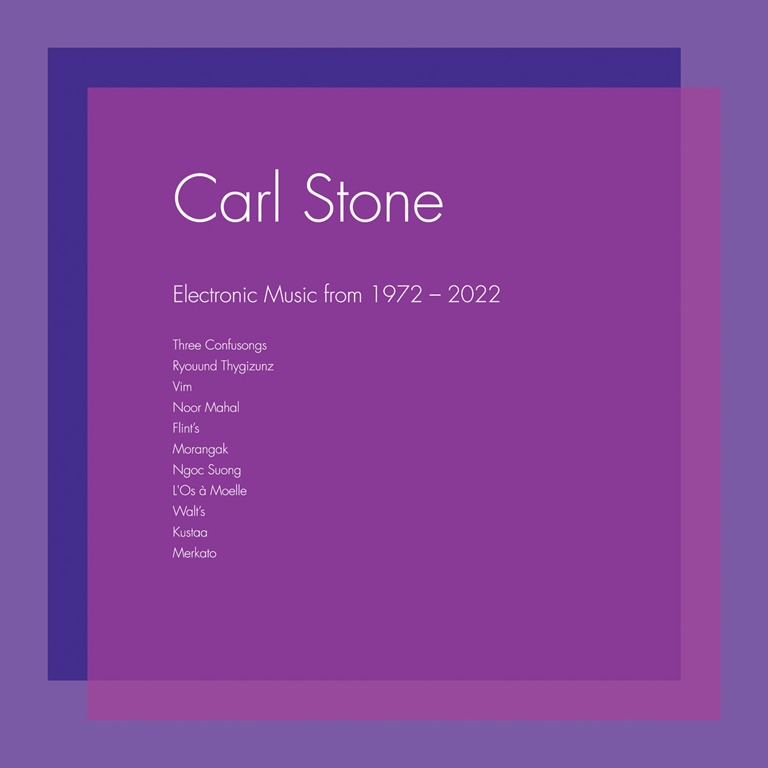
Having failed to make it to Carl Stone’s show in Leeds the other week – in the same way I’ve failed to make pretty much any shows this year and am largely tied to engaging with music in recorded forms for the foreseeable future, it feels only right that I should compensate in some small way with a review of his upcoming compilation album, a monster career-spanning triple album.

And when it comes to his career, the title sets out the immense landmark it represents. Not just the fact that this release is a summary of a career spanning half a century, but the broader context that there has been electronic music for so long. Village Voice have called him “the king of sampling”. Being born in 1975, I only became aware of sampling in the late 80s, and while Tangerine Dream and Kraftwerk and Throbbing Gristle are legendary as pioneers of electronic music, you probably don’t generally think of there being many other artists breaking ground and experimenting as far back as 1972.

The accompanying notes provide an outline that’s easier to quote than to summarise: ‘Electronic Music from 1972-2022 seeks to frame fifty years of Carl Stone’s compositional activity, starting with Stone’s earliest professionally presented compositions from 1972 (‘Three Confusongs’ and ‘Ryound Thygizunz’, featuring the voice and poetry of Stefan Weiser – later known as Z’EV) up to the present. This collection is not meant as a definitive history but rather as a supplement to be used alongside the previous two archival releases. It is simultaneously an archival release marking Carl Stone’s evergreen 70th birthday and a document of archival art. In the spirit of disorienting repetition and layering, call it an archive of archiving.’

This, then, is by no means a retrospective in the conventional sense, but it does clearly trace a trajectory of the evolution of Stone’s work. The album doesn’t spread the tracks evenly, being weighted heavily to certain years, with each year effectively representing an era.

The 1972 material, which occupies side A and represents the early years, is very much a cacophony of loops and echoes, reminiscent of William Burroughs and Brion Gysin’s tape experiments of the later 60s, and foreshadowing the first releases by Foetus and Cabaret Voltaire, as well as the disturbing drones and processed vocals off Throbbing Gristle, and clearly very much ahead of its time and venturing into the realms of dark ambient before it was even given a label.

Side B leaps forward fifteen years to 1987, with a brace of scraping, discordant pieces, both of which extend beyond the ten-minute mark. The production of these more structure, beat-orientated collage pieces is quite eye-opening: how times and technology change! ‘Vim’, which sounds like a cut-up of The Beach Boys is very much a cut-and-paste assemblage of loops, but the sound is crisp and marks an evolution more of light years than actual years. At ten and a half minutes, it feels it goes beyond proving its point, but then again, perhaps that is a point in itself. It also reminds us of the changing musi8cal landscape: 1987, the year the Justified Ancients of Mu Mu released the sample-riot 1987: What the Fuck is Going On. This is significantly more sophisticated than the JAMMs, and takes a less confrontational approach to the application of the emerging technologies. In contrast, the other 1987 track, ‘Noor Mahal’ combines tribal drumming and hypnotic folktronica, prefacing the airy new age folk crossover forms that would bubble up in Enya’s ‘Orinoco Flow’ and The Beloved’s The Sun Rising’ a year or two later.

And this is what ultimately threads Stones’ work together. He’s astute enough to be aware that evolving technologies are in themselves the soundtrack of the times, and it’s clear listening to this in sequence that experimental music invites chicken-and-egg discussion as to whether the music evolves because of the way technology facilitates it, or of the technology encourages those who are so inclined to push it to its furthest ends.

There’s just one nineties cut, with the jaunty ‘Flint’s’ from 1999, before the millennium brings a selection of dark jerky pieces (‘Morangak’ (2005) is a particularly gnarly Dalek-like mess of a loop) with two absolute beasts in the form of ‘Ngoc Suong’ (2003) and ‘L’Os à Moelle’ (2007), which both sit around the twenty-three minute mark and occupy a side of vinyl apiece, proving particularly disorientating. The former is also particularly testing, an experience akin to water torture, while the latter is… different by its sameness. Like listening to The Eagles on a three-hour car journey. I woke up with a jolt, my face on my keyboard, realising my review was incomplete and it was fifteen minutes later than it had been, and this track feels like a comment on the time in which it was created. It gets weirder as it progresses, of course.

Cut forward to 2022, with three much shorter pieces occupying side F, and ‘Walt’s’ presents a different kind of surprise, being bright, crisp, with technicolour energy and it’s almost game-showy. Spinning folksiness with cornball AI –sounding blooping, and also whipping in some Bollywood bang and an 80s synth-pop vibe, it’s dizzying, and these elements are present in varying levels on ‘Kustaa’ and ‘Merkato’ which are overtly ‘world’ music inspired wile spreading in all directions at once. And this, ultimately, is what Electronic Music from 1972-2022 tells us: Carl Stone has spent five decades ahead of and / or capturing the zeitgeist, distilling the essence of the contemporary into a headspinning whirl. This may be a swift tour, but at the same time it’s comprehensive, and well worth exploring.

AA

AA

a3301642996_10

5th June 2021

Christopher Nosnibor

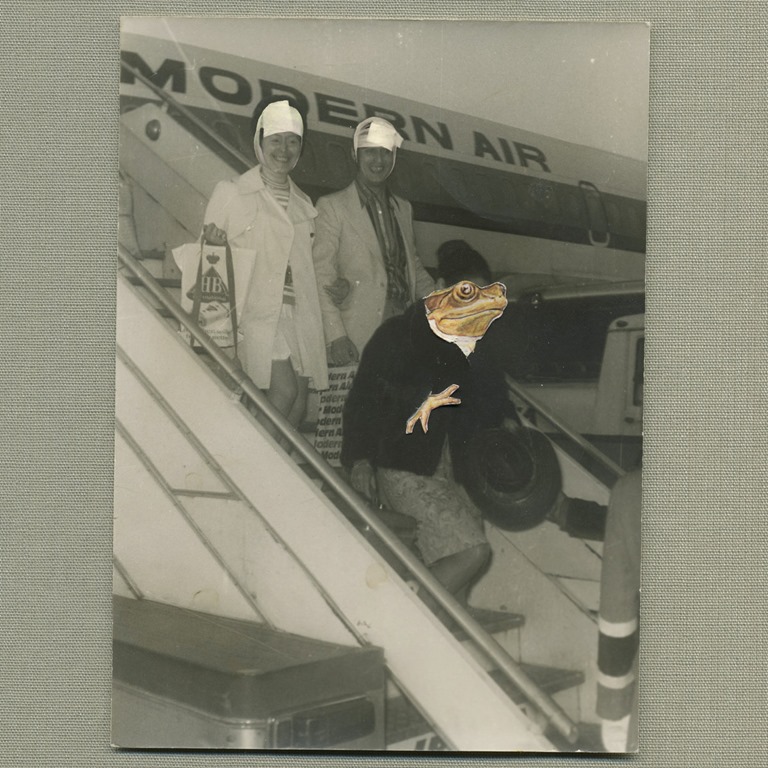
The only way to remain sane through all of this madness is to embrace it, or at least some of it. Then again, ( kröter ) have been ahead of the curve in the madness stakes for some time, as the conveyor-belt of releases over the last couple of years have shown, since they were all culled from some epic sessions around 2018.

*f is their third album of 2021, and the sixth album to be culled from these sessions. Remarkably, rather than a random collection of offcuts and flow-sweepings, it contains some of the most outstanding material yet, and one has to wonder how much did they actually record?

They’ve spent a lot of time sifting through the material and chopping it into tracks and sequencing them into albums – with varying degrees of cohesion – but as they note, ‘as usual, there are no second takes in this pond. All is nutritious, spiraling and slowly growing legs.’ These legs are long and hairy, and the sprawling eleven-minute ‘Trajectory’ is a dingy, dirgy grind dominated by a crunchy, dirty bass groove and plodding beat. It’s kinda post-punk, kinda no-wave, kinda noise-rock, and if there are moments when Mr Vast’s vocals hint at a Jim Morrison-esque swagger, the whole thing reminds me most of Terminal Cheesecake, for those who can handle an obscure reference point.

‘The Letter’ is swampy, minimal, meandering, while ‘The Rock’, another low-oscillating slab of dark industrial-leaning synth is propelled by clattering percussion and features snarling, growling manic vocals. Vast is a versatile vocalist, even if on this set his delivery isn’t particularly angled towards melody, as he drones and yelps and drawls and yowls all kinds of atonality over repetitive electronic grooves.

It all comes together on the eighteen-minute ‘casper hauser in the mirror’, a thumping, humping, ketamine-paced motoric industrial jazz odyssey. Vast sounds utterly deranged as his voice wanders lost, aimless, as he half speaks, shouts, raps and yawns out abstract lyrics that drift out in a drift of reverb. Again, around the six minute mark, it sounds like Kraftwerk fronted by Jim Morrison circa LA Woman, and yes, it’s a pretty fucked-up experience, and the atmosphere is not only intense, but also dizzying, bewildering in its hypnotic pull. It transports the listener to another place, out of mind if not out of body, conjuring an almost trance-like experience. It may be some kind of woozy, weirdy, hippy shit, but it’s also affecting. There’s much to be said for the power of repetition, and this just goes on, and on… and on. It’s not nightmarish as such, but it is trippy and disorientating.

This is a fair summary of the album as a whole: *f really does pack in the weird shit, and if the initial tone is one of quirky, oddball fun, the overarching experience is rather darker. The disorientation it creates is less kaleidoscopic joy and more the nausea of excess, and a kind of unsettled bewilderment. ( kröter ) depart from Hunter S. Thompson’s adage that when the going gets weird, the weird turn pro, and instead forge their own path, whereby when the going gets weird, the weird gets even weirder, and a few shades darker, too. Which is cool, because who wants their weirdness to be predictable, after all?

AA

a2240317846_10