Posts Tagged ‘Noise’

Christopher Nosnibor

This is a very different kind of gig vibe. I arrive way before there’s any music due on with a view to giving my brain a rest from stress with a book and a few beers. The Duck and Drake is a cracking boozer which boasts no fewer than fifteen cask ales. There are three gluten free offerings, for those who need to know these things, and several vegan brews. The Wensleydale Fire It Up IPA at 5% is a particular standout, but they’re all well-kept and the Old Peculier is superb.

Personal disclosure: I wasn’t feeling like turning out tonight. My motivation and confidence were through the floor this morning, and the prospect of heading off to Leeds on my own to an unfamiliar venue while the reliability of the trains, particularly getting home, was in question, had done little to compel me to venture out. But since Noisepicker – whose last two albums, both released via Exile on Mainstream – I had reviewed and enjoyed, had made the effort to come up from London to play a free show, and labelmates Might had made the effort to come from bloody Hanover, I knew I’d regret it if I yielded to my urge to retreat.

Shortly after my arrival, the pub’s invaded by a board of corporate tossers on a treasure hunt by way of a works night out, but they fuck off before too long, and I get to sup my pint while listening to the soundchecks, and it becomes increasingly apparent that I’ve made the right decision. Around nine, a cluster of beardies, hairies, and folks in black filter in and take up around the bar. And then the music starts.

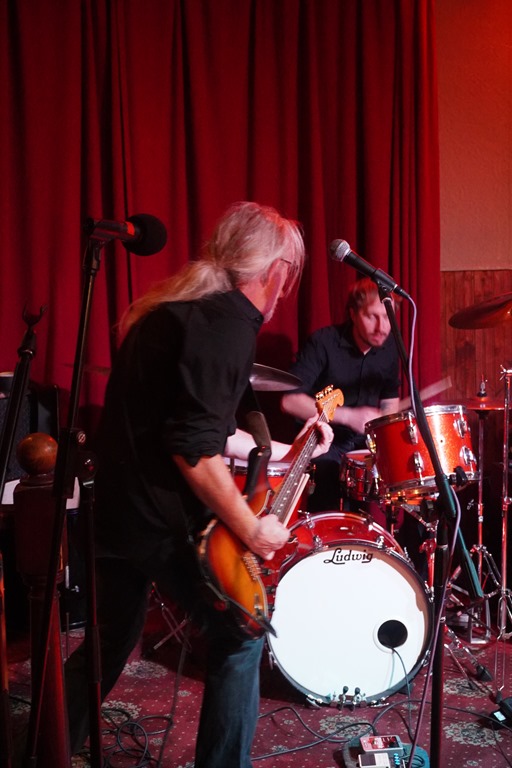
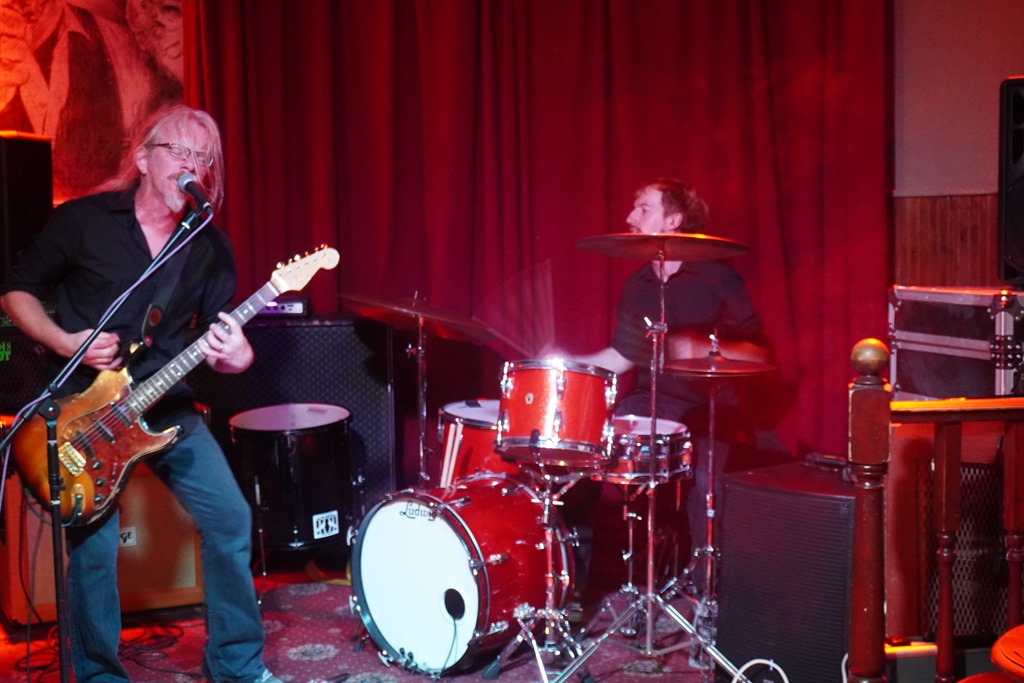
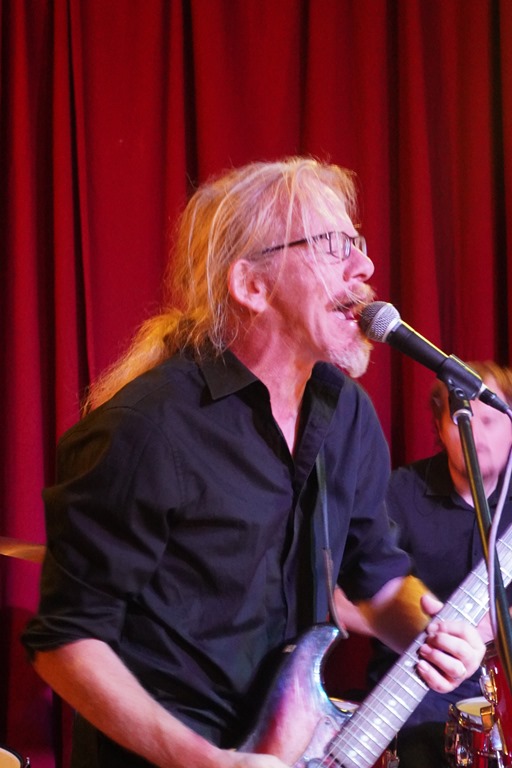
Noisepicker are an intermittent band, and a classic example of a band who fit making music around dayjobs and whatnot. There was a seven-year gap between Peace Off and the latest, The Earth Will Swallow the Sun, and they’re not a big touring band. But on stage, they present an almost telepathic cohesion from the outset. ‘No Man Lies Blameless’ lands second as they fire up the heavy blues riffery after a slow, drawling start. Harry Armstrong’s phlegm and whiskey (or Newcastle Brown) vocals growl and howl all the pain, anguish, and anger at the state of humanity, and there are times in the set where he and drummer Kieran Murphy articulate this with raw primal screams, and it’s magnificently cathartic. ‘Chew’ starts almost jazzy before hitting its stride with a thick riff. When they slow it down and strip it back, as on ‘A Taste of My Dying’, it’s got a hefty swagger. ‘The Earth Will Swallow the Sun’ brings a barrage of percussion, Armstrong playing drum and guitar at the same time. There’s a cover of ‘War’ which kicks ass, delivered with guts and gusto, and landing between Motorhead and ZZ Top. They go low and slow for the set closer, and they kill it. The rapport between the two players is apparent, as is the fact they’re clearly loving doing what they do.

DSC04854DSC04901DSC04867

Noisepicker

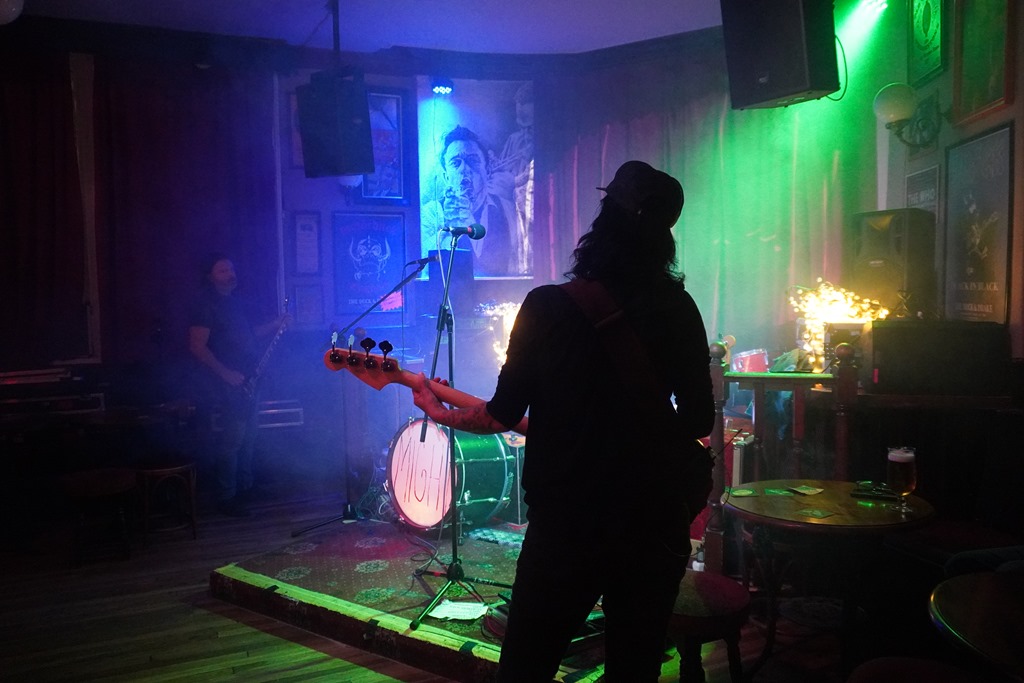
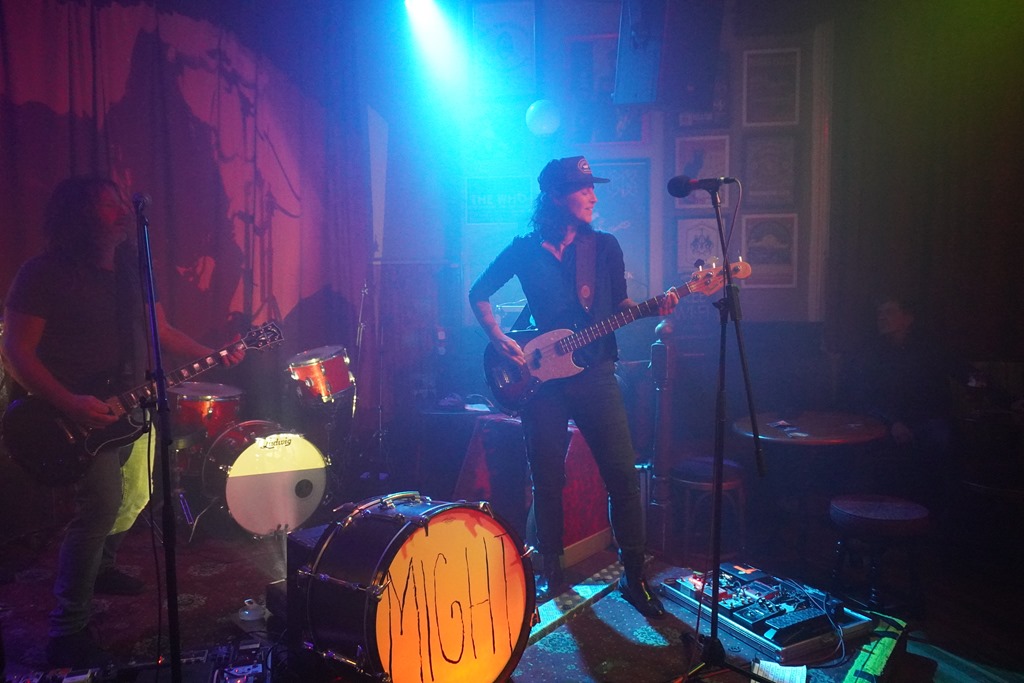
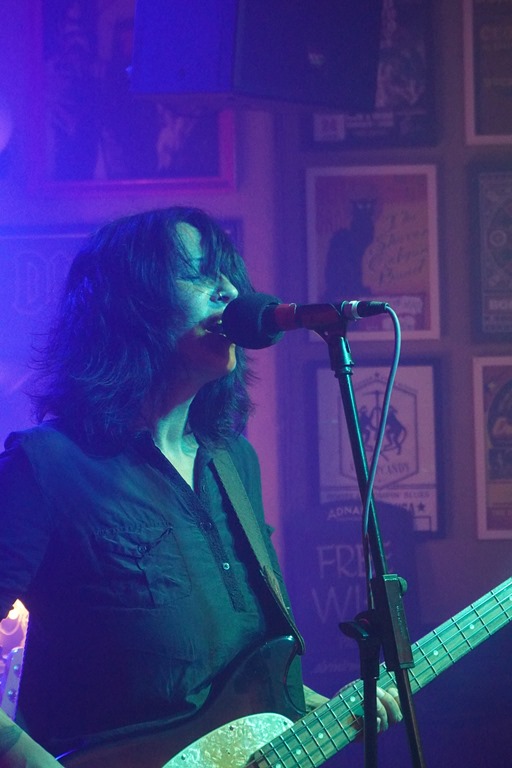
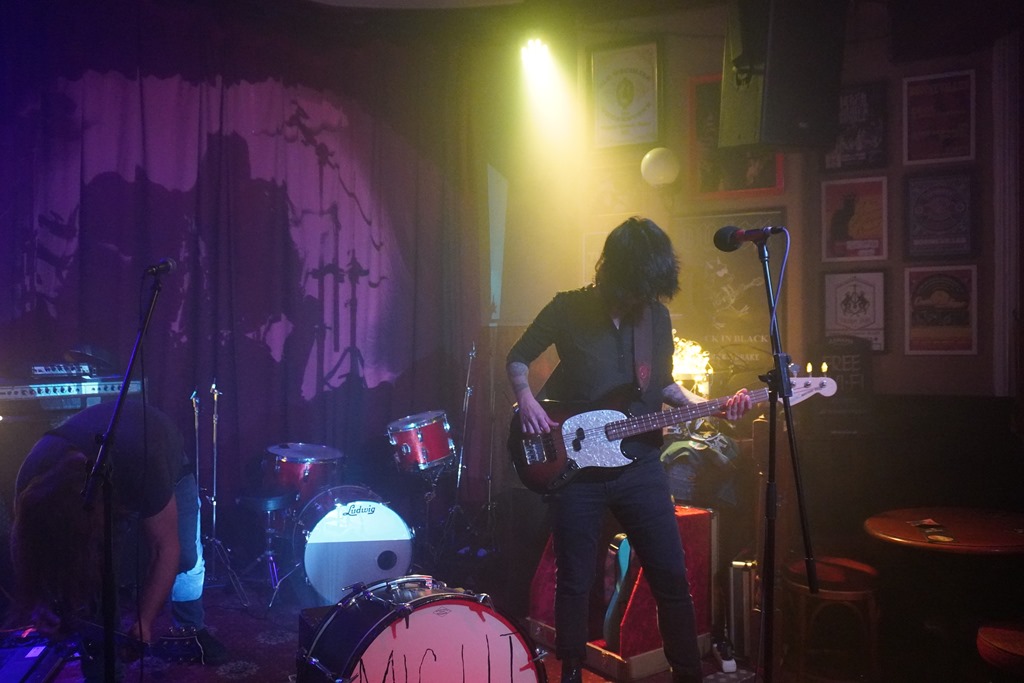
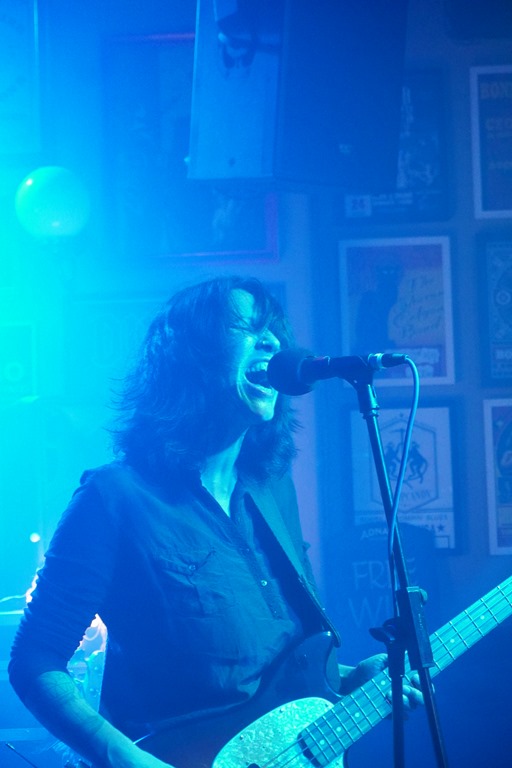
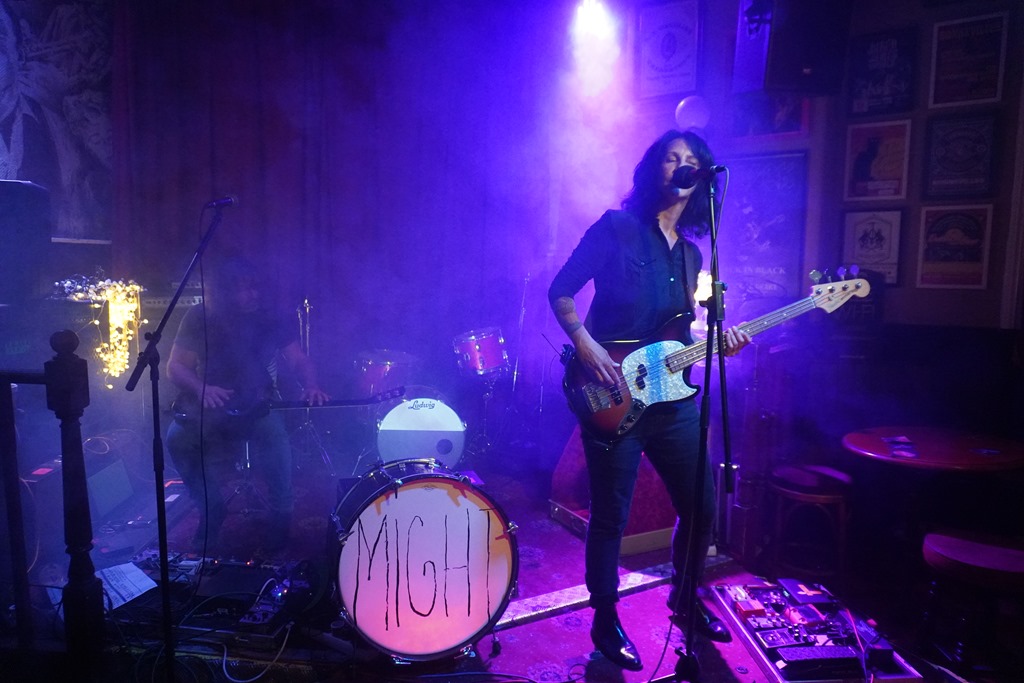
Making their UK debut, Might start their performance off the stage, with flashing lights, smoke and dark atmospherics, before a piano backing track starts… And then the drums kick in, followed by the and guitars. The sound is nothing short of mind shattering in its density. It’s hardly surprising with that towering backline which dominates the stage and this small room. They’ve not travelled light. On record, they sound immense. Live… they take the sound to a whole other dimension.

They way they’ve worked the sound – and the visuals – is remarkable. I’d been curious as to how the duo of Ana Muhi (vocals and bass) and Sven Missullis (guitar, vocals, drums) would contrive to multi-task, and what I first thought was a drum machine actually appears to be a recording of a live drum track, which is up in the mix at a volume which corresponds with a live drum kit. Consequently, it feels like there are three people on stage – and what’s more, it almost looks that way, too, as there’s a silhouette of the drums being played which – unless my eyes deceive me – is in perfect sync with the audio. And with Nosepicker’s kit on stage behind them, and an abundance of smoke, you actually get a sense of their being an extra body up there.

DSC04953DSC04958DSC04975

Might

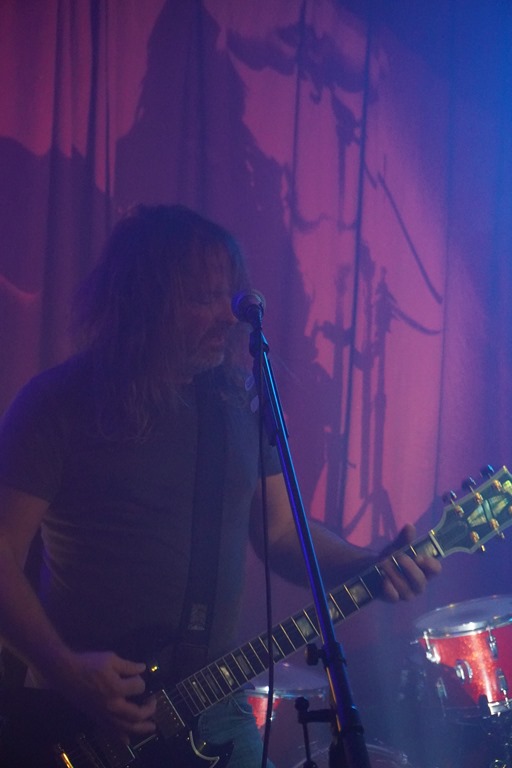
They churn out some monster riffs, which churn and grind, but there’s more than brute force and brutal volume happening here – there’s texture and layering, and what I can only describe as sonic alchemy. And what they conjure is something which renders the cover art for their second album, Abyss, as an aural experience, and it’s one in which time is suspended and you find yourself completely immersed and on another plane.

Stripping it back to a drone on Mrs Poise, the percussion comes from Sven striking the back of his guitar while it’s laid across his knees. The acoustic-led penultimate song ‘Tightrope Walk’ is almost folky, but nevertheless intense, Ana’s vocal delivery delicate and utterly captivating, before they close with ‘Zero’ – the final track on their eponymous debut – and it’s immense.

DSC05005DSC05016DSC05012DSC05055

Might

On the face of it, this – the first night of a little low-key package tour –was a pretty ordinary event. A couple of bands playing in a pub in a corner of Leeds. But, pitched on the premise of being 100% DIY, with free entry and serving to provide a drop of an antidote to the relentless shitness of the world, it proved to be so much more. The bands both gave it their all. The audience was small, but appreciative. They chatted with the bands, and bought T-shirts. They bought beer. And ultimately, it was pretty damn special. No corporate shit, no pissy lager in plastic cups. Grassroots music at its very best. No-one’s getting rich off this financially, but in terms of the humanity, the life-enrichment, and the inspiriting qualities of a night like this, we all end the night with wealth beyond measure.

FKN KVLT REKORDS – 18th September 2026

The band describe their latest album, Super Rebound, as ‘is an action packed record with an unsound hero at the wheel. Wildly navigating through a landscape filled with leaden riffs, open harmonies, foghorns, and a dose of unadulterated joy and radiant bliss. Deranged, but sweet. Fuming with feels.’

This is only their third full-length album in their fifteen-year career, although they’ve maintained a steady flow of EPs, some of which have been on the longer side (their last release, HONESTY INTEGRITY FRIENDSHIP PASSION contained only four tracks, but due to the last one having a run time of twelve and a half minutes long, it spanned a full thirty minutes) – and they reckon this could be their definitive document, their magnum opus, the apogee of their riff-centric intent rendered concrete.

It’s certainly a big old guitar-driven racket, and it’s not without detail or humour, either. The first bars of the first song, ‘The Gums’, are kinda nicey-nicey, picked, melodic, a bit indie, a bit emo even, then all hell breaks loose with a thunderous slab of a riff and rabid vocals and I’ve no idea what the fuck they’re yelling about, but waaaauughh! It’s all good. Then there’s a rather Shellac-like mid-section where they persecute a single note for what feels like an eternity before going black metal in a blanket of fretwork and explosive percussion. It’s a lot to cram in to five minutes, but in keeping with the band’s name and general ethos, it’s chaotic and wildly unpredictable.

The punningly-titled ‘Prism Break’ melds driving repetition and the dingy riffery of early Melvins with something more fiery as they fire up all cylinders for a brutal sonic assault.

The three pieces with (quite self-explanatory) parenthetical titles are instrumental interludes where they lay down the guitars and explore very different territories. Consequently, after the meandering instrumental of [Horns Wailing], the sledgehammer sound of ‘Mountainesque 4’ his even harder by virtue of contrast. It’s six and a half minutes of unbridled raging racket, which hammers away relentlessly. The guitars are as dirty as they come and blur into the bass in a mess of overloading distortion, the barking vocals low in the mix… the midsection is, once again, a complete shift, venturing into almost neoprog territories, with swirling synths and pomp-filled bass runs. It borders on muso, but feels somewhat tongue-in-cheek – not quite parody prog, but the lilting, picked notes which play to the fade certainly mark a contrast. And then there’s the recent single, ‘Unsound Hero’, which tests the patience with the most protracted, strung-out intro, consisting initially of nothing but a crashing snare for the longest fifteen seconds imaginable, and then a clean guitar pulse enters the mix and… are they in time with one another? Something doesn’t seem quite right… Yes, of course it’s intentional. I’m momentarily reminded of The Melvins’ track ‘Mine is No Disgrace’ from The Crybaby, with JG Thirlwell – a sprawling eight-and-a-half minute behemoth that pushed the quite-loud dynamic thing to its absolute limit – because here, 30,000 Monkies drag that intro out, and out, teasing at when the levee will break and the riff will hit, exploring a melodic, proggy, Oceansize-like melodic drift… at two minutes and seven, there’s a pause. Silence. Nothing. Suspense. Two seconds is a long time when you’re teetering on the brink, when you’re hanging, waiting… But at two minutes and nine, BLAM! And that riff is low, grinding, and raw. The slow grinding notes ring long and resonate as they trudge into the domain of rib-crushing weight. Stripping it all away leaves the sound of a soul being torn apart and offers no solace – quite the opposite, in fact – before the devastating onslaught of the final minute.

AA

You might think these guys are fucking with you, and in a way, they probably are. The title track is nothing short of pure riffmania, nearly seven minutes of punishing, pulverising power that’s absolutely relentless, crushing, and again holding a single chord for what feels like an eternity in the final minute.

This is noise rock with the emphasis on the noise, the filthy overdrive and feedback cranked to the max, and any moments of respite are simply lulls and lures designed to amplify the impact of the most brutal, rib-cracking riffs when they land. The formula isn’t genius, or even new, but 30,000 Monkies know precisely how to utilise it for optimal impact. And ‘Swerver’ hits hard, alright.

The ringing layers of ambience which shape [Bells Ringing, Tale Melting] are a world apart from the rest of the album, and while the warping sounds which drag and drift aren’t entirely soothing, they’re on another plane from the fiery wall of guitars which dominate Super Rebound… until the final three minutes, when they pull out the most devastatingly crushing doom of the entire album. It feels like a trick, an ambush, and one we should have seen coming, because 30,000 Monkies just can’t help themselves. There has to be a bone-splintering, skull smashing riff at some point in every song. It’s just a question of when it lands.

Super Rebound is a work of genius, with 30,000 Monkies really delving into suspense and detail – but more than anything, it’s a riff-laden rager of an album.

AA

069301

The Body and Cel Genesis share ‘Whole Wide World,’ the title track and second preview from their debut collaborative album of the same name, out November 13 via Thrill Jockey.
The song wastes no time getting to the point, fusing the punishing force of power electronics with a bitter nihilism that runs throughout the record. Built on lyrics by Chip King and Pauline Poderoso about exhaustion and the limits of continuing to place hope in humanity, the track offers a direct distillation of what emerges when the two projects’ sounds and sensibilities collide.

That confrontation extends to the song’s construction. As Chris Danko of Cel Genesis explains, when bandmate Poderoso delivers the line “You want a key change?,” the song gives way not to a key change but to a crushing breakdown, a moment that plays with spectacle while deliberately addressing and challenging the listener.

About the track, Chris comments, “What was once before you – an exciting, mysterious future – is now behind you. Lived; understood; disappointing. You realise you are not special. You have struggled into existence, and are now slipping silently out of it. This is everyone’s experience.”

AA

The collaboration was first conceived on tour, with few parameters set in advance, letting Cel Genesis’ maximalist compositions and aggressive editing meet Body’s improvisational approach on even ground, with both projects pushing their ideas to their outermost limits. The resulting record draws heavily from trance, distortion, and experimental electronics, anchored by the visceral interplay of dual drumming from Lee Buford and Nick Cowman and the combined force of both groups’ vocals.

Recorded at Machines with Magnets by Seth Manchester, with additional recording by Andrew Oswald in California, Whole Wide World evolved over two years of recording and meticulous editing. Some songs began with electronic beds generated by Cel Genesis, while others grew from live drums, with each group reshaping and reimagining the material.

Whole Wide World is a dense and heavy album, but one that nevertheless feels joyful and fresh—an uncategorizable ode to egoless invention. It’s a work born of artists with disparate approaches, who feel compelled and comfortable to surrender them in service of the birth of new art. Whilst the album was made with joy, its themes confront today’s harsher realities; we see this play out through the eyes of an unrelenting optimist processing the death of possibility itself.

AA

AA

StudioGroupStillEditv1-990000079e04513c

Photo: Chris Danko

Cruel Nature Records – 14th August 2026

Christopher Nosnibor

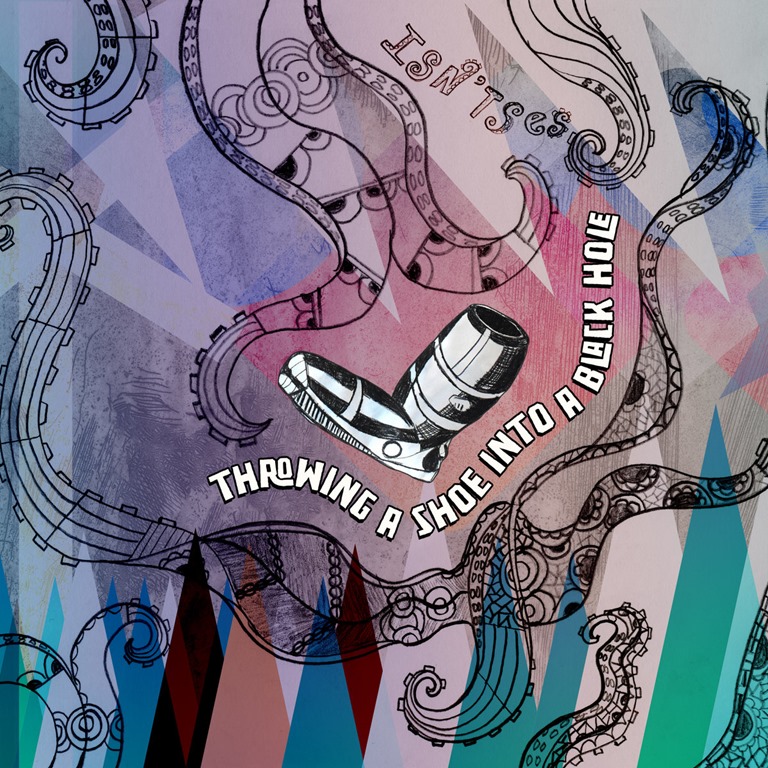
Working under the Isn’tses moniker, London duo Lisa McKendrick and Tim Drage have spent more than a decade sculpting noise with their own unique slant, evolving not only their own methods and methodologies, but their own circuitry, perhaps most famously the ‘Chernobylizer’, a compact yet devastatingly powerful noise-generating device.

The notes which accompany this, their latest release in a prodigious and ever-expanding body of work, describe Throwing A Shoe Into A Black Hole as ‘raw and chaotic’, departing from noise alone to deliver a work where ‘a mix of complex beats, textures, unpredictable sounds and frenetic rhythms enter the music, at times with melody and screamy vocals as they push the boundaries of electronic music,’ and finally summarising it as ‘an intense mind-bending spacey journey of wild explosive emotion and sonic textures.’

It contains ten compositions – songs would be a hell of a stretch – the titles of which either seem purposefully incomplete and therefore impenetrable, or otherwise oblique, apart from those which include references to ‘rave’. There is certainly an abundance of heavy-duty pulsating electronic beats and whoops and cheers and yelps crop up with a certain frequency. But if this is to be considered in any way a ‘dance’ album, it’s in the context of late 70s and early 80s electronica – the warped groves and unsettling, detached vocals of Throbbing Gristle circa 20 Jazz Funk Greats, and Chris and Cosey’s Trance. The beats are industrial strength, but shudder and stutter, pulsing through fuzzed-out, distorted synth waves and an endless array of extraneous interjections. Demented shrieks and wailings rise though the thick atmosphere towards the end of the first track, ‘Sol Receiver’, and ‘I Spit on Your Rave’ only amplifies their commitment to melding propulsive beats and throbbing synths and melting them together with a sonic haze and disconcerting sense of psychopathy.

The majority of the pieces evoke a kind of derangement of the senses, repetition and disconcerting discord conjuring a trance-like evocation – but it’s dark and murky, and there’s a thick, squelchy analogue feel which contributes to a sound that feels more like the drug-induced hellish nightmare of a cult than spiritual transcendence. The thumping, clumping stomp or ‘Freekfall’ is nothing short of purgatorial, and you want to escape, but you find your limbs are leaden and limp, and you can’t move as you find yourself staring into a swirling vortex, even when you close your eyes. There is no escape.

‘Undo Fear Biases’ is an unadulterated seething miasma of heavy noise propelled by a palpating myocardial spasm of a beat, while ‘Free The Party’ is centred around an interview or some other monologue about the days of rave culture. In contrast, ‘I’m Not The’ is the soundtrack to the rave where the trip is bad, man. It’s like hearing The Prodigy and some shit shoegaze indie at the same time while your brain is exploding one lobe at a time and the fragments form small vortices as they cascade from your ears. Pleasant, it is not, and the same is true of ‘Do Or Die’, with its sonic allusions to ‘Discipline’ and ‘Whorl of Sound’, and which escalates to something akin to the detonation scenes in Threads. Total sonic annihilation, absolute obliteration. Sitting here with only a beer, my head is beginning to spin and my stomach is slowly starting to churn. This isn’t accidental: Isn’tses understand the impact of frequencies, and the way sounds interact.

Throwing A Shoe Into A Black Hole is by no means especially harsh as noise goes, but it is relentlessly, unyieldingly hellish in its conception and execution. It’s no criticism when I comment that this is hard work and a difficult album: it’s supposed to be. But why is the churning, shifting, reverberating discord of Throwing A Shoe Into A Black Hole more challenging than a screeding blast of continuous harsh noise? Everyone’s brain processes things differently, so I can only speak for myself when debating this, but it’s more often than not possible to allow waves of noise to wash over and flow across the mind, to go with the flow, as it were. Dance music is different in many ways, but by the same token, it’s easy to process a steady four-four beat, particularly when it’s the constant, consistent bass thump which defines the majority of dance music – it’s that beat, and that consistent tempo, which makes it music for dancing. You zone out the extranea, and focus on that core element. And that’s the common ground shared by dance and noise when it comes to how we process it – by zooming out and focusing on something within it. This isn’t possible with Throwing A Shoe Into A Black Hole. Everything about how each piece is assembled is built on continual disruption. There’s nothing to latch on to, there’s nothing consistent. Yes, there are rhythms, but they’re jarring, riven with irregularities, or what the brain will likely perceive as irregularities, and there’s so much else going on, disconnected and disjointed sounds flying in all directions, that any attempt to filter them out and focus is impossible.

Back in the late 70s, much of what Throbbing Gristle and Cabaret Voltaire were doing was inspired by the tape experiments of William S. Burroughs, and the proposed methods for psychic warfare using sonic weaponry as detailed in Electronic Revolution and The Revised Boy Scout Manual. There’s a palpable sense that with Throwing A Shoe Into A Black Hole, Isn’tses are returning to the origins of industrial music. And what’s remarkable is that even now, it’s absolutely devastating. Complete sensory overload. A derangement of the senses.

AA

a4029856349_10

Chat Pile’s heralded debut album God’s Country depicted a particularly American flavour of dread, and their 2024 LP Cool World showed a cruel planet defined by global systemic violence. Now, Chat Pile return with Who Loves the Sun, an album that peels back the skin on how a collective indifference for a decaying world defines this new century.

Spanning imagery of coastlines devouring cities as a result of inaction on climate change, the dread of working dead-end jobs, and the species’ collective submission to data-driven inauthenticity, Who Loves the Sun depicts the common experience of existing in a doom loop which feeds the malaise that permeates all aspects of our lives.

The album”s latest single ‘Same Rules’ is lyrically and sonically as aggressive and confrontational as ever, but Chat Pile approach songwriting with hooks in mind, drawing on melodic tones. Bassist Stin says it’s the “…first real Chat Pile song mostly recorded on 4-track cassette. Ray B. had given us the challenge to write a trip hop song and this is what we came up with. Unfortunately he’s rejected ‘Same Rules’ from the challenge as he claims it’s not trip hop at all and that we have to try again. Perhaps we’ll get it right next time.”

Reaching into the collective consciousness to commiserate and carouse, Chat Pile dissect how the apathy-bloated state of 21st-century existence is an active, slow-motion apocalypse, threads of which are woven through the album. Vocalist Ray B. adds: “Everyone needs to read as much as possible. There is so little emphasis put on knowledge right now—  it is your most important tool. Engagement with the world might lead to death, but shutting off and staring at your phone all day is suicide.”

AA

Since Chat Pile’s formation just over six years ago, the Oklahoma City-based quartet has grown from a scrappy passion project of four local film and music enthusiasts into one of the defining heavy acts to emerge from the 2020s underground.

Ray B. (vocals), L. Manhole (guitar), Stin (bass), and Cap’n Ron (drums)’s crushing, crass, and cathartic take on noise rock resonates in a cracked reality. Their music captures a raw, undeniably human essence that’s increasingly fleeting in an age marked by ceaseless torrents of algorithmic slop, technological overreach, and the cold, crestfallen state of society. Nothing about their forthcoming third LP, Who Loves the Sun, feels synthetic.  In a world increasingly shaped by disposable content, Chat Pile answers with something defiantly real and organic.

Live dates:

UK/EU
08/11 – Vienna, AT – Arena (supporting HEALTH and Carpenter Brut)
08/12 – Munich, DE – Live/Evil ~
08/14 – Col Du Lein, CH – Palp Festival
08/17 – London, UK – Bush Hall ~ SOLD OUT
08/19 – Dublin, IRE – Button Factory ~ SOLD OUT
08/20 – Dublin, IRE – Button Factory ~ SOLD OUT
08/22 – Bristol, UK – Arctangent Festival
08/23 – Hasselt, BE – Pukkelpop Festival

NA

09/12 – Oklahoma City, OK – Tower Theatre = (SISU Fundraiser Fest)
09/17 – Minneapolis, MN – First Avenue +^
09/19 – Chicago, IL – Riot Fest 
09/20 – Englewood, CO – The Gothic Theatre +&
09/23 – Salt Lake City, UT – The Metro Music Hall + &
09/25 – Seattle, WA – Showbox SoDo + &
09/27 – Portland, OR – Revolution Hall + &
09/29 – Sacramento, CA – Ace of Spades +
09/30 – San Francisco, CA – The Regency Ballroom + &
10/03 – San Diego, CA – Music Box + &
10/04 – Los Angeles, CA – The Belasco + &
10/06 – Mesa, AZ – The Nile Theater + &
10/08 – Austin, TX – Radio/East + &
10/09 – Houston, TX – White Oak Music Hall + &
10/10 – Dallas, TX – Granada Theater + &
11/05 – Detroit, MI – The Majestic Theatre + %
11/06 – Millvale, PA – Mr. Smalls Theatre + % 
11/08 – Norwalk, CT – District Music Hall + %
11/10 – Brooklyn, NY – Brooklyn Steel + %
11/11 – Philadelphia, PA – Union Transfer + %
11/12 – Washington, DC – Black Cat + %
11/14 – Charlotte, NC – Underground + %
11/15 – Atlanta, GA – The Masquerade + %
11/16 – Nashville, TN – Brooklyn Bowl + %
11/18 – Columbus, OH – Newport Music Hall + %
11/20 – Indianapolis, IN – Deluxe at Old National Centre + %
11/21 – St. Louis, MO – Delmar Hall + %
11/22 – Lawrence, KS – The Granada + %

~ with Ragana
+ with Soul Glo
^ with Prize Horse
& with Virga
% with Shallowater
= with Portrayal of Guilt, Nightosphere, Traindodge, Primal Brain

RyanLawson9copy-990000079e04513c

Photo credit: Ryan Lawson

Dret Skivor – 7th August 2026

Christopher Nosnibor

How do I know it’s Bandcamp Friday? Is it because I’ve received in the region of fifty emails by midday for new releases? Well, yes, there is that. But ultimately, it’s the fact that there’s a new release on Swedish microlabel dret skivor. This month’s is a radio-friendly unit shifter available to download and as a CD in a limited edition of two copies.

With uncharacteristically voluble notes accompanying it, we find the work described as ‘A chance meeting between winged and un-winged and captured hooded crow monologue.’ It would be impossible not to infer some element of reference to the 1979 debut album by Nurse With Wound, Chance Meeting on a Dissecting Table of a Sewing Machine and an Umbrella, which in turn was taken from Lautréamont’s The Songs of Maldoror, a work which sits within the broader oeuvre of Surrealism. All of this serves to present a comprehensible intertext given what dret skivor and its artists are all about – which, to boil it down to less academic terms, is ‘weird shit’.

Tejploopare add, ‘We thank our avian masters for the source material and Remo de Vico for his programming skills in creating the time-stretcher Loom that has been used in the creation of this piece’.

But if you’re expecting birdsong, or even something inspired by Hitchcock’s The Birds, think again. Gråkråka is just one fifteen-minute track which, regardless of its source material, manifests as one extended echo-heavy swirling drone, as much akin to the sound of a giant millstone grinding against another from the depths of a huge cavern, or the sound of a million bats taking flight from a cave with the audio slowed by maybe three hundred percent. Admittedly, I’ve never really listened to crows in conversation, and was unaware – or had forgotten – that they have the capacity to mimic the sounds of other birds, animals, and machinery’, according to learnbirdwatching.com. While the veracity of this is debatable, it is understood and accepted that crows are capable of advanced and highly sophisticated communication, using a range of techniques.

But let’s suspend disbelief for a moment and take on face value that gråkråka is simply the sound of crows, manipulated to a greater or lesser extent to forge a churning, whirring, multi-textural sonic experience. It’s not a drone per se, so much as a rumbling eddy, an endless whistle, and a slow grind, all at once, and these all shift around in tone and the level to which they sit to the fore over the track’s duration. At times, the upper buzzes and hums, the higher frequency fizz, makes my inner ears itchy, and make me feel a palpable relief that I don’t suffer tinnitus, but am coming to the opinion that perhaps a certain level of hearing loss may not be such a bad thing for the avoidance of sonic torture at certain frequencies. If only I hadn’t been so bloody sensible wearing earplugs to gigs this last twenty years, eh?

Gråkråka is not a work of harsh noise: it’s not even overtly noisy. But it is one of those aural explorations which is designed to inflict discomfort. And in that, it succeeds. By the mid-point, it’s attained a quire specific level of torturousness, and while it does pull back from this for a time, what replaces that scouring blast is a quivering ominous rumble, which again swells and replicates the sensation of some unseen fear growing closer: put another way, it’s the soundtrack to a nightmare, to a horror without words or boldly manifestation, simply a psychological attack which goes on, and on, twisting to a trebly roar akin to a demon rasping suicidal ideations into your ear during the final five minutes.

It’s not actually a criticism when I express the view that gråkråka feels like a long fifteen minutes. It’s not intended to be one of those soft ambient drifts where half an hour simply evaporates. Quite the opposite: this is an album that’s raison d’aitre is to seed discomfort and make you squirm from beginning to end. And it does.

AA

a2862934852_10

Human Worth – 7th August 2026

Christopher Nosnibor

Having thoroughly enjoyed the churning racket of Leeds grindcore / sludge / infernal racket duo Pleb when they opened for Unsane at The Brudenell in April, the announcement of their debut EP being released on the esteemed Human Worth label came as excellent news. And even better news is that they absolutely deliver on the promise of the live show here.

The credits very much summarise the two players’ contributions, with D. Fraser providing ‘Guitar / Feedback Hell’, and S. Myles doing ‘Drums / Squawks / Grunts’.

This is one serious fucking racket, and it would be a massive letdown if it was anything else, with eight songs and a total run time of just over ten minutes. There’s no pissing about here, just squalls of feedback and rasping, rabid vocals barking away low in the mix amidst the churning dingy noise. But then, this was always going to be the case. Check their pedigree: between them, their CVs list Cattle, Grub Nap, Groak – luminaries of the Leeds DIY noise scene that’s been thriving in tiny pub venues and basements and rehearsal rooms and the like for an age. It’s a tight-knit, but incredibly welcoming scene that’s spawned countless bands all committed to making the most ferocious, ugly noise imaginable. And with Grease Trap, you don’t have to imagine it.

And despite being just the two of them, it sounds like a full band, the guitar signal split to provide grinding low end and raging feedback at the top simultaneously. The result is a devastating sonic blast that assaults the senses with all frequencies. But why Grease Trap? The band explain:

“A grease trap is a tank that folks stick under the sink in a place that deals with food, it’s supposed to stop clumps of food and fat from going down the drain. There was one down our gaff and we had to empty it when we first moved in and I’ve never smelt owt like it. Me and our lasses dad were boaking the whole time while carrying buckets of foul stinking water up and down the corridor to try and wash the bloody thing out. Feels like that’s where we’re at as a society at the moment, we had all this stuff in place to try and stop things from going wrong but everything is rotting from the inside out and it’s poisoning the water supply. Greed is absolute, hatred is being weaponised and apathy is apparently cool again somehow. These songs are about the world wide descent into Fascism, the dutty roz, that orange bastard, our entire generation not breeding cos we’re in a hostile environment, technology turning us inside out, our inability to face our own problems without decking it and a bunch of other fun stuff. It doesn’t offer any solutions but sometimes you need to scream into the abyss eh?”

Lacking a grease trap myself, and my house having been built circa 1890 and still connected to the original ceramic Victorian plumbing which connects to the (also Victorian) drain system, I’ve had to invest in a set of drain rods, which are subject to regular usage to unclog backups that threaten to plug my back yard. they seem to be caused predominantly by mini fatbergs congealed around masses of hair (which evidently aren’t mine). And I can confirm that the job is nothing short of rank, dragging out clods of stinking clumps of sludge. it still doesn’t stink as badly as Reform, though, or, judging by footage online, as much as Trump when he nods off and soils himself. Rotten politics, rotten behaviour, rotten intestines, it would seem.

This is all of the above compacted into the most intense sonic explosion. It distils the rage at the fetid state of Western culture and the sewer state of our politics, our media, social media and blasts with complete abandon, and titles like ‘CLODS OF SHIT AND BONE’, ‘THE BRUISES MEAN IT’S ON THE WAY OUT’ and ‘THE EYES MELT FIRST’ sound exactly as you’d expect. With Grease Trap, Pleb vent the rage in the rawest, most direct fashion. And it absolutely hits the spot.

PS fuck fascism.

AA

HW052_Pleb_GreaseTrap_CoverArtwork

Cold Spring – 26th June 2026

Christopher Nosnibor

This release is something of a curio, in the sense that it’s a collaboration between two of the most famously prolific recording artists of recent times – Sun Ra recorded over 100 full-length albums, comprising well over 1000 songs prior to his death in 1993 at the age of 79, while Merzbow, active since 1979, has released in excess of 500 albums to date. However, this collaboration occurred posthumously for Sun Ra, and it’s worth quoting the context as given by the label, Cold Spring here:

Officially licensed from Irwin Chusid, who oversees the catalogue of the late Afrofuturist artist/composer/bandleader Sun Ra, Cold Spring negotiated rare and unreleased tracks from the Sun Ra archive to be remixed and treated by Masami Akita (aka Merzbow). The tracks incorporate the jazz power of Sun Ra with the brutal excess of the Japanese noise artist Merzbow.

Originally released by Cold Spring a decade ago and long sold out, the music was spread across vinyl and CD, with completely different music on each format. The tracks have now been collected together for the first time, using the original master tapes and presented in the order intended (the vinyl format dictated the order due to optimal sound quality restraints).

Included for the first time on any release is a bonus two minute track entitled ‘Granular Jazz Part 5’, a special composition created for ‘Stuart Maconie’s Freak Zone’, a weekly radio show on BBC 6 Music in the UK. It was broadcast ahead of Merzbow’s live concert at the FAC251 venue in Manchester in September 2016.

There are obviously practical reasons why the different formats featured different track listings on the original release, although these things can prove frustrating for fans finding themselves faced with the dilemma of missing material or forking out for multiple formats. This ‘complete’ reissue has the added incentive of an unreleased track, and while it’s only a couple of minutes of unreleased music, it does round off what is unquestionably a monster release – the six pieces having a combined run time of a massive 104 minutes.

So, to begin with a brief content comparison, the contents of the original CD – the 32-minute ‘Livid Sun Loop’ and ‘Granular Jazz Part 2’ (34 minutes long) makes up the corresponding first disc here, while the 2016 vinyl contained ‘Granular Jazz’ parts 1, 3, and 4. Chances are that some will still be dissatisfied that the CD tracks still haven’t made it onto vinyl, but you can’t please all the people all of the time, and as much as I’m a fan of vinyl myself, the longform nature of the compositions does seem well-suited to CD.

As for the contents of this ten-year expanded reissue… it’s no criticism or complaint to comment that it very much sounds like what you’d expect. ‘Livid Sun Loop’ encapsulates the album in its entirety in the first few minutes – shrieking horns flying in all directions against an apocalyptic churn of cement-mixer noise with the treble cranked to the max, feedback and flayed circuitry exploding like fireworks on New Year’s Eve. A squall of treble, scraping, screaming, like a Brillo pad scouring away at the inside of your skull. There are prolonged segments which are pure Merzbow, shredding digital noise, but then, suddenly, amidst the blitzkrieg, there are honking horns and random toots which pop through the raging wall. The track is a truly relentless assault, and brutally harsh. The frequencies very much favour the top-end, with howls and hisses of tinnitus-inducing quality tearing from the speakers with not so much as a second’s let-up. Every time you think that this must – must! – be the limit, Merzbow does the Merzbow thing of finding new frequencies with which to cause injury. Oh yes: this hurts. But what else did you expect? Some cozy club vibes, a bit of mellow sax and piano? Right. Merzbow brings the harshest head-shredding hell.

Twenty minutes in, there’s a segment that sounds like everything is breaking – not just the gear, I mean it sounds like a field recording of the collapse of civilisation, the absolute end of the world as we know it. And it just goes on. And on. What have I done to deserve this? What has anyone done to deserve this? Actually, perhaps this is the answer to the UK’s issues in the penal system. Being forced to listen to this a couple of times may be a viable altern alternative to shorter custodial sentences. But here I am, listening with great interest and even with a degree of perverse pleasure – although after half an hour, I will admit that I’m wilting somewhat, and not just because it’s 30C with 70% humidity in my office at 9pm. This is nothing short of punishment: it hurts. And it ain’t very jazzy. It’s a mangled mess of skin-peeling, face-melting horror.

But if ‘Livid Sun Loop’ makes for a long and challenging half hour, you’d better buckle in and brace yourself for the endurance test of all endurance tests. To dissipate any doubt, I am a big fan of noise, and enjoy basking in blistering waves of aural annihilation. And Strange City is special in its vision and scope, and its sheer enormity. There are fleeting flickers of strolling double bass which pep through the wild bleepery, woozy drones and sheet metal shredding.

‘Granular Jazz Part 1’ yawns and snarls, bibbles and bleeps and pulses and creaks and swashes and swinges its way through just shy of eighteen minutes of existential anxiety, but it’s simply a prelude to part 2. The slow fade-in and trickling digital cacophony is simply a lure, creating the illusion of listenability. And it does take some time to build. But, of course, build it does. A quarter of an hour in, and it’s reached a sustained crescendo or chaos that’s dense enough to crush your skull. The jazz quota is ratcheted up, too, and the result is something else. Finding the words for this is a challenger, but I’m starting to feel that it’s not words I need, but an ambulance.

Strange City is… intense. In large parts, it feel like Merzbo is the dominant party in this mash-up (which is essentially what it is), and at its best, Strange City makes for a fitting posthumous release for Sun Ra. But from whichever able ou approach it, Strange City is one serious blast of noise. Killer all the way.

AA

AA

a1237961354_10

Lay Bare Recordings – 9th May 2026

Christopher Nosnibor

One may be inclined to jest that a release like this should carry a warning – but the joke falls flat when technically, it does: the notes which accompany the release on Bandcamp sets the scene for the debut EP from Dutch experimentalists of A Plague of Lighthouse Keepers thus:

Whilst most drone-metal outfits focus on creating atmosphere by composing ambient compositions with tremendous power and volume, the Lighthouse Keepers use more traditional doom/sludge metal as a starting point and explore its differences and similarities with genres such as free jazz, raga, noise and classical minimalism.

Elsewhere, they’re described as sounding like ‘a disturbed lovechild of OM, Sumac, Swans, Miles Davis, and Pandit Pran Nath, combining lengthy improvisations with ear-shattering explosions of intensity’. How could a lovechild of that lot be anything but disturbed?

And so it is that we enter by way of ‘The Massacre of Flour’, a title of which conjures images of a bloodbath in a bakery. What is sounds like is…. nothing short of wild. Its seven minutes leads the listener through a series of conjoined segments, arriving in a crazed blast of shrieking noise, a frenzied cacophony of feedback and squealing sax before lunging into a thick, sludge riff, which in turn yields to a slow, almost ambient drone passage with mystical swirls which rise like desert mirages. Each is gripping itself, and the transition to the next takes place almost imperceptibly: one moment you’re here, then, somehow, you’re there, in a completely different scene with no recollection of how you came to be here – rather like the way scenes change in dreams. And suddenly, the hazy serenity is torn asunder, lurching into a tectonic rift from which burst larval torture resembling Swans circa the Young God EP. It’s absolutely fucking brutal, the sound of pain, distilled and amplified

‘I Fuck People’, the shortest song on the EP, goes in hard on the avant-jazz noise chaos, forming a heavy undulation of bleats and shrieks by way of a backdrop to savage, ravaged, demonic vocals. It’s the sound of purgatorial torment. But all of this is simply a prelude to the main event, the nine-minute ‘Towers of Silence’, on which they really flex all of their muscles. Easing in gently with some abstract desert folk with hints of Eastern esotericism, it’s a slow, gradual build. There’s something meditative, spiritual in the vocals, until things begin to get twisted, mangled, and tangled. There’s anguish, there’s tension, and unease grows… breathe. But ululations which begin soothingly grow tense, and things spiral to a hypnotic cathedral of sound.

Towers of Silence may only contain three tracks with a combined duration of just over twenty minutes, but its range and intensity are something to behold. It’s drone metal, but not as we know it.

AA

AA

892210

5th June 2026

Christopher Nosnibor

I laugh, because the phrase ‘survival of the shittest’ was a phrase I used – a lot – in the late 90s, in my early years of being thrown into the corporate world after completing a degree in English literature. Back then, the belief still existed that a better education would lead to a better job, although in the three years between starting my degree and finishing it, a lot changed, and none of it for the good. ‘Graduate jobs’ stopped being a thing, meaning that it was a feat just to land a temp job doing data input work at an insurance company. It was fucking soul crushing, and Charles Bukowski’s Factotum became a book I came to relate to all too closely as I trudged my way through what felt like endless drudgery. And the managers, those who got promoted, those who did well? The common trait among them seemed to be that, when you boiled it down to the basics, they were all cunts. Backstabbers, self-promoters, overconfident wankers, twats with all the ambition but none of the skills… these bastards were killing it on the career ladder, while I sloughed away in a pit of despair. Scum floats, and all around me, it did. I wasn’t envious of their lives or their ‘careers’, but it was a gut-wrenching showcase of the shitshow that is capitalism and the greasy pole of corporate life: the survival of the shittest in sharp relief. This is now true of all aspects of life: as politics has become indistinguishable from business, and capitalism has taken over all aspects of existence, every bugger is using business-speak and striving to attain success not by means of hard work and talent, but by connivery and cuntishness. And it needs to be called out, and blocked wherever possible.

This new EP by GURT is nothing less than an absolute beast. With three tracks clocking in at ten and a half minutes, there’s no flab, no extravagant solos, no wanking about. They’re described as purveyors of ‘party doom’, but they’re a bit too uptempo to be doom and far too doomy to be party for most. Ultimately, their thing is a rabid racket, and at times, I’m reminded of the Leeds scene circa 2010 and shortly after, specifically around the emergence of crazed guitar noise acts like Pulled Apart by Horses and These Monsters. These were exciting times, particularly as it predated the need for professionalism to make it even onto a stage. Don’t get me wrong: these were great bands, but they were also wild, and things feel a lot more contained now.

GURT do not feel contained, GURT feel deranged, unhinged, rampant. ‘Live Nation, Dead Scene’ goes in all guns blazing, a rabid rager presumably targeted at the multinational ticket agency – operating what’s probably one of the biggest legal scams on the planet right now, with their exorbitant fees and dynamic pricing. The music industry has always sought to gouge every penny from fans while the artists themselves wallow at the bottom of the pile when it comes to benefiting from the proceeds, but Live Nation have hatched a whole new level of exploitatious robbery. They are literally – and yes, I do mean that – killing music for profit, and should be boycotted at all costs. I doubt this is a major issue for GURT.

The title track is a low-slung, sludgy, riff-driven roar, propelled by some ferocious drumming. The vocals are mangled to all hell, and it’s seriously gnarly.

Their cover of 2 Unlimited’s ‘No Limit’ simply shouldn’t work. It’s truly preposterous, audacious, and absurd. Metal covers of pop and dance tunes is old hat, predictable, corny… and yet they overcome all of this to conclude the EP with a ballsy, over-the-top take on a dance-pop song that’s as maligned as it was successful. This version’s not going to be making number one in a hundred countries around the world or filling dancefloors in perpetuity, but credit to GURT for the inspired choice. And now ‘party doom’ makes sense. Get on down, motherfuckers!

AA

AA

GURT_SOTS_Cover