We really do seem to be experiencing a Nu-Metal renaissance right now. And of all the genres I would have put money on sinking without trace, it’s Nu-Metal, which felt like a flash-in-the-pan fad in the late 90s. The idea of crossing rap and metal wasn’t entirely new even then. Aerosmith’s collaboration with Rum DMC may have sown the seeds, but it was most definitely a meeting of rock and rap. The collaborations which featured on the Judgement Night soundtrack in 1993, however, very much brought rap and metal together, and set the precedent for what Limp Bizkit and Linkin Park would go on to do. Helmet and House of Pain? Faith No More and Boo-Yaa T.R.I.B.E.? Slayer and Ice T? These were some fierce collisions of rap and metal. This was radical. But that was 1993 – and what a time to be alive! And now it’s 2026. Thirty-three years have elapsed. Holy shit. It’s not exactly ‘nu’ anymore. Is it? Perhaps it’s time for a rebrand. And since we’ve had Post-punk and even The New Wave of New Wave, how about Nu-Nu Metal, or ‘The Nu-Metal Revival’ or ‘The Nu-Metal Renaissance’?
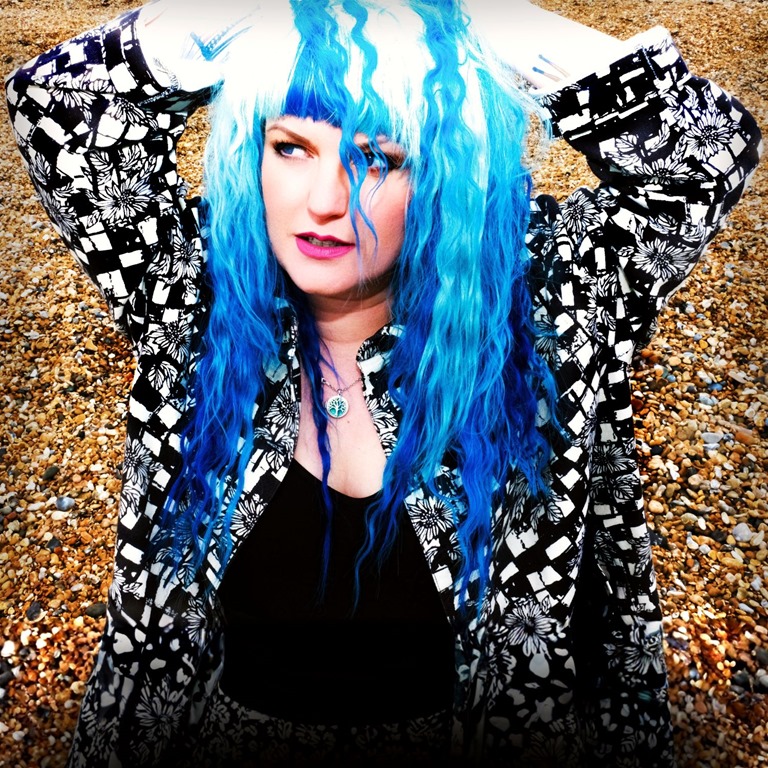
But while the Nu-Metal scene of the late 90s was dominated by blokes venting versions of adolescent rage (although Fred Durst was nearing 30 when Limp Bizkit released their debut album, and there always felt like a sense of arrested development hung around the genre – older guys making records for disaffected teens), the current scene is altogether more diverse, and most significantly, we’re seeing female-fronted acts like Eville breaking through and kicking arse.
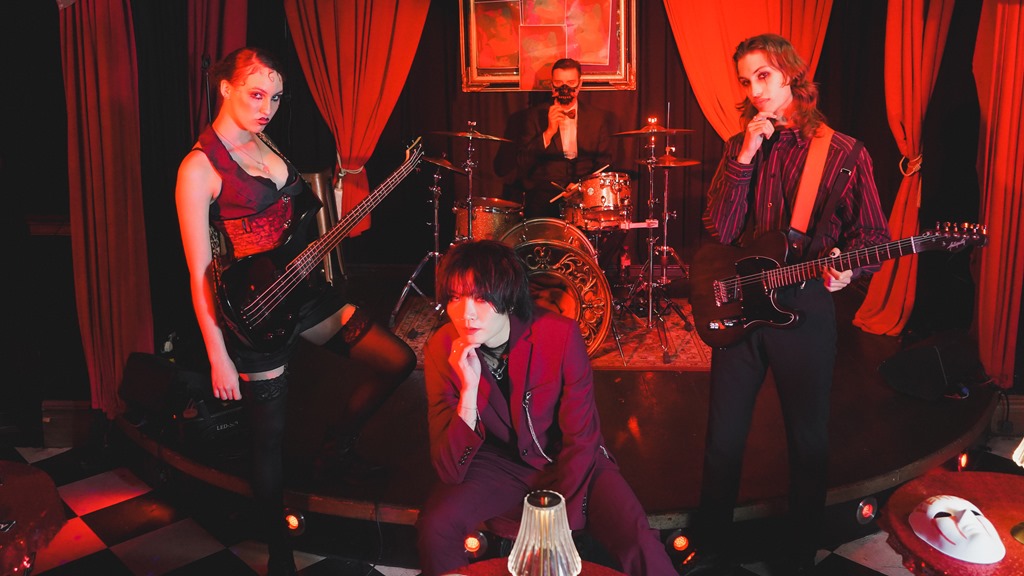
Smutclub Ldn share some common ground with Eville, as is happens, with whacked-out pop autotune colliding with skull-crunching riffs. And as such, ‘Elephant’ is a brain-melting identity crisis of a single: clocking it at precisely three minutes, it’s a mental mash-up of nu-metal, emo, and pop, all brought together and heated under compression, with explosive results.
The verse riff is a gnarly, churning beast which chugs and undulates menacingly, the chorus sounds like it belongs to a completely different song, and the breaks and bridges are something else again. How do you switch between hands-in the-air anthem and brutal slam-dancing and back again, and again, in just three minutes? ‘Elephant’ is positively schizophrenic, and love it or hate it, it’s the most inventive thing you’re likely to hear in 2026.
Irish synthwave outfit Tiny Magnetic Pets return with ‘Lost My Guiding Light (Again)’, a stellar single that reflects the search for hope and direction in an increasingly uncertain world, inviting listeners to consider what their own guiding light might be.
A compelling preview of their coming three-track ‘Astralux’ EP, slated for release on July 21, this is a bold reinvention of one of their most-loved tracks and Blending cinematic synth textures, soaring melodies and an irresistible electronic pulse, they transform the original into a vibrant new anthem.
Based between Dublin and Belfast, Tiny Magnetic Pets has become one of the most distinctive voices in contemporary electronic music since emerging in 2015. Here, vocalist Paula Gilmer, keyboardist-guitarist Sean Quinn and drummer Eugene Somers are joined by Seamus Quinn on bass.
Mixed and mastered by Tim Dorney, whose music career includes time as keyboardist of Republica, in addition to Flowered Up and Tin Gun, this release combines classic synth-pop songwriting with contemporary electronic production, bringing together melodic depth and club-ready energy.
“When we play live we like to do different versions from the records. Last year, we were asked to play a dance music festival in Dublin, so we re-arranged the opening track from our second album ‘Deluxe/Debris’ for an EDM audience, and it has now become the opening tune to our live shows,” explains Sean Quinn.
“We re-recorded this new version in 2026 and we feel it is significantly different from the original to warrant its own release and slight re-title: Lost My Guiding Light (Again) – a wee nod to Bowie’s John I’m Only Dancing (Again)…”
Paula Gilmer adds, “A re-imagining of two of our most popular live tracks for the 21st century dancefloor, this song is about how everyone at some point loses their way – in life, in work, in relationships, in faith but the theme carries more weight in 2026 with the whole world seemingly losing its way! What is your “guiding light” in 2026? Morality? Truth? Honesty? Love? Empathy? Compassion? Fill in the blank, post it on TikTok and hope it goes viral.”
AA
The Astralux EP also features two remixes of ‘Low Places’ by pioneering producer and DJ Paul Dakeyne, whose innovative work has helped shape electronic dance music for over three decades. A Ministry of Sound resident DJ, he has played sets for U2 and Kraftwerk. Endorsed by Paul Oakenfold and Fatboy Slim, he has created 250+ remixes, including for George Michael, The Cure, Tori Amos, New Order, Enya, Soft Cell, Erasure, Nancy Sinatra, Yello, and The Housemartins.
Combining the melodic songwriting and electronic textures that have defined Tiny Magnetic Pets’ sound, infused with adventurous new energy, ‘Lost My Guiding Light (Again)’ is a confident statement of where they are heading next, towards what promises to be the band’s most ambitious chapter yet.
A glimpse of the next phase in Tiny Magnetic Pets’ musical evolution, its rhythms and emotional core point towards the darker, more cinematic sound of their coming fourth studio album, A Black Frame. Out later this year, it is produced by Gareth Jones, whose work with Depeche Mode, Wire, Interpol and Nick Cave has made him one of alternative music’s most respected producers.
Norwegian cult act ULVER return again to the track ‘Hollywood Babylon’ from their previous album Liminal Animals (2024) for the best of all reasons: a stunning music video that has been long in the making. Following a fascinating remix by Gazelle Twin aka Elizabeth Bernholz that offered a brooding reinterpretation, the Norwegians now add this beautiful clip to the growing corpus around the original track.
AA
ULVER comment: “Working with our wonderfully mad old friend Christian Mona from the Bogus Blimp days never disappoints”, mastermind Kristoffer Rygg writes on behalf of Ulver. “He started to create this video before we released our last album (sorry about that) and he has finally delivered a splendidly grotesque little gem from within his Automated Bathroom. ‘Hollywood Babylon’ has never looked better! It is a distorted mirror of our times. Please feel free to stare into it a little too long.”
The Norwegian visual artist collective AKFF! adds: “2025 marked 20 years since Ulver made the animated music video ‘It Is Not Sound’ in cooperation with us”, Christian Mona states. “It has been a hypnotic journey through the Sea of Sorrows all the way to the Pinnacle of Truth. Thinking back on what a great experience it was to visualise and expand on Ulver’s universe, we started wondering why AKFF! hadn’t made more videos with Ulver. As it turns out, Ulver had been thinking along the same lines! And so the making of ‘Hollywood Babylon’ began.”
After an hour of 90s dance and indie, the PA switches to ‘Monkey Gone to Heaven’ and then ‘Disorder’ by New Order just as Ecce Shnak are due on. This is only partially representative of the eye-popping contrasts which define an unusual – but thoroughly fun – Sunday night in Leeds.
Ecce Shnak have been on my radar for a while, and the one thing you can guarantee from them is that whatever they do, it’ll be nothing you would have ever expected. This includes featuring on the recent single by EMF, ‘LGBTQ+ Lover’.
Yes, EMF have recent singles… Much maligned as one-hit wonders, they’ve been busy with new music in recent years, and while many of their live outings have been at retro festivals, they’ve remained a touring act in their own right. Tonight’s show is the final stop on a five-week tour of the US and Europe.
So, while I was eager to witness Ecce Shnak live, I was also curious how they’d go down with this crowd. They’re hardly similar to the headliners in style, and I’ve witnessed some quality supports receive dismal receptions from fans only interested in hearing the hits from the band they’ve paid to see.
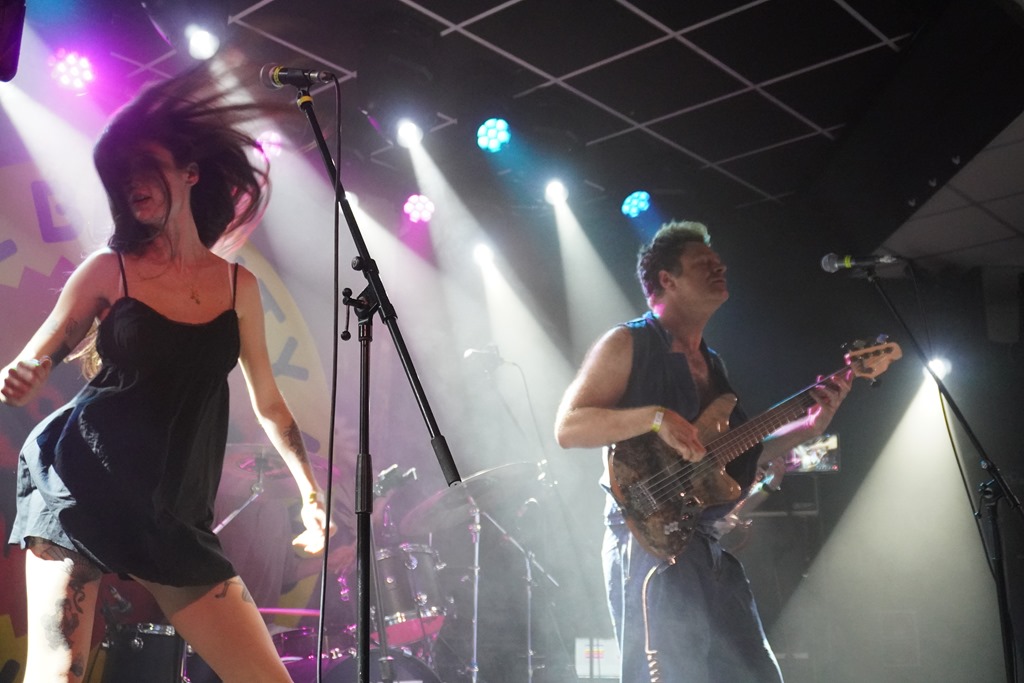
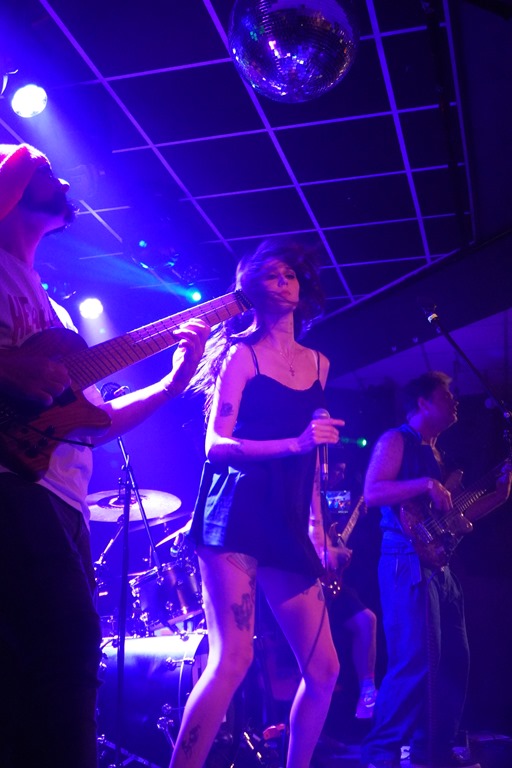
They arrive in a tempest of wild racket and opera, and it’s little short of dizzying, and instead of focusing on promoting previous releases, they drop a new song, ‘Owned Thyself’ second. Everything about the band is off the wall, with a 5-string bass and HOW many stings on that headless guitar? The neck is about 4” thick. They plunder prog and jazz elements, and the songs leap and lurch from here to there… and then they drop ‘Velociraptor Swayze’… It’s such a crazy, shackleless work, it feels like a gamble, but it’s at this point people start moving, and coming forward.
Ecce Shnak
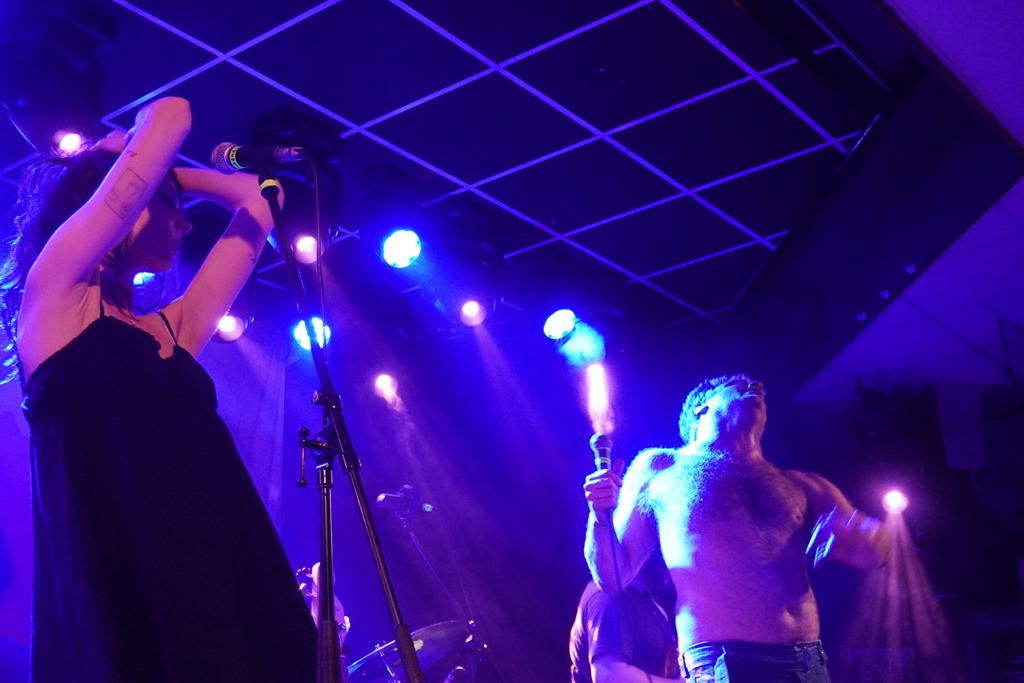
‘Jeremy, Utilitarian Sadboy’ – a song about Jeremy Bentham – goes heavy but still with operatic interventions. They go for the heavy finish to the set with ‘Fight Song’ followed by ‘Katie’s Wart’, going full-on growling metal. By rights, they should have cleared the room. But the crowd absolutely love it. There’s no question that Ecce Shnak have won them over, but it’s equally apparent that this is an audience open to the idea of something different, and for that, respect is very much due. There are no loud-talking lairy tossers, and everyone is clearly here to enjoy themselves, and not at the detriment of anyone else. There’s a woman waving a glowstick. It’s truly lovely.
Ecce Shnak
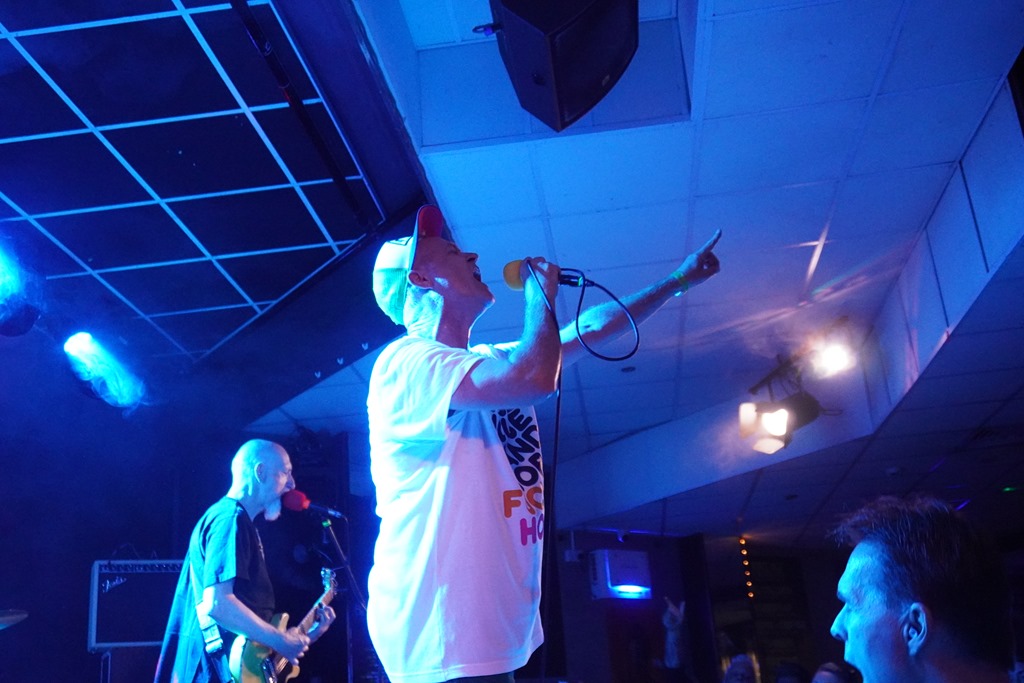
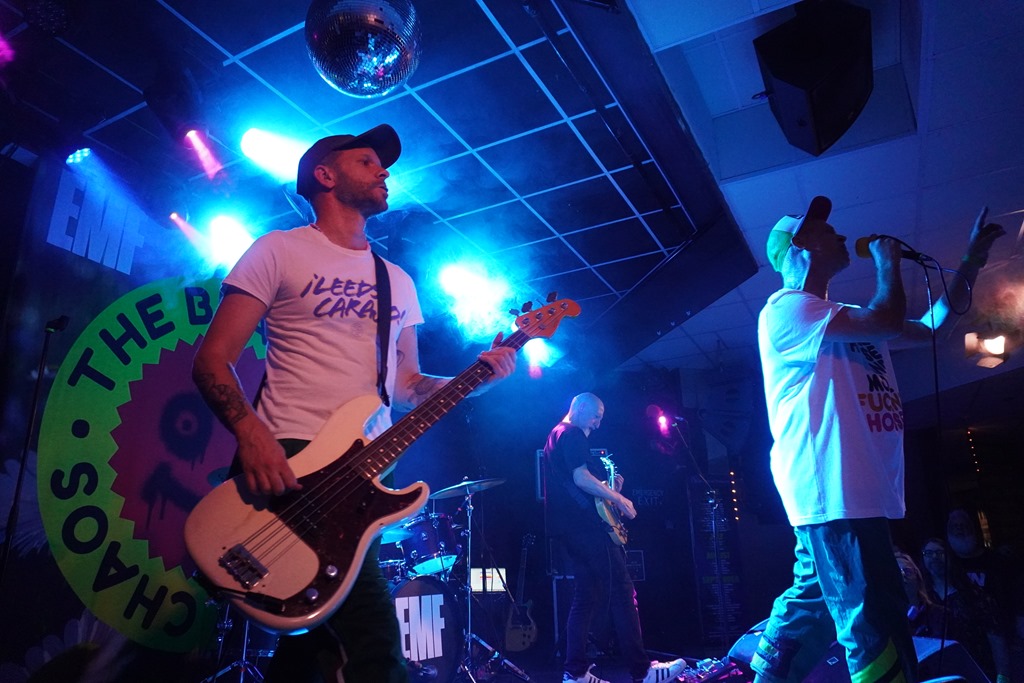
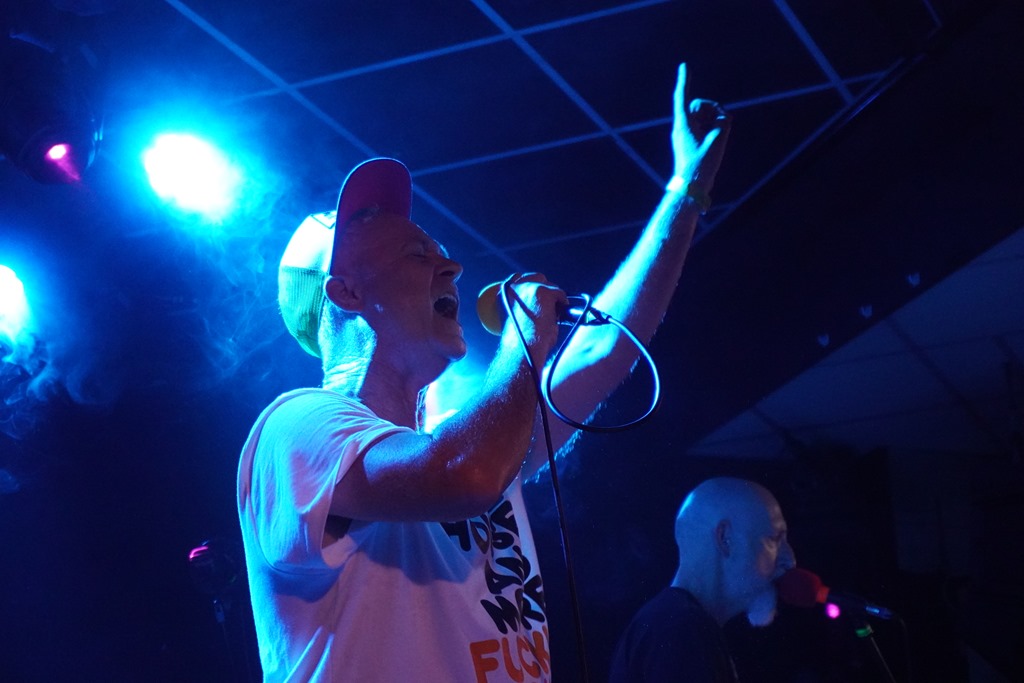
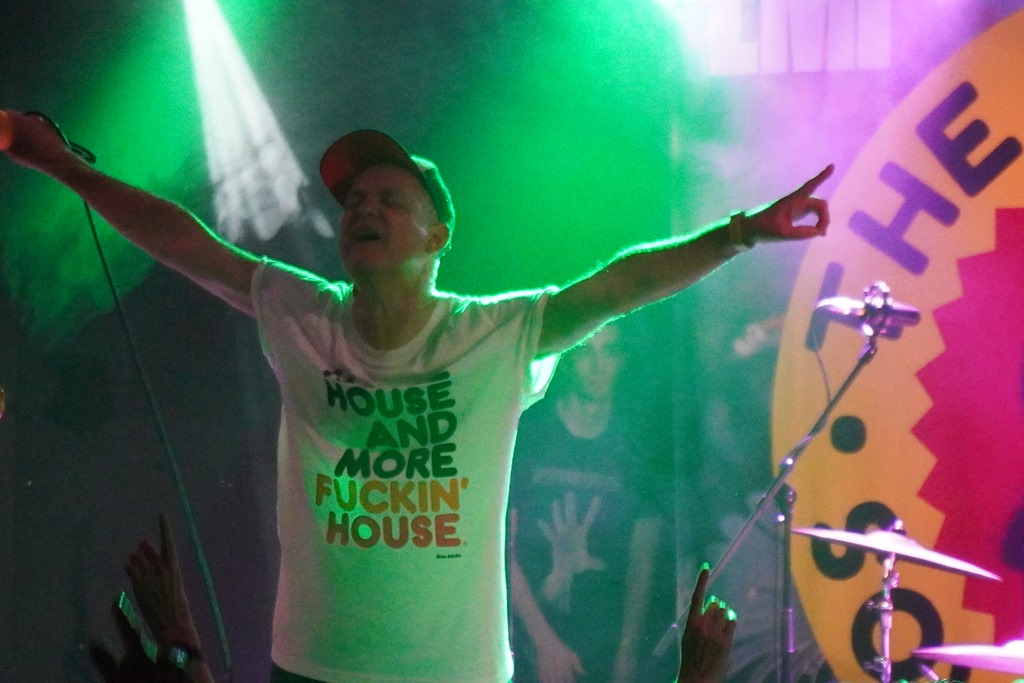
And EMF are very much here to give them a good time. EMF were never really one-hit wonders – although one hit is still more than the vast majority of bands achieve – and they front-load the set with a string of bangers that gets the crowd energised early. Despite having five albums to their credit, two from the last four years, half the set is still taken from debut album Schubert Dip – and fair play. They’re crowd-pleasers, and as a band they don’t only play with enthusiasm and work the crowd, but look to be genuinely elated to be up there. ‘I Believe’ lands second after ‘The Day the Music Died’ oner of just two songs from their last album, The Beauty and the Chaos, a banner for which provides the stage backdrop. Next up, ‘Lies’ maintains the pace. In fact, they don’t do slowies: it’s back-to-back uptempo anthems for the duration.
EMF
Homage to clubbing ‘Reach for the Lasers’ leads into a 90s dance medley which includes segments of ‘Pump up the Jam’, ‘Insomnia’, ‘Breathe’… and ‘Blue Monday’. Mid-set, ‘Children’ got the whole place bouncing like crazy. James talks of how he quit teaching for this, having taught in Keighley for some ten years, and how this is a homecoming show to conclude the tour, and the reception certainly makes it feel like one.
It’s a pretty bold move to open an album with a slow-paced and pretty bleak-sounding song which is more about dolorous atmosphere than chorus or hook. But then, Argonaut’s latest offering is pretty bold – albeit in an understated sort of a way. That likely sounds oxymoronic, so let me unpack it a bit.
After something of a purple patch, with the prolific spate of post-lockdown output which, over the course of a year and a bit and a new song each month saw the development of open-ended album Songs from the Black Hat (which ended up with a total of twenty tracks, with the inclusion of a couple of remixes), Argonaut were forced to make a change of pace. Life has a way of doing that – and events also resulted in a change of focus. The result is Interrupted – an album two years in the making, and by far the darkest and most introspective set of songs they’ve released. It’s not that the London DIY trio have always skirted darkness or introspection, but historically, it’s been balanced by lighter, poppier indie tunes. Now, though, they’ve embraced what one may call the therapeutic benefits of creativity, channelling – and coming to terms with – real-life issues and even trauma through those outlets.
As the accompanying notes lay things out quite plainly, Interrupted offers ‘Ten songs from the past year’s abyss, documenting breakdown, burnout, dementia, depression, memory, hope and healing’. This in itself is bold. Again and again, the conversation is ‘we need to talk about these things’, but the moment we do, there’s a sort of collective wince in society, on social media, among our friends even. We’re still not societally conditioned to deal with the difficult stuff. I can speak from experience here: following the loss of my wife at the age of 44, and finding myself as a single parent, I’ve had enough ‘well, I could be worse’ type responses to articulations of struggle to fill a book. And now, while witnessing the mental and physical decline of one of my parents, I’m finding a similar reluctance among friends to engage on a meaningful level on the subject.
Thankfully, there are always artists who are – not necessarily willing, but perhaps more compelled – to pour all of this into their work, perhaps because those in immediate proximity are found wonting when it comes to conversation, meaning that creative channels are the only channels available. The Twilight Sad’s latest album, The Long Goodbye is perhaps the most harrowing thing I’ve heard in years, but James Graham’s dealing with the loss of his mother to dementia through the songs is powerful beyond belief.
Interrupted, too, confronts real-life anguish. And so, after some digression, we return to that opening track. ‘We’re Not Hungry Anymore’ is a remarkable hybrid of jangly indie and post-grunge – the heavily chorused guitar carrying hints of Soundgarden’s ‘Black Hole Sun’, but mournful strings bring a different shade of melancholy, and Lorna’s vocal somehow manages to be cutesie and scared, giving vibes of Alison Shaw of Cranes. It culminates in a monumental crescendo.
Lead single ‘Leaves’ – which lands towards the end of the album – is similarly bleak, particularly Cure-esque and direct in its addressing emotional distress, here specifically on the topic of dementia. As Lorna writes on the single’s video, “I was thinking about the moon cycle and the new moon and wanted to incorporate that feeling into the music. The lyrics are about somebody who is getting older and their mind is starting to deteriorate. They can remember the past more than the present. I had the image of being lost in the woods and trapped inside their memories. It’s quite a personal song.”
AA
And in the personal lies the universal, the relatable. The last few times I’ve seen my mother, she’s talked mostly about her school days and her job. She’s 79, and has nothing much to talk about, and actually seems to recall very little, from any time since. She gets lost going to the village shop, despite having lived in the same village for a good twenty-five years. So yes, this resonates, and increasingly, friends – or friends of friends – tell of relatives – no longer just grandparents, but parents suffering a painful mental unravelling.
‘Hats Off’ lands in the region of Daisy Chainsaw remixed by The Cure, with a bassline that’s got the vibe of ‘Let’s Go to Bed’ while casting a nod to the niggly guitar bit in Prince’s ‘Kiss’ which fits with the post-punk pop funk vibe which goes some way to break the tension, and ‘I’m Not Getting Up After This’ is the perfect summary of a depressive episode, the encapsulation of both physical and mental exhaustion. ‘Sugarfree’ is one of the songs closest to what we’re familiar with from Argonaut, with Nathan’s gravelly, weary-sounding monotone providing a magnificent contrast to Lorna’s sweet, flighty tones, but something about it feels leaden, weighted – not in a lethargic way, but as if pulled by an emotional drag. ‘This Means Something, This is Important’, released a year ago while the album was still evolving, is another of the more upbeat, fizzy indie moments we’re used to, and ‘Unpredictable’ showcases their irrepressible pop penchant. The final track, ‘Rewind’ is heavy, Siouxsue and The Banshees gone sluge – it makes for a hard-hitting, climactic finale.
AA
Interrupted is often dark, bleak, intense, and incredibly sad, but still packs its fair share of poppy punk tunes to provide some balance. It’s a difficult album, and rightly so. It’s not meant to be easy listening. It’s taut, its pop moments propelled by a thunking bass and motorik grooves. It’s also an album with many depths. It’s perhaps not an album we’d have expected from Argonaut, and it’s likely not an album they themselves expected, or would have wanted to make. But it’s emotionally honest, and that is bold. It’s also probably their strongest release yet.
Fuck me, a new album by The Dwarves? They’ve now been going fully forty years. How? How is Blag Dahlia even still alive? They may have reined things in around the turn of the millennium, but no act this controversial, this wild, this excessive has a right to still be here after all this time. But we should be grateful that they are. The 80s were very different times, and while being perverse, gruesome, antagonistic, and all the rest for its own sake is a good thing – and G.G. Allin style shock for the sake of causing offence, disgust, or revulsion was never big or clever, and that we’ve moved on is a good thing… but. The danger is that we’ve come to a point where challenging artistic expression can be too readily conflated with misogyny or other discriminatory practices. No question, it’s a fine line, but confrontational art, at its best, challenges us to confront not only what’s socially acceptable but also our own boundaries and prejudices. Moreover, right now, is fringe art which is ugly and repulsive any more ugly and repulsive than mainstream discourse in politics or social media?
Unless it’s expounding ideologies of hate, is it perhaps not a function of art to test the boundaries still, as was always the case? The very purpose of punk was to raise a middle finger to the establishment, to be offensive to cultured sensibilities. Punk was rebellion. Somewhere along the way, something’s been lost. In truth, much was lost early on, when many punk acts signed to major labels in ’77 and ’78, but the spirit of punk remained, but underground. Now, much of what passes as punk is pathetically tame. Sure, Green Day gave us American Idiot, and used a major label platform to bring us their social and political critiques, but they were essentially no more than Clash copyists and fairly mild in their expostulations in real terms. The extent to which one can call the work of The Dwarves art is debatable, but it’s unquestionably punk in ethos.
The band which gave us gore, nudity, and an actual dwarf on the cover of their 1990 album Blood, Guts & Pussy (which packed twelve songs into just shy of thirteen minutes), and whose guitarist HeWhoCannotBeNamed performs live wearing a jockstrap at most, do what they’ve always done here: short, fast, abrasive punk songs about drugs and death and drugs and more drugs. The longest of the album’s fourteen songs is two minutes and two seconds long (‘Damned if I Do’, one of the album’s most accessible, catchy, and commercial songs, which packs in verses, choruses and a guitar solo); and the rest sit around the minute and a half mark.
And while PC is still not a concern for Dwarves, opener ‘Confused’ takes a balanced approach to gender confusion, touching on hypermasculinity within its squalling minute and eight seconds. ‘We Are The Scene’ melts together The Dead Kennedys and hardcore with some unexpected melody while flexing muscles.
AA
‘I’m Dead’ (which brings a heavy hint of The Ramones) and ‘I Wish You Were Dead’ seem to offer common thematic ground, albeit from different sides of the fence, and ‘Bad Drugs’ (a poppy tune about prescription drugs like Adderall), ‘Drug Lust’, ‘Too Messed Up’ and ‘Psychosis Tripping’ are all self-explanatory in their focus and frenzy, and much of this hopped-up set sits between The Dead Kennedys and Black Flack. It’s the quintessence of old-school punk, fast and furious, but with melodies packed and stacked, fun takes priority over shock or offence.
After last summer’s Saving Lilibet EP, Chess Smith continues her march back toward life-reclamation and self-possession with another slice of sparse yet crisp pop with intensely personal, autobiographical lyrics, in the form of ‘I’m Dead to You (And That’s OK)’.
It’s worth quoting the statement which accompanies the release, as it not only articulates the song’s meaning beyond the lyrics, but it’s an incredibly bold insight into an experience which few would be willing to articulate – and, essentially, she recognises that her experiences possesses a relatability. As I often say, within the personal lies the universal:
The single explores the very relatable fallout that occurs when relationships break down – and how women in particular often suffer the loss of friendships, support networks, and even their careers, as sides are taken, battle lines are drawn, and the people who you thought you could trust show their true colours… The people who you gave so much of yourself to, only for them to treat you like you never existed – or worse, tear you down, and drag your name through the mud.
More importantly though, I’m Dead to You is about turning these often painful realisations into positive self-affirmations – those people were never your friends… so don’t waste your energy missing something that you never truly had, and instead be happy that they’re no longer part of your life. Take away their power, take back your name, and eventually they’ll be consumed by their own toxicity… just as surely as they once tried to consume you.
While I can in no way claim to have experienced a precisely parallel journey, the loss of my wife at the age of 44, leaving me as a single parent with a ten-year-old daughter taught me lessons I had never expected. For example, when everyone says in the first couple of weeks ‘if there’s anything you need’ or makes some comment about keeping in touch, either they’re just saying it to fill the conversational space and sense of obligation, or they mean it until after the funeral, when everything returns to normal -at least for them. Supposedly close friends evaporate, and fast.
‘Took a break to give myself time,’ she begins her story, and we know straight away that this is a straight narrative. Some of the words are lost in the rush of energy and autotune, but the sentiment is clear: she’s not going to dwell on the people who don’t bother. Life’s too short, and friendship is a two-way street. It certainly shouldn’t be the one who’s experienced a major life event who should have to reach out and beg.
It may be that those ‘friends’ go about their lives in the assumption that if the persons doesn’t ‘reach out’ that they’re ok, but that demonstrates a lack of understanding. It’s much harder to ‘reach out’ in a time of crisis than it is to check in on someone who’s in the midst of one. So what do you do? Sink or swim. It’s not easy to cast off the people you’ve ached to hear from but who seem deaf to any previous intimations of struggle. But that is the only way to stay afloat. Grow a thicker skin. Fuck ‘em.
The fact that ‘I’m Dead to You’ is delivered as a bubbly, energetic, uptempo, and really quite busy pop tune is a double-edged: on the one side, there’s possibly an element of masking the anguish of abandonment beneath a polished pop surface, but on the other, and this is the top side, it’s a sassy celebration of empowerment, of cutting loose, separating from the wheat from the chaff, and recognising who your real friends are.
Postmodernism supposedly not only marked, but celebrated, the death of originality. Some time after the turn of the millennium, postmodern irony and the wit of parody began to evaporate, and now everything simply draws on explicitly stated influences. Art has become an endless treadmill of predictable recycling. There are rare exceptions, of course, and Chaidura is rare indeed.
Chaidura has been on the scene for a couple of years now, during which time he’s birthed an EP, Temple Paradise, and some standalone singles, showcasing styles ranging from JRock to emo, with his bio describing this work as ‘blending visual kei, emo, and alternative rock into a sound that’s heavy, emotional, and honest’.
Now resident in London, but raised in Asia, where, he says ‘beauty is often weaponized as a prerequisite for success’, ‘Plastic Beauty’ is the third single to be taken from forthcoming EP, Liminal. And what a single it is! It’s nothing short of an explosion of ideas– an entire album’s worth and more (hell, many bands with careers spanning decades don’t demonstrate this many ideas), packed into less than four minutes – leaping wildly yet also effortlessly and immaculately from one genre to another with each of the multitudinous segments.
And yes, the presentation is stunning – musically, of course, but also visually – taking cues from Adam Ant and Falco’s ‘Rock Me Amadeus’ – to forge something that is nothing short of spectacular, while at the same time presenting a strong message. Opening with a soft piano intro, we’re soon thrown into some loungey jazz with an understated drum ‘n’ bass beat before – a mere thirty seconds in – being hit with a ferocious blast of metal. The experience is akin to watching Roger Moore as James Bond being spun at organ-damaging speed in a centrifuge in Moonraker, one where you mind feels as if it’s been separated from your body and transported to another dimension. It’s like all of the new year’s fireworks from around the globe going off simultaneously. And yet, incredibly, it’s got a huge chorus with an instant hook that’ll be an earworm for a week. Nothing short of phenomenal. Now, excuse me while I go and lie down for a bit.
Friday 13th may be unlucky for some, but not for JW Paris – or their fans – with the eclectic ‘90s-grunge-meets-Britpop three piece’ dropping new single ‘Crazy’ as an opening salvo ahead of a new EP.
They premiered it at BBC Radio 1’s Big Weekend– a bold move, which takes some guts, but it’s one heck of a way to build anticipation with a massive audience. The power of mainstream radio may not be what it was back in the 80s and 90s – the fragmentation of the mainstream and the way we come to hear music is very different now, and the ubiquity of R1 has been diluted since the Internet reshaped the cultural landscape from around the turn of the millennium onwards, but it’s still the biggest single channel in the UK, with a weekly audience of almost three-quarters of a million. The Big Weekends feature big names and draw massive audiences, and are a big deal.
‘Crazy’ is a tune that’s right at home in this setting, not because it’s insipid churned-out digital chart-pop fodder, but because it is one of those songs that’s an instant grab, a massive, uptempo, singalong anthem that’s got a clear pop sensibility, but all the appeal for indie fans, too.
For those who are willing to go deeper than the immediacy of a huge chorus, the lyrical content is surely relatable to many, too, articulating ‘the madness that comes from repetition… the feeling of running on a treadmill you can’t get off, of doing the same thing over and over until it starts to warp your sense of reality. Built around the classic definition of insanity, the track digs into what happens when your routine becomes a loop, a trap, and eventually… a spiral.’ Who hasn’t been there, at least at some point? Where you wake up, go to work, eat, perhaps slump on the sofa in front of the TV, then sleep, and feel like life is passing you by as you spend weeks, which become months… etc. running just to stay still, merely existing just to keep paying the bills. It sucks. ‘Crazy’ doesn’t suck, though, and despite its subject matter, it’s uplifting and energetic, and it’ll surely make its way to a TV show or soundtrack of some sort soon.
The iconic Jah Wobble has teamed up with guitarist Jon Klein on Automated Paradise, their third collaborative album and debut album as a duo with Dimple Discs. Out March 27th, this eight-track collection is previewed by the invigorating lead track ‘Fading Away’, a track that pulsates with motorik drive and the raw electrical tension of British post-punk and new wave, its shimmering progressive layers seemingly surging through the circuits of life itself.
The pairing of post-punk legends Jah Wobble (Public Image Ltd.) and Jon Klein (Specimen, Siouxsie & The Banshees) is no coincidence. Initially combining forces on the Metal Box – Rebuilt In Dub album, released in 2021, they continue to collaborate – both live and creating music in the studio.
“Jah Wobble and I share a mutual desire to keep a momentum going at the centre of the creative process. So we keeping it moving and trust our instinctive decisions and ideas. Automated Paradise is essentially a collection of jams and sketches, all made very spontaneously. We’d made several albums together previously, starting with 2021’s Metal Box – Rebuilt in Dub, so he had a wide range of experiences and strategies to draw from,” says Jon Klein.
“‘Fading Away’ is an end-of-civilisation story, echoing one of the earliest themes of human literature and reflecting a persistent human anxiety about the fragility of social order.”
Jah Wobble adds, “Making this record with Jon Klein was (as ever) an absolute buzz . Totally in the moment. Proper post punk. Angry and humorous. ‘Fading Away’ was the first track we finished from this album. We did this record in a handful of very intense, spontaneous sessions. Right place, right time sort of thing”.
AA
This album follows two 2025 albums for Wobble - Dub Volume 1 (Dimple Discs) and the expanded reissue of the 2017 album The Usual Suspects, featuring 25 career highlights, re-recorded and including some of Wobble’s finest material, alongside tracks by Invaders Of The Heart and PiL.
This is Jah Wobble’s first post-punk album in recent years, following an array of travel and dub records. The brash guitar-driven tracks reflect his continuing preoccupation with the declining state of the nation. Driven by his experience working weekly at a music-based community project in Merton, along with Jon Klein, this record recalls the spirit of Mark Stewart – angry in an empathetic, constructive way. Like much of his recent work, the lyrical content was often inspired while traversing London’s transport system.
Jon Klein is a guitarist and producer best known as a member of Siouxsie and the Banshees from 1987 until 1994, which saw the release of the albums Peepshow, Superstition and The Rapture. Originally in the Bristol band Europeans, he then formed the glam-goth act Specimen and relocated to London, where he co-founded The Batcave nightclub. He has worked with Talvin Singh and Sinéad O’Connor, and co-produced a string of No. 1 albums for Warner-signed Spanish band Fangoria, fueling a decade-long streak of chart-topping success in Spain. His most recent work being as co-producer and guitarist with Jah Wobble.
Jah Wobble (born John Wardle) is a bass guitarist and vocalist from East London, whose career encapsulated genres from post-punk, dub and world music to experimental rock and electronic music. An original member of Public Image Ltd (PiL) from 1978-80, he made two groundbreaking albums with the band, which included the iconic Metal Box.