Posts Tagged ‘Techno’

Nocturnal Rainbow Recordings – 31st July 2026

Christopher Nosnibor

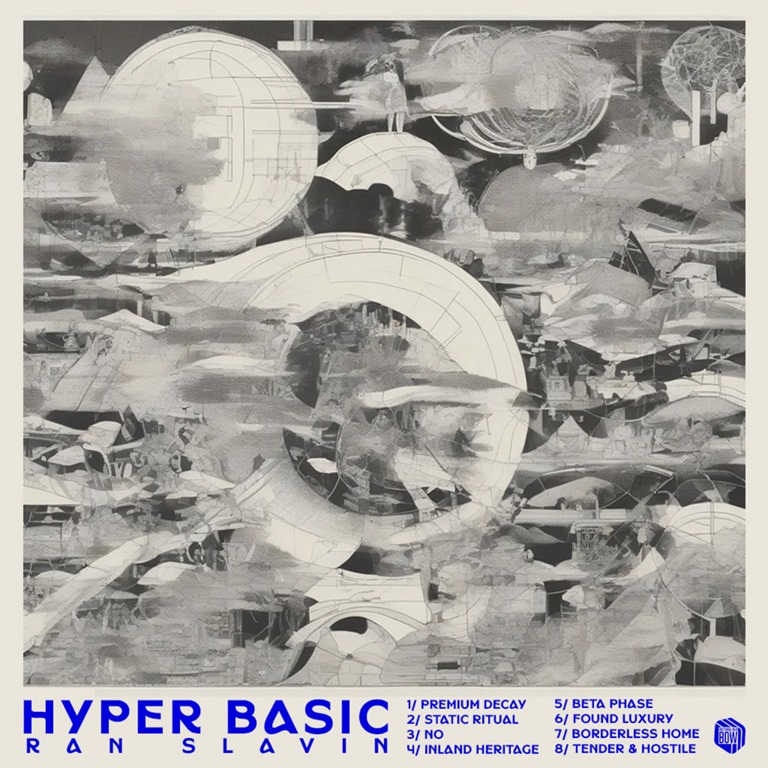
The title of Ran Slavin’s latest does, for all the world, sound like some slangy diss.

“I’m getting skibidi rizz.”

“Bruh’s hyper basic.”

“I can’t even.”

“Bruh.”

It’s been a while since I’ve penned any dialogue in a creative context, and it also transpires that it isn’t actually some slangy diss, but precisely what it is remains unclear, and the accompanying notes do little to solidify where we’re at here, focusing on informing us what the album isn’t, and what it doesn’t do, instead of shedding light on its actual objective:

‘Neither functional nor ambient, the album occupies a shifting territory where abstraction and physicality remain in constant negotiation – a deconstructed club language suspended between pressure, atmosphere, and perceptual displacement… Rather than offering release, Hyper Basic inhabits a state of suspension, where signals dissolve into beats, reduction folds into excess, and movement unfolds as much in the mind as on the floor.’

And so, from what I can discern, it doesn’t occupy any particular space, but hovers and ambulates in some ‘between’ space.

The ‘hyper’ seems to relate more to the schizoid energy which ripples through the album’s eight ridiculously hectic compositions. The first of these, bearing the title ‘Ritual Decay’ would, superficially’ suggest some snarling back metal grind, but what we get is some sparse electro groove, and ‘Static Ritual’ is infinitely more Gilles Peterson than John Peel, if you catch my drift. Still, while it may not be entirely my bag, I’d take Gilles Peterson over Jordan Peterson, or, for that matter, Gilles de Rais any day. And we shall move on.

It’s all pretty chilled, but for some reason, I personally find this kind of stuff impossibly tense. When the beats hit, it’s not that I fear bring grooved away, as much I wonder what will happen next.

This is very much a work steeped in the tropes of 90s and early 00s dance music – or, perhaps, more accurately, the sound of more underground club culture. Despite the insistent beats and vocal samples which drift in and out, Hyper Basic doesn’t even for one moment deploy the formula of the monotonous mainstream nightclub thud-thud-thud-thud. So that’s another thing it isn’t – a work of mainstream dance. Rather than glowstick territory, this is chin-stroking territory, dance music you don’t actually dance to, but reflect on, dissect, muse on the dynamics, the tones, the details of the beats, and the vibrations. The arrangements are sparse, and there’s space and separation between the beats and the low-key bass tracks.

There are moments when the introverted shuffles break out into all-out groove euphoria, as on the rushing bomp ‘n’ stop of ‘No’, which builds over the course of almost eleven minutes, but many of the tracks just flick and flutter along while whispers reverberate in the background. On ‘Beta Phase’ the beats turn harder, a thwocking metallic bin lid of a snare cuts through a woozy, rolling bass that’s dizzyingly dense and it’s anything but comfortable – although I suspect many would love it. A looped vocal snippet bobs to the surface here and there, too. ‘Found Luxury’ fires up a snarling, serrated bass which owes more to rock than dance, and it drives through a drifting wash of synths and samples amidst a rather conflict-filled semi-ambient concoction.

As with much of Ran Slavin’s work, Hyper Basic is hard to place, and just as hard to critique, largely because it doesn’t stay in one place long enough to get a handle on what’s happening. There are elements I just can’t get on board with, while accepting it’s a matter of taste, but it’s impossible to deny that Ran Slavin has a knack for bringing a unique slant to the dancier end of electronic music, and that Hyper Basic is anything but.

AA

a4168500375_10

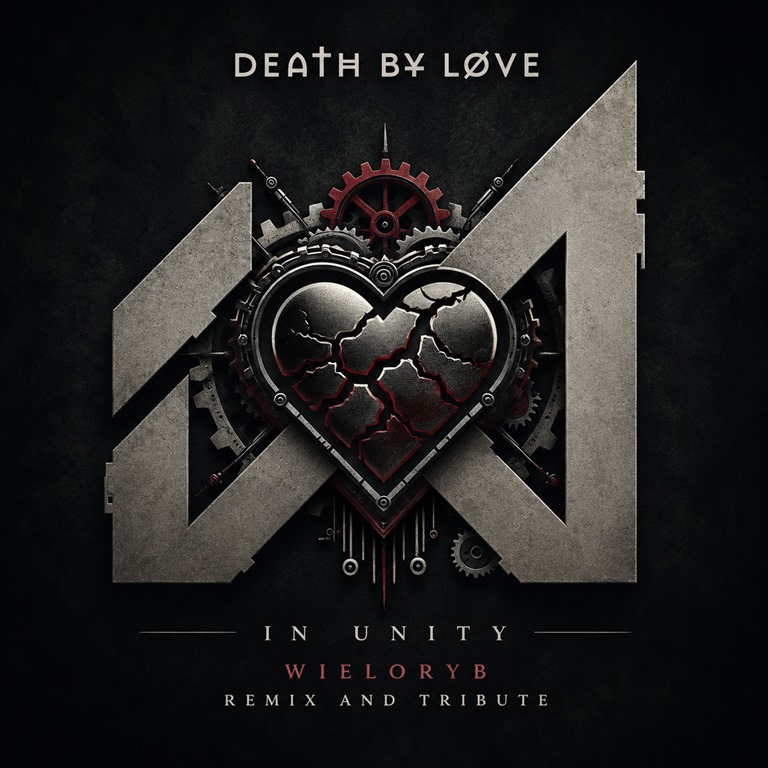
Trans-Atlantic dark-electronic duo DEATĦ B¥ LØVE presents their new single ‘n Unity (WIELORYB Remix and Tribute)’ which is dedicated to Wieloryb a.k.a. Paweł Kmiecik, a groundbreaking music and video artist, known forhis aggressive brand of industrial music and post-apocalyptic videos and who also, tragically, passed away just a month ago.

This two-track offering consists of "In Unity (WIELORYB Power Noise Remix)" and "In Unity (WIELORYB vs. PSYCHOTRIBE Tribute Remix)", for which the accompanying video was created by Wieloryb. This single arrives soon after the release of DEATĦ B¥ LØVE’s debut album 444, released via Distortion Productions.

A talented artist, Wieloryb was the dark pulse of Poland’s industrial music scene, emerging in Gdańsk in 1994 during an era of concrete, rust, and cold electronics. From his first recordings, Wieloryb struck without compromise. Electro industrial, EBM, and techno merged with noise, metallic rhythms, and haunting ambient soundscapes. The debut cassette "I" earned a Fryderyk Award nomination and opened a new chapter in Polish electronic music that was brutal, uncompromising, and devoid of light.

For decades, Wieloryb’s music has existed where aggression meets trance, and destruction gives way to contemplation. It is more than sound. It is a complete mechanical ritual, where raw electronics intertwine seamlessly with Paweł’s experimental visual art and video work, creating a singular aesthetic language of industrial melancholy.

“We dedicate this release to Wieloryb, Paweł Kmiecik, an extraordinary artist, producer, and video creator, whose vision left a lasting mark on the industrial scene. ‘n Unity’was the final remix he completed before his sudden and unexpected passing,” says Pete Guellard.

“His post-apocalyptic industrial landscapes sent chills down our spines, while his relentless rhythms and crushing soundscapes raised our pulse and demanded movement. His work was raw, uncompromising, and unforgettable. Thank you for everything Paweł. Your legacy lives on through the art you left behind. All profits from this release will go directly to support Paweł fmily.”

AA

986318

Christopher Nosnibor

Active since the mid-nineties, Chicago’s TATV GRAL (tätü ’gräl) are an industrial-leaning dark synth act, the vehicle of Allen Addington, and one very much represents the seedy, sleazier, grindier aspect of the scene. As they put it, ‘Forged in shadow, shaped by archetypal psychology, the gay male gaze, and the ritual power of containment’, and the songs in their catalogue are abrim with hints of fleshly sensuousness and dark desires pitched alongside pulsating beats.

The Treachery EP offers four versions of ‘Treachery’ – the original, plus remixes by DSTR (Daniel Myer of Haujobb), Tweaker (Chris Vrenna of NIN), and fellow Chicago industrial outfit [melter]. These are some names to be reckoned with, making this a significant release for TATV GRAL, making several steps up the ladder, so to speak. And it flexes some muscles, too.

AA

In terms of context, there’s a fair bit to this, from Hellenistic astrology to the psychology of James Hillman, we learn that ‘the song places these symbolic forces in dialogue with Coil’s ritual electronics, Kenneth Anger’s astrologically timed film work, and the Jungian tradition that informs them.’ Thankfully, knowledge of all of this is not a requirement when it comes to appreciating the song or the EP. But add to this the fact that Addington requested the project’s collaborators to not simply remix the track, but to draw out an emotional aspect not present – or at least, not explicitly conveyed – in the original, and it’s yielded some interesting results, which take it beyond the standard remix EP – thankfully. It’s a format that tends to feel lazy, delegating creative responsibility to others and milking material for all its worth and more, and more often than not I find I’m bored shitless of hearing the same song back to back to back with bigger beats or more bass or synth and stretched out over double the duration of the original… after Nine Inch Nails released Fixed, the remix EP had reached not only its peak, but its limit, as far as I’m concerned.

There are, of course, some exceptions, and this is one of them.

In its initial iteration, ‘Treachery’ grinds along, breathy, suggestive, with a pumping groove and with hints of DAF and Man 2 Man and Depeche Mode circa Black Celebration in the mix, and as when listening to ‘Stripped’, it’s hard to decide of you need a wank or a shower most.

The DSTR Remix is the longest of the three, adding almost a whole minute to the running time, and accentuating the heavy grinding bass synth and altering the vocals by downtuning them. The effect is weird, filthy, and vaguely menacing. The [melter] mix is all about the stomping beat and feels more aggressive, sweatier, more muscle-flexing. The arrival of the Tweaker Remix is well-timed, being altogether sparser, more minimal, and more expansive, picking apart the components and introducing significant space. You might say it’s less techno and more industrial, but whatever you say, it’s a dramatic shift in interpretation, and it works well.

AA

Editions Mego – 1st May 2026

Christopher Nosnibor

With absolutely no referencing of that animated Disney movie, the textual contextualisation for Russell Haswell’s latest sonic assault echoes what I’ve been saying – and writing – for some time now. I feel a small sense of elation… but equally a certain tiredness. I’m 50. And while no doubt global history is essentially a tale of innovation and destruction in equal measure, the last quarter of a century has felt truly hellish, as if the exponential pace of progress has run in parallel with an ever-accelerating desire to wipe ourselves as a species from the face of the planet.

It has been twenty-five years since the seismic events of 2001—when twin towers collapsed under terrorist attack and Coventry’s sonic insurgent Russell Haswell launched his inaugural salvo on the original Mego label with Live Salvage 1997–2000. The intervening era has delivered unrelenting turbulence: protracted wars, institutional corruption, a global pandemic, the resurgence of fascist currents, rampant media distortion, and omnipresent surveillance. For Haswell, a lifelong admirer of 1970s and 1980s dystopian cinema, the verdict is unequivocal: “Science Fiction is now!”

It’s hard to argue that the moment in which we find ourselves has all the hallmarks of every dystopian fiction ever imagined rolled into one unimaginable fusion, and that we are inching closer by the second to the end of days.

Haswell has long used sound to articulate the horrors of the 21st century, both as a solo artist and in collaboration, notably bringing additional layers of abrasion to Consumer Electronics, and while the accompanying notes detail quite extensively the equipment used, the influences, and the creative aims of Let it Go, my focus here is more on what it actually sounds like and the listening experience.

The first few seconds of the first track, ‘Exit Downwards’ are innocuous enough: a drone, nondescript, smooth – but within seconds its rent with shuddering glitches, squelches, and discordant clanks, not to mention the stammering thud of a particularly sharp kick drum. And over the course of seven minutes, it pumps and pounds blasts and bleeps like a circuit in meltdown. It’s pretty tense stuff, and descents, tension, and anxiety are recurrent themes not only in the titles, but in the formations of the compositions themselves.

‘Fall 3’ and ‘Fall 2’ follow the theme of descent, and manifest as wibbly collage works, while ‘The anxieties of our time’ is fairly straightforward in its implications and manifests as a head-swimming, dizzying panic attack, a meltdown in musical form, the crackling industrial glitch monster that is ‘Stress Testing’ functions on numerous levels. As much as the phrase relates specifically to financial, economic, and societal systems, there is also the stress test as it relates to the effects of physical activity on the heart, and, by association, it feels like an implicit hint of the stress we as individuals find ourselves subject to on a daily basis: how far can we – individually, and collectively – be pushed under the late capitalist model? At this moment in time, it seems like we’re close to finding out. And through swooshing sweeps and rippling fractures in sonic fabrics which twist and flare, Russell Haswell renders an aural replication of the overwhelming experience of life right now.

In comparison to some of Haswell’s releases, Let it Go is not particularly noisy or abrasive, but that doesn’t mean it’s any less intense. Even the ambient hums of ‘Curated narrative’ bring a hovering tension which is difficult to step away from.

Christmas is a difficult time for many, and while there’s no indication of what inspired ‘Thu 25 Dec 2025’, it buzzes and throbs for a relentless six and three quarter minutes like an angry hornet, trapped in a greenhouse which is slowly collapsing in on itself. The final track, the thirteen-minute ‘There’s always a bit of light somewhere’ seems to offer a thin ray of hope in its title, but the fine metallic scrapes and glistening edges which intertwine ominously and with no discernible form are far from comforting, and you find yourself on edge, sensing darkness visible and encroaching from all sides. Yes, There’s always a bit of light somewhere, but that somewhere isn’t here.

Let it Go is varied, exploratorily, and an artistic success, but it’s by no means the easiest listen. And for that, I say ‘good’. Embrace the challenge.

AA

eMego326CD front

20th March 2026

Christopher Nosnibor

With his debut release, Abel Autopsy makes his ambition clear, announcing that uunder is envisioned as a journey within a three-part series, with the next two releases in the series being overr and outt, and promising ‘dark, melancholic, shapeshifting worlds that slide between light and shadow’. Although the inconsistency of the double letters on this first release from those projected to follow disturbs my sense of necessary balance, I can close my mind to it while opening my ears and concentrating on the music.

The nine tracks take the form of layered, atmospheric synth-dominated compositions, and Abel Autopsy sets out the context for these thereal works, which evoke haunting (super)natural landscapes by electronic means.

“This started in my youth – pulling apart various musical instruments (battery powered) while in the woods of Appalachia. There was an eerie, ethereal vibe almost like something ‘other’ in the wilderness with me. That permeates through all of the songs and is woven in the mental tapestry throughout. This album is an exercise in capturing that – the balance between light and shadow, feeling another ‘presence’ with you that is not entirely from here.”

The vocals on ‘ghostride’ are muffled, indistinct, the words – if there actually are any – indecipherable, serving more as another instrument than anything else. The pieces are bold, sweeping, cinematic, the ambient tendencies given form by solid mechanised beats which are up in the mix. ‘unfound’ and ‘gates’ land in the space between later Depeche Mode and Nine Inch Nails, the latter also spinning in dance tropes and the haunting monasterial sounds of Enigma music.

He is very partial to the big thunderclap blast when making a change in key or tempo, or simply stepping up the drama – perhaps excessively so, as there are moments when things do feel a bit formulaic – something compounded by the comparative uniformity of the track durations, which are all within the range of 3:01 and 3:37 (three of the nine have a run time of 3:37).

‘mycenae’ tweaks the template to accentuate the contrasts between light and dark and thanks to a super-full, extra-low bass, goes darker than anywhere else on the album, and the crackling static which fizzes through the introduction of the heavier, more distorted ‘nihill’, which concludes the set, brings a sense of decay and a doomy finality.

There are some neat ideas spread across uunder, and the execution is similarly neat, with a clear attention to detail. More variety, particularly in terms of tempo and dynamics would likely create greater impact, but it’s a promising start, and it will be interesting to see how Abel Autopsy evolves over the next instalments of the trilogy.

AA

762177

26th March 2026

Christopher Nosnibor

Having slipped out ‘This and That’ as a forewarning of the imminent arrival of his ‘difficult third album’, the time is almost upon us for its unveiling. Just as it was six years between his debut, Grievous Bodily Charm and second album Touch & Go, so another eight years have elapsed since then, although he’s maintained his profile through touring – something which for him comes with the added challenge beyond the usual logistical matters with a wild stage act and even wilder and largely impractical-looking outfits. But then, Mr Vast is more than music. The creation of Henry Sargent of Wevie Stonder – perhaps the sole exponents of the cack-pop genre – Mr Vast is more than a musical project. It’s an entire world, where the Vast persona is all encompassing, bringing together music and performance art, and there are no half-measures here, Vast fully embracing the strange, the wonky, the incongruous and the improbable.

He’s at pains to stress that this isn’t art, though, and explicitly states ‘Mr Vast is not art. He’s something that happens to you. So let him.’ I rather feel that there’s no choice in this matter, really. The idiom goes that one should ‘expect the unexpected’, and this could well be a mantra for approaching Mr Vast – although it’s perhaps more appropriate to suggest that it’s all expected when it comes to his work. ‘Accept the expectable, yeah?’ he says on ‘Ants’, before blabbering on about ‘swan crisps’ and reflecting on deep water: the wrongness and the delivery remind me of Nathan Barley – perhaps one of the most underrated and uncomfortable sitcoms of the early 00s. ‘Failure is its own reward’, he croons moments later, spinning another classic postmodern dichotomy within a cocoon of New Age hipster jargonisms.

And so it was – and still is – that ‘This and That’ confounded expectation by being remarkably not-weird, a surprisingly danceable cut that could be legitimately referred to as a ‘bangin’ choon’. How serious or how ironic or parodic it is, remains unclear. Before we get to it on the album however, there’s ‘What’s Difficult About Being Stupid?’, which at twenty-nine seconds in length is more of a sliver of facetious frippery with a toy keyboard, and ‘Scatterbrain’, a sub-two-minute flourish of medieval folk absurdity that comes on like a collision between Horrible Histories and Steeleye Span. Or something. In this context, the pumping hyperactive acid beats of ‘This and That’ seems like a moment of sanity, despite its OTT KLF-style ‘stadium house’ / ambient / soul breakdown in the middle before going full-on happy hardcore. ‘Oh, listen to the sound effects… that’s fantastic’, he comments amidst a stream of conscious lyrics, before drum ‘n’ bass breaks drop.

Upping the Ante is appropriately titled: it’s peak Vast. ‘The Bench’ is almost – almost – a spoken-word vignette within a soft, mellifluous ambient composition, and it’s almost – almost – not weird or off-kilter. But then, as we learn a few tracks later in what seems like a confession of sorts, Vast tells us, ‘I Can’t Help It’. This track is another Hi-NRG work which incorporates drum ‘n’ bass and samples but breaks out into derangement worthy of a Brett Easton Ellis character – but there’s some observational content in the mix, too.

‘Neural Preening’ takes the form of jerky, quirky early eighties electronica, a bit Devo, a bit Thomas Dolby, a lot hyperactive. Keeping up with the sheer range of what’s going on is mind-bending, and while the gentle acoustic ‘Guess Who’ does offer some breathing space, it does so while offering something a bit trippy, a bit Syd Barrett era Pink Floyd. Then he goes and spins things into a different orbit with the murky groove of ‘Crumpet Man’, which could be a ‘Born Slippy’ meets Tubular Bells for 2026 if he wasn’t talking about animals, muffins, and pancakes.

It would be easy enough to simply bracket this as ‘experimental’ – and also ‘barking’ and ‘batshit’, which I’ve probably done myself before – but this fails to give due credit. Sure, there’s a certain sense that Mr Vast’s main purpose is to explore the furthest fringes with no regard for musical or social norms, instead seeing what new novelty oddness he can create, but equally, one gets the impression that this isn’t forced gimmickry, but simply how his head works – this is the work of someone who is wired differently. He doesn’t so much think outside the box, but exists outside the box, while performing origami on said box, which is, of course full not only of frogs, but newts and Natterjack Toads, all of which may or may not exist when the box is closed or folded in a certain way.

Some might think that with his evident ability, Sargent could make music that’s far more commercially viable, but as a writer who thought it would be a doddle to knock out a genre novel and actually get paid for this, only to find that the literary Tourette’s kicks in after a few paragraphs or pages. In other words, he really can’t help it. And this is a good thing. There’s too much bland shit out there. There’s too much manufactured shit out there. There’s too much shit out there, full stop. But there’s a real fear amongst musicians that they need to confirm to have any chance of success – whatever that is – and reach an audience and survive. Mr Vast exists not only outside of this, but in his own world, one almost devoid of reference points, comparisons, and peers. And this is what we need more of in the creative community. Arguably, such freedom to disregard pretty much all influence and all trends is a luxury, but to submit to conformity is to surrender the foundations of what it is to create.

Upping the Ante is warped, weird, and dances to its own tune and no other. It deserves applause – and your listening ears.

AA

crump yellow test

OMEN CODE reveal the pulsating and vibrant new SF-track ‘Tensor’ as the sinister final advance single taken from their forthcoming album Alpha State. The debut full-length has been announced to be released on December 5, 2025.

OMEN CODE comment on ‘Tensor’: “This was the second Omen Code track that I have recorded as a vocalist”, frontman Agi Taralas reveals. “Everything about it came very natural to me and exactly in the way that the vocals turned out in the end. As far as I am concerned, this track includes a few Nitzer Ebb tribute moments, which is hardly a surprise as they have largely shaped my personal preferences in electronic music.”

AA

With their debut album Alpha State, OMEN CODE deliver the sound of the future – and the future is grim and dark! Their future is also firmly built upon the remains of the past. Certainly constructed to fill the dance floor, the international duo channels the bleak, cold precision of mid-tempo FRONT LINE ASSEMBLY and the cinematic story-telling soundscapes of John Carpenter electronics into a thrilling sound that is both resurrecting a classic 80s vibe and also fresh at the same time.

OMEN CODE are the new rising star on the EBM firmament. Deep, dark, and gritty industrial sounds are channelled into captivating mid-tempo tracks that create the atmospheric feeling of a dystopian future ruled by technology and marked by social decline.

This grimdark science fiction approach is not meant to indicate that OMEN CODE embrace any political agenda or message. Rather the international duo took inspiration from the writings of Philip K. Dick and Alfred Bester as well as cinematic masterpieces by British director Ridley Scott such as Alien and Blade Runner among others. 
OMEN CODE were originally intended as a one-time project by Kevin Gould. The engineer, programmer, and lyricist was a member of the English Industrial EBM trio JOHNSON ENGINEERING CO. together with Sean Bailey and Ian Hicks, which released the album Unleash in 1988. He went on to found the electro-industrial act ELECTRO ASSASSIN with Ian Taylor. Following the release of Jamming the Voice of the Universe (1992), Taylor was replaced by Richard McKinlay with whom the next albums Bioculture (1993) and The Divine Invasion (1995) were recorded.

When vocalist and lyricist Agi Taralas was hand-picked from a stack of applications for the frontman position, the chemistry between the two artists proved so productive and strong that Gould and Taralas decided together to turn OMEN CODE into a permanent project that would also aim to perform live. The vocalist had already left his mark on the scene in a joint project with German electronic musician Stefan Böhm under the moniker OUR BANSHEE that released an album entitled 4200 in 2017.

AA

a95fced5-cee8-3410-d640-5c8912c593a1

British industrial techno/gabba artist JUNKIE KUT is excited to reveal his new single ‘OutPSYders,’ available on the main digital streaming platforms.

Following the release of last year’s ekstasis album, JUNKIE KUT returns more fierce than ever with his blistering new anthem for the outcasts:

“So many of us struggle to live in mainstream culture, so I wanted to make a track of optimistic rage, dedicated to the people who don’t fit in; the goths, the ravers, the punks, the geeks, the freaks – its a battle-cry for individuality in a painfully homogenous world.”

AA

Junkie Kut fuses industrial, punk and metal with the sounds of speedcore, gabba, techno & trance. Fresh from opening the main stage at both Resistanz Festival and Infest this year, Junkie Kutis bringing a wake up call to our ‘culture of despair’ with his fierce energy, raw passion and psalms of freedom.

Destroying traditional genre boundaries, he is recognised for confrontational live shows in both the industrial / alternative world and the digital hardcore / speedcore network – performing at hardcore raves and cybergoth festivals worldwide. Playing on stages with the likes of Aesthetic Perfection, Zardonic, Deviant UK and Ayria, as well as countless iconic hardcore festivals such as Hardshock, Pokkie Herrie, Terrordrang and Berlin’s F*ckParade – it has built a loyal fan base in Germany, Netherlands, and the UK.

Inspired by radical counterculture and neo-shamanic visions of a future utopia, JUNKIE KUT brings a refreshingly optimistic battle-cry to our lost society and summons the magick of our collective emancipation. This is music for the outPSYders!

AA

'OutPSYDers' Single Cover

Filmmaker Pavel Vishnevsky returns to collaborate again with Paradox Obscur, bringing a dynamic new visual interpretation to ‘Like A Freak’, an electrifying track from IKONA, the recently released new album by the Greek synth duo.

In a vivid performance, Nicola Di Pierro defies cliché and convention, embodying the song’s spirit of freedom and self-expression – because everyone, regardless of age, has the right to dance. The result is a cinematic celebration of exuberance and individuality, amplifying the pulse of Paradox Obscur’s kinetic sound.

‘Like A Freak’ opens side 2 of IKONA with a wild jolt, pulsing with the edge of the Hexagon house music label’s rebellious spirit. Powered by the Behringer Crave synthesiser, it spits out raw analog grit – the bass growls, the synths snarl – creating a feral, ecstatic soundscape that is as visceral as it is infectious.

Lyrically, ‘Like A Freak’ explores the duality of ego; the composed persona we present to the world versus the wild, unfiltered self that thrives in secret. It is a song for those sweaty, sunrise hours when inhibition fades, judgement dissolves, and you move only for yourself as you ask: Does it make you click? / Now it’s time to go deep. / Way deep. Like a freak. / Taste my analog kick!

AA

0631b1dae417a364c26f8af59510d7ba29ffd0fe

Nocturnal Rainbow Recordings – 5th September 2025

Christopher Nosnibor

One significant downside to digital music formats is that is reduces the dimensions of the experience. With a record, and even a CD, there is a physicality which is in many ways integral to the experience. I’m not here to sell the whole multi-sensory experience and tactility of vinyl line: yes, I grew up with vinyl, and in the 90s, a new LP was maybe £7.50 while a CD was £11, so I would often buy vinyl simply because I could get more music for my money. And records do scratch, sleeves get bent, and generally, vinyl requires more care than a CD, so I’m as much a fan of 5” silver discs as I am 12” black ones. And now, vinyl has become something of a fetishised luxury item: as much as there’s still pleasure to be had from sliding a thick chunk of wax cast in whatever hues from a glossy, heavy card sleeve, there’s sometimes a sense that they’re all trying too hard, and the £30 price tag takes some of the shine off the experience. There are a few exceptions – recent Swans releases have been works of art in every sense, and the physical formats have added essential dimensions to music which is something more than just some songs, recorded.

Had Ran Slavin’s latest offering been given a vinyl release, it would have been a triple LP, containing as it does thirty tracks, with a running time of almost two hours. It would have been epic. But despite having released previous albums on esteemed labels including Mille Plateaux, Cronica, and Sub Rosa, it’s unlikely that Ran Slavin has the kind of fan base that could justify, from a label perspective, a triple-vinyl release. But what Nocturnal Rainbow Recordings have done here is interesting, and utilises the digital format in a novel way, by offering alternative artwork in recognition of the album’s multi-faceted nature. Yes, it’s been done by major artists who’ve released physical albums with variant covers, with a view to enticing hardcore fans to buy multiple copies and thus increase sales and enhance the chart position (The Rolling Stones’ Hackney Diamonds probably wins the award for the pinnacle of pisstake on this score), but the idea of buying an alternative digital cover for a nominal price isn’t something I’ve seen before.

As the notes on the Bandcamp page explain, ‘Just as the music migrates across genres, the visuals migrate across states of being, extending the album into a network of parallel identities. Together, they construct a fragmented yet coherent cosmos, where each image is both an entrance and a deviation, multiplying the ways Neon Swans can be seen, heard, and inhabited.’

Appropriately, Neon Swan doesn’t quite sound like anything I’ve heard before, either. To unpack that, it contains many elements which are common and familiar. There’s sparse techno, minimal dance cuts with sped-up vocals and swathes of space between low-key beats and glitchy grooves, as represented by single release and album opener ‘tell///me///now’ – one of many titles which reflect the sense of fragmentation and juxtaposition which define the album (‘s4dert1ac’ and ‘d3xr3rity’ provide other examples, but then there are the likes of which also disrupt the conventions of language in the same way Slavin disrupts the language of genre tropes).

‘audio ease my pain’ plunges into darker territory, while introducing rap vocals atop heavy hip-hop beats (although there’s an instrumental version as well further on, which offers a different perspective again on the same material). Elsewhere, ‘c-r-i-m-s-o-n-schema’ brings spacey, spaced-out bleeps, heavy percussion that has a late 90s feel, a blend of The Judgement Night soundtrack’s melding of rap and rock, and the Wu-Tang Clan.

For all of the space, the reverb, the minimalism, something about tracks like ‘searching_heart’ is quite claustrophobic: the intense repetition and synthetic feel, paired with crackling fizz, brain-melting glitches and some grinding bass tones. It may be constructed using the fundamental elements of dance music, but this is not dance music. Electronic music to induce uncontrolled spasms and twitches isn’t a genre, but if it was, Ran Slavin would be a leading exponent.

It’s a long album, with a lot to digest, and as it thumps and wobbles and glitches away, snippets and fragments collaged across one another, there are times it all feels a but much, a bit bewildering. At times it’s draining, exhausting, at times you simply zone out, and often, I find myself questioning the wisdom of persisting with it. The vibe is that of the kind of underground clubs I never got on with in the 90s and early 00s, and I’m particularly reminded of the time Whitehouse played an Optimo night in Glasgow in 2003: I was there for Whitehouse, who played for forty minutes starting around midnight, and the music being played was rather in the vein of the more groove-centric cuts on here. The people there for the DJs weren’t happy for the low-key electro pulsations to be paused for the noise and antics of Bennett and Best, but for my part, I struggled to get into the low-key electro pulsations. But the other reason I recount this experience, challenging in its incongruousness, is that in places, Neon Swans feels incongruous with itself, an album riven with unreconciled contradictions.

The execution of Neon Swans is hard to fault, and it does cover considerable ground, with range, over its expansive duration. But it is sprawling in its scope, its focus is variable, and it is very long. And it’s maybe better with drugs.

AA

NRR38 art 1