Christopher Nosnibor
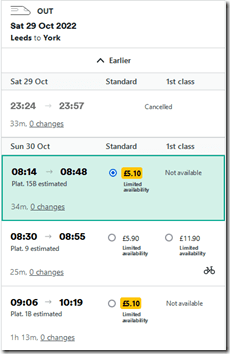
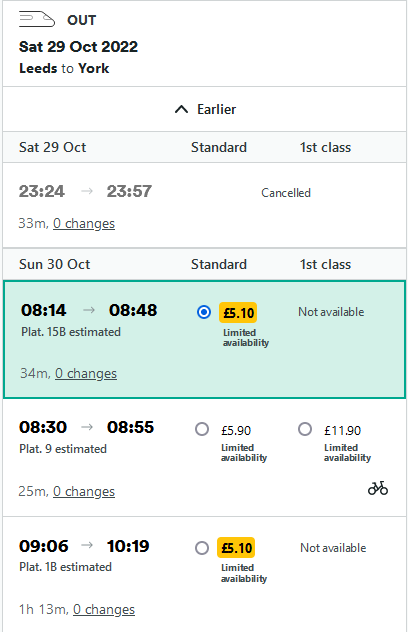
I am not happy. I was supposed to be at a gig in Sheffield this evening – a gig that had super-early doors – 18:30 – and a super—early finish (22:00). When booking the ticket for the gig, I checked the trains, and there was a 23:05 that got me home some time a little after midnight. Now, the last train home is at 21:22. I could split the journey, and make the 22:25 train to Doncaster, arriving into Doncaster at 22:49. But it only connects with the 23:50 out, which thanks to a lengthy wait in the arse-end of nowhere, takes 9 hours and 58 minutes, arriving into York at 08:48. Getting a train to Leeds is marginally, better, but not really: the sole train that goes via Leeds instead of Doncaster arrives in Leeds at 23:27, missing the 23:25 by 2 minutes, and so getting into York at, or there’s the 23:05 from Sheffield to Doncaster, which then connects to the 23:50 to Leeds, which, having missed the cancelled 23:24 means waiting for the first train out on Sunday at 08:14. No thanks.
This is not a criticism of striking rail staff: there are no strikes involved here. The reduced timetables are companies, heavily subsidised by the government, cutting services to maintain maximum profit. When I say cutting services, it’s not really a service when you can’t get anywhere when you need to.
They may not have sufficient staff to run the services, but why is that? The mantra that ‘no-one wants to work anymore’ is quite simply bollocks. It’s just that no-one wants to work to the detriment of their health and wellbeing, no-one wants to work two or three jobs to then have to still find time between shifts to queue at the local foodbank. No-one wants to work themselves to an early grave without spending any time with their families. People work to live, they don’t live to work, unless they’re deranged.
At a time when the economy is on its knees, the government claim to be supporting both people and businesses. But what gig venues need is for people from beyond the immediate catchment to be able to attend live music shows.
Back in 2014, I published a collection of essays entitled The Changing Face of Consumerism, which focused largely on the demise of the high-street record store and the like. Things felt pretty bleak then, but these were positively halcyon times compared to now, where we’re living in an amalgamation of every dystopian future ever written or dramatized.
Time was when travel was considered a luxury – but that related to air travel, not domestic rail. It simply should not cost more to travel domestically than to travel overseas. And in looking to book tickets for non-existent return to tickets from York to Sheffield, I noticed the price was around £28. Given that it’s approximately 50 miles between the two cities, that’s around 25p a mile, around 5p per mile more than the average vehicle, be it petrol or diesel. It wasn’t so long that it was perhaps £17. Similarly, pre-pandemic, a return to Leeds was around £12. Not it’s about £18. This cannot all be put down to rising fuel prices, and however much the government insist it’s all down to ‘Putin’s war on Ukraine;, this was escalating long before the tensions did.
But with crippling inflation and real-time wages crashing, like many people, I don’t have the same disposable income I had before, and so I choose the events I attend with a no small amount of consideration. To now not be able to attend because it’s simply not possible to travel isn’t only frustrating for me: the rail providers have lost a ticket sale, and the music venue has lost the sale of maybe three or four pints, and the band potentially, say a T-shirt or CD sale, in a climate when bands only survive by the skin of their teeth by selling merchandise on tour because everyone’s streaming music nowadays and the only people who make off that are the streaming platforms and major labels.
It’s a domino sequence, and what should be clear from this real-life example is that by cutting public services, or running what should be public services privately, for profit and the benefit of shareholders, is that the people who actually require the service are the ones who suffer, but it also has a knock-on effect to many other areas of the economy. The venue sells fewer pints, so they buy in less beer; the breweries sales decline, especially in the face of rising production costs and small breweries fold, large ones cut staff to reduce costs against declining sales. The staff who’ve been laid off don’t have an income, let alone disposable income to go to gigs, to go to pubs and bars, to go to coffee shops, to have meals out.
We no longer manufacture or have any industry to speak of: we’re dependent on people dining and drinking out, on going to the cinema, on going bowling, attending sporting events, on watching live music.
So when these tertiary industries are crushed, so is the nation as a whole, because there is nothing else. How does this stack up against the aim for growth and a high-skilled, high salary economy? This is, of course, a rhetorical question.
Call it trickle-down economics, call it what you like: the fact is that giving money to the rich, be it by tax breaks, or allowing major corporations to siphon off immense profits to divvy out to shareholders and top-flight executives does absolutely nothing for the majority of people, be they working people, laid-off people, or zero-hours contracts people who are statistically in work but in reality earning nothing.
One can’t help but feel that capitalism is slowly suffocating itself, and at an accelerating rate. Before long, the top 5% will own everything while the rest are dying in the gutter, at which point the elite will have no-one left to milk anything from. But until that day, they’re just going to keep on draining every last drop.
Fuck’s sake. I just wanted a night off with beer and live music over the county border.






Russell Haswell – Let it Go
Posted: 28 April 2026 in Albums, ReviewsTags: Album Review, Ambient, Consumer Electronics, critique, Dystopia, Editions Mego, electronica, Experimental, Let it Go, ominoius, Russell Haswell, social commentary, soundtrsck, Techno
Editions Mego – 1st May 2026
Christopher Nosnibor
With absolutely no referencing of that animated Disney movie, the textual contextualisation for Russell Haswell’s latest sonic assault echoes what I’ve been saying – and writing – for some time now. I feel a small sense of elation… but equally a certain tiredness. I’m 50. And while no doubt global history is essentially a tale of innovation and destruction in equal measure, the last quarter of a century has felt truly hellish, as if the exponential pace of progress has run in parallel with an ever-accelerating desire to wipe ourselves as a species from the face of the planet.
It has been twenty-five years since the seismic events of 2001—when twin towers collapsed under terrorist attack and Coventry’s sonic insurgent Russell Haswell launched his inaugural salvo on the original Mego label with Live Salvage 1997–2000. The intervening era has delivered unrelenting turbulence: protracted wars, institutional corruption, a global pandemic, the resurgence of fascist currents, rampant media distortion, and omnipresent surveillance. For Haswell, a lifelong admirer of 1970s and 1980s dystopian cinema, the verdict is unequivocal: “Science Fiction is now!”
It’s hard to argue that the moment in which we find ourselves has all the hallmarks of every dystopian fiction ever imagined rolled into one unimaginable fusion, and that we are inching closer by the second to the end of days.
Haswell has long used sound to articulate the horrors of the 21st century, both as a solo artist and in collaboration, notably bringing additional layers of abrasion to Consumer Electronics, and while the accompanying notes detail quite extensively the equipment used, the influences, and the creative aims of Let it Go, my focus here is more on what it actually sounds like and the listening experience.
The first few seconds of the first track, ‘Exit Downwards’ are innocuous enough: a drone, nondescript, smooth – but within seconds its rent with shuddering glitches, squelches, and discordant clanks, not to mention the stammering thud of a particularly sharp kick drum. And over the course of seven minutes, it pumps and pounds blasts and bleeps like a circuit in meltdown. It’s pretty tense stuff, and descents, tension, and anxiety are recurrent themes not only in the titles, but in the formations of the compositions themselves.
‘Fall 3’ and ‘Fall 2’ follow the theme of descent, and manifest as wibbly collage works, while ‘The anxieties of our time’ is fairly straightforward in its implications and manifests as a head-swimming, dizzying panic attack, a meltdown in musical form, the crackling industrial glitch monster that is ‘Stress Testing’ functions on numerous levels. As much as the phrase relates specifically to financial, economic, and societal systems, there is also the stress test as it relates to the effects of physical activity on the heart, and, by association, it feels like an implicit hint of the stress we as individuals find ourselves subject to on a daily basis: how far can we – individually, and collectively – be pushed under the late capitalist model? At this moment in time, it seems like we’re close to finding out. And through swooshing sweeps and rippling fractures in sonic fabrics which twist and flare, Russell Haswell renders an aural replication of the overwhelming experience of life right now.
In comparison to some of Haswell’s releases, Let it Go is not particularly noisy or abrasive, but that doesn’t mean it’s any less intense. Even the ambient hums of ‘Curated narrative’ bring a hovering tension which is difficult to step away from.
Christmas is a difficult time for many, and while there’s no indication of what inspired ‘Thu 25 Dec 2025’, it buzzes and throbs for a relentless six and three quarter minutes like an angry hornet, trapped in a greenhouse which is slowly collapsing in on itself. The final track, the thirteen-minute ‘There’s always a bit of light somewhere’ seems to offer a thin ray of hope in its title, but the fine metallic scrapes and glistening edges which intertwine ominously and with no discernible form are far from comforting, and you find yourself on edge, sensing darkness visible and encroaching from all sides. Yes, There’s always a bit of light somewhere, but that somewhere isn’t here.
Let it Go is varied, exploratorily, and an artistic success, but it’s by no means the easiest listen. And for that, I say ‘good’. Embrace the challenge.
AA