Posts Tagged ‘Noise Rock’

Ipecac Recordings – 18th September 2026

Christopher Nosnibor

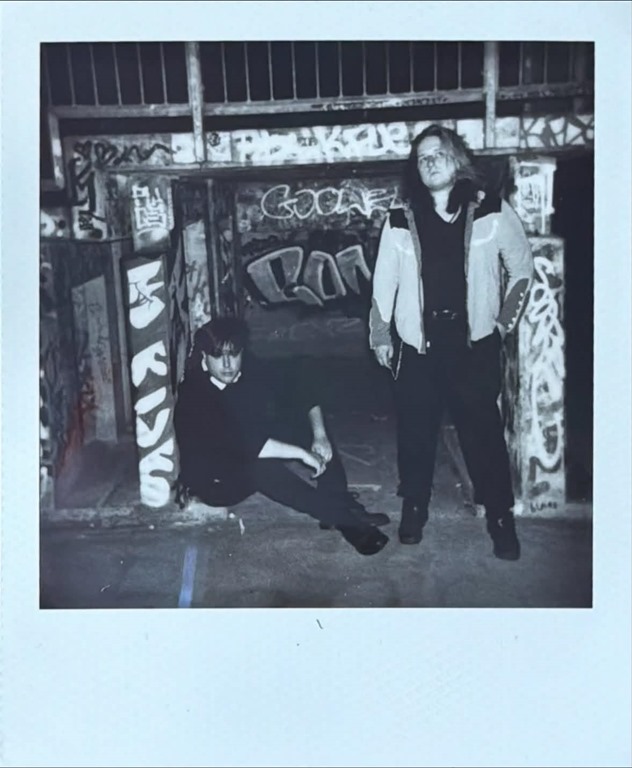
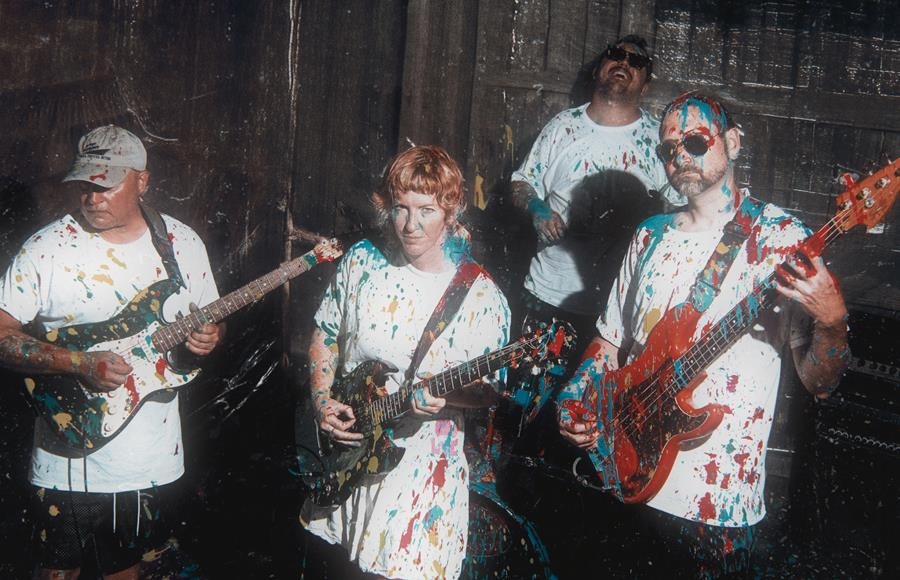
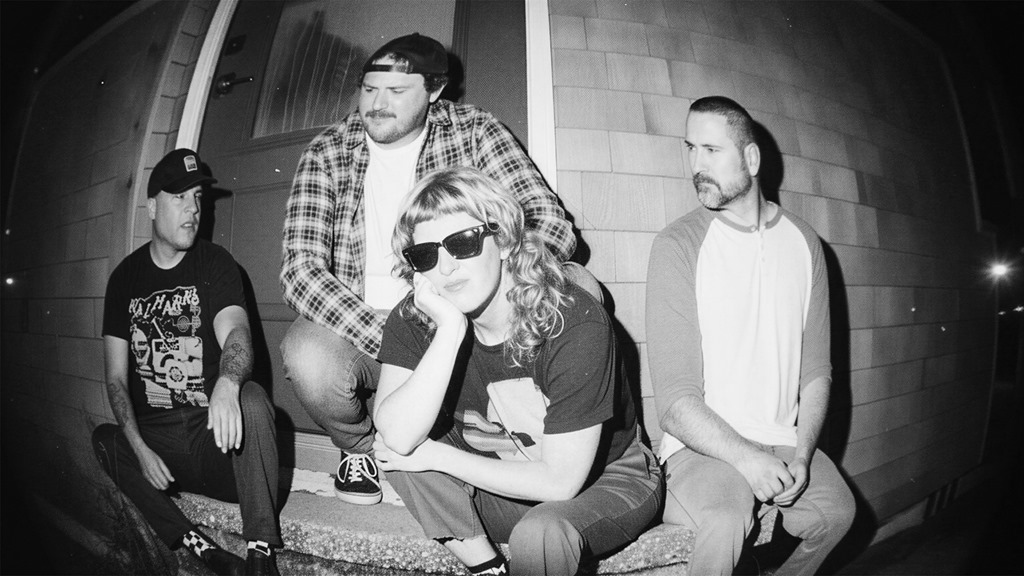
Their bio tells us that ‘Cor de Lux didn’t come out of a content pipeline, a shared folder, or an algorithmic moment. They came out of a rehearsal room,’ and their Bandcamp page describes them as ‘4 friends in a Post Punk-Noise Rock band. Melodic hints and synth tones that trickle into a garage angst progressive fury.’ These two snippets give an insight into what kind of band they are, and how they operate, but don’t really give the measure of Year of the Horse, an album which goes beyond both post-punk and noise-rock or any permutational crossover of the two to render something that’s varied, embraces experimentalism, and at times is quite off the wall.

Single cut ‘The Cringe’ is exemplary, crashing in on a lolloping rhythm and blistering squall of guitar by way of a backing to a dispassionate but nevertheless urgent-sounding dual vocals from Tim Lusk and Dawn Moraga, before suddenly pulling up and following a short but meandering moment of ponderous desert rock, swerves off in a vaguely trippy prog direction, with a swirling synth and strolling synth. In contrast, ‘Ping Pong’ – not a cover of the Stereolab classic – is a slice – and at six minutes long, a very generous one – of quintessential dream-pop. A laid-back, balmy indie song with a hint of C86 whimsy, gently melodic and evocative of dappled sunlight in woodlands in early summer, it’s neither post-punk nor noise-rock, but it’s easy on the ear – until the switch that lands around the four-minute mark when it unexpectedly takes off like a rocket. And it’s here that it becomes apparent why Ipecac would be interested in them. They’re a band unconstrained by genre boundaries: not necessarily weird, but different.

AA

‘Cannibal’ takes the chiming guitar and driving bass of the UK goth sound circa 1984 and spin them with slightly spiky vocals and a mid-80s indie twist – nothing that’s immediately specific to a band, but then not entirely generic either.

‘The Western’ whips up a choppy frenzy and is perhaps one of the most overtly post-punk-meets-noise-rock songs on the album, and it drives pretty hard, before ‘Bread Bag’ serves up a slice of mathy post-rock… but that’s not quite it. But I can’t think long enough to capture my thread because there’s a sudden explosion over overdrive, and then it’s off somewhere else again. As the album progresses, the harder it becomes to situate it in a way that feels in any way meaningful – but that doesn’t mean that Year of the Horse is in any way incoherent. The more wide-ranging and eclectic the songs are, the more the sound of Cor de Lux is defined.

‘The Deli’ is simultaneously motorik and noodly: Pavement might be an obvious touchstone, but it’s more obscure acts like Moderate Rebels that come to mind, and Rosa Mota, too, and as fast as can process and much faster than I can type, we’re into another post-rock noise burst and then some more breezy, jaunty indie rock. One thing that does stand out is just how un-American they sound, at least to my ear. Year of the Horse is quirky. It’s not a common American trait. It’s nuanced, and wile it’s by no means a flippant, inconsequential work – it’s anything but – it’s threaded with a kind of knowingness, a twinkle in the eye which hints at a certain humour. But more than anything, Year of the Horse is a work of genius, in that it brings together myriad incongruous elements and doesn’t just make them gel, but amalgamates them in a way which feels entirely natural. How do they do it? Magic, alchemy, or something, I guess.

So many acts strive to make hybridity work, and so many fail, because it feels forced, self-conscious, the segments don’t flow or connect up, and it sounds awkward, jarring. Not so with Cor de Lux, and Year of the Horse keeps it succinct with just nine songs and a run time of thirty-eight minutes, the majority of the songs sitting in the three-and-a-bit-minute bracket. It’s a rare beast, this: an album that will blow your mind, but subtly. It’s crazy, but it’s packed with tunes. Truly inspired.

AA

Photo_credit-_Jordan_Olivia_Howell_387686

Photo: Olivia Howe

Fysisk – 4th September 2026

Christopher Nosnibor

The line ‘here we are now, entertain us’ from Nirvana’s ‘Smells Like Teen Spirit’ is on which has come to resonate with me more powerfully in recent years than it ever did at the time. It’s a sad fact that – and I like to think of it as being through no fault of my own – my attention span isn’t what it was, and I’m no longer quite as patient as I was. I can still listen to a twenty minute instrumental without any issue, but have to be in the frame of mind to do so. But then, as far back as 2018, Forbes reported that 24.14% of songs were skipped within the first five seconds by users of Spotify, some 29% skip in the first ten, and that increases to a 35.05% chance of a skip within the first 30 seconds. I very much doubt that we’ve grown more patient in the last eight years. An article published earlier this year at Mixreflect detailed the reasons listeners skip, and gave practical solutions like ‘How long should a song intro be on Spotify?’ with advice including ‘The practical target is 8 to 12 seconds for pop, hip-hop, and R&B; up to 20 seconds for rock and indie if something is actively developing throughout.’

It’s twenty-six seconds before the vocals start on the single edit of ‘Smells Like Teen Spirit’. The intro to one of my favourite singles of all time, ‘Alice’ by The Sisters of Mercy occupies the first minute of its three and a half minute duration. And how long is the fade-in on ‘India’, the opening track on the eponymous debut album by The Psychedelic Furs? All very different songs, but each a classic in its own right. Are we really in a place where most people would simply skip before things got going? Instant gratification is one thing, but there is so much to be said for a good build-up.

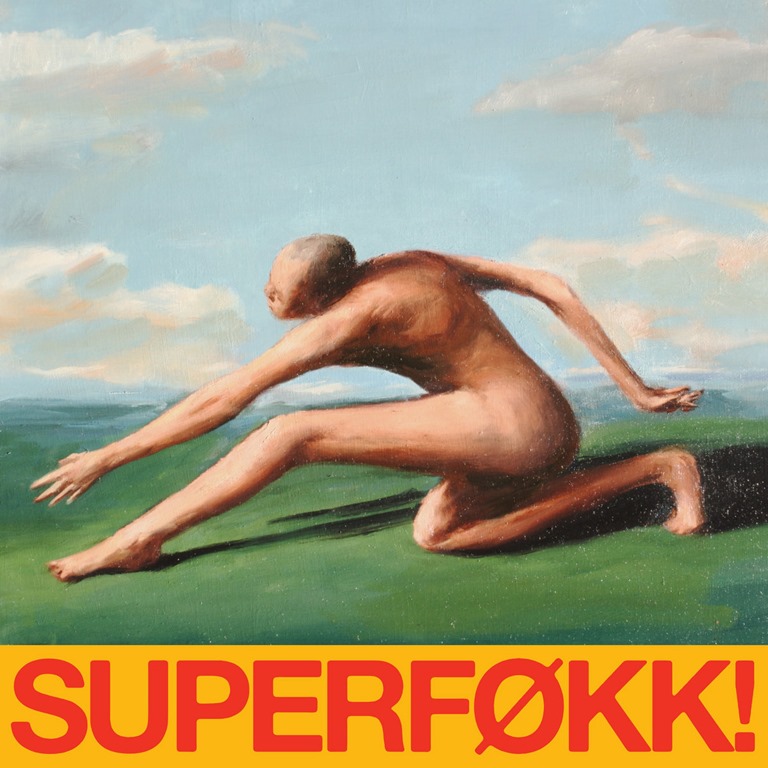
Thankfully, there are musical fields where a slow-build and an unravelling over time is appreciated, and Superføkk – pitched as ‘a bursting new raptus project that shoots off in inexplicable directions’ which is ‘neither background listening nor pop music’ they’re described as having ‘a foot in many camps’ and ‘aim[ing] to break down established genre conventions and create a sound that is distinctly their own…. drawing inspiration from jazz/noiserock, electronica, and no-wave’. And their debit album contains just three tracks, the shortest of which is six minutes long (there is a four-minute radio edit, but I doubt that it’ll get much airplay on the likes of Radio 1 or Kiss FM, or that it’s going to convince the Spotify casuals to stick around, not that the algorithm is likely to insert it amidst a lengthy cycle of Taylor Swift and Charlie XCX or whatever.

And so it is that ‘Grønn’ provides our introduction to Superføkk, and it may be brief (in comparative terms’, but it packs plenty in. It’s jazz in that cacophonic sense, horns blaring and doing so simultaneously in all directions – not smooth or noodly, but an instant riot – before an extended atmospheric post-rock passage in the middle before everything goes off at once, giving us an expansive post-rock surge topped with the most extravagant sax break. The twelve-minute ‘River Igjennom’ is remarkably light and easy going for the most part, but around three minutes in, the levels of tension explode with frenetic drumming and strains of the most demented fretwork colliding with crazed sax chaos, and it culminates on some kind of huge prog-like grand finale which on the one hand seems entirely incongruous, but on the other, perfectly fitting. I can’t say I’m entirely into it. And then there’s ‘Piggeple’, another twelve minute multi-segmented opus.

Around the mid-point, it drops down to a spare bass, squalling synth, and processed-sounding vocals, and it’s only after this that things really seem to kick off, with a locked-in drum beat, throbbing, insistent bass, and some crunky guitar dischord. Finally, the noise-rock element is freed! And they do go all-out in the final minutes.

When they write that ‘Superføkk is neither background listening nor pop music’, but that it’s ‘immediate and danceable, but also unhinged, hard-boiled, improvised, and idiosyncratic’, they’re mostly accurate. There are some deep bass-driven grooves buried in the mix here, but the chances of me actually dancing it any of it are non-existent.

Recent weeks and months have delivered some truly outstanding – not to mention angry, bleak, nihilistic, and highly political – noise rock releases, perhaps most notably from Chat Pile, Kings Sans, and Remote Viewing, and each has hit hard and resonated in a deep and powerful way. Superføkk (which continually reminds me of Superbock, which is great stuff) lands differently. Not only is it largely instrumental, its noise-rock elements are blended – and at times buried low – amidst an array of experimentalism, and an emphasis on the warped jazz leanings of the composition. But, being as hectic as it is, it’s no less tense that the aforementioned noise-rock works. In fact, there are moments which are little short of dizzying, and you wonder if your brain might burst.

AA

a0504777722_10

The Flenser – 4th September 2025

Christopher Nosnibor

Chat Pile have only been around for seven years, but in that time they’ve cemented themselves as among the leading exponents of contemporary noise rock. Timing, when even accidental, counts for so much, though. Their debut EP landed in the spring of 2019, with the follow-up coming towards the end of the year. They were hardly a hit on their local scene, and then there was the pandemic, which did nothing for any band looking to build a fanbase through live shows. They managed to get signed, but it seems that the key element in their favour was the fact that since the pandemic, everything has been utterly fucked. Fucked beyond words, fucked beyond comprehension. And this is why the world has been crying out for horrible, sludgy noise to give a voice or a home to those myriad confused emotions, for a band that speaks both to and for them.

Who Loves The Sun is their third album, and it’s worth stepping back from my review to quote from the bio which accompanies the album, since it provides valuable context and traces the band’s evolution: ‘Whereas their debut album God’s Country depicted a particularly American flavor of dread, and the follow up Cool World showed a cruel planet defined by global systemic violence, Who Loves The Sun now peels back the skin on how a collective indifference for a decaying world defines this new century. Touring off the back of their previous albums in part lent itself a confidence in the universality of their music. Stin comments, “I’ve always felt that Chat Pile is such an American concept thematically, but it seems like that’s not particularly true – people all over the world are resonating with what we have to say.” Spanning imagery of coastlines devouring cities as a result of inaction on climate change, the dread of working dead-end jobs, and the species’ collective submission to data-driven inauthenticity, Who Loves The Sun depicts the common experience of existing in a doom loop which feeds the malaise that permeates all aspects of our lives.’

And yes: these are global issues they tackle here. America might be a bit more fucked than some other places, but ultimately, we’re all fucked (in part because of America, although that’s no fault of these guys).

It’s a murky, rolling drum, bouncing around in a sea of reverb which launches the album, ‘Creature’ lurching in mid-pace with a filthy bass and some sinewy guitar. The atmosphere is tense, the vibe mid-90s gnarly. I’m straight back to Touch ‘n’ Go and underground scuzz, the grainy gritty heft of Tad, Oil Seed Rape, Zoopsia, It’s heavy, alright, but it’s more than that: it’s sweaty, greasy, and it’s intense. The walls move closer, the air becomes denser, and it’s harder to breathe.

Who Loves The Sun isn’t a hooks and choruses album. It’s a thick, treacle-like trudge through a succession of gut-churning riffs. As such, it’s very much the soundtrack to the trawling through doom loops. On the face of things, they don’t sound like a band with massive international appeal, but the same was true of Nirvana and Slipknot. It’s more Bleach than Nervermind, though. The world at large massively underestimates the need to vent complex emotions through difficult, heavy music, and if anything, the last few years have elicited the need for music that’s darker and heavier than ever. It feels like we’re living in the end of times, and we need music that reflects it.

‘Break my face and call me your friend,’ Raygun Busch sings in a cracked, tired voice during a quiet moment on ‘Deep Blue’. Most of the vocals are either screams or otherwise buried amidst the wall of jagged riffery. ‘Same Rules’ starts quiet and dungy, and explodes into a nihilistic roar. Neither are friendly, but both articulate the existence within dark spaces, both internal and external.

AA

Landing mid-album, ‘Shrine’ is a classic quiet / loud composition , and it captures the grunge feel but with additional metal fury, and a harsh hybridization that blends metal with grunge filth. The same could be said of most of Who Loves The Sun. It’s dark, it’s jarring, and is heavy. It’s bleak and does nothing to entice you out to a brighter space. ‘Influence’ simply becomes more claustrophobic over its four-and-a-half-minute duration as it stomps its concentric circles of anger and anguish. ‘Family Funeral’ strays towards Shellac territory as it builds a bludgeoning wall of noise ahead of closer ‘October all the Time’. This is not an accessible or easy album. But it’s the album we need to express all of the angst that’s pouring in all directions right now. It’s also the answer to how we will get through it all. More big riffs. And more again.

AA

a1878873385_10

Dipterid Records – 21st August 2026

Christopher Nosnibor

Chicago noise rock duo King Sans, consisting of Jake Steven James (guitars, synths, vocals) and Izabella Rose (drums, vocals) describe themselves as ‘cryptids of noisepunk’. Make of that what you will, but they’ve gone all out on the ‘cow’ theme of the title on the cover of their debut album and accompanying promotional shots.

This very much feels like the culmination of their work to date: since 2024, they’ve released half a dozen singles, four of which have made it onto the album. As such, Sell the Cow stands as a document of their evolution, from the raw and raucous blues-rock-via-Melvins blast of debut single ‘Liar!’ – all one minute and twenty-seven of it (remixed / remastered for the album)– to new and previously unreleased songs like ‘Sold.’, which opens with a piano part lifted from Mozart before crawling into sludgy morass of dark ambient experimentalism. It so happens that ‘Sold.’ bookends the album neatly, as the opener, ‘Two Figures’ is a brooding, atmospheric piece with droning fear-chord synths, jumpy incidentals, and a suspenseful spoken-word vocal that gives way to thumping tribal drums and dingy bass. These three songs alone are demonstrative of their huge ambition and stylistic range and illustrative of their operating far beyond the parameters of both noise and punk.

They pack in some high-octane bangers along the way, too: previous single ‘Jumpstart’ isn’t just appropriately titled, but appropriately placed in the track sequencing, kicking things into overdrive immediately after the more experimental intro. It’s a taut and explosive two-and-a-quarter guitar-driven minutes of stomping glam punk with a dash of the kind of mania that defined the first Pulled Apart by Horses album.

‘Let me Lie’ is the most excitable-sounding example of stoner sludge I think I’ve ever heard. It’s like Melvins on speed, and seems to manage a nod to Lene Lovich’s ‘Lucky Number’ somewhere in the melee. Herein lies much of the thrill of Sell the Cow. There’s a lot going on, so many different references and ideas drawn from across a vast musical swathe, that each listen reveals something different, something new.

‘Dienen’ is another which melts together thick, scuzzed out low-end overdrive with a kind of glam-influenced stomp and doomy power chords. That they manage to render this preposterous combination without sounding like the Spinal Tap of sludge is an achievement, but the fact it’s followed by ‘Lasting Hold’, which takes things a step further is almost beyond comprehension. The verses are soft, with a delicate, gentle vocal and almost folky, with an atmospheric, spiritual-sounding feel, while the choruses erupt into screaming filthy metal – and they take this idea further on the operatic art-rock infused thrash of ‘S.Y.D.’ Yes, it’s almost impossible to keep up with everything that they’ve got going on, and I keep finding myself thinking ‘this shouldn’t work’. But it does. And it works well.

There’s birdsong and a pastoral feel to the lulling ‘the floodplain’, while puntastic single ‘No Diddley’ is a squalling blast of guitars that’s equal parts blues and rock ‘n’ roll and noise rock, with a dash of Suicide.

Sell the Cow is the album you didn’t know you needed, but believe me, you sure do.

AA

a3543827553_10

Christopher Nosnibor

Just over six years ago, one of my favourite labels, Cruel Nature Records, released Pachinko, the third EP / mini-album from Newcastle noisemongers Ballpeen – a band appropriately named, given their capacity to hammer home heavyweight riffs with bludgeoning brutality. With noise rock, grunge, and hardcore punk all in the mix Pachinko was rabid, raw, primitive, recorded, not produced.

2020 was a productive year for them, with the release of two live recordings and a split EP, and 2021 saw the stop-gap EP Bunch of Sevens, which featured material recorded in 2017 at the same time as their debut release. And then, silence. It transpires that they sadly called it a day some time after this. They’re not the first band to abort before the release of their debut album by any means, but the shock news is that they actually recorded an album which then got ditched.

But now here it is. Ballpeen are no more, but finally, there is closure in the delivery of the lost album, What You Need, What You Deserve. And it’s a beast. Thirteen songs packed into thirty-seven minutes. That’s an average of approximately 2.8 minutes apiece. And into these compressed timescales, they pack in so much energy, so much explosive riffery, and so much… just so much.

The first single, released in May, is also the first track on the album, and from ‘Modern Life is Hell’, it’s immediately apparent just how much they’d evolved from previous releases. It’s by no means polished or pop, but the sound is crisper, denser, the songwriting more sophisticated, a solid hook snaring the listener early, with a sound and style which warrants comparisons with Hawk Eyes, who are also now sadly missed. And the sentiment probably resonates more powerfully now than when it was recorded. How times have changed – and not for the better. We thought the pandemic was hell – because it was. But little could we have anticipated what was to come.

What follows is nothing short of a gut-busting guitar-driven blast. ‘Unit Three’ amalgamates the steely nihilism and sinewy strain of Kowloon Walled City with a thick bass-driven grunge heft. There are some neat descending bass runs in the second half of the song which remind me of something else, but we’re into the squalling wall of feedback that drives ‘Poverty of Ambition; before my brain has remotely got itself into gear. But ballpeen are very much in gear: there’s no mid-album slump, no breath-catching ballad here. Instead of slowing the pace, they crank up the distortion and stoke up the rage.

The bass on the intro to ‘Engram Theory’ is nothing short of rib-rattling, a chunky, clunky, bruising assault of pure density, reminiscent of Shellac, for sure, but closer to that of Blacklisters with their original bassist – which is a fair comparison for the song as a whole, really, and it provides a welcome reminder of just how the North of England has been so strong in its generation of noisy bands over the last fifteen ears or so. Seattle and Chicago have the longstanding reputation for their scenes, but we’re looking back to the late eighties and early nineties for their heydays: more recently, Leeds and Newcastle have proven to be the crucial hotspots, and Ballpeen’s contribution is strong. The belated arrival of What You Need, What You Deserve only cements this view.

Second advance single, ‘Ukiah’ is yet another fiery onslaught, and compels one to consider what might have been. It’s true that such speculation is futile, and instead of mourning, we should be grateful, and the juddering riff of ‘Crossing Waters’ provides every reason to be grateful. It hits so hard, it makes you sweat. There isn’t a weak moment on What You Need, What You Deserve. In fact, there’s barely a moment to catch breath. It’s intense, alright.

There can be little doubt that it’s best to quit while you’re on top, kill things while you’re at the peak of your game (Nirvana perhaps took that a bit too literally, but Big Black are a fine example of a band who left a concise but unsullied legacy). And to the list, we can now add Ballpeen, a band who demonstrably saved their best for last.

What You Need, What You Deserve needs to be heard. It’s all killer and no filler, and more – and it doesn’t just go all the way to eleven: it starts at eleven and works its way up over its skull-cracking thirty-seven minutes. It’s the good shit alright, hitting with enough force as to dislodge your fillings.

This must surely be their legacy.

AA

cover

Cruel Nature Records – 31st July 2026

Christopher Nosnibor

It’s too hot. Granted, I make this complaint whenever it goes above 24C, but on day three – or maybe it’s day four or five or ten – of a 30-plus heatwave – the third heatwave of the year – I am absolutely dying. Typing is making me sweat like running a marathon. Hell, even thinking about typing is making me sweat like running a marathon. My brain is jelly.

The two bands have a side each on the vinyl, plus collaborative tracks closing each set.

I’ve devoted a fair quality of words effusing over the output of dour Derby dingemongers Pound Land, and as theirs is the second half of the album, I’ll focus first on the EMF who didn’t have any bouncy dance-driven indie hits in the 90s. Earh Mother Fucker formed in Ipswich – the hometown of the equally commercially-orientated Extreme Noise Terror – in 1988. Only unlike ENT, EMT (so close) didn’t record a bunch of Peel sessions, sign to Earache, or perform at The Brit Awards with The KLF before releasing a ridiculously rare collaborative single available only by mail order through Melody Maker or The NME. Again, so close.

Instead – and respect is due here – they’ve ploughed their own noise-rock furrow with a slow – very slow – flow of albums released on tape and CD-R. There was nearly a 20-year gap between Let Him Go Up (2001, CD-R) and It’s Shit (2020) and then another six years before the arrival of Do Not Resuscitate earlier this year. It seems they changed their mind, and are very much resuscitated, and two releases in a year is a real cause for celebration. Well, it is if you like Earth Mother Fucker.

There’s a sense that they don’t particularly want to be liked, and instead exist to test listeners with a uniquely English form of noise rock. Their solo cuts are scuzzy, grungy, abrasive and raw as it comes, but there are some sublime moments of melody, at least in the guitar department.

‘Happy Shopper’ powers in amidst a squall of angular guitars, landing primarily somewhere between The Fall and Sonic Youth. It’s a ramshackle racket, lo-fi grungy, gloriously unpolished. ‘Changeling’ does low-slung twisted country crossed with wonky noise and vocals – half-spoken, half-shouted, bridging Enablers and A Band of Susans. That’s a substantial gap to bridge, superficially, but Earth Mother Fucker span it with discordant, chaotic ease.

‘Puppy Fat’ is very much a spirit of 77 punk blast at heart, but twisted with a strong element of Krautrock as defined by its motorik beats, and almost veers into Fall-like Mancabilly. It also feels like the optimal summary of what EMF are about.

‘Second Aunt’, with Pound Land is a raucous maxed-out rendition of Eno’s ‘Third Uncle’, but based more on the Bauhaus cover than the original, and manifesting as a wild punky thrashabout.

Pound Land push things further still, ‘Liar’ being a rampant roar of disaffection. The bass is thick and booming, the production as gloriously primitive as the sax freak-out that runs all over it is wild. They lumber into even sludgier territory on ‘Janet’s Here’, a mangled mess of noise and snarling vocals atop that gut-churning bass giving it a hint of early PiL. ‘Feeling Sick’ lumbers and lurches in such a way it becomes a work of self-fulfilment, a musical manifestation of dire disgust and seething (self) loathing.

‘Shitoctacy’ sees Pound Land joined by Earth Mother Fucker, and is a true monster, with a collage of sped-up samples overlaid across some weirdy, warping drones before a ten-minute trudge begins, grimy bass and spewing vitriol atop the nastiest, most discordant racket, and from time to time there’s some pained sax from Jo Stone which wails in anguish over the whole heaving mess.

As split albums go, this one couldn’t have been better curated: it feels like the two bands – particularly with the collaborative works – are egging one another on to take the levels of grime and slime and nauseating churn up, notch by notch. The result is gritty, gruelling, and spectacularly visceral.

AA

cover

Following the recent release of ‘Peace Trader,’ Swiss noise-rock collective Coilguns now return with a brand-new single, ‘Carbon Magic,’ taken from the band’s forthcoming album, due later this year via Humus Records.

Out now alongside an official video, the track arrives with the announcement of a new European tour that will culminate in a special hometown release show at Le Romandie in Lausanne on December 12, the band’s only Swiss performance of the run.

AA

Directed by Louis Jucker and filmed and edited by Valentin Lurthy, the video captures the band’s raw and uncompromising energy while reinforcing the song’s central message, which examines an uncomfortable contradiction in Switzerland: the growing obsession with exporting carbon emissions elsewhere rather than confronting the environmental consequences at home.

The band comments: “You only know the price we’ll pay.”

While Switzerland is debating a racist initiative aimed at “limiting” its population and denying migrants their fundamental humanitarian rights, it seems perfectly acceptable for our most prestigious universities to develop projects designed to liquefy our industry’s carbon emissions and export them to foreign countries, with the ultimate goal of burying them deep underground, as far away as possible from our Instagrammable landscapes. How can we be so stupid and selfish? Do we really want our borders to function like a filter that keeps people out, while letting our waste slip away.”

Through ‘Carbon Magic,’ Coilguns challenge the idea of so-called carbon compensation, questioning a system that seeks to bury environmental responsibility out of sight while maintaining the illusion of sustainability.

Musically, the track delivers everything that has made Coilguns one of the most vital and unpredictable voices in contemporary heavy music: abrasive noise-rock intensity, post-hardcore urgency, and a fearless willingness to confront difficult subjects head-on.

Recorded by Scott Evans (Thrice, La Dispute, Neurosis), with additional production from Ben Chisholm (Chelsea Wolfe, The Armed), and mixed by Tom Dalgety (Ghost, Pixies, Royal Blood), ‘Carbon Magic’ continues the band’s evolution while preserving the visceral and DIY spirit that has defined them from the very beginning.

To celebrate the release, Coilguns will embark on a European tour this November and December, bringing their energetic live show to the Netherlands, Belgium, Germany, and Switzerland.

Tour Dates
25.11 – Utrecht, NL BUY TICKETS
26.11 – Brussels, BE BUY TICKETS
28.11 – Antwerp, BE
29.11 – Tilburg, NL
02.12 – Cologne, DE
04.12 – Hamburg, DE
05.12 – Berlin, DE
06.12 – Munich, DE
12.12 – Lausanne, CH (Release Show)

AA

f15a3d62-a0ec-4769-ffbe-369218f9d1c6

Photo by Andy Ford

Welfare Sounds & Records – 8th May 2026

Christopher Nosnibor

The Family Men sound like a bunch of nice, respectable, friendly fellows who espouse upstanding, moral values… in name, that is. Musically, they describe what they do as ‘Total Harmful Sound’, and following the release of their debut No Sound Forever in 2024, their bio records that ‘the band have toured extensively across Sweden and beyond, steadily building a reputation as one of the most intense and uncompromising live acts on the circuit. That relentless momentum feeds directly into Co/de/termination, a natural yet sharper continuation of their sonic evolution.’

They go on to add, ‘Pushing both intensity and precision to new extremes, the album refines the band’s sound into something tighter, heavier, and more deliberate than before. Urgent yet controlled, abrasive yet purposeful, Co/de/termination stands as a focused and uncompromising statement’. It’s certainly a bit more accessible, a bit cleaner, than its predecessor, but then, most records are.

‘Calamity’ arrives in a swirl of noise, the repetitive motifs of grunge – but also in some respects reminiscent of Pitchshifter after the change from being Pitch Shifter – with metallic guitars set to stun, and percussion pumping hard – while the raw, ragged vocals are more rooted in hardcore. And it all blasts in amidst a noise-rock tumult that bucks and blisters, acid house bleeps suddenly submerged in a tidal wave of guitar and driving bass. ‘Scanner’ and ‘Luxury’, too, belong in part to the Nu-metal revival, while clearly retaining roots in industrial and noise rock, and it makes for a pretty potent (and angry-sounding) cocktail.

AA

In places – ‘AOR’, and ‘Solving the Light Issue’ for example – they invite comparisons to early Revolting Cocks, colliding electro and industrial strength guitar atop some infectious – and really quite danceable – bass grooves and shouty vocals. The latter of these, in particular, boasts a particularly phat, distorted bass sound and pounding beat, and for all of the gnarliness and aggression of the sound – and Co/de/termination is an album that’s fully in-yer-face – it’s apparent that The Family Men know how to render a certain swing and introduce a level of catchiness.

AA

That said, elsewhere, they just go all out on the attack: ‘Heaven’ hits as a brawling scuzzfest, laden with feedback reminiscent of the most ferocious cuts on Daughters’ You Won’t Get What You Want (an album sadly sullied by subsequent revelations regarding their front man). Elsewhere still, the hypnotic, spacious ‘New Clear’ ventures towards shoegaze territory. Rather than seeming incongruous, it’s welcome, proving that it’s possible to create an album that’s focused while still having range.

It’s high-energy, high-octane stuff, and it’s certainly not tame or timid.

AA

a2670809488_10

17th April 2026

Christopher Nosnibor

The singles leading up to the release of The Hedonist, the second EP by The 113 have very much been cause for excitement and built a buzz about the band. Each of the four songs is tense, taut, edgy, quickfire vocals spitting lyrical depictions of the grim present in which we find ourselves with a splenetic urgency against a noisy backdrop where the combination of bass, drums, and guitar – in themselves, completely conventional – meld to forge a dense, unified aural assault.

As they put it, The Hedonist ‘revolves thematically around an anti-technology sentiment, raising questions about data, online worlds and how these can be weaponised against you.’ This – and various surveys and reports – is indicative of an increasingly anti-technology (and certainly an anti-AI) sentiment among younger generations. They have reason for concern, and it’s hard to decide what’s scarier, the prospect how personal data will be used, or how entire swathes of jobs will cease to exist in the imminent future. Anyone who blithely pisses about making caricatures and action figures in the name of fun is not only missing the point: they’ve already sold their soul and more. They’re part of the machine.

We’re living in every single dystopian fiction ever created all at once, right now. This isn’t hyperbole. And it feels as if we’re all trapped and helpless. It’s small wonder we’re experiencing a mental health crisis as we see an entire generation coming through paranoid and scared as we witness an existential threat in many ways worse than the cold war, inasmuch as it’s a war on all fronts.

The 113 recognise this, and The Hedonist is an articulation of this infinitely-faceted terror. Every single track is a standout, and in sustaining the high level of intensity across the whole EP, the potency of the material is amplified. Where The Hedonist succeeds is in the way it doesn’t depart from the blueprint of the debut, To Combat Regret, but instead builds on it.

It’s by no means music to chill out to: quite the opposite, in fact. It’ll likely raise your blood pressure and make you clench your jaw and fists. But if there’s a band that encapsulates the zeitgeist, it’s The 113.

AA

012The113_Jan26Press_BNW