Posts Tagged ‘Vince Clarke’

Mortality Tables – 14th August 2026

Christopher Nosnibor

Ordinarily, I tend to pave the way to grappling with a release with some form of discursive preamble, but here, I feel it would detract from the work itself. Instead, I present the context for Metanoia: Music From Therapy directly from the accompanying notes, and without comment:

The first spark for Metanoia came from a simple plan to meet for a drink after a gig. Peter Fitzpatrick (Circuit3) and Mat Smith from the Mortality Tables imprint ended up talking about trauma, therapy, and the parts of ourselves we usually keep out of sight. That conversation led to a small, recorded experiment. From there the music began to take form, guided by fragments pulled from their notebooks.

Metanoia grew out of therapy and the slow process of letting difficult truths surface. Instead of singing those words, Fitzpatrick shaped them through analogue machines. The title refers to the deep shift that can follow self-reflection: a break, a reset, a way of living with more honesty.

A defining moment in the project was the opportunity to work with Vince Clarke, a long‑standing influence on Fitzpatrick’s music. They created an eleven-minute piece titled ‘The Hope’, named after the bar near Farringdon, London where that first conversation between Fitzpatrick and Smith happened. The collaboration feels like a dialogue across time: the artist Fitzpatrick once was, the one he is now, and the one emerging through this process.

Metanoia is not a linear or predictable account of trauma, breakdown, and recovery. Instead, it moves through a series of moments and memories that surfaced during therapy.

Vince Clarke crops up with remarkable frequency around Mortality Tables artists and releases, and his presence proves to be a positive one. There’s nothing here, or on other releases, which directly hints at Clarke’s celebrated electropop career

‘Cracked Eyes’ offers minimal, dulcimer-like tones, the notes fuzzy around the edges, as the backdrop to a skipping, fractured vocal loop which resembles to some extent one of William Burroughs’ tape experiments, the phrase, or phrases – muttered, mumbled – reverberates in fragments, overlapping, cutting in and out while played at different speeds, to quite unsettling effect.

A number of the pieces – in particular ‘Mood’, and ‘Where Are We Going?’ are comparatively brief interludes, and some of the instrumentals, such as ‘Imperfect’ are very much in the vein of Tangerine Dream or Mike Oldfield, built around sift, rippling notes and textured drones – flowing sounds of tranquillity, which don’t immediately evoke trauma or anguish. But of course, trauma and anguish aren’t necessarily endless stricken screaming, and therapy – the key to unlocking this album – can, for many, bring moments of peace and clarity amidst the painful psychological excavations.

‘Burnout’, on the other hand, it tense, the sound of a palpating heartbeat and panting breaths, albeit against an overtly uplifting electronic backdrop. This is something I personally find more relatable in some sense, and I suppose this is the leading point to observe when it comes to Metanoia: clearly, it comes from a deeply personal space, and some listeners will relate to some aspects more than others based on their own experiences. I know many people who have been through therapy, for a wide array of reasons, and with mixed experiences and outcomes. The trilling 70s synth sounds which course through the six-and-a-half minute ‘Shielding from the past’ seem to make sense, with their soft ambient cushioning, and despite their more sci-fi leanings that seem to tip a hat to Dr Who. Titles like ‘What If Everything Goes Right?’ take the listener through the difficult journey of self-doubt and catastrophising, before finally arriving at the eleven-minute finale, ‘The Hope’. And while there are undercurrents of doubt as articulated through darker shades, particularly at the start of the track, it does, ultimately, bloom into light.

Metanoia may be non-linear – and I understand this is often true of the journey through therapy, which can be riven with setbacks and periods of stasis – but it very much concludes with a piece which feels like the sun breaking on a new dawn, the curtains opening on a new chapter.

AA

a3727223469_10

Mortality Tables – 25th September 2025

Bryan Alka’s brief post on Facebook sharing the news of his new release, is revelatory: ‘Today we release my 5th full length on Mortality Tables. After a series of breakdowns… The Magnitude Weighs Heavy.’

The Magnitude Weighs Heavy is the third and final instalment of a of dark and brooding albums, the first two parts of which – The Colour Of Terrible Crystal and Regarding The Auguries – were released by Vince Clarke’s VeryRecords. Alka, and particularly Bryan Michael, has no small back story: ‘a Philadelphia-area artist who has collaborated with Vince Clarke (Depeche Mode / Erasure / Yazoo), Roger O’Donnell (The Cure), Christian Savill (Slowdive / Monster Movie) and Michael Textbeak (Cleopatra Records). alka was formed around 2000 as a return to his bedroom producing days, and as a cleansing of his disappointing experience within the Philadelphia indie rock scene.’

This thirteen-track album is epic, grand, expansive. It’s also an exercise is taut electropop with a decidedly early 80s bent. Because what goes around comes around, the whipcrack snare and noodly electronic drift which defines many of the tracks, despite being pure 1989, have a contemporary feel, too.

‘Soliloquiy’ drifts into dreamy electro shoegaze, mellow and atmospheric, rippling, and soaked with a certain sadness, however sturdy the beats remain. Elsewhere, as on ‘Creeps; its clearly an attempt to lock things down with pinging robotic beats

This feels like quite departure for Mortality Tables, given their learning toward abstraction an ambience, but they’ve always leaned toward the different, and this is a work which is unashamedly different. ‘Unravel’ is exemplary here: it’s got groove, and is ostensibly a bopping dance cut, and a far cry from the implications of the album title. But everyone deals with trauma, grief, and distress differently, and we all articulate our internal strifes by different means. ‘enchanté’ locks into a hypnotic groove, the likes of which I haven’t been so immersed in since I discovered The Dancing Wu Li Masters by 25 Men back in 2008.

For all that, there are large, ambient expanses, passages of stuttering electro which draw together elements of industrial alongside the layered dance beats. The ten-minute ‘an attempt to conjure quiet’ feels like it’s quite willing to delve deeper into noise, the very opposite of the quiet it claims to seek, and the duration of this album feels like a teetering on edge. I’m reminded of how my late wife would hassle an and harangue over details, over chores, and the tense, jittery tone which leads n this album at times tales me there. But if the dark mutter of ‘thee individual visions ov jhonn’ is dark with resonating melancholia, The Magnitude Weighs Heavy brings things back to the light. ‘Whatever Will Become’ is a hybrid of pop and bubbling electronica, busy but mesmerising in its concentric circles of sound, its abrupt ending jolting the listener back to the moment.

The magnitude may weigh heavy, but this album has a remarkable lightness, delivered with a deftness of touch.

AA

a2561728450_10

Mortality Tables – 1st November 2024

Christopher Nosnibor

Spoken word is hard. I know. I’ve done it. I’ve been terrible at it. I’ve witnessed countless others be terrible at it, too. Spoken word is even harder as a prose writer. It’s just so difficult to hold an audience’s attention. This is why spoken word events seem to favour poetry: whether they rhyme or not, poems tend to focus on rhythm and to be brief, rarely longer than aa couple of minutes. And a lot of poets manage to memorise their pieces for performance, and poets who ‘read’ tend to be looked down upon in certain circles. It’s rather harder to memorise and recite a three-page slab of prose, and face buries in pages makes performing and engaging altogether harder. But worst of all, people simply don’t seem to possess the attention span.

Reading prose is hard. A segment of a story may not really work outside if its intended context, and a short story that only takes three minutes to read isn’t going to have much substance.

There’s a huge disconnect here: people listen to audiobooks but struggle with spoken word or anything that isn’t a renowned author or a celebrity voicing an accessible, pot-driven narrative.

William Burroughs told Philippe Mikriammos in an interview in 1984 that ‘many poets are simply lazy prose writers.’ He qualified this by explaining, ‘I can take a page of descriptive prose and break it into lines, as I’ve done in Exterminator!, and then you’ve got a poem.’

It’s true.

Chop your sentences down to phrases.

Cut your phrases down,

Down to their component parts,

Capitalise each line

– unless you’re e e cummings –

And lo,

You have a poem.

Burroughs had the advantage of recording his spoken word pieces and performing segments from his books in the 60s, 70s, 80s, when the medium was still comparatively fresh, and people had attention spans greater than goldfish, and had the additional benefits of a remarkable flair for reading and a truly unique voice. Here in the 2020s, it can be hard to attract – and maintain – any kind of attention with an audience. As I say, I know: I’ve done it, and I’ve been terrible at it. I’ve also been alright at it. I’ve driven people from the room, and considered it an achievement, because it’s infinitely better to have an impact of that nature than for audience members to fall asleep, or worse, forget the performance. The challenge for any spoken-word performer, be it in a live setting or in a studio, is how to grab, and maintain, the attention of any audience.

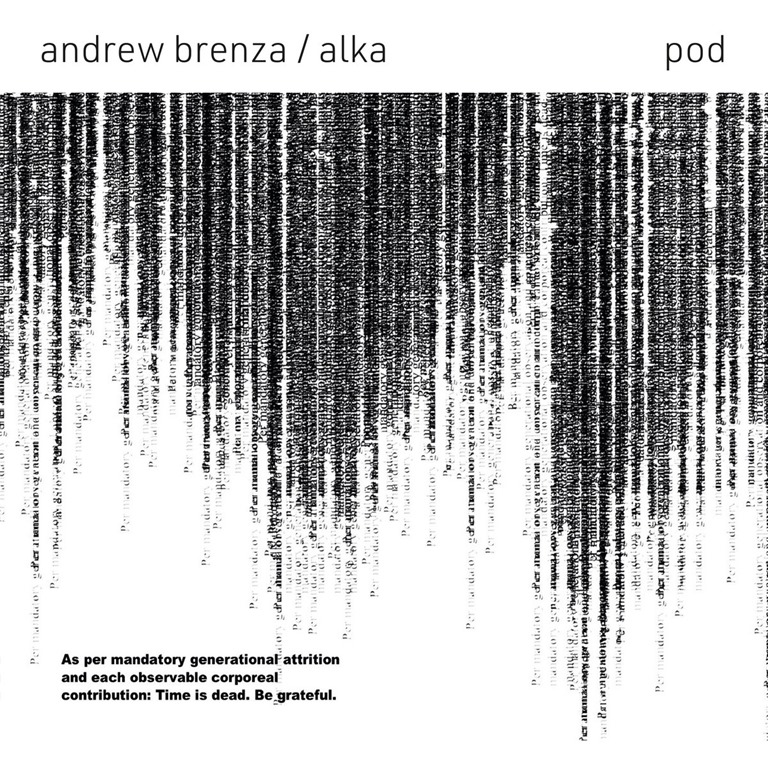
Here, Andrew Brenza reads from his book pod (ghosTTruth, 2023) with accompaniment from sound artist and electronic instrument restorer alka (Vince Clarke’s VeryRecords). Instrumental augmentation is the most obvious and immediate way of grabbing the attention. It transforms a spoken word work into a multimedia project, for a start, and moreover, the moment ‘music’ is involved, a whole new audience – which likely has no interest in spoken word – opens up.

His voice processed with a metallic flanged edge and epic reverb, and against an ominous organ droning ambient hum, Brenza becomes commanding, not to mention eerie in his delivery. This is the fine line all spoken word performers must tread, of course, but here it is felt acutely: The delivery can often overrun the work; style overtakes concept and content.

I find myself drawn into the delivery of pod – the sounds, the delivery. But engrossed in these, the content slips to become secondary, in a way. But perhaps that’s ok. ‘Intermission Meander’ provides a bleapsome interlude, and the narrative segments are vignettes, segmented scenes which are centred around image and concept rather than linear narrative, events, or characters. In this context, this release works. It is not an audiobook, but an audio accompaniment to a book. It’s difficult to absorb, but a successful project.

AA

a0689313884_10