Posts Tagged ‘Album Review’

Prophecy Productions – 7th August 2026

Christopher Nosnibor

Earlier this year, we received news that Belarus metal band Dymna Lotva were in some bother when some of their music videos were declared by a court in their home country to constitute ‘extremist materials’. As vocalist Katsiaryna “Nokt Aeon” Mankevich explained at the time, “This means that fans from our home country, who liked, reposted or commented on these videos in the past are now facing a real risk to disappear into a prison. The rule of law does not apply in Belarus. Just one like under a video that has only now been designated as ‘extremist material’ might mean time in jail”.

Having fled the country, they’ve continued to work, and work hard, and are now unveiling their fourth full-length album to the world, following a succession of killer singles, including ‘The Boat of Despair’ , featuring Aaron Stainthorpe, formerly of My Dying Bride.

AA

And now, on the eve of the new album’s release, Mankevich has been charged with ‘extremist activity’, ‘financing terrorism’, and three more criminal charges in her home country. The Investigative Committee of the Sovietsky District of Minsk officially opened a case against Mankevich, who lives in exile in Poland, in June. She has now been summoned to appear in the Minsk City Court for a hearing on August 14th.

Mankevich explains how this has come about, and remains defiant, writing ‘It is clearly connected to my participation in protests against the regime and to my support for Ukraine. To me, it feels even somewhat flattering that this regime is still keeping an eye on us six years after the protests and five years after I was forced to leave Belarus. This confirms that I am on the right path and also provides me with a strong motivation to keep going. Please do not worry about me. Poland has granted me international protection status because of such political persecution. As a result of this trial, Belarus could seize all my properties still remaining in the country. Well, spending my money on creating music turned out to be a great idea after all. And to the Investigative Committee of the Sovietsky District of Minsk I say: Kiss my extremist ass!’

Some say that politics has no place in music or the arts. Those people are ignoramuses. Even as far back as Shakespeare, art has been the vehicle by which political commentary – and dissent – has been disseminated, often via coded or allegorical means. And this context is essential in understanding the band, what they stand for, and why. And, within this context, the arrival of Vyraj is an achievement which is nothing short of phenomenal.

Dymna Lotva are staunch in their rebellious, dissident stance: as their bio states, ‘their name means “Swamp in Smoke”, which relates to the atrocities surrounding the burned villages of Paliessie, which has endured bloody massacres and brutal conflict in the past. Their lyrics are often based on Belarusian tales filled with accounts of sorrow gleaned from historical archives, folklore, and new horrors that are committed in their home country at the present’.

Black metal is clearly an appropriate medium for all of this, but they describe Vyraj as ‘a musical kaleidoscope’, a work which pushes far in myriad stylistic directions, and it’s not an album built around protest and anger, but an exploration of what they call ‘Belarusian ethno-astronomy,’ explaining that ‘in Slavonic legends, the starry sky is associated both with the afterlife and with journeys, which becomes closely intertwined with the musicians’ personal experience of forced emigration’.

The album itself delivers on everything it promises, and more. The first track, ‘Zory’ begins gently before sliding into an almost Swans-like hypnotic groove, before finally the black metal blast powers in. But there’s a twist: the demonic howls and thunderous drums are paired with a sense of expanse that offers hints of prog bombast and symphonic glory. incredibly, it not only works, but is a complete rush.

‘Veha’, which clocks in at over seven minutes, is a multi-faceted epic in every sense, with some dainty chiming notes offering a melodic delicacy which contrasts significantly with the blistering guitars and throat-ripping vocals, finally yielding to a softer closing passage which borders on the ambient.

The aforementioned ‘The Boat of Despair’, which bears one of only two titles in English, is a definite standout, not least of all because it represents such a stylistic shift, introducing hunts of post-metal alongside hints of Amenra, and offers so much emotional depth.

It’s the range and dynamics of Vyraj which make it such a gripping listen, as you find yourself wondering what the next twist or turn will be, and amidst the flaming fury, there are moments or transcendental beauty which are truly elevating. There are still plenty of rabid, raving black metal blastout passages on offer here, and when they go all out, Dymna Lotva really do go all out with face-melting ferocity. But ‘Niamah Darohi’, with its sweeping operatic vocal contrasting with a hellish howl, a rolling piano paired with shuddering rapidfire kick drum is exemplary of the album’s immense range and the remarkable vision when it comes not only to the songwriting, but its execution.

The closer, the eight-minute ‘Return My Coffin Home’ is the very definition of ‘epic’, and reminds us that this may be the only way they will ever return home, at least as long as the current regime is in place. That they have produced such a remarkably detailed, intricate, and impactful work against all the odds is testament to the artistic spirit. Long may it continue to represent the instinct for survival. Whatever happens next, with Vyraj, Dymna Lotva have determined their legacy as innovators within the sphere of black metal.

AA

f4a2f9f5-c45d-8909-f6e0-944215eb4872

Nocturnal Rainbow Recordings – 31st July 2026

Christopher Nosnibor

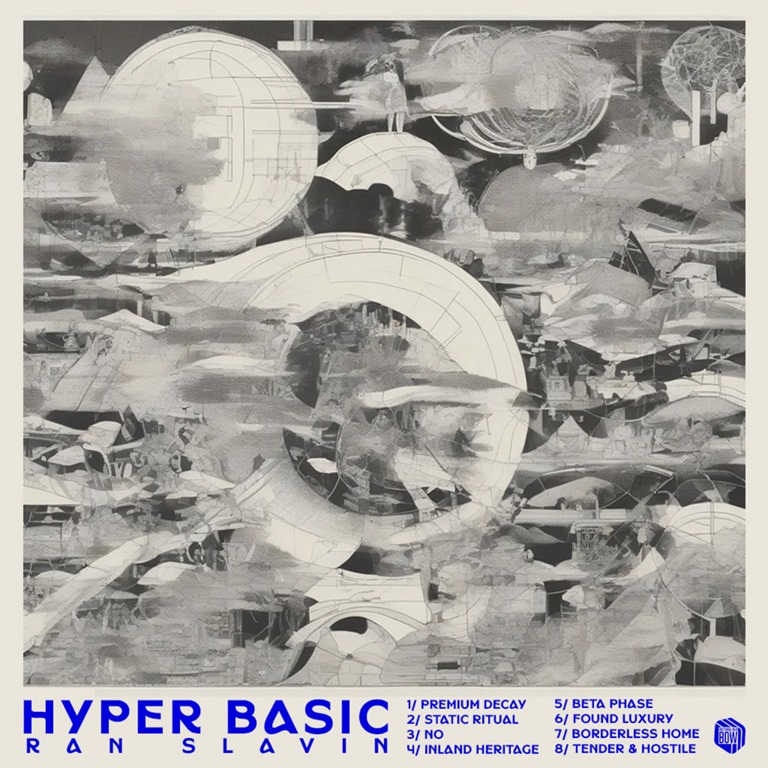
The title of Ran Slavin’s latest does, for all the world, sound like some slangy diss.

“I’m getting skibidi rizz.”

“Bruh’s hyper basic.”

“I can’t even.”

“Bruh.”

It’s been a while since I’ve penned any dialogue in a creative context, and it also transpires that it isn’t actually some slangy diss, but precisely what it is remains unclear, and the accompanying notes do little to solidify where we’re at here, focusing on informing us what the album isn’t, and what it doesn’t do, instead of shedding light on its actual objective:

‘Neither functional nor ambient, the album occupies a shifting territory where abstraction and physicality remain in constant negotiation – a deconstructed club language suspended between pressure, atmosphere, and perceptual displacement… Rather than offering release, Hyper Basic inhabits a state of suspension, where signals dissolve into beats, reduction folds into excess, and movement unfolds as much in the mind as on the floor.’

And so, from what I can discern, it doesn’t occupy any particular space, but hovers and ambulates in some ‘between’ space.

The ‘hyper’ seems to relate more to the schizoid energy which ripples through the album’s eight ridiculously hectic compositions. The first of these, bearing the title ‘Ritual Decay’ would, superficially’ suggest some snarling back metal grind, but what we get is some sparse electro groove, and ‘Static Ritual’ is infinitely more Gilles Peterson than John Peel, if you catch my drift. Still, while it may not be entirely my bag, I’d take Gilles Peterson over Jordan Peterson, or, for that matter, Gilles de Rais any day. And we shall move on.

It’s all pretty chilled, but for some reason, I personally find this kind of stuff impossibly tense. When the beats hit, it’s not that I fear bring grooved away, as much I wonder what will happen next.

This is very much a work steeped in the tropes of 90s and early 00s dance music – or, perhaps, more accurately, the sound of more underground club culture. Despite the insistent beats and vocal samples which drift in and out, Hyper Basic doesn’t even for one moment deploy the formula of the monotonous mainstream nightclub thud-thud-thud-thud. So that’s another thing it isn’t – a work of mainstream dance. Rather than glowstick territory, this is chin-stroking territory, dance music you don’t actually dance to, but reflect on, dissect, muse on the dynamics, the tones, the details of the beats, and the vibrations. The arrangements are sparse, and there’s space and separation between the beats and the low-key bass tracks.

There are moments when the introverted shuffles break out into all-out groove euphoria, as on the rushing bomp ‘n’ stop of ‘No’, which builds over the course of almost eleven minutes, but many of the tracks just flick and flutter along while whispers reverberate in the background. On ‘Beta Phase’ the beats turn harder, a thwocking metallic bin lid of a snare cuts through a woozy, rolling bass that’s dizzyingly dense and it’s anything but comfortable – although I suspect many would love it. A looped vocal snippet bobs to the surface here and there, too. ‘Found Luxury’ fires up a snarling, serrated bass which owes more to rock than dance, and it drives through a drifting wash of synths and samples amidst a rather conflict-filled semi-ambient concoction.

As with much of Ran Slavin’s work, Hyper Basic is hard to place, and just as hard to critique, largely because it doesn’t stay in one place long enough to get a handle on what’s happening. There are elements I just can’t get on board with, while accepting it’s a matter of taste, but it’s impossible to deny that Ran Slavin has a knack for bringing a unique slant to the dancier end of electronic music, and that Hyper Basic is anything but.

AA

a4168500375_10

Room40 – 7th August 2026

Christopher Nosnibor

Lawrence English is an artist who invariably creates works imbued with insight and purpose, with concept and theoretical grounding in the contemplative, academic sense. I had the good fortune to interview him by email some years ago, which proved to be not only illuminating, but exhilarating on a personal level when he wrote insightfully and knowledgeably of William S. Burroughs and the cut-up technique. I very much get the impression he spends as much time considering his work as he does creating it, in the physical sense.

That interview, sadly, is long gone, along with the site which published it. This is true of many interviews, reviews, and indeed, works of fiction which I had published online through the years, and I’m not sure they exist on hard drives anymore either so far down the line. Back in the late 90s and early 00s, we were sold the dream that The Internet would be the archive of everything. The idea went that if it existed, however niche, you could find it online, and this was essentially the precis for Warren Ellis’ 2007 novel Crooked Little Vein. This was also the time of MySpace and what felt like a new world, full of potential. And then the corporations took over and it all turned to shit. I daresay others have a different perspective, but this is mine. And of course, Ellis turned out to be another sleazy male shitbag and overnight saw his outstanding career sunk by his own actions. But I miss those days when the Internet was exciting, anarchic, and not dominated by AI and bots or riven with social and political engineering and so on.

And this is where we arrive at The Rest Is My Ghost, and Lawrence’s notes on the album:

‘Nostalgia is not an ideology, though in this moment, we could be mistaken for thinking it might be just that. Over the past years, the idea of nostalgia has been filtered through various political and technological lenses and has become a tool used for forgetting, rather than remembering. Instead of embracing histories’ complexities and inconsistencies, this version of nostalgia seeks only singular recollection. This contemporary phenomenon of nostalgia has become a methodology at best, and a weapon at worst, used to erode the past and project forward a collapsed and unimaginably sanitised version of things, places, and ways of being from former times. It’s this projection that sees it playing a mounting role in a social pathology associated with reducing the imagined possibilities of future.

‘The Rest Is My Ghost is a record that interrogates the manifestations of this reductive futuring and celebrates those that have tried (and failed), and those who continue to push back against decayed and revisionist positions. It’s a record that considers the weaponisation of nostalgia for the purposes of cloaking possible futures.’

These observations are on point. The far-right parties in the UK – in particular Reform and its adherents are largely basing their campaigns on nostalgia. But not even real nostalgia. They hark back go a golden age that never was with dewy-eyed yearning for a completely glossed reimagining of the 1950s, whereby kids cycled to school down cobbled streets, and bidding the milkman, who is whistling cheerily, a good morning, and dad does off to work in his tweed tie while mum goes to the village store and buys freshly baked bread and eggs laid on the local farm. And NONE OF THIS HAPPENED. This is probably why the Facebook pages in support of Nigel Farage and espousing this worldview are bursting with bollocks AI mages of London busses and phone boxes and cardboard cutout people.

We still had rationing until 1954, some nine years after the second world war ended – although by this time, we were living in the grip of the Cold War and fear of nuclear annihilation. A golden age indeed.

On The Rest Is My Ghost, Lawrence English conjures many rich, immersive atmospheres, many of which evoke nostalgic echoes of myriad shades. ‘大’ opens the album with a crashing gong and eerie wraiths and swirling eddies of sound which slowly give way to tectonic crashes and earth-shattering bursts of sound which connote a collapse of civilisation, and, indeed, the planet. It’s heavy, and it’s hard to breathe while surrounded by this rib-crushing, oxygen-bereft swirl of sound.

As much as ‘Acid Nostalgia’ makes an obvious nod to a particular moment in time, there is both humour and serious comment to be unravelled here. It’s something I noticed in my thirties: peers would bemoan how there had been no decent music released since they were twenty-one or so. This was patently untrue: what they were actually saying is that they switched off after they left college or university and got jobs, started families, and disengaged. Their rave days, their festival days, were their life pinnacle. They associated these experiences of their youth with freedom and a lack of responsibility, and found themselves unable to separate their ageing and becoming entrenched in adulthood, the 9-5 and all that shit, with the times themselves.

There’s no escaping or denying that things have a unique buzz when they’re new, and in your teens the senses are heightened, and you can spend the rest of your life failing to recapture that initial rush. But some of these sad fucks… it’s like their lives ended at eighteen or so, and by the time they hit thirty they’re embittered.

Echoes and layers and dark ambient forced define The Rest Is My Ghost. ‘Sodium Vapour Halo’ (remember when street lights weren’t white LEDs? Remember the sodium haze?) presents a howling wall of sound, a sound that screams anxiety, that swirls all around and grips your very being and shakes it. Ah, ‘Aerial Cable’… it’s a subtler, but no less wry commentary which stands alongside South Park’s ‘Member Berries’ episode. Nostalgia is big business, but one which very much traps people into an idealised misremembrance of the past – and keep them buying anniversary reissues of the albums they had on tape or whatever when they were in school.

By the time we arrive at ‘Hack’, we find ourselves worn out and exhausted as we trudge through drifting sand dunes of sound.

The Rest Is My Ghost is not a representation of the all-pervasive nostalgia trip that keeps the people docile – or angry, as they rage about wanting their country back, idealising a time before immigrants took over (which would, of course, predate the Roman Empire). As English positions it, it’s an interrogation – and in intense one, which responds to the ugly side of the wave of nostalgia which is sweeping through contemporary culture. It also feels like a response, and one which doesn’t shy from confrontation. While so much of this nostalgia appears to stem not so much from a love of the part but a fear of the future, so The Rest Is My Ghost encapsulates a certain sense of anxiety over the prospect that we fail to make progress in a meaningful and constructive way. This is a dark album for dark times. Without words, The Rest Is My Ghost not only conveys so much, but provokes so much thought and speaks on so many levels, making it an essential work.

AA

a0359375143_10

Evol Music Group – 26th June 2026

Christopher Nosnibor

Over on this side of the pond, in the UK, we have plenty to beef about, and more than enough to worry about, too. But while we see endless footage of war in Ukraine, Gaza, and the whole of the Middle East as the US and Iran wrestle their way through the most futile war, we’re in a petty sheltered place, and as much as we may reel in horror over news of the latest high school massacre and laugh at Donald Trump’s daily meltdowns, we do so from a position of relative safety. However hard we continue to lumber into a state of total surveillance, however emboldened the racists become thanks to the rising right, however rapidly our government are eroding our right to protest, favouring perpetrators of genocide over those who speak in opposition to it, there’s still no danger of some masked ICE psycho pulling your car over and demanding your papers before shooting you in the head. Our politicians may nearly all be slippery, deceptive careerists who accept ‘donations’ from individuals and companies with vested interests, but we’re not led by a demented narcissist who’s openly professed to being a wannabe dictator. In short, I don’t think we fully grasp what it’s like to live in America right now.

Elektrikill’s founder, Steve Vil, says of Küntzpiracy – a title that’s both a fairly lame pun and a bit of cliché, but gets a pass because America and an approximation of a Butthole Surfers reference – “Basically it’s my most political album touching on themes of government corruption and half of this country’s loss of humanity while claiming it’s all in the name of Jesus. That pisses me off. I also call out closeted government officials in ‘The Scream’. Look, guys, just be gay instead of crashing Grindr any time you meet in large groups. I do give the listener a break from the political stuff. ‘Vampire Blond’, for example, is about a vampire drag queen.”

There’s a fair bit to unpack here, and he makes a number of valid points. It’s not the whole of America. In fact, it’s a slender majority backing the MAGA madness. Unfortunately, they’ve voted to facilitate an insane power grab, meaning that while there are a fair few who aren’t happy with the direction things have been taking lately, tough shot: you could have seen it coming, so this is on you. And this also involves the most overtly racist, homophobic administration in memory – but as with anything which involves hypermasculinity, what the world outside sees is massive repressed gayness. Yeah, we’re looking at you, Andrew Tate, with your no-bollocks swimming trunks and purple satin blouse, and the culture you espouse. What utterly fucked-up times we live in.

‘Thrum’ makes for a dark, dense start to the album, throbbing bass dominating, the distorted monotone vocals low in the mix as extraneous squalls of electronic noise burst all around, and ‘S(t)imulation’ keeps things dark with some hefty tribal percussion battering away through a murky wall of sound – although the choruses break out with a genuine hook driven by a pumping beat and punchy snare. It’s like leaping from Coil to late 80s Ministry, but it works, and the aforementioned ‘Vampire Blond’ swings into classic electrogoth / technoindustrial territory, and I could chuck a raft of touchstones in here – and that’s no bad thing. they clearly know what they’re doing, and where they’re positioning themselves, and do it well.

‘The Scream’ is again a bit Ministry circa The Land of Rape and Honey, and perhaps a bit KMFDM, and more broadly, a bit Wax Trax! Hardly innovative, but the delivery is top-notch. The beats slam hard.

Landing at the album’s midpoint the piano-led ‘A Chill in the Air’ is both expansive and claustrophobic, and slowing the tempo to explore a more brooding atmospheric, it’s well placed, ahead of full-throttle rager ‘Monoshift’ which brings the industrial aggression pumped to the max. Indeed, the second half of the album is harder, faster, and the altogether synthier ‘My Salvation’ rhymes ‘my salvation’ with ‘masturbation’ in a style reminiscent of early Revolting Cocks.

Stylistically, Electrikill don’t really break any new ground, but Küntzpiracy is intense, angry, and relentless, the aggro and the tempo picking up noticeably in the second half, with ‘Manifesto’ delivering a power finish. With Küntzpiracy, Elektrikill bring the fury and bring the force – and the political ire. This is very much an album of the now, and it hits hard.

AA

a3444969996_10

Cruel Nature Records – 3st1 July 2026

Christopher Nosnibor

“This album is kind of a collage of all the books I was reading and my impressions of the general emotions swimming in the collective experience, as well as personal stories I’ve picked up along the way.” So says Emmaleen Tangleweed of her new album, The Weaving, which was recorded in September 2025 ‘in a log cabin in Swartvlei (“black lake”), Western Cape, South Africa’. The liner notes describe it as ‘a collection of gothic folk and blues ballads tinged with hypnotic magic realism’.

The first song, ‘The Hours’ is likely, then, to be a direct reference to Michael Cunningham’s 1998 Pulitzer-winning novel – which in turn was inspired by Virginia Woolf’s 1925 novel Mrs Dalloway. It’s a wonderfully earthy slice of dark, primitive blues, rendered all the more potent by the rich patina of Tangleweed’s voice. In the recent Six of the Best feature for Aural Aggravation, she cited Black Pudding by Mark Lanegan and Duke Garwood as an influence, citing ‘an archetypal timelessness’, and this is what very much comes through here, perhaps with a hint of PJ Harvey in the mix, too. There’s nothing complex – or even innovative – about it, but blues isn’t about complexity or innovation, it’s about feeling, about soul. And this is something The Weaving brings in spades.

‘Silent Killer’ could be a hundred years old, but it could also be an outtake from Rid of Me. Emmaleen sings from her gut, and with guts, too, and plays with a perfect feel for the swing required to bring the songs to life. There’s a bit of fuzz on the low strings which gives a vintage, analogue feel to the production. This is also true of the sepia-toned ‘Strangeling Angel’, which very much replicates the feel of those early twentieth century blues legends and those altogether more obscure.

The introduction of cello on ‘Blind Faith’ is done subtly, but adds depth to the otherwise sparse arrangement, and for the most part, everything hangs on her voice and acoustic guitar. Perhaps because of this, there’s a palpable intimacy and immediacy about The Weaving, capturing as it does the sensation of being in a small room as the songs are performed live. ‘Never Ending History’ is almost a crawl, and she drawls the lyrics low and slow, and something strange happens with time as it slips back. one can almost envisage grainy black and white photographs accompanying it.

Most of the songs are in the five-minute region and she fills the space with a rare tension. ‘Ask the Dust’ is another song which makes a direct reference, this time to John Fante’s 1939 novel set in The Great Depression, and shit, it’s bleak. ‘Is there anyone out there’ she asks against images of ‘the burnt out rust’ and a monotonous, repetitive riff reminiscent of Michael Gira at his most lugubrious. It’s here that is becomes most apparent that it’s possible to be heavy without distortion or volume, and that weight comes from the heart. You can hear her fingers hitting the strings on ‘Ask the Dust’, in a way that has the same feel as striking dry earth with a pick. It’s not entertainment, but labour, and The Weaving finds Tangleweed dredging deep. There’s no showing on the doll where this music touches: it’s somewhere deep inside, subconscious, subliminal. And herein lies its power – it’s something that’s affecting on an almost cellular or biological level, resonating with experiences of past lives or something. You feel it in a way that’s impossible to explain. But feel it, you do.

AA

cover

Raw Tonk Records – 15th May 2026

Christopher Nosnibor

I’m late to the party with this one. Can I pretend it’s fashionably late, rather than simply tardy? I’m going to say yes, since the event actually took place in 2019 and it’s taken till now to make its way into the world, but let’s focus on the fact that this is, indeed, one hell of a party.

Chewed Up And Spat Out was recorded in a one-off session in London. Hungarian master drummer Balázs Pándi (Merzbow, Thurston Moore, Mats Gustafsson etc.) was in town for a few days and contacted saxophonist Colin Webster (Sex Swing, Dead Neanderthals etc..) who suggested adding Matt Cargill (Sly & The Family Drone) to the session on electronics. And if that lineup isn’t enough, the whole thing was recorded and mixed by Tim Cedar of Part Chimp, who knows a thing or two about noise.

We’re deep in wild jazz experimentalism here, and this is apparent from the groans and honks of saxophone which warp and drone amidst a simmering cacophony of rolling drums – not so much a rhythm as a gathering storm. The electronic elements are subtle at first, a few bleeps and twitters of treble pass here and there while a low drone hums almost subliminally on the first track, ‘To Arise from Sleep’. But the drone mutates into a thick, throbbing pulsation which gargles like a digital didgeridoo on ‘Chewed Up’, while the percussion is more subtle, predominantly manifesting as clattering rim shots initially and the sax is similarly restrained, simmering under until it finally cuts loose. At over eight and a half minutes, counterpart ‘Spat Out’ is something of an endurance test, and works backwards, starting with a crescendo before lurching stop-start blasts of noise which almost approximate a riff give way to a prolonged freeform spasm.

Not only does it have the best title, but ‘Money Shitter’ is peak freak, one of those crazed cacophonous jazz monsters that starts like its ending and ends like its starting and never goes anywhere but at the same time flies in all directions simultaneously. It sounds like unplanned, unco-ordinated chaos – and perhaps it is – but the thing to remember is that it’s supposed to sound like that, and they manage to navigate a succession of explosive crescendos interspersed with subtler, more ponderous passages, and in combination, they interrogate the interplay between the instruments, the tones, the textures, the dynamics. The final piece, ‘Blot’, sees them inspect these sonic relationships in a more granular detail, ponderously pushing through a succession of peaks and troughs for almost twelve minutes. Here, the abrasive intensity is tempered in favour of atmosphere – although the mid-point finds Webster wringing some prolonged bleats over rolling, fluid beats, building to a frenzied extended crescendo and a slow collapse.

There’s a lot of movement on Chewed Up And Spat Out, an album which conveys not only great energy, but a physicality and kineticism – which does, ultimately, leave you feeling as the title tells it. This is the good shit, and by the conclusion, it’s fair to say that from a listening perspective, it does what it says on the proverbial tin.

AA

AA

a3118698241_10

zeromoon – 1st July 2026

Christopher Nosnibor

Gintas K’s relentless release schedule (Discogs lists a whopping 70 albums credited to him since 1999) continues with his second album of 2026, recorded, again, live, with no overdubs, ‘using computer, midi keyboard & controller.’ And while this album contains a not insubstantial seventeen pieces, there are a fair few which are barely over a minute in duration, meaning that it clocks in at under an hour, making it significantly shorter than Merzmania, released in March, with its seventy-five minute run time.

The title implies either sweet but harsh, or the brain froth of a surfeit of sucrose. This being Gintas K, it’s actually both, simultaneously. Sugar Noizy is by no means a radical departure from the vast majority of his work over the last decade, and that’s all to the good. Arguably, he’s emerging as Lithuania’s bubbly, glitchy answer to Merzbow, in that his sound is by no means as harsh, but he very much has a distinctive sound and style.

If anything, Sugar Noizy is rather more sparse and minimal than many previous releases. ‘geras noise ss’ is constructed around subdued trills of feedback, and it has that low-key, subdued, even vaguely muffled feel of ‘Never Forget Death’ by Whitehouse’ – minus the shrill, mangled vocals – but claustrophobic, quietly intense.

As ever, Gintas K’s work sounds like circuitry collapsing into a foamy, frothy meltdown, and amidst the bubbles and bleeps, a chaotic cacophony of dripping, glooping squelches and squiggles, Sugar Noizy is a hyperactive work that’s essentially intended to overwhelm. And it does. Even when it slows to an infrequent drip, you find yourself on edge, wondering what’s next. And when it comes to ‘letas noiz zem’, the answer is a mangled morass of fractured, stuttering distortion that sounds like your speakers are breaking.

Some of the shorter ‘interlude’ tracks are truly wild: ‘minutinis’ may be a minute long, but it’s fried, a complete frenzy, and there are a lot of moments – often extremely brief – which sound watery, and slow digital darkness drips amidst the freakout of dark, digital violence as the segments and elements intersect.

Like the majority of Gintas K’s works, Sugar Noizy is a discombobulating barrage of wibbles, dribbles, whirs and buzzes, fragmented shards and dying drones, often all at the same time – making for a nice addition to his ever-expanding catalogue.

AA

a2414828424_10

Kyiv Dispatch – 17th July 2026

Christopher Nosnibor

For those of us who have never lived through war – domestically, that is – it’s hard to imagine what life is like. Living in the UK, I have the privilege of not having experienced it: both of my parent were born at the end of the second world war and lived under rationing as children, but they didn’t grow up living in fear of bombs falling. And while I look out into my back yard and see the brick and concrete bomb shelter which I use to brew beer, it’s beyond my conception to imagine what it must have been like to live in a time where I would actually have to take refuge in it, although the part of York where I live – or nearby – was bombed in 1942, with numerous some 94 people killed and 238 injured by some 84 tonnes of bombs, dropped in just 90 minutes.

But the fact is that life goes on – because it has to. And art is still made – because what else are artists to do? The title of this release is a little confusing, but the text which accompanies this release, which is particularly powerful, and speaks of the effects of war on the citizens of those countries stricken by war sheds some light on the questions of artistic ownership. It also highlights the fact that wars are waged by governments, not the people. and so we learn how ‘In 2022, with war in Ukraine raging, the composer Valentin Silvestrov was forced, at the age of 85, to flee Kyiv, abandoning his home studio. Silvestrov is one of the leading figures of the Ukrainian musical avant garde, active from the early 1960s onward and for Evgeny Gromov, Ukrainian pianist, researcher and curator, his forced departure was a tragedy, his absence keenly and personally felt’.

The notes go on to explain how this prompted him ‘to hasten the release of this double album, on which Gromov performs key piano works by Silvestrov, from his early, modernist period to his later, more beautifully accessible pieces. The sense of urgency is not just because Silvestrov is approaching ninety years old but also out of the daily sense of mortality felt by all those living in Kyiv. Hence also the founding of the Kyiv Dispatch label in 2022, dedicated to showcasing the full spectrum of Ukrainian new music. Both artistic and existential immediacy underpin the album, as Evgeny Gromov explains: “A great deal of Silvestrov’s music simply does not exist in sound. It exists as scores, as reputation, as a name but not as a lived, performed body of work. There is still no real tradition of its performance. For decades I have been working with this music across its full range, from the early avant-garde works to the later Bagatelles. In a sense, I am its performing extension. And at a certain point it became obvious: if this is not played now, systematically, insistently, it will remain absent.’

This is significant. How much art, how much thought, is lost in time due to an absence of documentation? This, then, is more than a matter of the impacts of war, but also a question of legacy, and of ephemerality.

Recorded in just four days, Moments Of Silvertones is Gromov’s urgent, even desperate, attempt to capture and document the work of Valentin Silvestrov, and we are all fortunate that he has. ‘Five Piano Pieces 1961’ is dramatic – essentially neoclassical in style, in places playful, in others feeling more moody, while ‘Triad 1962’ is very much more geared toward the delicate side, but again revealing a levity which counterbalances the shade.

The expansive ‘Piano Sonata No 2’- extending to almost sixteen minutes in duration, is a magnificently balanced work, and entertaining, playing with the tropes of jazz and minimalism as well as classical music with some bold hits resonating as hard as falling down a flight of stair, and evoking the spirit of silent movies – although it’s a fair way from Laurel and Hardy. Because it’s as a bygone age, and as much as we may wish to remember it fondly… we are increasingly drawn by nostalgia, as we cling with ever-increasing desperation to a past which felt to much better, so much easier, but, despite its focus on compositions from the 1960 (in its first half, at least), while also being devoted to preserving the more recent past (the ‘Bagatelles, Op.’ pieces dating from 2003-2006), Moments Of Silvertones is ultimately a collection of pieces which are delicate and soothing. And despite the conditions of its recording, nothing could be further removed from war or its soundtracking. This is what it means to be human. Moments Of Silvertones is an album hat needs to be heard as a reminder of this – and also because it’s an example of magnificently poised composition and beautiful musicianship.

AA

Valentin Silvestrov – Moments of Silvertones, Evgeny Gromov digital cover

Cold Spring – 26th June 2026

Christopher Nosnibor

This release is something of a curio, in the sense that it’s a collaboration between two of the most famously prolific recording artists of recent times – Sun Ra recorded over 100 full-length albums, comprising well over 1000 songs prior to his death in 1993 at the age of 79, while Merzbow, active since 1979, has released in excess of 500 albums to date. However, this collaboration occurred posthumously for Sun Ra, and it’s worth quoting the context as given by the label, Cold Spring here:

Officially licensed from Irwin Chusid, who oversees the catalogue of the late Afrofuturist artist/composer/bandleader Sun Ra, Cold Spring negotiated rare and unreleased tracks from the Sun Ra archive to be remixed and treated by Masami Akita (aka Merzbow). The tracks incorporate the jazz power of Sun Ra with the brutal excess of the Japanese noise artist Merzbow.

Originally released by Cold Spring a decade ago and long sold out, the music was spread across vinyl and CD, with completely different music on each format. The tracks have now been collected together for the first time, using the original master tapes and presented in the order intended (the vinyl format dictated the order due to optimal sound quality restraints).

Included for the first time on any release is a bonus two minute track entitled ‘Granular Jazz Part 5’, a special composition created for ‘Stuart Maconie’s Freak Zone’, a weekly radio show on BBC 6 Music in the UK. It was broadcast ahead of Merzbow’s live concert at the FAC251 venue in Manchester in September 2016.

There are obviously practical reasons why the different formats featured different track listings on the original release, although these things can prove frustrating for fans finding themselves faced with the dilemma of missing material or forking out for multiple formats. This ‘complete’ reissue has the added incentive of an unreleased track, and while it’s only a couple of minutes of unreleased music, it does round off what is unquestionably a monster release – the six pieces having a combined run time of a massive 104 minutes.

So, to begin with a brief content comparison, the contents of the original CD – the 32-minute ‘Livid Sun Loop’ and ‘Granular Jazz Part 2’ (34 minutes long) makes up the corresponding first disc here, while the 2016 vinyl contained ‘Granular Jazz’ parts 1, 3, and 4. Chances are that some will still be dissatisfied that the CD tracks still haven’t made it onto vinyl, but you can’t please all the people all of the time, and as much as I’m a fan of vinyl myself, the longform nature of the compositions does seem well-suited to CD.

As for the contents of this ten-year expanded reissue… it’s no criticism or complaint to comment that it very much sounds like what you’d expect. ‘Livid Sun Loop’ encapsulates the album in its entirety in the first few minutes – shrieking horns flying in all directions against an apocalyptic churn of cement-mixer noise with the treble cranked to the max, feedback and flayed circuitry exploding like fireworks on New Year’s Eve. A squall of treble, scraping, screaming, like a Brillo pad scouring away at the inside of your skull. There are prolonged segments which are pure Merzbow, shredding digital noise, but then, suddenly, amidst the blitzkrieg, there are honking horns and random toots which pop through the raging wall. The track is a truly relentless assault, and brutally harsh. The frequencies very much favour the top-end, with howls and hisses of tinnitus-inducing quality tearing from the speakers with not so much as a second’s let-up. Every time you think that this must – must! – be the limit, Merzbow does the Merzbow thing of finding new frequencies with which to cause injury. Oh yes: this hurts. But what else did you expect? Some cozy club vibes, a bit of mellow sax and piano? Right. Merzbow brings the harshest head-shredding hell.

Twenty minutes in, there’s a segment that sounds like everything is breaking – not just the gear, I mean it sounds like a field recording of the collapse of civilisation, the absolute end of the world as we know it. And it just goes on. And on. What have I done to deserve this? What has anyone done to deserve this? Actually, perhaps this is the answer to the UK’s issues in the penal system. Being forced to listen to this a couple of times may be a viable altern alternative to shorter custodial sentences. But here I am, listening with great interest and even with a degree of perverse pleasure – although after half an hour, I will admit that I’m wilting somewhat, and not just because it’s 30C with 70% humidity in my office at 9pm. This is nothing short of punishment: it hurts. And it ain’t very jazzy. It’s a mangled mess of skin-peeling, face-melting horror.

But if ‘Livid Sun Loop’ makes for a long and challenging half hour, you’d better buckle in and brace yourself for the endurance test of all endurance tests. To dissipate any doubt, I am a big fan of noise, and enjoy basking in blistering waves of aural annihilation. And Strange City is special in its vision and scope, and its sheer enormity. There are fleeting flickers of strolling double bass which pep through the wild bleepery, woozy drones and sheet metal shredding.

‘Granular Jazz Part 1’ yawns and snarls, bibbles and bleeps and pulses and creaks and swashes and swinges its way through just shy of eighteen minutes of existential anxiety, but it’s simply a prelude to part 2. The slow fade-in and trickling digital cacophony is simply a lure, creating the illusion of listenability. And it does take some time to build. But, of course, build it does. A quarter of an hour in, and it’s reached a sustained crescendo or chaos that’s dense enough to crush your skull. The jazz quota is ratcheted up, too, and the result is something else. Finding the words for this is a challenger, but I’m starting to feel that it’s not words I need, but an ambulance.

Strange City is… intense. In large parts, it feel like Merzbo is the dominant party in this mash-up (which is essentially what it is), and at its best, Strange City makes for a fitting posthumous release for Sun Ra. But from whichever able ou approach it, Strange City is one serious blast of noise. Killer all the way.

AA

AA

a1237961354_10

Peaceville – 3rd July 2026

Christopher Nosnibor

Sometimes, you just need some metal, and the heavier and more extreme the better. This is something I only realised quite some way into adulthood. Perhaps it’s – at least in part – because the only metal I was exposed to as a youth in the 80s was chart or otherwise popular stuff like Iron Maiden, which struck me as corny and excessively widdly. It wasn’t until I started listening to John Peel in the 90s that I heard anything really fucking brutal, and grindcore proved to be a gateway of sorts. But even after that, so much metal felt a bit tame and rather like it was trying to hard to be menacing. It’s only through further exposure in my capacity as a reviewer that I’ve come to appreciate the myriad shades of metal and its cathartic qualities, particularly in a live setting.

I can immerse myself in ambience as a means of escape as happily as anyone, and often do. The tranquil, immersive experience is often soothing and transportative, even meditative and soporific. But there are times when a furious, guitar-driven blast of nihilism is what’s required. And with Mørketid, that’s precisely what Mortem deliver.

Although formed in 1989, amidst the most nascent bubblings of the swamp that would spawn the infamous Norwegian black metal scene, their first demo being produced by Euronymous and Dead of Mayhem, but they fizzled out fast, and it wasn’t until 2019 that they reconvened and recorded their debut album Ravnsvart. They could never be praised for striking while the iron’s hot, so to speak, but to toss another cliché, good things come to those who wait, and after nearly seven years of waiting, Mørketid has no weak spots whatsoever, with eight searing, lacerating sonic assaults that hit with an unrepentant fury.

It’s the six-minute title track that bursts in, all guns blazing, to announce the album’s arrival, after a dark ambient instrumental intro that makes way for thousand-miles-per-hour guitar and drums, rasping vocals and some rather playful but simultaneously sinister keyboard work. It’s quintessential black metal, but with a broader sonic vision and some tidier production. This is to the album’s benefit: there’s an abundance of vision on display, and it would be a shame to lose the detail to production that makes it sound like it was recorded from the next room on a 90s phone. That isn’t to say it’s overproduced – far from it. On Mørketid, everything is cranked up to eleven and it hits with all the force the music deserves.

The driving, dynamic ‘Skyggeånd’ is – in the main – slower in comparison to the majority of the album, and its seven-and-a-half-minute expanse is rich in atmosphere and strong on power, which makes for an album standout.

For the most part, Mørketid is simply relentless, double-pedal drumming and a blanket of overdriven chords provide a backdrop to vocals ripped from Satan’s very own larynx. It’s dark and it rages, hard. One could have readily forgiven and accepted an album of template-based black metal from Mortem given their back-story – but instead, Mørketid is an album that ventures forth in the most unexpected of directions. Sure, it’s black metal all the way, and that’s quire as it should be. But Mortem bring something more. And that more is the detail and compositional skills that make Mørketid a cut above.

AA

a3491107171_10