10th September 2026
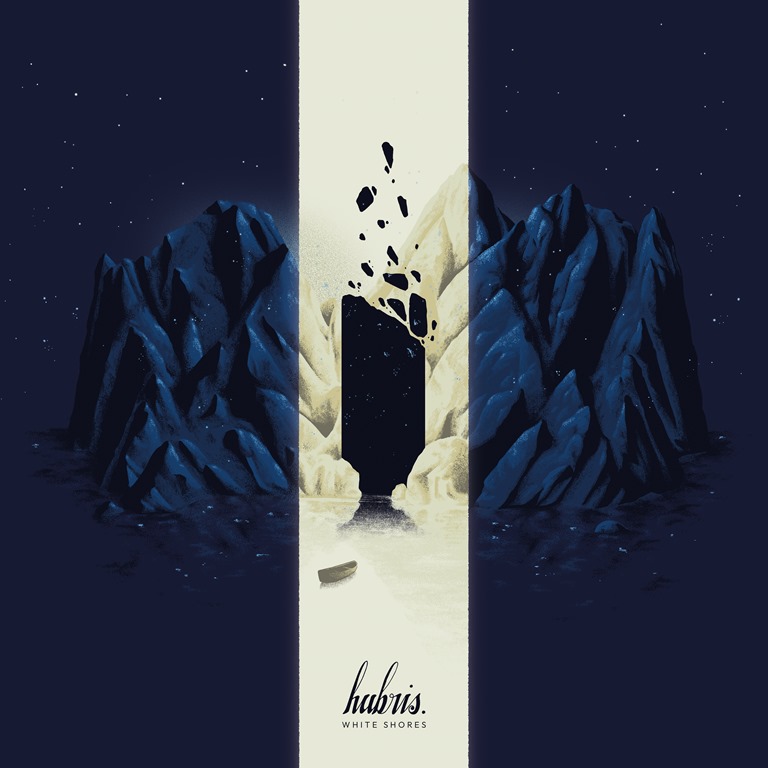
Having never felt compelled to explore Tolkien’s writing – and perhaps consequently even less compelled to watch Peter Jackson’s epic Lord of the Rings trilogy – I feel in some ways unqualified to review White Shores¸ the fifth album by Swiss post-rock band hubris. which follows four albums inspired by Greek mythology.
This is one of those albums which does require some grounding in context, not only in terms of its literary inspiration, but also the personal circumstances which prompted the shift in focus, and so I shall quote from the accompanying notes in order to avoid any misinterpretation.
In Tolkien’s legendarium, elves in spite of their immortality (a trait often coveted by humans) refer to death as the “Gift of Men.” This paradox offers a striking alternative to the Western perception of death as purely tragic. A “gift” implies something desirable, even fortunate. While Tolkien presents multiple perspectives on death throughout his works, the one that resonated most deeply with Jonathan comes from the main protagonist Frodo’s departure at the end of The Lord of the Rings: "the grey rain-curtain turned all to silver glass and was rolled back, and he beheld white shores and beyond them a far green country under a swift sunrise.”
In the wake of his grandfather’s passing, this perspective became Jonathan’s emotional and conceptual foundation of White Shores. The album unfolds across five movements, each representing a word in a single sentence: Death. Is. Just. Another. Path.
The sentence is drawn from Gandalf’s words to Pippin in Peter Jackson’s film adaptation. It was spoken in the face of what appears to be their last moments. This phrase serves as both a moment of respite and a thematic conception.
Inevitably, fans of the books and the films – and there are many – will appreciate White Shores in ways I simply cannot, in that they will be able to identify references and revel in the details. This is clearly an album where detail is important. Comprising five movements, the album is designed to reflect Dr. Kübler-Ross’ theory on the five stages of grief: Denial, Anger, Bargaining, Depression and Acceptance – although split into six tracks, with none making any obvious reference to this, it’s not readily apparent.
The first piece, ‘death’ is a delicate, rolling work, which is expansive and feels comparatively calm, particularly for the first three minutes. Additional layers of guitar with overdriven, choppy chords arrive at this point, but the same interweaving lead part continues to drift on through, before it all dissipates into a slow-motion ambience to fade near the end. This in turn segues into ‘is’, which is textured, and builds, but does so gently and in a way which remains easy on the ear. It’s pleasant, but there’s very little grab or bite to it, and as such, it’s music that’s easy to let slip into the background.
The nine-and-a-half-minute ‘just’ is the centrepiece in every way, and with its rolling drums, and a crashing snare which cuts through the rippling guitars which lap away for the first four minutes, it’s the first composition that feels like it’s going somewhere, and offers a glimpse of emotional intensity. The same overdriven guitar sound which brought the power chords on ‘death’ crunches in to underpin an arpeggiated lead line. There’s a definite tension which pulls through the weave of this cinematic composition, but while it conjures sweeping vistas and rolling hills, there’s no rugged, mountainous crescendo, nothing which conveys any palpable sense of anguish. As the final minutes taper down through a soft piano segment, there comes a greater sense of tranquillity, and a sense of ill-ease and frustration at the passage of time, but equally a sense of musical restraint placing limitations on what could have been an impactful epic, and what could have been.
The album’s shortest piece, ‘another’ goes a bit Radiohead, before the final movement, ‘path’ arrives. Split into two parts and with an overall run time of nearly twelve minutes, it unquestionably meets the ‘epic’ criteria. Around the four minute mark, they do finally cut loose, at least a bit, but it still feels lacking somehow.
White Shores is a most listenable album, but it’s not an album that makes you want to listen to it. Instead of grappling with the fundamentals which inspired in a way which demands attention, hubris. seem more interested in keeping things safe. The instrumental work is faultless in its execution, and the compositions are considered. The quieter passages are achingly magnificent and evocative… but they sound like they’re holding back, and the peaks don’t peak much: everything sits around the middle, rather than exploring a greater dynamic range which would have so much more impact, sonically and emotionally.
White Shores is pleasant, and near-flawless on a technical level. But perhaps that’s it’s greatest failing: it places technicality and production over dynamism and impact, and while I like it well enough, I simply find myself wanting more.
AA