Auf Abwegen – 3rd September 2026
Christopher Nosnibor
Is Internet radio really radio? There may still be live broadcasts, but they tend to be then saved and made available for streaming for a period of time, or indefinitely. This has certainly changed the way many of us listen to radio – for those who still do – in the same way streaming has completely changed out TV viewing habits. One obvious benefit of this for viewers / listeners is that there’s no cursing that you’re having to miss something because of another engagement or a clash or other external factor, but one thing that’s most definitely been lost is the way in which TV and radio schedules used to provide social and cultural cohesion. Of course, the near-infinite choice now available is also a factor in this, but even when a series captures mass attention, you simply don’t have a quarter of the nation stopping everything to tune into the same show at the same time. Rarely are schools and workplaces abuzz with the ‘did you see so-and-so last night?’ conversation anymore. There are a few things that still appear to have that pull on terrestrial television – the likes of Love Island and Strictly – but they’re increasingly rare. Even when series are released episodically, many viewers prefer to wait until the whole season is available, and ‘binge’ it. Personally, I don’t get how people have the time to watch six hours or so of a single show in just one weekend, but then, I hardly watch any television – live or streaming – because I’m usually reading or writing and / or listening to music.
It’s not simply nostalgia to reflect on the experience of tuning into John Peel on a night with a blank tape in the machine ready to record whoever was in session or anything else that was potentially interesting, not least of all because I don’t miss the days of tapes getting chewed, intros missed or spoken over, failing to catch the name of the artist, etc.. But it did make for a very different relationship with music, and one which made it more valued. Listening out for and also being introduced to new music in this way – or by being passed a compilation tape done by a friend – meant we were perhaps more invested than being fed endless recommendations selected by algorithms.
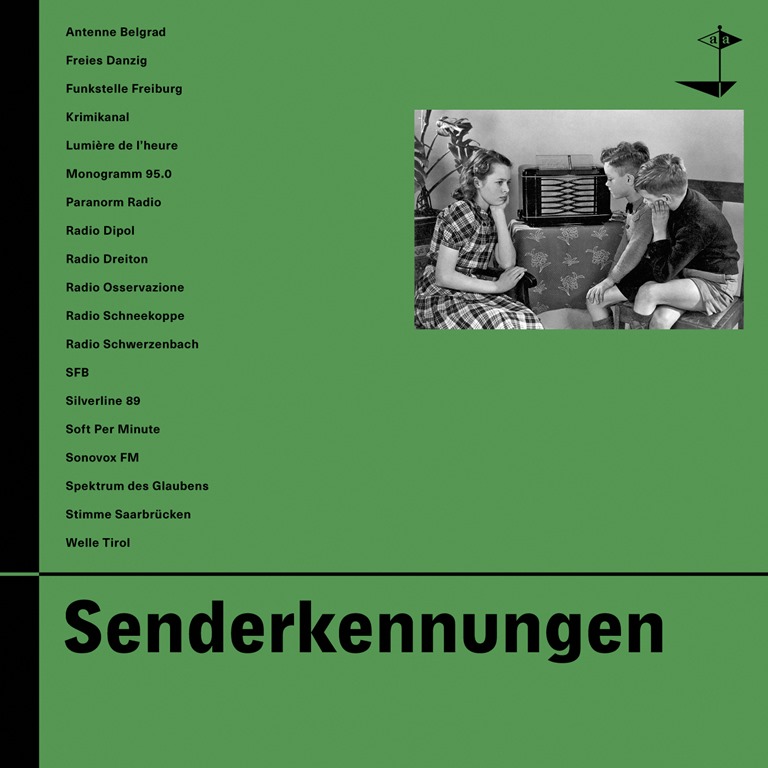
It’s in this context that we arrive at Senderkennungen, the first collaboration between Felix Kubin & Asmus Teitchens, of which the latter explains a follows:
‘In order to make radio stations acoustically recognizable they need a so called station ID. This audible signal is synonimous to a visible logo. Both logo and station ID create identities. The German word for station ID is „Senderkennung“. For the album Felix Kubin composed a series of unique Senderkennungen – each ca. 5 seconds long – which have been commissioned by various radio stations, who where in need of a station ID or were looking to relaunch their existing acoustic branding. Most of these miniature compositions are tonal but some verge towards an atonal or noisy character. Time and again Kubin and I discussed the possibility of creating pieces out of these ultra compressed and short Senderkennungen. This was realized for the album in applying the rule of keeping Kubin’s original musical material recognizable while at the same time using any form of manipulation, modification, stretching, shortening or expanding in the development of the new pieces. One limitation: Those new pieces should not be longer than three minutes each.’
The resultant double album contains an immense thirty-nine tracks, although the first nineteen, recorded by Kubin alone, are each around half a minute long. On the vinyl, these are all packed onto side A, meaning the remaining three sides are given to the collaborative pieces, which tend to be around the two and a half minute mark.
The nineteen initial station ID pieces are simple synth pieces, with a single motif – either a chord or two or some chiming notes – repeated a couple of times with some space between. Some sound as if they’ve been lifted from an album of sci-fi sound samples from the 60s and 70s, and occasionally – as in the case of ‘Radio Dipol’ and ‘Radio Schneekoppe’ – segues from old TV shows. Often weird, always unpredictable, Kubin seems to have a real thing for heraldic or faux-medieval-sounding motifs, and these microtunes are varied, as well as alien in that they have no place in the world of Internet radio and Spotify.
The newer, longer pieces, do mark something of a stylistic shift. It perhaps goes without saying that the expanded time markers give more room for sonic exploration which extends beyond simple motifs, but more than that, they feel like more fully realised compositions rather than functional sonic stamps. This is no doubt because that’s the fundamental difference: Kubin’s original commissions were created for a specific – and most utilitarian – purpose, rather than for musical entertainment, while the recent collaborative pieces are designed with being listened to, and perhaps even a sense of audience in mind. ‘Freies Danzig’ may be sparse initially, but builds from a multi-voiced synth piece into a layered work of tonal and textural contrast, while ‘Krimikanal’ leans towards dark ambient territory. ‘Paranorm Radio’ is eerie and squelchy, as good a sonic representation as you’re likely to hear, and there’s an abundance of reverberating, woozy weirdness on offer as the work progresses.
Senderkennungen feels less like an album of two halves, or even of one quarter and three quarters, but two quite separate albums, and the two sets of compositions make for very different listening experiences.
AA