Posts Tagged ‘Everest Records’

Everest Records – 25th September 2026

Christopher Nosnibor

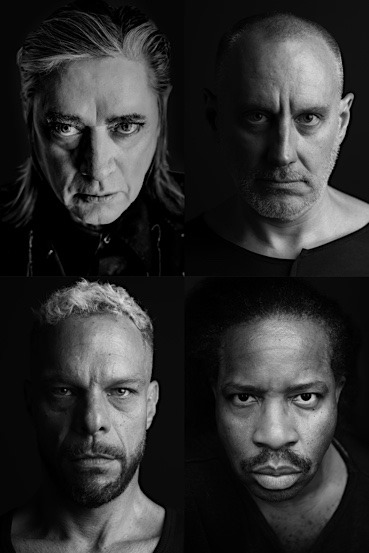
What we effectively have here is a pair of EPs from Swiss avant-garde act KiKu, led by trumpeter and composer Yannick Barman and drummer and percussionist Cyril Regamey, each one a collaboration – but rather than rendering them separate works, what we get is an album of two distinct halves, conceived, we’re told, as a diptych: ‘two distinct bodies of work held together by a shared musical architecture’, where, ‘on one side, Blixa Bargeld moves through language with precision, restraint and abrasion. On the other, Black Cracker turns language into rhythm, pressure and momentum. Between them, KiKu constructs a dense, unstable framework of trumpet, drums, sampler and electronics’. The result is something akin to a split album, on which the two sides of KiKu are as much a defining feature as their collaborators.

The first of the four works with Bargeld, ‘Orlando’s Victory,’ slides in with some retro-vibing electropop which isn’t a million miles away from late-career Leonard Cohen. Simmering synths strike some dramatic shapes and brooding tones atop a slightly shuffling, trip-hop infused beat. ‘The Number of the Millibeast’ is a slice of dark storytelling, a minimal, almost folky instrumental provides the backing for a half-sung, half spoken narrative, delivered with a theatrical flourish, before ‘Suzhou XX XY YX YY’ continues in the same sonic vein, while the lyrics become more abstract. The instrumentation becomes ever sparser and the lyrical cohesion crumbles with each successive piece, culminating in the flickering pulse and gasping weirdness of ‘Nonsense Rock ‘n’ Roll’, which seems to be a moan about some people playing music in the street in the night which rapidly escalates in divergent directions. The atmosphere is that of late-night, downtown, smoke and rough liquor, Bargeld adopting a persona that’s a bit Tom Waits, a bit Charles Bukowski, but which comes across with a hint of grizzled old man, chewed up and ground down by life, veering erratically between raconteur and curmudgeonly malcontent. ‘Do I like the music? No! Nonsense!”

While it’s Regamey’s percussion which sits to the fore on the Bargeld cuts, it’s Barman’s brass which takes the lead on ‘Bull Whip’, the first of four ‘bull’- themed tracks with Black Cracker. ‘So much road rage / so much road kill’, Black Cracker reflects. His delivery here is soulful yet sad, and the trip-hop vibe of ‘Suzhou’ makes a subtle but distinct switch to hip-hop on ‘It’s All The Rage’. ‘Leaping Bull (Chicago)’ is different again, and something deep within the song – the way the mournful trumpet which echoes out over stuttering beats, and Black Cracker’s grizzled, world-weary vocal, vaguely reminiscent in its patina to Mark Lanegan – tugs at half-forgotten emotions and a sense of memories of the past, hazed by time. And then, halfway through, it switches to a dense, droning slab of dark hip-hop, tense and twitching with angst. Coming out of nowhere, it hits hard, but paves the way for ‘The Running of the Bulls’, where bleak instrumentation and soulful but anguished vocals combine to convey a sense of conflict between the interior and the exterior. ‘Sleeping Bull’ notably is subtitled ‘Woke’ in parenthesis, and its lyrical and sonic latticework makes for a compelling combination while reminding us where the term ‘woke’ actually came from. It’s absurd to think that it’s been adopted as a pejorative term, predominantly by white, right-wing wanksacks. It’s high time to reclaim it, and to not only be woke, but woke and proud.

Decidedly more downtempo and downbeat than ‘Suzhou’, ‘It’s All The Rage’ feels less driven by anger or rage than it conveys an aching sadness, the kind that permeates the body to the core, and makes the limbs and the very heart weigh heavy. As a whole, Suzhou / It’s All The Rage is very much an album of two halves, precisely as intended. And as contrasting as the two sides are, they do, most definitely compliment one another, and, perhaps more importantly, they tap different triggers for response. It’s a multifaceted work, and most certainly an album to chew on.

AA
kiku-portraits-square

Everest Records

Christopher Nosnibor

Guess it pays to learn to trust your sources: if I’d seen pics of these guys or simply seen mention of this release in passing, passing is precisely what I’d have done, without a second thought. It would have vert much been my loss.

A skim over the press release cause me to take pause as I read that ‘Two Dogs are Beat Keller on guitars and Joke Lanz on turntables and voice, both based in Berlin. An uncompromising union of two musical individualists who are shaking up the noise world.’

Shaking up the noise world, are they? In that case, I’m all ears to hear what these two Swiss musicians who ‘oscillate between perfect dissonance and intelligent harmony’, and who, ‘with their stripped-down instruments, Lanz and Keller create a unique language somewhere between pavement poetry and free improvisation.’ The pair both have impressive resumes, which even mention artists I’ve heard of.

‘Mom’s Birthday’ is the first track and lead single from their debut album, Songs from the Trash Can. It’s a short (sub-two-minute) glitched-out collage of whacky shit which finds Lanz half-speaking, but almost shouting, about the events which befell him on waking, namely his inability to find his toothbrush or toothpaste. But, here’s the real wince moment: he got drunk and forgot his mum’s birthday. Ah, shit. So he sings an off-key rendition of ‘Happy Birthday’ by way of a belated apology. As you do when you’re probably still drunk from the night before.

‘Mom’s Birthday’ is discordant and chaotic and sits very much at the experimental end of noise: it’s also very much of the lineage from early 80s tape-looping noisemaking – think Foetus’ Deaf!.

It’s a fitting companion to ‘In the Pub’, the quirky track that’s available to stream as a taster for the album, which, with tongues firmly in cheeks, pokes droll fun at English pub culture with an astuteness of observation that should shame most natives, and in just two minutes, they capture the reasons why I avoid town pubs and miss Europe, and why these guys are great.

AA

Two Dogs (uncredited photo)

Everest Records – 14th January 2021

Christopher Nosnibor

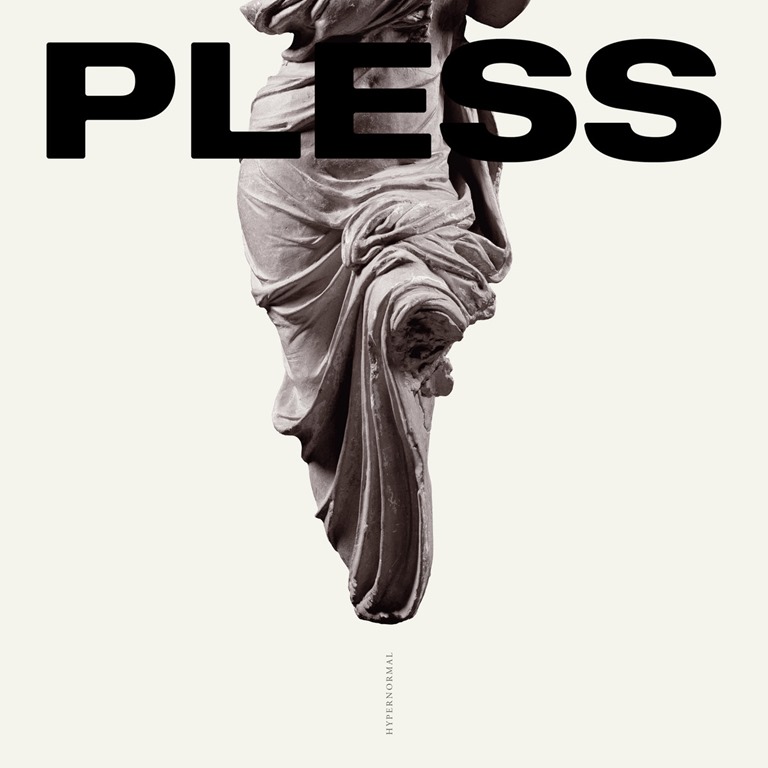
Language is fluid, it evolves. Sometimes I appreciate that, and like the fact. Other times, this is something which can be intensely frustrating, and it seems the meaning of hypernormal has evolved – seems to have been reconfigured, rechannelled – with remarkable rapidity. Initially, it was something of a colloquialism, an on-trend sassy term to describe something that was so normal it was beyond bland.

The connotations of the scarily mundane, the individual who was so lacking individuality that they made clones appear unique, which emerged late in the first decade of the new millennium remained largely stable until Adam Curtis delivered his seismic three-hour documentary in 2016, which espoused the theory that HyperNormalisation is a process whereby a mundane, readily-digested version of life and society has been superimposed over the complex world by those in power. And so according to this, we now live in a ‘fake’ world. And this concept of a constructed reality overlaying the true reality seems unsettlingly feasible. What, and who can you trust or believe? Trust no-one; believe nothing.

Perhaps because I think too much and don’t sleep enough, I’ve wondered ever since I was a child if the world we live in is real, or if we’re all figments of our own imagination, and if reality is a construct. Yes, I experienced existentialism combined with some kind of take on The Matrix at the age of five. But I digress, and there is a point to all of this, and that is that nothing is fixed, nothing is certain. We know so little, we don’t even know ourselves.

Pless’ hybrid sound is absolutely not normal, and it’s certainly not normal beyond normal so as to be the next level of mundane; but nor does it feel entirely like a carefully-constructed fiction which bears the ultimate lie. That said, there is a certain element of deception here: the façade of simplicity, of minimal, semi-ambient electronica belies the detail and complexity of these layered compositions, and as such, it’s something not normal, disguised as something that resembles normal, or at least familiar. Ultimately, it’s something else entirely; something mellow, something layered, something dark and something light. All of this filters into cognisance in the first piece, the slow-paced, semi-abstract ‘Azure’, whereby spectral synths drift around a metronomic drum and ever-moving bass tones.

The drum sound is noteworthy: it’s somehow immediate, up-front, and dry, as well as reverby, landing between Joy Division and Duran Duran.

The synths of ‘La Cienaga’ lean towards A Flock of Seagulls, but the stuttering drums and stammering incidentals contribute to transporting this track to another place entirely, one filled with dark shadows cast by brooding electropop and darkwave. Meanwhile, the six-minute ‘La Grenouille Volante’ has a bass that thrums like an engine throbbing at the dark heart of its soft ambient washes and distant drums. Around two-thirds in, it unexpectedly revs up a gear, and while the same, the additional volume translates to additional intensity, too.

The haunting, spectral organ drone of ‘Ante finem’ is blasted through with hefty tribal percussion, gradually shifting to a slow, deliberate bass-driven trudge, while ‘Fog City’ is every bit as murky and disorientating as you would likely imagine, with vocal samples and reverberated snare cracks echoing through stark synth stabs, and ‘Hot God’ comes on like a collision between Kraftwerk and DAF with a dash of early New Order, mining a deep seam of late 70s/early 80s electronica. The final track, the ten-minute ‘Reodorant’ is a dark-ambient epic in every sense, deep, moody, a little unnerving.

Each of the pieces shifts as it progresses, and evolves over the course of its duration, often subtly, twisting through expansive soundscapes front one plateau to another. Under the cloak of minimalism is shrouded considerable detail, and a quite remarkable focus on texture and movement. Even in the most stagnant of moments, there isn’t an element of stillness here. It may be cold, it may be distanced, but it’s also quite its own work. Normal? What even is that anyway? Stark, sparse, yet so, so rich, with Hypernormal, it becomes clear that Pless is more.

AA

a2732208461_10