Archive for the ‘Reviews’ Category

Christopher Nosnibor

The third Monday in January has been labelled ‘Blue Monday’ because studies have found it to be the most depressing day of the year. Christmas and new Year are but memories which have faded into the eternal darkness of dull days where sunrise happens after going to work – if it happens at all – and sunset has happened not long after lunch. For those on salaries, after the early pre-Christmas payday, bank accounts are drained and it’s still a long, long way till January payday, it’s cold and wet and frankly it’s all shit. For those not on salaries, the same is true minus the January payday. And that’s before you throw in the prospect of World War 3 and markets crashing around the globe while AI is rapidly taking over everything. So the idea of a cheap – four bands for three quid in advance cheap – gig with an uptempo party vibe and something of a ‘beach party’ theme is genius. Simple, but genius. In terms of marketing and the economy, enticing people out to put a few quid over the bar is infinitely better than everyone staying home vegetating while watching shit TV, and I’ve written variously on the therapeutic properties of live music.

This bill wasn’t quite as therapeutic as I might have hoped. I’m absolutely not averse to fun, but can’t say I’m mad keen when that fun is appended with a ‘k’. Because of a last-minute change from the advertised running order, Trip Sitter and Gents & Ginger (who were originally supposed to be on third and second respectively) swapped places and as a consequence, the first half of the night was very funk-orientated. It’s a matter of taste, of course, and the audiences – it seems there’s a different crowd in the room for each act, which feels strange (I’m accustomed to bands bringing their own fans and not all of them sticking around for all of the acts, but this was like a shift-change in the audience each time there was a switch on stage, and each lot brought a very different atmosphere) – would tell quite different stories.

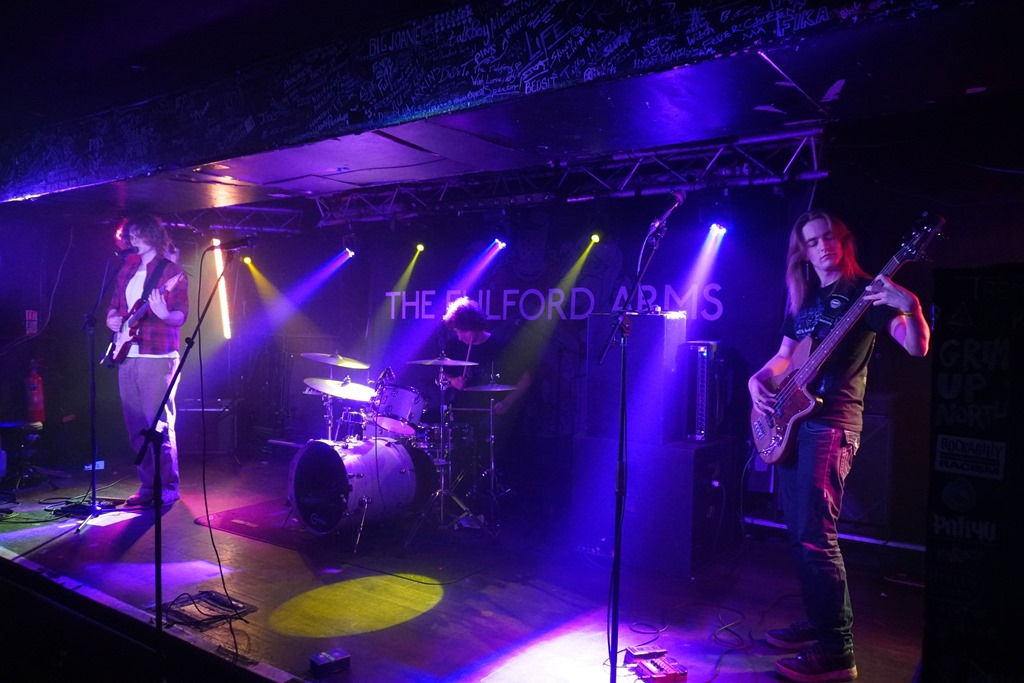
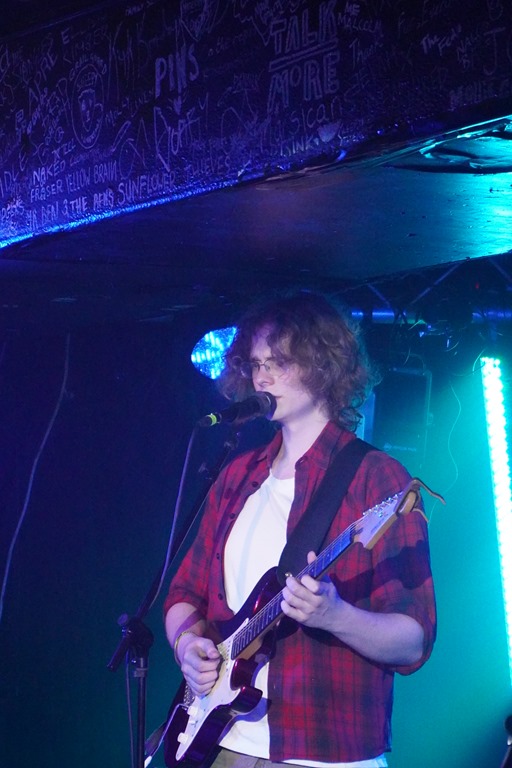
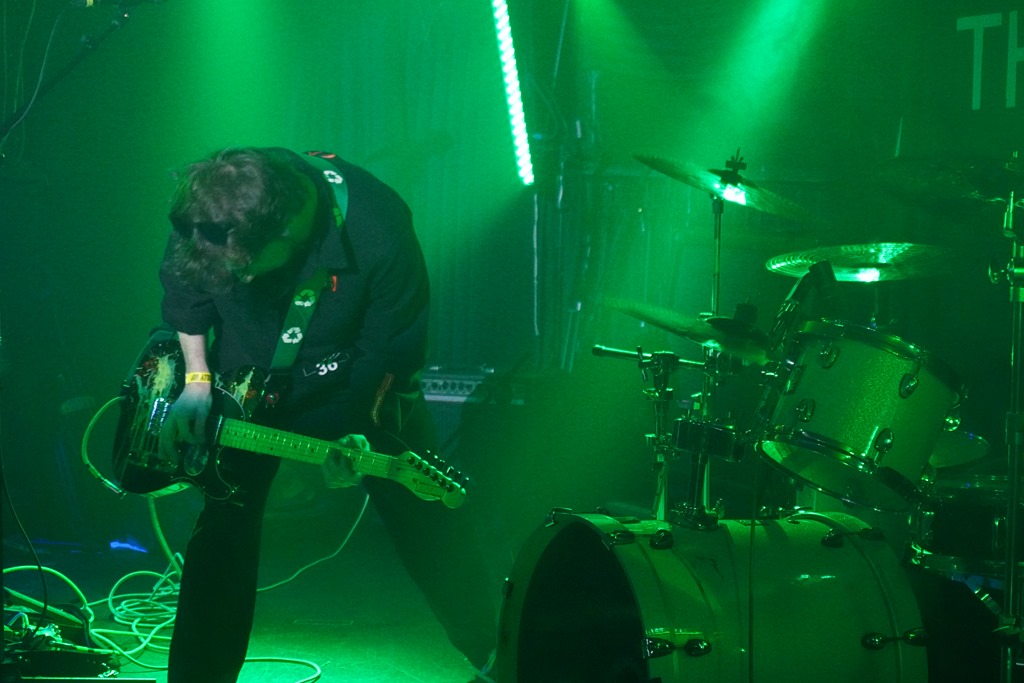
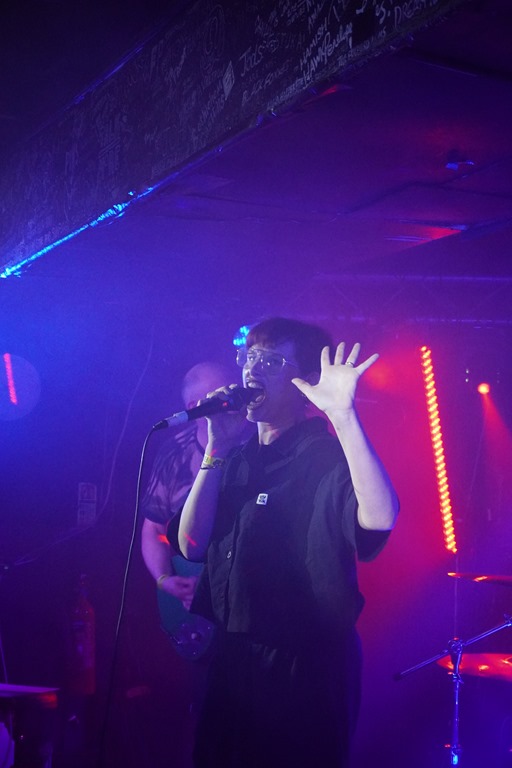
Reformed for tonight only, former college act Pedestrian bring a ska funk groove, and one song sounds far too much like RHCP to be forgivable. In fairness, they make up for it with a Mr Bungle cover. While they’re tight, handling the complex song structures with precision, the stage energy is quite low and seemingly self-conscious for a party band, but their mates go absolutely fucking ballistic. I find myself cowering beside the speaker to avoid being moshed to death by 6’6" sixth form virgins who seem hell-bent on breaking one another’s limbs.

DSC06435

Pedestrian

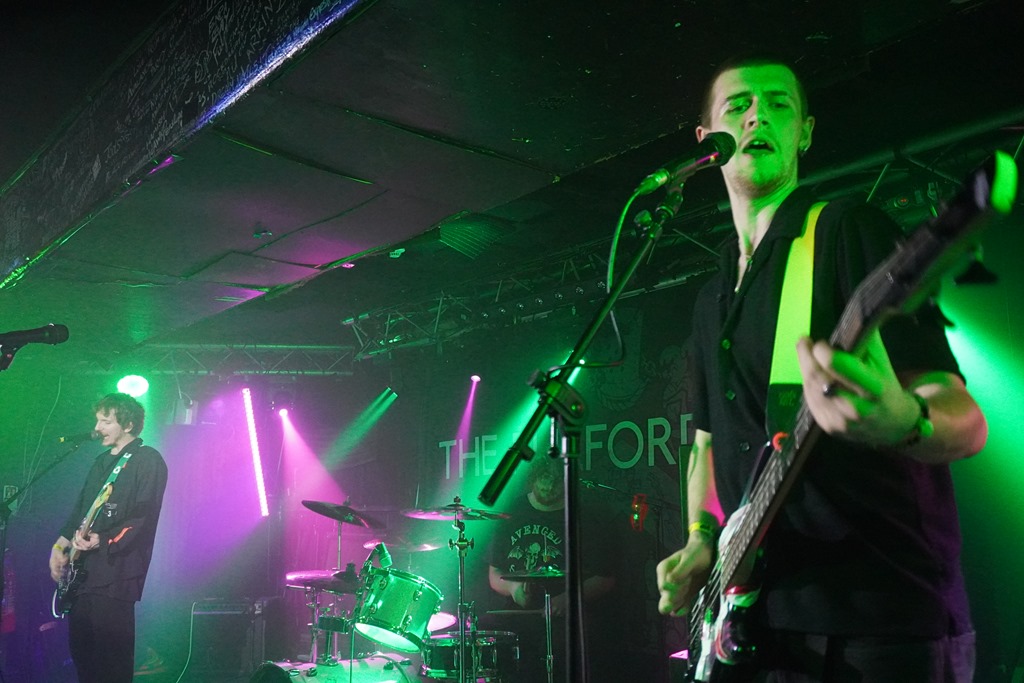
Gents & Ginger offer up some sort of lounge jazz muso wankery involving chords that require eight fingers spanning five frets, and with bad shirts. They play with eyes squinted and looking like they’re inhaling their own farts. The bassist has a knitted teacosey on the head of his guitar, and the last song sounds like Kings of Leon or something. They go down ridiculously well, too. I need more beer.

DSC06458DSC06464DSC06472

Gents & Ginger

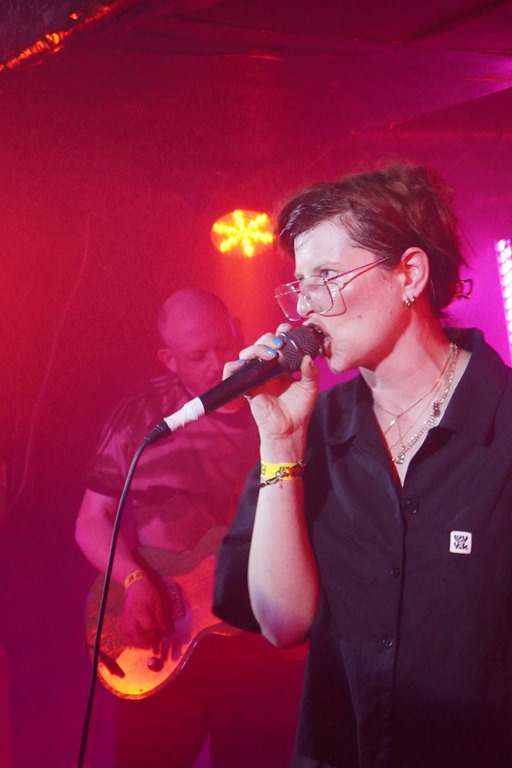
Trip Sitter proved a very different proposition, the foursome offering a Latin spin on 80s rock. And they do actually rock out and venture into blues territory with some style. And the last song of their energetic set is Eurovision worthy.

DSC06509DSC06518

Trip Sitter

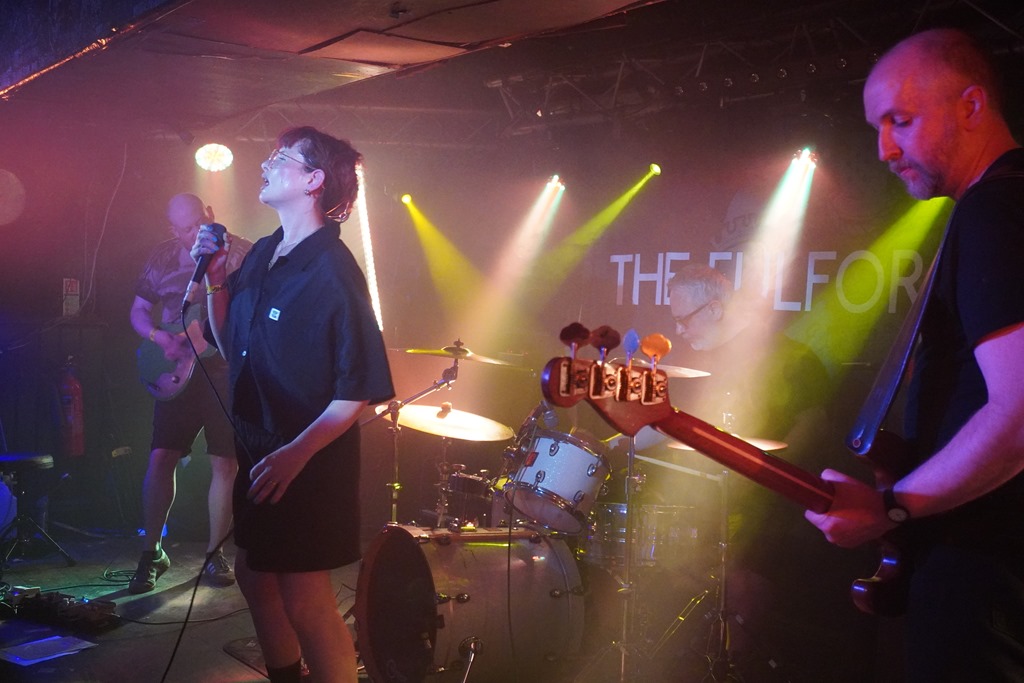
Flat Moon won me over the last time I saw them, despite reservations. Tonight…. No. Perhaps I was listening with different ears. Perhaps the very, very different crowd that suddenly packed to the front created a very, very different atmosphere. They were shouting and dancing and hugging and having a good time, but something just felt jarring, and Flat Moon were cocky and exuberant throughout their set of jizzy jazz-infused ska cuntery.

DSC06530DSC06567

Flat Moon

But loving all the bands is not always a prerequisite to a good night: seeing friends and simply getting out is enough. At this time of year, finding the motivation to leave the house can be the issue, and seeing friends doesn’t have to entail talking loudly over the bands, either. The bands could play, they went down well, people came out and supported live music. Good. And that’s all you need.

Christopher Nosnibor

I find it most disconcerting shopping in my local Co-op. The self-service checkouts film you, and you can see yourself on the screen above your head while you scan your items. Surveillance and facial recognition is everywhere now. The other day, I passed a venue where a guy in a flat cap was ordered my security to remove his hat and “look into that camera” before being told he could replace his cap and enter the venue. We really have come to this: you can’t go shopping or go for a drink without a capture of your visage ‘for security’. I appreciate that shoplifting is at a record high and violent crime is rife, but is this really the solution? How about asking why we have these issues? And what happens with these captured images? Who views them? How long are they stored, and where? Are they being passed off to train AI?

The ‘if you’ve got nothing to hide, you’ve got nothing to worry about’ argument is missing the point, and no longer holds water. The state of things in America with brutal ICE raids where countless American citizens have been mauled, detained, and even murdered (because regardless of the official line, Renee Nicole Good was murdered: those shots were not fired in self-defence, and we live in a horrible, brutal, fucked-up world). And this shit affects you. Well, it certainly affects me, and I know I’m not alone in feeling jumpy, on edge, endlessly anxietised by the prospect of what may happen next, the prospect of waking up to discover that WWIII has broken out while asleep.

This new single by 311 touches on this, significantly, as it happens. as their bio notes summarise: ‘Propelled by discordant guitars and thunderous offbeat rhythms, ‘Leach’ is an abrasive dystopian statement on surveillance, data harvesting and the quiet unease of modern digital life; both a rallying cry against the advancement and negative impacts of big tech, and an honest admission of powerlessness and inevitability in the face of it all.’

It’s a killer single and yet again evidence of just how fertile Leeds is as a spawning ground for fantastic bands. London, Manchester, even Sheffield receive so much hype, but despite being the epicentre of goth in the early 80s and the place for post-rock in the mid 2000s, Leeds seems to be criminally lacking in recognition for its contribution to music, despite Blacklisters, despite Pulled Apart by Horses… and 311 are another bands that should be flagging the city on the national – and international – radar. Because ‘Leach’ brings it all, from churning math-rock, angularity and anguish, colliding post-rock with post-punk and huge energy, they pack menacing and searing riff energy and… and… yeah. This is good.

It’s worth remembering punk and post-punk emerged from terrible times, where it felt like music offered a rare escape, both for those who created it and attended shows. And here we are again.

AA

The Helen Scarsdale Agency – 30th January 2026

Christopher Nosnibor

Cindytalk has been going almost literally forever, at least in terms of the life cycle of bands. A brief scan of my own archives reveals that the last time I wrote of Cindytalk was way back in 2013, covering A Life is Everywhere, released on the esteemed experimental label Editions Mego. The musical vehicle of Scottish musician Cinder, with an ever-shifting supporting cast, Cindytalk has been in a constant flux and perpetual evolution since the project’s formation in the early 80s – emerging from the post-punk scene and exploring every direction since, a career defined, as they put it, ‘by a continued process of disintegration and regeneration’. This is the very essence of the avant-garde, which was built on a manifesto that said that its function was to destroy the old to build the new. And implicit within that concept is the need to destroy its own creations in order to progress. Cindytalk has very much espoused that ethos over the course of the last forty years or more, with a career defined by perpetual reinvention.

Described in the press blurbage as ‘a labyrinthine opus, one that returns to the themes of the sacred and profane that have rippled through all of Cindytalk’s recordings’, Sunset And Forever opens with the eighteen-minute exploration which could reasonably be described as a (dark) ambient work. And it is dark. Spectral voices and spirits haunt every second of this unsettling drone-led work.

‘Labyrinthine opus’ is a fair description for an album which begins with a sprawling eighteen-and-a-half-minute ambient monolith, where falling objects cascade in caverns of reverb before slowly undulating drones gradually grow and turn. At times dense, at other more nebulous, around the mid-point, the scraping trickle of ‘embers of last leaves’ turns into a darker place, and is ruptured with percussive crashes and unpredictable extranea, while haunting voiced fade in and out through the swelling churn of abstract noise. This first piece, alone, feels like an album.

With seven tracks and a running time of around sixty-mine minutes, Sunset And Forever takes it time in exploring sonic contrasts, with graceful sweeps of watercolour synth washes underlaid with scratches and hisses and harder, uneven textures, the sonic equivalent of cobblestones underneath a velvet rug – or somesuch. Put another way, the soft and gentle is rendered uncomfortable by something altogether less soft or comfortable beneath, and hidden beneath a pleasant surface, and those hidden elements are reason to tread cautiously or risk twisting an ankle. It’s almost as if each track contains two compositions overlaid, a kind of collage or a palimpsest of a gentle ambient work and an altogether less gentle noise construction.

On ‘tower of the sun’, the dissonance and angularity rises to the fore to make for a skin-crawling ten minutes, while ‘my sister the wind’ screeches and scrapes, shards of drilling treble buffeted along by a train-track rumble.

The sound – and the meaning – of Sunset And Forever is forever just beyond grasp. For as much as the sounds and textures rub against one another and create discomfort, as a whole, it’s vague, indirect, hazy. It concludes open-ended, with questions unanswered and leaves a sense of uncertainty.

AA

AA

HMS078 front

16th January 2026

Christopher Nosnibor

Woah. They’ve gone and done it again. Eville continue to chart their own ascent through their single releases, and having previously toured with Glitchers and played at Reading and Leeds last year, they look like they’re on the brink of really ‘blowing up’ as tour support for As December Falls. They’re a band that tours hard and wins fans at every show, and that’s coupled with a steady output of singles over the last couple of years, culminating in the Brat Metal EP late last year. They’re kicking off 2026 where they left off last year, and ‘Blow Up’ is another rip-snorter, an audacious hybrid of slugging nu-metal, hyperactive rave metal, and autotuned pop.

As such, ‘Blow Up’ draws together all of the elements of their previous releases, and, true to form, compresses them into a pumping three and a half minutes (which is actually quite long for them). It’s not quite a party tune, but it is a beefy riff-driven banger with real bounce. It’s more electronic, more processed-sounding than any of its predecessors, and leans more into pop territory than metal – at least in the main – but the late-landing mid-section goes heavy… And then it bounds to the finish line with another surging chorus.

Right now, it seems as if Eville are reinventing nu-metal for the 2020s, and on their own terms. They’ve got Kerrang! jizzing themselves over their every move. And rightly so. This is a new kind of metal. Power to them.

AA

AA

14510253122600850278

Christopher Nosnibor

That a quarter of the tickets sold in 48 hours, and the show was sold out a full three months in advance speaks for itself. It’s been a huge twelve months for Glasgow purveyors of epic goth-tinged doom, Cwfen. It was only last February that they played their first show south of the border. Since then, they’ve toured supporting Faetooth and released their monumental and widely-acclaimed debut album, Sorrows, which has had Kerrang! positively frothing with enthusiasm. And they deserve all of this. There’s something quite special about Cwfen: they’re in a league of their own, and certainly not simply your run-of-the-mill doom band. Make no mistake, they’re full-on and heavy – in places gut-churningly so – but they have so much more going on, especially in terms of melody and dynamics.

This is an outstanding lineup. All three acts are heavier than lead, but each offers something quite different. This matters, because however much you may love a headline act, its tiresome and takes the zip out of an event if the supports are lesser versions of the headliners. I’m reminded of the mid 2000s, when you’d get four instrumental post rock acts on a bill, and I’d find myself crescendo’d out by the end of the second set and be falling asleep on my feet during the headline set, and also the time industrial noise duo Broken Bone supported Whitehouse at the Brudenell. Nothing like having a third-rate tribute act who think they’re amazing as a support.

Leeds is a significant spawning ground for metal acts of all shades, and both Acceptance and Helve showcase the depth of quality on offer. First up, Acceptance bring the weight with some heavy tom-led drumming behind the blanket of guitar. Theirs is a dense wall of screaming anguish, with billowing smoke often obscuring the stage. For all that, there’s remarkable separation between the instruments, and the remarkably thick but clean bass cuts through nicely. By the end of the set, the vocalist is crawling on his hands and knees, drained, having poured every last drop of emotion and energy into a blistering performance. When the opening act could easily be headlining, you know you’re in for a good night.

DSC06152DSC06102

Acceptance

Helve’s bassist is wearing a Swans Filth T-shirt. This is something I would consider a recommendation. As it happens, they sound absolutely nothing like Swans, being a full-on metal act, but they are as heavy as hell. With two guitars and bass and massive amps and piles of pedals, there’s no room for the lead vocalist on the small stage. Compared to Acceptance, who play everything at breakneck pace, Helve’s songs slower, more atmospheric, offering a sound that’s more post metal. Applying a screwdriver to his guitar strings, the first guitarist conjures some strange droning sounds at the start of their set. Their riffs are slow and dense, and whole there’s some nice mathy detail along the way, the end of the set brings a full-on chug-blast in the vein of Amenra.

DSC06207DSC06221

Helve

While Helve clear out and Cwfen set up, we’re treated to Shellac’s first album by way of entertainment, and when Cwfen hit the stage, opening with ‘Bodies’, it’s like a bolt of lightening. More powerful than even the volume is the stunning clarity of the sound, replicating all the detail of the studio recordings but with the added potency of the immediacy of being in the room and mere feet from the band. The song’s nagging lead guitar part is an instant, hypnotic hook.

Perhaps recognising that Sorrows is perfectly sequenced, the set is, essentially, the album played in order – with the addition of a new and unreleased song, ‘Revenge’, which is inserted – most comfortably – in between ‘Reliks’ and ‘Whispers’.

DSC06262DSC06276

Cwfen

For such a dark band, they seem pretty happy on stage, Agnes in particular beaming throughout the set. She’s every reason to: they’re on immaculate form, and the entire room is captivated and shows its appreciation. Each member brings something quite particular to the table: gum chewing barefoot bassist Mary Thomas Baker doesn’t simply play, but becomes the groove, a solid foot-to-the-floor low-end thud that’s more goth than anything else; drummer Rös is pure precision, while Guy deNuit manages to sound like he’s playing multiple parts at once, creating a magnificently textured, layered sound. Agnes, for her part, in addition to some tidy guitar work, is a formidable vocalist with immense presence, effortlessly shifting between commanding clean vocals to a banshee howl in a breath.

DSC06317DSC06403

Cwfen

The screaming metal verses of ‘Penance’ give way to a sweeping , majestic chorus, and I find myself blown away in the same way I was the first time I saw them. This is indeed a rare feat. But then, if anything, they’re even better now than a year ago, even more powerful.

Talk about an early peak. I may well see other gigs which equal this one, but the chances of a night which surpasses this before the year is out are, frankly, slim. Bad Owl have done an outstanding job in curating this lineup, and Cwfen are as good a live act as you’re going to find.

DSC06253

Testimony Records – 13th February 2026

Christopher Nosnibor

When I first started Aural Aggravation – kinda by stealth, with no fanfare – back in October 2015, with a review of Philip Jecks’ Cardinal, it was with a view to using the platform to break away from more conventional and comparatively short-form reviews to indulge in more personal, reflective, essay-type analysis. But with a bursting inbox and a desire to provide coverage to as many acts as possible, sometimes it’s not always appropriate to spend hours and column inches pondering the context and the content through a framework that sits between reception theory and gonzo journalism. More to the point, there simply aren’t enough hours.

Slaughterday is an old-school death metal duo, and Dread Emperor is their sixth album. They promise ‘crushing doom-ridden ultra-heavy parts to calculated outbreaks of utter brutality,’ and cite as lyrical inspirations ‘H. P. Lovecraft and other masters of horror’. They go on to add, ‘while sinister things crawl and creep through the duo’s timeless brutality, they have always portrayed them with a sinister flair of their own. These days, the band has repurposed those monstrous creatures as metaphorical ciphers for relevant contemporary topics’.

Titles such as ‘Rapture of Rot’, ‘Necrocide’, ‘Obliteration Crusade’ and ‘Astral Carnage’ speak for themselves, and the ‘crushing’ ‘doomy’ aspects they focus on in their pitch are very much to the fore: ‘Enthroned’ lifts the curtain with some slow, heavyweight riffery, and paves the way for the rabid attack of ‘Obliteration Crusade’.

That bands which blast out frenetic guitar mayhem at a thousand miles an hour with impenetrable growls and howls by way of vocals go to lengths to sell the merits of the lyrical content is something which is a source of vague amusement – I mean, as if you could make out a single word by ear. But it’s beside the point, really: as I’ve touched on before, it’s about the conveyance of sentiment, the implication of meaning.

On Dread Emperor, Slaughterday leap and lurch from bowel-bursting heavyweight sludge-trudge to flamboyant pirouettes on the frets. As they say themselves, they ‘deliver everything that they excel in, which is also precisely what their fans want from the duo’: as such, it’s no criticism to say that Dread Emperor ticks genre boxes, because it’s mission accomplished for the band. And it’s hard to argue otherwise. Dread Emperor delivers riff after riff, drives hard, brings the heavy and snarls, growls and spits its way with gut-churning malevolence from beginning to end.

AA

AA

a1341187244_10

Cruel Nature Records – 21st December 2025

Christopher Nosnibor

I fucking hate winter. And I fucking hate capitalism. These two statements are, in some ways, at least connected. Believe it or not, while the life of a serf is broadly associated with an existence synonymous with slavery, under feudalism, serfs were homed, and – harvests permitting – lived from the land they tended in exchange for providing some of their yield to their lord. As such, it was a system based on reciprocity. During the winter, when there was no work to be done, the serfs would rest, and without books or any of the mod cons we take for granted, would tend to live their lives around daylight hours. Even in Medieval times, a period in history commonly associated with barbarism and a comparatively primitive society, the landed gentry recognised that the people they owned were among their most valuable assets.

Under capitalism, the workforce has become expendable. There’s always another sucker, someone more desperate, who will work longer hours for less money to pay for their rented accommodation. For all the progress we’ve witnessed in giving workers rights in recent years, conditions remain pretty shit.

Since the industrial revolution and the ever-accelerating development of technology, capitalism has sought to squeeze every possible hour of labour from the workforce. Ill? Have a Lemsip and crack on, pussy.

My hatred of winter, then, is largely because of the demands of capitalism. It’s dark when I wake for work, it’s dark before the end of the working day. Many who work in offices or shops will be stuck indoors for the entire – brief – duration of daylight hours (if it actually gets light) and this simply isn’t healthy. I feel sluggish, lack motivation, and suffer from some crushing low moods, often wishing I could simply hibernate.

So arriving at Winter by Beckton Alps2 – the final part in the series of ambient concept albums released throughout 2025, imagining Stone Age people reacting to the changing seasons – I feel in some ways that little imagination is required. Technologically, we live in a different world. As beings… we have evolved… but only so much.

AA

a0783332579_10

Crónica – 20th January 2026

Christopher Nosnibor

As time passes, our tastes change. For some, they narrow and become more cemented, more deeply entrenched. There’s a broad acceptance that people become more conservative as they grow older – which may explain why, with our ageing population, we – that’s the western world – has become more in favour of conservative values, such as low tax and a belief that the past was a golden age in which hard work was rewarded, and of course, music was better. There is certainly more than a grain of truth in the boomer stereotype. And as a Gen X-er, I’ve observed people I grew up with, and /or have known for many years become set in their ways and their listening habits, locked in the 90s in their musical tastes, and becoming increasingly churlish about the youth of today and the like.

I consider myself fortunate to be surrounded by friends and acquaintances, both in real life and in the virtual world, who are deeply invested in new music. The fact I get sent new music of all kinds from around the globe is only half of the story, as it would be so easy to sweep vast swathes of it aside to listen to, and review, nothing but goth, contemporary iterations of post-punk and new wave, grunge, and reissues. In fact, I could devote my entire listening time and run a website dedicated to nothing but reissues and still be incredibly busy. It would probably garner a huge readership, too. But no: I am constantly encouraged to listen to new music, and the fact of the matter is that I thrive on it, and never fail to get a buzz from new discoveries. As such, since I began this journey as a music writer, my horizons have broadened beyond a range I would have ever imagined.

A measure of this is that my first encounter with the music of Rutger Zuydervelt, back in 2014, was marked by a most unimpressed four-star review, in which I said that Stay Tuned was ‘a bit of a drag’. While I don’t feel particularly inspired to revisit it now alongside my writing of this review, I feel I would likely have been more receptive to its longform minimalism now.

Spelonk is not quite as long in form – three compositions spanning a total of forty-two minutes, and sees Zuydervelt taking some time out from his dayjob to indulge in the act of creating for pleasure – or, perhaps, more accurately, creating out of the need to experience freedom, to feel that metaphorical – and perhaps literal – sigh of release.

As he explains, ‘Most of the music I make nowadays is commissioned for film, dance, or other projects. And I love it — it’s the best job in the world! — but sometimes I have to pull myself away from it, and make something purely for myself. My 2004 release Omval was one of these works, as is now Spelonk. These projects are always made in short bursts; once I start creating, things fall into place quickly, as if the ideas were (unknowingly) already there and just needed to get out of my system.

The three tracks that comprise Spelonk (simply titled I, II, III) are built with “hardware jams” that I recorded with my live setup. It’s all quite hands-on, with effects pedals, an oscillator, and electronic gadgets. The magic happens when combining different recordings, layering them, and hearing what happens. Listening is always a favorite moment in the process, with a welcome element of surprise. I guess it’s all about creating alien landscapes — alien also to me too — that are exciting to explore.’

‘Alien landscapes’ is a fair description of these sparse works, constructed with layers of ominous drone. On ‘Spelonk II’, there are chittering sounds which scratch like guitar string scraping against a fret, or perhaps a ragged bow dragging against a worn string, but by the same token, untranslatable voices come to mind. The drones are eerie, ethereal, and hang low like mist or dry ice: it’s not nor merely an example of dark ambient work – there is very much a 70s sci-fi feel to it, hints of BBC Radiophonic Workshop emerge between every surge and crackle as slow pulsations reverberate among the unsettling abstraction. Over the course of the track’s eighteen minutes, there is movement, evolution, and just past the midpoint, there is a shift, where trilling organ-like notes and digital bleeps emerge, evoking recordings from space travel, and, as rippling laser sounds begin to burst forth, vintage sci-fi movies and 70s TV.

There are moments of near silence as ‘Spelonk II’ drifts into ‘Spelonk III’, also eighteen minutes in duration. Here, clanks and bleeps bubble and bounce and echo erratically, unpredictably, over a backdrop of low hums and reverberations. The low-end vibrates subtly but perceptibly, and while the experience is not one which instils tension, the cave-like digital drips and sense of space, as well as darkness, is not relaxing. You find yourself looking around, wondering what’s around the corner, what’s in the shadows. And while there’s no grand reveal, no jump fright here, the second half of ‘Spelonk III’ grows increasingly murky and increasingly squelchy and unsettling.

Over the album’s duration, Spelonk grows in depth and darkness, becoming increasingly dark, strange, and unsettling. Rutger Zuydervelt makes a lot out of very little, to subtle but strong effect.

AA

Crónica 245 front

Glitch Mode Recordings – 9th January 2026

It’s been a little while since we last heard from .SYS Machine, when they slipped ‘Graceful Isolation’ out in the wake of the pandemic lockdowns. One reason for this is that Dave McAnally has been busy with industrial side-project Derision Cult – but with ‘Doubtless’, .SYS Machine presage the arrival of a new album, Parts Unknown due out in April.

While the dark electronic pop of .SYS Machine is sonically more accessible than Derision Cult McAnally’s lyrics have a tendency to draw on the experience of living through our trying times, and ‘Doubtless’ is no exception, exploring as it does the challenge of ‘maintaining sanity in an increasingly turbulent and chaotic world’.

The vocal melody and McAnally’s drawling intonation bring something of a country feel, which is quite a contrast to the metronomic pulsating disco beat and the synths, which are airy and even hint at a sense of optimism. There are strong hints of Violator-era Depeche mode woven into the fabric of the song, particularly in the chorus, and it balances broodiness with a certain buoyancy. The way the elements interlace is intriguing, and far from obvious – meaning this is a grower rather than an instant grab.

AA

a0086727392_10

Sky Valley Mistress continue the countdown to the release of their second album Luna Mausoleum, that is due to land on Friday 23rd January 2026 (New Heavy Sounds).

Intended to be the soundtrack of their Hearsecraft ride to the moon, Pilot Kayley “Hell Kitten” Davies and Commander Max “Leather Messiah” Newsome launch you into the Sonic Stratosphere with an audio journey fuelled by 70’s hard rock, driven off the road to a fresh new destination.

Today sees the release of the official video for previous single ’Too Many Ghosts’, a song which, according to the band, “is meant for the open highway. Somewhere you have the freedom to put your foot down and still feel like you’re cruising”.

Watch the video now, which stars the band and the hearse they drive around in on tour known as ’Thundertaker’:

AA

In a brief glimpse behind the curtain, the band have also shared the details and dangers behind the making of ’Too Many Ghosts’.

"The story behind making the music video for Too Many Ghosts is that it took five separate weekends to shoot with us only managing to actually record any footage during the last day. The reasons for the failed recording days were:

– A car full of drugs dealers moving us on from location and ‘politely’ requesting that we don’t return

– The power generator for the lights being faulty followed by torrential rain

– Our videographer realising he had forgot his memory card after driving 90 mins to location followed by the hearse breaking down due to a broken fan belt

– Kayley’s astrosuit zip breaking after shooting one take

The hearse battery also died moments after we finished filming, which meant I (Max) was left alone in the middle of Slaidburn Moors at the dead of night in a hearse with no power or heating (it was fucking COLD) for a few hours whilst I waited for a recovery vehicle and Kayley to return from driving our videographer home in the other car.

This video started the band’s catch phrase of ‘the curse of the hearse’ that we use any time something goes wrong, which it does. A lot."

New album Luna Mausoleum takes you through desert rock grooves and mountainous riffs, you are guided by Kayley’s soulfully smoked voice and her range of soaring, delicate, yearning and understated melodies as the band ride peaks and valleys of dynamics and pace with an eclectic selection of instrumentation of fuzz guitars, organs, real orchestras and a children’s choir.

Twisting influences of Queens of the Stone Age with Portishead and turning from Spiritualised-sized gospel choruses to the gallow heavy swing of Black Sabbath, with sound as fast as light they move between their influential orbit to create a modern classic that is entirely their own. There isn’t space in this genre the band haven’t explored. This is a demonstration of their refusal to wait for permission to create a record that stands in scale with some of the most monumental albums in rock.

The band’s statement on their intent behind creating Luna Mausoleum was that it should be “greater and beyond all reason”.

r1CpyOCw

AA

Sky Valley Mistress live:

The band who has one member play every instrument so that they sound like a four piece in the studio, defy logic with aspiration with their iconic live show as a Duel-Drumming Duo. Vocalist Kayley “Hell Kitten” Davies takes the sticks and one half of a drum kit whilst original drummer Max “Leather Messiah” Newsome battles the electric guitar with the kick drum under his foot. No samples. No backing tracks. No click tracks. No one is playing rock and roll the ways these two do.

Sky Valley Mistress will be performing at a number of live in-store shows this month.

FRI 23 @actionrecords Preston

SAT 24 @jacrecordstore Liverpool

SUN 25 @five_rise_records Bingley

MON 26 @crashrecords Leeds

TUE 27 @reflexrecordshop Newcastle

THU 29 @justdroppedin Coventry

FRI 30 @sunbird_records Darwen*

SAT 31 @vinyltaprecords Huddersfield

*Venue show supporting @hotwaxbandd