Posts Tagged ‘Post Rock’

Coup Sur Coup – 17th October 2025

Christopher Nosnibor

Few drummers receive much recognition, unless they’re the backbone of bands who are household names (people know Ringo Starr, Keith Moon, Dave Grohl, Mike Joyce, Lars Ulrich), or have otherwise featured prominently in a specific musical milieu (Martin Atkins and Paul Ferguson come to mind). Their contributions are overlooked and underappreciated, and in the main, there’s a tendency to only notice exceptional drummers, or poor ones. It’s not the job of a drummer to grab attention, but to hold everything together at the back. Consequently, you might be forgiven for being unfamiliar with William Covert, whose career is defined more than 15 years of drumming in math rock, post-rock, and post-hardcore bands (Space Blood, Droughts, and Rust Ring).

As the narrative goes, ‘Covert began experimenting with live-looped synths alongside acoustic and electronic drums. This experimentation birthed two full-length solo albums characterized by post-rock and krautrock-inspired synth loops and melodies, all performed solo with loop pedals and sequencers.’ Dream Vessel was born out of a desire to pursue a different approach and a different direction, and indeed, the first part of this latest offering was a collaborative, group effort, with Nate Schenck on bass and Jack McKevitt on guitar, while we learn that ‘the other half was performed entirely solo, diving deep into cinematic ambient soundscapes, dreamy Frippertronic-influenced guitars, modular synth, and free-jazz drumming filtered through a post-industrial lens.’ Nothing if not varied, then.

The album’s five tracks span thirty-eight minutes, and it’s very much an exploratory experience. ‘Brotherhood of Sleep’ eases the listener in gently, with a slow, strolling bass and reverby guitars. It’s an expansive and spacious instrumental work, rich in texture and atmosphere – a shade proggy, a little bit jazzy, unfurling at a sedate pace. ‘Trancers’ fades in, and offers similar vibes, but it’s both more spacious, and more groove-led. The guitars bend and echo that bit further, and as the track progresses, so the pace and urgency build, along with the density of the guitars, which warp and stretch more with every bar. It may not hit the extremity of My Bloody Valentine’s Loveless, but the guitars do sound as if they’re melting by the midpoint, before the track locks into a muscular, driving groove that’s a world away from where it began. There’s an appeal that’s not easy to pin down when it comes to compositions which begin in one place and end up entirely in another, while it’s not entirely clear how they’ve transported the listener from A to B. The experience isn’t completely unlike making an absent-minded walk somewhere, when you haven’t been paying attention, and arrive with minimal recollection of the journey- although the difference is that the walk is usually via a familiar route that requires little to no concentration or engagement, whereas a song that swerves and switches involves an element of brain-scrambling along the way.

‘Dream Void’ is a centrepiece in every way: The third track, right in the middle, it’s over nine minutes in duration and a towering monolith of abstract drone. It’s immense, cinematic, widescreen, gentle. Around the mid-point, the drums arrive, and they’re busy, but backed off in the mix, and we’re led down a path to a place where frenetic percussion contrasts with chords which hover and hum for an eternity. Slow-picked guitar brings further texture to the mellow but brooding post-rock soundscape of ‘C-Beams’, which pushes toward nine minutes, as the album ventures into evermore experimental territory. As present as the drums are, they don’t provide rhythm, but bursts of percussion, swells of cymbal and wild batteries of rolling, roiling whomps.

The more concise, feedback-strewn ‘Throttle’ marks a change in aspect, a roar of noise, a wail of feedback, and positively wild, before ‘Come True’ closes the set with some Kraftwerkian bubbling synth and undulating bass, paired with a rolling beat. It’s all nicely done. And this is true of the album as a whole.

Dream Vessel is gentle, overall, but not without edge, or variety, and certainly not without dynamic. Here, ‘interesting’ and ‘unusual’ are not dismissive shrugs with a hint of condescension: Dream Vessel brings together a host of ideas and traverses a succession of soundscapes , never staying still for a second.

AA

a0283722598_10

2nd October 2025

Christopher Nosnibor

The context for Ashley Reaks’ sixteenth solo album – and his third in three years (not counting the compilation of demos released earlier this year) – is weighty. He has written openly and extensively of his health issues, while sharing images and commentary nocturnal wanderings, and these both inform At Night The World Belongs To Me, of which he writes:

The looming spectre of death and loss haunt the album: Reaks survived two major health scares and a misdiagnosed terminal illness over the last 18 months, experiences that inform the reflective, poetically gloomy lyrics, and the 4 am downtempo grooves. Adding to the sense of loss, guitarist and long-term collaborator Nick Dunne died suddenly at home just one week after completing his guitar parts for the record.

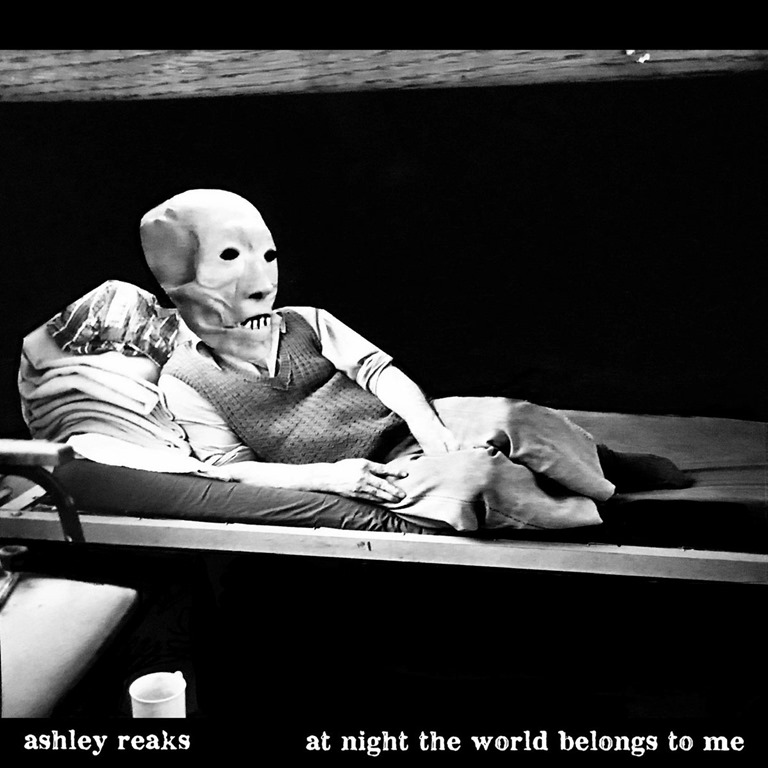
Through all of this, he has continued to collage and write prodigiously, but At Night The World Belongs To Me marks a distinct change of tone from its immediate predecessors, The Body Blow of Grief (2024) and Winter Crawls (2023). The usual elements are all present and correct – the sense of experimentalism, the collaging of genres, melding post-punk, jazz, and dub – but this feels darker, more introspective. The cover art, too, reflects this. While it has the same rather disturbing, grotesque strangeness of his usual work, the grim-looking figure in repose has connotations of ailment, frailty, even the deathbed.

The first track, ‘Playing Skittles With The Skulls and Bones’ has a bass groove that calls to mind The Cure’s early sound, melded to a rattling rhythm reminiscent of ‘Bela Lugiosi’s Dead’. The smooth sax that wanders in around the mid-point provides something of a stylistic contrast, but at the same time, it’s minor-key vibes keep the song as a whole contained within a bubble of reflection, evoking the stillness of night. I know, I’m sort of dancing about architecture here, but something about Reaks’ work prompts a multi-sensory response.

‘Rimmed With Yellow Haloes’ brings soaring post-rock guitars atop of an urgent ricochet of drumming and solid bass. On the fact of it, it’s almost poppy, but it soon shifts to take on a folksy aspect, while Reaks sings of death and funeral pyres, and the refrain, delivered with lilting, proggy overtones, ‘The Lord gave the day to the living, the night to the dead’. In context of the album’s title and theme, there is a tangibly haunting foreshadowing here, a suggestion that Reaks has not only accepted his mortality, but has assumed his place. It’s powerful, and deeply moving. Of course, Reaks can’t help but introduce incongruous elements, with some horns which are pure ska and some super whizzy 80s pop synths providing a pretty wild counterpoint to it all. It’s hard not to smile, because there’s an audacity to this approach to composition and arrangement – a lot of it simply shouldn’t work, but it does, and it’s uniquely Reaks.

The album’s shortest song, ‘Things Unseen’ is snappy, poppy, Bowie-esque, an amalgamation of post-punk and electropop, a standout which is succinct and tight, and consequently, the dark connotations of the bleak shuffle of ‘Life Forever Underground’ – a rippling synth-led tune – are rendered more profound. The sequencing of this album is such that the shifts between songs accentuate their individual impact.

‘Mask the face, unmask the soul…’ he sings softly on ‘Mask The Face’, which has a somewhat spacey Krautrock feel to it – before a guitar solo that worthy of Mark Knopfler emerges most unexpectedly. And as dark as things get here, Reaks never ceases to bring surprises. At Night The World Belongs To Me perfectly encapsulates the reason he’s so respected and critically acclaimed, but orbits light years outside the mainstream. In a world defined by an exponentially reducing capacity for sustained attention, Ashley Reaks makes music that requires real engagement, the musical equivalent of complex carbs and high fibre foods in a processed, white bread culture. But also, contemporary mainstream radio music favours short songs which cut straight to the chorus, where the hook has to land in the first twenty seconds. Here, we have eight songs, all but one of which are over five minutes long. They take their time, they’re expansive and exploratory, there’s atmosphere, there’s depth. And as ‘Eyeing Up The Sky’ tapers away on a buzzing drone, we’re left with much to chew on, much to consider.

AA

a2008509738_10

The forthcoming full-length from Los Angeles–based band Agriculture, The Spiritual Sound, traces a narrative arc through extremes.  The album is largely a fusing of the visions of its two principal songwriters: Dan Meyer and Leah Levinson.  Though distinct, their voices converge in a singular spiritual grammar—one that defines the totality of The Spiritual Sound, not as separate parts, but as one unified expression.

Dan writes like someone clawing toward the divine through noise, channeling Zen Buddhism, historical collapse, ecstatic grief. Leah’s songs move differently: grounded in queer history and AIDS-era literature, amid the suffocating fog of the present, they carry the weight of survival as daily ritual. Dan takes the lead on their next release, a quieter moment amongst the chaos. About the track, he says;

“This is a love song to a future child. It is so moving to me that even though this child does not exist in the form of a child yet, all of the matter that will one day make up their being is already in the world. And of course this is true of all things that have ever existed. So even though I’m talking about a kid that I want to have one day, I’m really talking about the principle that everything is totally connected.”

AA

Agriculture’s formation mirrors their duality. What began as a loose collaboration between Kern Haug and Dan Meyer in the Los Angeles noise scene evolved into a shared pursuit of the sublime through heavy music. With the additions of Richard Chowenhill and Leah Levinson, the project solidified into the band’s current form. The ecstatic black metal foundation that was laid on 2022’s The Circle Chant expanded into something more precise and far-reaching on their 2023 self-titled full-length, and deepened further with 2024’s Living Is Easy: a record that embraced devotional intensity and radiant heaviness in equal measure.

Agriculture’s writing process is built on dismantling and revision of self. Dan and Leah bring songs to the band and then allow them to be pulled apart and rebuilt communally: reshaped through conflict, repetition, and deep trust. Richard adds guitar melodies and solos, and Kern constructs rhythms which are sometimes familiar but often unconventional. Finally, with Richard producing, the final form of each song is realised through intense collaborative work in the studio. Although a time consuming and ego-frustrating process, this allows the band to find the spirit of the songs not through inspiration, but through persistence.

Yet, even in its most ambitious moments, The Spiritual Sound remains rooted in the ordinary and in the day-to-day relationships between the people who made it. Gas station snacks. Inside jokes. Sleeping on floors. Playing shows in rooms that smell like mildew. The spirit here isn’t abstract, it’s live. This is spiritual music that starts with imperfect gear and a long-in-the-tooth tour van.

Agriculture doesn’t offer salvation. The Spiritual Sound isn’t a map out of the fire. What it offers instead is presence: a confrontation with the moment, however unbearable, however divine. It insists that meaning is still possible, even in a world hell-bent on reducing everything to content, and where suffering itself can be conducive to recovery. As the Buddhist saying goes: “the only way out is in.”

AA

agriculture_river8copy-990451000004513c

Photo credit: Milan Aguire

AGRICULTURE LIVE DATES 2025:

Sep 17  Kortrijk, BE — Wilde Westen
Sep 18  Haarlem, NL — Patronaat

Oct 8  Brooklyn, NY — Union Pool (Record Release Show)

Oct 27  San Antonio, TX — Paper Tiger $
Oct 28  Austin, TX — Mohawk $
Oct 30  Atlanta, GA — Masquerade $
Oct 31  Saxapahaw, NC — Haw River Ballroom $
Nov 01  Silver Spring, MD — The Fillmore $
Nov 02  Philadelphia, PA — Union Transfer $

Nov 04  Louisville, KY — Zanzabar
Nov 06  Oklahoma City, OK — 89th Street
Nov 08  Albuquerque, NM — Launchpad
Nov 09  Phoenix, AZ — Valley Bar
Nov 11  Denver, CO — Hi-Dive
Nov 13  Salt Lake City, UT — The State Room
Nov 14  Boise, ID — Neurolux
Nov 16  Seattle, WA — Madame Lou’s
Nov 18  Vancouver, BC — Fox Cabaret
Nov 19  Portland, OR — Mississippi Studios
Nov 21  Sacramento, CA — Cafe Colonial
Nov 22  San Francisco, CA — The Chapel
Dec 04  San Diego, CA — Soda Bar
Dec 05  Los Angeles, CA — Lodge Room

$ with Boris

Vinter Records – 5th September 2025

Christopher Nosnibor

The post-rock boom feels like a long, long time ago now. Perhaps because it was: realistically, we’re talking about nearly twenty years since Explosions in The Sky and Her Name is Calla were super-hot topics. I discovered HNIC supporting iLiKETRAiNS on tour circa 2007, and Maybeshewill via their split 12” with Her Name is Calla, before seeing them playing with AndSoIWatchYouFromAfar… There are always chains and sequences, but the post-rock bubble burst in a tidal wave of oversaturation maybe around 2009. It all got a bit samey. But there was – and still is – always room for a band that take a genre template and take it somewhere else, offering something different, instead of a template-based rehash. Enter Osak:Oslo, who most certainly offer something different. Silt and Static is nuanced, but at the same time forceful.

There’s nothing like going all-out epic on an opening track, and that’s what precisely what Osak:Oslo do here, with the eight-minute forty ‘Biting In’, which begins with some enticing, chiming guitar that’s quintessential post-rock in every way, but then the rhythm section kicks in, and it drives along straight ahead, riding a solid motorik groove for a bit. After taking it down in the mid-section, they come back in, driving harder than before, a sprawling desert-rock soundscape expanding like a straight road headed to the horizon. Hell yes! You feel this. Exhilarating is the word.

They take things slower and bring more weight on ‘Days Adrift’, but still conjure rich layers of atmosphere, and bring things together with a chunky, chugging, bass-driven groove. In contrast, ‘Salt Stains’ is altogether more jangly, indie, at least to begin, and then, less than a minute in, a solid riff powers in, topped by soaring lead guitar work.

Over the course of the album’s nine expansive tracks, Osak:Oslo demonstrate a real knack for beefy riffery – nothing overloading, hugely overdriven, distorted or gritty, but just big, bold, solid and defined by a sense of forward trajectory, and what’s most remarkable is the way the band arrived at this work:

Recorded spontaneously, Silt and Static captures the band at their most stripped-down and unfiltered, balancing atmospheric fragility with crushing depth. With tape rolling and no roadmap, the album emerged naturally, giving shape to a sound that’s both deeply personal and bleak yet beautiful.

‘Bleak yet beautiful’ is a fair summary, but establishing, or unravelling, precisely what’s personal on an instrumental work is not easy, or sometimes even possible, although it is clear that certain elements, sounds, structures, transitions, which hit in a particular way are deeply evocative, often moving. But as a listener, those moments feel personal and are rooted in one’s own experience, one’s own individual response. I write this as someone who has sat with friends, playing songs saying, as I practically burst with enthusiasm, “Wait… there! That’s the key change!” or “That’s where the distortion comes in!” or “There! There!”, to be met with… mixed results. Is that moment which floors me the same one which the creators feel is the pivotal point in the song, the one which articulates, through the medium of sound alone, that deep-seated, complex emotion which has been tormenting your psyche for months, or even years? I suppose it doesn’t really matter. What matters – for artists and listener alike – is that connection, achieving that vital emotional resonance, where the music speaks.

‘Resonance in Ash’ slips into shoegazey territory, but also offers the most potent swell of noise that threatens the eardrums, bursting into a ragged explosion of noise, bordering on post-metal and racing to a blistering crescendo, and despite being one of the album’s shortest songs, ‘The Onward Strike’ feels like one of the most immense. Then again, there’s ‘Break and Sink’, which goes all-out to crush… It’s riffy, it’s heavy, and it lands hard. The bass… it grinds, alright.

The beauty – and creative success – of Silt and Static is that it succeeds on both levels. Because of the bold riffery – never succumbing to the post-rock cliché of the slow-build and epic crescendo, but instead forging these strong, cinematic, rock-orientated bursts of energy which are immersive, transportative, and reach far beyond genre confines. Silt and Static is an imaginative, inspired work, and the circumstances of its creation make it even more remarkable. It’s the work of a band operating with a rare level of cohesion, and it’s pretty special.

AA

a1841796365_10

Christopher Nosnibor

It’s good to be back at Wharf Chambers. Personal circumstances have meant that the trip to Leeds has been largely beyond me, but stepping into the place felt like coming home. It’s unassuming, some may even basic, but it’s got a unique – and accommodating – vibe. There aren’t many small independent venues that can keep going by sticking to a programme of leftfield live music, or being explicit in a keen leaning towards inclusivity for LGBTQIA+ and anyone else who stands outside the fence of the normies, but Leeds is a big enough, and diverse enough, city for a place like this to not only survive, but thrive. It’s kinda quirky, a bit shabby chic, and it works: the beers – local – are cheap, the sound in the venue space is good, and it’s all cool, and tonight’s advertised lineup is a cracker. Diverse, but solid quality of an international reach.

Before we come to that, it’s a strange and rare occurrence to arrive at a venue to discover that there is an additional, unadvertised, band on the bill, and even more so when the band in question has effectively gatecrashed the event without prior arrangement with the promoter, but by dint of deception. But the first band on tonight have done just that. Perhaps it’s the only way they can get gigs. Because they sure do suck, and it was obvious that they’d never have been booked for this lineup in a million years. I head back to the bar after a couple of songs, having heard enough. When they’re done, promoter and sound man (in both senses), Theo takes the mic to explain that he hadn’t booked them and that they didn’t espouse the experimental ethos of the acts Heinous Whining exists to promote. The band did not respond well to this, validating the opinion a number of us had already formed, and they fucked off in a huff. Dicks.

Thankfully, normality – of the kind we’re here for – resumed with the arrival of Sour Faced Lil, the solo project of Hilary from Cowtown. Her set starts – somewhat incongruously – with a quirky electropop cover of Bright Eyes. I just about manage not to cry. Then she swerves into swooshing space rock noise galore, and she explores the weird and wibbly, and it’s everything you’d expect from a Heinous Whining night. Live drums, looped, live guitar, and warped, undulating synths create a cacophony of sound in layers. The performance is a little tentative in places, but the audience is behind her all the way. There’s something quite enthralling about seeing a solo artist juggling myriad musical elements and instruments, knowing what a balancing act, how much effort it is to remember everything and keep the flow, and the fact she manages it is impressive.

DSC03057DSC03064DSC03070

Sour Face Lil

Also impressive are Lo Egin, but for quite different reasons. I feel I owe Lo Egin an apology, as it happens. When I reviewed their split release with Beige Palace a little while ago, I misspelled their name as Lo Elgin, more than once (although I managed to get it right when covering Volumancer in 2013) Hammering out reviews on a daily basis means I slip up sometimes. It’s not great, and I do try, to do better but… I did really rate that release, though, and I’ll admit that they were as much a draw for me as the headliners. And the fact is, they were worth the entry fee alone. On paper, they’re perhaps not the easiest sell, bring atmospheric post rock in the vein of early Her Name is Calla, with brass – sax and trombone – crossed with elements of doom – with the addition of screaming black metal vocals. They do epic. They do crescendos. They also do ultra-slow drumming, something I am invariably transfixed by having first become fixated during my first time seeing Earth live. The drummer raised his arms to fill extension above his head, before smashing down with explosive force.

DSC03079DSC03084DSC03092DSC03105

Lo Egin

Dolorous droning horns create a heavy atmosphere. Then, out of nowhere, from the delicately woven sonic tapestry they’ve been weaving, things turn Sunn O))) and the skinny baggy jeans wearing trombone guy who looks like a young Steve Albini delivers cavernous doomy vocals as he contorts and the mic stand and then all hell breaks loose. When they go heavy, they go heavy – and I mean HEAVY, the drummer smashing every beat so it hits like a nuclear bomb. To arrive with high hopes for a band, and to still be absolutely blown away is a truly wonderful experience, and one that stays with you.

I feel I should perhaps take this opportunity to apologise to Jackie-O Motherfucker, too: in my review of Bloom, I described them as a country band. And while there are without question country elements, they’re really not a country band. They’re not really a psychedelic band, either, or any other one thing. Instead, they’re a hypnotic hybrid, and they’re deceptively loud considering how mellow everything is. What they do is simple in many respects, but in terms of genre, it’s rather more complicated, not readily pigeonholed. I’d clocked them about the venue beforehand, and they seemed like really chilled folks, and while they’re not exactly chatty during their performance, it’s apparent that they’re humble, and simply really chuffed to be playing here. The room is pretty full, too. Tom Greenwood looks like he’s just taken some time out from doing some decorating to play. He’s got paint on his trousers, and is as unassuming as they come.

DSC03109DSC03130DSC03137

Jackie-O Motherfuker

The current lineup consists of three guitars, synth, and some electronic stuff including subtle percussion. No bass, no drums. There are, however, many pedals and much pedal fiddling throughout the set, as they sculpt a wall of reverb and feedback and a whole lot more from this hefty – but ultimately portable – setup.

The resultant sound is detailed, but at the same time a hazy blur. Picked notes – and much of the sound is clean, with next to no distortion, but with all the reverb – bounce off one another here and there, creating ever greater cathedrals of sound. I find myself utterly transfixed. Their hour-and-a-bit long set features just seven songs, and they are completely immersive. There’s no real action to speak of, just an ever-growing shimmer which envelops your entire being. In some respects, their extended instrumental passages invite comparisons to the current incarnations of Swans, only without the evangelically charismatic stage presence or crescendos. In other words, they conjure atmosphere over some extended timeframes, but keep things simmering on a low burner, without any volcanic eruptions. The end result is a performance which is hypnotic, gripping because of, rather than in spite of the absence of drama. Low-key, but loud: absolute gold.

The Norwegian–Swedish collective Orsak:Oslo returns with Silt and Static, their most emotionally intense and musically ambitious record to date. Set to be released on September 5, 2025 via Vinter Records, the album marks a profound new chapter for a band long celebrated for their introspective blend of psychedelic haze and dystopian post-rock.

Recorded spontaneously, Silt and Static captures the band at their most stripped-down and unfiltered, balancing atmospheric fragility with crushing depth. With tape rolling and no roadmap, the album emerged naturally, giving shape to a sound that’s both deeply personal and bleak yet beautiful.

“This is the most honest and emotionally charged record we’ve made to date,” says the band. “Silt and Static is not a concept album, but it still carries a distinct atmosphere that sticks with you. It maintains a fragile balance between friction and flow, born in this session that at times felt like it was on the verge of collapse, yet somehow kept enough momentum to find a winding way forward. None of the songs were written with a specific audience or genre in mind, they simply emerged while the tape was rolling. The entire album came about spontaneously, and we did our best not to get in the way of where it wanted to go. It’s not meant to be perfect, but it is meant to be real.”

“We hope there’s something, somewhere, in the space between the ugly, the fragile, the beautiful, and the unbreakable that stays with the listener as the needle approaches the runout groove on the final side of this double vinyl.”

Following the album’s gripping first single, ‘084 Salt Stains’, the band now unveils the second single, ‘083 Petals’, a brooding and hypnotic track that reveals the emotional tension at the heart of the new album. A track built on contrast and collapse, it begins with a sense of control before slowly disintegrating into distortion and desperation.

“For us, ‘083 Petals’ was an exercise in contrasts,” the band explains. “It began with confidence but quickly unraveled — a mask slipping, dignity hanging by a thread. It had to almost fall apart before it could come back together. Somewhere between muted cries and atonal screams lies this track.”

From the slow-burn psychedelia of their earlier work to the more introspective and improvisational textures of Silt and Static, Orsak:Oslo has never sounded more cohesive or more exposed.

Formed between Norway and Sweden, Orsak:Oslo has firmly built a loyal following over the years, with a sound that channels post-rock, krautrock, doom, and ambient psychedelia into captivating sonic landscapes. Their ability to stay unpredictable, while always sounding unmistakably like themselves has set them apart in the post-rock underground.

Silt and Static is a culmination of that journey: a double LP that breathes, fractures, mourns, and moves forward.

8d1d5160-a628-e5e8-ac37-e574c8b8d9b7

9th June 2025

Christopher Nosnibor

Sledges are described as ‘a four piece Alt-metal/Heavy-shoegaze band that blends genres like grunge, metal, shoegaze, emo/post-hardcore, and alternative to craft songs with catchy hooks and big riffs,’ and while this is true, it fails to convey the way the various elements melt into one another to conjure something quite special.

Take the first track, ‘Stumbling as I Fall’: the guitars bend and pixelate in a way that evokes the essence of My Bloody Valentine, but it’s grunged up and beefy, and at the same time the melodic vocals contrast with that thick overdrive, capturing the spirit and sound of ’94, and in particular, Smashing Pumpkins circa Siamese Dream. The title track is harder, heavier, with loping drums melded to a tight, chugging bass underpinning some hefty overdriven guitars that provide the backdrop for vocals that ae by turns breezy and gnarly, offering one of the most overtly metal moments on the EP. I find myself momentarily thinking of Troublegum by Therapy? – a classic example of solid tunes brimming with melody played with hard distortion and some raw aggression – but then Soundgarden also poke their way into my cognisance. If it sounds like I’m simply pulling bands out of the air, it’s very much not the case: Losing Pace simply has that much going on, although the fact that many of the touchstones I’ve referenced thus far are of a 90s vintage does also serve position the various elements which contribute to the Sledges sound.

‘Weightless’ is – ironically – pretty heavy, and it’s not (believe it or not) a criticism to stand it alongside Linkin Park, in that it brings nu-metal heft and a strong emotive hue to a song that’s both riffy and rich with a palpably sincere feeling of angst. It matters because this is no cheap stab at commercialism, and nor it is just another song that tries to alternative by hauling all of the tropes into the mix: there’s a sincerity to this which lends it an indefinable power, and it hits hard.

After a soft acoustic intro, ‘June is Better than July’ goes widescreen, a cinematic burst of post-rock, post-grunge, alt-rock riffcentric extravaganza. There’s a nagging sense that it’s a but emo, a bit ‘things we’re not supposed to like’… but bollocks to those strictures of convention. It’s pure quality, and that’s ultimately what it all boils down to.

Losing Pace was originally released as a four-track twelve-inch, but this new edition, which also marks its first digital release, offers a brace of bonus tracks, in the form of ‘Fading’ and ‘Letters’. The former is the weakest and most overtly emo song of the set, but it’s bathed in reverb and the guitars are bold and overdriven and grungy, and it’s impossible to deny that it’s well-executed. Rounding it off, bonus cut ‘Letters’ is both dreamy and dynamic, melding elements of early Ride and MBV and Chapterhouse with later exponents of shoegaze / nu-gaze like The Early Years as swirling guitars conjure cathedrals of sound around a pumping drum machine.

On Losing Pace, Sledges successfully combine classic and contemporary, and do so with an aptitude and energy, and a keen sense of dynamics. It’s quality all the way.

[bandcamp width=400 height=340 album=244179070 size=large bgcol=ffffff linkcol=0687f5 artwork=small]

AA

a3823762619_16