Posts Tagged ‘Gothic’

The catalogue of material released by Papillon de Nuit, the ever-shifting, ever-evolving musical project of Stephen Kennedy, continues to expand with the release of single number eight.

Kennedy’s approach to the project is both interesting and unusual, with each song recorded at a separate session, often not even fully-formed in terms of writing and arrangement beforehand, and realised with various guest musicians and vocalists. Retuning once more to Young Thugs studio in York, ‘The Pilgrim’s Arc’ again sees Stephen handle a considerable range of duties, from drums to grand piano and providing spoken and sung vocals, as well as writing and arranging the song itself, while joined by Michalina Rudawska (cello) and Karen Amanda O’Brien (spoken word).

The Exceptional Mr Hyde make a guest appearance here, providing ‘menacing spoken word’, while Steve Whitfield  added bass and guitar, as well covering production work

The result is a striking, dramatic, percussion-driven piece with some chunky bass, and layered vocals creating an almost schizophrenic mutter behind a soaring melody.

AA

a2654860644_10

15th August 2025

Christopher Nosnibor

In recent years, the field of doom has expanded in terms of range, and has, at the same time, become rather more populous. One suspects in part that because these are pretty fucking dark times, increasingly, people are turning to dark music to articulate their own challenges, and to navigate the world around them. One welcome development is the number of female-fronted doom bands with vocalists who bring not only powerful voices, but a strong emotional force to the heft of the instrumentation.

Amnesiak pitch themselves as ‘Alternative Doom Rock’ – a subtle but necessary distinction from the proliferation of doom metal, which is something rendered clearly on this, their debut album. Containing just seven tracks, the longest of which is just under five minutes in duration, and with a couple that clock in at under three, it’s a concise document – and that’s welcome, because unlike so many other releases in the genre, which can at times be indulgent and err towards the overlong, and leaving you feeling drained, Arkfiend leaves you hankering for more.

The instrumental intro track, ‘Deamoniacus’ is something of a trope nowadays when it comes to heavy music – and screamy post-hardcore – but here it works differently, with samples reverberating in torturous extreme stereo, the sounding of the muttering clamour of a fractured internal dialogue which crowds the mind with discomfort, paving the way for the slow, majestic ethereal grandeur of ‘Archfiend’, which blends sepulchral doom with soaring vocals which float to the skies. ‘Flamed In Solitude’ plunges into darker territory, with dingy guitars squirming queasily over loping percussion. Layered vocal harmonies contrast with the thick guitars and booming bass, and those vocals sit between doom and folk, elevating the song to unexpected heights.

The dynamics of each song is something special, and the stylistic interplay sets them apart from their peers. ‘Pillory Of Victory’ is theatrical, gothic, dramatic in a theatrical sense, but also in an intense real and immediate sense – and at two and a half minutes there’s a moment where the riff skews and things take a sinewy turn for the more discordant, before the riff returns, hard and heavy. And yeas, I’m one of those people who obsessively pinpoints the moment when a song switches, when it moves from ‘yes!’ to ‘woah, fucking yes!’ – and it all comes down to a second or so. I’ve digressed, but so have Amnesiak, until they come around to the churning riffery of ‘Bootlicker’, which is truly monumental. Everything comes together here, and this is track of the album. For all its dirty guitar grind and dark lumbering riffery, it’s majestic, epic, a song that fills you up and lifts you up with its power. The final track, ‘The Last Rattle’ is a perfect balance of light and dark, weight and melody, reflective and sad and uplifting in equal measure. The quality of the songwriting, and the attention to detail on display here is quite something.

Arkfiend places Amnesiak comfortably alongside Cold in Berlin and Cwfen – and that’s a strong recommendation.

AA

a4008843204_10

17th October 2025

Christopher Nosnibor

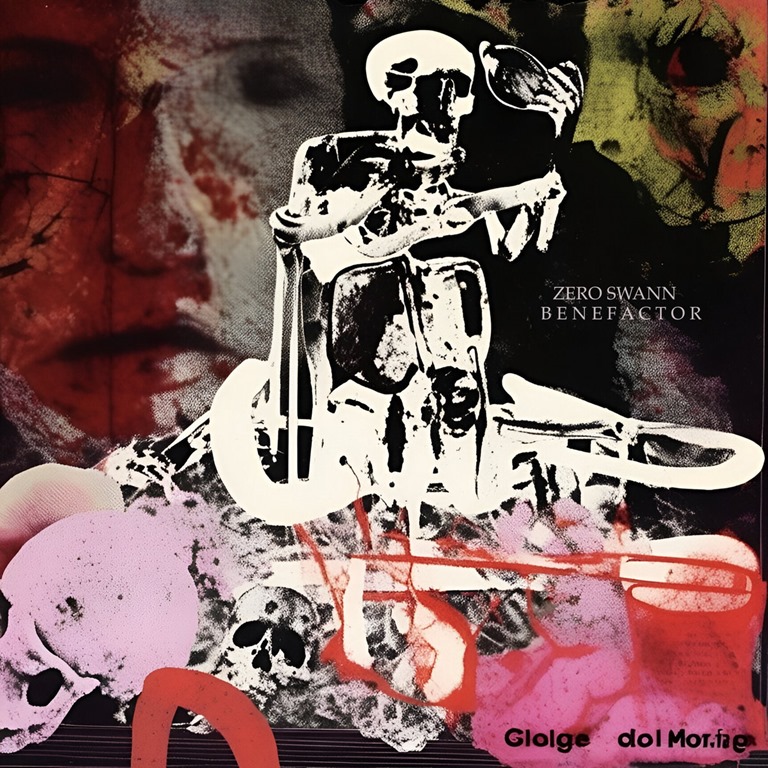
From the very outset, this is not easy on the ear. Sometimes, something leaps out about an album in the opening minutes, and here it’s the production – or lack of. The title track heralds the arrival of Benefactor, the first album by Washington D.C. improvisational psychedelic outfit Zero Swann in two years. And it’s a swampy, reverby, dingy mess. It’s integral to the experience, but it’s also likely to be a deterrent for some – but screw them, it’s their loss, right?

Although straddling heavy psychedelic and the dramatic gothic style, it’s the sludgy, feedback-riven outtakes of The Jesus And Mary Chains’s Barbed Wire Kisses which first come to mind when listening to this.

Benefactor is the follow up to 2023’s Amon Zonaris, which, at the time, was a one-off collaborative release with Scott “Wino” Weinrich. This time around, bandleader and Saccharine Underground label curator Jeremy Moore is flying solo, handling guitars, fretless bass, drums and noise assault. And there’s no shortage of the noise assault on this punishing no-wave behemoth. As they tell it, ‘From the noise rock / no wave snarl of Ritual Tension and early Sonic Youth, to the shoegaze sounds of My Bloody Valentine, to doom and free jazz chaos over a backdrop of pure lo-fi abrasion, Moore’s latest outing is a true crosspollination of styles’. It is, and what’s more, many of those styles are melted together to form a dark, disturbing sonic sludge.

‘Grave Wax Horticulture’ is a skull-splitting mesh of noise, equal parts The Jesus and Mary Chain and Christian Death. It’s theatrically gothy, in the vein of The Horrors, but primitively noisy – which is a fair summary of the album as a whole. It’s experimental, overloading in its racketaciousness – and while is a psychedelic album, it’s a full-on assault album, too, which draws parallels with Head of David’s first album, LP, and simply summarises a noise ethos which eschews convention in every sense.

Moore’s commanding baritone brings a sense of drama, not to mention a certain theatricality to the chaotic, palpating grind, and there’s an edge to his delivery which is both world-weary and tense, a voice emerging from the desolation of a society collapsing, a world in flames. This is surely the sound of the apocalypse, the sound of everything ending. Everything is overloading, murky, blown-out, blasted with distortion and reverb, resulting in a discordant thunderous attack which fires in all directions at once. It’s a primal roar reverberating from buildings collapsed to rubble, a brain-bleeding blitzkrieg of ruinous proportions, as mechanised drum sounds fire like machine guns and missile explosions, cutting through the wildest, densest racket. The absence of overt structures only compounds the sense of things falling apart. It’s the sound of unravelling, of societal threads pulling apart in real-time, a descent into mayhem, anarchy, barbarity.

‘Anagrams for Agnosia’ is perhaps jazz, but jazz in the loosest sense: it’s exploratory, experimental, freeform, but more than anything, it’s the sound of fracture, or fragmentation, instruments churning and burning, and pulling in different directions like splinters of an object in the wake of a detonation. As the screams die down, there is the thud of a panicked heartbeat, before the final track, ‘Phaneron’ obliterates with a squalling wall of howling guitar, stuttering drums and raw, ruinous noise.

Benefactor is an album without let-up, which provides no breathing space, and is thoroughly relentless in its intensity from beginning to end. Recommended, but approach with caution, and a stiff drink. It sounds like the cover looks.

AA

a0986994420_10

12th August 2025

Christopher Nosnibor

Zabus have been on fire lately, as their recent EP, Shadow Genesis, released in June. It’s not only the prolific output which is noteworthy – some acts spunk out new material every other week, but the quality simply isn’t there – but we’re looking at a creative purple patch of innovation and ideas flowing in full spate. Whores of Holyrood is their fifth full-length album in less than two years, and while Zabus is ordinarily a collective centred around project founder Jeremy Moore, Whores of Holyrood is the first ostensibly solo release by Moore under the moniker, and it’s also pitched as ‘one of the most overtly political statements from Zabus to date.’

This matters. Anyone with an outlet, or a platform, right now, has, a duty to state their position. Silence is complicity. We know this from history. Individually, there is next to nothing we can do to stop Trump’s fascistic march, or halt the genocide in Gaza, or stop the wat in Sudan. But fucking hell, we are witnessing hell on earth right now. To take a line from William Burroughs’ Exterminator, ‘There are no innocent bystanders … what are they doing there in the first place?’ I don’t necessarily entirely agree with the stance, but it’s worth unpacking a bit, particularly in the context of 2025, when people are more likely to film the most horrific events on their phones and post them on social media than to intervene. I know, people are scared and all the rest, but… something is deeply wrong.

The title, Whores of Holyrood, immediately made me think of the Scottish parliament, but it would appear that there is no connection or implication intended. Instead, the album ‘explores the positive feedback loop between fascist authoritarian rule and societal inaction, apathy and resignation. Holyrood is a metaphor for the established classist hierarchy which derives its strength and influence from our subjugation.’

As an aside, ‘rood’ is a middle English term with its origins in Saxon for the cross, and a rood screen was a feature of medieval churches, a carved wooden partition depicting the crucifixion. Whores of Holyrood may not have any direct or specific connection to these historical roots, but they still seem somewhat relevant, albeit tangentially.

It’s ‘Shadow Genesis’, the lead track from the recent EP that launches the album with its reverb-heavy blues guitar and gothic stylings, and it’s dark, brooding, but it’s nothing to the snarling lo-fo post-punk goth epic that is ‘Burn to Your Own Destruction’: six and a half minutes of echo-soaked guitar swirling beneath bombastic baritone vocals, while the tile track is commanding, archly gothic, but with murky black metal production values. The same is true of ‘A-YA Bullet V’, which brings the driving funk groove of Bauhaus at their best, while also pushing the experimentalism to the fore.

‘Cremation Psalm’ is a murky swagger, equal parts Nick Cave and The Volcanoes, and every track on this album is pure gold. The muffled, echo-heavy production is not a detriment, but an asset, accentuating the old-school vibe which is s integral to the experience.

‘Sod Martyr’ is dark, dark, dark, and sparse, and something about it calls to mind The Honolulu Mountain Daffodils, while ‘Strangers of Non-Being’ brings together goth and heavy psychedelia with the addition of low, slow drone

If the Shadow Genesis EP showcased a keen experimentalism, and a broad range of stylistic touchstones, then Whores of Holyrood takes it all to the next level. Zabus keep pushing forward, outward, onward. Right now, it seems there is no stopping them.

AA

a1395699222_10

8th August 2025

Christopher Nosnibor

The seventh single released by the Papillon de Nuit project / collective / ensemble centred around Stephen Kennedy is perhaps the most ambitious yet. It’s clear that Kennedy, who has for a number of years, operated as a live music promoter under the guise of The Velvet Sheep, is an irrepressible creative, a restless spirit never content to do or be any one thing. In Papillon de Nuit, he’s songwriter, arranger, vocalist and multi-instrumentalist, bringing to this track vocals, found-sounds, additional percussion, additional piano. And here, in just three and a half minutes, he and his collaborators have produced a song which is many things at once. They’ve also got Steve Whitfield, known for his work with The Cure and The Mission (admittedly, some of my least favourite works by The Mission, but that’s more a matter of material than production) in as producer again.

Being drawn to certain names because of songs is, I suppose, only natural: favourite songs create images and associations which in some way we use to orientate ourselves within the world, internally. And there’s no doubt that Charlotte, like Alice, is a name with special resonance to those with musical tastes which lean towards the gothier domains. That Robert Smith’s inspiration for ‘Charlotte Sometimes’ was inspired by Penelope Farmer’s haunting 1969 novel of the same title was reason enough for me to track down and read a copy of the book, and in context, the doubling / overlapping of the vocals can be seen to represent the parallel / interchangeable lives of the lead character.

‘Frozen Charlotte’ is also a work of a historical persuasion, described as ‘a dark Victorian morality tale about the folly of vanity.’ And it is, indeed, dark. It arrives with a sharp squeal of feedback and the crunch of feet on gravel, before a low but springy – classic goth – and ultimately stealthy bass strolls in and completely shapes the song’s framework. Rolling drums – a minimal, Mo Tucker style, which adds to the stark, brooding atmosphere. The addition of cello and piano builds things further ahead of the arrival of the vocals. It is all about the intro and the build here, but Kennedy gives a magnificent performance. It’s not the overdone booming baritone goth cliché, but a rich, soulful delivery which imbues the lyrics with meaning, in what I can perhaps best describe as a ‘literary’ sense. What I mean by this that while studying English literature at university, some lecturers had the ability to get you completely hooked in a writer because the way they delivered the quotations had impact: they felt the words, and could convey them in a way that opened your eyes to the fact the word on the page contained so much more depth when orated with passion.

The chorus here is understated, the emphasis very much on the dark atmosphere, although the vocal melody does still provide a clear and vital hook, and the ultimate result is alchemical.

AA

AA

Frozen Charlotte artwork

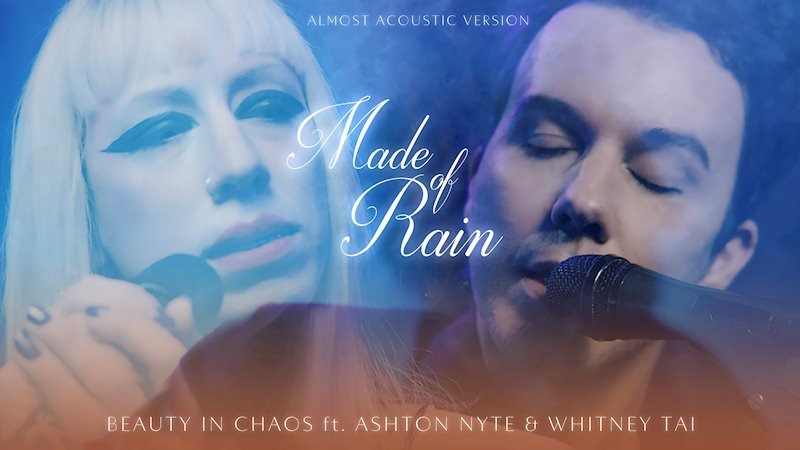
“’Made Of Rain’ is a song of hope. It is about getting up and trying again despite the scars life can leave. This “almost acoustic version” is very dear to me. I love the organic elements present: the pedal steel, violin, and, of course, Whitney Tai’s beautiful, ethereal voice elevate this piece, making it something transcendental. Similarly, the video shoot was an almost spiritual experience. A celebration of friends and art. What more can you ask for?” asks Ashton Nyte of The Awakening, who will soon tour Europe in support of the band’s self-titled album.

“‘Made Of Rain’ is a warm amber glow in a velveteen speakeasy where tales of folk and longing send a message from the beyond. There’s a wisdom and a patience in Ashton’s voice. His lyrics swarmed in the magic of Beauty In Chaos’ production for the acoustic version hits different. Doing this duet with Ashton is a dream, as he is someone with the vocal tenacity of the wisest tree in the forest. Together, it felt like we planted wildflowers in a gentle field. What made this collab special for me apart from the music is the friendship that Michael, Ashton and I share. We are family and making art with feeling is at the forefront of our passions,” says Whitney Tai, who appears on many BIC tracks. Her latest single ‘Slumber Party’ is out now, previewing her third full-length album ‘American Wasteland’ (out in September).

AA

BIC MOR

13th May 2025

Christopher Nosnibor

Papillon de Nuit, the ever-evolving, ever-shifting musical collective centred around the multi-talented composer, arranger, lyricist – not to mention promoter and musical / creative all-rounder – Stephen Kennedy, presents a sixth single in just a few short months, a run which began in December last year. And, true to form, ‘Ma’at’ is very different from each of the previous offerings.

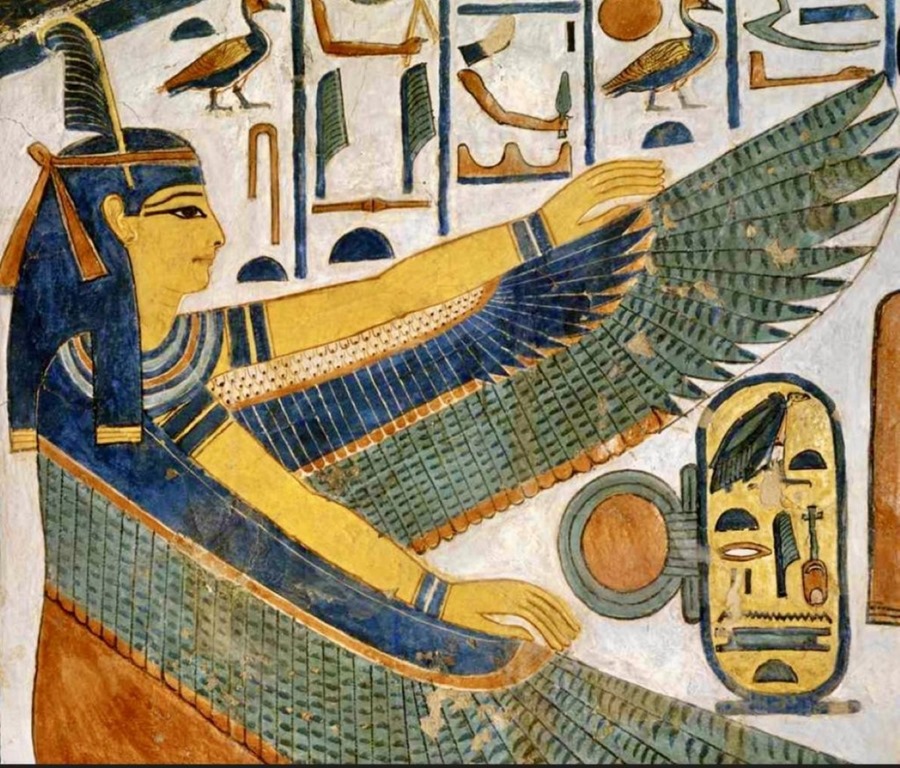
Once again featuring the grand piano work of Karen Amanda O’Brien and Michalina Rudawska on cello, along with the return of Megan Richardson providing vocals alongside Kennedy’s, ‘Ma’at’ follows its predecessor, ‘Adriane’, as a song built around strong, dominant percussion and brooding strings. Where it departs is that what emerges from the bold, dramatic intro is a pretty straight-up dark pop song that’s not a million miles removed from later March Violets. It’s graceful, melodic – and I’ll even add catchy, comfortably withstanding repeat plays – and naturally, it’s laced with a delicate hue of wistfulness and melancholy.

AA

a1804204922_10

Having completed a trilogy of experimental songs, Papillon de Nuit begin a new cycle, reaching for the epic, and with a more structured (but no less adventurous) approach. With Steve Whitfield on board (The Cure, The Mission) as Producer, and an array of incredibly talented, diverse musicians and singers, Ariadne is the first release in this phase. We are delighted to share it with you.

Continue with us on our journey….

AA

a2988112998_10

14th January 2025

Christopher Nosnibor

They only released their debut single on 1st December last year, and here we are, not quite halfway through January and we’re being presented with single number three.

While Argonaut’s track-a-month schedule for their ‘open-ended’ album Songs from the Black Hat, matching only that of The Wedding Present in 1992, seemed like the pinnacle of prolific – not to mention the ultimate advertisement for the DIY approach – three singles in six weeks must surely have the makings of a record (pun partly intended). As of this moment, though, we don’t know what their longer-term aim is, or even if there is one, beyond releasing new songs as soon as they’re ready, and if that is their MO, it’s admirable. Without the need to work to the schedules – or budgets – or a label, their only limitation is their own time and energy.

I had initially noted, following ‘Scarlet’, and ‘Amber’, a theme of colours linking their songs, but perhaps it’s female names. Or perhaps it’s pure coincidence, and they have simply plucked one-word titles to denote their songs.

‘Jude’ – which comes with appropriately dramatic artwork, somewhere between swooning gothic drama and pre-Raphaelitism, the source of which I haven’t been able to identify – once again features the voice of poet Monica Wolfe, here whispering, and, as credited, ‘breathing’. These contributions are significant in rendering an atmospheric composition, particularly in the introduction, before the arrival of the piano – of which there are, in fact, two, adding layers to the brooding theatricality of the song, and Stephen Kennedy’s voice.

The feel – particularly in his delivery, with some quavering intonation, and enveloped in a spacious reverb – is very much gothic folk, as he casts introspection, while chasing ghosts.

‘Will the world miss me?’ I whisper

And sigh, as my life drifts away.’

It’s moving, poetic, and powerful, presenting a straight-ahead contemplation on mortality – not in some cheesy ‘romantic’ gothic style, and not in a crass emo way, but a rare sincerity.

Somewhat ironically, in our teens and twenties, we tend to agitate about death, while also treating it with a flippancy, because it’s what happens to old people, but as we grow older, we go out of our way to avoid thinking or talking about it, because as we begin to lose parents, uncles, aunts, and even – increasingly – peers, shit gets more real than we can handle. Invariably, we bury our heads in the sand, shrug off life insurance and toss making wills into the distant future along with pensions, laughing darkly how we never expect to retire anyway.

In the final minute, the song swerves into more electropop territory as the rippling piano combines with a crisp, insistent drum beat. It’s a magical, ethereal moment, which is but fleeting, like dappling sunlight through the branches of trees in a woodland on a breezy day. In many ways, this captures the essence of the song and its sentiment, in its fleeting ephemerality, a metaphor for life itself.

It ends suddenly, with only inaudible whispers fading to the close, and again the metaphor stands. This is perhaps their strongest and deepest release to date, and best absorbed by candlelight, with a large measure of something intoxicating.

AA

a0763472052_10

Dark electronic music producer, MISS FD has just released her latest bewitching cinematic gothic music video for her song, ‘Curse Breaker’.

‘Curse Breaker’ is a liberating dark piano piece with laid bare female vocals that channel raw emotion, empowerment, and mystique.  A spell unbinding transformative song about overcoming and letting go.

The music video, directed by long-time collaborator and friend Tas Limur, was filmed in a Victorian mansion in Historic Old Louisville, KY.

The video follows MISS FD through a curse-breaking séance which releases her from a haunting apparition, symbolizing freeing oneself from the binds and limitations of the past.

Watch it here:

AA

c1152579-0f61-ec46-4e28-2c38a8e0a1d3