Posts Tagged ‘Post Rock’

From Coma To Catharsis is the second full exploratory mission in the current five-piece incarnation of NYC / NJ-based instrumental ensemble, The Royal Arctic Institute.

At present, The Royal Arctic Institute comprises five musicians who have played extensively with other groups and/or as backing/session musicians: drummer Lyle Hysen (Das Damen, Arthur Lee, The Misguided), guitarists John Leon (Roky Erickson, Summer Wardrobe, Abra Moore) and Lynn Wright (And The Wiremen, Bee And Flower, Shilpa Ray), bassist David Motamed (Das Damen, Two Dollar Guitar, Arthur Lee, Townes Van Zandt), and keyboardist Carl Baggaley (Headbrain, Gramercy Arms).

What are the first things you would feel coming out of a coma? Would it be cathartic, a full release of all your emotions? What would that sound like? From Coma To Catharsis tries to capture that auditory experience replacing the steadfast emotions expressed on From Catnap to Coma with the sounds of dreaming, then awakenings.

All the pieces were created communally, deconstructing then reconstructing material mainly composed by guitarist John Leon with a couple written by other band members. McNew recorded the band in a live setting with no digital magic and minimal overdubs except for pedal steel work by John.

This record also highlights the band’s musical development after a further year of playing together. This includes songwriting contributions by Dave (‘Angleman’s Lament’), and Lynn (‘The Elated World’) as well as more input from Carl. “This is the third record I’ve played on,” explains Baggaley, “and on this one we really broke the songs down to the bones. I was able to bring in new influences like King Crimson-style mellotron and electric piano inspired by the late Billy Preston performances during the recording of the Beatles’ Let It Be album.” Besotted by 2021’s Beatles documentary series stemming from those sessions, Lyle draped his drums in tea-towels ala Ringo for the song ‘Passover Bucket.’

Regarding that same title, John says, “During the COVID lockdown, everyone’s kids were home and parents were scrambling and grasping at straws to entertain them. A Jewish friend of mine decided to celebrate Easter with her children to give them something to do. They were fascinated by the concept of Easter baskets. The following year, instead of Easter baskets, the children were given Passover Buckets to keep them quiet.”

‘K-Style Circuit’ provides a flavour of the album, and you can watch the video here:

‘Terzo’ : an Italian word translating as ‘the third’, it represents an additional presence that new darkwave/shoegaze/post-rock duo Terzo sensed inhabiting their most creative moments when they began working together.

Karl Clinton (former bassist in post-punk act Diskoteket, plus co-founder of improvisational project Tsantsa) and Billie Lindahl (lead singer and guitarist in dream pop/dark folk act Promise and the Monster) share a mutual penchant for dark sounding music in all its forms. They have also both been itching to free the shackles binding them to strict timelines; not only those of the music industry, but society in general. “Terzo was born out of a discussion about songs we mutually liked and a wish to try a different work process to our then current projects,” they state. “We wanted to do whatever we wanted without restrictions, using our obsession and gut feeling as guidance.”

Their preference for music and art that embodies a degree of doom and gloom is evident on their upcoming self-titled debut album, with its central theme of ‘love and death’ linking all six tracks. Their very first studio session yielded the 10+ minute post-rock epic ‘Cymbeline’ (available now as a debut single), while in the midst of recording it they both had the sensation that a third presence was keeping them company. Intrigued by the thought, “we started talking about the appearance of a third element, in sleep and in dreams,” they explain. “Terzo is about acknowledging this, the swirl that light in the darkness generates, opening ourselves out toward our own weaknesses.”

‘Cymbeline’ is actually a unique cover of a 1991 song by the Celtic/world music singer-songwriter and composer Loreena McKennit, which has a lyric lifted from the William Shakespeare play of the same name. “We had a feeling that we could make something interesting with it,” says Lindahl. “Karl did most of the instrumental work, guitars and programming, while I recorded my vocal in one take. This song means so much to us because it was the first thing we did as a duo and I think we just sort of understood that we could do great things together.”

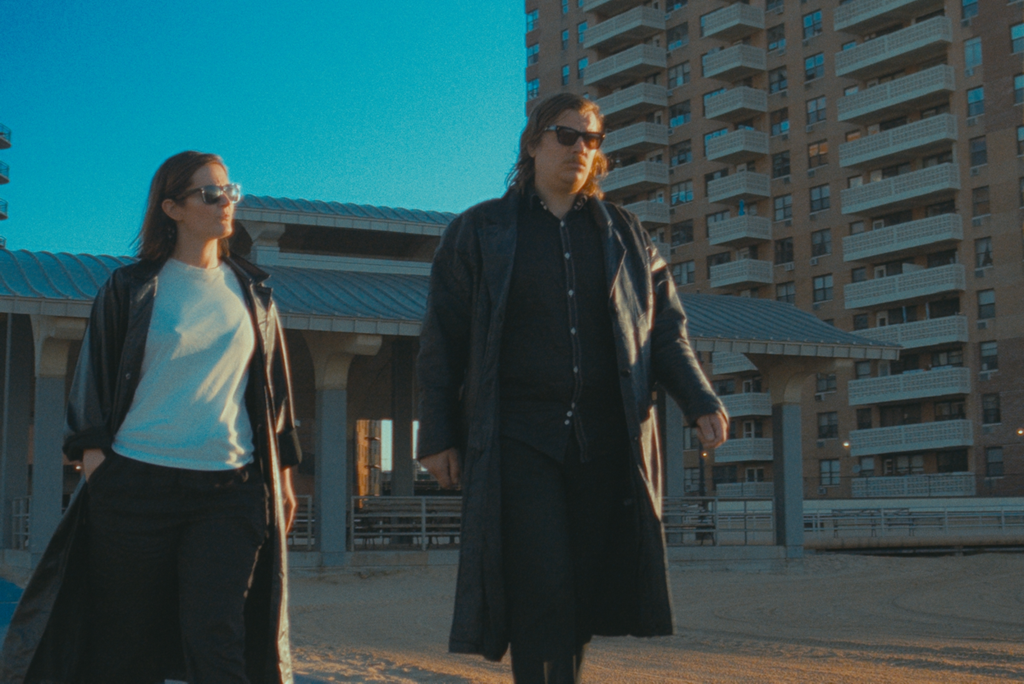
Terzo travelled to New York in the summer of 2022 to play their first live shows, with the video maker and photographer Johan Lundsten accompanying them to document the trip. Footage from this can be seen in the video for ‘Cymbeline’, with Lindahl adding that “we always pictured something in documentary style for this song. Johan filmed everything that we did, even just hanging around. It is very raw, but it feels right.”

Watch the captivating video to this immense song here:

AA

09fa22087a77c50ec64bf5bfc0b1abdd4f21a26c

TERZO | photography by Johan Lundsten

25th November 2022

Christopher Nosnibor

Two years on from when I covered Open to the Sea’s Another Year Is Over, it transpires that Milan-based Matteo Uggeri and his cohorts are back with Tales from an Underground River. A lot has happened since then – and yet in many ways, not a lot has, and for some of us, it feels as if lockdown never ended.

Governments and employers seem to be content to peddle the idea that with vaccines rolled out and restrictions lifted, the switch had been flicked that restores normality – so much for the endless talk of a new normal not so long ago. This is likely true of some things, primarily retail and public services, but then, many office workers have only returned on a part-time basis, if at all. For me, personal circumstances have meant not at all, which is welcome – much as I miss people, I don’t miss those people.

I digress, but this context is what I bring in terms of my reception to this album, which was, recorded over the course of a couple of years, starting in the Winter of 2019 and spanning the pandemic period – a time that has drifted into near-unreality and feels almost dreamlike, unreal. And this is very much the sensation that Tales from an Underground River creates. Listening to it feels like listening to a dream.

The text which accompanies the release, they’re at pains to point out, is not a press sheet, but a diary, and that makes sense, as it charts the album’s long and convoluted evolution. It certainly isn’t a sales pitch. But then, art shouldn’t be about sales pitches: creatively, the journey to the end result – if indeed it even is the end result – is far more interesting, and of significantly more value.

Beginning life as two long and multi-layered sets of improvisation with piano, guitar and synths recorded by Enrico Coniglio, it was then completely reworked by a process of additions and subtractions by Matteo Uggeri, and over time, incrementally, it was picked apart and broken down into thirteen relatively short pieces, where soft, rolling piano and mournful brass merge with the sounds of thunder and rain and a host off subtle field recordings which add delicate layers to the sound. And they’re segued together in such a way as to render the album one continuous piece in a succession of movements.

The mood transitions incrementally through the segments, and the titles are beautifully descriptive: I found myself forming mental images of scenes while listening, the music providing the soundtrack to a slowly unfurling movie in my mind’s eye – a movie brimming with scenes of nature, as ‘Pebbles Clink, Fluffy Echoes Make the Air Colder’ and ‘Pebbles Clink, Fluffy Echoes Make the Air Colder.’

Indeed, reading the lengthy titles in sequence conjures a semi-narrative in itself. At times ponderous, contemplative, brooding, at others with flickering sun offering hope – sometimes within the space of a single piece, as on ‘Limpid Lights Dig Words in the Rocks’, you feel yourself carried on a current through different terrains and landscapes. ‘Emotions and Thoughts Climb over Years and Years, Always the Same’ brings droning guitar textures and a rather darker hue of ambience with post-rock leanings, and Tales from an Underground River is an album where the movement and changes never cease over the course of its journey. At times eerie and unsettling, at times ominous, and at others – for wont of a better word – cheerful, it’s a magical piece of creativity that shows vision and was very much worth the three years of work.

AA

cover

Human Worth – 3rd February 2023

Christopher Nosnibor

A shriek of feedback prefaces the gnarly blast of a monster rhythm section, thunderous drums paired with a snarling bass. And so begins ‘Short Distance Runner’, the first of six songs on Remote Viewing’s Modern Addictions. You know in an instant that it’s going to be good.

Of course, you know it’s going to be good before you hear a single sound.

Featuring members of Palehorse, Million Dead, Sly & The Family Drone, Nitkowski and Wound (to name but a few) is quite the underground supergroup. Plus, Modern Addictions is being released on Human Worth, which is in itself a guarantee of heavy, noisy shit of the highest calibre. So yes, you know it’s going to be good. But even then, it’s hard to be braced for something this good.

The guitar alternates between thick, sludgy chords and really sinewy lead lines that buzz and drill, twist and bend and wrap themselves around you and dig in like barbed wire. The tracks are backed back to back, making the cumulative effect of the heavy battering even more acutely felt. Single cut ‘Your Opinion is Wrong’, showcased here in December is broadly representative of the dense, chunky, churning sound of the album as a whole, but doesn’t fully convey the extent of its textures and variety.

It’s not all punishing density, and the band are keen to highlight that theirs is a sound that demonstrates a ‘broader sound that incorporates elements of hardcore, post-rock and shoegaze into the palette of sludge and noise-rock’.

There are some tight grooves amidst the racket, ‘Wasted on Purpose’ effortlessly transitions through a number of varied passages, from full-on balls-out riffage to delicate, evocative swirling post-rock chimes which gracefully convey a very different kind of emotional weight, and if the title ‘Cleveland Balloonfest ‘86’ suggests something bright and airy, sonically it’s more the Hindenburg disaster with it’s slow, low-slung growling guitar that grinds away at a crawl for six and a half anguish-filled minutes.

If ‘Watch Me For the Changes’ is a demonic dirge of epic proportions with a remarkably light ending (and you can’t help but suspect the title is perhaps a reference to the band’s directions for playing it) ,the final track, ‘A.B.B.A. ABBA’ springs an unexpected surprise as the band switch into disco mode. No, of course it doesn’t really. It’s seven minutes of dolorous doom, thick with atmosphere and dripping distortion. It’s the sound of weight so great that it feels as if it’s collapsing in on itself, decaying and crumbling on the way to a slow death, that leaves you feeling hollowed out and devastated. It’s the perfect finale to a superlative album.

AA

RemoteViewing_ModernAddictions_CoverArt

Efpi Records – 27th January 2023

James Wells

Twittering birdsong and delicately tranquil tunes may not be things you’d immediately associate with jazz, but this is how the third studio album from Beats & Pieces Big Band announces its arrival. But as the track’s title suggests, you should wait: because in a moment, they’re offering up strolling, rolling sultry piano and bold brass on ‘op’ and we’re plunged deep into big band jazz territory.

There’s a lot of that, but the most striking thing about Good Days is its variety. The droning nine-minute ‘elegy’ is a sparse dirge of a tune, but it’s soft, contemplative, and ‘cminriff’ saunters into sultry, smoky territory with effortless ease.

The technicality of the playing is something else – and I really mean something else, on another plane.

Mojo have described them as ‘Spine-tinglingly good’, The Guardian love them, and the press release suggests parallels and links with not just Charles Mingus, Keith Tippett, Gil Evans, Charlie Haden’s Liberation Orchestra, but also suggests ‘there’s also a post-rock undertow to many of these tracks which shows a consciousness of such contemporaries as Björk, Radiohead, or Everything Everything’.

Whether or not you hear these – and I have to admit that I personally don’t so much, and I didn’t find my spine tingling either, although my ears were definitely totally grooved – there’s both a busy and a smooth element to Good Days as notes twist and spial against busy percussion. ‘blues (for linu)’ sounds like a sleepy improv based on Dave Brubeck’s ‘Take Five’. ‘woody’ gets woozy and goes all out on the bold brass, before the album is rounded off as it begins, with a snippet of a ‘reprise’ take on ‘wait’.

And at the end of the day, Good Days brings the swing – and if you’re talking jazz, that’s just what you want.

AA

B&P Big Band - Good Days album cover 3000px

HIBOU is back with new single ‘Night Fell’, along with the announcement of a new EP ‘Arc’ (due 13 January 2023).

Floating through a breezy blend of gossamer vocals, twinkling instrumentals and lush textured melodies, “Night Fell” is a delicate and jangling track that paves the way for Hibou’s new EP ‘Arc’.

Born in Seattle and now based in Paris, ‘Arc’ is Hibou’s first release since his 2019 full-length LP ‘Halve’ and the new body of work sees the artist emerge from his lengthy silence and reel listeners right back into the glistening whirlwind of his sound.

A delicate blend of lo-fi alt-pop, nostalgic shoegaze and diaphanous dream-pop, Peter Michel (aka Hibou) spent the summer writing the EP along the Canal de l’Ourcq, before recording in various apartments, bathrooms and rehearsal spaces in Paris. Engineered and produced by Michel himself, the multi-instrumentalist also performs vocals, guitar and bass on each track, with drums courtesy of Jase Ihler.

A dreamy and diverse project, ‘Arc’ melds together a rich amalgam of sounds: from the delicate and dazing “June”  to the buzzing and buoyant “Already Forgotten” and from the eerie twanging guitars on “Devilry” to the stormy, seesawing soundscapes on “Upon The Clouds You Weep”.

Taking its name from “an electric arc between things, or arc lightning”, ‘Arc’ is both sentimental and stylish with its carefully composed melodies seeming to tap into long-forgotten, hazy memories from the past just as easily as it does bolster hope for the future.

Inspired by shoegaze greats both past and present, Hibou’s elegant arrangements are hard to pin down, falling somewhere between the indie-rock tinted musings of Beach Fossils and DIIV, the folk-flecked intimacies of Alex G and the tenderly tormented sound of The Cure.

Listen to ‘Night fell’ here:

AA

thumbnail_unnamed-846

Otra is a duo of two sisters. Recorded at their home in foggy Pacifica, CA, their debut album I’m Not That Way (out digitally on Feb 10, 2023 via Thirty Something Records) documents their journey as they learn to see themselves more clearly and exist outside of expectations. As the band ruminates on their purpose and sense of self, the tracks search for their own sonic identities – weaving and wandering erratically through a fogfest of hypnagogic synths, chaotic clarinets, haunting vocal stacks, crunchy guitars, and polyrhythmic earth.

Of the first single ‘Repercussion Concussion,’ the band says: “It’s a love song we wrote in September 2019 inspired by Beirut and Sigur Ros! It’s about the weird little moments that make up a relationship, and the resounding joy of learning to move through challenges together.”

Watch the video here:

AA

Screenshot_2022-11-30_at_12.51.31_PM

Cruel Nature Records – 2nd December 2022

Christopher Nosnibor

Many of us were waiting for the snow. And then, it arrived. And then everything ground to a halt. Welcome to the world now. What happened? It wasn’t always this way.

It’s all in a single word: ‘remember’ immediately imbues the album’s title with a sense of nostalgia. It isn’t explicit, of course, but it’s so, so evocative. Because, so caught up in life and the way everything blurs as time races past, we forget so much. The things we remember, then, hold a special place in our crowded minds. Reminiscences between friends, where moments, events, occurrences, people and places are conjured in those moments of reflection whereby we ‘remember when…’

Winters now are simply not the same as they were. I remember, in the early 80s, a full foot of snow on my parents’ back lawn, from which I would build a six-foot snowman and an igloo. We’d even build igloos on the school field during breaks. Snow didn’t stop school busses from running then. Perhaps it’s because of climate change, perhaps it’s because of the sheer volume of films, art, and literature, that depict idyllic, snowy winters, that show is so evocative. Most of can only dream of a white Christmas, but then, even Irving Berlin’s 1942 song was in itself a slice off nostalgia: ‘just like the ones we used to know’ is perhaps more accurately summarised as ‘just like the ones we see in fiction dating back to Dickens’ but obviously, it doesn’t have the same chime. Ultimately, the world is changing, and

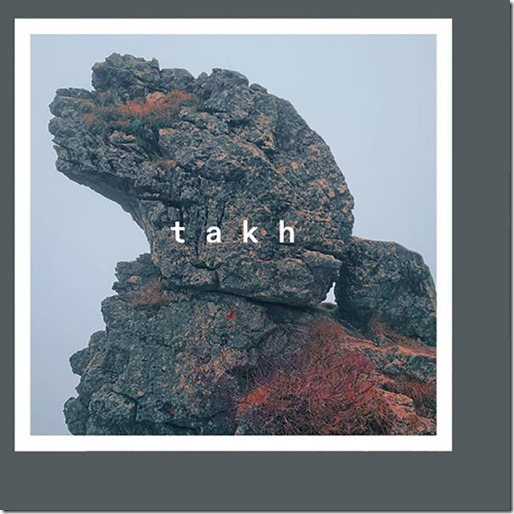
The text which accompanies the album’s release serves almost as an affirmation of my line of contemplation, with the explanation that Remember We Were Waiting For The Snow is about what is called ‘solastalgia’: our anxiety, our concern, our sadness to see some natural phenomenon disappear. Written 5 years ago, after Žils [Deless-Vēliņš – aka (Lunt)] relocated to Latvia, it is a collection of exquisite reflective moving guitar-driven ambience drawing from same the sonic well as soundscapers like Jim O’Rouke’.

The nine tracks of Remember We Were Waiting For The Snow range from the expansive – the eight-minute opener, ‘Flakes and Feathers’ and the nine-minute closer, ‘Auseklis’ – to the fragmentary – the sub-two-minute ‘Dead Man in the Sand’ and ‘Dead Man in the Snow’.

Between the bodies, there is atmosphere. There is tension, but it’s contained by the soft curtains of sound. ‘Plasma (Under the Ice)’ is stark, scraping, brooding, dark, and difficult, uncomfortable, uneasy on the ear.

The instrumentation is varied, from screeding synths to picked guitar and mellow woodwind that falls between jazz and post-rock. But genres matter not and dissolve in the face of such magnificence. Remember We Were Waiting For The Snow drags hard on melancholic reflections. It’s also melodic and intimate, and ultimately, quite magical.

AA

cover