Time marches on, and here we are almost midway through December still catching up with November releases, this time with Polish ‘dark rock’ duo Shrine Of Reflection.
There’s a great temptation to split hairs and that argue that surely the dark rock tag is goths pretending not to be goth, but that would be unjust, as this six-and-a-half-minute sonic adventure is more post-rock than anything, but there are also hints of prog and bleak neofolk vibes emanating from the murky tones, where a sparse, spindly lead line drifts over a slow, deliberate thunder-like beat that plods away like a heavy heart, before it blossoms into colour at the midpoint into an expansive, cinematic sweep.
The blurbage summarises that “‘Child Of The World’ is a song inspired by the movie, Interstellar. It’s about the misery of a human being who is trapped on planet Earth and who is unable to discover the truth of the universe’s nature despite the fact of being its child. All this person can do is just simply stare at the sky and dream.”
That sense of entrapment is relatable, but more than this, the vocals become increasingly cracked and desperate as the song progresses, before the slow-building crescendo takes over, finally tapering off into muffled samples that leave you looking into the emptiness, and wondering.
What we all need is a jolt, a shock. Right NOW. You may not even realise it, but consider this: while life and the world seems to be swirling in a vortex of addling bewilderment, a lot of music seems to have become incredibly safe, a retreat. I’m not even talking about that slick, mass-produced mainstream fodder: even so-called ‘alternative’ rock has become increasingly safe in recent years, in the post-emo, post Foos world. And while a few acts on the peripheries are smashing all genre conventions with sledgehammers, they’re pretty niche, and what the world needs is something that can really get into the mix and shake things up. Has anything turned the world even halfway on its head singe grunge?
I’m aware that even reminiscing about grunge places my voice in a time capsule and in the ‘old bugger’ demographic for many, but has anything really been even remotely as evolutionary since? Has there ever been a seismic event since? We talk – or talked – about the zeitgeist, but what is the zeitgeist at the flaccid tail-end of 2022? Disaffection, discontent, strikes? Maybe, but what’s the soundtrack? Ed Sheeran and the new Adele album sure as hell aren’t the voice of disaffected youth.
Brighton’s ‘rising alt-rock rebels’ Fighting Colours might not be the face of the revolution, but they are the band to deliver that much-needed shakeup.
The vibe around the opening of the first of the EP’s four tracks, ‘Your Choice Now’ is a bit post-rock, with a nice, clean, chiming guitar sound – but it yields to some beefy riffage that’s pure grunge, it’s clear from the outset that they’re keen to mix things up and create their own blend, and it’s one that works well. And then Jasmine Ardley’s vocals enter the mix, and with this kind of chunky alt-rock being so male-orientated, to hear a female voice is unusual – and while Ardley has a clean vocal sound, it’s not unduly poppy.
‘The Boat Starts to Shake’ shuffled closer towards the jazzier, noodling end of the post-rock sound that was ubiquitous circa 2004, but the mathy verses contrast with massive slugging grunged-out choruses and a climax that’s nearly nu-metal and beings some hefty noise.
‘The Cure’ is different again, venturing into almost urban territory, while still anchored in jazzy math rock elements, before rupturing into a bold chorus that’s in between Evanescence and Halestorm, both gutsy and melodic and with an ‘epic’ feel, and it’s delivered with style.
The final cut of the EP plays the slower, emotion-filled arena anthem card, but still has more than enough guts and a keen melody, not least of all thanks to Jasmine’s voice, to separate it from the countless Paramore-wannabe alt rock acts out there.
It all stacks up for a strong set with a lot of bold and exhilarating rock action. It’s the kick up the arse alt-rock needs.
Ahead of the release of Modern Addictions available to pre-order from 2nd December, Human Worth have unveiled a video for Remote Viewing’s ‘Your Opinion Is Wrong’.
Featuring members of Palehorse, Million Dead, Sly & The Family Drone, Nitkowski and Wound (to name but a few) the band are no strangers to making heavy music, but together they demonstrate an even broader sound that incorporates elements of hardcore, post-rock and shoegaze into the palette of sludge and noise-rock.
Featuring guest vocals from Amée Chanter of Human Leather, ‘Your Opinion Is Wrong’ is an absolute belter of a raging racket, and it’s absolutely brutal in the best possible way. Check it here:
While books have blurbs that likely indicate whether or not you want to read them, records are altogether less pitch-orientated in their physicality, which, back in the day, used to make sifting through vinyl in shops and at record fairs an exercise which was a measure of one’s attitude to risk. Sometimes you’d take a punt on a record because you’d heard of the band and they sounded interesting, others, you’d go by the label or the cover or something.
Some traders – and this is something Jumbo records in Leeds still do – is put a short summary on a sticker on the PVC sleeve the record is stored in.
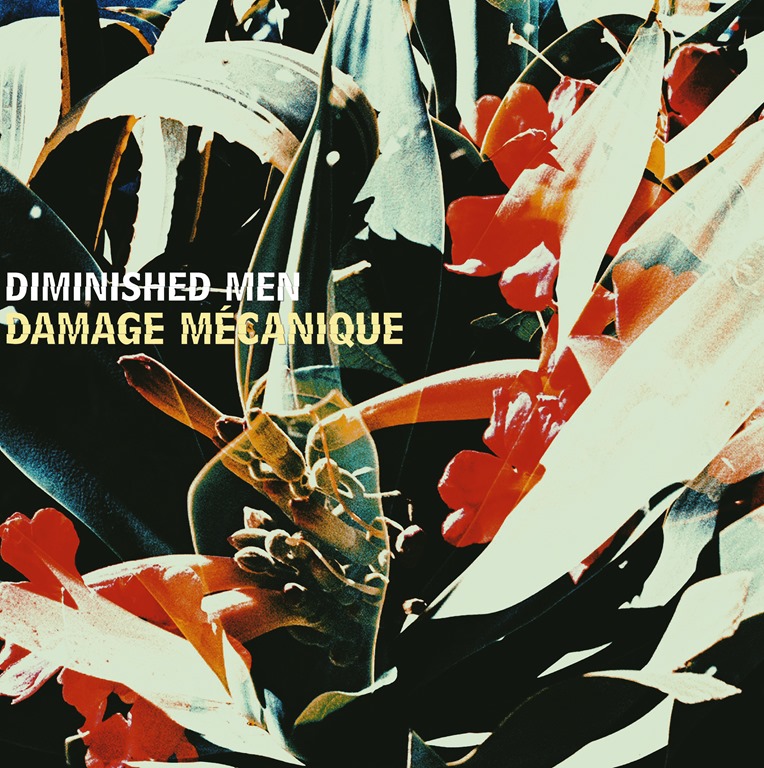
The virtual equivalent, for me, is scanning press releases. No way can I listen to everything I receive, let alone write about it, and some nights my inbox feels like flicking through boxes of records, unsure of what I actually want to hear until I find it. And lo, as I wander, aimless and befuddled, fatigued from another day of corporate chairpounding to keep the roof over my head and the bills paid, I stumble upon Damage Mécanique by Diminished Men. I’ve never heard of them, but on reading the pitch, I felt as if this was the thing I needed but didn’t know I needed until I found it.
Drawing from elements of film noir, psychedelic exotica, experimental rock, deviant surf and musique concrète, Diminished Men refocus their influences into something entirely unique. Collaged with menacing electricity, the raw materials are broken up and reassembled in their crude private facility. The group has spent more than a decade crafting their style and have established themselves as an integral part of Seattle’s underground music scene.
Their latest record, Damage Mécanique, thrusts the listener into a malfunctioning industrial sci-fi soundscape. Trance inducing guitars beckon with haunting wails, high-tension wires spin and spit with a crackling hiss. Circular kosmische rhythms and anxiety-drenched beats destroy and rebuild around fractured melodies and noise. The band oxidizes and melts into experimental post-punk and acousmatic environments as hypnotic groove and vertigo copulate in cinematic assemblage.
And there’s no question that they’ve got pedigree: drummer Dave Abramson is also a member of Master Musicians of Bukkake, Spider Trio, and has collaborated with Eyvind Kang and Secret Chiefs 3 among many others.
As ‘Double Vision’ crashes in amidst clattering, explosive percussion and dingy bass, I’m hauled by the collar into the realms of early industrial in the vein of Test Dept and Perennial Divide, and instantly, I’m home, knowing that this was indeed what I needed. It’s sparse in terms of arrangement, but dense in terms of sound, and it’s abrasive, rhythm-orientated, loud, heavy, and batters away at the brain.
It may seem counterintuitive to suggest that when your thoughts are in a mangled disarray and your focus is no-existent that the answer lies in music that bashes you round the bonce from all directions at once, but for me, at least, it’s infinitely more beneficial than any kind of chillout shit or ambient – although amidst loping, rolling rhythms, ‘Wet Moon’ conjures a shimmering ambience of sorts, while pointing towards esoteric oddity.
‘The Maze’ confuses and confounds with its daze-inducing cyclical riff and motoric beats which are pure Krautrock, evaporating into a mist around the mid-section of its six-and-a-half minute duration that sees it build through a jazzy post-rock segment before tumbling back into that nagging, dislocated groove – and it’s a nagging dislocated groove that dominates the wig-out weirdness of ‘Panopticon’. It’s likely of help to no-one to comment that it sounds like Murder the Disturbed but with the wild sax of These Monsters, but there it is: obscure post-punk collides with obscure jazz-infused noise rock, and it’s a corking way to end the first side of the album.
If ‘Axiel Tremors’ suggests rock excess played at a crawl, then it’s equally dragged out via some expansive jazz expressions into the realms of darkness. ‘Silver Halides’ brings a bold, brawling swagger to a cautious and subdued party of picked guitar introversion, and the final piece in this mismatched musical jigsaw, the six-minute ‘Spy’ hits the groove and drives it out of the door – while the door is still closed. Just as they clearly know how to make an entrance, they obviously understand the importance of a memorable exit.
There’s no particular or overt theme which unifies Damage Mécanique, and nor is there really anything that’s obvious stylistically speaking, as the album tosses a whole load into the mix and feels, in many respects, quite introspective in its influences and inspirations. There are, however, strong and unusual contrasts in evidence, with doomy bass and twanging desert rock working in tandem to forge a unique sonic experience., alongside, well, you name it. Quirky, atmospheric, Damage Mécanique is odd, but also compelling. It could be just the album you need, too.
While Dystopian Future Movies’ ‘difficult’ second album, Inviolate, took a full three years to land after debut Time, their third, War of the Ether crashed in after just over two, and it’s an immense sonic documents that the Nottingham trio have compiled in this time.
Back in the spring of 2020, I wrote of Inviolate that ‘Everything about Inviolate is bigger, bolder, more pronounced and yet more nuanced, shaper and more keenly felt and articulated. And every corner of the album is imbued with a sense of enormity, both sonic and emotional: Inviolate feels major-scale, from the driving riffs to the heartfelt human intensity.’ That amplification is again true of War of the Ether. Dystopian Future Moves’ previous releases amply demonstrate a band with both an interest in and a knack for the cinematographic, the dramatic, so it stands to reason that they should extend these focal elements here.
This time around they’ve drawn inspiration from little-reported but truly horrifying events which took place at the former Catholic-run Tuam Mother and Baby Home in songwriter Caroline Cawley’s native Ireland, where 796 skeletons found in the grounds after suspicions were raised by a local historian in 2012. As the press release explains, ‘to hide the shame of pregnancy outside of wedlock, women were sent to homes like this all over the country – forcibly separated from their mothers, many of the children died in infancy due to neglect, and some were trafficked for adoption to the US. The country is still dealing with the fallout from these discoveries.’
War of the Ether is not a joyful record. It is, however, a record with real depth, and imbued with real emotion, as well as an aching sense of tragedy. And, as has been established as Dystopian Future Movies’ signature style, it’s an album which balances riffs and restraint, and is built on atmosphere and menace. They promise an album that ‘explores a wide range of genres from prog and shoegaze to doom-metal, noise-rock and folk,’ and don’t disappoint.
War of the Ether opens – somewhat daringly – with the ten-minute spoken word crawler that is ‘She From Up the Drombán Hill’. For the most part, it’s sparse and spare, tingling guitars gently rippling behind the narrative – but there are bursts off noise, and it swells and grows and when it kicks in, it kicks in hard with piledriving riffage. The dynamics absolutely blow you away – exactly as intended. ‘Critical mass’ is appropriately titles, starting out with a haunting, echoed clean guitar and delicate drums rolling in the distance as a backdrop to Cawley’s aching, melodic vocal as it stretches and soars, and ‘The veneer’ is a magnificent slow-burner that builds to a shimmering sustained crescendo which unusually fades at the end. Against the weight of the subject matter and brooding instrumentation, it feels somewhat frivolous to focus on a fade, but it serves to highlight the many ways DFM are outside trends and exist in their own space. This is never more apparent than on the dreamy but serrated buzzing shoegaze of the title track.
For all its darkness, War of the Ether is a remarkably accessible album – not on account of its myriad hooks and killer choruses, but because it is simply so strong on melody and so utterly captivating. And because, as they demonstrate admirably on ‘No Matter’, the album’s shortest and most overtly structured song – they do have a real knack for snagging the listener with the combination of tunefulness and megalithic riffery. And then, the final track, the eight-and-a-half-minute ‘A Decent Class of Girl’ brings together all aspects of the album in a powerful accumulation of sedate, strolling psychedelia and climactic crescendos that optimise the impact of both.
Magical, majestic, and immensely widescreen, the scope of War of the Ether is simply breathtaking, and leaves you feeling stunned. Awesome in the literal sense.
Time flies when… life. And especially when a pandemic and a series of lockdowns rob you of two tears of doing anything. And so it is that Let Spin are marking the ten-year anniversary of their fourth album, Thick As Thieves.
The band are something of a supergroup: Formed in 2012, Let Spin feature four highly acclaimed musicians: Ruth Goller (Melt Yourself Down, Vula Viel), Chris Williams (Led Bib, Sarathy Korwar), Finlay Panter (Beats & Pieces Big Band, Sound 8 Orchestra), and Moss Freed (Union Division, Spike Orchestra), and Thick As Thieves features ten segued tracks of what they describe as ‘adventurous post-rock, experimental jazz’.
Thick As Thieves may be a cliché, but the music it contains is anything but. In fact, quite the opposite is true. Much as it subscribes to aspects of both jazz and post-rock, it’s an exploratory instrumental set that doesn’t really conform to any specific genre trappings, instead borrowing from them in order to form a unique hybrid.
While it’s largely driven by some crunched-up, noodling guitar work, Thick As Thieves very much mines an overtly jazz theme, and while it starts out quite gentle and doodly, on the third track, ‘Red’ it takes a hard lurch into altogether nor challenging terrain, and not just because it gets louder and more percussive: it’s altogether more jarring, the tempos and signatures tumbling into stop/start confusion before the brass ruptures into a cacophonic maelstrom.
‘Broken, I Told You!’ brings a chubby, strolling bassline that’s got some serous groove in a stuttering sort of a way and packs in some deft runs that weave in and out of the wild woodwind and jittery guitar work that’s disorientating and discombobulating. It’s pretty much ok that this feels a bit weird and woozy: it needs to be. ‘North Sea Swim’ takes things down a way and meanders along before swerving into ‘’Mixed Messages’. ‘Bead’ is perhaps the most overtly post-rock / jazz hybrid work, an expansive succession of crescendos with a soaring sax undulating into waves of stratospheric reverb. Closer ‘Liminality’ is almost nine minutes long, and is a space-rock jazz monster that’s absolutely dizzying.
This is one of those albums that not only feels like its album status is essential – you don’t seek out or skip to particular tracks, but experience it as a whole – but there’s a keen sense it would lend itself nicely to being performed live, in its entirety. It flows from end to end, with judiciously-placed peaks and troughs. The ten songs may be marked out individually, but this really feels like a single continuous piece segmented out into ten slices, and it’s a listening journey. At times intrepid, at times curious, it’s got a lot going on, often all at once. Brace yourself!
One’s perception of time changes with its passage. As you get older, it seems different, and passes differently too. In childhood, there’s the sense that summers are long and sunny, school holidays stretch out in front of you like a playing field the size of Wembley Stadium, whereas in adulthood, six weeks is no time, and the summer means it’s nearly time to start considering Christmas. But even in adulthood, while there’s a keen and pressing awareness of the rapid passing of time, it’s easy – and perhaps it’s how we’re psychologically wired – to ignore the overall narrative span while focusing on the rapid cycle of existing in the present. You get caught up in the infinite and swift cycle of the working week, thee routine, you complain about how time flies as New Year becomes Easter becomes Hallowe’en becomes Christmas, even how every birthday marks the passing of another year. But for all the talk of making the most of life and living every day or week like it could be your last, that’s what it is – talk. Because it’s almost impossible to comprehend there being an end, not just of life, but of anything. It’s simply human nature to take things for granted, that the sun will always rise, that you will always be able to buy the same bread and crisps and whatever in the supermarket.
And then they stop making a certain brand of crisps or chocolate and there are mutters of discontent, and then, twenty years later, online forums are oozing nostalgia for these things. These things of no consequence.
Over the course of seven previous album since 2001, Canadian quintet Esmerine, co-founded by percussionist Bruce Cawdron (Godspeed You! Black Emperor) and cellist Rebecca Foon (Thee Silver Mt. Zion, Saltland) have, as their bio notes, straddled the boundaries of ‘contemporary classical and late 20th century Minimalism’ and ‘more visceral and lyrical sonic terrain born from post-rock, folk and global.’
Such a broad palette is the perfect base from which to paint scenes of shifting perspectives that explore the theme of the title.
Time stalls during the nine-minute ‘Entropy: Incantation – Radiance – The Wild Sea’ – a piece which transitions through numerous parts and brings a range of atmospheres, from quietly brooding piano solo to soaring, majestic post-rock, trickling into the brass-orientated ‘Entropy: Acquiescence’ which evokes that sepia toned Hovis advert kind of nostalgia. And so it’s here I discover that that isn’t an exclusively English thing, but still – there is a cultural heritage of a nostalgia for a golden age of simplicity and innocence. It is, of course, a fallacy: past times were difficult, flawed. It’s easy to hanker for a rose-tinted rendition of a past you never knew, and ‘Imaginary Pasts’ seems to acknowledge this, wordlessly, via the medium of slow drones and rippling piano.
And so it is that Everything Was Forever Until It Was No More mines a golden post-rock seem of evocativeness, conveyed by means of slow-burning epics, interspersed with fragmentary pieces, which, while under three minutes in duration, give the album a certain sense of pace amidst the spic sprawlers, which culminate in the seven-and-a-half minute ‘Number Stations’. The brooding ‘Wakesleep’ is tense and eerie, with a sense of foreboding, that paves the way for the dolorous funeral chimes that herald the arrival of the closer.
There’s a sadness to it, and it’s this sadness which permeates the album as a whole. It’s a sadness that speaks of lost time and fading pasts. And when they’re gone, they’re gone. And yet there are soft hints of redemption, that nothing is entirely finite. Nothing is forever, but memories linger longer than life.
Back in the spring of last year it was our honour to stream ‘Pretvorivši se u ogradu, prošao sam kroz ogradu’ by Croatian noisemakers ### (which, their Bandcamp page advises is ‘pronounced by hitting a random object three times’) from the Nim Brut compilation Deprived of Occupation and Pleasure We Feast. And now they’re back with a full-length release in the form of the seven-track Nasilno. Produced by the band’s bassist, Anja Tkalec, they’ve made a conscious shift from using unusual locations in which to record, and instead spent some time camped out in Rattus Rattus studio in Zagreb ‘which allowed the band to fully record the wall of noise that is well known to all those who witnessed their concerts’.
The titles and lyrics may be lost in translation, but equally lost in a totally shredding, overloading wall of noise. There are magnificent quiet passages – brief as they are – and there are strong elements of post-rock and post-metal as well as the grainy, timeless analogue of Neurosis and associated acts, and they pack countless twists and turns in the sinewy, dynamic five minutes of opener ‘Jer život je ljepši kad se zaustavi’, with tense builds and an abrupt ending that collapses the expectation of a crescendo.
The blistering ‘Negativ cvijeće’ cuts free of genre to deliver a cataclysmic sonic blast that in time yields to shrieks and yowls of sculpted feedback atop crunching riffs, and of post-rock ad post-metal tropes have begun to grow weary – and yes, it’s fair to say that many of them have – ### breathe new life into them and then some. They also bring plenty of their own angles and a unique energy to proceedings: ‘Jednom kad tebe ostavim Satano’ and ‘Pretvorivši se u ogradu, prošao sam kroz ogradu’ have the angular jolt of Shellac, but the but the forrmer brings the juggernaut riffage of the likes of Amenra, and while it may not even extend to three-and-a-half minutes in duration, it’s expansive, solid, immense in scope and sound, and hot after lands the seven-and-a-half-minute ‘Oprostite, što u taj sumrak pada’ which blasts soaring riffs and squalls of feedback on a truly epic scale.
They do a lot with only a little: instrumentally, they work with a conventional rock format of instrumentation, but sonically, they’re staggeringly ambitious, and so often sound greater than the sum of their parts. Closer ‘Dvanaest boja za nasilje’ goes full Sunn O))) with grating drone and eternal feedback hums, and it makes for an intense and powerful eleven minutes of organ-kneeding that’s equally exhilarating and exhausting, in that it seems to go on for ever.
Nasilno is not an easy album, and it’s not an album that confirms to any one form or genre: it’s abrasive, angular, challenging – and GOOD!
Russian Circles have released their first ever music video for the title track of their forthcoming LP Gnosis, available next week, 19th August, via Sargent House. The centrepiece of the album “Gnosis” begins with a slow-build exercise in krautrock methodologies — drones, guitar arpeggios, cosmic synth, hypnotic drum patterns—that eventually explodes into the wall-of-sound bombardment Russian Circles are known for. The accompanying video, directed/edited by Joe Kell, is full of dark imagery driving towards the actual definition of the word ‘Gnosis.’ The band explains:
“’Gnosis’ is a special song that has grown with us over a number of years. The main theme of the song was re-conceptualised so many times that it provided nearly endless arrangement options. It’s rewarding to see such a minimal song idea evolve into one of our most dynamic and fully-realised songs to date.
When discussing a concept for the video, we agreed we wanted cinematic footage of nature and humanity. Ultimately, we wanted the video to feel fresh and inspiring despite dealing with a dark theme. Similarly, we wanted to compel viewers to re-watch the video and get something new from each viewing. Somehow, editor Joe Kell masterfully made this all happen.”
‘Gnosis’ eschews the varied terrain of the band’s past works by employing a new songwriting technique. Rather than crafting songs out of fragmented ideas in the practice room, full songs were written and recorded independently before being shared with other members, so that their initial vision was retained. While these demos spanned the full breadth of the band’s varied styles, the more cinematic compositions were ultimately excised in favor of the physically cathartic pieces.
Watch the video here:
AA
Russian Circles will be touring extensively in support of the album. Dates are as follows:
RUSSIAN CIRCLES N. AMERICA TOUR 2022:
Sep 15 Minneapolis, MN – Fine Line
Sep 17 Denver, CO – Gothic
Sep 18 Salt Lake City, UT – Urban Lounge
Sep 20 Seattle, WA – Croc Showroom
Sep 21 Portland, OR – Revolution Hall
Sep 23 San Francisco, CA – Great American Music Hall
Sep 24 Felton, CA – Felton Music Hall
Sep 25 Los Angeles, CA – The Regent
Sep 26 Phoenix, AZ – Crescent Ballroom
Sep 29 Austin, TX – Empire Garage
Sep 30 Dallas, TX – Amplified Live
Oct 01 Memphis, TN – Growlers
Oct 27 St. Louis, MO – Delmar Hall
Oct 28 Louisville, KY – Headliner’s
Oct 29 Atlanta, GA – Terminal West
Oct 30 Orlando, FL – The Social
Nov 01 Asheville, NC – Grey Eagle
Nov 02 Carrboro, NC – Cat’s Cradle
Nov 04 Washington, DC – 9:30 Club
Nov 05 Philadelphia, PA – World Cafe Live
Nov 06 Brooklyn, NY – Warsaw
Nov 08 Boston, MA – The Sinclair
Nov 09 Montreal, QC – Theatre Fairmount
Nov 10 Toronto, ON – Opera
Nov 11 Detroit, MI – El Club
Nov 12 Chicago, IL – Metro
RUSSIAN CIRCLES EU TOUR 2023 (Co Headline w/ Cult Of Luna):
Everything Was Forever Until It Was No More is such a quintessentially post-rock album title: without hearing a note, it evokes the spirit of 2003-2006 or thereabouts. On listening, it’s perhaps not as overtly post-rock as all that – it’s not a slow-building crescendo-fest with chiming guitars like Explosions in the Sky or even lesser-known acts like And So I Watch You From Afar, but with ties to legends in the field, it is every inch of that milieu, with ‘the cello of Rebecca Foon (Saltland, Set Fire To Flames, Silver Mt Zion) and the marimba of ex-Godspeed You! Black Emperor percussionist Bruce Cawdron at its core’.
It’s been a full five years since their last album, 2017’s Mechanics of Dominion, and during this time the Montreal-based collective have been doing what, it seems, the Montreal post-rock scene does best – detaching themselves from the world and conjuring magnificent, magical soundscapes that offer a conduit to planes of pure escapism.
Everything Was Forever Until It Was No More presents a rich sonic tapestry that incorporates a broad range of elements. The press released makes mention of ‘emotive chamber works using threads of post-classical, post-rock, Minimalism, neo-Baroque, jazz, pop and a wide array of folk traditions’ as being Esmerine’s palette.
‘Blackout’ opens the album with a soft, elegant piano draped with brooding strings that’s graceful, subtly emotive, and easy on the ear. ‘Entropy: Incantation – Radiance – The Wild Sea’, the first of the two-part ‘Entropy’ suite is a nine-minute journey through atmospheric ambience, where one treads with trepidation, uncertain of what may be hidden in the shadows. There’s an aura of ancient mysticism that echoes before eventually, the track refocuses toward a driving prog rock finale.
The beauty and joy of such a work is that while there are undoubtedly inspirations and emotions poured into the compositions, such wide spaces without words offer the listener a vessel into which to empty their own experiences and interpretations, and as such, a piece like the seven-minute ‘Imaginary Pasts’ with its lilting piano, roiling drums, and textured guitar work which trips out into hazy space offers so much scope for the listener to invest and reflect upon their own imaginary pasts. Such invitations to meditate on life and to journey into inner space are extremely welcome when life is so relentless.
Despite the title seemingly alluding to a sense of nostalgia, Everything Was Forever feels more like a work that creates its own space in time, rather than reflecting on a time past. Three of the four final tracks are under three minutes each in length, and as such, are almost dream-like fragments, and the listener finds themselves wandering through chiming bells and rippling notes that dapple like sunlight through trees in a breeze on ‘Wakesleep’, before ‘Number Stations’ guides the way not towards the light, but through a murky sonic swamp or eerie echoes before taking its final magnificent form, and reminds us that, ultimately, nothing is forever, and everything is just a fleeting moment in the scheme of eternity.