Posts Tagged ‘Post Rock’

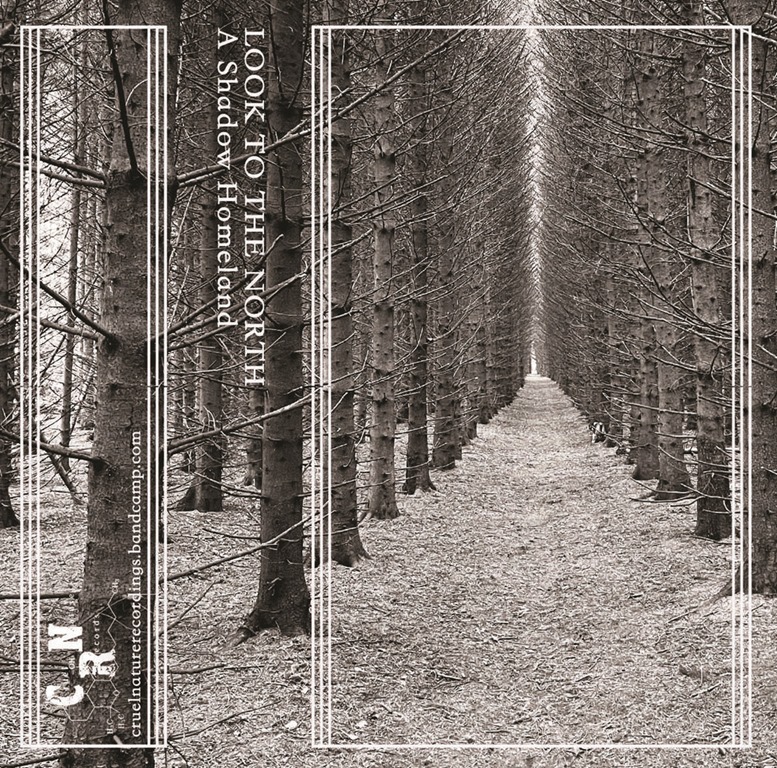
Cruel Nature Recordings – 24th November 2023

Christopher Nosnibor

The brief accompanying biography tells us that ‘Look To The North is the ‘dronefolk’ duo comprising David Colohan (United Bible Studies, Raising Holy Sparks) and Zachary Corsa (Nonconnah, Lost Trail)’, and that ‘Recorded in 2021, A Shadow Homeland is 4 tracks of atmospheric other-worldly introspection; melancholic ambience interspersed with sparse piano, spoken word and field-recordings, creating an immersive transcendental twilit experience.

We’re immediately in with what initially sounds like some form of narrative, and joining as we do seemingly in the middle of it, it’s difficult to orientate oneself in terms of context. Soon, soft droning tones drift in like mist and rings out heraldic over the hills and draping the woodlands with string-like sounds amidst images of clouds and nature, interlaced with spiritual abstractions rich in poeticism, but their meanings obscure. The title of this first composition, ‘Disintegrating Consoles And Cartridges’, has a ‘found sound’ connotation, a suggestion of decaying histories and lost origins, and in time, distant voices mutter almost imperceptibly while piano notes roll in and out. Increasingly I find sparse piano notes which are allowed to resonate conjure the saddest and most bereft of emotional sensations, and by the end of eight minutes, I find myself feeling empty, heavy of heart, and pining for something lost – something I can’t quite recall beyond a vague sensation, like the occasional pang of pining for childhood or people and places left long behind, the melancholia of hazy reminiscences which creep at the fringes of a fugue-like memory.

‘The Water That Shattered Their Image’ feels darker at the start, Not necessarily ominous, but there are grainy textures scratching lower in the layers of sound, elongated whisps and broad sonic washes, and they bring a certain discordance and discomfiture. Human voices mingle into wolf-like howls, baying, crazed, before growing hushed, as if in anticipation of the album’s dominating finale, the seventeen-and-a-half-minute ‘An Amulet For The Flux Of Blood’. Here, the piano is very much the central instrument, but surrounded by layers of organ and organic-sounding drones. These sounds coalesce to create a haunting yet smoothly tranquil atmosphere.

To suggest that it seems to share more in common with post-rock than any form of folk is perhaps to pick pedantically at irrelevant details, but I mention this because these genre distinctions have a tendency to set certain expectations. But as elegiac pastoral works, infused with subtle elements of collaging and experimentation, the pieces which make up A Shadow Homeland certainly don’t disappoint, and indeed, confound any expectations one may have. Mood-wise, I’m left feeling uncertain; neither uplifted now downcast, but somewhere in a strange place and a sensation of something missing. It’s neither pleasant nor unpleasant, but remarkable that such understated instrumental works can resonate in such a deep and complex way.

AA

a0117392340_10

Human Worth – 8th December 2023

Christopher Nosnibor

It’s only a bit of a brag – and a collateral one, at that – to say I’ve followed the Human Worth label since its inception. There’s a contextual reason to mention it, namely that while I’ve long raved about their being consistent in their selection of all things noisy, Human Worth isn’t a label with a ‘house’ style devoted to any one strain of music of an overdriven guitar nature. One need look no further than then recently-released angular indie noise-rock hybrid of Beige palace’s Making Sounds for Andy for evidence of that. It’s most definitely an ‘alternative’ record, in that it’s a million miles from the mainstream, but it’s not particularly noisy.

A. L. Lacey’s mid-bill placing on the label’s recent eight-act extravaganza in Leeds was an inspired one, as her graceful tunes provided the perfect respite from predominantly noisy guitar-based acts, and her performance set my level of anticipation for her album, Lesson.

It’s a landmark release for both Alice and Human Worth: having long established herself as a contributor to numerous acts in her locale of Bristol, Alice explains how “there was a frustrating sense of unfinished business. In that, my piano parts and ideas were being restricted to someone else’s’ vision – a vision which was often ‘less is more’ – a tasteful afterthought… A huge part of this project therefore became the need to challenge myself and to see what I could achieve or lessons I could learn, if I did things my own way – a bit of a journey towards autonomy – a predominant theme in most of my songs, along with finding purpose from confusion, and strength in your weaknesses.”

Lesson, then, is Lacey’s statement of identity, as she steps out from the shadows of other people’s work to present herself and her own musical ideas. And what’s striking is just how eclectic the album’s nine songs are.

‘Sewn’ opens up with rolling piano propelled by a vintage drum machine sound that’s pure late 70s/early 80s. But if this evokes the lo-fi sparseness and simplicity of Young Marble Giants, her vocals, swathed in reverb and strong yet delicate, are equal parts folk and shoegaze. And yet for all these elements, Lacey creates a maximal expansiveness with minimal instrumentalism. With swells of energy, it’s a soaring, uplifting piece, which hooks the listener immediately into the unique world she conjures with her magical fingers and tuneful voice.

It paves the way for eight further slices of creatively crafted musicality that combines elements of neoclassical, folk, and experimentalism. ‘Complaint’ is exemplary: the instrumentation is sparse, subtle, a soft wash of thrumming, droning synths underpinned by an insistent but understated beat. Incidental sounds weave in and out, creating depth, while Lacey’s multi-tracked voice is simultaneously trad folky and otherworldly.

There’s an energy and pace to many of the songs on Lesson which are far from the kind of bland, plodding fare common to many singer-songwriter types: ‘Memo’ may be but a brief note, but has the vintage pop vibes of Stereolab as it breezes on through and makes its mark. Elsewhere, the title track is wistful, swooning, without being remotely twee, and ‘Home’ brings post-rock dramatics to the proceedings. Bold yet understated, ‘Paper’ is worthy of all the airplay, and would sit comfortably on soundtracks and being performed at arena shows alike, being accessible, easy on the ear, hooky, emotive, and –

AA

Perhaps because she’s been doing this for a lot longer than the arrival of a debut would imply, Alice’s accomplishment as both a musician and a composer shine through every moment of this spellbinding collection of songs: the attention to detail the nuances of the playing and the production only accentuate the multi-faceted qualities of her songwriting and performance. It all adds up to a uniquely special album.

AA

HW026_ALLacey_Lesson_CoverArtwork

Scottish alt/post/progressive-rock outfit Midas Fall will release their fifth studio album, Cold Waves Divide Us on March 8th, 2024 worldwide on Monotreme Records.

Michael Hamilton joins founding members Elizabeth Heaton and Rowan Burn for the follow-up to their 2018 Prog Magazine Awards ‘Limelight Award’ winning album, Evaporate.

Cold Waves Divide Us sees Midas Fall at their most confidently visceral, each song moving beautifully between quiet and loud, gentle and crushing. “This album is a heavier and bigger experience than the last album”, says Heaton. “We kept the atmospheric strings and 80s synths of Evaporate but wanted to add heavier layered elements, to represent more what we sound like live.”

Today they also share the eponymous single from the album, with a dark sci-fi video from Sharon Ritossa and Gabriele Ottino of Riot Studio. The music builds slowly as Elizabeth Heaton’s voice floats gracefully above the growing force beneath it, against a racing visual landscape of "nature, but not-quite-as-we-know-it”.

According to Ottino, “We aimed to imbue this music video with the ambiance of a dystopian jungle. Nature is genetically altered by the virus of a hypercapitalist and hyperproductive civilization, where technology begins to gain consciousness. Instead of annihilating humans and plants, it opts to adapt and modify itself to exist within the bodies and limbs of those who have survived Earth’s catastrophes. No one perishes, no one lives as they did before; everything undergoes transformation.

The technique used is a mixed technique, combining footage, 3D, pure generative, and they were edited to create a narrative foundation. The next step involved passing various sections of the video through the AI Stable Diffusion tool to create surreal and unique environments, suggestions, forms, and textures.”

Watch the video here:

AA

HMqdvfBA

Crazysane Records – 24th Nov 2023

Christopher Nosnibor

The press release describes Zahn as a ‘German post–modern noise rock ensemble’, while their bandcamp bio offers ‘A bold escape from your daily life through technicolor transmissions of post–rock, krautrock, dark jazz, noise–rock, post–punk and electronic music. Influenced by the likes of TRANS AM, THE JESUS LIZARD, METZ, THE MELVINS and TORTOISE’, adding that ‘Adria is a compelling soundtrack to a 1980’s anti–utopian road movie!’

As a prospect, it’s head-spinning, sounding like an everything-all-at-once hybrid, and the actuality isn’t much different. There are plenty of driving grooves, largely propelled by solid bass and insistent drumming, but there are also some angular riffs and big splashes of noise.

The first track, ‘Zebra,’ boasts a bulbous bass with some big low-end and some easy, noodly synths which wibble and wander agreeably and mellifluously… and then towards the end it builds and distorts and things get altogether more twisted and less pleasant. And this is a feature characteristic of the compositions on show here. They don’t mash everything into every second simultaneously, and there’s none of that jazz / Beefheart kind of stuff that sounds like each band member is playing a different tune in a different key and time signature all at the same time. There are times where that kind of avant-gardism most definitely has its place, and works, but this isn’t what Zahn are doing here. In keeping with the road movie concept, the pieces are constructed around transition.

The ten-minute ‘Schmuck’ is a magnificent example of their ability to do mellow, with clean sounds and even a tinge of a country twang, it swings along breezily and evokes sunshine and expansive vistas. Then, near the seven-minute mark, the bass steps up to a crunching grind and things get a whole lot noisier, from where it builds into a big, driven riff which crackles with energy. ‘Yuccatan 3E’ is another colossus of a cut, running to almost nine and a half minutes and manages to take it time in pushing outwards and working a single passage for a fair while, but equally packs in at least three or four songs’ worth of ideas.

The changes feel organic, and sometimes emerge gradually, and at others there will be a sudden and unexpected swerve, and there’s so much happening that the absence of vocals barely registers.

Because the mood, tone, and tempo differs so radically between songs – and between sections – Adria very much does feel like a journey, through space and time. ‘Apricot’ is a sparse synth work with crispy vintage drum machine snare cutting through quavering analogue synth sounds – then, without changing the instrumentation or the simple repetitive motif, it goes massive. A post-rock Depeche Mode chronically undersells it, but it’s as close as I can get, at least off the top of my head. The final minute is an extravagant climax, and truly magnificent.

The majority of the album’s eleven tracks run past five minutes, with the majority sitting more around the seven-minute mark, but the eleven-and-a-half-minute ‘Faser’ is the album’s megalithic centrepiece. It blasts hard with a fuzzy, scuzzy repetitive riff cycle with stoner rock tendencies, and it’s dynamic and exhilarating. Dropping down to bubbling synths in the breakdown around six minutes in, the threat of a re-emergence of the heavy lingers suspensefully. When it does land, it does so with a vengeance, before transitioning once more into something altogether different again, skittering its way into Krautrock territory.

The power blast of ‘Tabak’ hits square between the eyes and feels unexpected however expected it actually is. These guys are absolute masters of the unpredictable and varied structure, and conjure some highly evocative and atmospheric passages, and while the playing is technical, it’s not technical for its own sake: there’s nothing showy or extravagant, and the focus is very much on the compositions, the structures, and the impact. ‘Amaranth’ piledrives a full-on doom riff, slogging away at it for what feel like an eternity. It’s a heavy trudge, and really hits the spot – again, when you least expect it.

Adria straddles many, many genres, and does so in a way that’s incredibly imaginative. The key to its success is its execution, which balances precision with passion.

AA

a0822649105_10

German post–modern noise rock ensemble ZAHN will release their second full–length album Adria on 24th November. Adria offers a bold escape from your daily life through technicolor transmissions of post–rock, krautrock, dark jazz, noise–rock, post–punk and electronic music. Influenced by the likes of TRANS AM, THE JESUS LIZARD, METZ, THE MELVINS and TORTOISE. Adria is a compelling soundtrack to a 1980’s anti–utopian road movie!

Adria was mixed and mastered by Magnus Lindberg (RUSSIAN CIRCLES, CULT OF LUNA) at his Stockholm studio. The cover artwork, based around photographs by Lupus Lindemann(KADAVAR), was designed by Fabian Bremer (RADARE, AUA).

The album is a testament to the incredible power of this trio and its ability to effortlessly ensnare your attention for the duration of a ten minute–song of purely instrumental music. Over the course of the album’s 11 tracks ZAHN emerge as a form of PINK FLOYD of noise rock, relentlessly pushing the envelope on what’s already accomplished while remaining tasteful and tasty at every corner.

Listen to ‘Schmuck’ here:

AA

ZAHN band

Sub Rosa  – 22nd September 2023

Christopher Nosnibor

So many reissues recently have taught me a valuable lesson. I don’t know nearly as much music as I thought I did. Of course, it’s impossible know all the music, and despite feeling I’m reasonably knowledgeable, and compensating what I don’t know with enthusiasm. Time was, I was worried about knowledge gaps: they made me feel stupid, ignorant, and I’ve spent evenings with people who have reeled off bands in genres I’m interested in and not recognised the name of a single one, let alone heard them. I felt like a fraud claiming to be a music enthusiast and worse still, a music writer (I never proclaim to be a music journalist. I write about music, and do so very much from a personal perspective. Sometimes, I stab at maintaining an element of objectivity, but the appreciation of art isn’t objective. As I’ve written elsewhere, the reason we appreciate art is because of the feelings it stirs in us, the way it speaks to us, not first and foremost because of its technical proficiency.

This is a lengthy circumnavigation to the confession that Die Anarchistische Abendunterhaltung completely bypassed me in the day – in fact, until today, the week of the reissue of their 1995 self-titled full-length debut. I suspect that they didn’t get much coverage in the UK music press, and this was still a while before the advent of the Internet as we know it – and I was a relatively early adopter, setting up my eBay account in 1999 following the demise of Yahoo! Auctions.

As the accompanying bio outlines, ‘The band consisted of four young, ‚classically derailed’ musicians who played their own compositions exclusively their with acoustic instruments such as violin, cello, clarinet and accordion… Their work contained influences from Roma music, Eastern European folk, klezmer and jazz, but was performed with the energy, rebellious spirit and Sturm und Drang of a bona fide punk band. DAAU was part of the fertile Antwerp scene, which also produced dEUS, Zita Swoon and Kiss My Jazz, and soon signed an international record deal with Sony Classical.’

dEUS may have briefly made a mark here in the UK in indie / alternative circles, but the others, not so much, and I suspect that even with its first vinyl pressing, this re-release will likely have a bigger landing in Germany and, indeed, the rest of mainland Europe, than this pitiful island that still celebrates Britpop, and which spent 1995 dominated by turgid sludge by the likes of Oasis, whose pinnacle release (What’s the Story) Morning Glory? and Blur’s Great Escape (which was anything but great); the best we got was The Bends, while Robson and fucking Jerome dominated the singles charts for half the year. As if we needed further proof that we’re a small, crappy island with an overinflated sense of self-importance that the longest hangover from the Empire ever. It’s embarrassing, as is the fact that this domestic Brit-centric bullshittery has denied us introductions to many great bands. Die Anarchistische Abendunterhaltung is a perfect example.

It’s perhaps not hard to grasp why this extravaganza of neoclassical extravagance and its wild woodwind and unpredictable compositional forms didn’t grab the attention of the British Music press, but they missed a work that’s hugely innovative and belongs to no one genre. It’s wild and it’s challenging , but these are positives.

Die Anarchistische Abendunterhaltung is droning strings, it’s by turns melancholy and slow, and remarkably lively. It’s an untamed beast almost with a life and energy all of its own. But the compositions aren’t in sequence!

‘V Drieslagstelsel’ is the first track, the first of five ‘Drieslagstelsel’ pieces, and it’s followed by the frenzied yet droning folksiness of ‘II Drieslagstelsel’: it’s pretty, but it’s strange. Or, it’s pretty strange. I’m on the fence, while it sounds like they’re stripping the fence with some frenzied violin work. ‘III Drieslagstelsel’ scuttles in with some cheeky chamber stylings before popping in all directions, and it’s kinda cheeky – and perhaps tongue-in-cheeky – jaunty, incredibly busy, and extremely varied. It isn’t the kind of explosive, head-spinning jazz I sometimes find myself wrestling with here, but it covers a lot of terrain in just five and a half minutes, with stage musical qualities pushing to the fore before dipping back down to something altogether less ‘production’ orientated. The last of the ‘Drieslagstelsel’ sequence is ‘I Drieslagstelsel’, and following the frenzied strings and dramatic orchestral sculptures of ‘VI Drieslagstelsel,’ it’s a compact piece of neoclassical music which fulfils the oft-underrated and oft-overlooked purpose of entertaining. It’s a fun and often frivolous piece, in parts a wild hoedown with wind instruments, with an eye-popping energy which delves in to drones and darker territory at times.

What happened to IV? Maybe it doesn’t matter. Rounding the album off is the eleven-minute ‘Doorloop’, which appears to be a traditional track, and its slow, drawn-out notes are funereal at first, before thing go g=crazy and there are even vocal.

Over the course of these six pieces, Die Anarchistische Abendunterhaltung brings massive range. Back in 95, I probably wouldn’t have appreciated it, and nor would anyone else I knew. But here we are, looking at an accomplished album with much texture and range.

And now, I appreciate it. Perhaps I wasn’t ready, perhaps it was out of step with the times for all but a few – and even fewer here in Britain – but Die Anarchistische Abendunterhaltung is a remarkable album, and one which is timeless.

AA

a3688988726_10

Neurot Recordings – 29th September 2023

Christopher Nosnibor

I’m finding myself on something of a Neurot trip this week, following my fervent frothing over the mighty new album by Great Falls. As if to prove that the label has been putting out outstanding records for a very long time (and with unstinting singularity, presenting a broad stylistic range, too: this is anything but heavy), twenty years on from its original release, Grails’ debut is getting a reissue. While the nice coloured vinyl pressings (in ‘Coke bottle clear’ and ‘beer’ hues) aren’t necessarily for everyone, the release does afford a timely opportunity to reflect on the debut release of a band who have gone on to forge a significant and varied career, with their latest album – number eight – being released next month.

Steve Von Till’s comments about hearing the demo for the album, on which the offer of’ the release was made, reminds us of the musical landscape of the time in 2002: ‘Most instrumental music at the time was trying to emulate Godspeed You! Black Emperor or Mogwai, but this was different. This seemed to have elements from more diverse sources that I loved such as Dirty Three, Comus, Richard Thompson, and Neil Young, not to mention, who in hell would dare to cover Sun City Girls?’

There was a lot of instrumental post rock around, and while there was a wealth of great bands around, locally as well as nationally and internationally, it’s fair to say that a large proportion of it was much of a muchness, with myriad explorations of chiming guitars and slow-building crescendos.

The prominence of acoustic guitars, softly picked and strummed, and rather unconventional use of violin creates an unusual dynamic on these compositions, which tend to be sparse in arrangement and with considerable space between both the instruments and the individual notes, and the crescendos are few and far between – the first doesn’t arrive until over halfway through the third track, the slow, meandering ‘The Deed’, when the swell of guitar pushes upward through yawning strings and finally the full drum kit crashes in. But the impact is less from whacking on the gain on the instruments, but the musicians utilising the dynamics of playing, and the simple equation that playing harder is louder. Against the prevailing tide of pedal boards as big as drum risers packed with effects, this stands out as being not only very different, but bold, the emphasis on the tones and timbres of the instruments in unadulterated form, the sounds the result of technique.

The soft piano of ‘In the Beginning’, when paired with picked guitar has an almost pastoral feel; the heavy smack of a drum feels incongruous before a soft yet almost clumsy waltz emerges briefly, and structurally, the pieces seem to belong more to jazz than anything else, although ‘Space Prophet Dogon’ (the Sun City Girls cover) draws together elements of Celtic-influenced folk and psychedelia, and goes for a long toe-tapping groove over a crescendo by way of an extended climax. It takes a certain courage to fly in the face of fashion in such an obtuse fashion, as well as to play in such an intimate way that you can hear the sweep of a finger across a fret, where natural reverberations become as integral to the sound as the notes themselves. This is nowhere more apparent than on the hyperpsarce intro of ‘Broken Ballad’, a sedate almost country-tinged tune and one of the album’s more conventionally-shaped pieces. The slowly-unfurling ‘White Flag’ shares a certain common ground with later releases by Earth: slow, spacious, revolving around a simple, picked guitar motif, but it does swing into an exhilarating full band finale that’s different again.

Closer ‘Canyon Hymn,’ presumably a reference to Laurel Canyon, the name of the and when they recorded the demos which would become The Burden of Hope, is by no means an anthem or a theme, but encapsulates all aspects of the album’s range within a soothing five minutes. If the title, The Burden of Hope, implies a certain weight of responsibility, the music it contains sees that hope take wings. Twenty years on, The Burden of Hope sounds uplifting, and still fresh.

AA

cosmicimg-prod.services.web.outlook

Scandinavian post-rock giants SPURV have announced the release of new track ‘Som skyer’ via Germany’s Pelagic Records. The penultimate single from Brefjære, the band’s fourth full-length release due September 22nd; ‘Som skyer’ sees the band layer orchestral grandeur over a shimmering, glacial guitar refrain as thunderous drums push the five and half minute piece to ever greater heights.

Having recently moved to Tromsø, a remote northern province far above the Arctic Circle, principal songwriter Gustav Jørgen Pedersen took inspiration from the forces of nature he found himself surrounded by. Despite the overwhelming presence of the mountains and the unrelenting Arctic winds, Pedersen was struck by the resilience and sheer determination of life, from the birch trees outside his window to a single butterfly battling the breeze.

This delicate balance is perfectly captured in the sheer euphoria of ‘Som skyer’ and its accompanying video. SPURV take us soaring through the sky as the sun peers over the jagged Norwegian fjørds; finding the joy of life in even the most desolate places.

Brefjære sees the band take their latent exploration of neo-classical composition even further. Throughout ‘Som skyer’, guitarist Herman Otterlei’s celestial, spiralling motif is complemented by glockenspiels, a brass section and a 14-voice choir; adding further depth to the incredible dynamic sensitivity that SPURV have carved out over their decade at the forefront of international post-rock.

Gustav Jørden Petersen on ‘Som Skyer’:

“’Som skyer’ is Spurv at its perhaps most ethereal. The song is about the wind that flies over the earth, rustles in the treetops, and plunges down over the mountain. It represents time and fleeting memories, words and ideas that are shared across generations. The song contains old melodies combined with new arrangements, and was finally realized as part of Brefjære after many years.”

Watch the immersive video here:

AA

MclyUEoQ