Posts Tagged ‘Metal’

Christopher Nosnibor

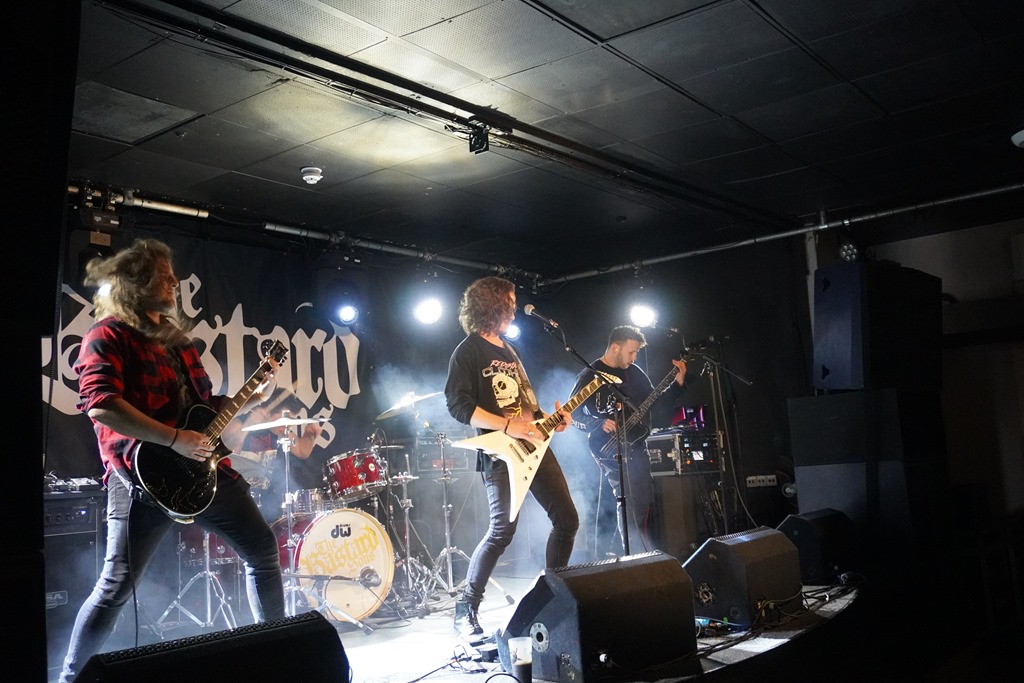
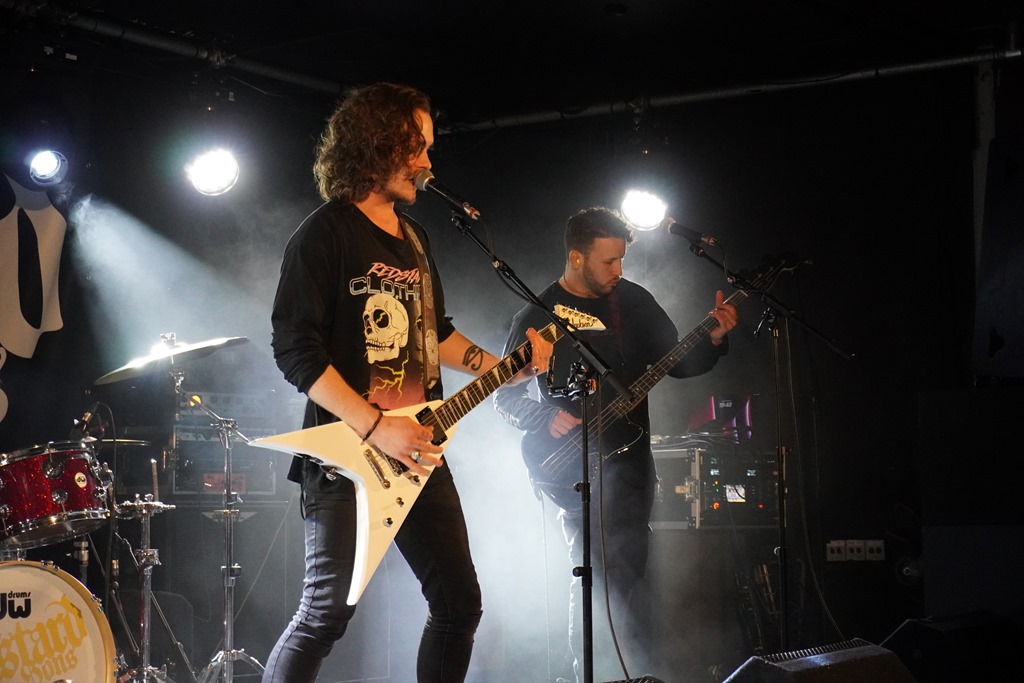
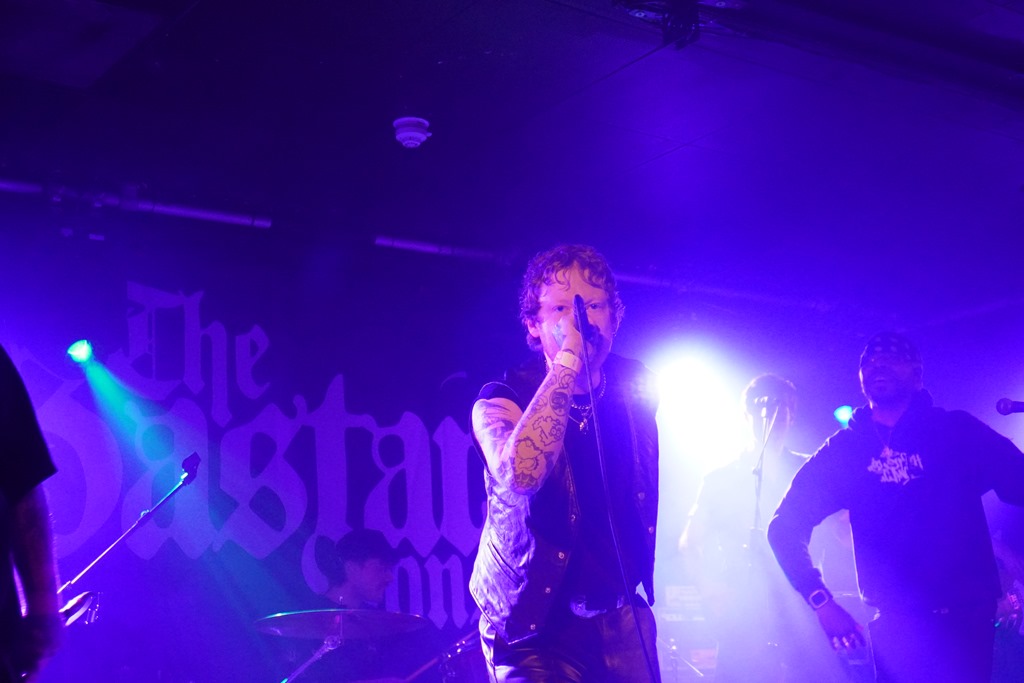
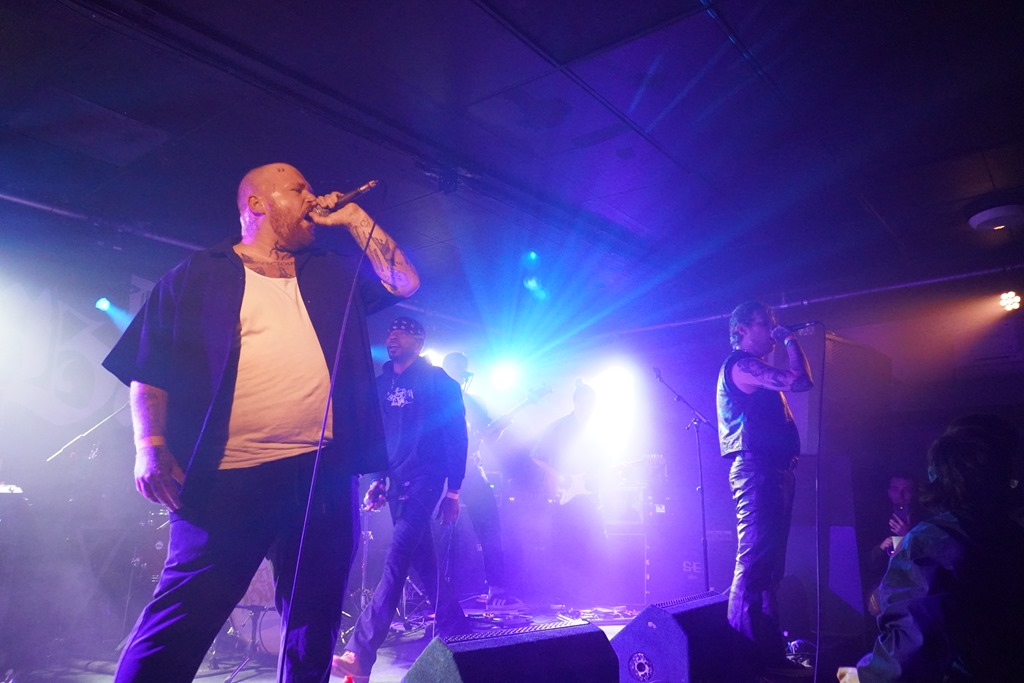
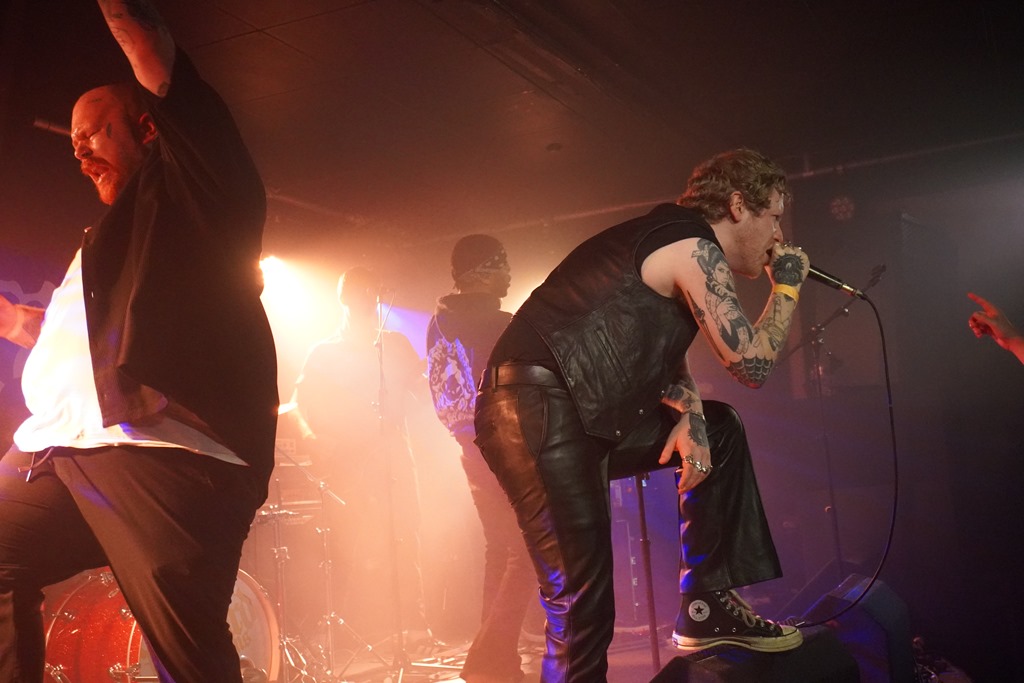
On arrival, it looks like Nu Jorvik have pulled and been replaced by Makhlon, and at somewhat short notice, but it’s hard to grumble when you’ve got three heavy bands for six measly quid and the headliners are guaranteed to be worth double that on their own.

There’s lots of leather, studs, long coats, and long hair in the gathered crowd, it turns out those sporting corpse paint – perhaps not entirely surprisingly – belong to the first band who are straight-up black metal.

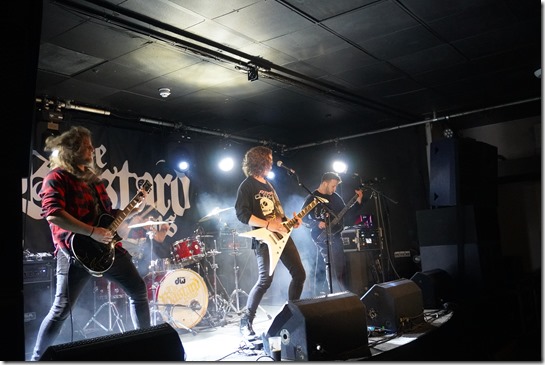
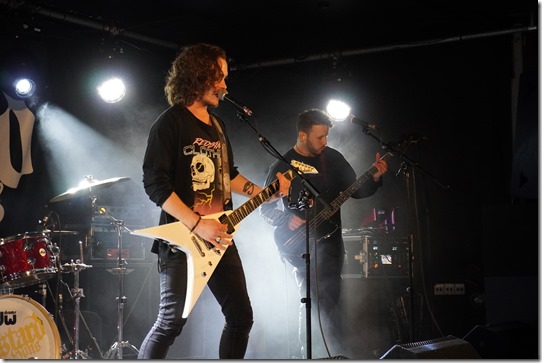
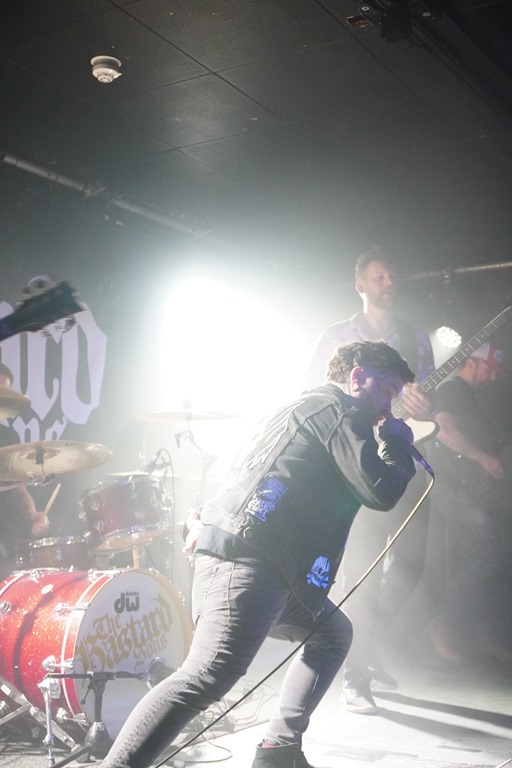
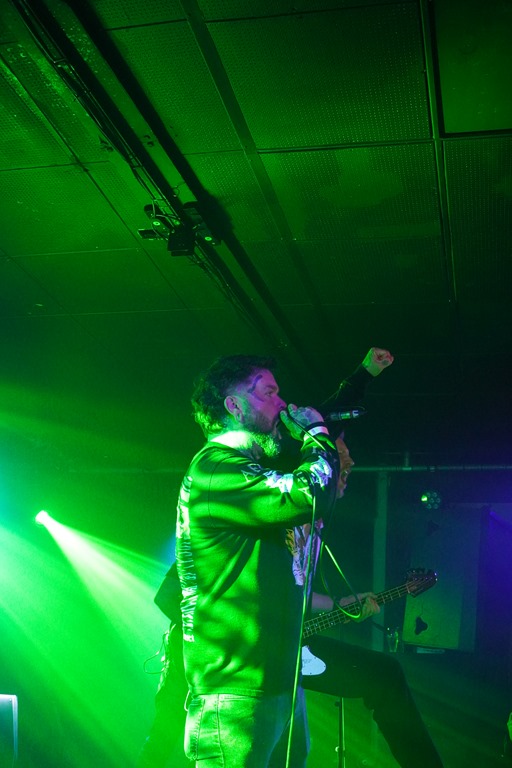
Makhlon’s singer has Neil from The Young Ones vibes. He’s about 7ft tall and wearing a Lordi T-shirt, but snarls full-on Satanic rasping vocals from behind his nicely-washed jet-black hair. The lead guitarist and front man swap roles for the last two songs – both of which are epic in scope, with some nice tempo changes, and they really step up the fury. It’s quite amusing to see him clutching a notebook in the arm which is thrust forward and enwrapped in a spike-covered vambrace, and checking the lyrics, as if it’s possible to decipher a single syllable. But this is all good: time was when York was wall-to-wall indie, folk, and Americana. Now… now we have homegrown acts like this, and the thing with black metal is that it only works when the band and its members are one hundred percent committed to the cause. These guys are, and while they may be fairly new, they’re tight, they can really play, and they give it everything.

DSC00987DSC00992DSC00999

Makhlon

Cwfen – pronounced ‘Coven’ – aren’t Welsh, but in fact Scottish, and this is their first trip south of the border. It seems that since relocating to Glasgow, Teleost have been making some good friends. And Cwfyn are good alright… Woah, yes, they’re good. They are heavy, so heavy, as well as melodic but also ferocious. There’s a lot going on, all held together by a supremely dense bass. The ‘occult metal four- piece’ may be the coming together of artists who’ve been around a few years, but the fact they’ve only been playing as a unit for a couple of years is remarkable, as they really have everything nailed. They’re both visually and sonically compelling: Siobhan’s fierce presence provides an obvious focal point, but the way everything melds instrumentally is breathtaking. The third song in their five-song set slows things, and brings some nice reverb and chorus textures. Piling into the penultimate song, the crushing ‘Penance’, which features on their debut release, they sound absolutely fucking immense. The closer, the slow-burning, slightly gothy ‘Embers’ is truly epic. With their debut album in the pipeline, this is a band to get excited about.

DSC01013DSC01026DSC01029

Cwfen

I’m already excited about Teleost, and the fact that there’s such a turnout on a cold Thursday night says the people of York are extremely pleased to welcome them home. Having knocked about in various bands / projects previously, with Cat Redfern fronting Redfyrn on guitar and vocals, before pairing with Leo Hancill to form Uncle Bari, who would mutate into the ultimate riff-monster that is Teleost, they departed for Glasgow, leaving a uniquely Teleost-shaped hole at the heavier end of the scene.

Absence not only makes the heart grow fonder, but it’s apparent they’ve spent their time getting even more immense since they left.

DSC01042DSC01067DSC01072

Teleost

They’re a band to watch with your eyes closed. Not because they aren’t good to watch, but because their sound is so immersive. Teleost have perfected that Earth-like tectonic crawl. Imagine Earth 2 with drums and vocals. Or, perhaps, Sunn O)))’s Life Metal with percussion. Each chord hangs for an entire orbit, the drums crash at a tidal pace, and with oceanic, crushing weight. Somehow, Leo Hancil’s guitar sounds like three guitars and a bass, and it looks like he’s actually running through two or even three separate cabs. It’s not quite Stephen O’Malley’s backline, but it’s substantial. And you’re never going to get a sound like that just going through a 15-watt amp, however you mic it up. They play low and slow, and Cat plays with drumsticks as thick as rounders bats, yielding a truly thunderous drum sound. In fact, to open your eyes is to reveal a mesmerising spectacle: two musicians playing with intense focus and a rare intuition, and Redfern’s slow, deliberate drumming is phenomenal, and the whole experience is completely hypnotic. They play over the scheduled time, and then, by popular demand, treat us to an encore with an as-yet-unreleased song. Everyone is absolutely rooted to the spot, currents of sound buffeting around us.

Teleost’s influences may be obvious, but they’re at the point where they’re every bit as good as their forebears. The future is theirs. But tonight is ours. We can only hope they visit again soon.

Metropolis Records – 10th January 2025

Christopher Nosnibor

According to their bio, ‘Morlocks are a Swedish act who combine elements of industrial rock, neo-classical, darkwave and metal with epic production values to create an exciting hybrid sound. Having issued the long-awaited and well received album Praise The Iconoclast in late 2023, they subsequently promoted it with two US tours in 2024, both in support of their friends and occasional collaborators KMFDM.’

Asked about the inspiration behind the song, the band state: “Watch the world from a distance. Get angry at first, but also inspired. Take the darkest parts of it and twist them into something weird, beautiful and batshit insane – something that you could either dance to, brood in the shadows to or scream at the top of your lungs at the moon. Preferably all of the above. Everything can be turned into art, and art must hurt. Situation normal: all fucked up.”

‘Everything can be turned into art, and art must hurt’ is a phrase which stands out here. It may seem somewhat dramatic, but to summarise Buddha’s teaching, ‘all life is suffering’, or ‘life is pain’, and the function or art – true art – is to speak in some way of deep truths of what it is to be human. Art must therefore, reflect life and capture something of the existential anguish of the human condition. If it doesn’t, it isn’t art, it’s mere entertainment. And if the idea that ‘Everything can be turned into art’ may superficially seem somewhat flippant, a diminishment of serious matters, if the work is, indeed art, and not entertainment, then the obverse is true: using the pain of life as source material is the only way to interrogate in appropriate depth those most challenging of issues. In other words, making art from trauma is not reductive or to cheapen the experience – but making entertainment from it very much is.

There’s a snobbery around what constitutes art, even now, despite the breakthroughs made through modernism and postmodernism. It’s as if Duchamps had never pissed on the preconceptions of art for the upper echelons of society who still maintain that art is theatre, is opera, is Shakespeare, that art can only exist in galleries and is broadly of the canon. This is patently bollocks, but what Morlocks do is incorporate these elements of supposed ‘high’ art and toss them into the mix – most adeptly, I would add – with grimy guitars and pounding techno beats. Art and culture and quite different things, and those who are of the opinion that only high culture is art are superior snobs who have no real understanding of art or art history.

The five songs on Amor, Monstra Et Horrore Profundi are therefore very much art, although that doesn’t mean they don’t also entertain. ‘The S.N.A.F.U. Principle v3.0’ arrives in a boldly theatrical sweep of neoclassical strings and grand drama – and then the crunching guitars, thumping mechanised drums and raspy vocals kick in and all hell breaks loose. Combining the hard-edged technoindustrial of KMFDM – which is hardly surprising – with the preposterous orchestral bombast of PIG and Foetus bursting through and ascending to the very heavens, it’s complex and detailed and thrillingly dramatic, orchestral and choral and abrasive all at once.

With tribal drumming and bombastic, widescreen orchestration, ‘March of the Goblins’ has a cinematic quality to it, which sits somewhat at odds with the rather hammy narrative verses. It seems to say ‘yeah, ok, you want strings and huge production and choral backing to think it’s art? Here you go, and we’re going to sing about radioactive dinosaurs like it’s full-on Biblical’. It’s absurd and audacious, and makes for a truly epic seven and a half minutes of theatrical pomp that’s admirable on many levels. Ridiculous, but admirable.

‘The Lake’, split over two parts with a combined running time of over ten minutes explores more atmospheric territory, with graceful, delicate strings, acoustic guitar, and tambourine swirling through swirling mists before breaking through into a surging tower of power, melding crunching metal guitars with progressive extravagance, and medieval folk and martial flourishes.

Amor, Monstra Et Horrore Profundi is remarkably ambitious and unashamedly lavish in every way. Quite how serious are Morlocks? They’re certainly serious about their art. But while delivered straight, one feels there’s an appropriate level of knowingness, self-awareness in their approach to their undertaking. And that is where the art lies: theatre is acting. The stories told are drawn from life, and resonate with emotional truth: but the actors are not the action, and there is a separation between art and artifice. Amor, Monstra Et Horrore Profundi is something special.

AA

a2788665137_10

Christopher Nosnibor

‘Do your research’ has become an admonition in recent years, mostly since the advent of COVID, and it’s probably sound advice when it comes to picking gigs. But a mate who had tickets alerted me to this one, and as it was pitched as a night of hardcore and the poster was bristling with illegible spiky writing, I thought it would be worth a punt. It’s healthy to be exposed to the unknown, to new artists and acts which may exist beyond the domain of your comfort zone. If you don’t like them, what have you really lost? I elected to do precisely no research in advance, and to take the bands as they came, with no expectations.

In the event, none of the acts were hardcore in any sense I’ve come to understand the term, and we’ll come to this – in particular Street Soldier – presently, but first, there were five other acts on this packed lineup.

With it being an insanely early start, arriving at 6:40, I only caught the last couple of songs by Idle Eyes. They presented a quite technical sound, with a sort of progressive instrumental metal feel. They announced the end of their set that they’re on the lookout for a singer. I’m not entirely convinced they need one, but it would likely broaden their audience potential.

Next up, Theseus opened with samples and atmosphere… And then went heavy and the headbanging and moshing – or solo slam dancing – started. With 5-string bass and two 7-string guitars, they bring some chug and churn. The songs have a fair amount of attack, but their sound is fairly commonplace metalcore, the look being regulation beards and baseball caps. Fine if you dig it, but it’s all much of a muchness.

DSC00697

Theseus

Miško Boba stand out, being the only female-fronted band – and indeed, the only act to feature a woman in their lineup – and also the only black metal band of the night. My mate shrugged and said that he simply didn’t ‘get’ black metal or its appeal, and it’s easy enough to see his point: as a genre it has a tendency to be pretty impenetrable. Misko Boba only accentuate the impenetrability with lyrics in Lithuanian, and they’re dark, the songs propelled by double pedal kick drum. But while black metal conventionally shuns any kind of studio production values, Misko Boba sound crisp and sharp through the PA, and are straight in, hard and fast, with raging guitars and demonic vocals. Epic blackness, and relentlessly fierce, and above the reasons mentioned previously, they’re a standout of the night for quality.

DSC00702DSC00717

Miško Boba

Final Words’ bassist has a hint of Derek Smalls about him, but with a 6-string bass and the biggest earlobe holes I’ve ever seen. The audience member who looks like he’s here for East 17 and keeps busting moves which are more like bad street dancing is bouncing around while they’re still setting up. They may have the grimy industrial hefty of early Pitch Shifter, but ‘motherfucker’ seems to account for sixty percent of the lyrics, and in terms of fanbase, they’re less industrial and more tracksuit and camos wearing, kick-the-crap out of one another metal and it’s carnage in the crowd. By now, the place is rammed, but there’s a good ten feet between the stage and the first row proper, with people staying back to avoid risk of harm from the increasingly wild scrummage down the front.

DSC00734

Final Words

It may have been after their set that the bar staff were out mopping the floor after what I had assumed was beer spillage, but transpired to have been the result of a couple of punters standing on a radiator to get a better view, resulting in the radiator coming off the wall and water from the broken pipes soaking the floor. And then of course, they legged it. It would be this story which would eclipse the night on social media and even make local press. It’s always sad when the actions of a small minority eclipse the representation of the majority. I don’t want to dwell on this, but by now the space near the stage was a high-risk area, and anyone with a camera was cowering in the small safe zone either side of the stage – which meant pretty much shoulder and ear to the PA stack.

Colpoclesis soundcheck the vocals with a handful of guttural grunts. They’re still setting up the drum kit ten minutes after they’re due to have started. Proportional to the stage, the kit is immense. It’s a lot of kit to sound like the click and rattle of a knitting machine. But they are, indisputably heavy, and sound nothing like the vocalist looks, blasting out brutal grindcore. Between songs, they sound like affable Scousers, then announce the songs in a raw-throated roar. There’s something amusing about this, in that stepping into the song they suddenly switch into ‘hard guy’ mode. Inflatable clubs suddenly proliferate around the venue and comedy violence ensues, followed by a circle pit.

DSC00760

Colpoclesis

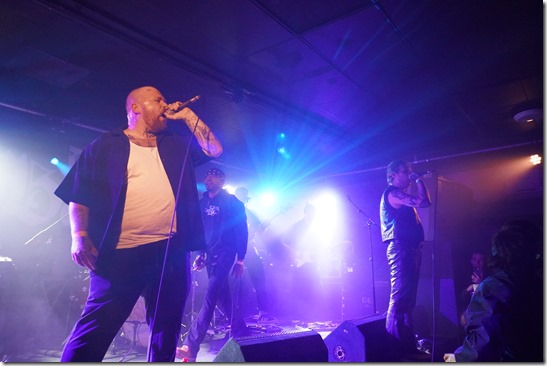
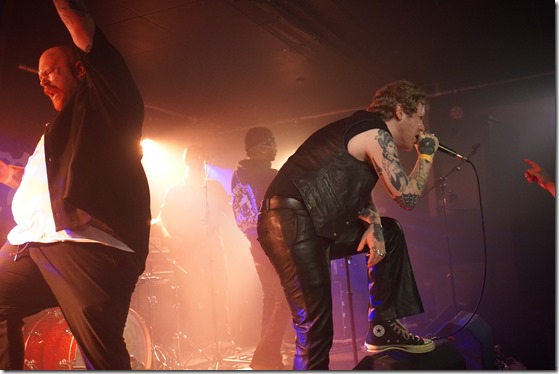
Street Soldier, I soon learn, are exponents of a new – at least to me – kind of hardcore. Alternating between quick fire tap and guttural metal, they whip up absolute carnage. A scan online suggests there is no such thing as tracksuit metal, but perhaps there should be, and defined as ‘grunty metal by people in vests and trakky bottoms and baseball caps shouting “c’mon, motherfuckers” a lot while people windmill and karate kick the crap out of each other with Nike trainers’. “I wanna see violence, I wanna see blood!” they exhort, pumping the crowd into a frenzy.

DSC00769DSC00787

Street Soldier

It’s difficult to put a finger on precisely why this doesn’t feel comfortable, but having recently extolled to a friend how metal gigs often felt like the safest of places, where people were ultra-considerate and kind to one another, united in their outsiderdom and sense of society being wrong. Sure, as with other moshpits, the fallen got picked up, but not before a few punches and blows, and however playful, I felt an undercurrent of senseless brutality, the tang of a lust for violence intermingled with the smell of sweat, and there was something dystopian, Ballardian about the spectacle. Having given up on fighting the man, Street Soldier,– as their Facebook page puts it, in ‘SPITTIN SHIT MADE STRAIGHT FOR THA PIT’ have adopted the self-aggrandising tropes of rap, and with cuts like ‘Middle Fingaz’, ‘Nonce Killaz’ and ‘Nah Nah Fuck You’, they appear to espouse anti-societal nihilism, but in a form that’s more aligned to rap than metal, while encouraging crowd behaviour which is more akin to blood lust and a reimagining of Fight Club than unity. Given the current state of things, it’s not that difficult to comprehend their appeal, especially to the under twenty-fives: smashing the living shit out of themselves and one another is probably far more appealing than whatever dismal prospects the future offers. But this is a bleak and nihilistic entertainment, and it sort of feels like torture dressed as fun.

’I Choose Violence’ is the first single from a forthcoming new album by the cult US act Psyclon Nine. Melding elements of Industrial Rock, Metal, Deathcore, Ambient and Trap, band mastermind Nero Bellum states: “I specifically set out to break as many genre limitations as possible with this song, while staying true to the concepts and imagery that Psyclon Nine evokes. Lyrically, it’s a reflection of the world we live in. An anthem for the unseen and unheard.”

Listen here:

AA

cf4e8f026fc2406d552a95233cddf22a6a256b0a

Psyclon Nine will headline a 22 date North American ‘Devils Work’ tour commencing on 31st January 2025, while there are plans to tour Europe later in the year.

AA

7e3efa0bcc4c6382544d10fa29386054eadb6d6b

Majestic Mountain Records – 1st November 2024

Christopher Nosnibor

It was the single release of their cover of The Sisters of Mercy’s ‘Body and Soul’ which brought me to this album. I’ll not retread the ground I covered in my review of aforementioned cover, other than to note that I was uncommonly impressed by the band’s spin on the track, and shall instead pick up on the point that I was intrigued as to precisely how a cover would fit into the art of a concept album.

In a sense, I find myself back in the 80s, when – before it was possible to stream an album online or otherwise hear it without owning it, unless a mate passed you a tape recorded from their copy – one purchased an album on the strength of a single heard on the radio. It was not all that uncommon that the single was absolutely in no way representative, and you’d feel somewhat duped. Imagine buying Faith by The Cure in the basis of ‘Primary’, for example. You may not necessarily feel duped, but you’d probably struggle to reconcile the single and album experiences, assuming you could lift yourself off the floor to do anything at all by the end of the album. But then, oftentimes – because you probably only bought an album a month, on vinyl or cassette, you’d play it enough times to come to appreciate it anyway. This simply doesn’t happen anymore, and what’s more, the art of the album is one which is criminally undervalued. That isn’t to say I feel in any way duped by The Somnifer: it’s simply that the single, while obviously the most accessible and attention-grabbing track, is not entirely representative.

Taking pause for a moment, there’s that term – ‘concept album’ – which creates immediate obstacles; it can be perceived as self-indulgent, overblown, conceited, arty in the way that implies a superiority, or even just plain wanky. You can largely blame prog for that, but there have been plenty of excessive concept albums in other genres, particularly metal. But I’m not here to prejudge: I am genuinely curious, especially as the single showed considerable promise. So, first things first: what is the concept?

As they set it out, ‘The album captures the different mental stages one can pass through, from feelings of self-empowerment to existential dread. The Somnifer takes listeners on a journey that blends the drama of classic doom (Candlemass, Cathedral), cosmic psych explorations (All Them Witches, King Buffalo), and the aggression of hardcore and crossover scenes, with the timeless instrumental journey of classic heavy metal.’

The title track certainly builds atmosphere, and it’s the kind of brooding, heavy-timbred tones which call to mind Neurosis, interlaced with a hint of the gothic, which draws the listener into the album. The guitar sound is clean, but rich, and earthy, gradually shifting towards a thicker, overdriven sound, but there’s lots of space and separation. This paves the way for the haunting ‘Draining the Labyrinth’, which takes some time before really going all-out on the riffery before ploughing into ‘Rapid Eye Movement’, the first track to really feature vocals prominently. With ethereal backing vocals floating in to balance the almost speechified spoken-word delivery atop a Sabbathesque riff, it’s an interesting blend of elements.

‘Eat The Day’ comes on like Melvins aping Sabbath with an overloading blast of thick, mid-rangey guitar, before the rippling instrumental ‘Delta Waves’ brings softness and respite, starting out a bit Pink Floyd before growing gradually more intense in its playing. ‘Recurring Nightmare’ slams in out of nowhere, snarling, downtuned doom riffing, churning power chords and darkness, replete with dramatic, theatrical vocals and searing lead guitar work. One of the album’s heaviest pieces, is brings the intensity of the sense of being trapped in a nightmare, the repetitive guitar motif recreating that terrifying sense of déjà vu.

In terms of concept, it works well: instead of pursuing some artificially-imposed narrative arc, The Somnifer explores the way in which moods and emotional responses can manifest as rapid and unexpected transitions, which aren’t always provoked by obvious triggers.

‘Image Rehearsal Reaction’ is a towering monolith of a track, a colossal ten-minute stoner/doom exploration that suddenly hits turbo at the mid-point, blasting fierily forward while the guitar solo runs wild. This is where they’re at their most ‘trad 70s metal’ of anywhere on the album, which is impressively diverse, something which the ‘concept’ allows for.

The album in fact closes with ‘Body and Soul’. It’s incongruous in many ways, but it oddly works to conclude a varied and yet consistent and quality album.

AA

a1275374827_10

Cold Spring is extremely proud to announce the first ever release of the legendary BBC radio sessions that the seminal Nottingham-formed industrial metal act Pitchshifter recorded for the late, great John Peel in the early 1990s.

These ultra heavy tracks were recorded over two sessions at the iconic BBC Maida Vale Studios on 28th April 1991 and 30th March 1993 and were sourced directly from the BBC Archives (with thanks), with careful remastering for CD and vinyl.

The 1991 session was recorded during the same period that saw the release of the band’s debut album, ‘Industrial’ (Deaf Records/Peaceville), with the 1993 session recorded around the time of its follow-up, ‘Desensitized’ (Earache).

“If you look on your Pitchshifter album sleeves, you will see that we always credited John Peel,” states frontman JS Clayden. “He was instrumental in getting the band out there and often played our music on the radio when no one else dared. The ‘Peel Sessions’ we did were a great honour and every time I met John he was always such a great guy…a legend.”

Founded in 1989, Pitchshifter’s early music can be described as heavy industrial metal, with the band long cited as one of the originators of the self-termed ‘Death Industrial’ genre along with Godflesh. These sessions and their first two albums define that classic period, before the group shifted towards the beat-driven, crossover industrial style that they are best known for.

Ahead of the release, the Peel Session version of ‘Gritter’ can be heard here:

AA

a3964039450_10

Majestic Mountain Records – 10th October 2024

Christopher Nosnibor

The Sisters of Mercy have a long history of unexpected covers, and a not only that, but of really ‘making them their own’, as you’ll hear TV talent show judges froth at contestants. Notably, among their B-sides, BBC sessions and live sets, they’ve covered Dolly Parton’s ‘Jolene’, ‘Emma’ by Hot Chocolate, ‘Gimme Shelter’ by The Rolling Stones, and Kylie’s ‘Confide in Me’. All great songs, all completely Sistersified, irreverent, but in no way sacrilegious.

When it comes to other bands covering The Sisters (obviously, I’m not meaning tribute acts here, a topic I’d perhaps rather avoid right now)… it tends to be metal bands doing pretty predictable and incredibly straight, faithful renditions, cranking up the distortion and giving the vocals some growl. Paradise Lost’s well-known rendition of ‘Walk Away’ is exemplary, in that it really brings precisely nothing. For this, I have to hand it to Lambchop for their stripped-back country rendition of ‘This Corrosion’, which succeeds in making the wildly bombastic epic something completely different, while still retaining something of its core essence. Such achievements are rare.

So here we come to this take on The Sisters’ 1984 single, ‘Body and Soul’: the band’s first release on Warners and their first recording in a 48-track studio. It was also, notably, the first to feature Wayne Hussey, and marked a radical shift from its predecessor, the seething alternative dancefloor monster and arguably definitive single, ‘Temple of Love’.

Critics and fans alike seemed rather underwhelmed at the time, and while it was a fixture of their live sets though ’84 and ’85, it’s not had many airings since their live comeback in 1990. And yet, for me, it’s a song which holds a unique pull which is hard to describe. The cascading lead guitar line, lacing its way across a busy, detailed, yet still nagging and repetitive bassline, and Eldritch going for a more melodic vocal style makes it something of an anomaly in the Sisters’ catalogue. It also contrasts with the rest of the tracks on the 12”: ‘Train’ is a blinder, murky, urgent, echoey and strung out, while ‘Afterhours’ is a truly unique classic, and the 48-track rerecording of ‘Body Electric’ is strong. In this context, I can appreciate why Vessel may have been drawn to the song.

Credit where it’s due, they’ve made a really decent fist of it, too. Sure, they’ve kind of metalized it a bit, but not in a way that’s big on cliché. And it’s not a completely blueprint copy with just a bit more distortion and growl, either. They’ve slowed it down a bit, and in doing so, succeeded in emphasising the guitar detail to good effect. If anything, this comes on more like Godflesh than any generic goth / metal, the thick, sludgy bass trudges along while the guitar rings harmonic, controlled feedback. The drum machine – an essential component here – follows the pattern of the original, but slowed and with more space and reverb, again, Godflesh and early Pitch Shifter come to mind. The vocals are gravelly, but not overtly metal and work well, especially with the harmonies in the chorus.

It does perhaps seem curious that this should be culled form a concept album but as the band explain, “It’s interesting that a cover song was able to fit the narrative of a concept album so well. I’m a huge fan of The Sisters Of Mercy, and was listening while working from home and taking breaks between writing for the new album when ‘Body And Soul’ spoke to me so directly. It was saying exactly what I needed to hear, what I wanted to say, and that was how the story of The Somnifer ends.”

For context, we learn that ‘Musically, The Somnifer merges the epic drama of Candlemass and Cathedral, the cosmic psychedelia of All Them Witches and King Buffalo, and the aggression of hardcore and crossover scenes, all tied together with the timeless spirit of classic heavy metal.’

It may well be interesting to hear this within that wider setting, but for now, as a standalone – and I write as a huge Sisters fan – that this is, for me, one of the best Sisters covers I’ve heard. The cover art is a nice tribute to one of the Sisters’ best sleeves, too.

AA

462703274_1067006528763433_7149155280560932979_n

Panurus Productions – 24th August 2024

Christopher Nosnibor

I take heart from discovering that Panurus Productions are as far behind on their PR as I am on my emails and messages. Even if it weren’t for the relentless flow of submissions – I’m looking at an inundation of around fifty a day, via email, messenger, and all the rest, even drops of CDs through the letterbox – there’s still that matter of… life. It consumes all of your time, and it wears you down. It’s an endurance test. Just living is a full-time job. No, it’s more than that. It’s exhausting, draining, it saps your very soul. On a personal level, just the day to day is too much at times for reading emails and listening to submissions. Throw in a dayjob, life and a single parent, and bereavement on top, and simply opening all the email submissions become too much. So arriving at the most recent Shrimp album around two months after its release, I feel ok about that – and by ok, I mean pleasantly calm, which is a rare sensation in the main.

Fucking hell. It’s a monster. It packs four tracks, the shortest of which clocks in at just under twenty five minutes. It’s more than a monster. It’s a skull-crushing leviathan. It will leave feeling week and so drained. It makes predecessor Mantis Shrimp sound like Barry Manilow.

They promise ‘a sprawling mass of free-form guitar, vocals (an associated miscellanea), effects and percussion’, whereby ‘the listener is thrown about the room with the sound, as the initial dirge collapses into a frantic scramble of activity, glitch and movement as the various pincers and claws dart out from the sonic mass. The sound field shifts as elements are isolated or the entire band is channelled through the snare, sometimes in line with the music and others completely of its own accord. Not even the platform you are listening from is stable.

‘Hidden Life’, with a running time of forty-one and a half minutes is an album in its own right. And it’s dropping tempo mood-slumping jazz with stutter percussion, at least at first. Before long, a slow-driving riff grinds in, and shortly after, it slumps into a drone and a feedback wail, while snarling, gnarling, teeth-gnashing, demented vocals rave dementedly amidst a tempestuous cacophony of… of what, precisely? Cacophonous noise. Everything is a collision, a mess, every second is pulled and pummelled, and it’s like The Necks on acid, only with chronic roar and an endless raging blast bursting every whichway, amidst howls of feedback.

Then you realise that this is only the first track and you’re already physically and mentally exhausted. You are absolutely on your knees here, battered, bruised, ruined by the noise, and still the frenzied furore continues.

There’s mellow, trippy, almost jazz vibe which lifts the curtain on ‘Leaf-like Appendages’, another epic track – but then they’re all epic, all challenging. ‘Maximum Sanity’ brings maximum pain and derangement, as howls and sputters from the very bowels of the very depths squall in anguish. James Watts has a rare talent for creating the most chthonic tones

Brine Shrimp trills and shrills, quills and spins in so many directions. It’s not only a mess of chaos, but a truly wild, and at times hellish, mess of chaos. It’s heavy, and it hurts. It’s Shrimp erupting like the Godzilla of the crustacean world: a monster in every way.

AA

a0473555031_10

Blood Incantation have finally released a preview into their forthcoming album, Absolute Elsewhere which sees its release next Friday via Century Media. Its first movement, ‘The Stargate’ is available today in its entirety across digital retailers and comes with an exquisite short film, The Stargate which was directed by award winning cinematographer Michael Ragen (Guillermo del Toro’s Cabinet of Curiosities: The Viewing) and features mesmerising analog fluid effects by Chris Parks (The Fountain).

‘The Stargate’ Side One: A violent storm invokes the familiar before a grand cosmic key turn for a hint of sweeping scope to come with spiritual acknowledgement and accompaniment by Tangerine Dream’s Thorsten Quaeschning on synths on the song’s second tablet. Musically as violent as it is mediative, with subtle spoken passages flitting between Nicklas Malmqvist’s (Hällas) busy synthesiser keys and Mellotron strings invoking both the modern and ancient, and it is all given sharp focus by Arthur Rizk’s powerfully dynamic and enveloping mix. Blood Incantation depart Extreme Metal’s traditionally antiquated way-station, warping their way towards ‘Genre of One’ stature, as ‘The Stargate’ intones the disembodiment of consciousness itself, careening through the stargate towards Samsara-like reincarnation, punctuated by the occasional growl from Sijjin/ex-Necros Christos main-man, Malte Gericke.

‘The Stargate’ short film is unlike anything you have experienced before. It presents the saga of a mysterious artefact and its victims in a hallucinatory synthesis of science fiction and folk horror, where mind-bending imagery and unsettling atmospheres converge in a surreal tale of primeval blood magic, inter-dimensional travel and grotesque otherworldly technology beginning in the Dark Ages and journeying into voids of deep space.

Watch the video here:

AA

Absolute Elsewhere hovers at nearly 45 minutes, their longest full length recording yet, the album’s two movements – ‘The Stargate’ and ‘The Message’ – are as confounding as they are engaging, exponentially expanding upon the formulas laid down by their scene-shattering debut Starspawn (2016) and landmark follow up Hidden History of the Human Race (2019).

As Blood Incantation’s Paul Riedl tells, “Absolute Elsewhere is our most potent audial extract/musical trip yet; like the soundtrack to a Herzog-style Sci-Fi epic about the history of/battle for human consciousness itself, via a 70s Prog album played by a 90s Death Metal band from the future.” For inspiration, the group looked to the mid-70’s progressive rock collective, Absolute Elsewhere (best known as a celestial stopover for King Crimson drummer, Bill Bruford) as the album’s namesake. For the uninitiated, Absolute Elsewhere’s obscure 1976 album, In Search of Ancient Gods, was constructed as a musical accompaniment to the works of Chariots of the Gods author, Erich Von Daniken, and his theories of non-terrestrial humanoid prompts towards mankind’s evolution. The subject matter of which should serve as no surprise to anyone familiar with Blood Incantation’s cosmically philosophical leanings. But make no mistake, the four musicians working under the Blood Incantation banner for the past decade – guitarist and vocalist Paul Riedl, drummer Isaac Faulk, guitarist Morris Kolontyrsky and bassist Jeff Barrett – have successfully left the microgravity of genre behind and are re-writing the Rosetta Stone of extreme music with a new language entirely. Demonstrations like their 2022 all-synth show or 2024’s Roadburn Festival headlining appearance where they played back-to-back death metal and ambient made it clear: Blood Incantation have honed their abilities to go boldly where few bands have gone before, and reveal no signs of slowing down.

Absolute Elsewhere’s release comes alongside a 73 minute feature film All Gates Open: In Search Of Absolute Elsewhere which tells the story of their time in Berlin during the summer of 2023, while recording at the legendary Hansa Studios. It will be available on Blu-Ray with the album’s deluxe mediabook package and will also include the documentary’s original soundtrack, All Gates Open (Original Motion Picture Soundtrack) which includes 60 minutes of exclusive new music distinct from the new album. This special edition will also include Blood Incantation’s 2023 maxi-single, ‘Luminescent Bridge’ for the first time ever on CD, and of course, Absolute Elsewhere in both standard and Dolby Atmos / 5.1 mixes, alongside exclusive liner notes, exclusive interviews, behind the scenes photos and a forward by Ross Dolan of Immolation.

JULIANWEIGANDDSCF1996Kopie-sw-9903cf000004513c

Photo By Julian Weigand

Phoenix-based metal band Buried has just released a gripping lyric video for their single ‘No Saviors,’ off the band’s forthcoming debut EP, Infect and Replicate.

‘No Saviors’ is just a taste of what’s to come from their debut EP, set for release in early 2025. With this powerful introduction, Buried is poised to establish themselves as a force to be reckoned with in the metal world.

Watch the video here:

AA

Founded by the creative forces of Preston Wilson (bass) and Alex Valdés (guitar), they sought to channel their vast array of influences into a sound that melds multiple genres. In search of like-minded bandmates, they brought on Erik Scott, a powerful drummer with a diverse style, and Ben Rosputni, a fierce vocalist who had shared the stage with Preston in a band 15 years prior. Their reunion added a layer of depth and history to the band’s formation, grounding Buried in both experience and renewed passion.

Buried’s music can be described as a mix between the heavy, doom-laden riffs of Black Sabbath and the aggressive intensity of Burn the Priest. Infect and Replicate is set for release in early 2025, promising to introduce their powerful sound to metal fans everywhere.

AA

115ebb46-92da-b0d3-30ee-815e47b06517

Photo Credit: Fargone Productions, Mikel Pickett