Archive for the ‘Reviews’ Category

9th June 2025

Christopher Nosnibor

Sledges are described as ‘a four piece Alt-metal/Heavy-shoegaze band that blends genres like grunge, metal, shoegaze, emo/post-hardcore, and alternative to craft songs with catchy hooks and big riffs,’ and while this is true, it fails to convey the way the various elements melt into one another to conjure something quite special.

Take the first track, ‘Stumbling as I Fall’: the guitars bend and pixelate in a way that evokes the essence of My Bloody Valentine, but it’s grunged up and beefy, and at the same time the melodic vocals contrast with that thick overdrive, capturing the spirit and sound of ’94, and in particular, Smashing Pumpkins circa Siamese Dream. The title track is harder, heavier, with loping drums melded to a tight, chugging bass underpinning some hefty overdriven guitars that provide the backdrop for vocals that ae by turns breezy and gnarly, offering one of the most overtly metal moments on the EP. I find myself momentarily thinking of Troublegum by Therapy? – a classic example of solid tunes brimming with melody played with hard distortion and some raw aggression – but then Soundgarden also poke their way into my cognisance. If it sounds like I’m simply pulling bands out of the air, it’s very much not the case: Losing Pace simply has that much going on, although the fact that many of the touchstones I’ve referenced thus far are of a 90s vintage does also serve position the various elements which contribute to the Sledges sound.

‘Weightless’ is – ironically – pretty heavy, and it’s not (believe it or not) a criticism to stand it alongside Linkin Park, in that it brings nu-metal heft and a strong emotive hue to a song that’s both riffy and rich with a palpably sincere feeling of angst. It matters because this is no cheap stab at commercialism, and nor it is just another song that tries to alternative by hauling all of the tropes into the mix: there’s a sincerity to this which lends it an indefinable power, and it hits hard.

After a soft acoustic intro, ‘June is Better than July’ goes widescreen, a cinematic burst of post-rock, post-grunge, alt-rock riffcentric extravaganza. There’s a nagging sense that it’s a but emo, a bit ‘things we’re not supposed to like’… but bollocks to those strictures of convention. It’s pure quality, and that’s ultimately what it all boils down to.

Losing Pace was originally released as a four-track twelve-inch, but this new edition, which also marks its first digital release, offers a brace of bonus tracks, in the form of ‘Fading’ and ‘Letters’. The former is the weakest and most overtly emo song of the set, but it’s bathed in reverb and the guitars are bold and overdriven and grungy, and it’s impossible to deny that it’s well-executed. Rounding it off, bonus cut ‘Letters’ is both dreamy and dynamic, melding elements of early Ride and MBV and Chapterhouse with later exponents of shoegaze / nu-gaze like The Early Years as swirling guitars conjure cathedrals of sound around a pumping drum machine.

On Losing Pace, Sledges successfully combine classic and contemporary, and do so with an aptitude and energy, and a keen sense of dynamics. It’s quality all the way.

[bandcamp width=400 height=340 album=244179070 size=large bgcol=ffffff linkcol=0687f5 artwork=small]

AA

a3823762619_16

Futura Resistenza –16th June 2025

Christopher Nosnibor

Much of Felix Kubin’s work since the turn of the millennium has involved radio, although film and theatre and other soundtrack works have also been a feature. Der Tanz Aller is one such soundtrack work, which was ‘created for the performance of the same title by the experimental arts collective LIGNA. The group specialized in site-specific, participatory works. Der Tanz Aller is based on Rudolf von Laban’s radical 1920s concept of ‘Bewegungschöre’ (movement choirs), collective dances in public space that aimed to reimagine social order through shared movement.’

The context and objective behind the composition are particularly useful to be aware of when listening to this album in isolation, as Kubin sets out: ‘When the performance group LIGNA approached me in 2012 to compose music for a play based on Rudolf von Laban’s revolutionary kinetic theories and so-called ‘Bewegungschöre’ (movement choirs), I thought of a soundtrack that would be both rhythmically engaging, abstract and mechanical. I knew there would be pre-recorded voices talking about his philosophy and guiding the audience via headphones. So, I had to leave some “air” in the arrangements, allowing the visitors to concentrate on the spoken words, while simultaneously becoming dancers. In LIGNA’s conceptual works – just like Laban’s idea of the movement choirs – the audience members become the performers.’

I shan’t dwell too long on the conceptual aspects here, beyond noting that this predates John Cage’s 4’33” by more than two decades, and while Cage’s silent work was on many levels a quite different proposition, the way in which any sound made by the audience – be it a cough or the shuffling of feet or the creaking of a chair – immediately becomes part of the performance indicates clear common ground. Likewise, William Burroughs’ cut-ups, which invited ‘creative reading’ whereby the engagement of the reader and their experience and perception was integral to their success, arrived some thirty years later. As such, ‘Bewegungschöre’ represent the cutting edge of avant-gardism, belonging to the era which brought us Duchamps’ readymades and – perhaps more pertinently – Tristan Tzara’s directions to make a Dadaist poem.

For the most part, the ‘air’ in the arrangements is apparent: there is space, separation, and while we can only imagine the prerecorded voices talking about Laban’s philosophy through headphones, it’s possible to get a sense of how it would work. But then, occasionally, Kubin’s compositions get father more busy, as on ‘Dämonen der Zerstreuung’, with big band percussion and noodlesome orchestration that’s of a strong jazz persuasion, but has a whole lot happening, and often simultaneously. There’s drama with orchestral strikes, and creeping, urgent glockenspiels that bring a noirish, detective movie feel – not a chase scene, but a cat-and-mouse scenario.

There are some spoken-word passages, in German, as on ‘Raumstunde Vera Skoronel’, accompanied by evolving sonic backdrops, the likes of which I find hard to imagine inspire dancing, but spasmodic twitching and erratic lurching, while the title track is a slice of jerky, and quite insular and intense, Kraftwerkian synth bleepery, and ‘Rotes Lied’ is a perfect exemplar of sparse, spaced-out, glooping, blooping, reverby weirdery with occasional chimes and stuttering shot of snare. There is plenty of air here, as you sit and wonder what exactly is going on?

Who knows? And does it even matter at this point? The percussion builds from all sides, and the nagging away – until suddenly it doesn’t.

The unpredictability of Raumstunde Vera Skoronel is its strength. It is weird, unexplained in many respects, beyond simply the initial onboarding awkwardness. We should probably celebrate this weirdness, this sense of separation. Raumstunde Vera Skoronel is never dull, but always strange and alien – and these are reasons to appreciate it.

AA

AA

RESLP040 front

Panurus Productions – 2nd May 2025

Christopher Nosnibor

Northern noisemongers Belk are no strangers to the virtual pages of Aural Aggravation: I personally first caught them live as a duo back in 2021, when I remarked in my review that as fierce as they were, they might benefit from some bass. I could never have imagined just how much. These days, their sound is dominated by some juddering low-end that’s practically arsequake. It’s as if they thought ‘you want some bass, eh, bastard? Here’s some fookin’ bass. BOWWWWWWWMMMM’. They’ve certainly evolved over the last four years – but what that means, in real terms is that they’ve developed methods of making noise that’s even more nasty and gnarly and generally unkind to the eardrums. This is a good thing, and ‘Flayed’, the first of their two contributions to this split release is a beast. It has a definite and undeniable sense of swing to it, a swaggering groove that’s somewhat unexpected. But what is expected – and delivered – is a crashing riot of noise, a juddering wall of distortion, squalling, dirty guitars, drums blasting at a hundred miles an hour and guttural vocals half-submerged by the swirling chaos, with tempo changes galore and simply all hell happening at once inn explosive, brutal frenzy.

‘Cloak of Bile and Oil’ begins a little more gently – and for a moment I’m reminded of the intro to Fudge Tunnel’s ‘Hate Song’, which inevitably bursts into shards of incendiary sludge and squall – and sure enough, so does this, the extended intro giving the deluge of noise even more impact when it finally does arrive. They describe their style as ‘Blackened Leeds Hardcore’ and this must surely be a definitive example of what that means.

Casing are an unknown quantity, and their two contributions are brief – the longest piece is just over two minutes in duration. The sound they offer is certainly no less abrasive or disturbing. There’s nothing to indicate what the initialisms of the song titles actually mean, but the electronic excursion which is ‘L.U.A.N.L.B.’ begins with some rumbling dark ambience, soon rent with the wail of siren-like feedback, before a wall of harsh noise distortion swells like a tsunami and swallows everything. In contrast, ‘D.T.H.D.T.C.’ launches headlong into a gut-churning blast of manic grind, with a nauseating bass churn to rival that of Belk.

What it lacks in duration (the four tracks have a combined running time of less than eight minutes), this release more than makes up in devastating intensity. Mission accomplished.

AA

cover

Human Worth – 6th June 2025

Christopher Nosnibor

Where does the time go? No, really? I’m not just stunned by the fact we’re a week into June already, but the fact that it’s been six years since the last Lower Slaughter album, and nine years since I missed their show in Leeds with Working Man Noise Unit supporting because I was watching Man of Moon play to a nearly empty room across town instead. That’s almost a decade I’ve spent being frustrated by my inability to clone myself, and I find it hard to let these things go.

They’ve undergone some changes since their last outing – changes of the nature which would have terminated, many a band. Their bio traces a raid succession of personnel switches:

Following the departure of long-time vocalist Sinead Young, their surprise return in 2024 saw the remaining former members unveil a new line-up, welcoming James Gardiner to the fold on bass, and with previous bass player Barney Wakefield switching over to vocal duties. Upon Gardiner’s addition, a considerably more expansive sound has emerged, bringing the band’s now recognised output of what the Quietus once referred to as ‘lurching noise-rock’ to new exciting heights, all the while set against an equally more confident and expansive dynamic, reinforced by the chemistry of Graham Hebson and Jon Wood, who remain tighter than ever on drums and guitar respectively.

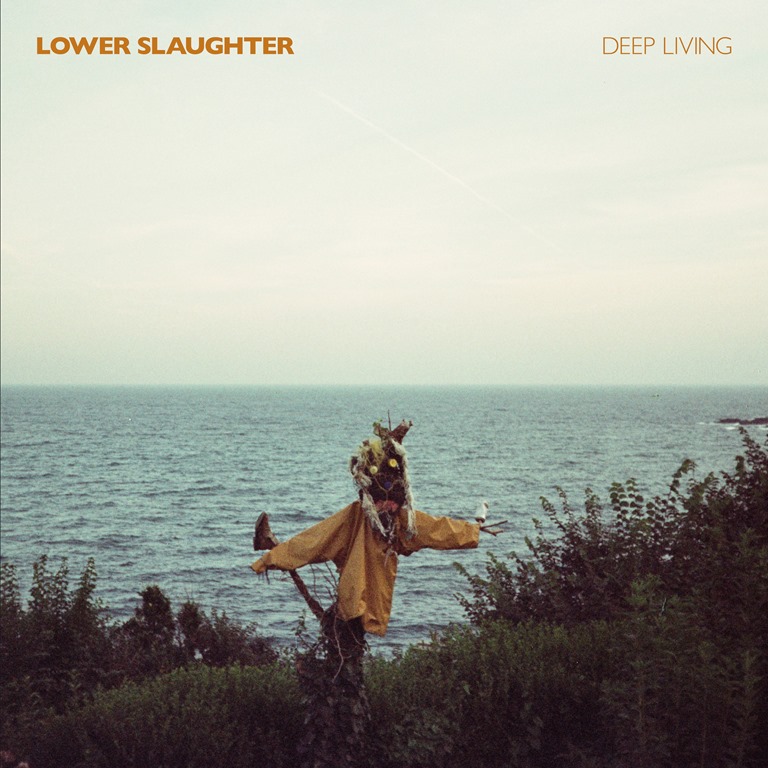
And so seemingly miraculously, they’re still here. Thus, we arrive at Deep Living, a colossal twelve-track document of the new Lower Slaughter, a release of blistering overload dominated by rolling percussion and thick bass. It’s varied, to say the least, and most certainly does not pursue the most obvious or commercial avenues. It was certainly worth the wait, and we’re most grateful that they are still here. And because it’s being released by Human Worth, 10% of all sales proceeds donated to charity The PANDAs Foundation – a trusted support service for families suffering with perinatal mental illness.

After a good couple of minutes of rolling, tom-driven percussion and muted vocals which sit partially submerged beneath a fat, fuzzed out bass ‘Year of the Ox’ suddenly slams the pedals on and erupts and Wakefield roars in anguish, ‘My eyes! My eyes!’. ‘Take a Seat’ is quite different, more overtly mathy, post-punky, and more accessible overall, despite its hell-for-leather pace and wild energy, and there’s a bit on jangle to altogether mellower ‘The Lights Were Not Familiar’ that’s a shade Pavementy – but it’s Pavement as covered by Fugazi. And the guitars sound loud. In fact, everything on Deep Living sounds loud, and what’s more, the recording and mixing work done by Wayne Adams (Petbrick/Big Lad) captures and conveys that it such a way that it feels loud, like you’re in the room with the backline practically in your face. This is nowhere more apparent than on ‘Dear Phantom’, which has something of a Bug-era Dinosaur Jr vibe to it – and the big grungy riff is magnificent. Then halfway through it goes slow, low, and sludgy – and that’s magnificent too.

Balancing melodic hooks and some quite breezy indie / alt-rock with some hefty, heavier and hugely overdriven passages, Deep Living has some range.

The six-and-a-half-minute ‘Memories of the Road’ is a slow-burning epic that builds to a roaring finish, and makes for a standout cut. It’s a trick they repeat on the title track which brings the album to a close.

In between, ‘Hospital Chips’ brings pace and jittery tension via thumping bass and jarring, sinewy guitars, and straight-up punk brawlers ‘The Bridge’ and ‘Motions’. All the range, but it’s the fact there are tunes galore that make Deep Living a cracking album.

AA

Lower Slaughter LP.indd

Christopher Nosnibor

Sure, having Kurt Cobain proclaim his fandom and bringing them on tour as a support act may have helped bring Shonen Knife to a wider audience, but in the Internet age, when it’s much easier to discover bands who aren’t shoved under your nose by pluggers and playlists, it seems probable that they’d have reached the current place on their journey on their own merits.

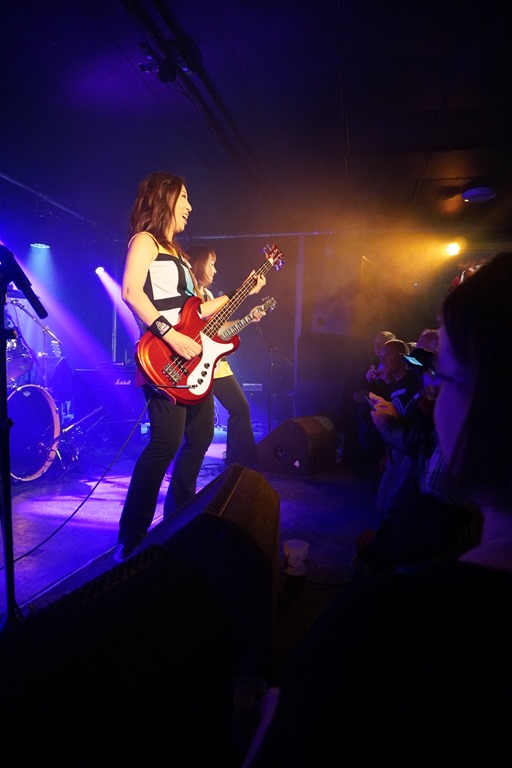
And so it is that the original all-female Japanese pop / punk power trio return to York after quite some time, bringing their ‘Have a Knife Day’ tour to a sold-out Crescent the night after stopping at the legendary Brudenell in Leeds. With the twenty-seven EU / UK tour taking in Hebden Bridge, Manchester, and Sunderland, it’s nice to see the North getting a decent share of shows, and the turnout and response tonight shows it’s appreciated.

The front bar is busy a good half an hour before the doors open, and local support Speedreaders seem genuinely surprised by the size of the crowd they’re playing to. They’re never the most conversational of acts, with the gaps between songs spent turning up and keeping their eyes to the floor, but their brand of slowcore indie – a significant contrast to the headliners’ uptempo style – is well-received, and deservedly so: they’re tight, and the arrangements are such that there is considerable air between the instruments, The sound is crisp and clear, and their concise set no doubt won some new converts.

 DSC02209DSC02206

Speedreaders

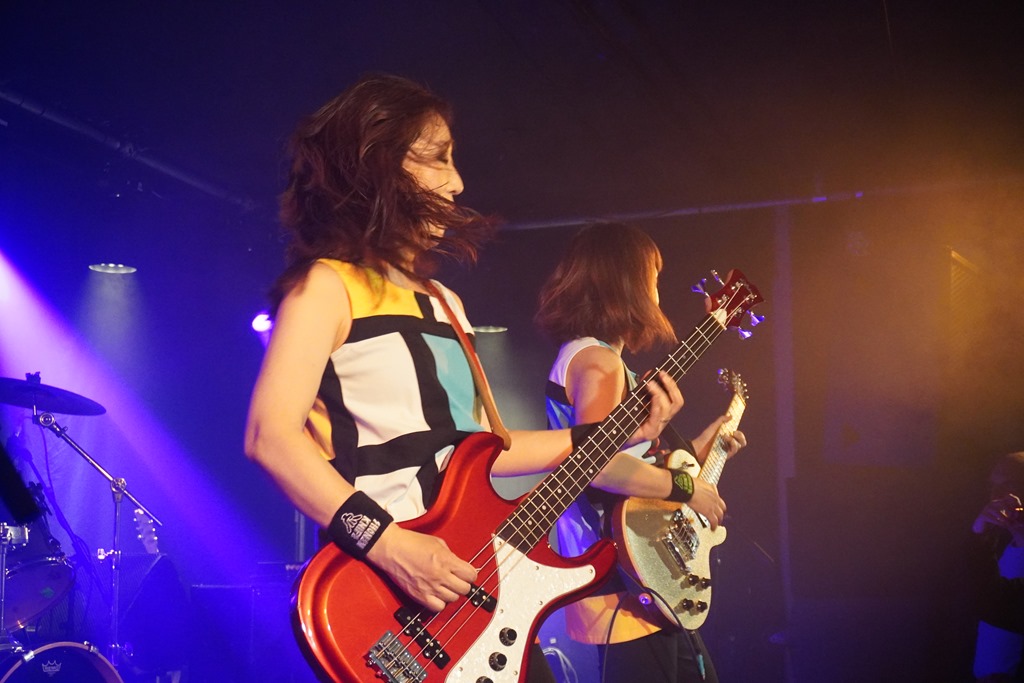
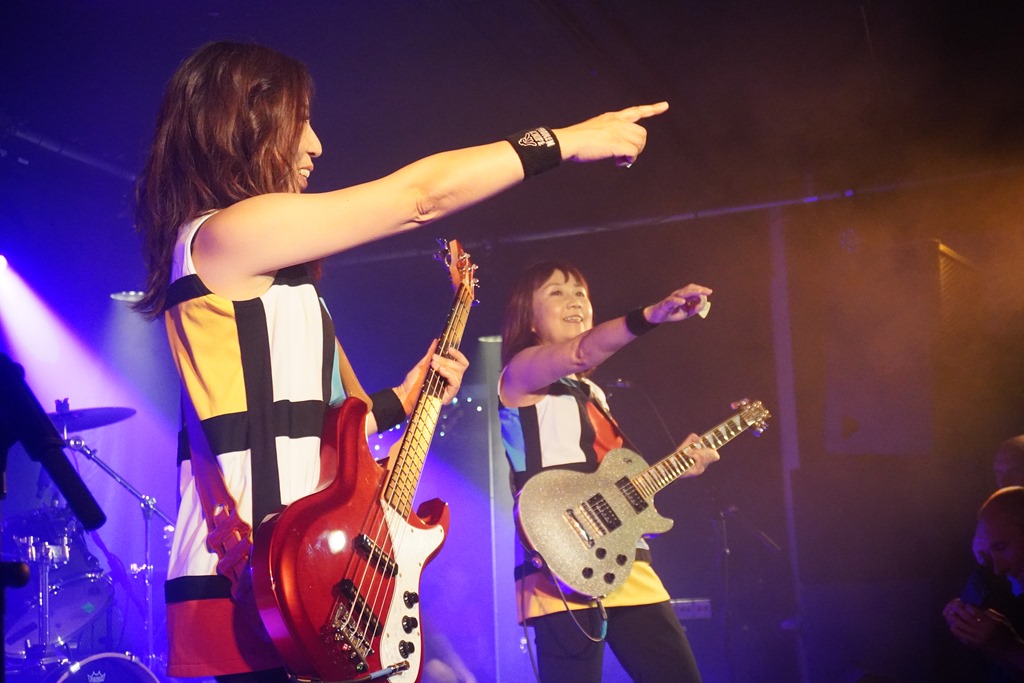
Shonen Knife set up their own kit – drums, the lot, tuning, etc., all wearing their own current tour shirts. One bass pedal, perhaps half a dozen guitar pedals, small amps, there’s nothing fancy about their setup. That’s the essence of punk right there. A tech does come on and make some final checks before they return, T-shirts removed to reveal their co-ordinated colourful stage dresses, and they’re proceed to serve up a set which is pure joy from beginning to end.

For a band that’s been going for nearly forty-five years, their lineup has been consistent for long periods of time, and currently consists of co-founding sisters Naoko and Atsuko Yamano (guitar / vocals and bass / vocals respectively) and singing drummer Risa Kawano, who’s been with the band since 2015. This stability is likely one of the key factors in their tightness as a unit: the songs may not be especially complex, but their played really well – to the extent that it stands out. What also stands out is just how much they look to be enjoying themselves: they smile a lot, and Kawano in particular beams throughout the set, like she’s having the absolute time of her life on every swing of a stick. And that joy is infectious.

DSC02282DSC02251

Shonen Knife

For the uninitiated, Shonen Knife sound like a Japanese female Ramones experiencing a massive sugar rush. Their songs are perfect pop, and revel in the pleasures of ice cream, candy, and cookie dough. They’re the musical equivalent of kawaii drawing, and their stage show is in keeping with this. It’s not just the outfits, but the spangle guitars, the way the harmonies come together, the way the jumps aren’t jumps so much as bunny hops. Yet none of it feels trite or contrived, and it’s never cloying. It’s simply good, clean fun. A couple of times, I find myself thinking of Dogtanian and the Three Muskehounds – and it’s theme tune, that hyperpop energy the likes of which I had never heard before at the time.

DSC02215DSC02212

Shonen Knife

For an hour and a half, I find myself uplifted to a point that I am simply bursting with joy. While they play, everyone is in the moment, transported away from everything: the room is filled with happiness which celebrates simple joys. It’s pure escapism, and absolutely wonderful.

Limited Edition 7" Dubplate / DL Blank Records – 13th June 2015

Christopher Nosnibor

Tobias Vethake aka Sicker Man has spent a quarter of a century doing things differently – differently from other artists, and differently in terms of his own sound and approach to making music.

As his bio points out, ‘as our world changed a lot during the last 25 years, so did his music. On his last release, KLOTZ WENZEL VETHAKE, the interaction with other musicians and the political dimension of a musical wake-up call became a main focus… The single „Gravy Train / Hollowed“ marks a new and fresh look at both, his musical history and present. It features Sicker Man’s love for dub, noise and electronic music as well his passion for classical composition and spiritual jazz… ‘Stop The Gravy Train / Hollowed’ feels like a collaboration of Moondog and The Bug’

It certainly does. For these two pieces, Sicker Man has enlisted saxophonist Matze Schinkopf, and

How many ideas is it possible to pack into four and a quarter minutes? With ‘Stop The Gravy Train’, Sicker Man manages more ideas per minute than it’s possible to even begin to count. The piece starts with a low, grinding bass and industrial hums, before the saxamaphones enter the mix, interweaving through and across one another. They trickle smoother, teasing with points and counterpoints, laid-back and mellow over the simmering rhythm section, the bass and the beats building currents beneath. Around the midpoint, the piece makes a change of trajectory, the gentle jazz giving way to something altogether more urgent and driving, locking into a robust groove with low saxophone punching rhythmically and in syncopation with the whip-cracking snare and palpating kick drum.

‘Hollowed’ is different again: a swampy surge of seething electronica, a morass of meshing noise – at least to begin, and then it melts into a rather pleasant swaying jazz work, a clip-clip beat nodding along nicely. Swells of noise bubble and surge, but don’t quite break through, and industrial grooves settle in while the saxes tootle off in different directions, hither and thither to brain-melting effect.

‘Genius’ is a word which is chronically overused and often severely misapplied. Is this a work of genius? Maybe not, but it’s got to be close. There’s no question that it’s wildly inventive, and unexpectedly listenable, while challenging every musical preconception.

AA

a1110512025_10

30th May 2025

Christopher Nosnibor

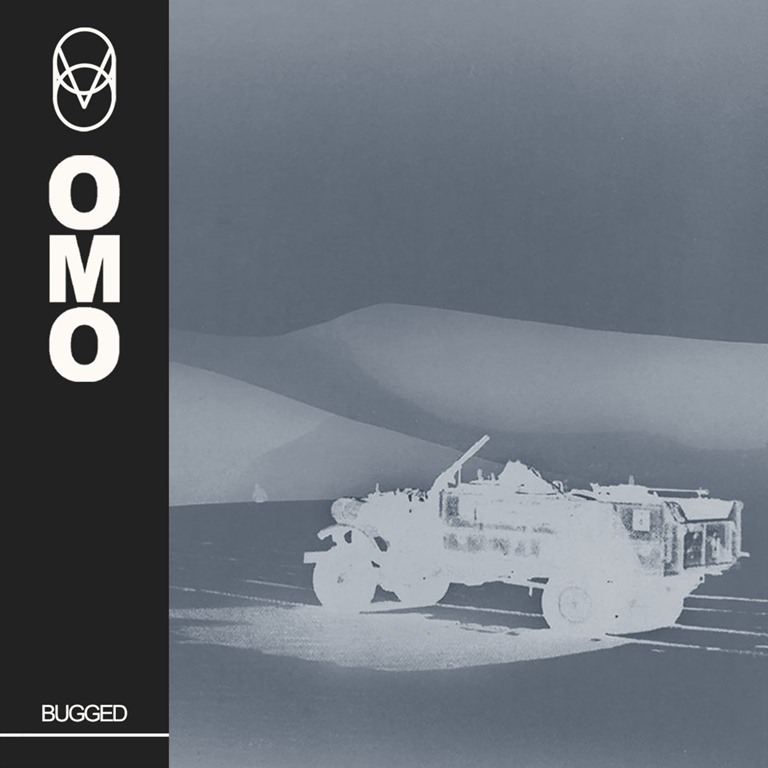
With mainstream music, all you have to do is stay tuned to prominent radio channels, watch TV, let Spotify recommend the next tune, and it lands in your lap. The further away from the mainstream you get, the more it becomes about keeping your ear to the ground, word of mouth, groups and forums – and occasionally, press releases and inboxing. Despite being a fan of a number of the acts involved, I discovered this one quite by fluke via a share in a Facebook group, which announced that ‘OMO DOOM , the Glasgow group who comprise members of Mogwai , The Twilight Sad , Desalvo , Areogramme and Stretchheads put out a new track this week, an intensely claustrophobic cover of a Head of David track – the brilliant late 80s UK Blast First act who everyone seems to have forgotten now’.

I’m perhaps one of the few who not only didn’t forget Head of David, but has a near-complete collection of their releases – and I can tell you it’s taken some years to assemble. While their first album – LP, released on Blast First in 1986, and later reissued as CD in 1990 isn’t too hard to find, and has a buzz around it on account of the fact that Justin Broadrick drummed with the band between leaving Napalm Death and forming Godflesh (although he didn’t actually play on any of their releases apart from their 1987 Peel Session, which features on the nigh-on impossible to find White Elephant compilation), their other releases are like rocking horse shit (as they used to say at record fairs in the 90s.

Their second LP, Dustbowl, which featured ‘Bugged’, was produced by Steve Albini and released in 1988. It’s a belter. While I snagged a vinyl copy in the 90s, I have never yet seen a CD copy in the wild, and it’s never been reissued, either. ‘Bugged’ also appeared on one of the 7” singles in ‘The Devil’s Jukebox’ Blast First 10-disc box set, and that’s hardly common or cheap either.

H.O.D.I.C.A. was a semi-official live album which captured Head of David playing at the ICA in London, delivering a purposefully unlistenable set with the explicit purpose of repelling EMI music execs who were sniffing around, and their final album, Seed State, released in 1991 lacked the same brutal force as its predecessors.

The reason for the history lesson is that they’re largely forgotten because their music is so hard to come by, and because Stephen R. Burroughs has pursued a very different musical trajectory subsequent to their demise, with both Tunnels of Ah and FRAG sounding nothing remotely like HoD.

But if you can hear Dustbowl, it’s aged well, a snarling mess of noise driven by pulverising drums and snarling, grinding bass that tears you in half. And this is where we resume the story, I suppose.

OMO DOOM’s version of ‘Bugged’ is slower, starker, more malevolent and menacing than the original which was ferocious in its unbridled brutality. Here, we get thick synths and punishing drum machines dominating the sound. The bassline is twisted around a way, and sounds for all the world like ‘Shirts’ by Blacklisters, and at around the two-minute mark is slumps into a low-frequency range that’s unsettling to the bowels as well as the ears. This sure as hell brings the dirt. The vocals are rabid. It’s gnarly, alright. Fans of Mogwai and The Twilight Sad and the late, lamented Aerogramme may be drawn to this, but probably won’t like it: it’s the work of a bunch of musicians trying something that’s nothing like their regular work, and it’s unfriendly and inaccessible and noisy and horrible… and of course, I absolutely love it. And maybe it could spearhead a Head of David Renaissance… We can hope.

AA

a2460593698_10

Magnetic Eye Records / Redux Records – 6th June 2025

Christopher Nosnibor

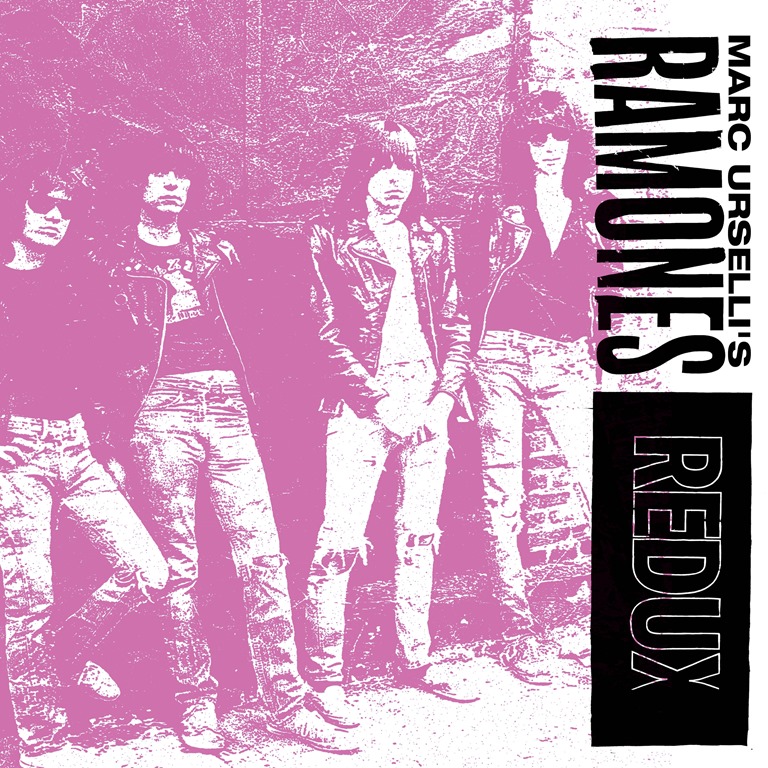
Magnetic Eye have released a few of these ‘Redux’ tribute albums now, each of which has come in two editions, and each of which has taken a different approach. Whereas the Meantime Helmet releases offered a standard and expanded version, for example, others have presented an album on one version and a ‘best of’ as a companion. And in all instances, they’ve managed to score some outstanding names as contributors. This time around, it’s the Ramones’ eponymous debut which is accompanied by a ‘best of’ set as a counterpart, and the project was ‘masterminded and curated by New York City and London-based Italian-Swiss audio engineer, sound designer, composer, multi-instrumentalist, and Grammy winner Marc Urselli’ – hence the titles.

Mondo Generator, Napalm Death, Ufomammut, Arthur Brown, David J, and Voivod are among the big-hitters featured here, but as I settle down with a cold pint of Oranjeboom, I contemplate the need for a Ramones tribute – or, more specifically, another one. There have been a few, perhaps most famously 2003’s We’re a Happy Family, which featured The Red Hot Chilli Peppers, Marilyn Manson, Green Day, Garbage, U2, Metallica, and The Pretenders, among others, and there are so many tribute acts out there, too, one has to ask ‘is this not overkill?’ Well, no, because that would be Motörhead, and what’s more, with a lower tier of ‘name’ contributors, it feels more authentic, somehow. I’m not saying U2 aren’t fans of The Ramones, but they feel like they’re on a par with the fans who bought a T-shirt in Primark and only discovered they were a band after the fact. Casuals, in other words.

Some might say that the debut album doubles as a ‘best of’, and there’s a case for that, given that every single song is a pure classic. Mondo Generator kick off the debut album covers set with a roaring ‘ONETWOTHREEFOUR’ before launching into ‘Blitzkreig Bop’, and it’s a faithful but fiery, fizzy rendition, the guitars like jet engines on what you could only describe as a proper punk blast.

Daníel Hjálmtýsson and Mortiis offer an altogether different take on ‘Beat on the Brat’ – slowed down, moody, gothic, a bit theatrical, a shade menacing, and yet somehow accentuating the pop currents which flow through this, and indeed, all Ramones songs. Boots Electric, with the help of none other than Wayne Kramer, push the pop to the forefront

Ufomammut bring the metal and convert the sub-two-minute surf-pop ‘Chain Saw’ into a six and-a-half minute grind that’s downtuned, dense, and dirty. It’s also absolutely brilliant in its execution. Napalm Death have enlisted Thurston Moore for their take on ‘Now I Wanna Sniff Some Glue’, which is a minute and a half of speaker-shredding thrash nihilism, and absolutely perfect.

The Ramones weren’t only punk progenitors, but purveyors of precise and often perfect pop songs, and this pair of albums represents the fullness of their influence (still not saying they. didn’t influence RHCP or U2., but…) Arthur Brown and The Berserker’s take on ‘I Don’t Wanna Walk Around With You’ is crazy, and absolutely perfect.

Voivod rope in JG Thirlwell for their hell-for-leather yet hooky as hell take on ‘Zero Zero UFO’ which opens the ‘best of’ set. And there are some corkers, with a slowed-down, heavy psyche yet oh-so-pop take on ‘Pet Sematary’ by Impostor Cult with Amy Tung Barry Smith being exemplary. So Hideous’ twangin’ take on ‘The KKK Took My Baby Away’ is one of the most radically different interpretations on the album, although Kayo Dot and Ihsahn push ‘Teenage Lobotomy’ in the most unexpected directions, while David J and Paul Wallfisch push ‘I Wanna Be Sedated’ to a soporific seven minutes. With a super-sparse arrangement, it sounds as if they’ve achieved their wish before entering the studio.

What these two albums illustrate, more than anything, is that The Ramones wrote superlative and truly classic songs, with earworms galore. And as tributes go, these albums do feel perfectly fitting.

AA

691820395539

30th May 2025

Christopher Nosnibor

Knox Chandler may not be universally known, but many of the acts he’s credited as playing with over the last forty years are, with long stints as a member of  and the Cyndi Lauper band. Then there’s his work in various capacities with REM, Depeche Mode, Grace Jones, Marianne Faithful, Natalie Merchant, Tricky, The Creatures, Dave Gahan, Paper Monsters and The Golden Palominos… it makes for quite the CV.

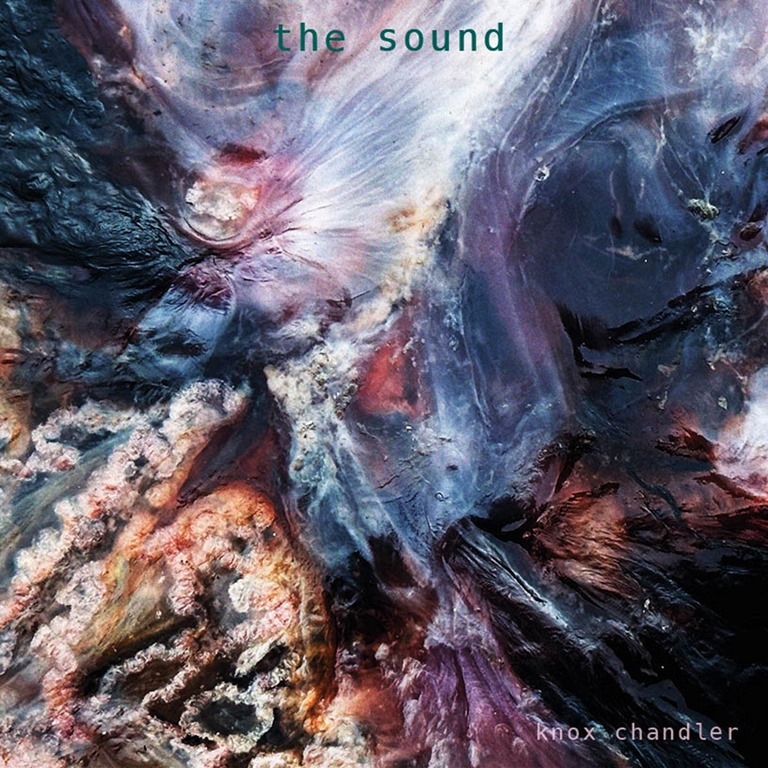
This solo outing marks a fairly significant departure from all of that, though. The context behind it is that ‘Knox spent a decade residing in Berlin, Germany, while he explored sound-scaping. He developed a technique he calls “Soundribbons”, which he recorded and performed in its own right as well as applying it to different genres and mediums . He composed, recorded, toured, produced, and wrote string arrangements for Herbert Grönemeyer, Jesper Munk, Pure Reason Revolution, The Still, TAU, Miss Kenichi and the Sun, Mars William’s Albert Ayler Xmas, Rita Redshoes, Them There, The Night…”

And so what we have here is a collection of ten instrumental works, whereby the guitar doesn’t sound like a guitar. In fact, it doesn’t sound specifically like anything. Chandler conjures wispy, ephemeral sound sculptures, atmospheric, brooding, a shade filmic, soundtracky, with hints of sci-fi and BBC radiophonic workshop about their strange, twisting, abstract and keenly non-linear forms.

There’s more than simply droning guitar on offer here, though: flickering, surround-sound precision provides a shifting backdrop to the ever-morphing ‘Tea Stained Edge’, where tremulous, reverby guitar bounces here and there off sonorous string-like sounds and even something resembling a jazzy double bass, but in contrast, ‘Lost Dusk Feather’ takes the form of a magnificently disjointed collage work, flipping between ambience and discordant confusion. The playfully-titled ‘Hidden Hammock Pond’ is one of the album’s most overtly experimental works, a mish-mash of sounds overlaying one another, smooshed together and as strange and unpredictable as it gets, venturing via exploratory ambience and quivering drones and allusions of abstract jazz into Krautrock . It’s wilfully perverse, and swings between the dark and serious, and the light and entertaining within the space of a heartbeat. ‘Mars on a Half Moon Rising’ goes a shade New age strange, insectroid flutters, field sounds and mystical hoodoo, bells and chimes, Morris dancers and scraping bass which occasionally strays into some kind of Duran Duran bending bass moments.

It’s all going on here. It’s impossible to predict direction over the duration of this release: The Sound meanders here, there, and everywhere. At times expansive (as on ‘Burn’), at times claustrophobic, it’s never less than compelling or varied listening.

If you’re seeking anything in the vein of the headline acts with which Knox Chandler is associated with, you may well be disappointed. But if your ears are open to abstract, instrumental strangeness, you’re in the right place. The Sound is weird, unapologetically and strange – and it’s the sound of an artist cutting loose and exploring sound. It’s weird, and wonderful, in equal measure.

AA

a0385212710_10

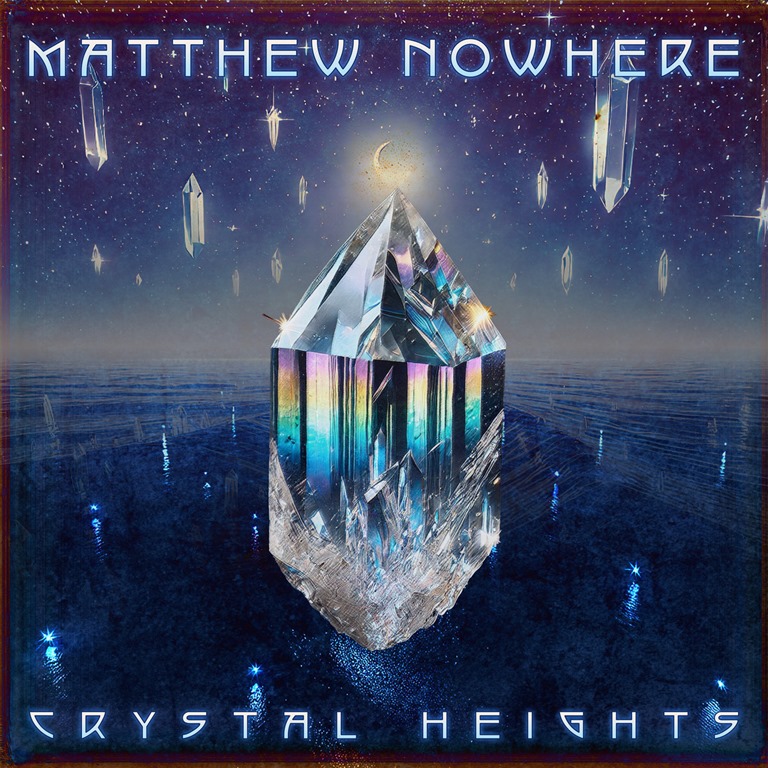
How times have changed. Back in the early 80s, this would have been mainstream. It would have been major label. It would have been huge. It would have smashed the charts. 2025: nah. And so Crystal Heights is a self-released effort, and the chances are its audience will be respectable but limited.

This is an album which is steeped in all things retro: it’s an electropop work which is light and airy and easy on the ear, and low on demand.

He describes it as ‘a sonic love letter to the 1980s’, and the title track is exemplary: it’s light, bouncy, melodic. But it feels somewhat shallow, a shade flimsy. Then again, this was also true of much 80s pop, and it was a criticism levelled at pop music at the time. Critics in particular were not especially enamoured by electronic instruments, particularly sequencers. Here in the UK, the Musicians’ Union sought to ban drum machines as they were seen as doing drummers out of a job. They weren’t really all that keen on synths, either. Using machines to make sound wasn’t considered ‘real’ music.

Again, how times have changed (although drum machines in a ‘rock’ context are still unusual). Drum machines didn’t eradicate drummers, but the death of small venues pretty much killed off bands, impacting the number of places for them to play in the most dramatic fashion. And the proliferation of two-piece acts, and solo acts, is nothing to do with technology, and everything to do with the simple practicalities of performing live music. Rehearsal spaces are as scarce as gig spaces: what are bands to do?

The mid-tempo ‘Love is Only What We Are’ sounds like mid-80s radio-friendly movie soundtrack material, and drifts along nicely with some picked reverby guitar work, and it works nicely as a counterpoint to the crisp snare and clinical kick drum sounds. ‘Echoes Still Remain’ is atmospheric, evocative, and also sounds so familiar – not because it is, but because it’s the very quintessence of so much music released circa 1984. It’s hard to fault the level attention to detail here. ‘Ruby Shards’ provides perfect evidence of this, in that it manages to compress pretty much the entirety of New Order’s output into four and a half minutes.

‘Transforming’ was recorded with Lunar Twin, and is a bona fide electropop banger. Constructed around a rippling loop, it’s a supple work that oozes 80s vintage. It’s going to nag me for weeks which songs it reminds me of. It’s a clear standout in an album that’s solid but… but what, exactly? It feels light, perhaps lacking, even. But what more should we want from it, realistically? Innovation? No, that was hardly the objective here. Lunar Twin also features alongside The Antonio Family Singers on ‘Persist3nce’, a brooding slow-burner built around a mesmeric beat which fades to grey.

With Crystal Heights, Nowhere has achieved something that’s not insignificant – an album that’s instantly accessible, strong on melody, and enjoyable.

AA

a0495838035_10