Posts Tagged ‘Extreme Electronica’

Christopher Nosnibor

Is it possible for there to be too much happening? This evening’s show was brought forward to a matinee start with 8pm finish in order to accommodate England’s World Cup quarter final match with its 10mp kick off. And while another tasty lineup headlined by Soma Crew on the other side of town got rescheduled, there’s also Super Furry Animals headlining one of the city’s biggest nights of the year at The Museum Gardens, and York Races. These are the challenges which can face promoters – and given other issues, like the first band on the original bill having to pull out because of being unable to make the earlier time slot, and Steatopygous having van issues that resulted in their having to cancel their Glasgow show the night before and having to be rescued from limbo in Leeds, it’s little short of a miracle that tonight even went ahead, let alone that people turned up.

It’s oft said that most music reviewers are failed musicians – usually by the kind of cynics who trot out lines like ‘if you can’t do, teach’, while themselves being incredibly self-satisfied by their having never attempted anything to fail at. And so it is that I find myself here as a last-minute replacement for The Pennydrops, who had to cancel, and while it’s true that the early doors meant the vast majority turned up after my set, I’d call getting to blast my racket without clearing the room a success.

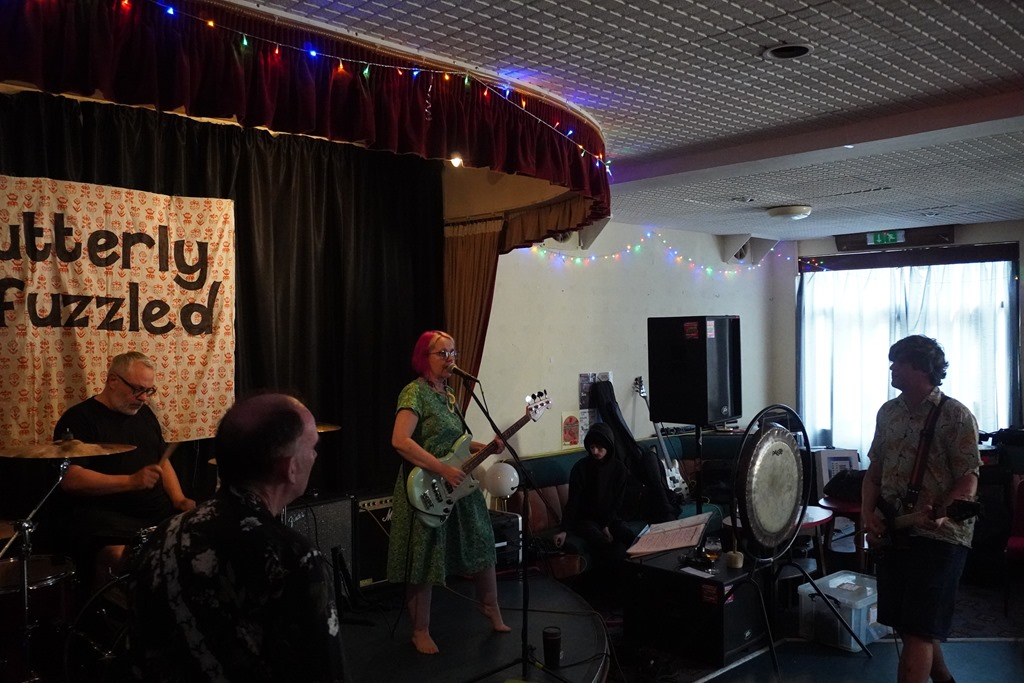
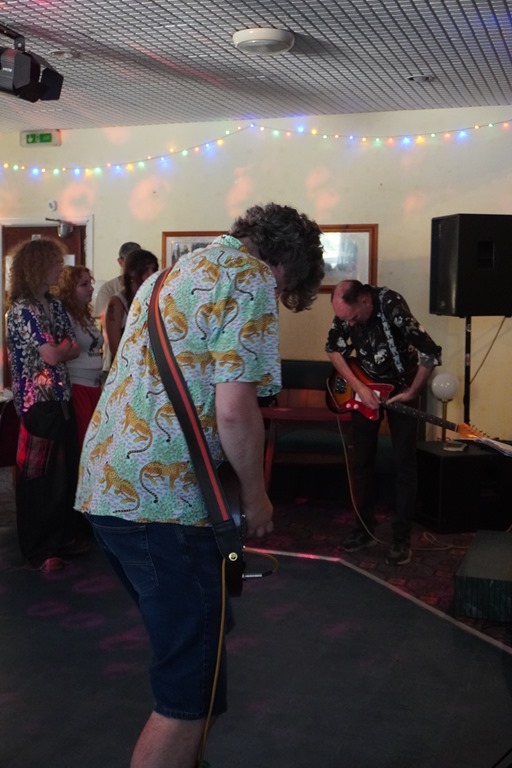
Chaffinch may visually resemble York band Knitting Circle with an additional guitarist, but they’re very, very different indeed. And here, playing their fifth ever show, they cement the differences, not just sonically, but in terms of presentation, with all but the drummer playing the majority of the set in front of the stage, largely with their backs to the audience, with the jabbing twin guitars playing against and across one another to forge jolting No-Wave discord atop shuddering bass and powerful syncopated drumming. Their set is rapidly evolving, too, with a couple of new songs packed into their succinct and thrilling set.
DSC02510DSC02548DSC02575

Chaffinch

It’s here that I should once again highlight the eclecticism of Utterly Fuzzled lineups. As much as they do perhaps have a leaning towards indie, alternative rock, contemporary punk and post-punk, as Jo Dale explained to me in a recent interview, their fundamental criteria are ‘Absolutely no all-male line-ups! …We’re not genre specific, between us we have very wide musical tastes. Basically, if it excites us then we want to put it on, simple as that really’.

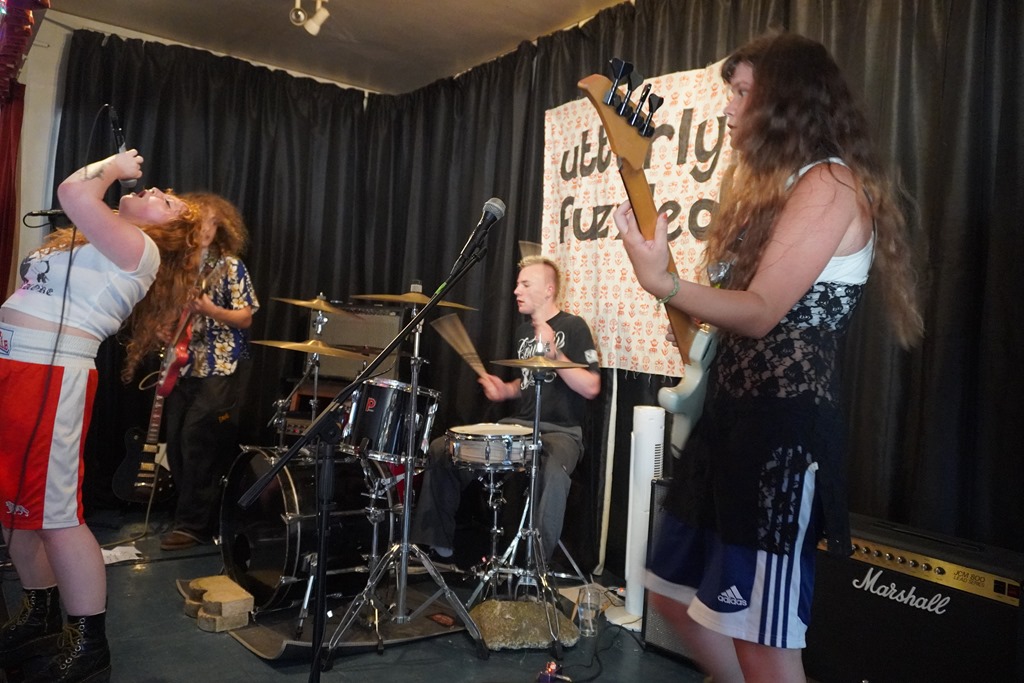
Even so, having seen Wiltshire four-piece Steatopygous (whose name, incidentally, means fat or prominent buttocks) advertised as ‘teenagers playing high-energy punk with a rather 90s riot grrrl feel’ and trading in ‘raging expressions of angered feminist teenage anguish did nothing to prepare me for the full-on aural assault that incorporates elements of hardcore and metalcore. With heavy, filthy bass dominating the dense sound, I’m at times reminded of the dirty noise rock of Fudge Tunnel, only rendered all the more terrifying by Poppy’s throat-rippingly demonic vocals. A high, crisp snare cuts through the sludge noise. But there’s subtlety and detail to their sonic palate, too. Mellow passages border on folk, with spoken word segments, showcasing some intelligent and articulate songwriting that’s so much more than mere rage. That said, their fiery and passionate final song, is a beast and whips up a mini-moshpit down the front, and that’s no small feat when it’s absolutely melting.

DSC02683DSC02642DSC02673

Steatopygous

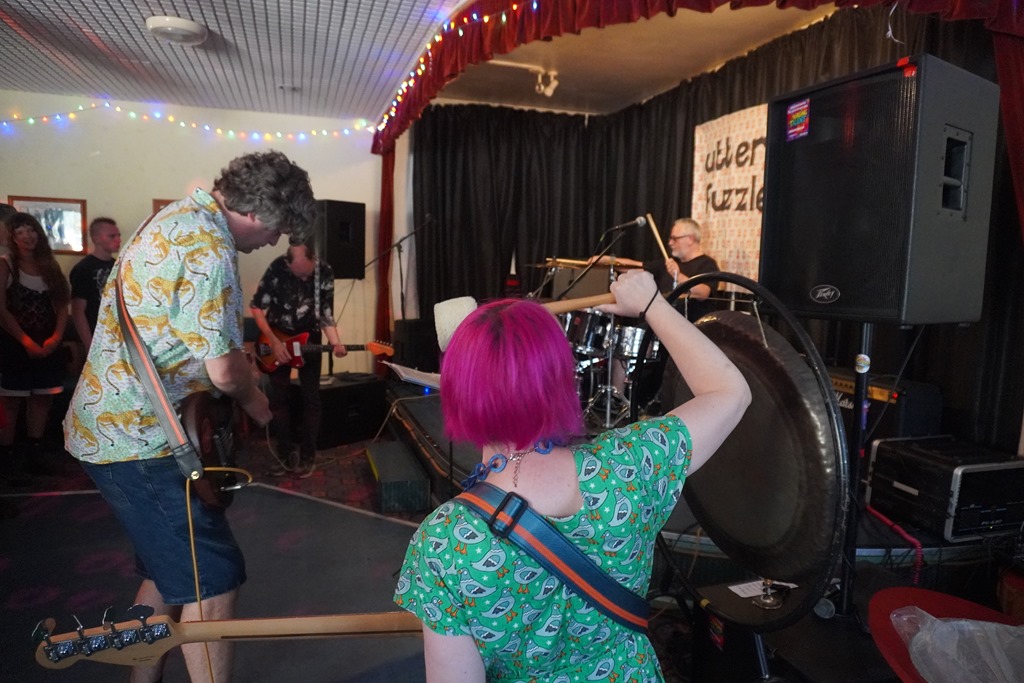
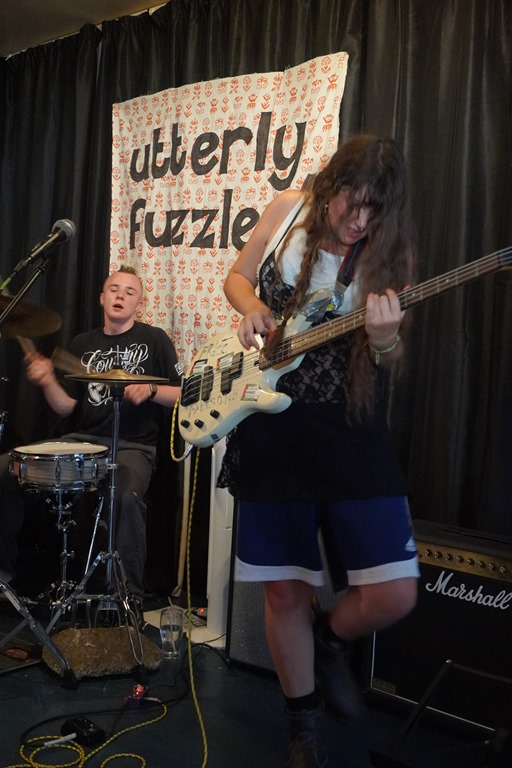
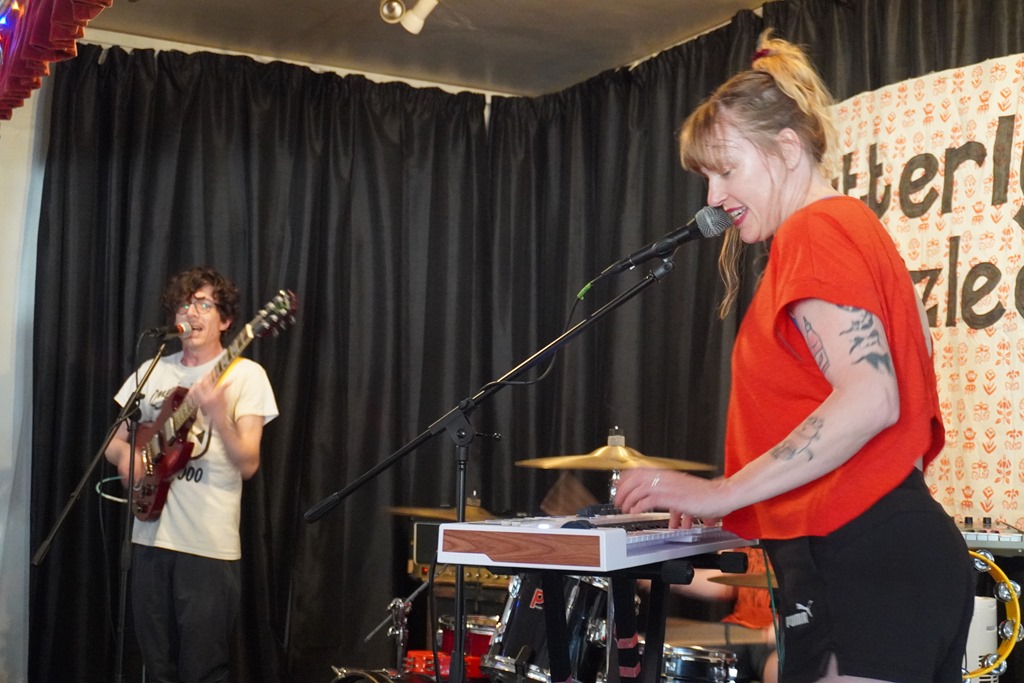
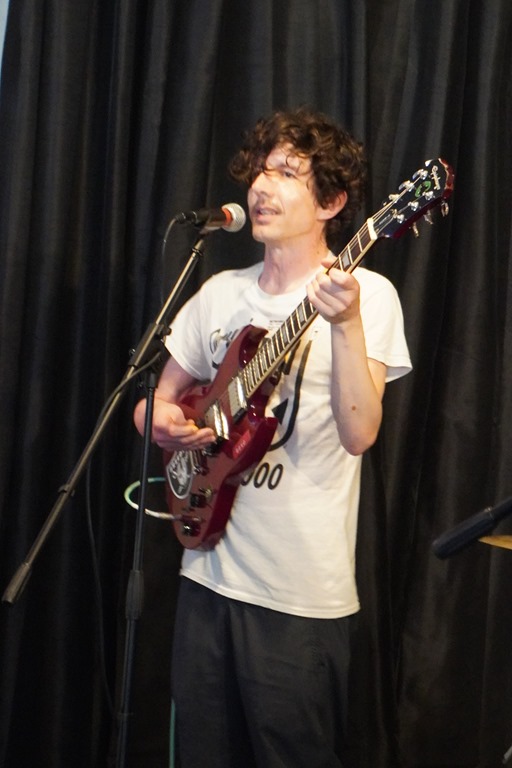
So after extreme electronica, angular no-wave noise rock, and multi-faceted hardcore, Cowtown are perhaps the most overtly indie / alternative act of the night, but the thing about Cowtown is that, well, they’re uniquely Cowtown. Stalwarts of the Leeds scene in the same way as Bilge Pump (and, more recently, Objections, and Thank, for that matter), it’s the quirkiness that’s as integral to their appeal as their commitment to the DIY scene. Oh, and songs, of course. They have some songs. Good songs, too. But what are they about? Tonight, we get to find out about some of them. And so do they, seemingly for the first time, too. This is a significant part of the great and enduring appeal of Cowtown: they never fail to entertain, and as they race through the songs – grunge and punk at heart, but with pop keen leanings –with unbridled energy and effervescence, there’s a joy which radiates from the stage: they genuinely love doing what they do – and tonight, Hilary is loving the gong, a fixture of Utterly Fuzzled events used primarily to herald the commencement of each set, but here, used as punctuation between songs, and equally, just for the fun of it. And ultimately, fun is what they specialise in, bringing a near-miraculous evening to a most uplifting finish.
DSC02707DSC02730DSC02758

Cowtown

Dret Skivor – 1st August 2025

Christopher Nosnibor

Having debated the merits – or otherwise – of the extensive, expansive, hyperdetailed press release, and having felt a certain trepidation when tackling a work rooted deeply in weighty postmodern theory beyond the peripheries of my personal field of – perhaps rather specialist – expertise, I find myself on altogether more confident footing here. The latest release on Dret Skivor, a Swedish label devoted primarily to drone, noise, (darker) ambient, and general weird shit, offers up two longform tracks, each corresponding with a side of a C30 cassette, accompanied by precisely zero information, beyond the fact that it was ‘Mastered by Dave Procter at Svinig Studio, Skoghall.’ Hell, it doesn’t even have any capital letters.

I’m at ease with this. When it comes to abstract / instrumental / experimental works, I don’t need to know who the musician or musicians are, what gear they’re using, and unless there’s something quite specific which inspired or motivated the work on a theoretical or personal level, I generally prefer to allow the music to speak for itself, and for my mind to do the work of interpreting how the sounds affect me.

The tracks are, in fact, both exactly 14:27 in duration – which is oddly precise. It’s the only thing which does seem to be precise, but not odd, about the compositions – such as they are, with ‘my crustacean brother’ manifesting as a huge, churning wall of full-spectrum noise. It’s the mod-range that fills the space and fills your ears and your head as it barrels from the speakers, a dense, relentless rumble like a mangled engine – but there’s low end that hits around the gut and enough treble to add an extra level of pain. Sometimes, it sounds as if there may be fucked-up vocals gnarled up in the machine, distorted, fractured, and buried in the mix – but it’s as likely that it’s my ears deceiving me as my brain tries to subconsciously find form in the formless. If you mic’ed up a tractor engine and then ran the recording through half a dozen distortion pedals, it would likely sound like this. The sound feels mechanical, analogue: rather than harsh in the way pure digital often is, this is the sound of moving parts, or rusted metal flapping as it slowly disintegrates. Around eleven minutes in, it seems to gain in volume and intensity, but this again could be an auditory hallucination. Yes, this is how methods of torture involving sonic elements, the likes of which were trialled as part of MK Ultra, work. It’s not sensory deprivation, but complete sensory overload. When it stops, the silence feels wrong.

‘gås!’ is a fraction less dense, favouring treble a little more, and also containing more detail, or at least more clarity, which allows the detail to be heard. There is a distinct throb which creates a rhythm – one which glitches and stutters as it snarls and roars. It’s harsh, pure, brutal sonic punishment, taking the Merzbow template and… replicating it perfectly, not just sonically, but in the spirit of inflicting damage, both physical and psychological, on the listener, knowing that the whole thing is insane, beyond excessive, testing the patience as well as the stamina over the course of almost a quarter of an hour. It’s nasty, and I love it. You (probably) won’t like it, sugar…

AA

a0540901673_10

October 2024

Christopher Nosnibor

Having just effused over the benefits of Bandcamp Friday, as well as wrestled with the overwhelming volume of notifications and review submissions, this one lands as the kind f curveball only the likes of Foldhead are likely to deliver, in that this is by no means a new release. Beserk Pinball Machine / Quasar Delirium was in fact first released back in 2021, as something of an archival recording: ‘Recorded in 2015 for a tape label that ceased to exist prior to the intended release date. The 25 copies that had been made were distributed at the Experimental Yorkshire festival which took place at Hebden Bridge Trades Club on 21 July 2018’ And now the Bandcamp page has been refreshed, with ‘two new mixes + a new piece.’

I’m not sure if ‘beserk’ is an intentional variant of ‘berserk’, but I’m going to assume it is. The etymology of the word ‘berserk’ is quite fascinating. The word itself means ‘out of control with anger or excitement; wild or frenzied’, but its origin lies in the reverence the Saxons held for bears. ‘Berserk’ translates as ‘bear shirt’, and berserkers were the warriors placed at the front of a battle formation: their job was to chew their shields, gnash their jaws and foam at the mouth like frenzied bears in order to share the shit out of their opponents before the charge.

This release is every bit as scary and unpredictable as a frenzied bear, and certainly inflicts a bear-like mauling on the senses, being particularly brutal on the ears, and on the lower intestines for that matter.

The opener and lead track, ‘Beserk Pinball Machine’ is an absolute noise monster. There are – sort of – vocals in the mix, but they’re distorted and largely buried beneath a deluge of mangled noise, churning distortion and feedback all mixed together to forge the nastiest mess of trebly sonic ruination. It’s just shy of fifteen minutes shattering, explosive, convulsive digital meltdown which makes Merzbow sound mellow, and Kenji Siratoi supremely calm in comparison. Paul Whatshisface, having previously been a member of Smell & Quim and Swing Jugend – as well as occasional noise duo …(something) ruined has had a long career operating in harsh noise circles, and this is both noisy and almost unspeakably harsh. The noise frenzy ends abruptly, but there’s a spell of low-level hum at the end which offers some respite, however much the not-silence nags.

‘Quasar Delirium’ is appropriately titled: another quarter of an hour of brain-melting, tinnitus-inducing noise squall. Only this has more fizz, more squeal, more laser bleeps, more treble, and more feedback, more melting circuitry, all against a backdrop of churning cement-mixer grind, washing machine spin-cycle metallic reverberations. The experience is how I imagine standing next to a massive propeller engine without ear defenders, while a Star Wars type laser-gun battle takes place all around – while buildings explode and collapse all around, and there is nowhere to hide.

The concept of remixes in this context is rather amusing, and ‘Machine Pinball Bezerk’ and ‘Delirium Pulsar’ are more about fucking shit up even harder than remixing in the more conventional sense. ‘Machine Pinball Bezerk’ sounds like an atomic bomb: it’s noise on the scale of the scene in Threads where the buildings are decimated by a wall of white-hot flame. It’s a scene that seems to last an eternity despite being maybe five minutes at most. The fifteen minutes of ‘Machine Pinball Bezerk’ feels like a lifetime and you can almost feel the tinnitus coming on after just five minutes, while your brain melts and trickles out of your ear.

‘Delerium Machines’ delivers more of the same, the most pulverising, excruciating blasting racket. It hurts, and the overall experience is disorientating: an hour and a quarter of the most abrasive, churning noise imaginable. It’s not Harsh Noise Wall, but there’s not much variety, either, meaning that this release is a relentless assault that will likely leave you wilted, drained by the end – and that’s assuming you can still hear.

AA

AA

a1518553209_10

Dret Skivor – 12th February 2021

While there have been a few shady folks who have dwelt in prominent places on the noise scene through the years, leading to a certain association between noise and the ugliest aspects of the far right, my own personal experience has been, fortunately, quite different, and the noise-orientated circles I’ve found myself moving in are populated by some of the most sincere left-leaning people who devote their time to speaking up for equality, workers’ rights, and railing against bigotry, discrimination, and fascism. In a way, it feels strange that I should even feel the vaguest need to preface a review by setting this out by way of a context. But there we have it: the world is full of cunts, and sadly certain genres have more than their share of prominent ones, and it only takes a couple of mouldy grapes to taint a batch of fine wine. Or to bypass the metaphor, a handful of cunts to tarnish the reputation of a large group.

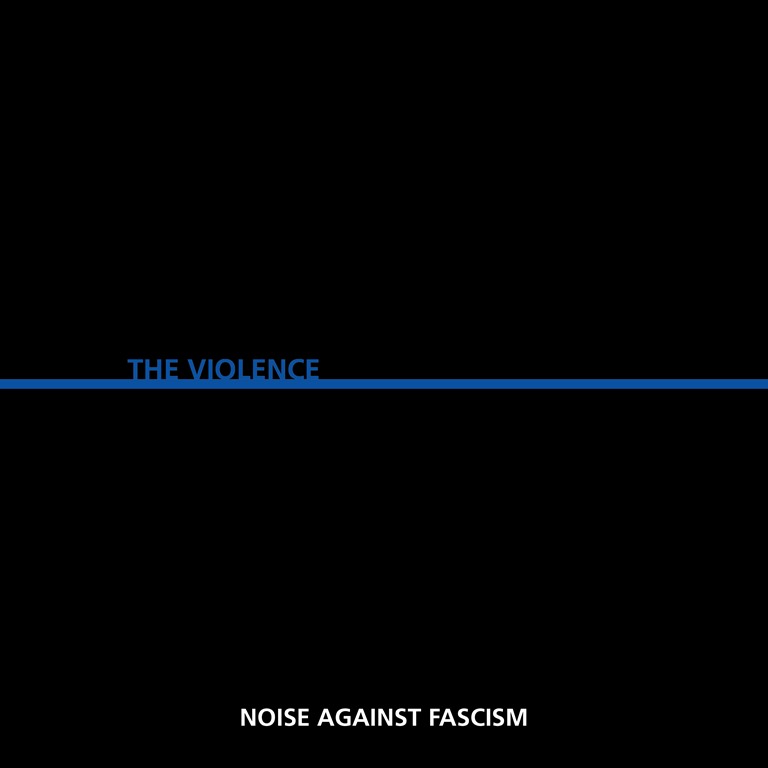
There’s no question around the politics of Malmö act Noise Against Fascism, the latest additions to the Dret Skivor label, founded by the ubiquitous Dave Procter following his recent relocation from Leeds to Sweden (prompted partly by the shitshow of Brexit). The band’s bio describes the project as ‘harsh noise against all forms of oppression and injustice. A violent non-violent tool of resistance’. And it makes sense: noise, when it’s harsh, can be one of the most brutally violent things around. And The Violence lives up to its title. Released on limited cassette, it features a longform track on each side, and they’re unswervingly optimally harsh.

‘Policemachine’ is a churning blast of mid-range noise, a welter of distortion that’s remorselessly abrasive. It’s difficult to tell it it’s resonance of a rapid phase, but it pulsates at a high frequency, the metallic shuddering racket positively shaking the walls, while occasional snarls and crashes and heavy blows add more horror to the relentless assault. It is, of course, entirely fitting of the title, which is take as a reference to both police brutality – a topic which has been hot for some time now, and never more so than in the last year or so, giving rise to the Black Lives Matter movement. But it’s a trope that reaches back far further. A Clockwork Orange was published in 1962, and forty years, how much has actually changed? The track is a real fucking horrorshow, a nuclear assault of devastating sonic proportions that speaks of every kind of violence. Lasers blast through the tempest toward the end, only accentuating the sensation that this is a war trasmited sonically. It’s an aural battering, a sonic blitzkrieg, a full-on gut-shredding mess of overloading nastiness, that’s sustained for over half an hour, with not a moment’s respite, and it’s enough to leave you feeling absolutely ruined.

And so, still staggering, battered and bruised, the listener is thrown headlong into the engulfing racket that is the title track, a further twenty-five minutes of extreme noise that beings with a sample that’s cut to a loop and separated by some dramatic stereo that feels like a sharp left-right punching before the devastating noise crashes in like a bulldozer. Obliterative is an understatement. The cut loop of ‘the violence’ continues throughout, reminding me of Rudimentary Peni’s Pope Adrian 37th Psychristiatric album, with it’s mind-bending loop of ‘Papus Adrianus’ which runs for its entire duration.

It’s noise, and holy fuck is it harsh. The monotony only accentuates it, of course, but sonically, it’s a howling mess of overloading circuitry that offers not even so much as a microsecond’s breathing space. If you want to lose yourself in body-breaking, brain-shredding noise, then this album is going to deliver. With the added benefit of knowing they’re not nazi cunts.

AAA

Thin blue line cover DIG

Dret Skivor – 11th January 2021

I had the pleasure – and it was a pleasure for me, if not necessarily the audience – to perform a couple of times with Legion of Swine. They were noisy, brutal affairs: while Dave Procter’s many musical guises span most shades of noise, with a particular leaning toward all things drone, his work as the lab coat wearing porcine purveyor of aural pain.

The audio on this release is taken from Legion of Swine’s set for the Chapel FM 24-hour Musicathon, which took place on 12th-13th December 2020, which featured forty-five acts in twenty-four hours. Performing at 6:15am on Sunday 13th, the chances are few caught the performance as it aired live, but here, a year on, is an opportunity to bask in the gnarly noise at leisure and a more socially amenable hour. Not that there’s much that’s socially amenable about this: the liner notes explain how ‘It’s “almost” Harsh Noise Wall, but not quite as some random parts of reverb tails interact with others at various stages to create the slight variations.’

So how does that translate as a listening experience? Well, as the title suggests, the noise never abates during this twenty-six-minute blast of electronic abrasion. There are no breaks, no vocals, and next o no sonic variety, although there is some – and it’s heavily textured. In fact, it would be most readily summarised that it sounds like the cover looks: grey, grainy, but woven so as to be not entirely monotone and uniform in shade.

When I find myself listening to HNW – which admittedly, isn’t that often, as I generally prefer the concept to the experience, despite the fact I do very much like my noise to be immersive, not to mention somewhat testing – I find myself hearing subtle shifts in tone and frequency. I suspect it’s the result of some auditory illusion, the aural equivalent of an optical illusion as my receptors strain to find some variety, some detail on which to pin a response of some sort, in the same way a freshly-painted wall will reveal patches that are not as well covered as others the longer you look at it. The beauty – and I use the term with extreme caution here – of this performance is that those patches do exist, and are purposefully brushed into the finish.

This is alternately the sound of a distant swarm of hornets and swimming underwater. The recording doesn’t convey the kind of extreme volume that is an element of a lot of harsh noise, although one suspects that a large proportion of the interplay between sounds is derived from the way that reverberate, resonate, and rub together and against one another, and any comparison to Merzbow is entirely appropriate. But the lack of overt volume only accentuates the sameness – or near-sameness – of the sound, and what’s more that sound is a continuous torrential churning noise that sits in the midrange, and hammers like metal rain, a relentless digital downpour. It’s ultimately oppressive in its relentlessness, and over time seems to fade into the background, as anything with such a lack of dynamics inevitably will. But this is not about stimulating the senses so much as numbing them and challenging the listener to endure. It’s a test alright, and a tough – but good – one.

AA

a2596588712_10

gk rec – 18th February 2019

Gintas K’s catalogue continues to expand at a remarkable rate, and yet again, he demonstrates his deep interest in the production of theory-driven experimentation. However, the theory behind M isn’t necessarily as it may appear, as the text on his Bandcamp page for the release indicates:

Ralph Hopper: Is ‘Mimicry’ a re-imagining of the earlier ‘M’? It appears that ‘M’ is computer music and that ‘Mimicry’ is also computer music but in a live performance if I have that right and thus I’m thinking that your are ‘mimicking’ the earlier release. Maybe not?

Gintas K: well, when you said so it looks quite logical. Music inside is a bit similar. But in fact it is not. It is made using a different vst plugins. M is made from live played files, but later from them is made a collage. Mimicry is made just from real time made files, without any overdub.

In effect, M and Mimicry – released here together under the single monograph banner of M – are the product of a process played forward and then in reverse: first, the live performance collaged and generally fucked with, and second fucked-with sounds played as a live performance.

As a consequence of its modes of production, M is very much an album of two halves, a call-and response, an expostulation and reply, a working as a reworking. Comprising two album-length suites of compositions, ‘M’ and ‘Mimicry’, M was originally ‘played, composed & mastered by gintas k by computer in 2012. M (2012)’, while ‘Mimicry’ was ‘played live / real time & mastered by gintas k by computer’ some five years later in 2017.

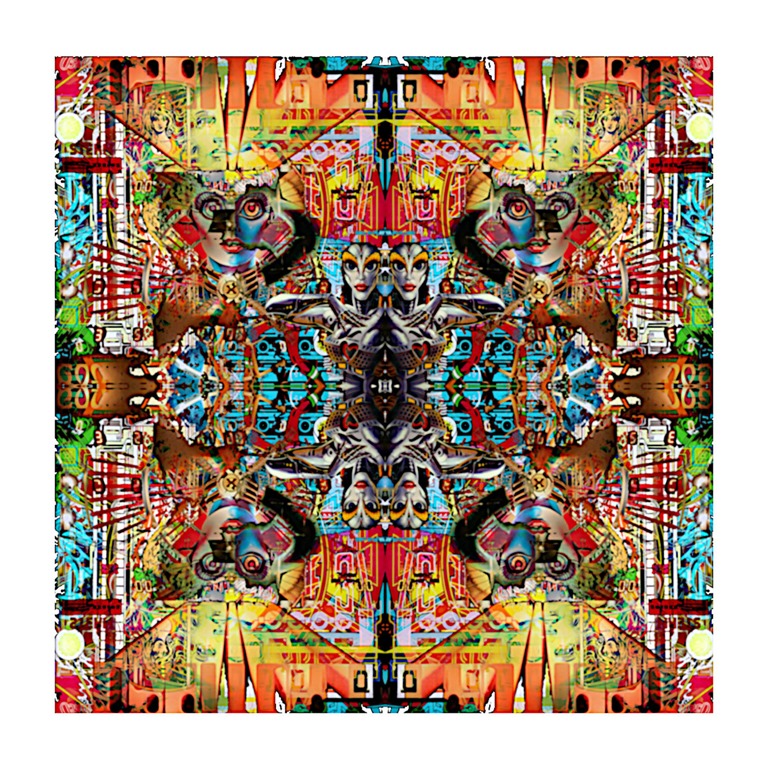
‘M’ consists of six compositions, numbered in sequence, with the longest being the first, ‘1m’ which clocks in with just shy of 18 minutes of gurgling digital distortion, hissing static, whistles of feedback and fucked-up overloading, glitching gnarliness that sits comfortably in the bracket of extreme electronica. It’s not the frequencies which hurt: it’s the relentlessly stuttering, juddering, fracturing of sound, the jolting, the jarring the cutting out, the intermittency. By nature, the mind works to fill in gaps, and so the subconscious work required to smooth the tremolo effect of the stammering noise mess is mentally exhausting.

‘3m’ and ‘4m’ are substantial pieces, over seven minutes in duration, while the remaining three are snippety fragments of drone and hum, although they all congeal into a morass of brain-pulping pops and whizzes which crackle and creak and skitter and sizzle in erratic tides of discomfiting discord. And yet there’s something oddly compelling about this sonic sup that bubbles and froths and tugs at the nerve-endings without pity.

My synapses are fried and firing in all directions by the time I’m halfway through ‘3m’, a grinding, grating mess of clipped signals with all dials in the red which resembles ‘A Cunt Like You’ by Whitehouse, minus the ranting vocals. And then on ‘4m’… what is that? Some kind of subliminal vocal? Or is my mind just messing with me as it struggles to find orientation and points of familiarity in the stream of inhuman sound. It’s disorientating and difficult – and these are the positive attributes.

The ten ‘Mimicry’ pieces are perhaps re overtly playful – bleeps and whirs, crackles and pops, all cut back and forth so fast as to induce whiplash – not necessarily in the neck, but in the brain stem as the organ shifts into meltdown as it attempts to process the bewildering back-and-forth transmission of sonic data. Tones bounce and ripple at pace in confined spaces, and much of the sound seems to be in reverse, which adds to the dizzyingly fractured, disorientating sensation. There are dark moments, which hum and throb and drill and yammer and chew at the guts, but overall, the ‘Mimicry’ suite is less dense, less brutal, less painful.

The two sections would have worked as standalone albums, but to hear them side-by-side as contrasting and complimentary works is, ultimately, a more fulfilling experience, despite also being something of an endurance test. Its clear that as much as M challenges the listener, Gintas K is an artist intent on constantly challenging himself. And in an era when trigger warnings, entertainment and safe conformity have infiltrated and now dictate every corner of the arts, Gintas Kraptavičius’ unswerving commitment to pursuing his own interests and ends stands out more than ever.

AA

gintas k - M