Posts Tagged ‘Jazz’

LAAG Recordings – 10th May 2024

Christopher Nosnibor

Over the last couple of decades, Leeds has thrown out some truly amazing acts, and while few have achieved the kind of commercial success of Kaiser Chiefs, in terms of creativity and sheer range, it’s come to stand in a league of its own. It was round about twenty years ago that The Brudenell began to build its reputation as being s place that provided a space for non-mainstream acts, notably becoming something of a residential spot for iLiKETRAiNS in their early days, hosting their Signal Failure nights. While I saw a lot of post rock there around this time, I also got to see the likes of That Fucking Tank, Pulled Apart By Horses, Blacklisters, as well as visiting acts which included Whitehouse and Unsane. The Brudenell may have expanded in terms of what it offers now, but it remains in many ways the essence of the Leeds scene, an open and accommodating space where pretty much anything goes, with emerging local acts still getting a platform and, significantly, high-profile support slots. And then that are – and have been – an array of smaller independent venues which have all been integral to the crazed melting pot which is the Leeds scene, from Wharf Chambers, to the Packhorse, via Chink and Mabgate Bleach.

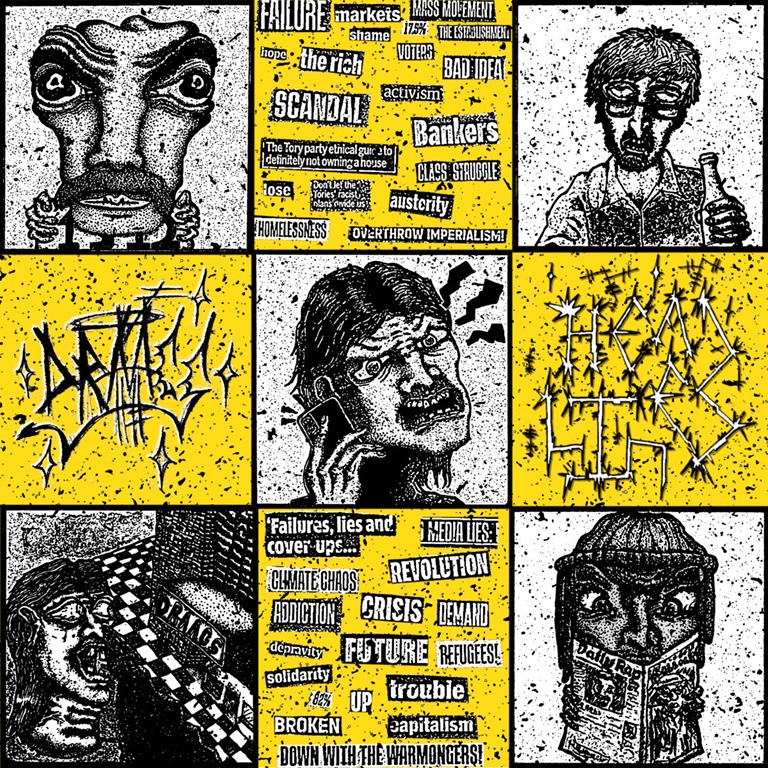
From the quirky alternative noise of Thank to the banging rave mania of Straight Girl, Leeds in 2024 really does provide a broad span of representation, in every way. And if further evidence is needed, step forward queer-dance-punk five-piece DRAAGS, who offer up their debut album on their own DIY label, LAAG Recordings.

Their bio and album pitch set out their stall nearly, as they recount how the album was ‘Made in their home over 2023’, where ‘the five-piece explored themes of escapism, queerness, rebellion, anti-capitalism, -police and -mass-media, creating melodies and lyrics to reflect their feelings at the time. No one song sounds the same, just as no member of DRAAGS is the same.’

They go on to explain how ‘In Headlines we are grappling with the alienating nature of post-internet capitalist society, fuelled by a will to understand our surroundings and not succumb to normality and drudgery. The album is an unraveling of self-purpose, self-destruction and escapism vs reality in a world that distorts the truth and seeks exponential growth through false ambition. The work as a whole intends to reflect the overstimulating impact that a possessive individualist society has on the human psyche. How this obstructs our ability to connect and the challenges we face to not degrade our beings to reflect our bleak surroundings. This project has been a driving force for us to rebel, find togetherness, community, collective joy and purpose and we hope others feel that too.’

Headlines is a deranged mash-up of absolutely everything. ‘SPINNER’ is exemplary: starting with a recording of a standard call-queue experience – we all know that that the reason all the agent are busy and an agent will be with us shortly – or not – is because no company ever hires enough staff because paying staff to provide any real service eats into their profligate profits… and then everything goes crackers, a head-on collision between Age of Chance and iForwardRussia!, in turn continuing the lineage of Leeds bands who dare to be different. Then it goes a bit operatic, a bit Sparks, a bit drum ‘n’ bass, a bit Foetus, a but Mr Bungle, a bit Selfish Cunt. To say that it’s a crazed and bewildering three-and-a-half minutes would be an understatement.

Every single song on here is ABSOLUTELY WILD! It’s quite difficult to pay attention to the lyrics when there’s so much going on. It’s arch, it’s arty, it’s a bit campy, it’s WAY over the top. It’s a RACKET! And as the song titles evidence, THEY LOVE CAPITALS, because SHOUTING AND IN YOUR FACE IS THE THING! I don’t even mean that critically: this is an album that feels like a relentless blizzard of barminess, and everything is just brain-melting. ‘PAPERS’ is a full-on, brain-melting slice of jazz-flavoured derangement, and there isn’t a moment’s let-up here, with helium-filled freneticism leading a cacophonous carnival of dementiture.

Twisted jazz and grinding funk coalesce, or congeal, into a maniacal mess, and sometimes, it gets noisy, too. How do you possibly keep up with this, or stay sane? Maybe you don’t. HEADLINES isn’t really a SONGS album, so much as an EXPLOSION that leaves you shaking our head to get clear as you find yourself sitting dazed, utterly floored.

There is no sane or objective response to this album. There is no easy way to process it: there is simply too much.

DRAAGS are going all out here to push and test themselves and their potential audience. Surrender to the CRAZINESS.

AA
a1343560981_10

Sub Rosa – 24th May 2024

Christopher Nosnibor

Yet another 24 May release… It really does feel as if the world had conspired to release 75% of the years albums on this one day. So I’m still working my way through them. And this release from some known names is not what I was expecting. I can’t recall precisely what it was that I was expecting but certainly not anything as heavy or as percussion-led as this.

They describe SIHR as a ‘sonic manifesto by a post-anything quartet’, a work that offers up ‘new folklore for a devastated planet’. Within these words, there’s a sense of nihilism and gloom, but simultaneously an undercurrent of ‘fuck it’ and of quintessential avant-gardism, the principle ethos of creating anew only being possible from the destruction of that which came before. There’s a sense here that the destruction – the devastation of the planet – clearly isn’t something they’ve chosen, but in the face of apparent futility, they’ve come together to create, perhaps in the hope of a brave new world, or perhaps, more likely, something to be discovered among the ashes and the ruins of society and life as we know it.

The way in which they document their coming together and the creation of SIHR has all the hallmarks of the first stages of developing a mythology, which has the potential, in time, to grow its own legend: ‘The first sonic moves of this eclectic quartet, made in a bunker studio somewhere between Paris and Berlin, urgently took the form of a quest, that of a neo-folklore for troubled times, a music seeping with many kinds of atavism and experimenting in all directions. A fertile no-man’s-land where trance and contemplation, jazz and electronica, acoustics and electricity would merge in a stimulating mystical magma. From the possible emergence of a Babelian language to the shared desire to rediscover music as a ceremonial act, this encounter took place over three days of improvised sound bacchanalia, the phases of which were all recorded by Benoit Bel.’

The first track, ‘Oui-Ja’aa’ is a nine-minute colossus of a cut, drawing together elements of electronica and ‘world’ music with a dash of Krautrock and the sensibility of Suicide, with a throbbing rhythm melting into a hypnotic bubbling sonic cauldron. The tempo twists and seems to quicken as drones and jazz horns warp this way and that as if blown by the wind and everything builds to a frenzy before collapsing, exhausted in the dying moments.

While conjured in a bunker studio, SIHR sounds as if it was improvised around a fire in the middle of a desert while string out in an hallucinogenic haze. I suppose in some respects, the two scenarios bear numerous similarities in terms of their psychological effects: while one setting is a vast expanse of space with a huge sky vista and a distinct absence of other people, so the other, equally devoid of other people, forces the contemplation of the infinite realms of inner space.

‘YouGotALight’ is slow, smoking, soporific, a crawling, sprawling, mellowed-out meditation, before the glitchy whorl of bleeps and jitters that define the sound of ‘OhmShlag (Quake Tango)’ sees things take a very different trajectory at the album’s midpoint. A pulsating, seething miasma of sonic swampiness, punctuated with a metallic tin clatter of a snare that cuts through the murk, it’s like slowly sinking, not only in boggy terrain, but in a mental fog.

‘Babel Cedex’ eliminates the fog and just goes for the mental, beginning as another slow, serpentine, hypnotic exploration before building to a deranged frenzy of frenetic percussion and howling horns and chaotic discord that’s truly brain-melting. Eastern vibes and glitchtronica ripple through the woozy ‘Black Powder’, and you find yourself marvelling and utterly bewildered by the whole experience.

My earlier visions of desert campfires dissipate life vapourising mirages during the second half of the album, and I come to conclude that SIHR is indeed the sound of bunker life: one envisages the collective huddled in semi-darkness, hunched and half-crazed after months below ground in the wake of a global catastrophe, trying to keep it together in the hope of one day being able to return above ground. How will they know when it’s safe, when the coast is clear? Or is this a scenario akin to Philip K. Dick’s The Penultimate Truth?

We live in perilous times, and likely closer to the brink than any of us know or can even compute. In this context, SIHR feels like a document, and a message to future times.

AA

a0579997776_10

“’These Things’ was the last song written for Delights Of My Life. Often the last song is written with the aid of what has come before it, the other songs on the record.
We have one song to write, or so we think, now then, what shall it be and why? I think that I asked this question. We will never know. And I also think that I thought that it might be novel to have a song with a very clear form (four times through a melodic verse, with a tag at the end that wraps it nicely). That, and that the record may very well appreciate a song with little to no improvisation. A straight curveball!

Eric Cazdyn, who made the ‘These Things’ video (and around 18 other videos for my music) may have heard the song similarly. He has certainly given me that impression. What I see in the video is a very simple movement or gesture, but with an immense amount of minimal detail. Well, that is how I often describe the dance of Angela Schubot, although she is just on the verge of dancing here in this video. She dances like vegetation. Or, she shows me again and again that vegetation is a dancing world.”

— Eric Chenaux

Check ’These Things’ here:

AA

c3f8bb22-38b3-c83d-5f15-f7d3d75630f5

Janka Industries – 3rd May 2024

Christopher Nosnibor

Once again, I find myself tussling with a jazz album and in a quandary as to quite what to make of it. For many, many years, I was absolutely certain I detested jazz. Until, that is, having been introduced in my line of work to acts like The Necks, I came to learn I’d simply been exposed to the wrong kinds of jazz. The weirdy, noisy, cacophonous kinds of jazz made sense in context of my appreciation of mathy noise rock, and wasn’t such an immense leap from Shellac to be incomprehensible. Like any genre, or even tea or coffee, it’s all about finding a point of entry, a flavour that suits your palette. I used to hate both tea and coffee, having been given the former with full-fat milk and sugar and the latter in the form of a fairly weak blend with milk but no sugar, and they only really clicked when I ditched the sugar and discovered Earl Grey, and that you could have really dark-roast coffee with no milk and a shovel-load of sugar. So, you know, you find your thing.

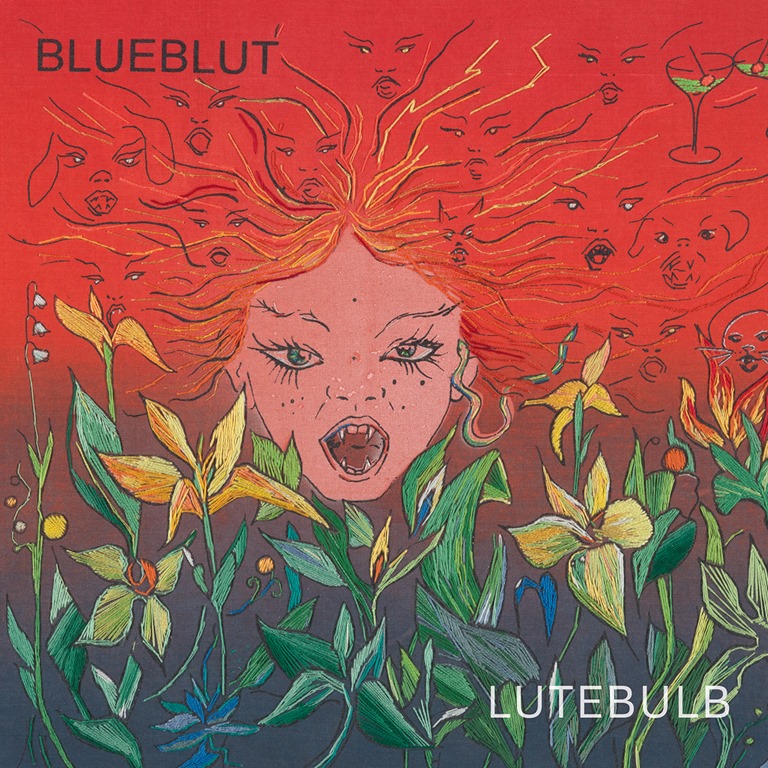
And then along comes Lutebulb, by Blueblut.

The blurb isn’t wrong in describing Blueblut’s lineup as ‘highly unusual, bringing together ‘three musicians acclaimed for exceptional contributions to their respective spheres in experimental jazz, electronica and rock.’ It’s a jazz-centred fusion, for sure, but it’s not jazz fusion as one tends to think of it, and certainly not as I’ve come to understand it. So what is it? As we learn, ‘Lutebulb is the fabulous culmination of ten years of intensive touring, with the Vienna based trio of Pamelia Stickney (theremin, vocals), Chris Janka (guitar, loops, samples) and Mark Holub (drums, vocals, percussion) socking it to global audiences with an international polystylistic musical language which takes in improv, jazz, avant-rock, ska, folk and Krautrock among other elements.’

There’s certainly a lot going on: initially, it comes on a bit laid back, not so much loungey as a smug muso pop collision of jazz and Latin dance, and I suppose the title, ‘Cocktail’ is something of a giveaway as to its swinging party vibes, but then shit happens – particularly some pretty crazy guitar work, and the percussion goes big and suddenly the party’s been crashed by a towering riot of sonic chaos, before suddenly, the entertainers seemingly remember themselves, pull their ties straight again and try to pull together some semblance of a funtime groove.

This sets the album’s template, really. Tracks tend to begin a bit kinda loose, a bit kinda boppable, a bit pool party fun times, albeit with some weirdness in the way the rhythms and the notes don’t quite chime in the conventional ways, and you wonder if it’s maybe the punch or the heat, but the tempo drifts a bit, first one way, then the other, and then maybe something doesn’t quite feel right, and it certainly doesn’t sound right and… what is going on? The room’s spinning and there are all sorts of random noises and you can’t tell if it’s people losing the plot or if some chickens have escaped and the sky’s falling in.

‘Aumba’ starts rather differently, a gentle piece led by acoustic guitar that brings a more reflective atmosphere, but it takes a hard swerve, the pace picks up, there are choral chanting vocals and then a handbrake turn into buoyant math-rock territory before some truly frantic fretwork. And because more surprises are needed, from nowhere, we get a crooning lyrical ballad in the last couple of minutes.

There’s unpredictable, and then there’s Lutebulb, which emerges with a fourteen-minute centrepiece of oddball experimental jazz that mashes absolutely everything together: one minute, I’m reminded of America’s ‘Horse With No Name’, the next, it’s Paul Simon’s Graceland and a Joolz Holland world music extravaganza. Then, somewhere in the midst of it all, we get the jazz breakdown with erratic percussion and space, dogs barking, and then, something else again. Led Zep riffage. Noise. More dogs barking. Every time I leave the house, the streets and parks and fields are like bloody Crufts, and the headfucking noise that’s emanating from my speakers – mostly a horrible conglomeration of barking and a strolling bass is making me angry and tense. And then the last piece, ‘Kaktusgetränk’, incorporates a familiar and popular jazz piece I can’t place or be bothered to research because by now I can’t decide if I need a lie-down or a massive gin.

With Lutebulb, Blueblut have created one of the most wildly varied – and in places, difficult, irritating, random – albums I’ve heard in a long time. I neither like nor dislike it: it has some truly great moments, and it has some not great moments. But when you throw this much into the blender, it’s to be expected, and I’d like to think that this kind of reaction isn’t entirely unexpected. The musicianship is outstanding, and their capacity to switch style, tempo, form, is something else, and the results are enough to leave anyone punchdrunk.

Blueblut – Lutebulb cover 1240px

26th February 2024

Christopher Nosnibor

Having recently had his early punk rock recordings reissues, Stewart Home makes a new foray into the recorded medium, this time with a rather more experimental collaboration with JIz. Delivering a spoken word list of ‘problematic memorials’ (as the title suggests) with some additional commentary, in a fashion not dissimilar from The Justified Ancients of Mu Mu’s ‘It’s Grim Up North’, across three variants with backing that ranges from swampy experimental noise to minimal avant-jazz, Home leads us on a tour of London taking in sights that most people don’t realise have unsavoury connotations and commemorate people and events which probably ought to be damned rather than celebrated.

The long history of slavery throughout the British Empire has – belatedly – become subject to more open discourse in recent years, but our current government, who seem determined to resurrect the spirit of the empire through jingoism and xenophobia and a completely false reimagining of history as a way of selling Brexit as a win, are averse to such discourse, branding anything and everything from the Army to the National Trust as ‘woke’ – as if being woke is a bad thing.

For the most part, the sense of ‘Britishness’ which is increasingly only a sense of ‘Englishness’ in our ever-more isolated and impoverished part of a small island on the edge of Europe – geographically, and sinking off the coast of Europe politically – is born of ignorance. Stubborn, belligerent ignorance, but ignorance nonetheless. And out of such ignorance arise pathetic, futile culture wars.

Home has so far managed to slide his antagonistic sociopolitical position under the radar in recent years – in contrast to his controversy-piquing earlier years when he was churning out pastiche works about skinheads and riots and anarchy. What happened? Perhaps in developing his approach to be more subtle, Home achieved even greater subversion by being able to continue his mission without interference. Whatever the reason, here we have Problematic Memorials. Call it woke, call it what you like, but it needs to be heard. And beyond the message, it’s a top-notch spoken word / experimental music crossover collaboration, so go get your lugs round it.

AA

a2330344121_10

16th February 2024

Christopher Nosnibor

A good cover brings something different to a song. That doesn’t mean rendering it unrecognisable or necessitate complete irreverence, but a cover that’s so faithful to the original as to be a carbon copy is utterly redundant. Marilyn Manson’s cover of Soft Cell’s cover of ‘Tainted Love’ is a perfect example of a pointless cover. Johnny Cash’s cover of ‘Hurt’ and The Fall’s take on ‘Lost in Music’, on the other hand, are everything you could want from a cover. ‘Owning the song’, as they say on shit like X Factor and The Voice.

How could any artist bring anything new to either of these well-trodden and frankly threadbare standards? That Ever Elysian have actually succeeded is quite a feat, and a welcome and pleasant surprise. They pitch themselves as purveyors of ‘classic rock,’ ‘soft rock,’ and ‘soul rock’ which does them rather a disservice on the evidence of this inspired offering.

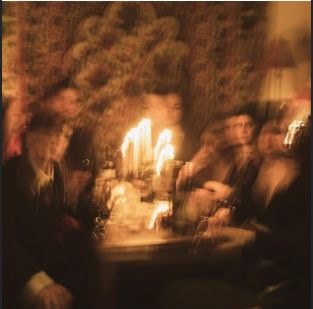
The blurred image which serves as the single’s artwork conveys the woozy, warped opening of their take on ‘Feeling Good’. It’s still got the essential jazzy vibe, but it’s twisted, messed: sultry is replaced with sedation, as if the room is spinning in a late-night nightmare. It’s the sound of ‘feeling good’ a few moments before you fall flat on your face and find you’re incapable of getting up, and you realise everything looks weird and you haven’t a clue who you are, let alone where. And then it takes wings with some big, bold strings, and finally, the flourish of a heroic guitar solo.

‘House of the Rising Sun’ again pairs it back, and slows it down, too, getting deep under the skin of this cautionary tale to render it with nightmarish qualities. This is one of those covers that gives one a moment’s pause to confirm it is in fact a cover, and when the penny drops as to how they’ve approached it… it’s a shiversome moment. Deep, dark guitar tones imbue the performance with a haunting, gothic quality, delivered with a dash of theatricality. The jazz flavour leans into tipsy post-rock and a slow burn that surges to something like the Amy Winehouse Bond theme that never was. It’s a daring rendition, but by absolutely no means disrespectful or irreverent: instead, these two interpretations draw out dark elements which lie at the heart of the originals and bring them to the fore. These are smart, considered, well-executed and exciting versions.

AA

Ever Elysian

5th February 2024

Christopher Nosnibor

People often say they hate surprises. I know where they’re coming from, although by and large, the surprise is less the issue than their reaction being seen. As children, we’ve all had the Christmas party and the birthday where we’ve suffered a head-exploding embarrassment where something’s been sprung unexpectedly, and where, as a consequence the walls have closed in and you’ve felt entrapped within a tight, tunnelling space and simply wanted to disappear – right? But there are two kinds of surprises: good ones and bad ones, just as there are two kinds of music: good, and bad.

‘Cryptic Bodies’ is good music, and the perfect surprise, presenting as a discordant chaotic mess of purgatorial abrasion, which smashes its way into a collision of post-punk and… well, what else is hard to say, beyond sinewy, straining dissonance. Really, this is one of those ‘what the fuck is this?’ releases. Personally, I absolutely love this kind of stuff, that’s challenging, shouty, difficult to listen to, let alone define. The music shifts in tone and intensity, a meandering twisting thread of jangliness and extraneous noise that bears jazz influences without being jazz, noise-rock elements without being noise-rock. What does it mean? What is it for? Cryptic is certainly the word, and perhaps it’s best to simply revel in the strangeness than attempt to unravel and decipher it.

But there’s more. The track is lifted from Hungarian artist Porteleki’s forthcoming album Smearing, which is out in March, and it’s not his first work by the title ‘Cryptic Bodies’, as a moment’s cursory research brings us to a ‘documentary’ film on YouTube, uploaded in three parts, which captures Porteleki – a percussionist first and foremost – performing a solo score, which is ‘structured yet improvised’ as the audio backdrop to ‘a contemporary dance piece, where 5 dancers traverse through space, body and time to throbbing experimental live metal music. The work is inspired by ancient bodily practices such as Egyptian mummification and Mesopotamian occult healing rites’.

Being instrumental, and extending to around forty minutes, it’s a powerful soundtrack to a visually striking and remarkably compelling multimedia experience, which also showcases Porteleki’s inventive, atmosphere-building approach to guitar playing. Elsewhere online, his SoundCloud uploads present an array of experimental works, ranging from minimalist dark ambience to wild, maximalist bursts of noise, meaning how representative of the album this cut might be is anyone’s guess. But given the title track, which is currently streaming on Bandcamp, there’s a strong possibility that it’s going to be an extremely varied and extremely unusual collection of highly experimental bits and pieces. ‘No genres’ he states on his Bandcamp. No kidding: Porteleki’s modus operandi appears to be to shatter every mould there is. He isn’t so much leftfield, or outside the box, but outside the field, and he’s burned the box to ashes.

Porteleki clearly likes to push boundaries, and none more than his own. ‘Cryptic Bodies’ offers a gateway into the world of an artist who warrants exploration – but not if you don’t like surprises.

AA

a3137193342_10

AA

Not Applicable – 16th February 2024

Christopher Nosnibor

What we’re given to expect from this three-way collaboration is ‘an album of explorative, freely improvised electroacoustic music by an acclaimed trio of acclaimed genre-defying musicians’. I can’t help but blame the music press – as was, rather than the broken skeleton of what remains of the music press – and streaming algorithms for the obsession with genre. One could probably take it as far back as to the 50s when the press was all over this shocking ‘Beatnik’ counterculture, but to consider more relevant and recent history, ever since the ‘goth’ tag was applied to a fairly disparate selection of post-punk bands – and their fans – categorisation has been the method by which to both shortcut detailed analysis and to market acts. The groupings rarely make sense, or at least never did to me. For example, I loved Nirvana, but had absolutely no interest in, say, Soundgarden or Pearl Jam, who lacked ant of the elements I loved about Nirvana, and to my ear weren’t especially grungy. Bauhaus and the Sisters of Mercy have nothing in common beyond there being an arch, art aspect to their work, and the idea that both Throbbing Gristle and Ministry are ‘Industrial’ is absurd (and while I get that ‘industrial metal’ may be the distinction when considering Ministry, Pitch Shifter, etc,. it’s never rendered any more clear than when the term ‘hardcore’ is used. Many acts claim to be ‘genre defying’, but so few are. That said, the very function of the avant-garde is to defy genre, to smash preconceptions, to push boundaries, to do something different. In the Gloaming, remarkably, is something very different, and is truly ‘genre defying’.

It’s often intriguing to see just what players of such an unusual selection of instruments will produce when they come together and set out with the primary purpose of seeing what happens. Lothar Ohlmeier’s bass clarinet, Isambard Khroustaliov’s electronics, and Rudi Fischerlehner’s drums make for an interesting lineup, and sometimes, even the most experienced musicians will come together and create sound, but it doesn’t really gel. This is most certainly not one of those instances.

The album contains six pieces, and they each explore subtly different musical terrain, seemingly with all participants working on the understanding that less is more. There is a lot of space in which they all breathe and step back from soundmaking to allow the atmosphere to evolve. While the bass clarinet clearly has jazz connotations, this isn’t an overtly jazz album in any sense.

‘Leaf Silhouettes’ is a celebration of discord and dissonance, as clattering drum rattle like bin lids blown down an alleyway in a gale, the squelching electronic sounds conjuring an eeriness amidst seemingly random toots, while ‘Out to Dry’ has an almost sixties sci-fi feel, with hints of the BBC Radiophonic Workshop about the alien ambience, where the electronics take the lead, but remain restrained, with the result being sparse and atmospheric.

If any one of the pieces does have a more avant-jazz feel, it’s the nine-minute ‘Violet Weeds’, where the clarinet tootles and hoots every which way, spreading like tendrils over the bibbling synths. The percussion remains noteworthy for its restraint, as it does over the course of the album. And if ‘End Zone’ employs the same elements, the mood is quite different by virtue of the difference in balance of its instruments. It is, in the main, a subdued, understated piece, but whistles of feedback and extraneous bleeps bringing extra dimensions..

The final piece, ‘Pixel Head’ is a ten-minute monster of a composition, and one which, while spacious, brings so many different ideas and segments that it really does bend the brain.

From the beginning In the Gloaming is a work of intuition, and the interplay between the three musicians is something special.

AA

a1898630103_10

Transcending Obscurity Records – 10th November 2023

Christopher Nosnibor

Somehow, despite James Watts having about a dozen musical projects on the go, with each touring in support of recent releases in addition to running a label, Newcastle quartet Plague Rider have come together once more to record a new album. It’s been out a few weeks already, but now, in addition to the myriad packages which include all the merch bundles you could possibly want and more besides, from mugs to denim jackets, it’s available on some pretty lurid-looking coloured vinyl. One might describe the retina-singeing flame-coloured hues of the disc as intense, which is fitting, given not only the album’s title, but its contents.

All of the various outfits featuring Watts are at the noisy end of the spectrum: the man has been blessed – or cursed – with vocal chords which have the capacity to evoke the darkest, dingiest, most hellish pits of hell, and the ability to transform the least likely of objects, like radiators and so on, into ‘musical’ instruments capable of conjuring the kind of noise that would bring forth demons.

Whereas Lump Hammer are devotees of relentless, repetitive riffs, and Friend are heavy buy dynamic, Plague Rider are… Plague Rider.

This isn’t just about Watts, though: guitarist Jake Bielby is of Dybbuk, and ex-Live, Lee Anderson (no, not that one) on bass is ex-Live Burial, and ex-Horrified), as is Matthew Henderson on drums. They make for one mighty unit, who, according to the accompanying notes, exist to weave together ‘vile, repulsive, and challenging death metal music whose original influences are now twisted and decomposed beyond recognition. Sure, you can find bits and pieces here and there, traces of hair, fingernails, broken teeth fragments, but overall their music is too far gone for any obvious comparisons. And that’s only remarkable because it adds an element of uniqueness and unpredictability in their music, a rare thrill to be derived from this style these days.’

There is so much going on all at once, it’s brain-blowing. It’s not technical metal, because it’s simply too raw, to ragged, and it’s not jazz, because, well, it’s just not – but they apply the principles of jazz to extreme metal, resulting in a mess of abrasion that’s… I don’t know what. I’m left foundering for marks and measures, for adjectives and comparisons and find myself grasping at emptiness. ‘Temporal Fixation’ explodes to start the album, and within the first three minutes it feels like having done six rounds in the ring. It’s as dizzying an eight minutes as you’ll experience. When I say it’s not technical, it’s still brimming with difficult picked segments and awkward signatures – but to unpick things, the technicality is more jazz-inspired than metal, the drums switching pace and fitting all over. The vocals are low in the mix, lurching from manic frenzy to guttural growling at the crack of a snare.

And at times, those snare shots land fast and furious, but not necessarily regularly. The rhythms on this album are wild and unpredictable – but then the same is true of everything, from the instrumentation to the structures. The mania and the frenzied fury perhaps call to mind Mr Bungle and Dillinger Escape Plan, but these are approximations, at least once removed, because this is everything all at once.

It’s as gnarly as fuck, and if ‘An Executive’ is all-out death metal, it’s also heavily laced with taints of math rock, noise rock, jazz metal and grindcore. It’s a raging tempest, an explosion of blastbeats and the wildest guitar mayhem that sounds like three songs all going off at once, and that’s before you even get to the vocals, which switch between raging raw-throated ravings and growls so low as to claw at the bowels. The sinewey guitars and percussive assault of ‘Modern Serf’ are very Godflesh, but in contrast, immediately after, ‘Toil’ is rough and ragged, and dragged from the raw template of early Bathory.

The lyrics may be impossible to decipher by ear, but thanks to a lyric sheet, it’s possible to excavate a world that’s broadly relatable to the experience of life as it is: ‘Psychically exhausted / Yet still plugged in and wired’ (‘Temporal Fixation’);

‘An Executive’ nails the way corporate speak has come to dominate everyday dialogue:

‘Chant the slogans

With conviction

Doesn’t matter

What we tell them

All that is solid melts into PR’

Fuck this this shit and capitalism’s societal takeover. As if it’s not enough to dominate the means and the money, the cunts in suits are taking over the language, too. But they’re not taking over Plague Rider. No-one is touching them as they lay convention to waste with this most brutal album. ‘The Refrain’ takes the screaming noise to the next level and brings optimum metal power for almost ten minutes before, the last track, the twelve-and-a-half minute ‘Without Organs’ is grim and utterly relentless.

With Intensities, Plague Rider deliver a set that lives up to the title. It’s utterly brutal, frantically furious, and devastatingly dingy. It’s almost impossible to keep up with the rapid transitions between segments, and it’s likely many will move on swiftly because it’s simply too much. But that’s largely the point: Intensities spills the guts of dark, dirty metal. Utterly deranged, this is the best kind of nasty.

AA

band photo

Ni Vu Ni Connu – 2nd November 2023

Christopher Nosnibor

While the late 80s and early 90s saw the absolute peak in format-driven consumer exploitation, with the major labels finding evermore extravagant and ostentatious ways pf presenting a single or an album to boost its chart position by milking hardcore fans who would buy every format for the sake of a bonus track, a remix, or a poster, there’s been a strong return for physical releases in recent years. Admittedly, the days of CD singles packaged in tri-fold 12” sleeves, cassette singles in album-sized boxes, 12” boxes in which to house a series of CD singles, albums released in boxes as six 7” singles, and the like are well over, the fetishisation of the object is very much enjoying a renaissance, most likely as a reaction to the years when everything became so minimal and so digitised that no-one actually owned anything.

This was a bleak period. As someone who had spent a lifetime accumulating books, records, CDs, even tapes, I found it difficult to process. I had grown up aspiring to own a library and a wall of records, and found myself foundering, drifting in a world where entire lives were condensed to a playlist on a phone and a few kindle picks. I’d walk into houses – admittedly, not often, since I’m not the most sociable of people – and think ‘where’s the stuff?’ Stuff, to my mind, is character. It’s life. People would endlessly wave their Kindles and tell me ‘it’s just like a book!’ and rejoice at their Apple playlists on their iPods because they had their entire collections in their pocket and no clutter. I suggesting I should clear out my ‘stuff’, these techno-celebrants were missing the point, and continue to do so. Rifling through a collection, finding lost gems, engaging in the tactility, remembering when and where certain items were purchased is an integral part of the experience. My collection isn’t simply a library of books and music, it’s a library of memories.

In more underground circles, the existence of the artefact remained more consistent, perhaps because more niche artists and labels always understood the relationship between the artist and the consumer as conducted via the medium of the object. The release of this epic retrospective as a 4-LP box set is, therefore, less a case of getting on board with the Record Store Day vinyl hype in the way that HMV are now carrying more vinyl – at £35 a pop for reissues of 70s and 80s albums you can find in charity shops and at car boot sales for a fiver (and you used to be able to pick up in second-hand record shops until they died because no-one was buying vinyl), and more a case of business as usual.

a2289573057_10

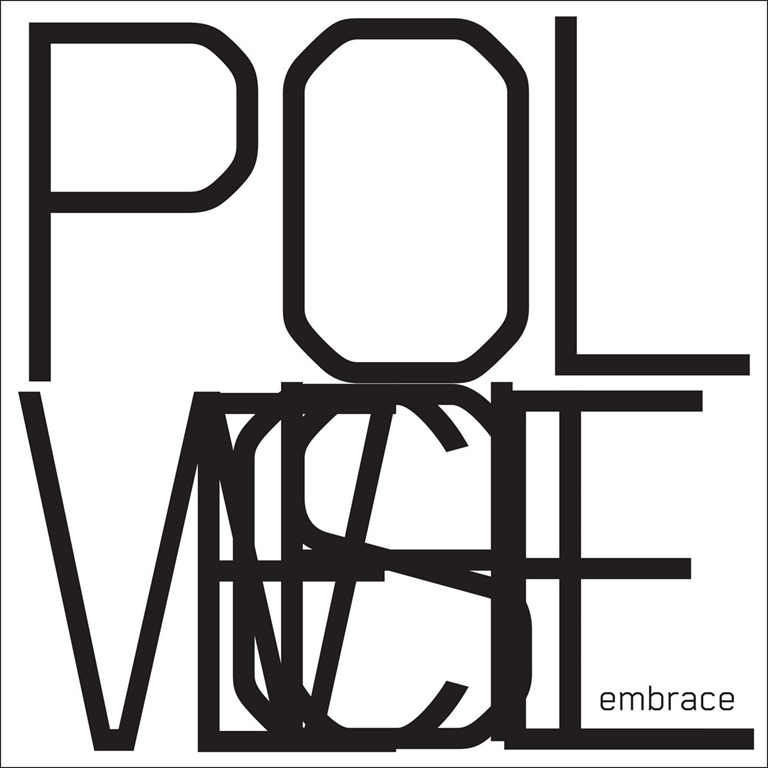
Vienna- and Berlin-based ensemble Polwechsel have a thirty-year career to reflect upon, and with a substantial back-catalogue to their name, and it’s a landmark that truly warrants a box-set retrospective. Although it’s not a retrospective in the conventional sense: this is a work created in collaboration with a selection of instrumentalists and improvisers who share their exploratory mindset. Traditional compilations feel somewhat lazy, and are ultimately cash-ins which offer little or nothing new to the longstanding fan. And so this set serves to capture the essence and style of their extensive catalogue, rather than compile from it.

There’s a lot of ground to cover, too. As the accompanying notes detail, ‘Vienna- and Berlin-based ensemble Polwechsel have been making music at the interface of collective improvisation and contemporary composition. With their changing cast, the group have been at the forefront of musical experimentation, from style-defining works in reductionism in the 1990s, which concentrated on silence, background noises and disruptions, to a change in direction in the 2000s, which saw the introduction of traditional musical aspects such as tonal relationships, harmony and rhythm. Through varying constellations, instrumentations and collaborations, Polwechsel have developed a unique body of work that has firmly established them as one of the driving forces in contemporary music-making… Their music has mostly straddled a line between contemporary music and free improvisation, and is characterized by quiet volume, sustained drones, and slowly developing structures.”

And so it is that for EMBRACE, Werner Dafeldecker, Michael Moser, Martin Brandlmayr and Burkhard Beins are ‘joined by a roster of likeminded guest musicians and former band members to perform a series of new pieces reflecting the whole breadth of their musical investigations.’

‘Jupiter Storm’ is spacious, spatial, strange and yet also playful, an assemblage of sounds that lurch from serious and atmospheric to sleeve-snickering toots and farts, and everything in between over the course of its eighteen minutes, with slow—resonating gongs and trilling shrills of woodwind and plonking random piano all bouncing off one another, while the bass wanders in and out of the various scenes in a most nonchalant manner. On ‘Partial Intersect’, drones and hesitant drones occasionally yield to moments of jazzification, parps and hoots and squawks rising from the thick, murky sonic mist which drifts ominously about for the track’s twenty-minute duration.

Sides C and D contains ‘Chains and Grain’ 1 and 2, again, longform pieces almost twenty minutes long, comfortably occupying the side of an album, are the order of the day. Clanking, clattering, chiming, bells and miniature cymbals ring out against a minimal drone which twists and takes darker turns.

cover

The tracks with Andrea Neumann are eerie and desolate, and occupy the third album. These pieces are different again, with the two ‘Magnetron’ pieces building from sparse, moody atmospherics to some piercing feedback undulations. The shrill squalls of treble, against grating extraneous noise, make for some tense listening. The second in particular needles at the more sensitive edges of the nerves. ‘Quartz’ and ‘Obsidian’, are more overtly strong-based works, but again with scratches and scrapes and skittering twangs like elastic bands stretched over a Tupperware container. The fourth and final album contains two longform pieces, with ‘Orakelstücke’ occupying nineteen and a half minutes with creaking hinges, ominous tones, and a thud like a haunted basketball thwacking onto a bare floorboard. There are lighter moments of discordantly bowed strings, but there’s an underlying awkwardness with crackles and scratches, muttered conversation in German. The fifteen-minute ‘Aquin’ is sparse, yet again ominous and uneasy, majestic swells of organ rising from strained drones and desolate woodwind sinking into empty space.

The set comes with a thirty-two page booklet containing essays Stuart Broomer, Reinhard Kager and Nina Polaschegg (in both German and English) and some nice images which are the perfect visual accompaniment to the music, and while it’s doubtless best appreciated in luxurious print, a digital version is included with the download.

EMBRACE is a quite remarkable release – diverse and exploratory to the point that while it does feel like an immense statement reflecting on a career, it also feels like four albums in their own right. It’s a bold release, and an expansive work that certainly doesn’t have mass appeal – but in its field, its exemplary on every level.