Posts Tagged ‘Experimental’

12th November 2025

Christopher Nosnibor

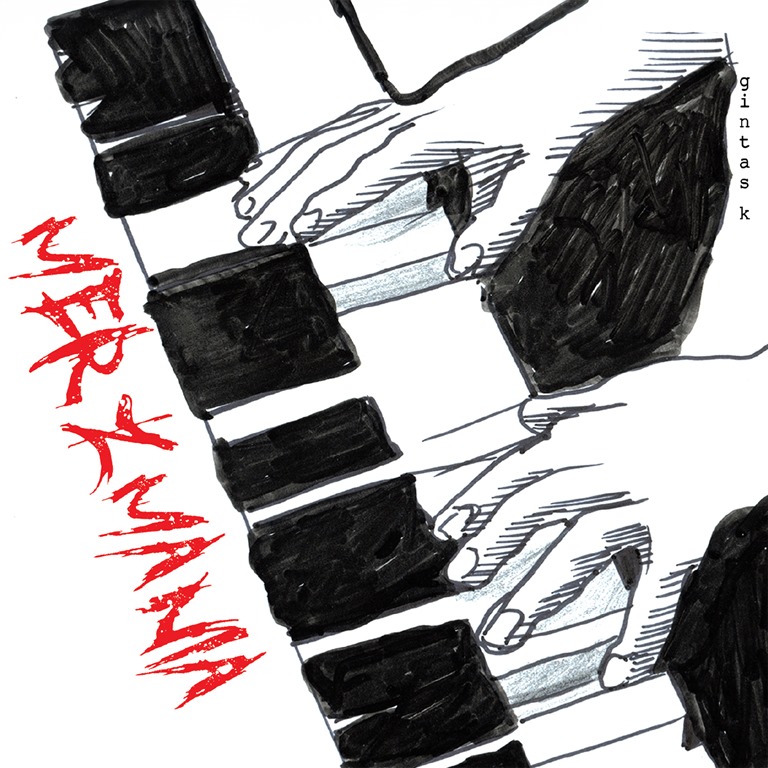
While the approach to recording his latest album is pretty much standard for Lithuanian sound artist Gintas K – that is to say, ‘recorded live, without any overdubs, using computer, MIDI keyboard, and controller’, the inspiration and overall concept is a little different this time around, with Gintas explaining that ‘The album is a subtle allusion to Flann O’Brien’s absurdist novel The Third Policeman, reflecting its surreal and enigmatic atmosphere through sound. In itself, this is quite ambitious – not quite the musical equivalent of interpretive dance, but nevertheless.

And, in contrast with many of his other albums, which tend to be relatively concise and often contain some shorter, almost fragmentary pieces, this one is a whopper, with thirty-one tracks and a running time of over two hours.

Initially, it’s display of K at his most manic, with ‘black box#1’leading the first four-track suite more frenzied and kinetic than ever, the sound of an angry hornet the size of a cat trapped in a giant Tupperware container. There aren’t always discernible spaces between the individual pieces, and after just the first eight minutes of wild bleeps and buzzes, I’m already feeling giddy. ‘black box#1 – 4’ is a quintessential Gintas K blizzard of noise which starts out like trickling digital water tinkling over the rim of a virtual glass bottle and rapidly evolves into an effervescent froth of immolating circuitry.

The second suite of pieces, ‘black box inside#2 Dog Hoots’ is made up of eight chapters – compositions feels like a bit of a stretch – and while there are a couple of sub-two-minute blasts, the fifth is a colossal nine minutes and forty in duration. This marks distinct segment of the album, in that it sounds a little more structured, like the sounds of a toy keyboard or a mellotron, rewired and then tortured mercilessly. It grinds and drones, hums and yawns, it bubbles and glitches and whirrs and it fucking screams. Before long, your brain will be, too.

The third segment, a set of six pieces labelled ‘black box inside… Calmness’ is anything but calm: in fact, it’s more likely to induce a seizure, being more of the same, only with more mid-range and muffled, grainy-sounding murk. There are more saw-like buzzes and crackles and pops and lasers misfiring in all directions. It’s not quite the soundtrack which played in my head as I read the book, but the joy of any art is that it affords room for the audience to engage and interpret on a personal, individual level.

The nine-part ‘rolling’ (or, to give it’s full title ‘black box iside#4 Rolling’ is more fragmented, more distorted, more fucked-up and broken. The pace is slower, the tones are lower, and it’s the sound of a protracted digital collapse. It’s unexpected to feel any kind of emotional reaction to messy noise, but this conveys a sense of sadness. By ‘Rolling – 4’ it feels like the machine is dying, a breathless wheeze of a thick, low-end drone, an attempts to refire the energy after this are reminiscent to trying to start a car with a flat battery. It’d messy and increasingly uncomfortable and wrong-sounding as it descends into gnarly distorted mess. ‘Rolling 7’ is creaking bleats, woodpecker-like rattles. and warping distortion, with additional hum and twang. The last of these is no more than roiling, lurching distortion, without shape or form.

Arriving at the four pieces tagged as ‘omnium – The Fourth Policeman’, its feels like you’re surrounded by collapsing buildings and the exhaustion is not just physical. Gintas K has really pushed the limits with this one. The is an arc, a trajectory here, which can be summarised as ‘gets messier and more horrible as it progresses’. Artistically, this is a huge work, a work of patience, and a work of commitment and focus. As a listening experience, it’s intense, and will likely leave even the most adventurous listener feeling like their head’s been used as a cocktail shaker and that their brain has been churned to a pulp. Outstanding.

AA

a3200436950_10

25th October 2025

Christopher Nosnibor

As the blurbage explains, ‘The Third Side Of The Coin is a split, 2 part album which includes 2 sides of one coin, Anima and Animus. They are separate entities but together they create a bridge between dark and light, outer identity to inner truth and form a union of opposites that gives birth to universal truth. They are the gatekeepers of transformation.’

Well that’s two sides, but what about the third? Of course, this is where the truly conceptual aspect of the work comes in – the part which goes beyond the recordings themselves – and which only really makes sense in context of the following explication:

The Third Side Of The Coin is about the natural but paradoxical dualistic state of the universe. This split album explores both sides of a polarized world by peering over the precipice of the coin only to see a reflection staring back from the other side. It is a surreal mirror showing that what you fear and what you hate is living within the unconscious parts of yourself, both sides being parts of a whole. As you look into the familiar and uncomfortable reflection the coin spins, dissolving duality and revealing a clear image of the third side.
Dissolve the duality! The magic is in the middle!’

Taken literally, this suggests that the magic resides in the space between track five and track six, but I don’t think that’s what they’re meaning. Similarly, although I’m reminded of how William Burroughs and Brion Gysion expounded the concept of ‘the third mind’ as how two minds in collaboration can create a work greater than the sum of the parts, as if there’s a ‘third mind’ at work between them, I don’t feel that this quite first with the concept Moons in Retrograde are offering here.

To delve into the album itself is to venture into a world of thumping beats and deep emotional exorcism: single cut ‘Mirror Obscura’ launches the set in classic style, forging a dark, industrial-infused, goth-hued slice of dark electropop – mid-tempo, atmospheric, anthemic, and completely enthralling. The tracks which follow feel rather more generic, particularly ‘Eternalgia’: it’s a solid electrogoth stomper, and while the synths are sweeping, layered, rich in texture, everything is centred around the hard kick drum, which cuts through it all and really slams. The final song on the ‘Anima’ side is a supple exercise in dreampop, with the emphasis on the pop, a quintessential anthemic mid-tempo ballad.

While the atmosphere is overtly darker during the second half of the album – the ‘Animus’ side – it doesn’t seem so radically different at first. ‘The Edge of Entropy’ very much employs the same instrumentation and approach to composition, and ‘The Rotten Tree’ is a classic, processed dark pop cut. But closer listening reveals more twangy guitar in the mix, and a more claustrophobic and subdued style of songwriting. ‘Taxidermy Mouse’ may sound like a rather humorous title, but it’s a slow, deliberate pulsating piece which goes full aggrotech stomper at the mid-point, drawing on elements of metal while pumping out technogoth grooves. And by the time we arrive at the heaving churn of ‘Biological’, with its rampant, frenetic nu-metal percussion and gargling noise, it’s clear that this is very much an album of two halves, and at times the second half feels like a goth Prodigy.

For the most part, The Third Side Of The Coin feels a shade too clinical to really hit the mark on the emotional scale. It packs some bangers, for sure, but there’s some distance between pumping beats and emotional intensity which has a resonant, moving impact. And perhaps, stripping away the concept and taking the album as it is is the best way to approach this…

AA

a1338474138_10

Constellation welcomes Montréal-based jazz ensemble Bellbird to the label.

Meanwhile Bellbird celebrates with new track ‘The Call’ and will kick off 2026 playing a half-dozen shows on a winter tour of Western Canada in January.

Bellbird features tenor saxophonist Claire Devlin, alto saxophonist and bass clarinetist Allison Burik, bassist Eli Davidovici, and drummer Mili Hong. The players hail from various countries and backgrounds: rooted in modern jazz, Bellbird’s music also channels influences from the players’ wide range of influences steeped in Montréal’s genre-mashing experimental undergrounds, including punk/rock, drone/minimalism, electroacoustics and more. (Constellation has previously worked with Hong via her terrific drumming on The Obsession With Her Voice by Erika Angell and for Angell’s smouldering live shows).

Bellbird’s first album Root In Tandem was self-released in 2023, garnering some well-deserved critical accolades, and acclaimed live appearances on the Avant/Jazz circuits in Canada ever since.

Hear ‘The Call’ here:

AA

BELLBIRD LIVE

January 2026 • Canada

January 15 – The Esplanade (Medicine Hat)
January 16 – Yardbird Suite (Edmonton)
January 17 – Buckingjam Palace (Calgary)
January 18 – ArtsPlace (Canmore)
January 23 – Alliances Français (Vancouver)
January 24 – The Bassment (Saskatoon)

AA

Bellbird

Bellbird photo by Marc Etienne Mongrain

27th November 2025

Christopher Nosnibor

Richard Rouka is… an unusual man. He’s existed around the Leeds scene since the emergence of the goth scene, and he documented it back in the day, in real time, but to describe his own musical output as ‘adjacent’ would be generous, to say the least. The mid-to-late eighties saw his label, Rouska, release a stack of stuff, predominantly by The Cassanda Complex and Dustdevils, bands with strong Leed connections.

His own works, released under the guise of WMTID aka Well Martin This Is Different! draws on the post-punk vibe of that period, but is predominantly primitive electropop with a distinctly bedroom / four-track vibe. WMTID has been a thing for over forty years, but Rouska’s output has skyrocketed in recent year.

One way of pitching it would be early Depeche Mode as performed by Young Marble Giants, but this wouldn’t really convey the ways in which these elements – played and tossed together in the most ramshackle of ways coalesce. But what it hopefully would convey was the fact that this is steeped in early eighties analogue experimentalism, the time when synths were breaking through as emerging technology and the Musician’s Union was shitting itself about how this would herald the death of ‘real’ music – particularly on account of the increasing popularity of drum machines, which they feared would end the need for drummers. Just as home taping didn’t kill music – and if anything it meant that music sharing exposed more people to new acts (I know I discovered countless new bands because people gave me mix tapes), so synths and drum machines broadened musical horizons instead.

Silica Bombs revels in the primitive: ‘Fool Moon’ is simple, sparse, in its arrangement, synths quavering around a persistent piston-pushing drum machine beat. With its stark, minimal production, paired with a fairly flat, monotone vocal delivery, ‘If It Happened Anywhere Else’ very much channels the spirit of Joy Division. The bleak, synth-led ‘Walk With Me (Into the Sea) sounds like a demo for New Order’s Movement. And yes, the recording quality is pretty rough, and it very much captures the spirit and sound of the late 70s and early 80s.

It’s different, alright, but above all, it feels like a magnificent anachronism. The eighties revival had been ongoing for at least a decade now, and so many acts have sought to replicate the sound and feel they’ve largely failed. Maybe you needed to there. Maybe you need the right kit.

But the weird, trilling organ sound of ‘Good Mourning’ brings a dark weight and fizzed-put production which are incompatible with contemporised production values. ‘Crushing Bore; brings a certain humous to proceedings, while coming on like Cabaret Voltaire. ‘Opposites Attract’ brings some heavy drone which contrasts with the sing-song vocal melody, and in may ways this is typical of the way in which WMTID explore polarities with a shameless eighties naiveté. By this, I mean that the 80s was really the last decade of real innovation. The 90s were exciting, and that’s a fact – I was there – but the 80s witnessed the arrival of synths, of electronica, and marked a real turning point in the trajectory of music. And Silica Bombs doesn’t replicate that era so much as live there. With its thumping beats and swirling synth sound, ‘Rouge Planet’ has a strong club vibe. That vibe gets stronger and harder, with the pulsating groove of ‘Sweet Jesus’, which Rouska tells us ‘I’ve got a friend in Jesus’. Yeah. The Jesus and Mary Chain, perhaps. ‘Personal Jesus’ maybe. It drives hard fir a relentless five and a half minutes.

This is an album which wears its influences on its sleeve and shows no signs of shame in that. And why should it? Rouska is very much of that era and played a part. The fact that his musical output over the last few years is indicative of a person who doesn’t go for meetups with former colleagues. More than its predecessor, Finding the A.I. G-Spot, Silica Bombs feels significantly beat-orientated, and more hard-hitting. It’s retro, and its catchy. It’s retro and it’s weird in that it has no specific identity… it’s just what it is. And it’s a groove.

AA

AA

AA

a2195822840_10

22nd November 2025

Christopher Nosnibor

The second collaborative release of the year by Deborah Fialkiewicz & {AN} EeL (aka Neal D. Redke) lands amidst a blizzard of output from two musicians who are both insanely prolific – by which I mean prolific on a scale which isn’t far off Merzbow or Kenji Siratori: they each release more frequently than the average person has time to listen to it. I don’t in any way consider myself to be an average person – and we’ll not go there – but writing about music means that having something play in the background while I do other stuff, like changing the cat litter or whatever, isn’t always something I fancy, and certainly isn’t my way of hearing a release for the first time. Ok, so this is not how, say, my daughter, who’s fourteen, or her generation, or even some of my peers take in new music, but my formative experience of new music involved sitting down and setting a new album to spin and giving to my undivided attention for its entire duration. Sometimes twice in succession, or more on a weekend.

Attention, in 2025, is, it would seem, in short supply. And yet, flying in the face of this, albums with long tracks seem to be becoming increasingly more common. Perhaps it’s a sign of artistic rebellion. Perhaps it’s that artists feel a need to reclaim the focus and concentration associated with longer works. Whatever the reason, it’s welcome, and Purple Cosmos contains three compositions spanning a solid half an hour.

This is a thoughtful, delicate trilogy of compositions, which build from hush to tumultuous tempests of sound incorporating powerful space rock and progressive elements within their protracted ambient forms.

‘The Floating Monk’ is centred primarily around a thick, earthy drone that has the texture of soil, and it’s enmeshed with dark layers of serrated tones and thunderous rumblings. It’s dark and it’s dense, and it’s uncomfortable. The rest of the album doesn’t offer much by way of light relief.

Yes, the title track strays more toward bleepy electronic experimentalism –a different kind of space rock, if you will – and the final track combines wailing synth overload with some persistent beats… but first and foremost this is an unashamedly experimental work.

Purple Cosmos is a work which reflects a rare attention to detail, and it possesses a certain persuasive relentless in its marrying of dark noise, analogue undulations, and insistent beats. There’s more than a hint of Throbbing Gristle about it, and perhaps a dash of Factory Floor. It gets inside your head, and at the same time enwraps your entire being with its otherworldliness. It sure is a far-out groove.

AA

a2147012585_10

Mortality Tables – 17th October 2025

Christopher Nosnibor

Among their ever-expanding catalogue, Mortality Tables have put out a number of releases which are essentially singles or EPs, with this being one of them: with a running time of just over eleven and a half minutes, this single longform composition is only marginally longer than its title, but its creator, Michael Evill, has condensed a considerable amount of material and experience into this space.

As he writes, ‘I have created a movement which includes the last breaths of my beloved dog Watson. It also includes the last time I recorded with my most talented and wonderful best friend Gustaf in 2001, which I have slowed down so I (and you) can spend more time with him. There are the sounds of new stars being born – my own interpretation and ones ripped off from NASA through this modern internet connection we all have. Surely we own the stars still?

‘We have Aztecs having fun with drums. These were recorded live in Mexico, sadly not from the 14th century before we invaded. We have the hourglass from our kitchen, which Mat inspired me to sample. This was the first idea of this piece and everything else fell in to place very quickly as it’s been swimming in the back of my mind for a while.’

Clearly, some of these elements have deep emotional significance for Michael, but this isn’t conveyed – at least not overtly or explicitly – in the work itself. It’s a collage-type sonic stew, where all of the myriad elements bubble and roil together to form a dense soup, in which none of the flavours are distinct, but in combination, what he serves up is unique, and provided much to chew on. That this protracted food-orientated metaphor may not be entirely coherent is apposite, but should by no means be considered a criticism.

As Evill goes on to write, ‘this was the beginning, and I didn’t spend much time thinking about it and just coalesced those ideas.’ Sometimes, when seeking to articulate life experience, it doesn’t serve to overthink it. Life rarely happens that way: life is what happens when you’re busy thinking and planning. And just as our experiences aren’t strictly linear, neither are our thoughts and recollections. Indeed, our thoughts and memories trip over one another in an endless jumble of perpetual confusion, and the more life we live, the more time we spend accumulating experience – and absorbing books, films, TV, online media, overheard conversations and dreams, the more everything becomes intertwined, overlayed, building to a constant mental babble.

William Burrroughs utilised the cut-up technique specifically to bring writing closer to real life, contending that ‘life is a cut-up… every time you walk down the street, your stream of consciousness is cut by random factors… take a walk down a city street… you have seen half a person cut in two by a car, bits and pieces of street signs and advertisements, reflections from shop windows – a montage of fragments.’

This encapsulates the artist’s quest: to create something which conveys the thoughts in one’s head, to recreate in some tangible form the intangible nebulous inner life, if only to help to make sense of it for oneself.

‘Even Though It Was The Blink Of An Eye’ is a woozy, disorientating churn of noise, which is, at times, dizzying, unsettling, nausea-inducing. But then again, at other times, it’s gentle, even melodic, reflective, contemplative. There are some passages where it’s all of these things all at once. It very much does feel like a scan of the artist’s memory banks, the human brain equivalent of skipping through the RAM files and pulling items seemingly at random. It does feel somewhat strange, even awkward, being granted access in such a way, but at the same time, it feels like ‘Even Though It Was The Blink Of An Eye’ is more than an insight into the mind of one individual, but an exploration of the human psyche.

AA

a0518044244_10

Sinners Music – 1st October 2025

Christopher Nosnibor

Sinners Music – the label established by electronic music maestro and one-time music shop owner, Ian J Cole, continues to offer up new music that’s interesting and unusual. There are some context where ‘interesting’ is somewhat dismissive, diminishing, and people of a certain age will remember snooker legend Steve Davis being given the nickname of Steve ‘Interesting’ Davis ironically… although the double irony emerged that he was genuinely interesting, as his work with The Utopia Strong abundantly attests. Here, my use of ‘interesting’ is neither ironic nor dismissive: it’s meant sincerely, as there is no specific ‘house’ style or overt genre specificity evident. This is one of the reasons why boutique microlabels can be worth following – you never know quite what you’re going to get from them, but you can guarantee if won’t be ordinary. And this release by no means ordinary.

As for The Azimuth Tilt, their bio informs us that this is the work of ‘a solo ambient electronic project exploring the liminal spaces between sound, memory, and landscape. With a name drawn from the alignment of a real to reel tape head, the project orients itself toward the unseen—subtle shifts in perception, emotional resonance, and the hidden geometries of the natural world… Blending atmospheric textures, glacial rhythms, and immersive sound design.’ There are no clues as to who this is the project of, but it matters not, and in fact, the less we know, the better. This is the joy of abstract ambient works: all you need is the sound, and all you need from the sound is to let it drift, to carry you away. And this is what Alignment does.

On a certain level, it does very little. On another, it is a quintessential deep ambient album. Alignment features just six compositions, but has a running time of some fifty-seven minutes. The soundscapes which define it are sonically rich, with soft, drifting, cloudlike contrails merging with lower drones and contrails. In combination, filling the entire sonic spectrum, Alignment does a lot.

From nowhere, halfway through ‘An Unqualified Person’, a raucous sax breaks out.

And the layers build. Against scrawling spacious drift, it’s quite a contrast. And then there’s some subtle piano intervention, and from hereon in, the piano and sax alternate in leading. It’s nice… and not in a turtle-neck top kind of way. It’s nice but… a little strange. But ‘The Exquisite Space’ crackles and swirls abstractedly, with some supple motifs rippling and intertwining with a mellow mood exploration which arrives at more sax. Always more sax.

This seems to be a dictum The Azimuth Tilt are happy to follow, although it’s melted into the echo-soaked atmospherics of the final track, ‘And the Band Played On’. Alignment is not a dark album, but it’s one which feels unsettled, uncomfortable, unsure of its destination – and whatever it may be, the journey is worth the exploration.

AA

a0054555481_10

Legendary Italian experimental trio Zu recently announced their return with Ferrum Sidereum (produced by Marc Urselli), a big and bold double album arriving on House of Mythology on the 9th January.

The music combines the complexity of progressive rock, the grit of industrial music, the precision of metal, the spirit and energy of punk, and the freedom of jazz. The result is a sonic journey that is as cerebral as it is visceral, defying easy categorisation while remaining unmistakably Zu.

Today they share the new single and video for ‘A.I. Hive Mind’ – about which the band comments, “Smart cities, brain computer interfaces, internet of things, singularity. This particular track addresses all of these things as well as questioning the loss of self, the idea of single consciousness and collective predictable behaviour. Perhaps the most burning question for us is: What does it mean to be human in a world increasingly shaped by artificial intelligence, simulated realities, and technological control?”

AA

Zu have also shared live dates in support of the new album – dates and details below.

2026 LIVE DATES

10/01/26 – Bologna, TPO – Italy
21/01/26 – Caserta, Lizard Club – Italy
23/01/26 – Palermo, Candelai – Italy
24/01/26 – Catania, Zo Culture Contemporanee – Italy
28/01/26 – Milano, Santeria – Italy
29/01/26 – Verona, Colorificio Kroen – Italy
30/01/26 – Zagreb, Mocvara – Croatia
31/01/26 – Nova Gorica, Mostovna – Slovenia
01/02/26 – Bratislava, Žalár – Slovakia
02/02/26 – Prague, Palac Akropolis – Czech Republic
05/02/26 – Berlin, Neue Zukunft – Germany
06/02/26 – Copenhagen, ALICE – Denmark
07/02/26 – Malmo, Inkonst – Sweden
09/02/26 – Bruxelles, Magasin 4 – Belgium
10/02/26 – Eeklo, N9 – Belgium
11/02/26 – Amsterdam, OCCII – Netherlands
12/02/26 – Paris, Le Chinois – France
13/02/26 – Bulle, Ebullition – Switzerland
14/02/26 – Torino, Magazzino sul Po´ – Italy

Ferrum Sidereum – Latin for ‘cosmic iron’ – draws inspiration from the mythological significance of meteoritic iron, found in artefacts like ancient Egyptian ritual objects, Tibenta ‘Phurpa’ blades, and the celestial sword of Archangel St Michael. This elemental force imbues every moment of the album’s apocalyptic sound. Whilst heavy in tone and subject matter, bassist Massimo Pupillo comments that their music also aims to "raise good energy… people would come up to us after the show and tell us that they felt alive."

The trio – Paolo Mongardi (drums, percussion), Luca T Mai (baritone saxophone, synth, keyboards) and Massimo Pupillo (electric bass, 12-string acoustic guitar) – spent a year refining this sprawling 80-minute epic through relentless rehearsals and live studio recordings in Bologna. Produced and mixed by three-time Grammy-winning engineer Marc Urselli, known for his work with Laurie Anderson, Lou Reed, and Mike Patton, the album balances raw intensity with refined production tweaks and textures.

“We are very spiritually-oriented people,” says Massimo. “Machines and AI do not have spirituality. So they can mimic and they can assemble existing things, but they cannot create. That spirit is probably the most important thing that our music carries.”

AA

IMG_18602-9903cf03cf05143c 

Photo credit: Marco Franzoni

Dret Skivor – 7th November 2025

Christopher Nosnibor

Dave Procter is / has been involved in more musical projects than your mum’s had hot dinners. Having left Leeds for Sweden, not least of all on account of Brexit, he’s currently paying the UK a visit with a tour which features performances by no fewer than five of them – last night’s set in York was one of two halves, featuring the polite extreme electronica of Trowser Carrier and the whacked-out post-punk infused racket that is Loaf of Beard. So about these ‘Brexit benefits’… and the fear of taxing the rich for fear they’ll leave the country. Since they’re not paying much tax anyway, where’s the loss there? Meanwhile, we’re losing migrant workers who keep the NHS operating, who harvest crops, and flip burgers, AND we’re killing creative industries by making it harder for artists to tour here. A few years ago, there was considerable coverage given in the media about the country’s so-called ‘brain-drain’; there’s been rather less coverage given to the slow murder of the arts. The Guardian and The Independent have raised their hands in quite anguish over the killing off of arts degrees, degrees which are being targeted as not providing a route to a well-paying career, but in the main, this is happening quietly. What’s painful is that there’s so much raving about ‘small boats’, hardly anyone is noticing, and even fewer care because they’re too busy buzzing over the Oasis reunion or Taylor Swift. I’ve got no specific beef with Taylor Swift and her sonic wallpaper, but the point is that there is so much life and art and creativity beyond the mainstream. There is an extremely diverse array of subcultures, an underground that’s as big as the overground, only more diverse, eclectic, fragmented, and this is what’s suffering.

To return to topic, somehow, amidst all this activity and while in transit, Procter’s managed to launch both a new release and a new project via his Dret Skivor label, in the form of OSC, the debut – and likely one-off – album by the imaginatively titled oscillator.

The accompanying notes are unusually explanatory for a Dret release, forewarning of ‘Glitch, ambient and toy keyboard experiments. Play through decent speakers and headphones, the lows are LOW!!!’ The tracks were created during some free studio time in Copenhagen in October 2024, and, as ever, the CD run is minuscule, with just 6 copies. This, of course, is typical of the DIY cottage industry labels, particularly around noise circles. It’s not only a sign of an awareness of just how niche the work is – and it very much is that: no point doing 50 CDs or tapes when it’ll probably take a year to sell four – but also indicative of a certain pride in wilful obscurity. Just think, if the bigtime ever did beckon, those spare copies sitting under the bed may actually acquire some value. Just look at how much early Whitehouse albums go for, for example.

OSC is very much an overtly experimental work, featuring six numbered pieces – the significance of said numbers remains unclear, if there even any significance, although notably, they’re all zeros and ones, or binary – which range from a minute and twenty seconds to just over eight and a half minutes.

‘01’ is a trilling electronic organ sound skittering over long drone notes, and abruptly stops before the bouncing primitive disco of ‘10’ brings six and a half minutes of minimal techno delivered in the style of Chris and Cosey. It’s monotonous as hell, but it’s intended to be, hypnotic and trance-inducing. Zoning out isn’t only acceptable, but a desirable response. ‘100’ is seven and a half minutes of dense, wavering low-end drone, the kind which slows the heart rate and the brain waves. As the piece progresses, the rumbling oscillations become lower and slower and begin to tickle the lower intestines, while at the same time some fizzy treble troubles the eardrums. Nice? Not especially, but it’s not supposed to be. Sonically, it’s simple, but effective.

‘101’ is so low as to be barely audible: not Sunn O))) territory, so much as the point at which the sun has sunk below the horizon and the blackness takes on new dimensions of near-subliminal torture. The final track, the eight and a half minute ‘110’ is a classic example of primitive early industrial in the vein of Throbbing Gristle, with surging oscillations which crackle and fizz, a thrumming low-end pulsation. It ain’t easy, but it’s magnificent.

Procter loves his frequencies, just as he loves to be eternally droney, and at times Kraut-rocky. OSC reaches straight back to the late 70s and early 80s. OSC is unpredictable, and tends not to do the same thing twice. It’s in this context that OSC works. Embrace the experimental.

AA

a2917884968_10