Archive for the ‘Singles and EPs’ Category

Come Play With Me – 6th December 2019

Christopher Nosnibor

Leeds-based singles label Come Play With Me end 2019 on a high as they continue to promote the most exciting fresh talent from the region – and remind us that regional and local doesn’t have to mean substandard or amateurish. Then, Leeds has long been a hotbed for emerging talent to cater for all tastes, to the extent that listing the acts that the city has produced in recent years – and further back -seems vaguely pointless and moreover, there are simply too many to name.

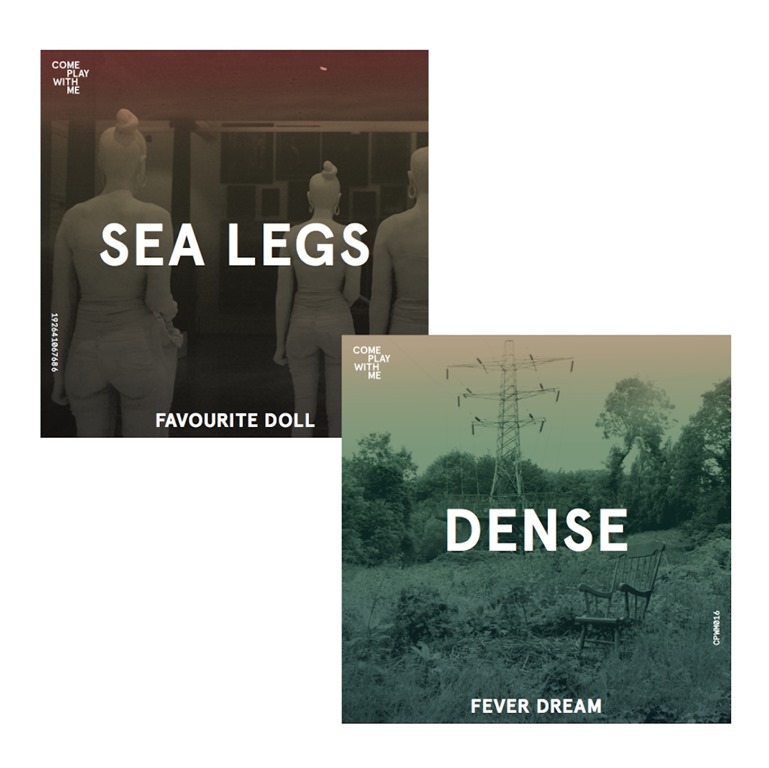
Dense live up to their name on ‘Fever Dream’, a song inspired by a dream the band’s singer Charlie had while ill, and conveys the horror of vivid scenes and heightened sense as he hollers gruff and manic into a shuddering wall of juddering bass, crashing drums and thick guitars. It’s dirty, it’s grungy, it’s gritty, and it’s loud. Somewhere in the murky mess is a surprisingly tight groove that pins everything together. Around the midpoint, everything explodes into a frenzied, head-shredding mass of noise and demented yelping. This seems the only way to truly convey an unspeakably disorientating and otherworldly trauma.

Sea Legs offer up something altogether lighter and brighter: ‘Favourite Doll’ is a sliver of buoyant but shadow-shaded indie that has Hints of the Cure about it. It’s a nice contrast to Dense’s brutal noise, and with a light melody and ready accessibility, provides a welcome contrast. That’s a contrast that’s complimentary, of course: CPWM have long demonstrated a knack for perfect pairings, and this latest is no exception.

DENSE - FEVER DREAM (ARTWORK)

CPWM016

Christopher Nosnibor

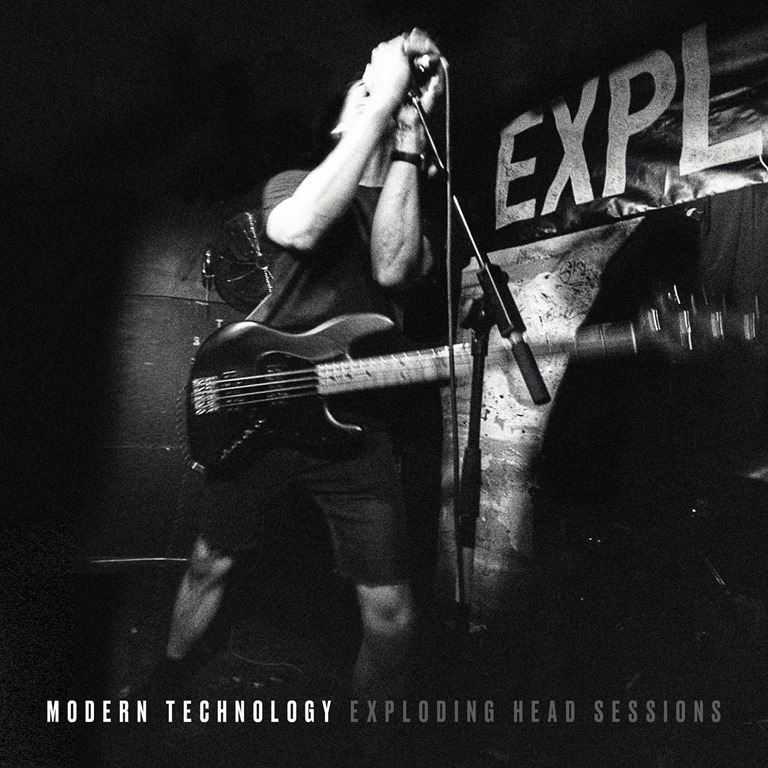
It’s fitting that noisy-post-punk London duo Modern Technology should have recorded a live session at the Shacklewell Arms under the banner of Exploding Head: everything about the band to date has been explosive, from the sonic blitzkrieg of the eponymous debut EP to their growing fanbase, due to a committed live schedule which has seen them deliver some killer performances. The fact they’re thoroughly decent guys whose sociopolitical message extends beyond the lyrics and into the active donations of proceeds and profits to charitable causes hopefully counts for something, too: they’re not Bono about it: they just fucking get on and do it. and so the proceeds from this release are going to Crisis at Christmas ‘to help support the homeless during this critical time of year and to help fund and support Crisis’ vital year-round work with homelessness’.

Hearing the nihilistic fury of the music, it’s clear that this philanthropy is born almost entirely of frustration and despair at social injustice and inequality, and this six-tracker captures the live experience very well indeed, with four tracks culled from the aforementioned EP along with a brace of new cuts in the shape of ‘All is Forgiven’ and ‘Bitter End’.

It packs full-throttle viscerality from beginning to end, and two things stand out on this release: 1) the colossal noise they churn out with just bass and drums 2) how faithful to the studio renditions the EP songs are.

2) is a testament to how tight and well-rehearsed they are, with metronomic grooves holding everything together 1) is about ore than just pedals. Modern Technology do volume and appreciate that effects and all that stuff only fill so much space. Ultimately, there is no substitute for hard volume. There is a 3), as well. What’s unique about Modern Technology’s sound is that for all the thunderous density, they create a vast amount of space, and the way the air hangs between the notes, between the punishing snare hits, creates a stark, yet simultaneously oppressive atmosphere.

‘I ain’t quick, I ain’t cheap’ Chris Clarke barks on ‘Queue Jumper’, against a backdrop of tumultuous drums and a grating bass chord that sustains into infinity. It’s a simple but effective refrain that’s instantly memorable. It’s all in the delivery, of course.

The new material is monumentally dense and abrasive, with the downtuned, sinewy riffage of ‘All is Forgiven’ reminiscent of Melvins, while ‘Bitter End’ is sparse, slow and bleak and throws in a vaguely psychedelic twist in the verses, crashing into a grinding low-tempo riff for the chorus, such as it is.

One of my bands of 2019, and with dates booked for 2019 already (I may have something (ruined) of a vested interest in the February dates), Modern Technology are a band on the up because they’re a band for our times.

AA

cover

Buzzhowl Records – 24th January 2020

Christopher Nosnibor

Masks are generally used to either obscure, hide, or otherwise present an alternative identity. The press blurb which accompanies the debut release by Masks, which arrives in the form of a two-track (lathe-cut) seven-inch gives little away, beyond the ‘fact’ that Masks is a New Zealand based artist. Singular. Although this is immediately thrown into question by the statement ‘We’re very excited to be putting out Masks’ debut release. We’ve been fans of the people involved for some time now.’ This doesn’t discredit the singular aspect, but does compel questioning. Toward the end of any interrogation, it’s perhaps worth asking ‘does or should it matter?’ Probably not, although our instinct is to seek something upon which to pin an identity or similar concrete elements as identifiers, as a means of basing experience and engagement.

Most songs about weekends I’m aware of are jaunty, jubilant, celebratory tunes. Take Michael Gray’s 2004 chart smash ‘The Weekend’, accompanied by a video with a sultry secretary busting moves around a photocopier, for example Reverend and the Makers’ ‘Living for the Weekend’ was irksome wank, and ‘The Weekend’ by Interpol is one of their weakest tracks by yards. The emphasis is very much on the separation pf the working week, and the weekend, which for many is not the reality of how work and life balance.

Masks sounds like their weekend contains back-to-back funerals as they grind and hammer their way through a murky mess of guitar that’s more about atmosphere than definition or tune. The percussion is pure punishment, industrial-strength pounding, while a synth howls an anguish-inducing drone around a monotone vocal that carries hints of Brian Molko. Yes, ‘Our Weekend Starts Tomorrow’ comes on like a bleak industrial / post-punk Placebo and packs some serious punch in a lugubrious, mid-tempo but thunderously dense sense.

There’s a change of mask for ‘Broken Glass’, a drifting, beat-free swell of instrumental ambience. It’s pleasant, but dark and contrasts starkly with ‘Our Weekend Starts Tomorrow’ in its overt formlessness. Is it a different face of the ‘band’ / ‘artist’, or another identity altogether? It’s unquestionably a departure, and if nothing else, suggests that Masks are multi-faceted.. complex. Unpredictable. Subject to change. What lies behind the mask? Maybe all will be revealed in good time…

Artwork Credit_ Sven Soric

29th November 2019

Christopher Nosnibor

For me, there are few things worse than a story untold and only alluded do. Tell it or don’t! The press release for Cologne-based Roman Jungblut’s solo debut tantalisingly informs us that ‘His mainly improvisational musical live performances – in varying constellations since 1996 – are temporarily reduced to a few selected appearances in Cologne since 2009, due to reasons’. First and foremost, of course, my thoughts are with the artist: we all have our reasons for done – for not doing – things. Sometimes, they’re painful, or we simply don’t want to talk about them. But a story-half-told can lead to speculation. Not that I’m about to speculate on anything here, and shall instead focus on the sonic document presented in the form of Back To Where It Never Started, which comprises four pieces which explore a broad territory in a short span of time.

The blurb goes on: ‘After a ten-year full abstinence of recorded output besides contract work – and only ever having released music as a member of bands or collectives – Roman finally found it to be inevitable to not only release some music, but to do it as a solo artist, not hiding behind a pseudonym, an ensemble or even ironic distance. “Back to where it never started” is the first product of a long time filled with lots of artistic and personal moments of growth, of finding the courage for imperfection and embracing the potential of constraints’.

The most striking thing about the EP is its diversity.

‘Detox – Retox’ packs a lot into just five minutes, as a trilling top synth that surges and builds tension suddenly gives way to a plunging, thumping bass pulsation that’s low and low, and registers around the lower abdomen, before spiralling scraping drones evolve around it, conjuring a cinematic, texture-heavy soundscape that resonates in ever-expanding ripples.

‘78-7-88’ is radically different, a piano-led piece that’s almost jazzy in its stylings – but not so jazzy as to be irritating. Long, drawn-out notes hang and taper over the jaunty, mellifluous babbling backdrop, while ‘Einsicht’ is a space-age bloop-out, with whistles, bleeps, and whirrs hovering in zero-gravity slow-mo.

The final composition, the eleven-minute ‘Two for Tooth’ takes the form of a sparse yet layered ambient work that gradually grows warmer as it develops, slowly and subtly, around a rippling repetitive wave.

In some respects, the fact the set tapers out after so many shifts and ups and downs feels vaguely disappointing, but ultimately, its slow ebbing departure seems fitting as the listener’s journey ends with Jungblut meandering toward the horizon.

AA

RJ01_front

Los Angeles-based dark punk band The Wraith share the first single "Wing Of Night" from their incoming debut album, Gloom Ballet (Southern Lord, 29th Nov). Influenced by the likes of Killing Joke and 1919, The Wraith’s post-apocalyptic ‘Wing of Night’ juxtaposes a relentless verse groove – the ominous march of a spiritual death squad – with faint hope flickering amidst its expansive chorus.

“’Wing of Night’ is about not just surviving the pain and struggle of living in a dark world, but also welcoming these,” says The Wraith vocalist/lyricist Davey Bales. He continues, “Embracing hell and rejecting heaven as your reality, but in a positive way.”

Gloom Ballet delivers twelve infectious tracks drenched in the band’s ‘80s UK post-punk (Death Cult, Killing Joke, Chameleons) and SoCal deathrock (T.S.O.L., Samhain) influences. Recorded by Puscifer guitarist/producer Mat Mitchell, Gloom Ballet was mastered at Audiosiege by Brad Boatright (From Ashes Rise, Tragedy, Alaric) and the artwork by Rebecca Sauve.

Listen to ‘Wing of Night’ here:

29th November 2019

Christopher Nosnibor

Ahead of the release his seventh solo-album, Exo, in January next year, Swiss electronic artist Bit-Tuner indicates a significant change in direction with this single release. The two pieces on offer here are brief and – here’s the headline – beatless, as Bit-Tuner goes fully ambient.

It’s also a surprisingly succinct sonic document, the two tracks combined clock in at a mere fraction over seven minutes. ‘Passage’, the press release tell us, is ‘based on field-recordings, synthesizer pads and fluttering arpeggios,’ and ‘resembles a winding descent into a weightless but fragile science fiction world.’ The music in itself conveys almost nothing of this yet at the same time, succeeds in creating its on psychological space through the language of sound. It’ hushed, subdued, fragmented. Sounds like seagull calls drawl across ethereal twistings. Sometimes, abstractions conveys more than anything concrete or specific.

Virtual flipside / counterpart ‘Irisia’ is described as ‘a call from way below’ in which ‘a thunder-like growl from the underworld wraps itself around a floating choir-drone’. At a mere two-and-a-quarter minutes, and consisting of echoed notes and a mist-like sonic mist swirling directionless, it’s barely an interlude. And yet, despite its lack of substance, it has atmosphere and a certain depth.

I am left pondering the oddity of a ‘single’ release in the context of an ambient work that’s most likely designed to be consumed as a single while, but this showcases Bit-Tuner’s latest work in a digestible and readily accessible, bite-sized format, and it works nicely.

AA

OUS022_cover

Christopher Nosnibor

For some inexplicable reason, I woke up feeling nostalgic today. Perhaps it was unloading a pile of NME and Melody Maker from 1992-1995 recently collected from my father’s house from the boot of the car that triggered it, but then I got to thinking about all kinds of random things from my youth, from Noodle Doodle pasta to the smell of classrooms.

Videostore’s third independent DIY release, ‘Every Town’ is two and a half minutes of swirling, spaced-out shoegazey-indie. Think Slowdive covering The Jesus and Mary Chain. Or vice versa. It doesn’t really matter either way: it’s a laid-back, low-tempo effort that harks back to an early 90s vintage, while at the same time casting a nod back a long way further, to the 60s when pop single was just two and a half minutes long, with no filler.

This in itself is nothing new: The Smiths were very much geared toward that perfect pop template, and The Wedding Present’s ‘Hit Parade’ project in 1992 was very much centred around creating succinct slices of pop.

Videostore – a side project of husband and wife duo Nathan and Lorna of London indie-pop act Argonaut – absorb all of this and add their own twist to the template to create something special here, and the result is nostalgia-drenched and retro without being twee.

AA

Videostrore

1st November 2019

Christopher Nosnibor

So The Shakin’ Nightmares gatecrashed my radar thanks to a message via Facebook from Dan Gott, guitarist and the man wit all the whoops and howls for manic rockabilly duo Snakerattlers. Since he books gigs at my favourite venue as a day-job he sees and hears a lot of bands, so if he reckons I need to hear an act, the chances are I really do.

They do the matching outfits thing – which is a bit Snakerattlers, but also reminds me of The Computers – and the four songs on this, their debut EP are kicking, but with a sense of order and a determined sense of identity.

‘(I’ve Got) The Shakin’ Nightmares’ kicks it off with a slow swagger and a reverb-heavy twang that struts its way into a swampy gothed-up surf riff that reminds me of The Volcanoes – which means I’m instantly sold. It’s very much about a well-worn template that has its origins in the blues and has been kicking around in various mutant forms since ‘The Hippy Hippy Shake’ in 1959, but it gets increasingly wild, twisting 60s psyche with grunged-up alt-rock.

They step up the pace on ‘Revenge’ which brings a frenzied punk aspect to the boogie-woogie wig-out and ‘I Wish’ chops a groove that sashays into the more straight-ahead rock closer ‘A Little Death’. It’s still dominated by a choppy guitar and some deep reverb, and these guys are cruising hard on an obsessive death trip. I can get on board with that. If it’s not sex or drugs, then rock ‘n’ roll needs death. We can’t all get sex or drugs, and don’t even necessarily want them, but we’re all going to die. And given the state of things, sooner rather than later seems increasingly appealing. On that basis, plus the basis of some solid tunes, The Shakin’ Nightmares have all the appeal right now.

Christopher Nosnibor

Something is wrong. Seriously wrong. That there is something wrong with the enigmatic Paul T, who is Foldhead, almost goes without saying: purveyor of strange and dark noise via means of a multitude of collaborative projects as well as solo channels, creator of avant-garde visual art, William Burroughs nut, and passionate left-winger, Paul is the epitome of the fringe polyartist who confuses and confounds all things mainstream and normal. These are all the reasons I like the guy and so enjoy collaborating with him whenever we manage to get our shit together. He gets it: he lives and breathes cult and outsiderdom, and has both the means and the theoretical comprehension. Which in the eyes of the many, makes him wrong. He doesn’t fit and neither does his work, and his output as Foldhead is just so much noise to most ears.

The (at least on the surface) inexplicably-titled liveBufferingErrorTimeout (I must clean the black milk with brine) is typical, and wrong on every level. This is electronica that splinters the peripheral senses. It focuses on frequencies that register almost subliminally and that hurt the most, with shards of brain-piercing treble attacking from all sides while whipping whorls of stuttering circuit crackling prod the synapses like needles. It’s a relentless crackle, pop, hiss and fizz, like a firework display exploding inside your cranium exploding over a wash of analogue froth.

Recorded on 19 October 2019, the recording features just the one piece – ‘rotting tongue: nature’s assailed’. It’s as brutal as whiplash and ten times more likely to induce tinnitus, and with a running time of only 7’34” – instead of a classically Burroughsian 23’ that’s more typical, something is very wrong indeed. The noise stops abruptly, and in the absence of information accompanying the release itself, the clue, I suspect, is in the title.

Equipment malfunction or failure is one those things that plagues the recording artist in the digital age. And so what was mapped out to be an hour of racket has emerged as a mere seven minutes; a single rather than an album. But what it lacks in duration, it makes up in pian infliction. A short, sharp shock indeed.

AA

Foldhead - Buffering error

Buzzhowl Records – 18th October 2019

Christopher Nosnibor

What came first, the music or the mindset? I’m going to put it down to how some of us – myself included – are wired, and will forever be drawn to that tense, dark sound that came out of the late 70s and early 80s that was a reaction to – and against – everything that was happening at the time. Just as punk was a reaction to – and rebellion against – prog and the beigeness of the times, so post -punk and its various strains, including (dare I whisper it?) goth harnessed the frustration and the dejection that was a product of the first years under Thatcher and the political climate of the second cold war and rendered it in a more articulate, and perhaps more musically resonant way (because let’s face it, 90% of so-called punk bands were just playing pub rock with the amps up).

To revisit briefly an observation I’ve made variously in recent years, these are bleak, bleak times, and the future is well out of hand. The post-punk renaissance that began around 2004 with the emergence of Editors and Interpol grew from an underground which was there long before, but now it’s in full spate. Reading’s Typical Hunks fully embrace all of this as a guitar bass duo backed by a drum machine.

The guitar on ‘Snakebit’ is spindly, reverb-heavy, weaving one of those tense post-punk guitar-lines that’s pure Joy Division, and it snakes its way around a tight, insistent bass that booms and drives along with the insistence of the grooves Craig Adams laid down to define the sound of The Sisters of Mercy in the early years. That in turn is wenled to thumping beat that’s a distillation of all things Yorkshire circa 1983-4. It’s all in the programming: nothing fancy, no attempt to make it sound like an actual drummer, no flash fills or flourishes, just a hammering repetition and a snare sound that’ll slice the top off your head. Those Boss Dr Rhythm machines really are unbeatable. The vocals are tense, paranoid, and channel disaffection.

Strains of feedback and a hesitant bass hover before everything locks in around another relentless rhythm on ‘Unravelling’ with elements of March Violets, Red Lorry Yellow Lorry, and early Danse Society all spun into a solid block of discomfort. Vintage in its roots yet ultimately providing the soundtrack of the zeitgeist, this is a cracking Aside / B-side combo housed in a suitably barren sleeve, that showcases Typical Hunks at their strongest and most focused yet.

AA

Artwork