Archive for the ‘Albums’ Category

Nocturnal Rainbow Recordings – 5th September 2025

Christopher Nosnibor

One significant downside to digital music formats is that is reduces the dimensions of the experience. With a record, and even a CD, there is a physicality which is in many ways integral to the experience. I’m not here to sell the whole multi-sensory experience and tactility of vinyl line: yes, I grew up with vinyl, and in the 90s, a new LP was maybe £7.50 while a CD was £11, so I would often buy vinyl simply because I could get more music for my money. And records do scratch, sleeves get bent, and generally, vinyl requires more care than a CD, so I’m as much a fan of 5” silver discs as I am 12” black ones. And now, vinyl has become something of a fetishised luxury item: as much as there’s still pleasure to be had from sliding a thick chunk of wax cast in whatever hues from a glossy, heavy card sleeve, there’s sometimes a sense that they’re all trying too hard, and the £30 price tag takes some of the shine off the experience. There are a few exceptions – recent Swans releases have been works of art in every sense, and the physical formats have added essential dimensions to music which is something more than just some songs, recorded.

Had Ran Slavin’s latest offering been given a vinyl release, it would have been a triple LP, containing as it does thirty tracks, with a running time of almost two hours. It would have been epic. But despite having released previous albums on esteemed labels including Mille Plateaux, Cronica, and Sub Rosa, it’s unlikely that Ran Slavin has the kind of fan base that could justify, from a label perspective, a triple-vinyl release. But what Nocturnal Rainbow Recordings have done here is interesting, and utilises the digital format in a novel way, by offering alternative artwork in recognition of the album’s multi-faceted nature. Yes, it’s been done by major artists who’ve released physical albums with variant covers, with a view to enticing hardcore fans to buy multiple copies and thus increase sales and enhance the chart position (The Rolling Stones’ Hackney Diamonds probably wins the award for the pinnacle of pisstake on this score), but the idea of buying an alternative digital cover for a nominal price isn’t something I’ve seen before.

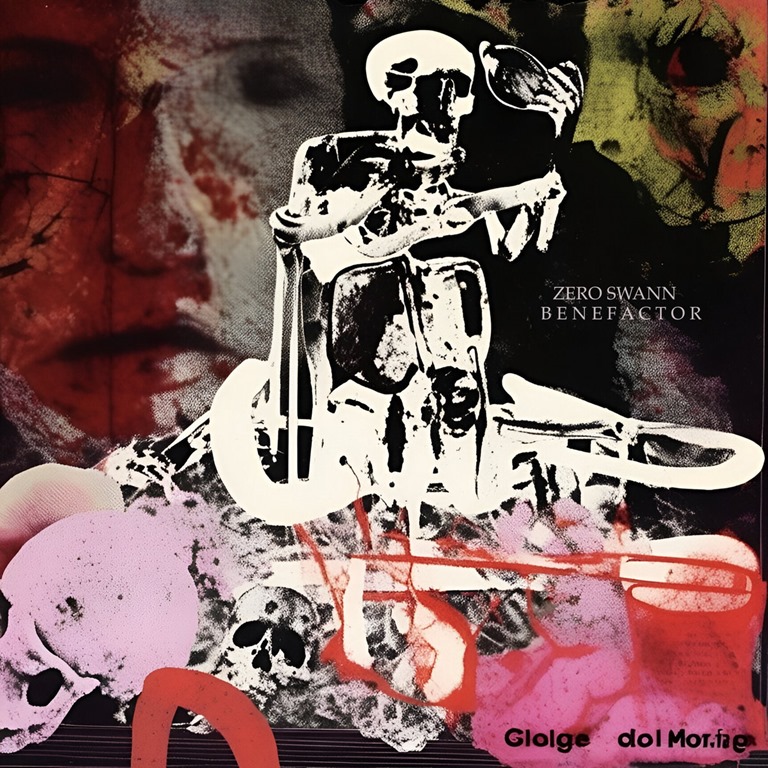
As the notes on the Bandcamp page explain, ‘Just as the music migrates across genres, the visuals migrate across states of being, extending the album into a network of parallel identities. Together, they construct a fragmented yet coherent cosmos, where each image is both an entrance and a deviation, multiplying the ways Neon Swans can be seen, heard, and inhabited.’

Appropriately, Neon Swan doesn’t quite sound like anything I’ve heard before, either. To unpack that, it contains many elements which are common and familiar. There’s sparse techno, minimal dance cuts with sped-up vocals and swathes of space between low-key beats and glitchy grooves, as represented by single release and album opener ‘tell///me///now’ – one of many titles which reflect the sense of fragmentation and juxtaposition which define the album (‘s4dert1ac’ and ‘d3xr3rity’ provide other examples, but then there are the likes of which also disrupt the conventions of language in the same way Slavin disrupts the language of genre tropes).

‘audio ease my pain’ plunges into darker territory, while introducing rap vocals atop heavy hip-hop beats (although there’s an instrumental version as well further on, which offers a different perspective again on the same material). Elsewhere, ‘c-r-i-m-s-o-n-schema’ brings spacey, spaced-out bleeps, heavy percussion that has a late 90s feel, a blend of The Judgement Night soundtrack’s melding of rap and rock, and the Wu-Tang Clan.

For all of the space, the reverb, the minimalism, something about tracks like ‘searching_heart’ is quite claustrophobic: the intense repetition and synthetic feel, paired with crackling fizz, brain-melting glitches and some grinding bass tones. It may be constructed using the fundamental elements of dance music, but this is not dance music. Electronic music to induce uncontrolled spasms and twitches isn’t a genre, but if it was, Ran Slavin would be a leading exponent.

It’s a long album, with a lot to digest, and as it thumps and wobbles and glitches away, snippets and fragments collaged across one another, there are times it all feels a but much, a bit bewildering. At times it’s draining, exhausting, at times you simply zone out, and often, I find myself questioning the wisdom of persisting with it. The vibe is that of the kind of underground clubs I never got on with in the 90s and early 00s, and I’m particularly reminded of the time Whitehouse played an Optimo night in Glasgow in 2003: I was there for Whitehouse, who played for forty minutes starting around midnight, and the music being played was rather in the vein of the more groove-centric cuts on here. The people there for the DJs weren’t happy for the low-key electro pulsations to be paused for the noise and antics of Bennett and Best, but for my part, I struggled to get into the low-key electro pulsations. But the other reason I recount this experience, challenging in its incongruousness, is that in places, Neon Swans feels incongruous with itself, an album riven with unreconciled contradictions.

The execution of Neon Swans is hard to fault, and it does cover considerable ground, with range, over its expansive duration. But it is sprawling in its scope, its focus is variable, and it is very long. And it’s maybe better with drugs.

AA

NRR38 art 1

Vinter Records – 5th September 2025

Christopher Nosnibor

The post-rock boom feels like a long, long time ago now. Perhaps because it was: realistically, we’re talking about nearly twenty years since Explosions in The Sky and Her Name is Calla were super-hot topics. I discovered HNIC supporting iLiKETRAiNS on tour circa 2007, and Maybeshewill via their split 12” with Her Name is Calla, before seeing them playing with AndSoIWatchYouFromAfar… There are always chains and sequences, but the post-rock bubble burst in a tidal wave of oversaturation maybe around 2009. It all got a bit samey. But there was – and still is – always room for a band that take a genre template and take it somewhere else, offering something different, instead of a template-based rehash. Enter Osak:Oslo, who most certainly offer something different. Silt and Static is nuanced, but at the same time forceful.

There’s nothing like going all-out epic on an opening track, and that’s what precisely what Osak:Oslo do here, with the eight-minute forty ‘Biting In’, which begins with some enticing, chiming guitar that’s quintessential post-rock in every way, but then the rhythm section kicks in, and it drives along straight ahead, riding a solid motorik groove for a bit. After taking it down in the mid-section, they come back in, driving harder than before, a sprawling desert-rock soundscape expanding like a straight road headed to the horizon. Hell yes! You feel this. Exhilarating is the word.

They take things slower and bring more weight on ‘Days Adrift’, but still conjure rich layers of atmosphere, and bring things together with a chunky, chugging, bass-driven groove. In contrast, ‘Salt Stains’ is altogether more jangly, indie, at least to begin, and then, less than a minute in, a solid riff powers in, topped by soaring lead guitar work.

Over the course of the album’s nine expansive tracks, Osak:Oslo demonstrate a real knack for beefy riffery – nothing overloading, hugely overdriven, distorted or gritty, but just big, bold, solid and defined by a sense of forward trajectory, and what’s most remarkable is the way the band arrived at this work:

Recorded spontaneously, Silt and Static captures the band at their most stripped-down and unfiltered, balancing atmospheric fragility with crushing depth. With tape rolling and no roadmap, the album emerged naturally, giving shape to a sound that’s both deeply personal and bleak yet beautiful.

‘Bleak yet beautiful’ is a fair summary, but establishing, or unravelling, precisely what’s personal on an instrumental work is not easy, or sometimes even possible, although it is clear that certain elements, sounds, structures, transitions, which hit in a particular way are deeply evocative, often moving. But as a listener, those moments feel personal and are rooted in one’s own experience, one’s own individual response. I write this as someone who has sat with friends, playing songs saying, as I practically burst with enthusiasm, “Wait… there! That’s the key change!” or “That’s where the distortion comes in!” or “There! There!”, to be met with… mixed results. Is that moment which floors me the same one which the creators feel is the pivotal point in the song, the one which articulates, through the medium of sound alone, that deep-seated, complex emotion which has been tormenting your psyche for months, or even years? I suppose it doesn’t really matter. What matters – for artists and listener alike – is that connection, achieving that vital emotional resonance, where the music speaks.

‘Resonance in Ash’ slips into shoegazey territory, but also offers the most potent swell of noise that threatens the eardrums, bursting into a ragged explosion of noise, bordering on post-metal and racing to a blistering crescendo, and despite being one of the album’s shortest songs, ‘The Onward Strike’ feels like one of the most immense. Then again, there’s ‘Break and Sink’, which goes all-out to crush… It’s riffy, it’s heavy, and it lands hard. The bass… it grinds, alright.

The beauty – and creative success – of Silt and Static is that it succeeds on both levels. Because of the bold riffery – never succumbing to the post-rock cliché of the slow-build and epic crescendo, but instead forging these strong, cinematic, rock-orientated bursts of energy which are immersive, transportative, and reach far beyond genre confines. Silt and Static is an imaginative, inspired work, and the circumstances of its creation make it even more remarkable. It’s the work of a band operating with a rare level of cohesion, and it’s pretty special.

AA

a1841796365_10

False Door Records – 5th September 2025

Christopher Nosnibor

More than five years on from the onset of the pandemic, and still pandemic projects are emerging. The arrival of this release provides a timely reminder of a time which already many seem to have moved on from, forgotten. More than likely, there was a collective keenness to return to normal as quickly as possible, to bury the trauma and make like it never happened. There are many, of course, who will never forget, for a host of reasons. Many lost loved ones, but still many more suffered mentally, from isolation, from being trapped in abusive situations, or simply – I say ‘simply’ as if it’s something minor – the fear of the virus and the way the entire situation was managed and messaged by governments and media – not to mention the bewildering effusions of misinformation on social media.

In between home schooling, struggling to work as key workers, or struggling financially due to reduced furlough incomes, the idea that we were all in it together was essentially a myth – but people found ways of coping, and for those of a creative bent, new ways of creating became the focus.

For Johnny Richards and Dave King, this new way of creating involved emailing digital files across the world to one another: as the bio explains, ‘Richards recorded piano parts, some prepared, some using the piano as an explicitly percussive instrument, then sent King the files to the US for him to record his drum parts. Richards would then record further piano parts and overlay them, in response to King’s parts.’

At the time, there was much talk, many virtual column inches, devoted to the discussion of ‘the new normal’. Fleetingly, there was optimism, a hope for a kinder world, a world where we consumed less fossil fuels, where work / life balance was more evenly distributed… but since the end of the pandemic, it’s been hell, as if people pent up all their hatred and fury and have been unleashing it in war and antagonism and making up for lost time.

And so it is that The New Awkward reminds us of that fleeting spell of optimism, and as they reflect, ‘It could have happened at no other time. With its multiple layers percussion and piano, treated and untreated, it would be impossible to recreate live.’

Awkward is an appropriate choice of word for the title of this album. There is something almost feverish about the compositions, which are bursting with complex – and often irregular, contrasting, even conflicting – time signatures. At times, drums and piano happen upon coincidental timing, but for the most part, they seem to be duelling one another – not in an aggressive or antagonistic way, but playfully. On ‘The Chance Would be a Fine Ting’, there are moments where the parts intersect to forge a groove that almost has a swing, a swagger, albeit a slightly off-kilter, drunken one that staggers a little, the tempo changing as if the crank handle of an organ is slowing, then picking up pace again.

It’s a little disorientating, but ultimately fun, as titles like ‘Sleepless in Settle’ suggest – a title which only really makes sense in the context of Johnny’s being based in Leeds, or, more broadly, the north of England. The best jokes are always puns, especially when they’re super niche.

AA

The seven-and-a-half-minute ‘Memory Man’ has something of a vintage film feel to it, as well as a strong swing, and it’s easy to forget that this album features only piano and drums while listening to what, for all intents and purposes, sounds like a busy bassline leading a full band. The title track twists and twangs, is a bit noir, a bit late-night jazz café, but weird and woozy. ‘Gene Heard Wrong’ is another busy piece, the drums, played quietly but shuffling rapidly around the kit, as it twitching with anxiety, while the piano… the piano chinks and rolls with a nervous energy. ‘Darts’ strolls and stutters, while the last track, ‘Climbing on Mirrors’ builds slowly from dark atmospherics through softly loping beats with jarring discordant piano, and it sounds like everything is winding down… down… down.

From my own experience of lockdown – balancing working from home and home schooling a primary-school-aged daughter while my wife also worked from home, converting the living room sideboard into a desk until she installed a desk in our bedroom – devoting time – or stealing time, carving cracks in time late at night – for creative output was about the only thing that kept me even half sane. The fact that The New Awkward is far from straightforward makes sense in this context: I can relate to becoming so immersed, so invested in a project that it becomes its own world, and that its creation closes the door on the madness outside, all the texts and other messages, the screaming social media frenzy.

The New Awkward brings a lot back, and does so with mixed emotions. But throughout, it buzzes with a tense creative energy, urgent but also immersive and upbeat, the sound of unadulterated creative freedom.

AA

Johnny Richards & Dave King – The New Awkward cover 1000px

Analogue Trash – 15th August 2025

Christopher Nosnibor

It’s been a busy spell for The Royal Ritual. You might say that David Lawrie is making up for lost time. With real-world activity off the cards during the pandemic, he assembled The Royal Ritual’s debut album, Martyrs, and followed up swiftly with the more sophisticated Pleasure Hides Your Needs last year, as well as an EP and some proper touring, which saw that sophistication taken to the stage in such a way that created a spellbinding live show and immense sound. Despite there only being two bodies on stage, two live guitars, a combination of programmed and live drumming, looped, not to mention ambitious visuals makes for a compelling performance. There’s no question that this this was a show that would be perfectly suited to a bigger stage, and landing a slot at Infest provided the opportunity for the band to truly come into their own. The live footage they’ve shared online confirms this, and the quality of the performance very much justifies this live album’s release, capturing as it does the full set with first-rate fidelity.

AA

It’s a masterfully structured set, which draws equally on the two albums, and begins with atmospheric organ leading into the slow-building ‘Vantage Point’, slow, brooding synths and a pulsating kick drum giving way to a barrage of beats and crunching, metallic industrial guitar. There’s no dead space between the songs: a tapering drone and snippets of samples maintain the atmosphere before ‘(nothing) On the Other Side’ thunders in on a thunderous percussive assault, and things only turn darker, heavier, more intense and more percussion-led on the claustrophobically intense ‘Pews in the Pandemic’. Lawrie gives it some guts in the vocal department, switching between menacing and wracked with anguish, and peaking at epic, emotive.

The processed-sounding guitars and synths have that KMFDM / Pig vibe and would be perfectly at home on a Wax Trax! release from the early 90s, but the colossal drumming sets it quite some way apart. Moreover, where The Royal Ritual really succeed here is in the way they preserve the sound – and the detail, and, importantly, the mechanical tightness – of the studio recordings, while the use of so many live instruments and, for wont of a better term, ‘moving parts’ means that this has the full energy and dynamics of the live setting, that edge, that bite. Naturally, this is felt more strongly when you’re actually in the room, in the moment, with the electricity of the proximity to the band, and in a room full of people, but this does a top-notch job of capturing it all through the medium of sound alone.

‘Martys’ is a full-blooded industrial-strength dark glam-tinged stomper, and ‘Modes of Violence’ takes things up a notch, combining solid hooks and gritty, hard-as-nails industrial guitars. It’s fitting, then, that ‘Coma’ closes the set with a more reflective feel, with expansive almost trance-like passages intersecting with electronic-led progressive segments. Lawrie’s soaring vocals are rich with emotion that’s almost spiritual as they ascend to the skies, before the set concludes with a glitching stutter, somewhere between a Morse Code SOS and teetering on a flatline, amidst a mutter of sampled dialogue and siren wails. It’s a bleak, almost apocalyptic, Bladerunner-esque finish. There is high theatre here, but there is also real human spirit, and an emotional range not always found in the sphere of electronic / industrial music, which can, at times, feel cold, clinical, detached.

The quality of the songs was already evident in their studio releases, but Live at Infest demonstrates that not only do the songs have further dimensions which only become apparent in a live setting, but that The Royal Ritual are a killer live act.

AA

The Royal Ritual - Live at Infest (Digital Cover)

Prophecy Productions – 19th September 2025

Christopher Nosnibor

Founded in Chicago, by vocalist Paul Kuhr, Novembers Doom have been going since 1989, and have to date released a dozen albums, if we include their latest offering, Major Arcana, since their 1995 debut, Amid Its Hallowed Mirth.

According to their bio, having started out as exponents of ‘death doom’, they’ve come to formulate a genre unto themselves, ‘dark metal’, which blends their death metal and doom roots with progressive, folk, and classic rock influences. Sometimes, I think I should probably avoid reading bios before listening to releases, because this stylistic summation is somewhat offputting to my sensibilities. I also think bands should check their punctuation – particularly apostrophes – when declaring their name, but I’m a pedant.

As the album’s title suggests, the theme – or concept, such as it may be – revolves around the tarot deck, which originated in the middle ages and has inextricable ties to occultism and mysticism. The major arcana (greater secrets) are twenty-two cards which feature in the 78-card deck used by occultists and esotericists.

‘June’ is not one of them, but this atmospheric piano-pled intro-piece is a well-considered composition which blends neoclassical instrumentation, underpinned with a sense of foreboding, and menacing vocals, makes for a suitable appetiser. The songs are not all specifically focused on a specific card, but instead explore their meanings and more.

These are some long songs, extending past the five-minute mark and well beyond, and the scale of the ambition – both conceptually and musically – is clear. The sound is cinematic in scale, the production is clean and expansive, the drumming switching from double-pedal thunder to more standard four-four beats adding emphasis to a solid guitar sound.

It turns out that the bio is fairly accurate. Sometimes, they hit a crunching metal groove that’s burning with churning distortion and snarking guttural vocals, as on ‘Ravenous’, a powerful blast of infinite blackness. These moments are charred gold.

But as songs like the title track and ‘Mercy’ find the band easing into more melodic territory, emanating progressive, and in places, vaguely folk vibes. On the latter, they cross towards Black Album-era Metallica – by which I mean the mellowness of ‘Nothing Else Matters’, and such serious emotive efforts feel somehow wanting. In the main, they’re better when you can’t make out the lyrics, but more than that, it’s not easy take the overly bombastic, overwrought thing delivered with a straight face entirely seriously.

AA

‘The Dance’ brings a magnificent chugging riff that just goes on and on, relentlessly, and it’s satisfying and solid. But the vocals, gritty but tuneful, feel like a bit of a letdown in contrast. Perhaps it’s the context, which makes melodic tracks sound simply weak in contrast to the might of the full force they demonstrate elsewhere. Perhaps it’s just my personal preference. I can handle diversity and range across an album, but there’s a sense that Novembers Doom are simply striving to cover too many bases here, or otherwise show a lack of focus. Either way, as bold and ambitious and well-played as it is, and despite the thematic framework, Major Arcana isn’t particularly cohesive, switching styles hither and thither without really pulling things together. The eight-minute ‘Bleed Static’ is a standout by virtue of its sustained menacing atmosphere, and while it’s as guilty of the Metallica-isms and folk appropriations as other tracks, it’s realised in a way that feels more committed, and there’s a mid-point crescendo that lands nicely and everything falls into place… and I suppose it’s against this benchmark that other tracks fall short.

I doubt existing fans will be deterred by any of this, but, objectively, Major Arcana isn’t bad, but it is patchy, an album that’s mired in metal cliché and fails to scale the heights of its ambition.

AA

a4251308479_10

Dimple Discs – 22nd August 2025

Christopher Nosnibor

Weird shit is welcome here at Aural Aggravation. It was a part of the ethos of my starting this site back in 2015. Yes, it’s been that long since I decided that I wanted to strike out alone with a view to creating a platform devoted essentially to stuff that appealed to me and exploring them with more long-form, discursive essay-type writing. This of course completely went against the grain of where most media, in particular music media, is at now, and this has only become more pronounced over the last decade, in which time attention spans have largely been reduced to circa 120 characters or simply .GIFs and memes. But – presumably because my focus is on rather niche music which doesn’t always receive a wealth of coverage, rather than because of my propensity for divergence into the personal or the political – Aural Aggravation now attracts a respectable readership. I don’t feel any desire to celebrate 10 years of doing this: to do so would really be to celebrate a decade in a lifetime of stubbornness, a compulsion to write, and a musical obsession which I choose to inflict upon the world, but I do suppose, on reflection, that the rarity of the format, occasionally touching on theory, but – hopefully –without too much hypotactic wankery.

And so we arrive at XiX by Kev Hopper, who despite fourteen solo albums, and despite co-founding electronic act Ticklish in the late ‘90s, and was composer/bassist with Prescott in the 2010s, and working as a visual artist by the medium of painting for a good number of years, is still probably best known for being the bassist in Stump between 1983 and 1988. Despite only releasing one album proper, their output of singles and EPs was solid, they were all over the music press at the time, and they were championed by John Peel. This potted history throws into sharp relief just how times – and the face of the music industry, particularly outside the mainstream – have changed.

Hopper’s second album on Dimple Discs is a collection of quirky, whimsical electronic experiments. Skittery, light, and lively, there’s a playfulness which defines the pieces, even when sliding into low-end notes and minor chords. ‘Vector Prodder’ plunks and plonks, twangs and reverberates, and slides into spooky but fun territory, and in some respects it’s got 1960s Addams Family vibes. ‘Gruntian Forbes’ twists and spins strangeness into a sunny calypso groove, and this, in many ways, encapsulates Hoppers’ approach to composition on the twelve tracks on offer here – namely taking a comfortable form, and rendering it uncomfortable by warping, twisting, and distorting it in some way or another, tossing in some ethereal haze and a bucketload of l’aissez-faire oddball elements. And why not?

XiX fully embraces the spirit of experimentalism – the idea of simply trying things out and seeing what happens, and not even being hugely concerned if it’s only half-successful. That isn’t to say there are any semi-successes or borderline failures on XiX: what I’m driving at is the spirit of creative freedom which pervades. When cut free of the constraints of commercial concerns, when liberated from self-censorship, and simply creating for the sake of creating, for the joy that experimentation and making sound can bring, a work takes on a level of buoyancy. XiX is the sound of creative freedom. ‘Devils’ may be dolorous, with hints of Tom Waits, but ‘Lance The Prawn’ is an exercise in gurling synth and ridiculously OTT vocal processing (half-burying absurd couplets like ‘lance the prawn / on the lawn’) amidst bleeps and wiffles and space-age throbs and pulsations.

It’s sci-fi in its influences, but it’s Douglas Adams on the serious scale. While I’m no fan of Adams myself – I find the humour simply too cheesy, but worse than that, I find the fans of his works, who insist on referencing him relentlessly beyond irritating, I would like to think that this scaling works in context. The album’s material is not irritating or nerdy, but it is, at times, overtly strange, and nowhere more so than on ‘Brand Street Psychodrama’. It may be but a brief interlude, but it’s all the disorientation. ‘Window Seat’ brings all the chimes and gentle brass, evoking that mythological bygone age crossed with intimations of ‘made in China’, in the brittle 80s plastic sense.

Having just written about Eamon the Destroyer’s new release, it seems that this belongs in the same field, but represents an altogether different face of the experimental dice.

And this is a good thing, in that we are able to wander through very different corridors while stroking our chins and pondering the work emerging from the field of ‘experimental music’. Towards the end, there’s an urgency that builds to XiX. Or perhaps it’s just my anxiety rising as midnight draws closer.

Either way, this is a supple work, which ventures across a range of styles and forms, with the chiming, tinkling nine-minute closer, ‘The Cucurella Problem’, with its whimsical , warping lead lines and tentative, wandering bass being truly exemplary. It bends the brain, but slowly, gently, softly, and it’s kinda nice.

AA

a0361012740_10

Bearsuit Records – 5th September 2025

Christopher Nosnibor

The thing with Eamon the Destroyer is that you never know what you’re going to get. The Maker’s Quit is different again from We’ll Be Piranhas, which in turn was quite unlike Small Blue Car (which remains a personal favourite, even if it does make me feel impossibly heavy on the inside). If We’ll be Piranhas marked a step forward in terms of experimentalism and optimism, The Maker’s Quit sees a greater emphasis on songwriting and structure – but don’t for a second think it’s in any way straightforward, and that the experimentalism has taken a back seat – it’s still very much a copilot here, and with the accent on the mentalism.

Here, the title track commences what is an incredibly varied set with a song that has the theatricality of Alex Harvey crossed with 1990s Leonard Cohen, before ‘Silverback’ confounds all expectation by bringing some shuffling funk-infused jazziness. In contrast to the fairly minimal arrangements common to previous ETD releases, this is pretty busy, then is settles into a mellow groove that’s almost loungey – bar the mid-section, which is rent with a protracted burst of extraneous sound. It’s almost as if he purposefully weaves around the line between genius and self-sabotage simply to tests us as listeners. There are some nice, light, poppy moments on here, and – albeit fleetingly – some captivating grooves. But it wouldn’t be Eamon the Destroyer without a huge helping of straight-up weird shit mashups, and The Maker’s Quit brings the lot, from frenzied jazz and post-grunge, wonky vaudeville waltzes and whistling, via electropop and slices of pan-culturally inspired melody.

More often than not, the verses and choruses are so contrasting as to seem to have been spliced from different songs – that’s when there are verses and choruses. ‘Three Wheels’ is a veritable patchwork, which compresses segments of what sounds like half a dozen songs into five minutes as it spins from grandiose heavy country dirgery by way of an intro, which even hints vaguely at recent Swans, before swerving into Europop with a hint of Sparks, through a off-kilter but gentle soundscaping that slides into laid-back salsa before winding up with a segment of jaunty indie rock. But rather than feel like an identity crisis, the effect is more that of a multi-faceted artist showing all his facets simultaneously. It’s hard to keep up, but one can only imagine what it must be like to live in his head.

The lyrics are equally fragmented, between stream of conscious and cut-ups, producing a Burroughsian, dream-like quality. This snippet from ‘The Maker’s Quit’ exemplary: ‘Saturn kid – spins and reels – in a city / Little Feet – lost in a wave – out to sea / A grandmother – nods – to a space in the crowd / Cap gun assassin – emerges – from a conjurers cloud…’ Beyond oceans and waves, it’s impossible to pin down any notion of themes or meanings. The images float up and fade out instantaneously.

‘The Ocean’ begins dramatically, a swelling, surging drone that halts abruptly, yielding to one of the most typically Eamon the Destroyer passages – lo-fi folktronica with a low croon reminiscent of Mark Lanegan, which slowly tilts its face upwards from scuffed boot-tips towards the sun…. and then all mayhem happens in a brief but explosive interlude, and your head’s suddenly spinning because wherethehellhasthiscomefrom? It’s this wild unpredictability and unapologetic perversity which is – strange to say – a substantial part of the appeal of Eamon the Destroyer.

When Eamon the Destroyer goes downtempo, as on the mournful, string-soaked introductory segment of ‘Captive’, you can actually feel your heart growing heavier by the bar, but then it twists onto some semi-ambient avant-jazz, and the sensation transitions to bewilderment.

The final track, ‘The Buffalo Sings’, is a twelve-minute behemoth is s slow, surging lo-fi electronic exploration. Face the strange? It embraces it, hard, then absorbs it by ghostly osmosis. If ever a song was less country, less ‘Buffalo’… maybe some of the western themed electrogoth songs by James Ray and the Performance are on a par on that score, but this wanders into a sonic desert without even a hat for protection from the punishing sun, and slowly, everything melts in the heat. Circuits bend and warp, and the weirdness rises like a heat haze… and it’s wonderful to be immersed in a work which celebrates creative freedom with no sense of constraint or obligation.

On reflection, with Eamon the Destroyer, you know exactly what you’re going to get: visionary hybridity, moments of aching sadness and fractured beauty, shards of melancholic memory , unbridled inventiveness and fevered creativity, and music like nothing anyone else is making. In a world where meaning seems to have all but evaporated and it’s increasingly difficult to make sense of any of it, The Maker’s Quit feels like a fitting soundtrack. It exists purely in its own space, and it’s the perfect space to escape to in these most dismal of times.

AA

Eamon-TD-3_Cover

Ideologic Organ – 5th September 2025

Christopher Nosnibor

Umberto Eco is one of the many authors I feel I should have read, and hope that one day I will get around to reading. Social media has of late showered me with posts and reposts with a quite from Eco about owning more books than you will ever read – something I never much relate to. I only have so many hours in the day, and reading – since I insist on engaging with books rather than passively absorbing audio books while participating in other activities – is one of those pastimes which is time-intensive. I find music-listening to be comparable. As much as I enjoy listening to music while I’m cooking or participating in other activities, I like to give music full attention, especially new music. And it’s in this context that I often find I purchase music – like books, albeit to a lesser extent – at a faster rate than I can consume it. And this is why it’s taken me until the twentieth anniversary release of Slomo’s The Creep to catch up with this cult classic which brings together sludge / doom and vintage industrial influence.

The album’s context, too, is worth providing here, and so, I shall quote at length rather than paraphrase – not because I’m lazy in my writing, but because I fear making omissions, and feel that liner notes or press releases articulate in a way which better represent the artist.

Just one week after the passing of COIL’s Jhonn Balance in late 2004, the 61-minutes of "The Creep" manifested in a Sheffield suburb. Not yet a band and only captured due to happenstance, this first music of Slomo flowed forth without any consideration of it even being "a piece", let alone a release, though it didn’t take long for the participants (Chris "Holy" McGrail and Howard Marsden) to realise they’d captured something of distinct colour on account of how often they were listening to it.

Initially dubbed "The Ballad of Jhonn & Sleazy", the pair soon instead ascribed the music to Boleigh Fogou; a prehistoric underground chamber on the Land’s End peninsula that both had recently visited and been affected by. "The Creep" took its name from the peculiar side chamber assumed to be if ritual function, having no apparent practical use. This ponderous music chimed perfectly with the fogou; an apparently stolid place that teems with life once you become attuned to its frequency.

Fitting in perfectly alongside other massive single-track albums such as Sleep’s "Dopesmoker", COIL’s ‘Queens of the Circulating Library’, Cope’s "Odin", and Boris’ "Flood", "The Creep" secured a limited release on Cope’s Fuck Off & Di CD-R label in 2005 that quickly sold out via supportive outlets such as Southern Lord, Aquarius Records and Stephen O’Malley’s Ideologic Organ – then operating merely as a blog and micro-store.

And now, Ideologic Organ present a twentieth-anniversary vinyl edition. No doubt there will be plenty of people who are happy about this: after all, it’s never been released on vinyl, and I expect the tonal qualities of vinyl are ideal for a work where there is so much texture, so much richness of tone. The slow, resonant, reverberating bass during the quiet intro deserves deep grooves and decent speakers.

One downside of where the industry is now – and there are, as most of us are aware, many – is that the days of a promo copy of a slab of vinyl are essentially over (unless you’re writing for a major national or international publication), meaning I’m here with some decent enough speakers, but basing my opinion of the mastering and overall sonic experience based on an MP3 version. And as the low notes crawl, quivering, from those decent enough speakers, the rooms seems to darken and the atmosphere grows thicker, heavier.

Not a lot really happens during the first fifteen minutes, but the effect is profound, in that it resonates throughout the body. There is movement, but it occurs at a tectonic pace, and by stealth, rumbling around the far reaches of internal organs. For anyone who has read The Anatomy of Melancholy, Robert Burton’s seventeenth-century analysis of depression which explores the effects of the various humours on both mind and body. And The Creep slowly pulls on the gut and the intestinal tract in the most shuddering, lugubrious ways. At times it’s barely there, but shudders and shivers uncomfortably low on the psychic register. Others… there are low peaks among the troughs, but this is an album that registers more on a subliminal level and certainly low in the guts.

Where I raised the point of the vinyl release likely being popular with many fans, the counterpoint to this is the disruption to the continuity that the format creates. Listening to the MP3 version, there’s a fractional pause at just over thirty-two and a half minutes. It feels like a minor stutter, given that there is a long, low, undulating bass boom that fans out like a ship’s horn or subaquatic signals – but imagine having to get up and flip the record at this critical point before things begin to build. I’m perhaps being picky, but this feels like an unwarranted disruption.

The second half is even lower and slower than the first: twenty-nine minutes of bleak, rumbling abstraction. It’s the perfect amalgamation of drone, experimental, and dark ambient. And The Creep is dark. Whisps of feedback trail around and waft over hovering bass tines which simply roll and reverberate. Time stalls. Everything hangs in suspension: even your mind, and your digestion, hang, suspended, paused. Your breath… your mind. You stop thinking and simply float in this, this sound. Immersive is an understatement. It’s all-consuming, and you can easily lose yourself – completely – in this slow, slow, heavy drone.

20 years on, it’s clear that this is a work which is timeless. Niche, but timeless, in the same way that Earth 2 and Sleep’s Dopesmoker are more than just heavy droning noise. It’s no means an easy listen, but I’d still point to it as an essential one.

AA

a3748639222_10