Posts Tagged ‘Doom’

15th August 2025

Christopher Nosnibor

In recent years, the field of doom has expanded in terms of range, and has, at the same time, become rather more populous. One suspects in part that because these are pretty fucking dark times, increasingly, people are turning to dark music to articulate their own challenges, and to navigate the world around them. One welcome development is the number of female-fronted doom bands with vocalists who bring not only powerful voices, but a strong emotional force to the heft of the instrumentation.

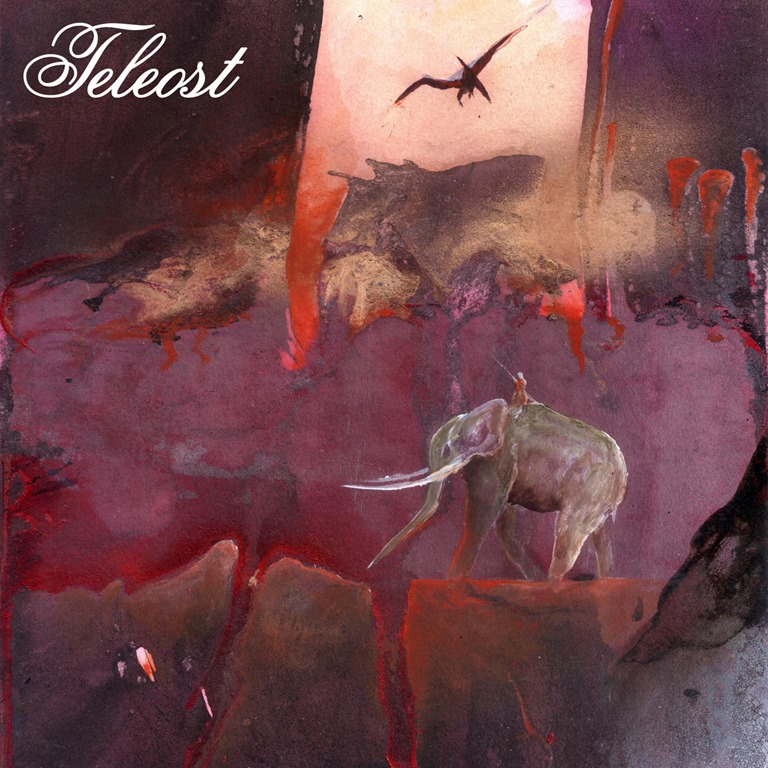
Amnesiak pitch themselves as ‘Alternative Doom Rock’ – a subtle but necessary distinction from the proliferation of doom metal, which is something rendered clearly on this, their debut album. Containing just seven tracks, the longest of which is just under five minutes in duration, and with a couple that clock in at under three, it’s a concise document – and that’s welcome, because unlike so many other releases in the genre, which can at times be indulgent and err towards the overlong, and leaving you feeling drained, Arkfiend leaves you hankering for more.

The instrumental intro track, ‘Deamoniacus’ is something of a trope nowadays when it comes to heavy music – and screamy post-hardcore – but here it works differently, with samples reverberating in torturous extreme stereo, the sounding of the muttering clamour of a fractured internal dialogue which crowds the mind with discomfort, paving the way for the slow, majestic ethereal grandeur of ‘Archfiend’, which blends sepulchral doom with soaring vocals which float to the skies. ‘Flamed In Solitude’ plunges into darker territory, with dingy guitars squirming queasily over loping percussion. Layered vocal harmonies contrast with the thick guitars and booming bass, and those vocals sit between doom and folk, elevating the song to unexpected heights.

The dynamics of each song is something special, and the stylistic interplay sets them apart from their peers. ‘Pillory Of Victory’ is theatrical, gothic, dramatic in a theatrical sense, but also in an intense real and immediate sense – and at two and a half minutes there’s a moment where the riff skews and things take a sinewy turn for the more discordant, before the riff returns, hard and heavy. And yeas, I’m one of those people who obsessively pinpoints the moment when a song switches, when it moves from ‘yes!’ to ‘woah, fucking yes!’ – and it all comes down to a second or so. I’ve digressed, but so have Amnesiak, until they come around to the churning riffery of ‘Bootlicker’, which is truly monumental. Everything comes together here, and this is track of the album. For all its dirty guitar grind and dark lumbering riffery, it’s majestic, epic, a song that fills you up and lifts you up with its power. The final track, ‘The Last Rattle’ is a perfect balance of light and dark, weight and melody, reflective and sad and uplifting in equal measure. The quality of the songwriting, and the attention to detail on display here is quite something.

Arkfiend places Amnesiak comfortably alongside Cold in Berlin and Cwfen – and that’s a strong recommendation.

AA

a4008843204_10

Sub Pop – 14th October 2025

This one has seemingly come out of nowhere. And it’s on Sub Pop. And they’re calling it a Maxi 12”, as was the term for a 12” EP back in the 80s and 90s. And I suppose it does actually quality, given that the old-school Maxis tended to feature either two tracks per side, or an extended version of the single, plus B-sides, and that’s then case here. But with this being a sunn O))) release, the lead track is just shy of fourteen minutes in duration, and the tracks on the flip are eight and seven-and-a-half-minutes long respectively. Back then, a maxi would cost maybe £3.50, or £3.99 (I’m talking about the ‘90s: it was a couple of quid in the 80s… I can’t actually remember the price of an LP in the 80s, but have receipts sitting inside sleeves that verify that in 1994, a new LP on vinyl cost around £7 and a CD £11… so the fact that this ‘maxi’ is $25 tells you all you need to now about inflation and capitalism and how times have changed.

Anyway. The three tracks on this release, with a total running time of almost half an hour are notable as ‘first official sunn O))) studio recordings to feature only the original core duo on heavily saturated electric guitars and synthesis.’ It’s also introduced with a sense of elevation that’s typical sunn O))), when they inform us that ‘sunn O))) gave extreme focus and care to each step and aspect of the recording, each tone and level of saturation, each gain stage and speaker, each arrangement and harmonic. The Pacific Northwest forest is our guide.’

‘Eternity’s Pillars’ is a raging behemoth of feedback and sustain, every chord struck a billowing beast that punches through the endless drone, and while it is unquestionably classic sunn O))), it also brings together the defining elements of early Earth, in particular Earth 2, an album which effectively created the blueprint for the entirety of sunn O)))’s existence. Not a lot happens: that’s never the point. Downtuned guitars churn the bowels, scraping and snarling their way to monumental, megalithic sustain, though a continuous whine of feedback, each strike hanging in the air for what feels like an eternity. The pace is a crawl. Time stalls. It’s absolutely punishing. New shapes emerge, fleetingly, toward the end, notes rising like monuments from a cloud of smoke – by no means a melody, but it’s a progression, a change in mood.

‘Raise the Chalice’ is named ‘for a rallying cry often uttered by Northwest legend Ron Guardipee throughout the mid-1990’ – making it their second composition in his honour (the other being 2023’s ‘Ron G Warrior’, which was also released on Sub Pop), and opens with a full growl like a giant engine slowly revving , but instead of revving up, it gradually revs down into a slow-churning sonic abyss. It doesn’t sound, or feel much like a rallying cry. With the density of dark matter, the enormity of the sound engulfs the senses. By the arrival of ‘Reverential’, there’s a feeling of exhaustion, as if all the light and oxygen has been extracted, and yet still the sound continues to apply a crushing pressure.

While it’s difficult to really rank or compare sunn O))) releases as to what constitutes their ‘best’ or ‘heaviest’ work, this is certainly classic, quintessential sunn O))), and it’s very, very heavy indeed.

AA

a3585267222_10

Wounds is Cold in Berlin’s long-awaited and recently announced fifth album – their first in six years. As heavy as it is haunting, the record masterfully blends doom, post-punk, and driving krautrock in a dynamic, hypnotic maelstrom – pushing London’s most exciting cult band into intoxicating new territory.

Wounds is a series of songs about the different ways people live with and process ‘the wounds’ of their lives,” explains vocalist Maya. “A strange celebration of that formative pain we have all experienced in some way. The loss and joy of survival – the celebration of finding others like us, the gift of knowing life comes after fire.”

New single ‘The Stranger’ is a song that is meant to allow for multiple interpretations. Vocalist Maya adds:

“Perhaps it is a song about addiction- the wound that doesn’t heal. The way the focus of an addiction sings to you, searching you out, twisting and flowing through the body- whispering beneath the skin until you answer the call and find home once more.

Perhaps it is a song about finding your place in the world- groups of people watching and experiencing something meaningful together- a way to heal and close old wounds. How live music can stay with you even as you are separated from it. How finding the strange songs, sang in dark places can actually bring you home to yourself.

Or perhaps it is a song about that sharp kind of love at first sight that can overwhelm, offering freedom and constraint all at once. When you are drawn to that person that you know can destroy you, but you cease to matter because they are somehow instantly your home and only resting place.

‘The Stranger’ can be all these things- a healer, a cage, an addiction, but it is most definitely a call into the darkness, reaching out to the listener to join us in the howl of life, to wake up the bones and the skin. Be with us in the noise and know that whatever it is that led you to us, we are grateful you are home.”

AA

AA

zDIwBwtg

Rocket Recordings – 17th October 2025

Christopher Nosnibor

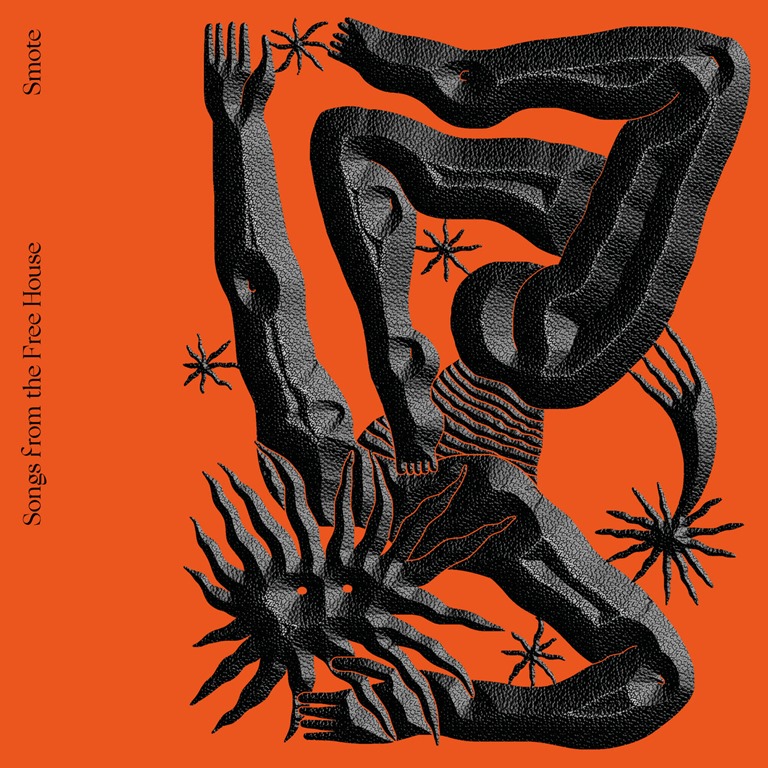
The thing that particularly stands out in the bio for the latest Smote album is this: ‘Daniel Foggin has spent the majority of his adult life working as a landscape gardener, frequently pursuing his trade in conditions of either baking heat or freezing cold and, as he puts it “more often covered in mud than not”. Yet the primal, meditative aspects of this work, the act of communing with nature, its histories and its depths have fuelled his art on a profound level. As Daniel himself relates; “I think the music is a direct reflection of this feeling that I haven’t quite managed to define yet, it is dirty and hard but there is an overwhelming comfort to it.”’

It’s something artists rarely mention: they have day jobs. Perhaps there’s an element of shame in it for some. Maybe it detracts from the mystique. Or it could be that it’s considered a detraction from the pitching of the latest creation. But it’s a truth rarely spoken: most musicians, and artists in any medium, have day jobs and have to make time for their creative work. Tours have to be negotiated with work, taken out of annual leave, often juggled with family responsibilities. Sleevenotes by Joe Thompson of Hey Colossus and Henry Blacker is the most open narrative on the realities of this I’ve read to date, and at times the exhaustion crawls from the pages. As such, it’s refreshing that Foggin not only acknowledges his day job, but recognises it as a significant influence on his creative work. And why not? The most engaging art is drawn from life, after all. Much as it would be a more ideal situation that artists could make their living from art, at the same time, there is perhaps greater value in art created by those who live in ‘the real world’ rather than floating, detached, elevated above it in some kind of bubble.

The words ‘Free House’ make me automatically think of pubs, which perhaps says more about me than the artist, of whom we learn that ‘In the world of Smote, going further out means going inward. Less a metaphysical journey into inner space, more a physical journey into the ground itself, converging with its roots and vibrations. What’s more, a journey right to the heart of its principal architect’s daily experience’.

A cottar is a farmer, and with the album’s first piece, we’re plunged into a deep, surround-sound immersive dronescape, There are many layers to it: reverberating voice, trilling flute, sonorous synths, distant percussion… and it builds, and builds, growing into a hypnotic swell before finally breaking into a slow, weighty post-metal riff that twists and turns with spectacular force, hammering with the force of Pale Sketcher by the six minute mark. It has the weight of sodden earthworks, and conveys the hard exertion of ploughing and tilling, as it descends into a speaker-shredding wall of distortion.

‘The Linton Wyrm’ brings heavy Nordic connotations as it plods on, and on, over the course of a rousing nine and three quarter minutes. It’s not so far removed from the epic force of Sunn O))), but equally Wardruna, a band who evoke earthiness and the essence of pagan spiritualism – not about worshipping mythical gods, but celebrating a connection with nature on a level which is almost primal, and isn’t readily articulable through words: it’s something which transcends language.

Single cut ‘Snodgerss’, which clocks in at under four minutes is both representative of the album as a whole – and not. With its trilling flute and thunderous slow riffery, it incorporates some of the leading elements, but in a way which is considerably more accessible, not least of all with its folk leanings, and presents them in a condensed format. That said, it’s an intense piece, which offers no let-up.

The ten-and-a-half-minute ‘Chamber’ is slower, heavier, dronier, and encapsulates the true essence of the album as a whole, building on a low, resonant throb before the introduction of mournful woodwind. As graceful and soulful as it is, it connects with a primitivism which reaches to the core, a place beyond linguistic articulation. This is the sound of forests, of hills, of streams and moorlands.

The final track, ‘Wynne’ hammers the album home in a squalling blast of overloading guitar and powerful oration propelled by thunderous percussion. It’s mighty, and beyond, seven and a half minutes of blinding intensity which concludes an album that’s varied but unswerving in its density and force. You can truly feel the earth move.

AA

a1730365911_10

Wounds is the band’s long-awaited fifth album – their first in six years. As heavy as it is haunting, the record masterfully blends doom, post-punk, and driving krautrock in a dynamic, hypnotic maelstrom – pushing London’s most exciting cult band into intoxicating new territory.

Wounds is a series of songs about the different ways people live with and process ‘the wounds’ of their lives,” explains vocalist Maya. “A strange celebration of that formative pain we have all experienced in some way. The loss and joy of survival – the celebration of finding others like us, the gift of knowing life comes after fire.”

First single ‘Hangman’s Daughter’ leads the charge and is available to stream and download from today. Opening with a hypnotic techno bassline, the song quickly gives way to post-punk guitars, huge choruses, and vocalist Maya’s magnetic storytelling.

“Hangman’s Daughter is an unrequited love song,” says Maya. “A woman was loved but could not love in return so she is drowned by the man who loves her. She is not lost though – she haunts the killer and he can’t escape her. The title hints at the past, but actually this is a very current issue for women today – how to literally survive when they can’t love a man who has decided he only wants her.”

Watch the video now:

AA

Wounds was recorded by Mike Bew, on location at Foel Studio. The band could be found working deep into the witching hours, experimenting with new sounds and filling the valleys with cantankerous wails of sound, bursting from amps borrowed from My Bloody Valentine.

"The Welsh countryside has a mystical quality to it," says guitarist Adam. "We recorded in a deep, dark valley; misty days and shooting stars at night. You could wander through nearby woods and stone circles during breaks. Foel Studios is woven into this setting with a transcendence of its own – its storied history includes sessions by Electric Wizard, Hawkwind and The Fall."

Synths on the album are arranged by Berlin-based Bow Church, an influential figure in the dark electronic scene and a long time collaborator of the band. His work weaves icy and atmospheric textures into the songs, layering complexity that demands repeat listens. The horns on 12 Crosses were recorded by a high profile jazz musician who appears anonymously due to label ties.

While meticulously crafted, Wounds captures the visceral energy of Cold In Berlin’s renowned live shows. The album’s arrangements and raucous sound remain true to the unrelenting intensity and atmosphere of their stage performances – every track retains the sweat, urgency, and immediacy of a band performing in the moment.

Wounds is the band’s first studio album since 2019’s Rituals Of Surrender, which Narc Magazine praised for its “crushing doom-laden riffs that assaulted the speakers with a steady pulse of noise”. It follows the 2024 EP The Body is The Wound, described by Metal Epidemic as featuring “hooky melodic songs” with a “swelling heavy intensity”.

Featuring free-jazz brass sections, off-beat structures, techno rhythms, and soaring synths, Wounds is the band’s most ambitious release yet.

AA

uwjjuFVQ

Photo: Rupert Hitchcox

Prophecy Productions – 19th September 2025

Christopher Nosnibor

Founded in Chicago, by vocalist Paul Kuhr, Novembers Doom have been going since 1989, and have to date released a dozen albums, if we include their latest offering, Major Arcana, since their 1995 debut, Amid Its Hallowed Mirth.

According to their bio, having started out as exponents of ‘death doom’, they’ve come to formulate a genre unto themselves, ‘dark metal’, which blends their death metal and doom roots with progressive, folk, and classic rock influences. Sometimes, I think I should probably avoid reading bios before listening to releases, because this stylistic summation is somewhat offputting to my sensibilities. I also think bands should check their punctuation – particularly apostrophes – when declaring their name, but I’m a pedant.

As the album’s title suggests, the theme – or concept, such as it may be – revolves around the tarot deck, which originated in the middle ages and has inextricable ties to occultism and mysticism. The major arcana (greater secrets) are twenty-two cards which feature in the 78-card deck used by occultists and esotericists.

‘June’ is not one of them, but this atmospheric piano-pled intro-piece is a well-considered composition which blends neoclassical instrumentation, underpinned with a sense of foreboding, and menacing vocals, makes for a suitable appetiser. The songs are not all specifically focused on a specific card, but instead explore their meanings and more.

These are some long songs, extending past the five-minute mark and well beyond, and the scale of the ambition – both conceptually and musically – is clear. The sound is cinematic in scale, the production is clean and expansive, the drumming switching from double-pedal thunder to more standard four-four beats adding emphasis to a solid guitar sound.

It turns out that the bio is fairly accurate. Sometimes, they hit a crunching metal groove that’s burning with churning distortion and snarking guttural vocals, as on ‘Ravenous’, a powerful blast of infinite blackness. These moments are charred gold.

But as songs like the title track and ‘Mercy’ find the band easing into more melodic territory, emanating progressive, and in places, vaguely folk vibes. On the latter, they cross towards Black Album-era Metallica – by which I mean the mellowness of ‘Nothing Else Matters’, and such serious emotive efforts feel somehow wanting. In the main, they’re better when you can’t make out the lyrics, but more than that, it’s not easy take the overly bombastic, overwrought thing delivered with a straight face entirely seriously.

AA

‘The Dance’ brings a magnificent chugging riff that just goes on and on, relentlessly, and it’s satisfying and solid. But the vocals, gritty but tuneful, feel like a bit of a letdown in contrast. Perhaps it’s the context, which makes melodic tracks sound simply weak in contrast to the might of the full force they demonstrate elsewhere. Perhaps it’s just my personal preference. I can handle diversity and range across an album, but there’s a sense that Novembers Doom are simply striving to cover too many bases here, or otherwise show a lack of focus. Either way, as bold and ambitious and well-played as it is, and despite the thematic framework, Major Arcana isn’t particularly cohesive, switching styles hither and thither without really pulling things together. The eight-minute ‘Bleed Static’ is a standout by virtue of its sustained menacing atmosphere, and while it’s as guilty of the Metallica-isms and folk appropriations as other tracks, it’s realised in a way that feels more committed, and there’s a mid-point crescendo that lands nicely and everything falls into place… and I suppose it’s against this benchmark that other tracks fall short.

I doubt existing fans will be deterred by any of this, but, objectively, Major Arcana isn’t bad, but it is patchy, an album that’s mired in metal cliché and fails to scale the heights of its ambition.

AA

a4251308479_10

Christopher Nosnibor

It’s good to be back at Wharf Chambers. Personal circumstances have meant that the trip to Leeds has been largely beyond me, but stepping into the place felt like coming home. It’s unassuming, some may even basic, but it’s got a unique – and accommodating – vibe. There aren’t many small independent venues that can keep going by sticking to a programme of leftfield live music, or being explicit in a keen leaning towards inclusivity for LGBTQIA+ and anyone else who stands outside the fence of the normies, but Leeds is a big enough, and diverse enough, city for a place like this to not only survive, but thrive. It’s kinda quirky, a bit shabby chic, and it works: the beers – local – are cheap, the sound in the venue space is good, and it’s all cool, and tonight’s advertised lineup is a cracker. Diverse, but solid quality of an international reach.

Before we come to that, it’s a strange and rare occurrence to arrive at a venue to discover that there is an additional, unadvertised, band on the bill, and even more so when the band in question has effectively gatecrashed the event without prior arrangement with the promoter, but by dint of deception. But the first band on tonight have done just that. Perhaps it’s the only way they can get gigs. Because they sure do suck, and it was obvious that they’d never have been booked for this lineup in a million years. I head back to the bar after a couple of songs, having heard enough. When they’re done, promoter and sound man (in both senses), Theo takes the mic to explain that he hadn’t booked them and that they didn’t espouse the experimental ethos of the acts Heinous Whining exists to promote. The band did not respond well to this, validating the opinion a number of us had already formed, and they fucked off in a huff. Dicks.

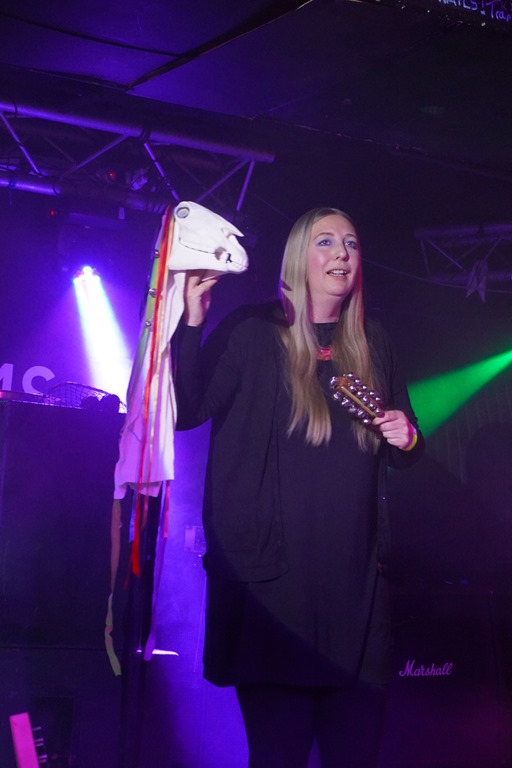
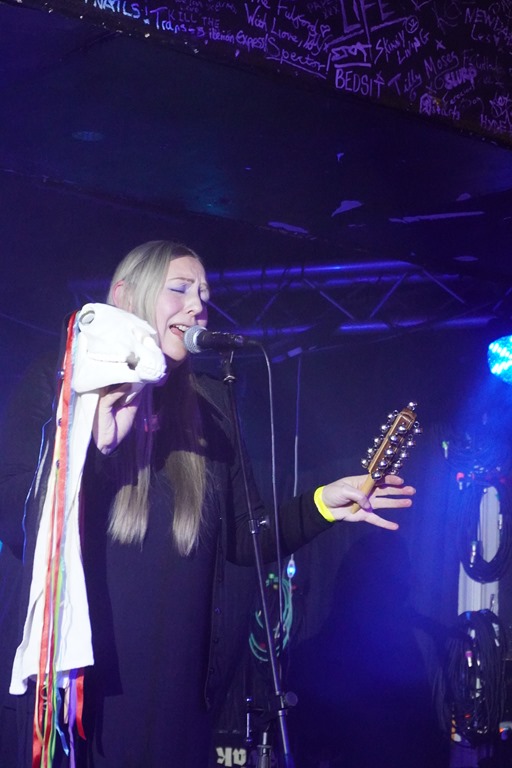
Thankfully, normality – of the kind we’re here for – resumed with the arrival of Sour Faced Lil, the solo project of Hilary from Cowtown. Her set starts – somewhat incongruously – with a quirky electropop cover of Bright Eyes. I just about manage not to cry. Then she swerves into swooshing space rock noise galore, and she explores the weird and wibbly, and it’s everything you’d expect from a Heinous Whining night. Live drums, looped, live guitar, and warped, undulating synths create a cacophony of sound in layers. The performance is a little tentative in places, but the audience is behind her all the way. There’s something quite enthralling about seeing a solo artist juggling myriad musical elements and instruments, knowing what a balancing act, how much effort it is to remember everything and keep the flow, and the fact she manages it is impressive.

DSC03057DSC03064DSC03070

Sour Face Lil

Also impressive are Lo Egin, but for quite different reasons. I feel I owe Lo Egin an apology, as it happens. When I reviewed their split release with Beige Palace a little while ago, I misspelled their name as Lo Elgin, more than once (although I managed to get it right when covering Volumancer in 2013) Hammering out reviews on a daily basis means I slip up sometimes. It’s not great, and I do try, to do better but… I did really rate that release, though, and I’ll admit that they were as much a draw for me as the headliners. And the fact is, they were worth the entry fee alone. On paper, they’re perhaps not the easiest sell, bring atmospheric post rock in the vein of early Her Name is Calla, with brass – sax and trombone – crossed with elements of doom – with the addition of screaming black metal vocals. They do epic. They do crescendos. They also do ultra-slow drumming, something I am invariably transfixed by having first become fixated during my first time seeing Earth live. The drummer raised his arms to fill extension above his head, before smashing down with explosive force.

DSC03079DSC03084DSC03092DSC03105

Lo Egin

Dolorous droning horns create a heavy atmosphere. Then, out of nowhere, from the delicately woven sonic tapestry they’ve been weaving, things turn Sunn O))) and the skinny baggy jeans wearing trombone guy who looks like a young Steve Albini delivers cavernous doomy vocals as he contorts and the mic stand and then all hell breaks loose. When they go heavy, they go heavy – and I mean HEAVY, the drummer smashing every beat so it hits like a nuclear bomb. To arrive with high hopes for a band, and to still be absolutely blown away is a truly wonderful experience, and one that stays with you.

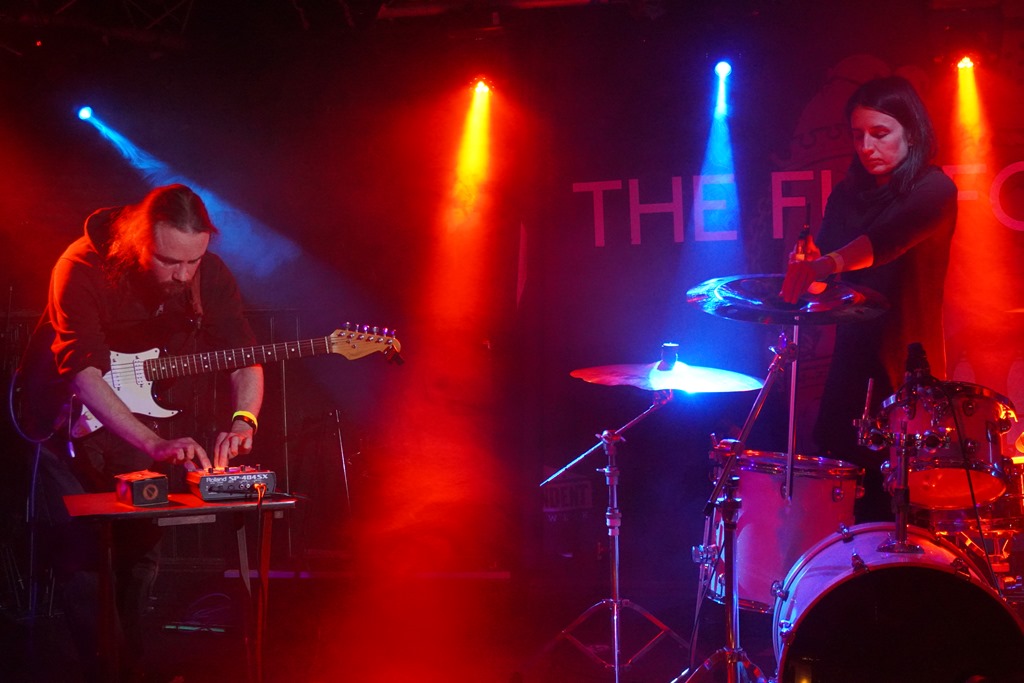
I feel I should perhaps take this opportunity to apologise to Jackie-O Motherfucker, too: in my review of Bloom, I described them as a country band. And while there are without question country elements, they’re really not a country band. They’re not really a psychedelic band, either, or any other one thing. Instead, they’re a hypnotic hybrid, and they’re deceptively loud considering how mellow everything is. What they do is simple in many respects, but in terms of genre, it’s rather more complicated, not readily pigeonholed. I’d clocked them about the venue beforehand, and they seemed like really chilled folks, and while they’re not exactly chatty during their performance, it’s apparent that they’re humble, and simply really chuffed to be playing here. The room is pretty full, too. Tom Greenwood looks like he’s just taken some time out from doing some decorating to play. He’s got paint on his trousers, and is as unassuming as they come.

DSC03109DSC03130DSC03137

Jackie-O Motherfuker

The current lineup consists of three guitars, synth, and some electronic stuff including subtle percussion. No bass, no drums. There are, however, many pedals and much pedal fiddling throughout the set, as they sculpt a wall of reverb and feedback and a whole lot more from this hefty – but ultimately portable – setup.

The resultant sound is detailed, but at the same time a hazy blur. Picked notes – and much of the sound is clean, with next to no distortion, but with all the reverb – bounce off one another here and there, creating ever greater cathedrals of sound. I find myself utterly transfixed. Their hour-and-a-bit long set features just seven songs, and they are completely immersive. There’s no real action to speak of, just an ever-growing shimmer which envelops your entire being. In some respects, their extended instrumental passages invite comparisons to the current incarnations of Swans, only without the evangelically charismatic stage presence or crescendos. In other words, they conjure atmosphere over some extended timeframes, but keep things simmering on a low burner, without any volcanic eruptions. The end result is a performance which is hypnotic, gripping because of, rather than in spite of the absence of drama. Low-key, but loud: absolute gold.

1st August 2025

Christopher Nosnibor

The other day, while riffling through my record collection, I found a few LPs and 12” I had quite forgotten owning, including a promo copy of ‘Chance’ by Red Lorry Yellow Lorry. Stapled to the plain black die-cut cover of this white-label record with the title hand-written in biro, is a press release which simply reads ‘I know this is what you’ve all been waiting for….. Yep. The new Red Lorry Yellow Lorry single It’s called “Chance” and as usual it’s on Red Rhino Records. It’s very good’ and is signed ‘Yours condescendingly’.

You just don’t get press releases like that any more – especially not typed in all block caps and photocopied.

I appreciate the effort that goes into a good press release, and a solid band bio, because it does help me as a reviewer get a sense of context, of what a band’s about, what an album’s about. But the counterpoint to that is that there’s so much detail being spoon-fed, there’s less room for creative interpretation. The fact of the music industry has changed radically since the 80s and 90s, the days of the weekly inkies, the time before the Internet.

There simply was no way of ‘doing research’. And writers had tight deadlines. And so they just riffed to fill the column inches. Facts were hazy, critiques were often based on first impressions and knocked out in an hour after an extended liquid lunch. Names, dates, titles weren’t always accurate. And fans scoffed at the errors – and still do when clippings are posted online – but that was the nature of the beast.

Now, misspell the name of the bassist or give the wrong year for their debut EP, or somesuch and PRs, labels, and bands are onto you straight away asking for corrections. In a competitive market – I often report that on average, I receive around fifty submissions a day – simply getting coverage is a massive feat. This is certainly not to say that those times past were better – simply different, and I simply navigate my way to this release via this route to demonstrate the ways in which things have changed in the years since I started out writing about music in the 90s. It’s also altogether rarer now to find negative reviews, and while a part of this is due to the overwhelming amount of music being released meaning that reviewers are generally more inclined to spend what time they have promoting music they like, there’s also a certain element of fear of there being a social media pile-on, or having their supply of gratis music cut off. But artists and their labels and PR really need to accept that they’re not going to please all the people all the time, and sometimes, it’s necessary to call out an act with dodgy politics or whatever, or to simply call a turd a turd.

Anyway. Before I’ve even hit play, I’ve learned that this release by MOTHS is ‘a visceral journey through the Seven Deadly Sins, with each track embodying a facet of indulgence, obsession, and self-destruction — from the corrosive jealousy of “Envy” to the insatiable hunger of “Gluttony” and the rage of “Wrath”. The album plunges listeners into a dark, immersive experience where desire spirals into chaos’, and that ‘Diving deeper into heavier territory, MOTHS fuse elements of death and black metal with their signature blend of progressive, psychedelic, doom, and stoner metal, crafting a sound that’s both aggressive and atmospheric. With every step forward, MOTHS continues to explore new sounds and challenge genre boundaries, proving that music has no limits when driven by passion and innovation.’

I feel as if my work is already done. I can pour myself a large vodka and kick back, right? Well, I could. But that’s not my style. At least not the kicking back part. Large vodka in hand, I brace myself for the sonic onslaught… to be faced with some tinkering banjo or acoustic guitar giving country licks that are pure blues / Americana. And it gets jazzier and groovier as it goes on. What the fuck is this?

‘Sloth’ slides into ‘Envy’, a slippery, sultry alt-rock cut where the vocals are bathed in reverb, and the lo-fi production belies the fact that this is a vaguely jazzed-up take on grungy emo, at times coming on like Paramore recorded on a 90s cassette four-track. The haziness of the recording is actually something of a positive, but these are songs which require a slicker, fuller production. As a consequence, these takes sound more like demos than final versions.

The murky rawness works better on ‘Greed’, which brings rabid, raw-throated, growling black metal elements to the vaguely gothic metal compositions. It segues into ‘Pride’ which goes full-throttle skin-peeling abrasion before suddenly going commercial rock with fancy licks at the midpoint. I like ZZ Top, as it happens. I just wasn’t expecting a riff from Eliminator here.

‘Pride’ does take things full heavy, a prime slice of sludgy doom, and ‘Lust’ is, without question, a slugging slab of doominess, with some fancy fretwork thrown in on top. There’s certainly a lot going on here, and most of it works. MOTHS certainly bring some megalithic riffs and a lot of fire to an album that may be unpredictable in places, but is, overall, solid and with no shortfall of gutsy, guitar-driven heft.

AA

MOTHS - cover

Christopher Nosnibor

It’s encouraging to arrive twenty minutes before the first band are due on, and, despite it being a pleasant, sunny spring evening in the middle of the week, it’s already busy inside the venue, and not just at the bar. There’s a tangible buzz.

The arrival of the first act, Chefs Kiss, who describe themselves as a ‘comedic food themed slam metal band’, brings a fair few forward, and it’s clear that they’ve brought their mates with them. There was a time when I may have viewed this in a rather sneery way, but what matters, I realise these days, is that if they’ve got people in through the door, then it’s all to the good.

With a wardrobe which included kilts and masks and aprons and chef hats, Chefs Kiss weren’t all that comedic – or at least that funny – a comedy act, nor especially musically accomplished either. Does the world need a joke thrash act? Actually, it probably does, and fair play to them, in that they didn’t take themselves seriously, and largely adhered to their rather daft concept, and were good fun, bringing out a life-size cardboard cut-out of Ainsley Harriot which was passed around the venue above the heads of the audience like some sort of crowd surfing cardboard deity. What’s more, they looked we enjoying themselves, and every young band has to start somewhere. This is once again why we need venues like this.

DSC02062DSC02070

Chefs Kiss

Just as Chefs Kiss were a shade shambolic, so Kraken Waker were finely honed performers, clearly with not only hours of rehearsals behind them, but also a lot of gig experience. They seriously were incredibly tight. Their sound is very much classic US rock at the heavier end of the spectrum, with a strong, dirty, stoner leaning. I had afforded myself a chuckle while they checked their mic levels: the three beardy longhairs all came on with affectations as if they were from Texas. But piling into their set, they were instantly impressive, and it soon became apparent that they were unapologetic Geordies, with strong songs about being drunk, smoking weed, and wanting all the billionaires to fuck off to Mars. Quite possibly the band of the night.

DSC02078DSC02079

Kraken Waker

If you’re going to pursue a concept – particularly one that’s ridiculous – you really have to go all-in to pull it off. Oh, and Froglord do. The Bristol band’s five – yes, five – albums to date, including the most recent, Metamorphosis, released just a couple of weeks ago, are all preoccupied with expanding the lore of The Frog Lord, centred around the Book of the Amphibian, with swamp rituals and The Wizard Gonk and the like. Behind all this stupidity, there are some fierce riffs, and a fantastically solid doom metal band. I would have been perfectly happy if they turned up in jeans and T-shirts and blasted out the raging riffs. I might even have found it easier to connect with. But this is about performance, theatre. It’s also about doing something different. There is certainly no shortage of serious doom bands. There are considerably fewer doom bands who have devoted their entire careers to a concept as absurd as this.

DSC02089DSC02098

Froglord

The more preposterous the concept, the more committed you have to be, and Froglord prove that they’re one hundred per cent committed (or that they perhaps ought to be), with a stage set which has all the props, from a stage backdrop to a lectern on which stands a copy of some esoteric bible, via masks, cloaks, and a giant plastic frog. The set is structured around a swamp ceremony, and there’s no breaking character – apart from when plugging merch, which is done in character while acknowledging it’s a break in character, which offers some postmodern reflexivity, and in the way front man Benjamin ‘Froglord’ Oak will adopt the stance of a high priest before getting down and grooving to the monster riffs, cloak flapping, mask slipping. It’s funny because they clearly know it’s daft but play it with straight faces. That kind of dedication is impressive – as is their shit-your-pants bass sound.

DSC02106DSC02111DSC02120

Froglord

And perhaps this is why it works. There’s a knowingness in the delivery of the performance, but they’re feigning that they don’t know we know it. Or something. And musically, they’re really strong. By the end, there are people traversing the venue, just grazing beneath the room’s low ceiling, in the same fashion as the cardboard Ainsley at the start of the night, and we filter out into the night to a chirping chorus of frogs. No two ways about it, Froglord put on a show.

New Heavy Sounds – 30th May 2025

Christopher Nosnibor

One of the strongest cases in favour of attending shows at local grassroots venues is that a punt may reward by striking pure gold with the discovery of a band that absolutely blows you away. It may be rare, but when it happens… POW! And so it was that a few months ago, I witnessed Glasgow’s Cwfen’s first live performance south of the border in the middle of the lineup for a £6 midweek gig at my local 150-capacity venue. Even before I learned that they were signed to New Heavy Sounds – a label which consistently delivers on the promise of its name, in finding bands which are heavy, but offer something new, something different, and have homed so many outstanding acts through the years – and had some much bigger shows lined up, it was clear that this was a band of rare talent, and who wouldn’t be playing 150-capacity venues for long. On stage, they had that quality that you only know when you see it. And they had songs.

And here they are, recorded in the studio, on their debut album, Sorrows. The huge, riff-driven epics are interspersed with brief incidental instrumental pieces, appropriately entitled ‘Fragment’ and numbered sequentially. The first provides a soft intro before ‘Bodies’ blasts in with seven minutes of supreme chuggage. It’s a gritty hard rock behemoth, but it’s more than just another monolithic riff monster: there’s a shade of goth sensibility about it, not least of all in Agnes’ brooding vocal, but there’s also the brittle-edged lead guitar work, and the song brings a powerful sense of drama and theatricality, building to a rabid, demonic climax… and straight away, it’s apparent that this is something special.

Cwfen have a supreme grasp of dynamics, of mood, of atmosphere, and Sorrows has all of these in spades. Single cut ‘Wolfsbane’ grinds in, meshing together gothy lead guitar, rich with chorus, and reverb-laden vocals which are simultaneously haunting and commanding, while a thunderous bass nails things down tight at the bottom end. Next up is ‘Reliks’, released as their debut single, and it’s different again, an atmospheric mid-tempo song which soars, managing to incorporate elements of classic 80s rock and shoegaze, while at the same time bringing the atmosphere of Fields of the Nephilim. Nothing’s overdone, and nothing’s underdone, either: everything fuses together in perfect balance, while ‘Whispers’ melds 70s rock vibes with a hard rock, delivered with a hint of anthemic power ballad. And in the background, raw banshee screams fill the swell of sound towards the end with pure emotional release. ‘Penance’ brings the weight with thunderous drums, squalling feedback, and a crushing riff behind a demonic howl of a vocal, which switches to achingly magnificent melody for the chorus. ‘Embers’, meanwhile, makes for a megalithic monster of a tune, delivering seven minutes of crushing riffery and standing as the heaviest and maybe one of the most overtly ‘metal’ song in the album – although full-force closer ‘Rite’ plunges deeper into darkness, a blackened anthem by way of a finale to a superlative set.

On Sorrows, Cwfen deliver on their name: magical, mystical, menacing, haunting, dark… but they bring so much more, and certainly do not belong in any given pigeonhole. While this is indisputably a ‘heavy’ album, it’s accessible – without going pop or being overly polished. It’s an album which makes a high-impact first impression, but reveals more depths and layers with subsequent listens. Sorrows is a masterful work, which ventures far and wide in its musical inspirations and touchstones, meaning it’s never samey, never predictable, but at the same time, Cwfen demonstrate an intense focus, forging a sound which is distinctive, rather than derivative. A rare gem, and a standout of 2025 so far.

AA

cwfen-sorrows-artwork-final-3000px