Posts Tagged ‘collaboration’

1st May 2024

Christopher Nosnibor

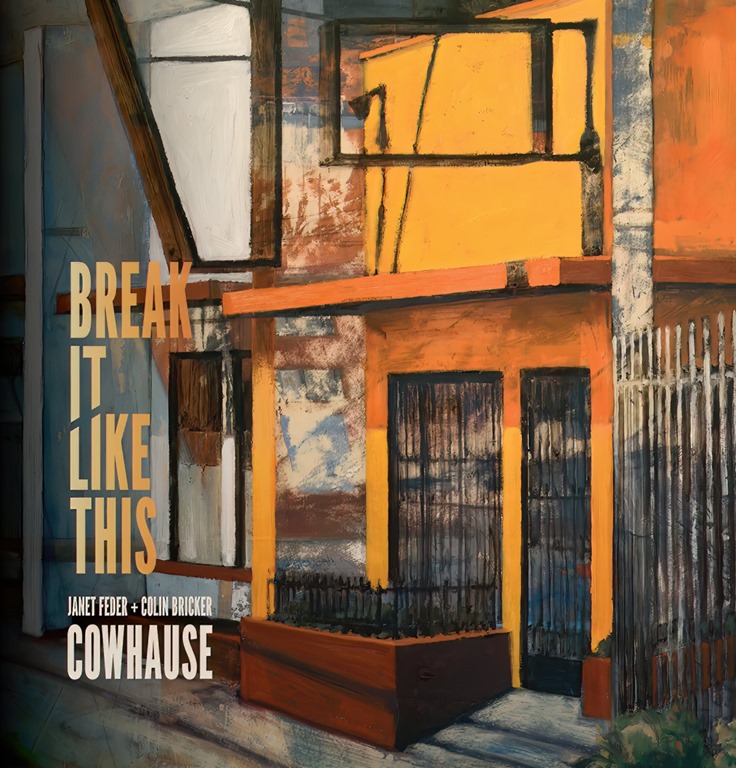
Once again, I’m late on this one, but also, once again, not nearly as late as the artist. This album has been a long, long, long time in coming. And that’s an understatement. As the bio details, ‘Janet Feder plays mostly baritone guitars and analogue, hand-made sounds; Colin Bricker (aka Brokerclinic) is an electronic musician and record producer known for his cutting-edge computer music, characterized by beautiful, twisted, broken soundscapes and skittering rhythms. This is their first new album in 19 years.’

19 years! Consider that for a moment. Almost two decades: there will be people who have been born, gone through school, got married and have started families of their own in this time. After such a protracted time out, it feels perhaps likes less of a return and more like starting afresh. Not that Janet has been creatively dormant during this time by any stretch (I recently covered the reissue of See It Alone by Sorry For Laughing, on which she features, and there have been numerous other releases in recent years, but collaborating with different people inspires different approaches and Break it Like This sounds and feels fresh, inspired and invigorated.

Break it Like This is brimming with ideas and range. The first composition, the appropriately-titled ‘Opening’ introduces the album’s manifold varied elements – scratchy guitar scraped and manipulated more often than picked or strummed intersect with extraneous noise and stuttering electronic beats. The volume see-saws and things suddenly break down at the most unexpected moments, disrupting any emerging flow.

Then again, there are some folksy runs of picked notes, and some heavily treated vocals, as on ‘Angles & Exits’, a crackling collision of disparate elements. Gentle guitar and clattering percussion joust it out as if two songs are overlaid in a sonic palimpsest, and what could be a beautiful pastoral tune is rendered as wreckage.

There are tangles of notes and serpentine rhythms which clamour, clatter, and crack from every whichway, and the mix is such that details spring from left and right, from the back of the room, from above your head and around your ankles, adding to the extreme disorientation of jarring pieces like ‘Blue State’. There are so many hints of songs and melodies which exist in a potential state; there are moments where something threatens to take shape, but simply never emerges. ‘Plan to Live’ offers haunting echoes of something atmospheric, splintered by rapid-fire beats which seem completely at odds with it. ‘Banjo’ reconfigures hillbilly wanderings into a postmodern, post-apocalyptic, post-everything soundscape which evokes visions of broken down cars and broken down society, a fatigued scraping out of making music after there’s nothing left but desolation, the notes ringing out into ruins and rubble, a theme which continues through the desolate flamenco-tinged ‘Heater’, before it swings into a psychopathic dance groove. It feels like the soundtrack to a bleak, Ballardian tale set amongst drifting sands, rusting vehicles, and dilapidated buildings, while the only survivors are the deranged.

A deep-running sense of ‘otherness’ runs through Break it Like This. Familiar elements, twisted and misshapen to a point that they no longer feel so familiar, and instead take on a more curious and uncomfortable form, abound. So many moments feel so close, and yet so far, in their proximity to the things we know and are comfortable with. But twisted, distorted, mangled, they take on more sinister forms, shadowy, strange.

Break it Like This is testing, nudging at the senses, piling up the discord and the irregularities of the structures and stoking a sense of bewilderment. This is experimentalism and collaboration at its best, excavating new terrain and forging something unexpected and challenging – while retaining a musicality which keeps it within the realms of listenability.

AA

a0587584873_10

5th July 2024

Christopher Nosnibor

Sometimes, I really do feel as if my brain is my enemy. Word association and wordplay are a particularly frequent and annoying curse. Oftentimes, I keep this to myself, but midway through listening to this, it struck me, completely at random, that Killzones isn’t a million miles away from Calzone, at least when written down. So why share this? A problem shared, and all that, for one. But as much as anything, I felt the urge to purge, or moreover to crack open the challenges that present themselves as part of the creative process. Writing – and finding something new and interesting to say – about music, day in, day out, is a challenge in itself, without other factors.

Seemingly, the recording of this EP proved rather less challenging for its makers, who came together and developed it swiftly and fluidly –although the same can’t be said for listening to it. That’s by no means a criticism. In a climate where the airwaves are jammed solid with anodyne sameness and slickly-produced beige sonic slop disguised as raw or edgy on account of some explicit content and some choice language that requires beeps or asterisks in the mainstream media, anything that does something different offers a welcome challenge in the way many pit themselves against the Great North Run or similar. We’ve grown accustomed to everything being delivered neatly-packaged and pre-digested, and feeling like following a recipe from Hello Fresh makes us a Michelin chef. Collectively, we’ve forgotten how to chew – meaning that this will either kick-start your metabolism or simply make you spew if you’re unaccustomed to anything that’s this high-fibre. Just look at that cover art. It’s dark, grainy, uncomfortable. It’s the perfect encapsulation of the music it accompanies.

Machine Mafia is quite the collaborative paring: Adam Stone of gritty northern grimsters Pound Land and Jase Kester of ever-evolving experimental noisemakers Omnibael / Omnibadger have come together to do something different. Very different.

As Jase explained to me, the EP features ‘no live instruments, leaning into the way dub reggae was so embraced by punk right in the early days.’ And there’s no question that it has both – simultaneously – the spaciousness of The Ruts (D.C) and the density of early PiL. It’s a formidable combination, that’s for sure.

The title track assembles sampled snippets as its foundation, drawing parallels with the collaging methods of Cabaret Voltaire and Throbbing Gristle, evolved from William Burroughs and Brion Gysin’s late-50s tape experiments – in turn a progression from the cut-ups on paper. Atop of this slice ‘n’ splice selection of political speeches and an almost subsonic, floor-shaking bass, Stone delivers a mumbling, drawling semi-spoken spiel. It’s like Sleaford Mods on Ketamine, a heavy trudge of ever-degenerating sound which eventually collapses to a low-end buzz and a crisp sample that makes the pair’s political position clear through antithesis.

On ‘Faces’, scrapes of discord, distortion, and a thudding beat half-submerged in the mix grinds out the opening before a dark, dense bass groove starts a gut-shaking growl. The drawling, atonal vocals, too, are distorted and low in the mix, and I’m reminded of some of the more obscure Ministry offshoots witch Chris Connelly – the vibe is dingy, sleazy industrial, a bit early Pigface, and sounds like it was recorded in a damp mould-stained basement on a salvaged reel-to-reel.

The songs get slower and heavier – and longer – as the EP progresses. ‘I Am Not You’ comes on as if Dr Mix and The Remix had done dub, while ‘Lecture 0.3B’ goes all out on transforming a simple spoken-word piece into a cut-up tape experimental headfuck with loops and delays and effects galore, all laced with crackles of distortion and sonic degradation fuzzing and fading the edges. It lands somewhere between the JAMS, Max Headroom, and Throbbing Gristle’s ‘Hamburger Lady’ – weird, unsettling, dystopian, with near-familiar elements twisted and recontextualised in an ugly mash-up collage work.

Conceptually, Killzones is far from new – but then, there’s no claim to innovation here, explicitly drawing a line from the past. But the kind of reference points and influences in evidence here are not the ones you find often, if ever – independently, perhaps, but the whole point of intertextuality as a method of creating is the nexus of divergent touchstones and the way in which they’re combined. With Killzones, Machine Mafia deliver a crash course in experimental music 1976-1994. It’s a mangled, messy cognitive assault. It’s knowingly, and purposefully, difficult, unpleasant, and a complete creative success.

AA

a0890048129_10

Mortality Tables – 16th June 2024

Sometimes, personal events drive creative work in a way which runs away from the artist. It ceases being first and foremost about ‘art’, and the need to expunge, to offload, to outpour takes precedent. It’s not a conscious thing, something planned: the fact is that creativity leads the way, and art is not something one necessarily can direct or determine – at least, not true art. Art happens in response to things, and oftentimes, the most powerful art is born from exploring the deepest, most intensely personal scenarios. Such explorations may not reveal a great universal truth, but then again, they may present something that’s unexpectedly relatable. And this is where we find ourselves with The Engineer.

Mat Smith has no ambitions of leading the country, and nor does his musical output seek to obfuscate his journey or his reality. The Engineer documents this reality, and I shall quote, quite comfortably, the press release which provides vital context here:

‘In 2012, writer and Mortality Tables founder Mat Smith (Electronic Sound, Clash, Further. wrote a short story, ‘The Engineer’. A work of fiction, the story was loosely based on his father, Jim Smith, a skilled mechanical engineer who had spent most of his adult life working in a factory in Stratford-upon-Avon. The Engineer represented Mat’s thoughts, feelings and fears about his father’s retirement.

‘The story was later narrated by author, producer, playwright and poet Barney Ashton-Bullock. 29 artists, working in the fields of sound art, electronic, experimental and contemporary jazz music, were then approached to provide a sound response to a thirty-second extract of Barney’s narration. The order in which they agreed to be involved determined which section of narration they would be asked to respond to.

‘The collated 29 responses were curated and recorded over the next two-and-a-half years and assembled into a single, 14-minute collage by James Edward Armstrong. Its sprawling, disjointed presentation of short, rapidly-replaced ideas is intended to evoke the devastating confusion of Alzheimer’s, which Mat’s father was diagnosed with in 2018.’

This is about as intense and personal as it gets, and I’d like to think that this well-crafted work makes for a fitting homage. The sleeve image depicts a teenage Jim Smith on Margate’s Promenade in the 1950s, and the narrative tells the story based on his life against a shifting sonic backdrop.

On the surface, it’s a quite charming work. But it’s also sad, a tale of the way the ageing process is one of decline. And as the story progresses, a different kind of decline becomes the focus. It’s also a narrative of the way work has a way of stealing life away, especially for the manual worker. It also speaks of the difficulty of relationships, emotional disconnection, and ultimately faces the issue of mortality in the most real and matter-of-fact way. Time passes, and it passes far too fast. When you reach a certain age, every birthday gives pause for thought, and every picture gives rise to a pang of sadness. Even the passage of a year or two… how do you compute? How do you deal?

It seems that many simply don’t: I often hear or read people remark how people dying – and they die, they don’t pass, although hardly anyone ever says or writes it – people dying in their 60s or even early 70s is ‘no age’ or how they were ‘taken too soon’. I struggle with this. People have a finite time, and I speak from painful personal experience when I write that I feel that it’s quality of time which counts most. To witness a slow degeneration tends to be far more painful for those around the person experiencing it. Alzheimer’s is a cruel disease, and all profits from this release are going to the Alzheimer’s Society. This is to be applauded, of course, but not simply for its charitability, but because of its art.

The Engineer may only be fourteen minutes in duration but represents twelve years in the making, and the input of more than thirty people in various capacities. In short, it’s an immense project, and the amount of time and energy poured into such a complex, detailed work is immeasurable.

The narrator starts out feeling vaguely AI, but in no time, we come to feel a connection with poet Barney Ashton-Bullock’s delivery. It’s crisp and clear, and in some respects has BBC documentary commentary. Its power derives from its simplicity: the narrative itself is straightforward and linear. Its sonic backdrop is not, and it’s disorientating, and at times uncomfortable, incongruous, at odds with the point of the narrative with which it’s paired. The sounds behind the narrative range from grinding, churning industrial din to woozy blooping electronica and shuffling disco and is altogether less linear, mutating over the course of the piece. It will leave you feeling disorientated, it will leave you feeling harrowed, possibly even stunned, and drained. But this is as it should be. The Engineer is ambitious, and a quite remarkable work.

AA

a0182982649_10

Finish purveyors of extreme noise, Vorare, has paired up with Earthflesh to create the abrasive blast of an album which is Rope Tower. We’re on the edge of our seats for the album, and are beyond thrilled to present an exclusive premier of the second track from the album to be unveiled after ‘Seepage’.

On the face of it, a mining disaster in the North of England which occurred way back in 1844 may seem like an unusual choice of subject matter for two artists based in mainland Europe: it’s a pretty niche piece of local history. But it’s also a harrowing historical event that warns of the risk to life the industrial age brought. County Durham had a long mining heritage, and Haswell was one of the county’s largest collieries, employing over 300 men and boys. This single incident – an explosion – caused the deaths of almost a third of the workforce, with the blast itself killing 14, and a further 81 dying by suffocation.

For a moment, just imagine the scene, and the sensation. ‘Haswell’ makes for a fitting soundtrack, with a reflection on not only the how of their deaths, but the why…

Lyrics:

We find ourselves in the mines day in and day out, breaking our bones, shoveling our route to the alluring ore necessary for someone else to thrive off of. The caged canary leads the way deeper and deeper into the uncharted maw of Earth left gaping by bombs built by weak little men far from here. The clangs of pickaxes haunt our dreams while the fetters on our ankles might as well be extensions of our limbs alongside the instruments designed to violate the soil below our homes. As the morning seeps in lightless, we continue our work. Descending to the black hole stretching for miles on end, the explosions seem particularly strong today. We can’t see, but we can hear and feel. The chirp of the canary abates and soon runs out. Is this the smell of profit?

An account of the Haswell Colliery Explosion can be found here.

a0716606382_10

Skoghall Recordings – 5th April 2024

Christopher Nosnibor

I don’t really know too much about this release. It came my way via one inbox or another, with a download, but no cover art, no press release. And for some reason, I had expected it to be longer. But it’s a Skoghall release, and features Dave Procter (Legion of Swine, Dale prudent, Wharf Street Galaxy Band, etc ad infinitum) and some mates.

We’re looking at a couple of tracks, both short of five minutes. Nothing wrong with that – there’s a lot to be said for keeping things simple, and keeping things concise. Do I need the backstory, an essay on the contributors and their backgrounds? No, no I don’t. No-one does, really.

I do feel we’ve become altogether excessively invested in the wrong details in recent years. Time was when an act could release a record, it would be reviewed on its merits, or it’d slip under the radar and all we’d have would be the music. There would often be no mention of who did what on the record., and there would of course be no website, no source by which to obtain details of personnel or a bio. Nowadays, journos – people like me, although I don’t consider myself a music journalist by any means – get picked up on the slightest inaccuracy, we get asked to change spellings and correct who played bass, amend the cover art and the release date… This is not right. The press’ purpose is to independently proffer opinion, to critique, and where facts are missing, perhaps plug the gaps with assumptions, why not? While reviews are a part of the promotional cycle, it’s important – at least for me – to be apart from it all. In short, press is not PR, and should on no way feel obliged to give frothingly enthusiastic reviews simply because they’ve received an advance copy.

I digress, and admit that I tend to provide positive coverage of the releases which come my way which I like, rather than slapping down the releases I’m less keen on. When you get fifty or more submissions a day, you can afford to be selective, and besides, life is short and I’m not going to spend mine squandering energy on stuff I have no interest in.

I have a strong interest in this, though.

What’s on offer are two slices of minimalist electropop with a keen late seventies / early eighties feel. A single droning note hangs throughout the first track and a drum machine clips and clops away recreating the sound of early Young Marble Giants – only here, Procter drones and stutters a blank, low vocal delivery, half-robotic, half crooning, and drifting astray in a swamp of reverb.

The (virtual) flipside is dronier, noisier, a serrated-edged grating drone providing the backdrop to a challenging piece where a clanking percussion saws away and Procter rants -away in the background, again, immersed in reverb and low in the mix – about control and its uses and abuses. Now you’ve got control… what are you going to do with it? He asks, antagonistically.

The answer, well, it depends on who you’re asking. Power is a difficult thing, and – so hark back to an early SWANS track, what we see is power for power’s sake – use and abuse, but more of the latter. Show me – when was power last used for benevolence? I don’t want to be dragged down in this now, and there is plenty of mainstream outrage in circulation, so let’s get back to the release.

It’s succinct, it’s tense, it’s uncomfortable. Bring on ‘Two’.

AA

a4206158382_10

ant-zen – 12th February 2024

Christopher Nosnibor

First – the format! So much is being made of the vinyl renaissance right now, and much as I love vinyl, it’s hard to be entirely comfortable with this comeback, in this form. Back in the 90s, when CDs were in the ascendence, I often bought vinyl because it was cheaper: I could pick up an LP for £7.50 when a new-release CD was £11. I still have the receipts in my vinyl copies of PJ Harvey’s Rid of Me and Pandemonium by Killing Joke, among other treasures. Now, vinyl is a luxury item. Even a standard LP is around £25, and many are pressed on two pieces of heavyweight vinyl and cost closer to £40, or more if released on Record Store Day. This isn’t right. It’s not honouring the format, it’s another example of exploitation.

But this is rather different, and altogether cooler on so many levels: ant-zen have brought us this release by Kojoohar & Frank Ursus in the form of a 7” EP, with two tracks on each side. You can’t blame them for the price tag given production costs, but the unique hand-printed inlays, etc., at least make each copy unique and make this release a million miles removed from the capitalist conveyor belt.

The thing that matters here is that this release is completely suited to this retro format: a 10” or LP release would have been extravagant, indulgent, and frankly, ill-keeping.

It’s worth quoting the liner note for the back-story here, too: ‘The spark that ignited this collaboration came from a conversation between KOJOOHAR and FRANK URSUS – aka Te/DIS – about the kojoohar album that has just been released at the time and about angst pop and its position in the music scene. talking about new tracks kojoohar was working on, the decision was made to start a collaboration.’

And so we’re presented with Frost Drought, which they describe as ‘a 4-track ep that offers edgy angst pop with analog, gripping synthesizer sounds, metallic rhythms and enigmatic melodies, complementing by frank ursus’ vocals… music and lyrics of FROST DROUGHT describe a world of isolation, mistrust, alienation and the individual’s distance from itself. left alone in the dark…’

Entering the ‘debris field’, we’re presented with dark synths, groaning, whining, whistling, and a slow-tempo-echo-heavy beat. If the baritone vocal is distinctly from the gothier end of post-punk, the instrumentation is equal parts post-punk and ultra-stark, bleak hip-hop. ‘never compromise’ pushes into stark, dark, electro territory, in the realm of mid-80s Depeche Mode. Ursus’ vocals are commanding, but so dark, and the music is so claustrophobic as to be suffocating. ‘never compromise’ sounds like a manifesto, and whipping snares sounds crack and reverberate in an alienating fog of synth, and with hints of Depeche Mode’s ‘Little 15’, it’s as bleak as hell, too. ‘threshold’ is dark and boldly theatrical, like Bauhaus battling it out in the studio with Gary Numan.

There’s no light here: this is dark and it feels like a dragging weight on your chest, on your heart. Drawing on early 80s electro but adding the clinicality of contemporary production – and a dash of Nine Inch Nails – Frost Drought is a challenging work, thick, dense, and intense, it’s a heavy listen, and one that’s incredibly intense.

AA

a3285530151_10

Janka Industries – 3rd May 2024

Christopher Nosnibor

Once again, I find myself tussling with a jazz album and in a quandary as to quite what to make of it. For many, many years, I was absolutely certain I detested jazz. Until, that is, having been introduced in my line of work to acts like The Necks, I came to learn I’d simply been exposed to the wrong kinds of jazz. The weirdy, noisy, cacophonous kinds of jazz made sense in context of my appreciation of mathy noise rock, and wasn’t such an immense leap from Shellac to be incomprehensible. Like any genre, or even tea or coffee, it’s all about finding a point of entry, a flavour that suits your palette. I used to hate both tea and coffee, having been given the former with full-fat milk and sugar and the latter in the form of a fairly weak blend with milk but no sugar, and they only really clicked when I ditched the sugar and discovered Earl Grey, and that you could have really dark-roast coffee with no milk and a shovel-load of sugar. So, you know, you find your thing.

And then along comes Lutebulb, by Blueblut.

The blurb isn’t wrong in describing Blueblut’s lineup as ‘highly unusual, bringing together ‘three musicians acclaimed for exceptional contributions to their respective spheres in experimental jazz, electronica and rock.’ It’s a jazz-centred fusion, for sure, but it’s not jazz fusion as one tends to think of it, and certainly not as I’ve come to understand it. So what is it? As we learn, ‘Lutebulb is the fabulous culmination of ten years of intensive touring, with the Vienna based trio of Pamelia Stickney (theremin, vocals), Chris Janka (guitar, loops, samples) and Mark Holub (drums, vocals, percussion) socking it to global audiences with an international polystylistic musical language which takes in improv, jazz, avant-rock, ska, folk and Krautrock among other elements.’

There’s certainly a lot going on: initially, it comes on a bit laid back, not so much loungey as a smug muso pop collision of jazz and Latin dance, and I suppose the title, ‘Cocktail’ is something of a giveaway as to its swinging party vibes, but then shit happens – particularly some pretty crazy guitar work, and the percussion goes big and suddenly the party’s been crashed by a towering riot of sonic chaos, before suddenly, the entertainers seemingly remember themselves, pull their ties straight again and try to pull together some semblance of a funtime groove.

This sets the album’s template, really. Tracks tend to begin a bit kinda loose, a bit kinda boppable, a bit pool party fun times, albeit with some weirdness in the way the rhythms and the notes don’t quite chime in the conventional ways, and you wonder if it’s maybe the punch or the heat, but the tempo drifts a bit, first one way, then the other, and then maybe something doesn’t quite feel right, and it certainly doesn’t sound right and… what is going on? The room’s spinning and there are all sorts of random noises and you can’t tell if it’s people losing the plot or if some chickens have escaped and the sky’s falling in.

‘Aumba’ starts rather differently, a gentle piece led by acoustic guitar that brings a more reflective atmosphere, but it takes a hard swerve, the pace picks up, there are choral chanting vocals and then a handbrake turn into buoyant math-rock territory before some truly frantic fretwork. And because more surprises are needed, from nowhere, we get a crooning lyrical ballad in the last couple of minutes.

There’s unpredictable, and then there’s Lutebulb, which emerges with a fourteen-minute centrepiece of oddball experimental jazz that mashes absolutely everything together: one minute, I’m reminded of America’s ‘Horse With No Name’, the next, it’s Paul Simon’s Graceland and a Joolz Holland world music extravaganza. Then, somewhere in the midst of it all, we get the jazz breakdown with erratic percussion and space, dogs barking, and then, something else again. Led Zep riffage. Noise. More dogs barking. Every time I leave the house, the streets and parks and fields are like bloody Crufts, and the headfucking noise that’s emanating from my speakers – mostly a horrible conglomeration of barking and a strolling bass is making me angry and tense. And then the last piece, ‘Kaktusgetränk’, incorporates a familiar and popular jazz piece I can’t place or be bothered to research because by now I can’t decide if I need a lie-down or a massive gin.

With Lutebulb, Blueblut have created one of the most wildly varied – and in places, difficult, irritating, random – albums I’ve heard in a long time. I neither like nor dislike it: it has some truly great moments, and it has some not great moments. But when you throw this much into the blender, it’s to be expected, and I’d like to think that this kind of reaction isn’t entirely unexpected. The musicianship is outstanding, and their capacity to switch style, tempo, form, is something else, and the results are enough to leave anyone punchdrunk.

Blueblut – Lutebulb cover 1240px

“We may not speak the same language, but in the vortex of sound there is a raw, primal understanding that transcends words. Noise can be art – a visual representation could perhaps be Jackson Pollock’s ‘No. 5, 1948’ – a plexus of chaos redefining what music can and could be. Pushing boundaries with Masami wasn’t just a musical adventure, it was a masterclass in sonic anarchy.” Jack Dangers – MEAT BEAT MANIFESTO

Cold Spring is proud to present a unique collaboration between Industrial Breakbeat pioneers Meat Beat Manifesto (Jack Dangers) and the undisputed king of Japanese noise, Merzbow (Masami Akita). ‘EXTINCT’ sees the duo take listeners on a transcendental journey, focusing on the dismantling of beat and structure and recycling the result through layers of beautifully crafted noise and feedback loops, giving birth to new rhythms buried deep in the dirt.

The 20 minute opener ‘¡FLAKKA!’ takes constantly evolving breakbeats which are gradually broken down over time, driven through a filter of harsh noise, destroying the old to give birth to the new. Raw and unforgiving, the track is a behemoth that blends mutant forms of broken beats and hints of dub, creating rhythmic noise of the highest calibre in the process.

‘BURNER’ takes the record to its ultimate conclusion, the initial drum beat broken down so that it is barely recognisable. Pulsating distortion and high end audio fragments bleed into each other as the track lumbers forth and destroys everything in its path before slowly unravelling, degrading and falling apart.

A harrowing yet somewhat cathartic trip through walls of harsh industrial noise and audio degradation, ‘Extinct’ is a masterful pairing of artists who have delivered something truly unique yet totally relevant. Don’t sleep on this one!
(Text by Todd Robinson / Subunit)

Listen to the edit of ‘¡FLAKKA!’ here:

AA

f0f13226c8ffd8197b8401592d5d3cdd30872f0c

1st March 2024

Christopher Nosnibor

Joe Solo is a man with a message. Through tireless touring, relentless releases, and devoting endless toil to the cause, he has established himself as a strong and singular voice for not only the working classes, but for social equality, fairness, and a proud advocate of socialism. He sings songs of solidarity, without resorting to lumpen sloganeering, penning protest songs which are bursting with humanity – political without being overtly mired in politics. He’s also staunchly DIY, plugging away at making music from his shed, from where he also hosted a radio show for a number of years.

The biggest obstacle facing any DIY artist is actually reaching an audience: the algorithms of social media don’t exactly favour the little guy, and so for his latest album, Sledgehammer Songs, he’s gone all-out on engaging his friends / fans on Facebook to help spread the word – and it’s paid off, with pre-sales sufficient to necessitate the production of more CDs and a big run on the vinyl, not to mention the wealth of merch. And why this album, and why now?

Well, first, it’s so easy to get stuck in the cycle of record, release, tour, often to returns which are plateaued or even more dispiriting, and second, Sledgehammer Songs is a significant work. And because Sledgehammer Songs is very much an album which is about collectivism and community, and features a number of likeminded singers – notably Rebekah Findlay, who features on several songs, as well as York’s Boss Caine, Jess Silk, Carol Hodges, and some community choirs, too.

As Joe’s notes on BandCamp explain, ‘This is an album about music and its importance, not only to the political struggle, but to our own sense of who we are. It is both personal and protest.’ Joe’s no middle-class muso lecturing on working-class issues: he squeezes in music-making around a dayjob repairing washing machines, and he knows what it is to grind out a living to support his family, and often recounts conversations with the people he encounters in his work. Real people, real lives. Real struggle. And so, when he speaks, he speaks for both himself and for the people, and does so truly from the heart.

This very much comes through in the songs themselves. It’s a set of acoustic-led songs with simple structures, some augmented with harmonica, there are hints of The Clash, hints of Bob Dylan, slivers of Billy Bragg, and Solo sings with an unashamedly northern accent, and his voice is melodic, gentle, but he’s capable of bringing some throat for emphasis when it’s called for. ‘The Last Miner’, which adds a folksy violin and the voices of The Hatfield Brigade for a lilting sing-song tune which balances melancholy and positivity.

‘A Better Way’, released ahead of the album, encapsulates the sound and spirit of Sledgehammer Songs. It’s a depiction of the everyday realities of life in Brexit Britain, from nurses in the food banks to the diminishing spending power of wages under rocketing inflation, social division and inequality, and each line a call and response met with the refrain ‘there has to be a better way’, and while it’s a bleak picture, the sentiment is positive, unifying.

The title track with Boss Caine and Rebekah Findlay brings folksy Americana, and a celebration of the power of music, while on ‘City of Sanctuary’, the message is simple, but effective: ‘If you’re a refugee, you’re alright by me’. Listening to Sledgehammer Songs reminds us just how bad a state we’re in, where we have members of parliament saying that asylum seekers should ‘fuck off back to France’ and demonising the poor and disabled in the most shamefully dehumanising ways – led by a multi-millionaire prime minister who’s so far removed from the realities of everyday living that he doesn’t know how to fuel a car and pay at the pump. But despite it all, instead of wallowing in the endless shit – the likes of which is floating along our rivers and washing up on beaches around our sorry island – everything about this album is so direct, vibrant, real, and uplifting that it restores faith, and brings hope in the human spirit. All is not lost yet.

AA

a3482388156_10

With the release of The Body & Dis Fig’s debut collaborative album Orchards of a Futile Heaven just on the horizon, coming 23rd February, the group share smouldering new single ‘To Walk a Higher Path.’ Heavy without conforming to any of the usual tropes of metal or electronic music, the trio here carve out their own distinctive soundworld, neon-lit scenes slowly unfurling amidst light and shadow. Rippling synthesisers beam out like searchlights scanning the horizon, slowly coalescing into strafing melody and staggered rhythms, with Dis Fig’s vocal vapour trails floating weightless above The Body’s obliterated howls and blasted electronics.

Orchards of a Futile Heaven’s walls of sputtering texture and tectonic booms are soaked in the reverence and melancholy of sacred spaces brought to life by palpable intensity by Chen’s voice. Crafted during a time of personal fragility, the album’s devastating force lies beyond any of the expected noise and abrasive textures typically associated with both The Body & Dis Fig. Suffused with a raw vulnerability and a longing for catharsis, Chen’s voice searches for escape in the midst of oppressive atmospheres as if determined to find relief from guilt.

Following the new single, The Body have also announced a string of U.S. tour dates. The Body & Dis Fig plan to tour throughout the US, UK, and Europe in 2024, with collab tour dates to be announced.

Listen to ‘To Walk a Higher path’ here:

AA

Body and Dis Fig