I hadn’t been looking for something that straddled Bauhaus’ more experimental cuts and David Devant and his Spirit Wife… But that’s how it goes. You don’t know what you want – or need – until you find it, and stuff lands on your lap when you least expect it. This is theatrical, crazy, over the top. It’s the sound of a band flipping out, melting down in every direction – more of a document of an electrical shock to the brain than the frazzled fizz of the frothing seafront.
‘The Wheel, the Spade, the Stars in Motion’ is no instant grab post-industrial froth: instead, it’s a frenetic electronic mania, all the froth and panic. The panic… the panic is real. It’s the soundtrack to waking up disorientated and wondering where the hell you are and what on earth is going on, and the video only adds to the bewilderment, the wackiness as surreal as the most inexplicable dream.
Strolling bass and wonky guitars are only half of a story which throws into the melting pot the sharp, sinewy guitar pop of Franz Ferdinand and the over the top agitated dramatics of The Associates.
The lyrics are utterly barking, but shouldn’t be dismissed as mere quirky nonsense: there’s a genuine poeticism and flair for language on display here.
The maid was in the garden
Disfigured by a bird
That reactionary raptor
Left her undeterred
The specksioneer made it clear
harpoon held aloft
Declaring that his love for her
could melt the permafrost
Playing with the tropes of the Elizabethan sonnet, but at the same time spinning circles of Surrealist imagery, Erotic Secrets of Pompeii are a unique proposition, and for all the warped oddness, which shouldn’t work but does, ‘The Wheel, the Spade, the Stars in Motion’ is a cracking single if you can step back from the craziness for long enough to reflect and absorb.
Pink Floyd, Joy Division, and Queens of the Stone Age don’t leap to mind as compatible influences for the pollination of a new musical venture, but we learn from the outset that these are the touchstones of Manchester act Dirty Laces, whose debit album, Blink for Nothing has been fully six years in the making. It’s a fully DIY venture, too – self-produced, self-released, and presented in their own artwork. Steve Albini would approve. It may be that Blink for Nothing won’t sell truckloads, but there’s much satisfaction in knowing that any proceeds will go straight to the band, meaning that any profits will, too, instead of lining everyone else’s pockets first before the band receive any leftover change, if they’re lucky. The model is fundamentally flawed, but of course, the industry thinks otherwise: of course it does, because artists who turn a profit turn a profit for labels, management agencies, etc., etc., and those who don’t, find themselves ejected pretty swiftly. It’s unlikely that the industry machine would have afforded these guys six years to evolve and hone their sound, their songs, and tinker with everything, while giving them complete creative control.
‘Midnight Mile’ makes for a strong opener with a bold, melodic lead guitar line carving an entry into a song that packs in so many different elements while keeping it all tightly together with some strong hooks. With some digital bleepery and kicking guitars and an atmospheric breakdown about two-thirds in, it’s got a very 90s/00s alt-rock indie vibe, and somehow manages to land somewhere between Jesus Jones and The Cooper Temple Clause, all delivered with an archetypal Mancunian swagger.
The swagger is something that could be rather divisive, and the baggy beats and bass runs which crop up here and there make nods to the likes of The Stone Roses and The Charlatans which feel a shade derivative and don’t necessarily do them any favours. But despite these features, ‘Old Friend’ is innovative and solid, some nonsensical lyrics aside (‘There’s an old friend I know / Never seen him before)’, and transitions from paired-back and primarily acoustic to big and – yes, I’ll say it – anthemic. ‘All I See’ does the big, expansive funk-tinged blues thing, but unexpectedly, Charlie Jordan’s vocals are soulful and in combination, the end result is rather more like Mansun than anything – and then it really blasts off. these guys really know how to build a song and bring a rushing climax.
The guitar licks on ‘Another Day’ are a bit Dire Straits, but they fire both barrels on ‘Seeker’, which again boasts a chorus that’s absolutely fucking massive, and the fact it reminds me of several other songs, none of which I can put my finger on, doesn’t detract. ‘Tomorrow Comes Again’ arrives as something of a surprise: a slow-burner that again brings hints of Mansun and even a more guitar Duran Duran.
The fact I’m personally conflicted is no bad thing, and while no doubt some will be absolutely gripped by this from the first listen, it’s healthy to accept that music isn’t always an instant grab, especially when there are moments that feel just a bit standard, a bit Oasis, even. I might not get much of Pink Floyd, Joy Division, or Queens of the Stone Age from this – apart from the mid-section of ‘Wanna Know’, where a bassline worthy of Peter Hook lunges into a dirty riff that does have a strong whiff of QOTSA, that is – but what I do get is a shedload of ideas and some strong attitude, backed up with some solid musicianship.
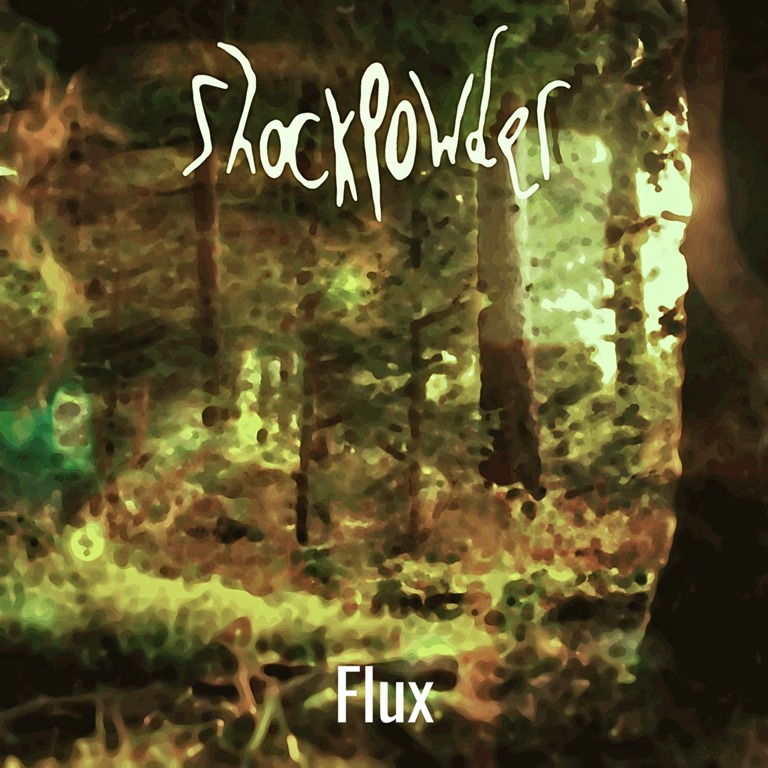
Ah, the power of a strong intro… and the power of nostalgia. The beefy riffage that launches ‘Flux’ by London act Shockpowder… it’s bold and it’s grungy, and the vocals are dreamy melodic, drifting, and I’m instantly dragged back to the early 90s.
Formed in 2015, I wonder if the members of Shockpowder would even remember the early 90s, but they clearly have a strong affinity, and note that they’re ‘heavily influenced by post rock, shoegaze and metal bands such as God is an Astronaut, Alcest and Slowdive.’
What I get from ‘Flux’ is a wistful, emotive element which is carried on some amped-up guitars that are simultaneously jangling and loud, and in many ways reminiscent of early Ride, and, perhaps rather less well-known, Eight Storey Window. Why they never gained more recognition, I will never understand, but then, the era was littered with great bands who were criminally underrated. How long did it take for The God Machine’s greatness to be recognised? Too long, and even now, they seem to be something of a cult for connoisseurs.
It’s not just a question of sound: any musician who’s spent enough time immersed in listening and paying attention to detail, and given the right gear, the right amp, the right pedals, the right production, can recreate the sound of their influences. But what counts is the feeling. ‘Flux’ is imbued with that vaguest, most inaccessible and yet essential ingredients – emotion. There’s something that goes beyond the minimal lyrics, reflecting on the ephemerality of life, something that goes beyond the distortion and reverb, hitting that indefinable spot of resonance. You don’t hear it, you feel it.
After this long, and having amassed a considerable catalogue, Shockpowder probably aren’t about to go stratospheric any time soon, but it’s the world’s loss, ultimately, because ‘Flux’ is, quite simply, a great song.
By way of a name, Reciprocate doesn’t give much away. With its connotations of collectivism and collaboration, it could be anything from limp indie to a jazz ensemble, although to my ears, it suggests ska-punk or some other corny right-on festival friendly guff. But no: they’re an avant-rock trio, and something of a supergroup when it comes to representatives of the UK DIY scene, consisting of Stef Kett (Shield Your Eyes), with drummer Henri Grimes (Shield Your Eyes, Big Lad), and Marion Andrau (The Wharves, Underground Railroad) on bass, and the name, it transpires, is a reflection of the synergy between the three, promising ‘intoxicating, super catchy good-time, big heart music – a human album delivering a human message of love and love lost.’
The blurbage goes on to outline how Soul To Burn proceeds at a cadence all of its own, halting and blasting, ducking and weaving, zooming away from its distant cousins: Taste era Rory Gallagher or Mr Zoot Horn Rollo of Beefheart’s Magic Band, leathering it at full throttle, fuelled by virtuosic back beats that remind of somewhere between the rolling rock of Mitch Mitchell and the fractured noisebeat of Lightning Bolt’s Brian Chippendale: immediate, innovative, virtuosic, exhilarating.
The album’s ten songs are concise and precise, with ninety percent keeping below the four minute mark, and it’s perhaps this focus which really makes Soul to Burn pop. ‘Sleevetugger’ is pretty minimal, and has soulful, bluesy vibe with even a dash of county twanged into the mix – but it’s played with a wonkiness worthy of Pavement, and that absolutely changes everything. They amp it up on the groovesome ‘Rhodia’, where a riff that comes on like a Led Zep lift is delivered with a rough and ready noise-rock approach.
For context, my first exposure to live music was electric blues acts playing in pubs in my home town of Lincoln, at the tail end of the 80s and very dawn of the 90s. While I was just starting to discover alternative music – via the top 40 and also Melody Maker – I was still that bit too young to go to ‘proper’ gigs, and besides, there weren’t (m)any in Lincoln back then. But what struck me was the musicianship of so many of the acts, many of which would play a mix of originals and covers, and I also came to appreciate how everything blues-based springs from an extremely limited root stock. ‘Derivative’ isn’t really a criticism that holds any water. But, to make blues rock work, it has to either the executed extremely well, or otherwise fuck with the formula in some way, and bring something different to the party. Either is really, really hard to do in such an immense field. The last decade or so has seen countless acts achieve success with some pretty mediocre blues rock played loud: I began to think I was bored of blues. But then an album like Soul To Burn turns up unexpectedly, doing it with a real punk attitude, and turns everything around.
Whereas many power trios – not to mention duos, who are the power trio of the post-millennium years – go all-out to fill every inch of space with sound, Reciprocate create space and separation. Everything isn’t blasting to the max, and instead, what we get is a rare level of detail. The bending strings, the fret buzz, the rattle of the snare, the ragged imperfections – they’re all there, and are integral to the fabric of the recordings.
They do melody and groove, and it’s enjoyable, but when they wander off track, as they do most spectacularly towards the end of ‘Pissed Hymn’ there’s something truly glorious about it. The title track is ahead-on collision between Shellac-like mathiness and raucous, rabble-rousing folk. Everything gets twisted and knotted up, the template gets tangled and torn, and it’s unpredictable and exciting.
Regular readers – and fans of Argonaut – will have probably observed that we’ve been pretty consistent in plugging their open-ended album-in-progress Songs from the Black Hat, which has seen the li-fi DIY indie act self-release a song a month via BandCamp. But October’s tune is today getting an official release on a real label – namely Criminal Records, home of The Kut, with whom they’ve released two previous albums.
Nathan explains the band’s methodology for the album’s continual evolution this: “At band practices we each write song titles on slips of paper & put them in the hat. One is then picked at random. We jam around that title & see what alchemy occurs. Most times the magic flows & the combined band chemistry creates something we are really pleased with.”
With two previous albums on Criminal Records, Argonaut’s newest release is produced by Jack Ashley of Popes Of Chillitown, and mastered by The Kut who was drummer/producer on Argonaut’s self-titled debut.
I still can’t hear the world ‘vulnerable’ without thinking of Nathan Barley and an image of David Bowie pissing into a Dualit toaster, but perhaps, particularly since the pandemic and our government’s shameful treatment of the poor and the disabled, I’ve become significantly more sensitive to the way in which vulnerability can be life-shaping, and rarely in a positive way.
Whereas perhaps even in the not so distant past, vulnerability was perceived as being synonymous with weakness, a great many of us understand that it is a fundamental facet of the human condition, and recognise that almost everyone is vulnerable in some way at some time or another. This may not be true of the right-wing tossers who scoff at showing vulnerability – or sensitivity to it – as being ‘soft’ and ‘woke’, but anyone who is a reasonable human being can empathise with how circumstance and life events can place strain on an individual, and just as we’re getting to a place where we can talk about mental health without being stigmatised, so we appreciate that to show vulnerability in fact requires strength in a way we didn’t not so long ago.
The fact that ‘we’ are the vulnerables – all of us – is the crux of the song’s lyrics, along with the painful truth that others will exploit vulnerability for their own ends:.
We are the vulnerables
And we are being used
We are the vulnerables
Me and you and you and me and you
Because it’s Argonaut, it’s a natty tune in the classic indie / alternative style: Lorna’s vocals are sweet and ultra-poppy and there’s both jangle and bounce to the instrumentation – but Nathan can’t resist bringing blasts of fizzy, fuzzy distorted guitar. It all stacks up to a superbly catchy indie pop tune from a band who have quite a catalogue to catchy indie pop tunes to their credit, and no doubt plenty more to come.
Deadset were formed just last year, originally a product of guitarist James Massey and vocalist Sam Mellors, who discovered a genuine bond over writing together. Their sound was moulded into a more claustrophobic, gritty and tense direction when bassist Adam Arnold and drummer Rio Campbell joined, taking the classic indie sensibilities of the two original members into harsher new territories.
Deadset truly came to life when the band wrote as a group and embraced each other’s musical preferences, their influences now relying to an extent on alternative 80s and 90s bands. Influences being taken from bands such as New Order, Fontaines DC and Interpol. Striving to be ever more progressive and unique, the band’s live sound is renowned for fluctuating between genres. Chorus laden and loaded with fuzz and grit.
New Deadset single ‘Bleak’ encapsulates why Deadset is a band and what they want to achieve from it. The track, which was produced by Pat Pretorius (The Talks, Life, Counting Coins) and mastered by Howie Weinberg (Nirvana, Yeah Yeah Yeahs, Daft Punk), really feels like it is humming with the anxiety and fever that everyone feels around Hull. It’s both a commentary on what they see and how they feel, looking at the social issues the band see in the area and how that’s impacted and twisted their lives. ‘We all want something to believe in’ is a feeling that resides in every member of Deadset. All feeling at times as if they’re stuck in a rut. Deadset being their opportunity to escape that rut.
“There’s a really prevalent mutual feeling about the area we all live in. Its rife with boredom and it feels like everyone’s stuck in mundane, monotonous cycles here”, says Sam Mellors. “Most people fall into traps of binge drinking or substance abuse to get away from it. It’s really hard not to fall into that trap when there’s genuinely nothing else to do. There’s still a great community of people here, everyone trying to make it a special place and it will always be a special place to us. But it’s still difficult to get away from the fact a lot of people are struggling”, he further explains. “Deadset became a band because we wanted to escape that cycle, dream of something better and create new horizons for ourselves. It’s our own escape from the depressing reality around here”, adds Adam Arnold.
Have I lost the plot covering such commercial stuff as this? No, not at all, and besides, plot is overrated, and this is an interesting one. Having built up something of a following since emerging a few years ago, Luna Aura’s latest EP release coincides with her touring as support for Slipknot Frontman Corey Taylor on his solo tour. If on the face of it, it seems like a surprising choice for such a pop-orientated act to bag such a slot, however big on guitars they are, Corey’s ubiquitous media of late in promotion of his second solo album has seen him really pushing to emphasise the fact that he’s a multi-faceted, genre-fluid songwriter.
I think I’ve been growing a newfound respect for him for this: he genuinely seems more about making the music that he enjoys than about being remotely cool, which is a far cry from the enigmatic masked presentation of Slipknot, where no-one ever knew who any of the members were for a long time. I always thought Slipknot were shit on every level, and I’d always suspected they were middle-aged record company execs donning boiler suits for some postmodern nu-metal equivalent of The KLF, only more calculatingly exploitative. I was wrong, but not completely off track. But it turns out Taylor’s had some high-profile feuds with the kind if people who warrant feuding with, although I digress. The promo rounds for CMF2 have been interesting, in that they show Taylor, aged 49, facing up to the fact that he’s staring directly at a point in life where his physical capacity is waning and frankly, he’s reached a point in his life where he doesn’t care about cool and just wants to do his thing. At 48, I find this far more relatable than an artist trying to remain relevant and be the voice of ‘youth’, like so many acts who emerged around the turn of the millennium, not least of all so many punk-pop acts who are old enough to be grandparents to their target audience. But also, credit due for giving a young, up-and-coming female artist the exposure instead of some predictable all-male band.
Perhaps unsurprisingly, half of Luna’s EP has already been unveiled as video singles, because that’s how it works now, but regardless, hearing all five songs in sequence is what this is about, and over the course of five songs, we get a sense of Luna’s range and what she’s about.
It’s hard to evaluate new music from new artists that resembles the new music by new artists that was emerging when I was at the same point in my own life. As a teen in the 90s, it didn’t only feel like the most exciting time in music ever, but it felt like our generation had something of its own and something that spoke both to and for us. This was our punk, our new wave, our new romantic. I may have been aware of and listening to new romantic and electropop as it emerged, but at the age of maybe eight or nine, I can’t claim it was for ‘me’. Grunge and the alternative music of 92-94… that was different. On the one hand it seems unusual that a generation behind should revisit and reclaim it. But after a wilderness spell of shit mass-produced r‘n’b and a truly dismal decade socially politically, and all the rest, it makes sense that this should once again reflect the zeitgeist.
But something has changed. There has been a shift. Not only has life in general got shitter, but technology and social media have changed everything. Attention spans have shrunk, and that’s a fact. When it comes to music, you’re got maybe ten, fifteen seconds to make an impression (although an article published earlier this year suggested it was as little as five seconds – but interestingly, the study showed listeners tended to like a song more if they listened to the whole thing first, rather than just being exposed to just a clip).
In this context, it’s obvious why ‘Money Bag’ is the first track and why it was the first single: it’s uptempo, guitar-driven and punky and blasts in, all fuzzy guitar, and arrives at the hook in under a minute. It’s a promising start. Savvy songwriting for attention-deprived times. The guitar is up-front, overdriven, gutsy. But the chorus goes for the bubblegum vacuous style, with an airy ‘woo-hoo’ at the fore. It’s popular right now, and it’s a winning formula, but it just gets on my tits because it feels like a lazy stab at a radio-friendly hit without actually writing a lyric. And it often seems to work. Well, for some people: not for me, really.
But after this obvious start that’s probably only weak in my view, the majority of the rest of the EP is pretty solid. ‘Lost in the Fiction’ is smoother but no less guitar-based, and with an overtly digital feel, it slots in comfortably alongside Garbage sonically and stylistically.
Blind? Bland would perhaps describe this derivative turn-of-the-millennium alt-rock bounce-along that’s Avril Lavigne and Natalie Imbruglia and Alanis Morrisette all rolled into one, which isn’t the worst thing, and it’s neatly crafted, but you can’t accuse Luna Aura of being predictable or one-trick. ‘Candy Coloured Daydream’ is an explosion, with a monster hook and killer chorus, and ‘Cut and Run’ closes in kick-ass style, with an opening riff that’s pure Nirvana before adding a 90s shuffling drum groove and more driving guitar. The Fiction EP is grunge for the 21st century – it’s perhaps more melodic, but it’s got attitude and you can mosh to it. And that’s more than reason enough to say yeah.
Cruel Nature keep the good shit coming with this absolute monster of discord courtesy of Repo Man, who are new to me despite their twelve-year existence. According to their bio, ‘
Repo Man emerged in Bristol in 2011, reshaping ‘rock groop’ sturm-und-clang into subnormal forms, son-of-Oldham vocal slurries, oozing free sax splatter and shards of punishing guitar bliss. If you ever freaked to The Fall, Sonic Youth, Swans or Ornette Coleman then Repo may be your ticket to oblivion.’
I’ll admit, the title didn’t entice me, perhaps because it reminded me of the narrative form of the impenetrable and truly awful Chick Palahniuk novel Pygmy. I write that as a huge Palahniuk fan, and despite having found both Pygmy and Adjustment Day to be so dire that I have up fairly early, I’ve devoured everything else h’s written and have the ultimate admiration for the fact that he will try something different with each outing. It’s testament to his creative integrity that he doesn’t simply rehash the same winning formula.
This is also true of Repo Man, presumably named after Alex Cox’s 1984 cult classic movie. Wikipedia describes it as a ‘science fiction black comedy’, and in this context, the band’s fourth genre-smashing noise explosion album makes sense.
We’re eased in gently with a slow, trepidatious atmospheric twang before, thirty seconds in, ‘Back on the Meat’ explodes in a chaotic frenzy of pure mania. It’s all going off all at once, the jolting sinewy guitar mess of The Jesus Lizard and Blacklisters cut against a stuttering percussion. Things stay schizophrenic with ‘Simian’, which is rather more of a hectic math-rock persuasion, the guitars jangling but jarring and the bass kinda groovy, sort of like Gang of Four gone wrong.
How to pitch this? The vocal delivery is sort of spoken word, like John Cooper Clarke on acid, while the musical backing veers all over, from slugging post-metal to avant-garde via mathy post-punk… The first ‘Pop Me Now’ and ‘Me Pop Now’ (the fact there are three of each scattered across the album only adds to the overall bewilderment that this album cooks up in a cauldron of chaos, but also serve as a thread which weaves the album together in a loose sense) are but brief interludes, wedged back-to-back and packing industrial Krautrock oddness and squalls of feedback into a couple of minutes, and then ‘Butter Pump’ bursts in and brings a blast of brash brass, but there’s blustering bass and all sorts happening in this psychotic sonic collision. Me Pop Now is without question the most outré album I’ve had the joy of running into in a while, happily reminding me of the most mental shit of the 90s – I’m talking about the likes of Trumans Water and Terminal Cheesecake. When a friend – younger than me – asked why I thought being the age I was in the 90s was exciting, I went with the obvious response of the way Nirvana and the whole grunge thing changed the face of music. I forgot to mention that reading Melody Maker, I discovered the weirdest of shit, and it was noisy and crackers and nothing like most of what passes for alternative now. Pummelling programmed beats are assaulting my ears as I realise that Repo Man capture that whole off-the-wall musical experience, the likes of which I haven’t had since listening to John Peel in the early 90s. And while I’m not one to harp on about the past – at least not in the sense that ‘music’s been shit since I turned thirty’ whining – Repo Man evoke the spirit of the 90s in their approach.
It’s taken me a while to warm to jazz-flavoured stuff, although I suppose seeing Gallon Drunk on SNUB:TV in the early 90s was the first time I saw how jazz and noise could be fused to powerful effect. I was blown away by the intensity, and it’s that intensity that Repo Man replicate: yes, there’s jazz and art rock and stuff that some might find pretentious all going on, but what stands out is that this is a set of driving rock tunes, albeit of an extremely alternative persuasion.
And how the hell do you fuse ska and jazz – and make it work? It shouldn’t be possible, yet on ‘Sirhan Sirhan’, they achieve it, and then spin off in a skewed manic math-rock direction.
It’s deranged and demented, and impossible to guess the direction they’ll blast in from between one song and the next, but it works, perhaps because the noise leads and the jazz is more of an infusion: ‘Ratsgrave’ and ‘The Blues Lawyer’ are simply a straight up angular noise driven by chunky churning bass with shouty vocals that sit squarely in the territory of Shellac and The Jesus Lizard, with enough chops and changes to induce whiplash as you try to keep up.
Jason Blackmore (Molly McGuire) and Mario Quintero (Spotlights) have combined forces with their new band known as SISTERS.
The duo’s new single "Through The Cracks" appears on the upcoming album Leecheater, which will be released August 25th on Spartan Records.
Listen here:
Blackmore says, “’Through The Cracks’ was actually a last minute song. I came up with the riffs for the song the morning of the day before I was flying home from our second recording session. Mario had come down to the studio that morning and I showed him the riffs. While he went upstairs to get coffee, I threw together the structure and then we just recorded it. I walked around the block to come up with the verse lyrics and melodies. We recorded my vocals after we recorded the music and while I was doing my vocals Mario came up with the chorus lyrics and melody. We slapped some vocals on the bridge and did a couple guitar overdubs and voila. Basically it’s a song about a person having a midlife crisis. Or that’s how I perceive it at least.”
The album, Leecheater, is a tour-de-force of heavy, atmospheric rock. Featuring powerful, distorted guitar riffs, driving rhythms, and Jason Blackmore’s distinctive vocals, Leecheater is a gripping and immersive listening experience that showcases the band’s ability to create big sonic soundscapes that push the boundaries of modern rock.
With its lush production and dynamic arrangements, Leecheater is a must-listen for fans of heavy, atmospheric music and is sure to cement Sisters’ place as one of the most exciting and innovative bands in the contemporary rock scene.
Today I did something that was pretty alien to me: I took a break. Having dropped the car at the garage for a service, I walked some four miles back into town, and with another mile and half to get me back home, I stopped in at a pub and sat on the first floor with a pint, just looking out of the window watching people drift by on the street below. There were some interesting tunes being aired through the hidden speakers, from early New Order to The Jesus and Mary Chain. At some point, Dum Dum Girls’ cover of ‘There is a Light That Never Goes Out’ came on and not for the first time in recent months, began to reflect on The Smiths, since I recently offloaded my entire vinyl collection of their works. It wasn’t just that I need the money – and the £800 I raised was certainly useful – but this was an act of purging. That Morrissey is a monumental cunt had certainly been bugging me for some time, but then I have many records by people who have long been known to be monumental cunts and I haven’t felt the compulsion to jettison their junk. No, his cuntdom was just the tipper after I came to the conclusion that these records no longer spoke to me and hadn’t been played much since I left my teens, and the death of our monarch, which led to the obvious song gaining ubiquity on my social media feeds simply left me weary.
But on hearing this cover, I found myself thinking ‘but this is a great song’. And so, arriving home to find Spiritual Front’s cover of ‘Bigmouth Strikes Again’ in my inbox felt somewhat serendipitous.
Taken from their upcoming album of Smiths covers, The Queen is Not Dead, it’s a very straight cover that not only pays homage but great attention to detail in terms of the arrangement, mostly only adding swathes of strings near the end. And it, too, is – still – a great song. Although not all of The Smiths’ songs were great – the albums included a a lot of pap, like ‘Frankly, Mr Shankly’ – but it’s hard to fault their singles and the craft. Perhaps, then, it does come back to the issue being Morrissey, his cuntiness and his adenoidal tones which my wife always hated so – meaning that, ultimately, at least for me, it becomes a question of context, and hearing covers of the songs is preferable and less problematic than hearing the originals.
As the bio which accompanies the release details, ‘With The Smiths carved so deeply into the Romans’ collective heart that they had played full shows featuring the English rockers’ classic hymns in recent years, it was only a short step to record a full tribute album when taking a break from touring. Spiritual Front went about their task with the explicit aim to pay a respectful homage yet at the same time to stay away from cloning. Across the album’s fifteen tracks, which many consider sacred, the Italians stayed true to the original recordings, while pulling those songs closer to the sonic world of Spiritual Front for example by adding strings and horn parts.’
This, of course, is the ultimate pull of The Smiths: anyone who has endured those awkward teenage years as an outsider, who’s been sixteen, clumsy, and shy, will feel that connection to these songs. And for a band whose recent output, dubbed ‘nihilistic suicide pop’ has drawn comparisons with Nick Cave, Swans, and Scott Walker, it still makes sense that The Smiths would be there in the background.
But to hear the weathered, tattooed Simone Salvatori enunciating ‘ah-ho, la-la, ladadada’ – well, it does seem somehow incongruous. For all that, he pulls it off well, and while I’m on the fence with the video, it’s a solid cover that suggests the album will be worth hearing.