Archive for the ‘Singles and EPs’ Category

Christopher Nosnibor

Stoneflies – Now I am Become Death

This one has landed timely and on trend, with a title quoting J. Robert Oppenheimer, in turn quoting The Bhagavad Gita, a 700-verse Hindu scripture, which contains (in translation) the phrase “Now I am become Death, the destroyer of worlds.” With things potentiaally still on the brink in nuclear terms between Russia and Ukraine, the prospect of global nuclear annihilation stands as likely now as any time as in the early nighties. To take a line from The Psychedelic Furs, ‘get smart: get scared’. And if it’s not nuclear annihilation, it’s climate change… we are all fucked, and the clock is ticking.

And yet…

If Barbenheimer has become a thing, whoop for the resurgence of cinema. Really. This is not an easy time to stay afloat, to keep things together. But… bigger picture. The world is on fire, but instead of funding fixes to climate change, the mega-rich are taking holidays in space. Hawaii will take billions to rebuild, but instead of donating from their spare billions to support it, Musk and Zuckerberg are facing off over a cage fight in the most embarrassing showcase of a machismo pissing duel this millennium. Fuck! This is wrong, so, so wrong.

In the face of this, it figures that black metal and goth and a host of genre forms which emerged from the bleak times of the 80s and early 90s have taken a firm hold on the now. Sure, I’ve mentioned it before, but it clearly needs reiterating: dark times inspire dark music and dark moods, and these are certifiably dark times. Fascism, racism, and oppression, are on the rise. You can’t trust anyone, least of all the government. They’re fucking you, and they have an eye on your escape.

We’re told that ‘Now I am Become Death’ is ‘a powerful and thought-provoking journey through the depths of human emotion and introspection. With hauntingly intense instrumentals and emotionally charged vocals, this track encapsulates the band’s vision of merging extreme metal’s raw power, progressive metal’s experimental arrangements, and psychedelic rock’s mesmerising spirit into a genre-defying sonic experience.’

We’re also told that ‘Their music is an exploration of the human psyche and the complexities of our existence with the new track a journey through the darkest corners of the mind, confronting our fears, and the struggle to emerge with a newfound sense of purpose and strength. ‘Now I am Become Death’ is part of a series of singles, which will be released over the coming months, from upcoming album All Too Human.’

Emerging from a hovering hum and an electrical crackle and darkness visible, a whistle of feedback pierces the eardrum… slowly descending, for a moment ominous and eerie, before the drums and guitars start to build… and then everything kicks in, a monster trudge of overdriven guitars and gasoline gargling vocals.

It’s brutal, pure devastation. ‘Now I am Become Death’ is four and a half minutes of ferocity. From the low, slow, insistent bass and wailing anguish of otherwordly voices before things assimilate into a demented, dark, groove. Where Stoneflies succeeds is in their balance and menace at the same time; the weight isn’t without detail, but the detail doesn’t diminish the weight, making for a tune of massive impact.

AA
Stoneflies artwork

Christopher Nosnibor

Engineer Records

I have mentioned – more than once – that I’m not fan of punk pop. But I am a strong believer in that there are two kinds of music – good and bad – and that there are exponents of both in any genre. A quote that sticks in my mind is Morrissey’s declaration that ‘all reggae is vile’. Now, I’m no fan of reggae, but that doesn’t mean that reggae is shit, it simply means that most reggae is not to my taste – but then there are reggae-flavoured songs and bands I absolutely fucking love, from The Special to The Ruts, not to mention some of Bauhaus’ dub/reggae dabblings. But vile? I suppose this was one of those early hints that Morrissey was a racist twat, along with his comments about needing to be black to get on Top of the Pops or whatever it was. Only back in the mid-80s, it was simply viewed as being niggardly, misanthropic, and contentious because it made good press.

I know absolutely nothing about the band, or the release: this is one of those CDs that just arrived through my letterbox. Some people would worry about how people find their email address or whatever, but I’ve come to be comfortable with people sending me stuff, because, well, as long as it’s downloads and CDs and books, rather than death threats, it’s a good thing.

Bed of Snakes definitely sit at the punkier end of the spectrum, rather than the poppier end. and it’s an instant grab with ‘Bridge to Nowhere’. It has the drums right up front and centre, the guitars crackle with crunch and big speaker volume, and the vocals are lower in the mix than the mixed-for-radio stabs at success that’s depressingly commonplace. There is, to my ear, nothing more irritating than clean vocals at the top of the mix on a tune that purports to be punk… and even in general. Mix really does matter, and with guitar-based music, the vocals should sit in it, rather than dominate, way above it. Too much vocal just sounds… wrong. But this, this is perfect, And those vocals are gritty, full-throated, raw, they grab you, and they’re riven with energy and sincerity.

‘Over You’ slumps into middling mediocrity and it would take far longer than the song’s two minutes and thirty-seven seconds to list the bands it sounds like. For me, it’s two and a half minutes of wondering why. Why do something so derivative? Why, when you can clearly do so much better, be so much more exciting? I suspect that radio play is the goal. Let’s write the tune that could get radio play, guys! I get the rationale, but no-one wins here.

But they’re back hard and heavy on the closer, ‘Stolen Moments’. As on ‘’Bridge too Nowhere’, the guitars are big and gritty, and the sound is dense and there’s a punchy, passionate edge that feels real. And two outta three ain’t bad: Bed of Snakes have proved that they’ve got guts and grit, and some knack for riff-driven tunes. Let’s have some more!

11th August 2023

Christopher Nosnibor

One of the great pleasures I derive from reviewing music, particularly that of experimental and ambient persuasions, is the amount I learn from reading about the inspirations behind the works. Because of the nature of these musical forms, the inspirations are wide and varied, but often reactions or responses to events or places, or even abstract concepts, and unencumbered by the conventions of lyrics, which are so often hampered and constricted by the limitations of meter, rhyme, even vocabulary and simple words themselves, lyrical songs fail to convey things which, on occasion, music alone can do. Because music speaks its own language, and has the capacity to communicate, to convey more than words. As a writer, and writing about ambient compositions, I am often acutely aware both of my limitations and the contradiction of the process, in essence, or reversing the magic of instrumental musical works to ‘explain’ them using rather blunter tools, but at the same time, I relish the challenge. Moreover, I have learned more of history and geography and beyond from my curiosity-led research than I ever did from my formal education.

So much information is simply not given to us, and so much history – recent history – is lost to us, unless it has a specific local interest, and even then, many people who are natives to the very town or city they life often know woefully little of the heritage which surrounds them. I am guilty of this also, knowing comparatively little of my locale, although it was again my own curiosity which compelled me to learn the history behind the existence of a brick and concrete bomb shelter in my own back yard.

Globally, we’re so wrapped up in the moment, and a nostalgia for the recent past that the history of a generation or more ago may as well be Elizabethan rather than Victorian or Georgian.

And so it is that I had absolutely no knowledge of Carabanchel Prison… which of course meant that I simply had to find out about it. How did I not know about the largest prison in Europe, built between 1940 and 1944, and operative until 1998? Disused and abandoned for a decade, plans to convert the immense brick complex to flats came to nothing (can you imagine actually living there) before it was demolished in 2008. So many questions… about its occupants, about it mere existence, about its collapse… so many questions about a place which housed political prisoners after the Spanish Civil War, and many more besides.

This EP is, in fact from the soundtrack to a forthcoming movie, released next month. As the accompanying notes explain: ‘The film portrays a person painting a line from the prison’s epicenter to across the wall. The abstract textures that drown the images are created by streams of water. The film was shot in 2006, inside the prison of Carabanchel, Madrid. The prison had then been closed and abandoned for over 10 years. It was finally demolished in 2008. The tapes were edited in 2023, 17 years after its making. The film features Ragnar Bey as the painter.’

Painting a line through aa disused prison my seem a rather curious film project, but no doubt context bolsters its content. But the soundtrack…

Across three pieces, each around four to six minutes in duration, War San (Swedish composer Kim Warsen) leads us through the building’s structure, and the titles correspond with the location: ‘Wall’, ‘Cell’, ‘Exit’.

Despite taking the form primarily of an elongated, wavering drone, ‘Wall’ has soft elements, trilling long notes as though from some pipe or another: not a pipe organ or bagpipe, but something long, droning but at the same time bright, airy. Meanwhile, ‘Cell’ feels almost spiritual. There is an oppressive darkness which pervades, and lingers at the corners throughout, but the overall sensation blends contemplation with optimism, before ‘Exit’ breezes, cloudlike towards freedom.

Perhaps, then, this EP’s function of a soundtrack to a post-abandonment creative project means any presupposition about it being a place of confinement is mistaken. Instead of chewing over its darker history, Carabanchel Prison invites us to reflect on the fact that those days are over now, and looks to a brighter future. It traces a line – quite literally – from confinement to exit, and to freedom. If only this was possible for more historical dates and places.

AA

CARABANCHEL_PRISON_Cover_NEW

Icons Creating Evil Art – 4th August 2023

Christopher Nosnibor

The third single from Swedish act Darkplace is their first to feature vocals, and is not a cover of the Gary Numan hit.

The band are described as ‘a mysterious new Swedish dark dream pop/post-punk group whose forthcoming debut album, About The End Of The World, is a conceptual work inspired by the bleak landscape of the Stockholm suburbs that birthed them.’ They go on to say ‘for the members of this highly secretive group, it is not just about the music. They perceive themselves as more an art project that happens to be exploring and commenting on the state of the world through their chosen mediums of music and video.’

Is a band mysterious if they tell you they are, or does that undermine the mystery? Surely a lack of disclosure is mysterious in itself? If I’m overthinking, it’s almost certainly a consequence of their overexplaining, although I am entirely on board with the idea of an act taking their art seriously to the point of fully inhabiting that space. When it comes to concept-based creations, you have to fully believe in it, otherwise, how can you expect anyone else to?

When it comes to Darkplace, context counts for a great deal, and to provide this, I shall quote liberally here: ‘Centred around an alternative reality – or is it just a grim present and future? – the album is being unveiled gradually via a series of videos based on animated digital paintings for each of its tracks… Their new single, ‘Cars’ […] sees the story move on to a man who travels north following cryptic messages written on highway signs that only show up in the blast of his headlights. Is he the only person who can see them and follow the trail? Darkplace cryptically state that “trying to escape this psychotic, slow burning apocalypse is not easy. Nowhere is safe. These weird structures and phenomena seem to occur everywhere, all over the world. Nowhere is safe!”

Perhaps somewhat ironically, the slow-burning apocalypse of which they write is accelerating at a pace no-one can keep up with, and half the planet is on fire now, quite literally, although this afternoon I read of hailstorms of biblical proportions in Germany and Italy, smashing car windscreen and requiring snow ploughs to clear the streets. It really does feel like the end of the world, and there’s a strong chance that is truly is.

Detached from the narrative of the album, ‘Cars’ stands well as a standalone single. It’s a taut, dark (of course) slice of post-punk inspired tunage, and while its lineage is clearly one that can be traced to the early 80s, it’s equally indebted to the school of the early 00s, which brought us Interpol and White Lies. What goes around comes around, and here in 2023, times are the bleakest they’ve been since the early 80s, with the added bonus of climate change threatening the collapse of civilisation and life as we know it. It’s dreamy but driven by an insistent beat and nagging guitar lines, and if the vocals, floating in reverb, evoke The Charlatans or Slowdive, and there’s perhaps a hint of Doves in the mix, the energy is more reminiscent of early Editors. Lyrically, it’s anything but uplifting, but the musical counterpoint really sweeps you along, making for an exhilarating three minutes.

AA

fc7f46444f143114c333beafb3be754b3b51910f

The Quietus

Christopher Nosnibor

It’s not that I like to brag, but I’ve been writing about Sly and the Family Drone since 2012, when they blew me away at the Brudenell in Leeds, with a chaotic, percussion-heavy, audience-participation-led performance (and since when my writing has improved and I’ve become a shade more sensitive, perhaps). Witnessing Matt Cargill standing aloft on a stack of amps while surrounded my members of the crowd battering drums distributed by the band was one of the most exhilarating experiences of my life, and I was an instant convert. In some respects, I was fortunate to witness it: in a recent interview, Cargill was at pains to stress that it’s one of those spontaneous things: “It doesn’t happen at every gig,” he warns. “And I don’t want it to become a thing that people expect or are disappointed when we don’t do it. There are times I’ve seen people write, ‘Bring your drumsticks!’ I’ve never said that and I don’t want you to do that! If we were doing it every night people would be, like, ‘Oh, fuck off! They’re doing their schtick.’”

It’s this spontaneity and true commitment to improvisation that is a significant part of the band’s appeal. You never know quite what you’re going to get, and there’s a sense that nor do they: it all unfolds in real-time.

Their subsequent releases since my introduction in 2012 have never disappointed, and for me, at least, the best thing about Sly is that they embrace the difference between the live and recorded media. As such the recordings are the recordings, the performances are the performances. Explaining the difference to The Quietus, Cargill says “It was nice to be able to do all that spatial and stereo stuff which we wouldn’t be able to do live,” he says. “Because of mics on drums and stuff, it just doesn’t really work in that way. So we were able to spend a bit of time just working on that and doing some quite weird-sounding drum stuff which I’m really happy with.” The same article also explains, ‘The passages of manipulated drumwork are bookended by the band performing together in full skronking and lumbering flow and, in a move that vaguely echoes the ecstasy of their live sets’ endings, it finishes with a warm and symphonic cacophony of horns. “It’s kind of a pieced together track but I think it works as an entire piece,” reflects Cargill.

They have forged a career – or perhaps eked one, on the breadline, with a cult reputation which exceeds the returns a fringe act can attain in this crappy climate, a climate whereby post-Brexit overseas travel is prohibitive and not just financially – from being far out. Embracing elements of jazz and noise and a whole spectrum beyond, it’s fair to say that this is an act who plough their own furrow, and for that, respect is due, and them some.

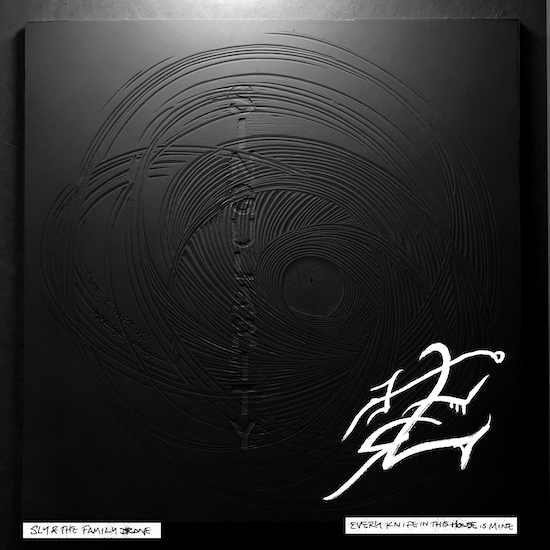
This latest release is – as ever – an interesting one. It’s a limited lathe-cut 12” released via The Quietus, a publication with an immense reputation for its championing of the weird and the wonderful, and which perhaps more than any online publication with a significant readership plugs the gap left when Sounds, and then Melody Maker ceased to be. For non-subscribers, it’s available digitally via the usual platforms.  The ones I don’t use or advocate. But I digress. ‘And Every Knife In This House Is Mine’ is Sly at their best.

As a single track – less a composition than an exploration – with a running time of twenty minutes, it’s an EP or an album by some bands’ standards, but what it ultimately is is an immersive experience which sees them make the most of having access to studio facilities to push their sound further in different directions.

It’s a shrill, rippling wave of feedback that pierces the eardrums in the opening seconds which announces its arrival before a tempest of crashing drums, wayward brass and extraneous noise deluges in, and more happens in the first forty seconds of this tune than the entirety of many albums. Shortly after, it settles into a thunderous groove, the rhythm section grindingly heavy while wild horns – Kaz Buckland’s alto sax and James Allsopp’s baritone sax interplay is a back-and-forth that is timed with perfect precision.

There’s a lot of reverb, and a lot of space here. They pull back from the brink of pure chaos and meander through some expansive gentler passages, before, each time, exploding into a wild crescendo. It’s hard to differentiate snarling electronics from barking vocal yelps , and there isn’t a second where there isn’t something happening. It’s impossible to maintain a commentary on this sequentially.

A tumult of noise, bleeps and glitches, bloops and whirls, all fuse to form a wild cacophony, and it’s pure bliss to yield to this sonic tidal wave. But over the course of the track’s twenty minutes, there are constant ebbs and flows, the lower-level churning swashes rendering the louder segments and extended crescendo’s all the more impactful.

Things get decidedly Throbbing Gristle around the midway point, with swampy electronics and groaning low swoons taking things down, disrupted by random clatterings of percussion, before things take a turn for dark around the fifteen minute mark, with drones that sound like a 747 heading towards the ground in a nosedive… and then the climaxes with an extended jazz frenzy, and… woah.

Running through every form and texture, Every Knife In This House Is Mine is both exhilarating and exhausting… and everything you would expect from Sly and the Family Drone, and all that jazz.

AA

SlyAndTheFamilyDrone_Flat_copy_1669300606_crop_550x550

26th June 2023

Christopher Nosnibor

‘Industrial’ is a definition that’s shifted significantly over the years. The shift seems to have come some time in the late eighties or early nineties, when the likes of Ministry and Pitch Shifter were breaking into a much more mass-market audience: the former smashed MTV with the singles from Psalm 69, with even Beavis and Butthead getting down to ‘NWO’ and proclaiming ‘even the old dude is cool’ in reference to William Burroughs’ appearance in the video to ‘Just One Fix’. It seems hard to reconcile the enormity of that album with the face of music in the media now, but the early 90s really were something. You’ll read endlessly about how Nirvana smashed open the doors and so on, and perhaps to an extent that’s true, but they were simply a part of the zeitgeist in an era when MTV focused on ‘M’, and you would find bands like Soundgarden and Butthole Surfers and Rage Against the Machine being played alongside ‘Sabotage’ by The Beastie Boys, and it didn’t seem incongruous with all the mediocre pap because, well, that was what people were listening to. I even picked up a Therapy? live bootleg CD in a record shop while on holiday in Venice in the summer of ’94. I was excited, but it didn’t seem particularly strange at the time. Pitchshifter, meanwhile, had named their debut album Industrial, and it was fucking heavy, but it wasn’t until they changed their sound and rode the wave of sports metal around the turn of the millennium that they got popular, doubtless aided by their intersection with The Prodigy.

But because of the bracketing of these bands as ‘industrial’ in the 90s, the original characteristics of what had previously been deemed ‘industrial’ became buried, and forgotten. It’s hard to really find a connection between Ministry and the likes of Throbbing Gristle and Cabaret Voltaire (at least musically: they all loved Burroughs, but Jourgensen’s fascination was more about the junkie guru legend, whereas TG and The Cabs were into exploring ways of applying the cut-ups and Burroughs’ tape experiments of the late 50s and early 60s to music.

Binary Order sit firmly in the bracket of contemporary industrial, or what many refer to as Industrial Metal, and with this release they really show their influences and wear them with pride.

Now, I do get somewhat twitchy when the running order of a review stream or download differs from the Bandcamp stream or whatever, because the flow of a release is important – at least to me, and I tend to consider the overall flow of a release in my appraisal of its success.

So we’re going with the Bandcamp sequence here, which kicks off with lead single and title track, ‘Thrown Away’, a cover of the song by the oft-maligned nineties nu-metal act Papa Roach, who, remarkably, are still going and releasing albums at a steady rate. Are people really still buying this shit? Rap Metal was surely one of the worst things to have happened to music… but here it is. They blast off the four-track EP with a chunky riff-dense rendition of ‘Thrown Away’, and with that out the way, be can finally turn to the rest of the EP.

The remaining three tracks are remixes of songs from their debut album, Songs from the Deep, released in November of last year. The ‘Bleeding Mix’ of ‘Parasite’ is a gut-churning gurgle of stuttering electronica, that starts with a pumping, shuddering beat and a quivering synth groove which provides a stark backdrop to the raw vocals… but then it gets a bit ravey and autotune and straddles the uncomfortable intersection between dancefloor and sonic assault.

The Arcadmix Remix of ‘A Good Death’ is altogether more atmospheric and moody, and works well, largely because it’s neither overtly dancey nor Industrial / Nu-Metal. The six-and-a-half-minute ‘Irreversible Mix’ of ‘Hands of Time’ manifests as a long, oppressive, darkly ambient drone that’s a real departure from the rest of the EP.

The diversity is the key strength of this release, paired with the fact that it shows a band wanting to push their limits and aren’t especially precious about how their material is reshaped or adhering rigidly too their chosen genre.

AA

812429

Warren Records – 31st July 2023

Christopher Nosnibor

There are few things quite as gratifying as seeing one of your own quotes as the lead on a press release. And so it is that Hull noise punks Bug Facer, who I declared were my new favourite band on the release of their debut single, ‘Horsefly’ in Nov ember, praising them for their ‘claustrophobic, pulverising heaviness that leaves you aching’, rage hard on their debut EP.

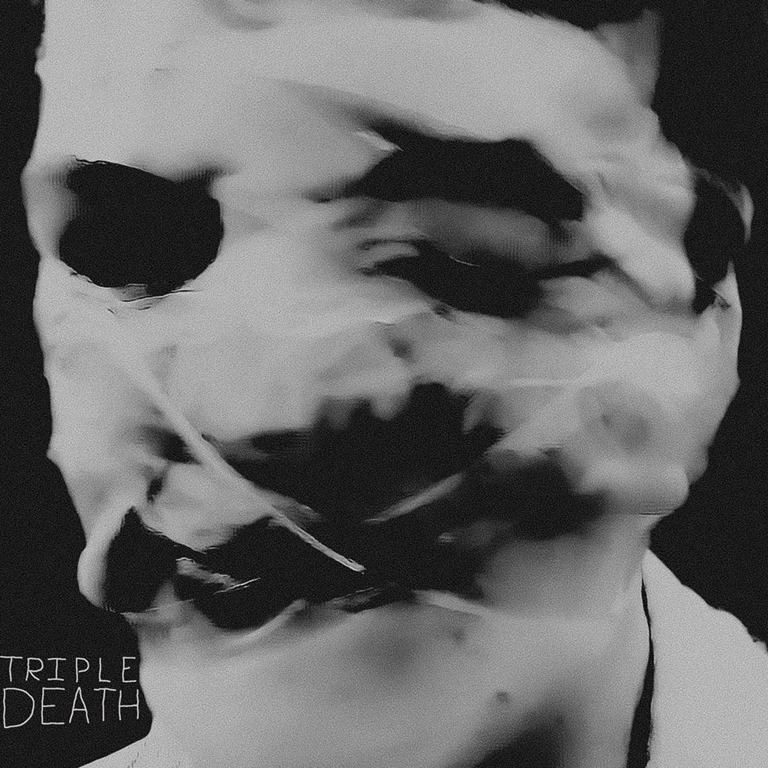
What are they angry about? Everything and anything: modern life in general. Triple Death may only contain three tracks and have a running time of less than fourteen minutes, but they pack in the fury with a critical mass. The first cut, ‘Eggshell’ sets the tone, and, they say, ‘explores the idea of cycles with no end and how on an existential level we try to apply meaning to struggle.’ This isn’t just noisy shit: it’s noisy shit with some deep thought involved, and ‘Eggshells’ is low and slow, with a hesitant bassline and swirling guitar that swishes around in a gush of treble, and instrumentally it lands somewhere between The Fall and ‘Budd’ by Rapeman, and it’s completed with howling vocals that sound like every syllable is being torn from James Cooper’s lungs. It’s harsh and harrowing and truly the sound of pain leaving the body.

Theirs is an usual setup, with the drummer and bassist contributing vocals alongside co-founder Cooper who plays guitar. I say play: he and second guitarist Josh Burdette torture their instruments, channelling their angst through mangled chords at high volume. Sonically, their approach is unusual, too: they’re not big on riffs or distortion or driving percussion, the popular cornerstones of angry music of many genres: the sound on Triple Death is steely, grey, murky, creating the kind of oppressive sensation I feel listening to Unsane and Red Lorry Yellow Lorry. It makes you feel tense, twisted up and knotted inside.

Picking up the pace with ‘Prod’, which, with the addition of some gurgling synths, steps into a Krautrock groove, before the guitars lunge in and things get messy, the deranged, raw-throated vocals and serpentine guitar lines interweaving in a thicket of discord flay the nerves without mercy. ‘We are all the cattle… We are all the cattle, is the refrain’. And we feel it.

It’s a reworked version of ‘Horsefly’ that closes the EP off, and it’s a cleaner sound that marks the primary difference from the original release of this six-and-a-half-minute trudger of a tune that has the kind of earthy weight of Neurosis. The guitars chime dolorous doom as the bass and drums hammer hard, heavy, relentlessly thudding, so low and slow as to drag your heart down towards your knees.

The clue, I suppose, is in the name. This isn’t just death: it’s triple death, and Triple Death is grim, gloomy, the soundtrack to battling against the tide of shit on shit, when a trip to the seaside is a game of dodge the turds and a tub of butter costs seven fucking quid. When they tell you that inflation is a global issue but the fuel providers and supermarket chains record bumper profits and immense payouts to execs and shareholders while nurses are querying at food banks… fuck this shit. Triple Death is the soundtrack to telling the world, ‘fuck this shit’. One more time: fuck this shit.

AA

BugFacer_TripleDeath_artwork_1080sqr

28th July 2023

Christopher Nosnibor

Funny how time goes. Precisely two weeks short of a year ago today, I reviewed Bedroom Tax’s debut single ‘Kin’, against a backdrop of a heatwave and wild fires in the UK, and increasing level of panic over fuel costs ahead of the winter in prospect. And we thought things looked bleak then. No heatwave in the UK this year: instead, we’ve spent the last three months swinging between regular summer weather and days that more closely resemble October while the rest of the world burns, and we long for the days when it was only the cost of energy and Lurpak that were heading into the stratosphere.

Bedroom Tax are one of many bands with sociopolitical leanings who have adopted names which set their stance out in the simplest of terms. I’m thinking BDRMM, Bedsit, Benefits, bands born in many ways out of frustration and necessity, and their very existence is a statement about the crushing economic climate we live in – at least if you’re a regular person and not in the executive echelon, or otherwise comfortably off thanks to inherited wealth, a backhander from a mate in government, or an MP.

The so-called ‘bedroom tax’, introduced in 2012 is one of many examples of the tory government shafting the poor and the disabled, and as Michael Rosen pointed out in an article for The Guardian in 2014, the bereaved, was found in 2019 to be discriminatory by the European Court of Human Rights. No wonder the government are keen to ditch the ECHR: they keep ruling that their inhumane policies are illegal.

Since releasing ‘Kin’, Bedroom Tax have spent their time reflecting and refining their sound. It’s been time well spent.

‘Bad Behaviour’ is a magnificent melding of post-punk and post-rock with ‘urban’ elements, and possesses both beauty and bleakness simultaneously. Chiming guitars and programmed beats provide the backdrop to the incisive yet flowing rap of the lyrics, poetically dissecting social division and the hand we’re dealt due to privilege or lack of. It’s got bounce and groove, and even a certain noodly indie jangle that’s seen the sound of The Smiths cast through a more current prism that’s still more 2006 than 2023, but there’s a joy in witnessing the bounds of genre time being dismantled, and knowing that Morrissey would fucking hate it.

It’s a progression from the kitchen-sink reflections of ‘Kin’, but at the same time, there’s still that gritty realism, with echoes of The Streets, and the reason Bedroom Tax are so appealing is because there’s no pretence, no artifice: they’re telling it like it is.

And just as punk and post-punk emerged from the desolation of Thatcher’s Britain, so the current wave of acts who hark back to that but with the addition of more contemporary twists are coming from parallel circumstances. Austerity may not be the buzzword of the present, but we never left it: cuts upon cuts by cunts upon cunts are why we are where we are. And acts like Bedroom Tax articulate the everyday realities of life right now. We need these guys.

thumbnail_Bedroom Tax

7th July 2023

Christopher Nosnibor

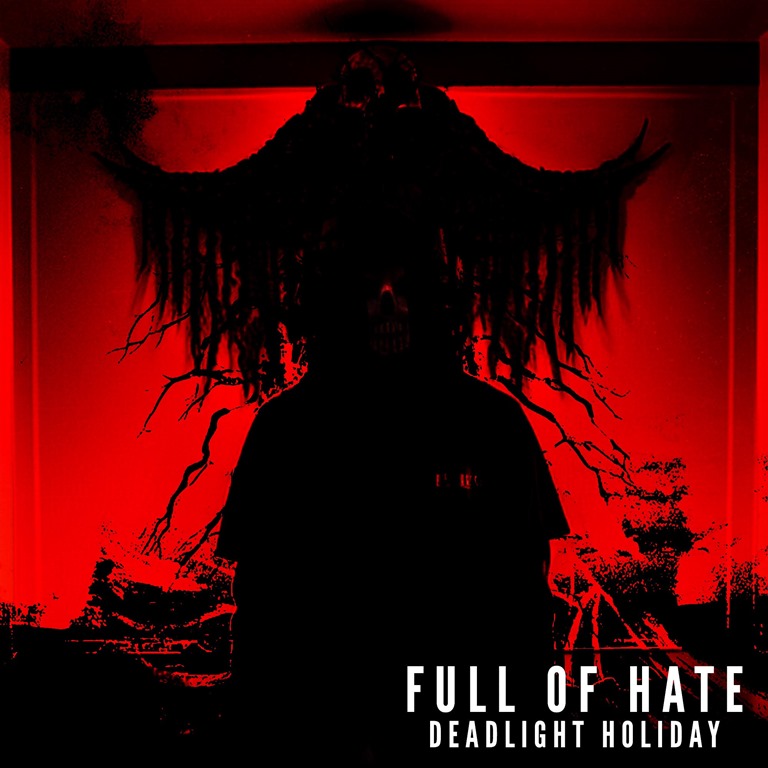
I recall, when I was growing up, people often being admonished for using the word ‘hate’. ‘It’s such a strong word’, would be the lecture. Usually it was adults telling teens this: no, you don’t ‘hate’ school, you don’t ‘hate’ that band, or that annoying kid in your class. I never saw it as such a big deal. I suppose, on reflection, we were using ‘hate’ in a hyperbolic sense. Now, however, we seem to use the word somewhat less frequently, but feel hate – real hate – being expressed more freely. It’s not pleasant, and while much is said and written about the toxic environments of social media, the real world really isn’t any more pleasant. From toxic work environments to increasingly right-wing governments creating division and stoking hatred of minorities, be they immigrants, the poor, or the disabled, the world we live in is not a nice place to be, and it’s small wonder that mental health issues are at an all-time high.

‘Full of Hate’ isn’t about the outward projection of hate onto individuals or groups, but the inward-focused grapplings of torment, as the accompanying notes explain: ‘The song captures the suffocating feelings of anger and isolation that engulf us and often leave us with a feeling of being confined. Moreover, the song does so within the span of ninety seconds.’

And that it does: they’ve condensed all the intensity of emotion into a minute and a half. Zero fat here. It’s the bass that defines ‘Full of Hate’. By which I mean it’s a 360-degree immersive sound, the thick distortion secondary in impact to the booming frequencies. So dense is the sound that it almost submerges the mechanised drums and growling vocals. The vocals are unexpected, at least on first listen: there’s an association with screaming and full-lunged roaring as giving vent to anger, rage, and catharsis. But on ‘Full of Hate’, the vocals are controlled, focused, all the more difficult to process in context. There are some moments of dodgy autotune, but overall, it’s that sense of keeping a lid on things that suggests psychopathy, and which renders ‘Full Of Hate’ all the darker, all the more intense.

It’s one powerful, tension-blasting minute-and-a-half that’s awkward and uncomfortable, seething rather than foaming as the rage flows.

AA

476853

23rd June 2023

Christopher Nosnibor

Talk about moving fast: as their bio details, ‘The Bleak Assembly was formed in July, 2022. Two weeks after its inception, the first EP, We Become Strangers was unveiled. The Bleak Assembly’s meaning takes inspiration from Charles Dickens’s Bleak House – the ‘Bleak Assembly’ being the chain of people in the story whose lives are destroyed by the promise of wealth.” This seems a fitting parable for modern times, and show how we never, ever learn from history.

Comprising Michael Smith (all Instruments) and Kimberly (from Bow Ever Down), they continues to create at pace (ugh – I hang my head at having written such a corporate phrase in a review… but, phraseology notwithstanding, it’s true), and followed up their debut EP with the ‘Alibi’ single in February of 2023, and now they present Strangers Among Strangers. The goal of this EP, says Michael Smith was to “try a different sound. Bands seem to fall into a certain sound after a while, so if that should happen to us. I wanted to open it up to a more electronic sound to give us more room in the future.”

They have pedigree and experience, having between them shared stages with the likes of Assemblage 23, Razed in Black & Switchblade Symphony with their own individual projects, and it’s unusual to see them declare up-front that The Bleak Assembly will likely remain strictly a studio project. But why not? Sometimes the creative process evolves organically and feels like it needs to have that live outlet, while at other times, recordings simply don’t lend themselves to being replicated live. And then there are logistics, not to mention economics. The latter is a very real factor in determining how artists operate now. Funny (not) how the cost of everything has gone up apart from wages and the fees paid to artists.

But this sounds like a studio project, also. And that’s no criticism, and no bad thing. Oftentimes you’ll find bands striving – and failing – to capture the energy of their live performances in the studio. It’s often the case that they developed out of playing live and that’s the platform on which they’re familiar and on which they thrive. And fair play to them: but other acts evolved in the studio and are detrimented by distance, while others simply don’t feel comfortable as live entities and feel they simply cannot replicate their studio works in a live setting. Whatever the case with The Bleak Assembly, they’ve clearly found a method which works for them, facilitating a rapid stream of material.

With Strangers Among Strangers, The Bleak Assembly, who clearly have something of a fixation on strangers and the unheimlich have crafted a crisply-manufactured piece of electropop, and while it’s got some strong gothy / darkwave elements, there’s a lot of Midge Ure era Ultravox and Violator-era Depeche Mode in the mix here, as is immediately apparent on ‘A Night Like This’ (which isn’t a Cure cover).

Strangers Among Strangers is solidly electro-based and packs some real energy. It’s synthy and it’s dark – and nevermore dark than on ‘Ready to Die’, where Kimberley faces straight out into the abyss and confronts the ageing process and, ultimately, the end, against a backdrop of swirling chorus-soaked guitar that’s pure 1985. ‘Remains’ is similarly bleak on the lyrical front, and these songs channel a lot of anguish. It may well be that they’re common tropes in the field of goth and darkwave, but the delivery is gripping, as well as keenly melodic. There’s something of a shift on the EP’s second half, moving to a more guitar-driven sound, but the throbbing synth bass and cracking vintage drum machine snare keep everything coherent and push the songs along with a tight, punchy feel. There’s much to like.

AA

a0917300862_10