Archive for the ‘Reviews’ Category

9th April 2025

Christopher Nosnibor

With his latest offering, Gintas K promises a work of ‘ambience, electroacoustical micromelodies and noise played and record live without overdub.’ That he is so relentlessly active is perhaps one of the reasons its possible for him to create such wild improvised works on a first-take basis – which in turns means it’s possible to crank out new releases at such a staggering rate.

The first of the seven sequentially-numbered pieces is eleven and a half minutes in duration, and begins as a barely audible drip, a tiny trickling sound at the fringe of perception. Instantly I find myself on edge: it’s a sound I’ve become increasingly and acutely aware of in recent days, as the shower in my bathroom – only an internal stud wall away from my office where I listen and write – has progressed from a slow and infrequent drip to a full, continuous dribble, a nagging, torturous sound which has led me to place the shower head in the bath in order to mute it. There’s something of a liquid, and sometimes foamy, frothy sound to many of Gintas’ works, and Atmosphera begins with all the promise of being another one of these. And, indeed, as the drip and trickle increases in rate to become a gurgling stream, there is a sense of growing volume – in terms of liquid, rather than sonically. But a sparse piano rings out over the babbling stream, and as the piece progresses, creaks and bleeps and bumps and strange warps in the very fabric of time and space disrupt the flow. And yet, as the abstract interruptions and distractions become increasingly frequent and ever-more alien, sometimes extending to washes of fizzing distortion, and even fill-on frenzies of chaotic noise, echoing drips and splashes, like water falling from above into the lake at the bottom of a heigh-vaulted cavern, and reverberating piano notes remain at the core of this bewildering sonic collage.

There is a certain sense of evolution as the pieces run into one another: by Atmosphera #3, there is a sense of ambience blended with dissonance, and slow pulsations merge with the brooding and often melancholic piano lines, and these elements certainly contrast with the organic yet equally turbulent, almost artificial grunts and gurgles. Atmosphera #5 is the sound of lasers set to stun, with robotic squawks and a relentless whistle of feedback that hits right at the tinnitus pitch and congeal into concoction of wrongness, like a stew with a bunch of ingredients that should never be combined.

The album winds down gradually, sparse piano notes and a soft trickling liquid flow slowly descending, falling, and fading away…

Something about listening to Atmosfera is like watching a large fish tank. Just as the fish flit blithely and without any attention to the world beyond their own, darting here and there without any predictable linear path, so Atmosfera doesn’t follow a linear flow – and is all the better for it.

AA

a2258515655_10

Suicide Records – 30th April 2025

Christopher Nosnibor

Blammo! With Absolutely Launched, Demonic Death Judge slam straight in with the juggernaut riffage: ‘90s Violence’ is full-throttle, in-yer-face, no pissing about, thick guitars welded to a ball-busting rhythm section where the drums absolutely pound and the bass is lurking darkly, filling out that low-end with a heavy throb, while the vocals are a full-throated roar. Drawing together the extravagance of 70s heavy rock and the raging rawness of grunge, Demonic Death Judge land firmly in the territory of 00s racketmongering guitar slingers like Pulled Apart By Horses.

The six-minute ‘You’ve Got Red on You’ chugs and lurches along with all the grain and heft and would be just another heavy stoner cut taking its cues from Les Zeppelin and Black Sabbath were it not for the ravaged, gargling gasolene vocal, which is raw, incendiary. And on Absolutely Launched, they just keep on blasting out the meatiest, most monster riffs with no let-up. Any slower, less-up-front segments, such as the mid-sections of ‘You’ve Got Red on You’ and ‘Goner’, the latter of which chimes nicely, are simply brief breathers where they reload and come back, all guns blazing, twice as hard. They do chill things out on the mellow blues of ‘I Realise That… Now’, and it presents a switch in the emotional tone, too, hinting at a more reflective, contemplative side to the band which stands in contrast to the rest of the album, which is anything but reflective or contemplative, and instead rages all the way, breathing fire with every chord struck – and those chords are struck hard and at maximum volume.

Absolutely Launched is a magnificent exercise in spectacular excess, and it’s truly glorious. If you’re going to go big and hefty, and utterly ballistic, there can be no half-measures. Everything is overloading, cranked up to eleven. There aren’t many solos, instead favouring the monster riff as the dominant feature, but when the solos land, they’re epic, and wild. ‘Dead Dogs’ simply tears. ‘Spliffhanger’ roars in a raw-throated forest fire of a relentless rager, while the seven-minute title track which wraps the album is monumental in its punishment.

The easy blues rock touches which occasionally grace the compositions hint at accessibility and a more overt musicality, but more than anything, Absolutely Launched is all the revs, foot to the floor riffery, and it’s a behemoth of an album.

AA

a1384961471_10

Bearsuit Records – 30th April 2025

Christopher Nosnibor

It’s been a couple years since we last heard new material from Harold Nono, enigmatic purveyor of weirdy electronica, and platformed by the go-to label for weirdy folky worldy electronica, Bearsuit Records. And Faro is suitably strange, and, well, Bearsuity.

It doesn’t start out so: ‘Raukar’ is primarily sedate, piano-led, sedate, strolling, and overall, feels quite calming, despite jangles and scrapes of dissonance whispering away in the background. As the ambience trickles its way into balmy abstraction, we feel a sense of discomfort, and while the expansive ‘Sketch for Faro’ is soothing, expansive, cinematic, and feels like it could easily be an excerpt from Jurassic Park or another sweeping passage from a big-budget family-friendly movie, there are undercurrents which are subtle but nevertheless discernible which add an element of ‘otherness’ to it, particularly the abstract, almost choral vocal which rises near the end.

An EP consisting of only four tracks, Faro is a brief document, but Nono brings together many elements within this succinct work. Besides, it’s not all about length, right? Faro is sonically rich, imaginative, and ambitious in scope and scale. It feels expansive, transporting the listener over huge landscapes of trees and hills and field and planes, and you kinda feel carried away on it all in a largely pleasant way, despite the niggles of tension which creep in. And during ‘The Hour of The Wolf’ everything begins to explode and expand like some kind of galactic simulation, and suddenly, from nowhere, there are beats are blasts of distortion and everything somehow crumbles, and as silence falls, you find yourself standing, dazed, amidst rubble and ruins wondering what just happened.

While many of the elements common to Nono’s work are present here, Faro does seem like something of a development, expending in the direction of 2023’s ‘Sketch for Strings’ and moving further from the more disjointed, collagey compositional forms of earlier works. It’s less overtly jarring, less conspicuously weird, but don’t for a second think that Nono has gone normal on us – because Faro is subtle in the way it unsettles, and the last couple of minutes completely rupture the atmosphere forged gently and carefully over the rest of the EP. And this is why it’s both classic Nono and quintessential Bearsuit – because whatever your expectations, it is certain to confound them.

AA

a0171664628_10

God Unknown Records – 25th April 2025

Christopher Nosnibor

A new album by World Sanguine Report is always something to pique the interest. The jazz-tinged avant-rock collective centred around Andrew Plummer, with longtime collaborators Matthew Bourne, Ruth Goller, and Will Glaser, has a knack of producing music that Does Something Different. In a world of mass-produced, off-the-shelf sameness, were even every ‘independent’ or self-professed ‘boutique’ business of any persuasion is simply a carbon copy of all the rest in their striving for Instagram perfection, this is welcome. Very welcome – even in their less accessible moments. Because all this endless sameness is brainrot.

A few years ago now, people started setting up independent burger places as a rebellion against the dominance of McDonalds, etc. But now there’s a hipster place doing smash burgers every few hundred yards, just as there’s an indie coffee place on every corner, and that’s great, but it’s total overkill. How much fucking coffee do we need?

In the early 00s, there was an oversaturation of post-rock. I can’t recall a time when we’ve ever been drowning in jazz-infused avant-rock, and while there are acts which stand by way of comparison when exploring their work, World Sanguine Report stand apart in a very open and sparsely-populated field. And for Songs From The Harbour, they’ve decided they need to do things a bit differently – just in case there was a risk of things getting a bit predictable.

They consider Songs From The Harbour ‘The most direct WSR album to date’. Plummer goes on to recall how ‘We auspiciously recorded the majority of the album aboard the Lightship 95 Studios on the Thames. The ship moved us, the ship moved with us. The Thames lapped at the boat, its tides washing in the Lightship’s echo chamber, housed in the hull of the ship, made its way into the recordings.’

London has a way of infiltrating the psyche and the creative mind of artists, in a way few other places do, other than perhaps New York. I digress. As usual.

‘Lay Down With Me’ makes for an interesting intro track: Less than two minutes log, it’s a low, slow, droner which leaves you pondering ‘where will this go from here?’ The answer is that will go deep, delving down and exploring difficult terrain. ‘She Is All’ is huge in its mere four minutes, with Plummer’s brooding baritone vocals resonating out over the space as reverb covers a crushing embrace. ‘Blue Skin’ finds Plummer brooding and musing, and sitting somewhere between late Leonard Cohen and Jim Morrison, only with a certain feel of despairing.

The same gloom hangs on the remainder of the album, with ‘Starboard’ not only clinging to the nautical theme of the album’s title, but sounding like a slightly inebriated sea funeral. ‘No Kids’ brings a slow, weary-sounding blues feel – and by weary, I mean fagged out, fatigued, it’s a knackered-sounding groan of a song, while the last song, the seven-minute ‘The Catching of the Bull’ rings out in a fuzzy-edged drift of melancholy with an almost sing-song back and forth with the dual vocals. It’s pretty and sad in equal measure, and leads the album out on an extended sonic cascade, like a slow incoming tide.

Songs From The Harbour is more bluesy and folky than jazz, and it’s also slow and weighty in its lugubrious mood. There’s a solidity to it, a coherence, and an assurance which radiates from its carefully-woven tapestry.

AA

a1542432635_10

Cruel Nature Records – 25th April 2025

Christopher Nosnibor

Limited to 30 cassette copies worldwide, which sold out in advance of the release date, anyone wanting this now will have to satisfy themselves with a stream or download. Tapes really have become cult cool again of late. Raised on vinyl, the cassette was my format of choice in the mid- to late-eighties, until I got a CD player for Christmas in 1991, although I continued to buy vinyl through the 90s because an LP cost about £8 whereas a CD cost around £12. I loved tapes, and I especially loved being able to copy stuff to tape, and do it so cheaply. It was a long time before the advent of the technology to rip and burn CDs.

But for a time, I would buy albums on tape, often in Woolworths or WH Smiths and sometimes from Britannia Music when my parents had made enough purchases to earn a free album – because a tape was about eight quid and you could stuff it in your Walkman and sometimes, perhaps, get it played in the car when going on holiday. Although I recall purchasing Children by The Mission in 1988 on the same trip my parents took me to buy a snake, and my mother moaned and asked if we could have ‘the nice man’ back on (meaning the Bruce Springsteen album I’d been listening to before discovering The Sisters of Mercy and The Mission.

So, the status of the cassette release has certainly changed – again, and one can’t help but wonder if it’s only a matter of time before the cassette single makes a comeback.

Before the Skeletal Dance Of Our Festering Jesters is… bassy. And with good reason for certain. As the Bandcamp blurbage details, ‘Blind Johnny Smoke was born severely deaf in both ears, and started to lose his vision as a teenager with only a few degrees of central vision remaining and still decreasing. Then at the end of 2023 he experienced a sudden loss of his remaining hearing on his left side leaving him profoundly deaf. This posed huge questions for him, what life will be like going forward, how this would change how he felt about the nefarious shit going on in the world around him, and whether he was still equipped to be able to express himself through music. With the aid of The Juddaman, the answer lies within the tapestry of Before the Dance of our Festering Jesters.

Musically, the album is almost obscenely focused on bass frequencies, which coincidentally are the only sounds Blind Johnny can detect without hearing aids. There is a dub sensibility that the band have always dabbled with, but here it weighs in heavily alongside trademark percussive programming and unmusical cut up noise. The accompanying words are as angry as ever and, after a few years of Blind Johnny performing on the spoken word circuit, the lyrics have depth and trickery sitting alongside blunt vitriol.’

‘Sensory Denudation’ presents a groaning mass of distortion, and the spoken word vocals offer up comparisons to Pound Land and Sleaford Mods, and nothing about this is easy on the ear as ambience and trudging industrial noise grind away. It’s the Mods and Benefits who come to mind during the stark electronic grind of ‘Safety First’ and ‘Words Without Echo’, which also introduces a Public Image kind of slant, and Before the Skeletal Dance Of Our Festering Jesters brings together post punk and ranty rap with hip-hop and industrial and spoken word. It’s hard going if you’re wanting tunes, but ‘Ghouls’ is perfectly representative of the low-tempo, thudding noise approach the band have taken to the creation of Skeletal Dance.

‘This is All I Hear Now’ is pure rant, raw and aggressive, the ‘blah, blah, blah’ refrain snarled over a thick, woozy bass, before the six-minute ‘Party On’ turns its focus on the UK government’s COVID lockdown ‘partygate’ shenanigans and dubious contracts for PPE as dense, industrial percussion builds, and I’m reminded of Test Dept’s The Unacceptable Face of Freedom. It’s pretty potent stuff.

Running beyond seven minutes, ‘Crooked’ is the album’s centrepiece, a murky postindindustrial wasteland of a soundscape dense in distortion, crashing beats trudging hard through an unusually melodic chorus which provides the album’s lightest moment at the point it was least expected. Sorry for the spoiler there. It’s back to seething and sparse, throbbing techno bass and thumping beats on ‘Behind Closed Doors’, a bleak slice of dark dance that wouldn’t have been entirely out of place on a Wax Trax! release in the late 80s or early 90s.

‘Laughter’ offers a sliver of illumination in this overall dark offering, although it’s very much relative and it’s a cold, mirthless cackle than an uproarious belly-shaker: a piano-led piece of Numanesque electropop, it’s stark but structured.

Everything builds perfectly for the monster finale, the twelve-minute ‘Satellites, a low, rippling drone crawling and billowing from the speakers in the most lugubrious and ominous fashion. A chorus of voices rises up, dissonant but united, before fading out in a waft of reverb, to be replaced by slow-smouldering synths and a sparse but insistent beat that strolls its way to an almost tranquil horizon.

Before the Skeletal Dance Of Our Festering Jesters covers a lot of ground, and while much of it is pretty desolate, it is not an album entirely bereft of hope.

AA

a0086783039_10

Christopher Nosnibor

And this is why it’s always worth turning out in time to see the support acts… Just last month, I was in this very same venue to see Feather Trade, a band who pretty much guarantee a quality show. There were three other acts on the bill, all of whom were well worth seeing, but the pick of the crop by some margin were Suspicious Liquid, who, it transpires, won the York Battle of the Bands last year. It wasn’t hard to see why. But has I stood outside chatting, or just rocked up for the headline act I knew, I’d never have seen them. And having seen them play as a support was what compelled me to come and see them headline tonight. And once again, the support acts proved to be good value – especially when you do the sums of three bands for seven quid.

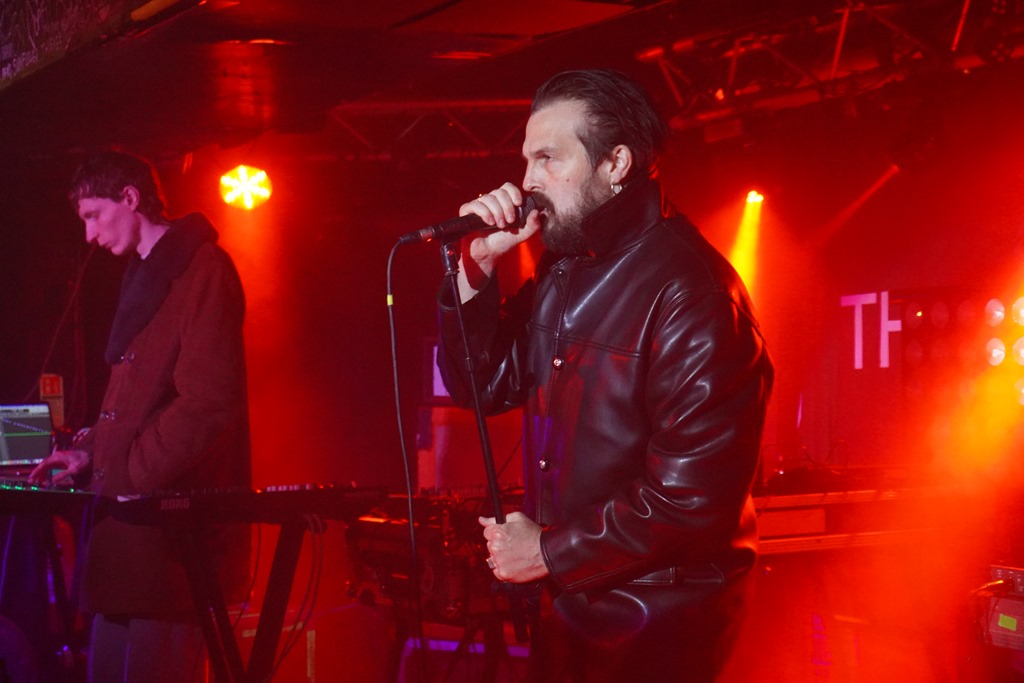
As they took to the stage, I had some initial doubts about Echoviolet: image-wise they look a bit 90s indie, especially the singer / guitarist who’s sporting a bad indie haircut, and they sounded like a band who are still working things out. Sometimes the bass and guitar lines don’t really gel, with one running ascending chords and the other descending and not necessarily in perfect time either, but then suddenly from nowhere they’d land a cracking chorus. The vocals, too, aren’t quite there yet: they sound somewhat tentative, undersung, as if rehearsing quietly in a bedroom rather than going all-out. But, as a power trio, they’re unusual in that the guitar parts favour spindly picking rather than fully-struck chords. It’s certainly distinctive, and they’ve definitely got things going for them.

DSC01896DSC01898

Echoviolet

Broadly speaking, their sound could be reasonably described as alterative rock with a 90s flavour and some heavy moments that would have really hammered hard at higher volume. There are hints of Bleach era Nirvana, and a few dashes of dark psych, and at times they call to mind The Horrors.

The punky ‘Micromaniac’ is driven by some foot to the floor bass but dominated by an unexpected drum break near the end. Drummer definitely overplays, but he brings a vibrance, an energy to the stage, and while they’re a bit rough in places, there is clear potential here. Would see again.

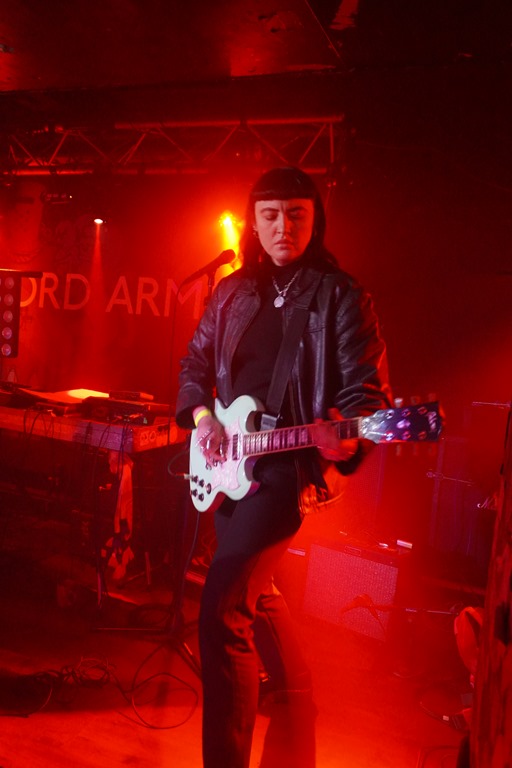
Velleity are straight in with a groove, they’re as tight as fuck and the layers of synth add polish. Sure, they’re a bit muso, a bit groggy, there’s a bit too much sexface guitar wankery, but they radiate confidence and it’s forgivable because – and it’s a rare thing – they actually are as good as they think they are, and you could easily envision them going down a storm at festivals, bringing in a range of elements from Pink Floyd to Led Zepp and… Muse.

DSC01919DSC01921DSC01922

Velleity

It’s certainly a remarkable debut even from seasoned musicians, and the quality of the performance and musicianship is impossible to deny. Mid-set they drop a tune that could easily be a Smashing Pumpkins outtake, before going Alice in Chains for the last song. They grew on me as the set progressed, and the bass tone was supreme. During last song, singer popped to the bar and returned with shots which he fed the band before a particularly indulgent instrumental break. I guess you could call that showmanship…

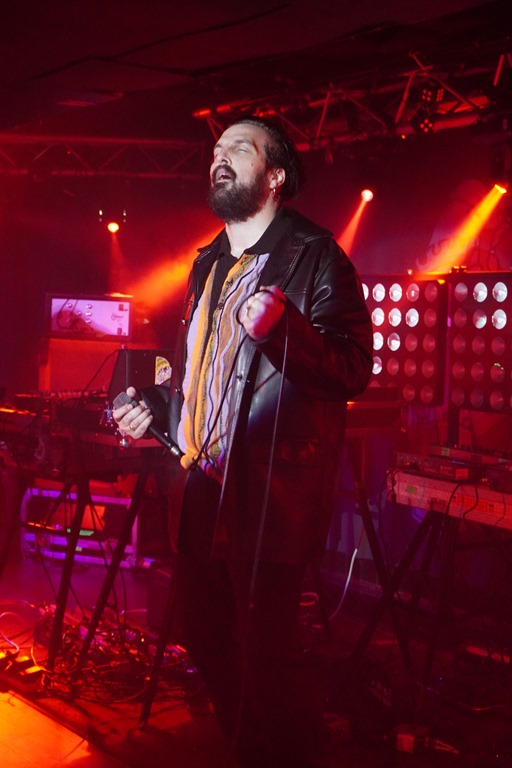
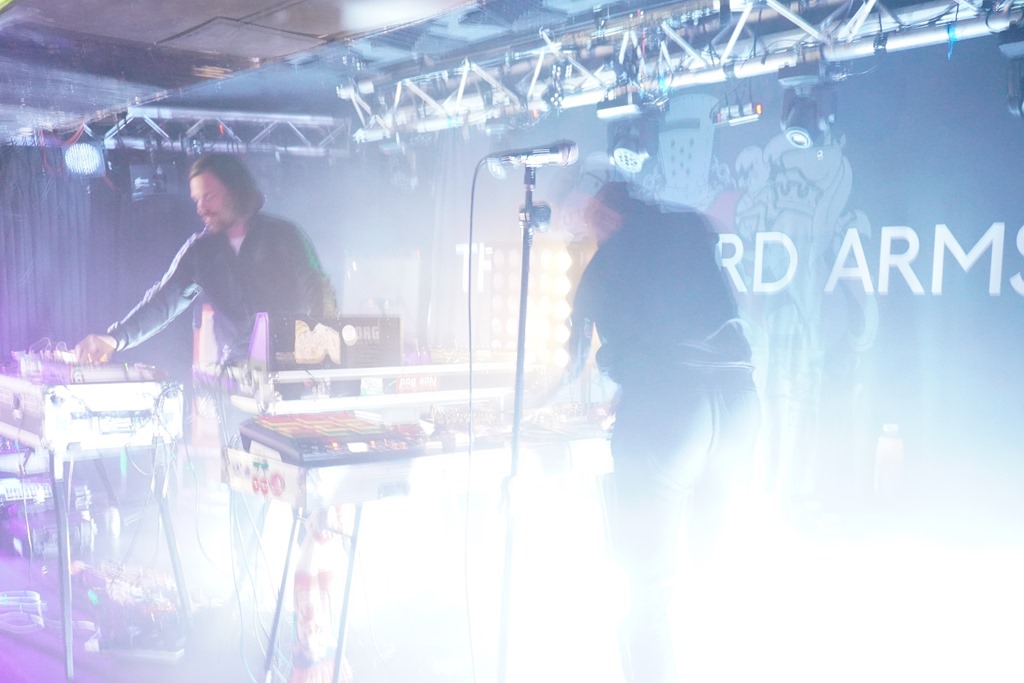
Suspicious Liquid are the reason most of us are here, and while it’s only a third full, it’s not bad for a Thursday night when students are still drifting back after Easter. And they give the show 100% from start to end. It takes some guts to open with a slow, sprawling epic… which is just what they do. Showcasing new material – a lot of new material, for that matter – and some seriously meaty hard rock riffs, they are on fire. The small audience pack forward and close to the stage, things look busy. It must be gratifying for a band to see faces up close instead of playing to a void with lights in their faces. All the elements come together perfectly, with no weak parts. Sound and performance, everything is just superb, and they play with intense focus. They boast powerful vocals with incredible range, especially at the upper end, and collectively they seem so comfortable on stage, too. Yes, this is how it’s done.

DSC01933DSC01937DSC01963

They chuck in a King Gizzard cover mid-set, followed by more new material and some colossal riffery, debuting one nine-minute behemoth near the end of the set. Every second of the set is pure quality, and on the strength of the new songs, you get the sense that the best is yet to come.

2nd May 2025

Christopher Nosnibor

British-Israeli krautfolk collective staraya derevnya are the epitome of obscure and underground, and it’s precisely for releases like Garden window escape that Aural Aggravation exists. Obscure and underground are not criticisms or judgements here: the world of music is broad and exciting because it affords room for all forms of expression. I’m not going to touch on politics or anything else that may impinge on this as an exploration of a creative work, and suffice it to say that I in no way consider any government to be representative of all of the people, especially not the artists, the creatives. staraya derevnya are the kind of artists who exist not only beyond politics, but simply beyond, and Garden window escape is one of those albums which isn’t only bold in its experimental, but

Precisely what ‘Tight-lipped thief’, the album’s first track expresses, is unclear to me. While containing traditional folk elements, the experimental edge is strong, and it twitters and tweaks, like a squeaky toy for a dog or a baby, over an array of clattering percussion, and the cumulative outcome is a wild, murky, jazzy cacophony, whereby the muttered vocals are largely submerged beneath a discordant tumult.

This isn’t only discordant, but it’s also pretty dark: while ‘What I keep in my closet’ brings a sandpapery scrape and a monotonous vocal yelp, and the effect is cumulative, like sandpaper applied to the skin slowly but steadily, becoming increasingly sore over time, before the woozy, warping, dissonant drone of the twelve-minute ‘Half-deceased uncle’ offers up new levels of discomfiture. It’s a gloopy Krauty swell and surge, combining elements of Suicide and Throbbing Gristle with the electronic pulsations of Chris and Cosey’s Trance, along with some low and heavy drone and tooting horns which evoke the spirit of Joujouka, but with a sci-fi swirl a creeping uneasiness and a tension which pulls away as the chords, the limbs, and ultimately the senses. Noises peel and lurch over a loping rhythm which plugs and plods away relentlessly for quite some minutes. There’s an acoustic guitar strumming away amidst the pings and pows and muffled vocal mutterings which melt together in this lo-fi sonic froth which occasionally calls to mind the breathy discordant tension of Xiu Xiu.

‘Cork flight operation’ grumbles and rumbles on, and on, and constructed around a sparse guitar, it’s faintly evocative of later Earth, but instead of rolling beats, there’s an insistent crunching thud like slow-marching feet and there’s rippling synths and slow drones backing the almost melody of the vocals.

AA

Amidst squealing circuitry and melting synths, ‘Onwards, through the garden window’ emerges, sparse and gloomy. The hushed vocal, thick with a syrupy distortion, is menacing, the instrumentation borders on jazz but with an industrial / dark ambient edge, which is unsettling, uncomfortable, and this is how Garden window escape slowly grows its unsettling sonic tendrils. There is nothing easy or accessible about it, but it is strangely compelling.

AA

AA

a1455615488_10

Subsound Records – 18th April 2025

Christopher Nosnibor

Twenty-eight years and fourteen albums into their career, Zu continue to confound, and to defy comfortable categorisation. Jazzisdead, their first release in six years, is their third live album. It’s most certainly not, however, a set comprising live renditions of greatest hits and fan favourites, and instead being a collaboration between Zu bassist Massimo Pupillo and saxophonist Luca T. Mai, with drummer Yoshida Tatsuya, founder of the Japanese band Ruins – and as such, the moniker follows in the vein of Zu93 (Zu with David Tibet of Current 93). The result, then, is a crazed hybrid of punk, sludge metal and jazz driven by some frenetic full-kit drumming.

‘Gravestone’ kicks it off with a thunderous riff and it’s a track that wouldn’t sound out of place on a Melvins album, while the frenzied ‘Speedball’ comes on like The Dead Kennedys but with some wild falsetto vocals and a blustering blast of sax. How is this even possible?

There are some more sedate passages, but they seemingly exist as tricks to convince you that they’re capable of delivering something more conventional: the introduction to ‘Asmodeo’ is gentle, atmospheric, and it’s almost soothing – but halfway through, it’s explodes in a riot of honks and parps, drums flying in all directions, and each composition slalems hither and thither: at times they’re tightly together, at others , the three instruments play across one another at wildly divergent angles, as if playing three completely different tunes – and yet somehow there’s a groove happening.

‘La Grande Madre Delle Bestie’ features some eye-popping machine-gun snare work before slithering to a swampy crawl, and the thing about Jazzisdead is that it’s simply impossible to second-guess what’s going to happen next. Repeat listens don’t render the work more familiar, but instead reveal entirely different albums. Elsewhere, ‘Hyderomastgroningen’ is a lumbering beast that brings a grungy swagger that brings hints of the Jesus Lizard. However, it’s perhaps Melt Banana who stand as the closes comparison to this in their crazed and irreverent approach to music-making, and this is nowhere more apparent than on ‘Memories Of Zworrisdeh’, the album’s longest track with a running time of five minutes, and which packs in an album’s worth of ideas into that time. ‘Muro Torto’ is another track of two halves, with long, groaning drones giving way to an almost ska-like bouncing thumpalong. Predictable, this is not.

There are several pieces which are but fragments, intersecting passages a minute or two in duration, and these only add to the experience of an album so packed with changes in tempo and key that it’s most discombobulating. It’s dizzying, jaw-dropping, impossible to keep up with, and the interplay between the players is remarkable. Ultimately, Jazzisdead makes for a hell of a listen – although you might need to lie down for a bit afterwards.

AA

a3703079166_10

Christopher Nosnibor

As a venue for a live music event, The Cemetery Chapel in York is an inspired one. It’s not only a remarkable building and a perfect space for music – its high ceiling and being a perfect rectangle mean the acoustics are superb – but it is a functioning chapel in the middle of a massive graveyard. Again hosted by The Velvet Sheep, it’s a very different affair from theGothic Moth’ event held in this same space last September, but still feels entirely fitting to be here.

I arrive a few minutes before doors, and spend the time indulging in one of my favourite graveyard games, of ‘find the oldest headstone’ but soon find myself distracted by the ages of many of those who died in the mid-1800s: there were many children, some only months old, and many adults between the age of thirty-five and fifty, which made the ones who made it into their eighties and nineties something of a surprise. And this would not be the only surprise of the night after purchasing a glass of Shiraz and finding a seat close to the front.

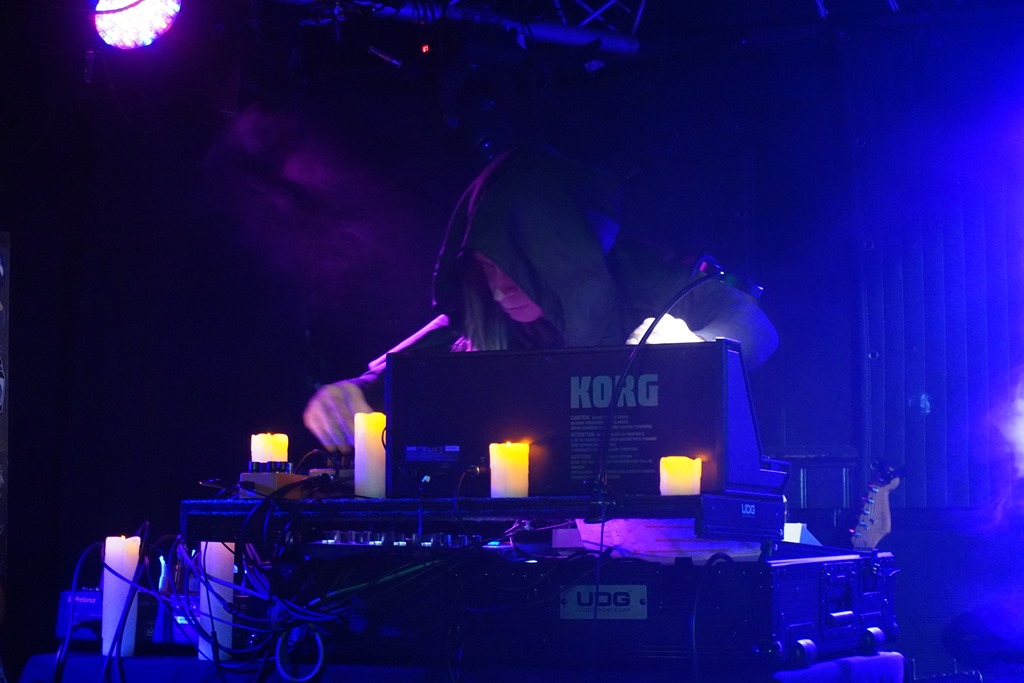
Futures We Lost presented a pleasant surprise by way of a start to the evening. The solo project of Doug Gordon, the set offers up expansive, haunting synths, occasionally brooding and dark, propelled by reverby, hypnotic programmed drums. For large passages, it’s beat-free, and dense, sonorous drones, distorted, ominous samples, discordant chimes, and occasional blasts of abrasive noise echo around the high-ceilinged chapel. Cracking hums and fizzing static swell into thick layers which hang like mist in the candlelit space.

DSC01853

Futures We Lost

Following immediately, Hanging Freud – a band I’ve raved about in the recorded format for quite some time now – bring the temperature down a few degrees: icy synths, thick with gearing textures grind against dolorous drums. Paula sings with her eyes cast upwards to the ceiling, or the heavens, her vocal between Siouxsie and an almost choral croon, rich and often reminiscent of Zola Jesus. Musically, they offer strong hints of Movement era New Order. The songs are concise and compelling and pack in a palpable density of atmosphere into their brief spaces. It’s growing dark outside now, and against the candlelight the duo are barely visible apart from Paula’s platinum hair and pale forearms, but the mood is even darker inside as the songs bring an ever-increasing emotional weight. The songs are all driven by bold beats, with crisp and heavy snares cutting through the thick swathes of synth. They don’t talk, they just play, never breaking the wall or the spell, ending with a simple ‘Thank you’ before slipping away and cueing the arrival of the interlude.

DSC01863

Hanging Freud

Raising the curtain on Act II, The Silver Reserve – another solo project – bring a significant stylistic shift with a set of introspective post-rock / slowcore, with soft-focus solo acoustic guitar and vocals with additional loops and lots of reverb. A couple of the songs felt a bit disjointed, and sat at odds with the gentle flow of the emotive, reflective ballads, which draw heavily and with sincerity and honesty, on personal experience. The perhaps less-than-obvious comparison which came to mind as I was listening was later Her Name is Calla, although their work was in turn drawing on Radiohead. In between the tuning and returning and chat, the songs are pleasant, but the set as a whole, though well-received, wasn’t entirely gripping, and while contrast is key to keeping an evening moving, this set seemed to stall the flow a little.

DSC01874

The Silver Reserve

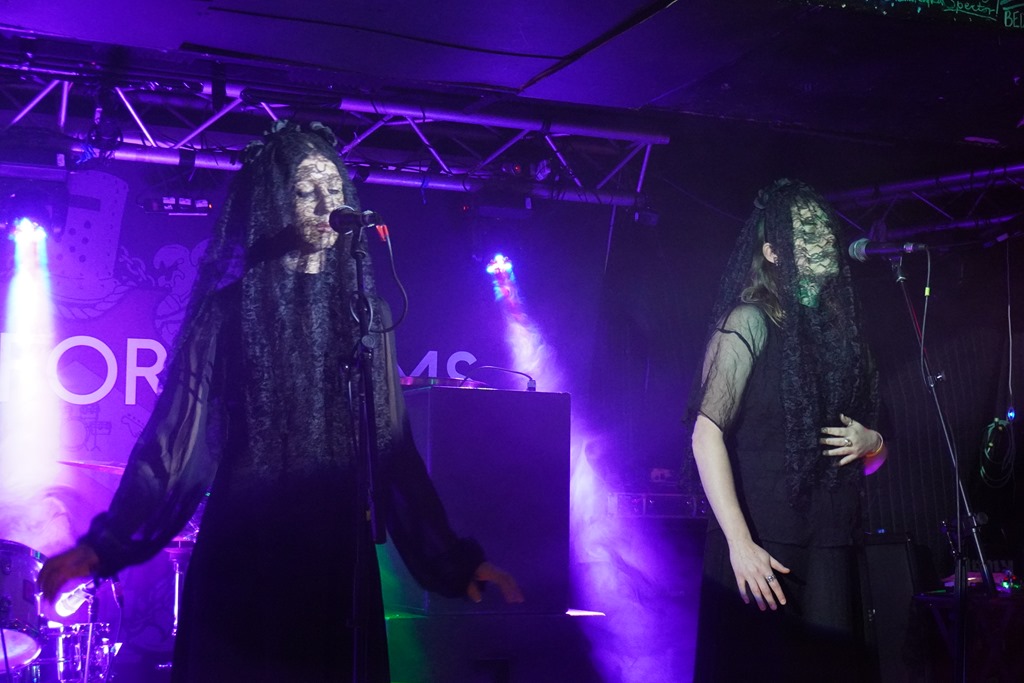
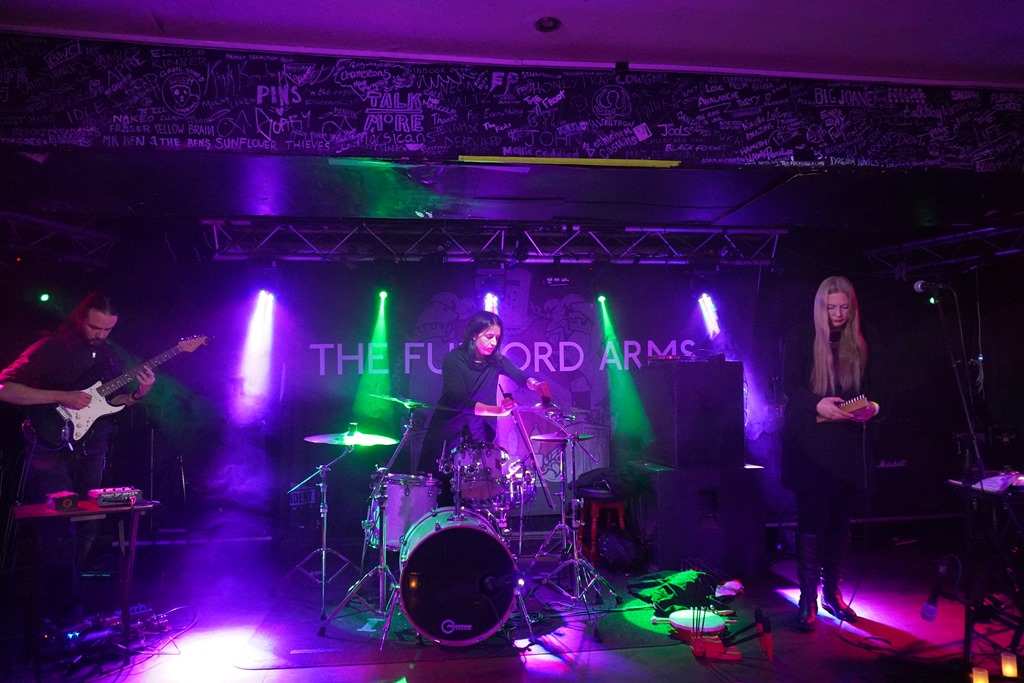
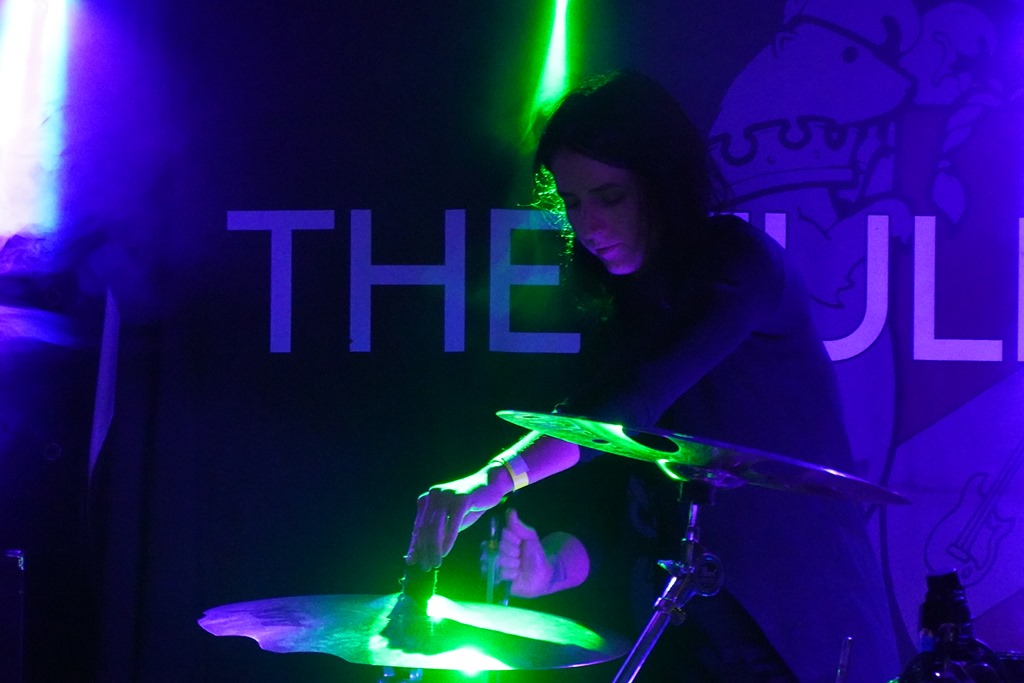
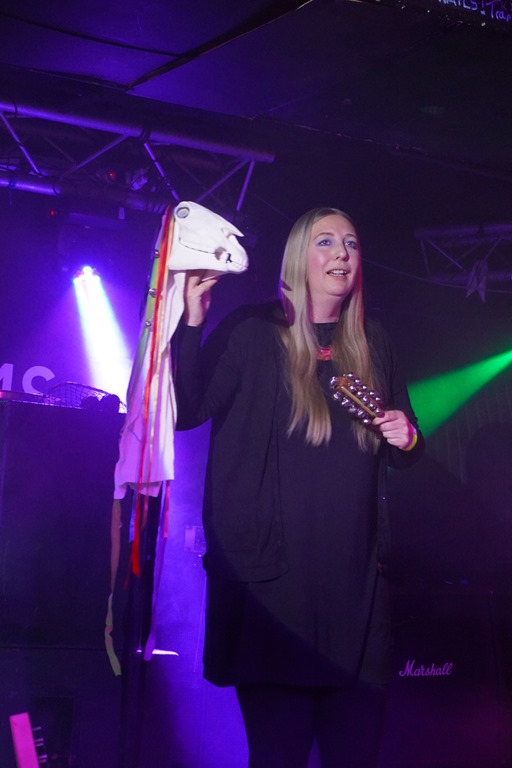
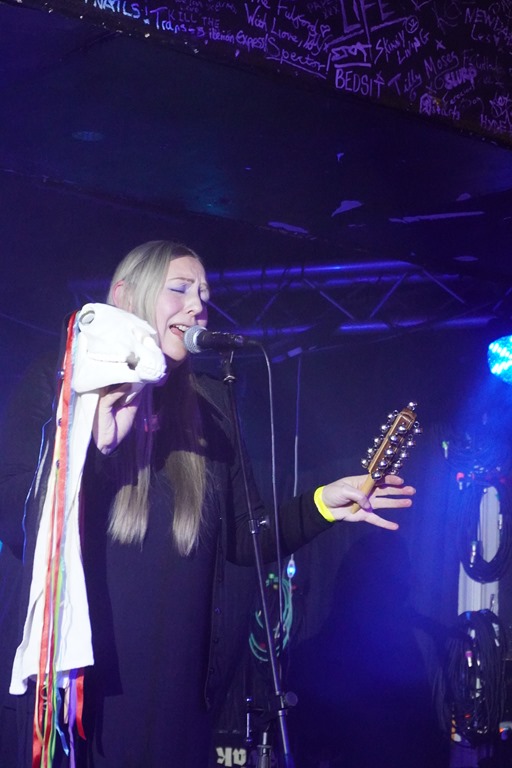
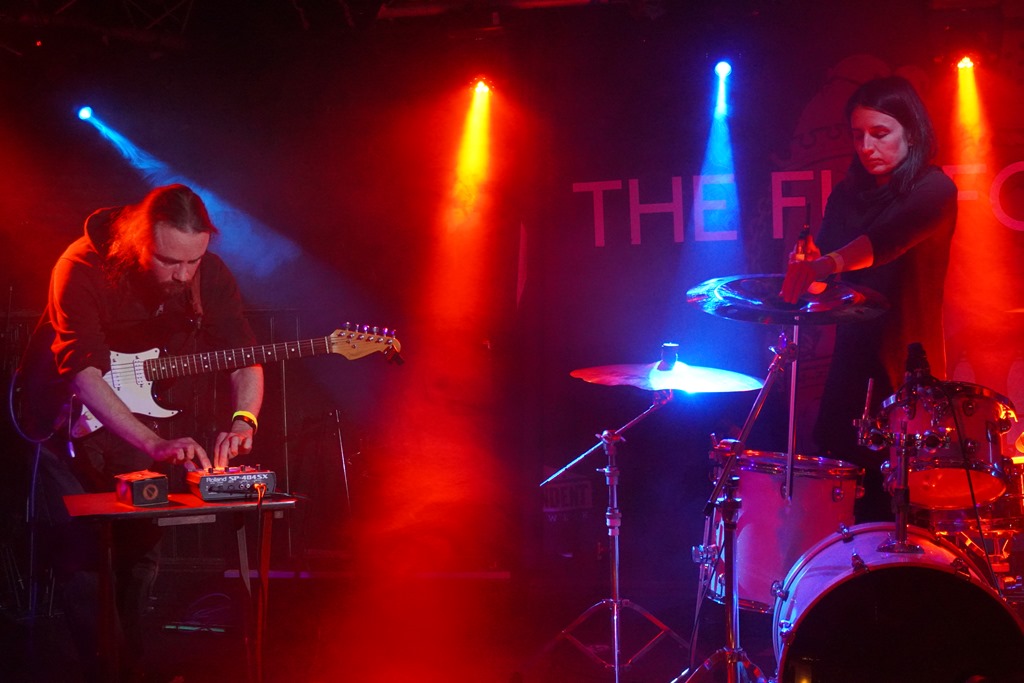
Dead Space Chamber Music are something else altogether, and you would never know by sound alone that there are only three of them. The set begins by stealth, a sparse introduction with percussion like soft waves on sand, folk vocals seem to emanate from the back of the room before ringing glasses create a haunting wail. Then things begin to get really interesting, and their innovative approach to the creation of sound is something to behold. Drummer Ekaterina Samarkina is particularly impressive in her work and provides a real sonic focal point, first applying a bow to the edges of the cymbals, while singer Ellen Southern occupies herself for large parts by creating remarkable sounds in unconventional ways: the rustle of a foil sheet being unfolded slowly is just a start, and abstraction gives way to thunderous drums and slow, deliberate guitar. This is dramatic, and this is exciting, unexpectedly so. They incorporate a wide array of instruments, from bells and whistles to horse’s skull – although in truth there are no whistles, but pretty much anything else you could name is in the mix their sound and performance is bold and theatrical.

DSC01888DSC01876DSC01890

Dead Space Chamber Music

I tend to wear earplugs when in the presence of live music, but didn’t for this: it wasn’t loud, until it was: from seemingly out of nowhere, the volume had crept up to a pulverising roar, evolving towards a Swans-like climax consisting of a brutal percussive barrage and squalling guitar and vocal ululations. The blistering wall of sound attained the force of a tsunami for a sustained crescendo, during which time stood still, and while some members of the audience swayed and nodded in their seats, I found myself practically paralysed by the sheer sonic intensity. The focus of the three musicians was absolute, and while Southern went through a number of changes to her visual presentation, Samarkina and guitarist Tom Bush, who really cut loose with some monumentally treble-heavy distortion during the second half of the set, lurk in the long shadows of the flickering candles as they grow ever shorter and the venue grows ever darker. The effect is nothing short of stunning, making for an almost overwhelming finale to a night of the most remarkable music.

Dret Skivor – 4th April 2025

Christopher Nosnibor

This latest release on Swedish microlabel devoted to the most underground of underground music, Dret Skivor, may be form an act we’ve not heard of before, but something about it has all the hallmarks of the eternally prolific Dave Procter all over it. The man behind Legion of Swine (noisy) and Fibonacci Drone Organ (droney) and myriad other projects and collaborations – some occasional, some one-off – has a distinctive North of England drollness and a penchant for pissing about making noise of all shades, after all.

Released on CD in a hand-painted edition of just two, the notes on the Bandcamp page for the release are typically minimal: ‘Is it dungeon synth? Is it just spooky music? Is there torture afoot?’ I would say I will be the judge of that, but dungeon synth is a genre I’m yet to fully get to grips with, although it does for all the world seem as if it’s a genre distinction that’s come to be applied to spooky music, and seems to have grown in both popularity and usage comparatively recently, despite its roots going back rather further.

The cover art doesn’t give much – anything away, and in fact, I might have hoped for something more… graphic. But perhaps less is more here. However, the titles of the two tracks –‘the shithouses’ shithouse’ and ‘the festering flesh of the neoliberal’ are classic Procter and could as easily be titles for poems by Dale Prudent, another of his alter-egos.

The first begins with a swelling thrum of what sounds like a chorus of voices, possibly some monastic indentation, layered and looped and multitracked to create a torturous cacophony. For the first twenty, thirty, forty seconds, you wait for a change to come, for something to happen. After a minute that expectation is diminishing, and by the three-minute mark it’s impossible to be certain if there really are keyboard stabs swirling in the mix in the midst of it all, or if your ears and mind are deceiving you and you’re losing the plot. For some reason, I’m reminded of the Paris catacombs – not because it’s actually creepy, but because, just as seeing rows and rows of bones stacked up for quite literally miles becomes both overwhelming and desensitising after a time, so hearing the same sound bubbling away for ten minutes is pretty much guaranteed to fuck with your head. Near the eight-minute mark, there are most definitely additional layers of buzzing drone and there are some tonal slips and slows, like listening to a tape that’s become stretched or is slipping on its spool, but by this time your brain’s already half-melted, and I find myself contemplating the fact that while visiting the catacombs on a sixth-form art trip, one of my fellow students accepted the challenge to lick a skull for eight Francs – which was about a quid at the time. I was less appalled by the fact it was a human skull than the fact the bones looked dusty and mossy, and had probably been touched by even more unwashed hands than the handle of the gents lavs at a busy gig venue.

And so we arrive at the twenty-two-minute ‘the festering flesh of the neoliberal’. It begins with a distant clattering percussion – like someone bashing a car bonnet with a broken fence post heard from a quarter of a mile away, but with a gauze of reverb, as if echoing from the other side of a valley – or, put another way, like listening to early Test Dept through your neighbour’s wall – while a pulsing, pulsating electronic beat, like a palpating heartbeat, thuds erratically beneath it. And that’s pretty much it. But there are leaps and lurches in volume, and the cumulative effect of this monotonous loop is brain-bending. There are gradual shifts, and seemingly from nowhere rises a will of croaks and groans which grow in intensity, and it may well be an auditory confusion, but regardless, the experience is unsettling. Twenty-two minutes is a long time to listen to a continuous rumbling babble that sounds like droning ululations and a barrage of didgeridoos all sustaining a note, simultaneously, for all time.

Is it dungeon synth? Probably not. Is it spooky? Not really. It is torturous? Without doubt. This is a tough listen, with dark babbling repetitions rendered more challenging by the cruelly long track durations. The torture afoot is right here.

AA

a2009823040_10