Glasgow-based post-metal collective Void of Light have unveiled the new video for ‘Mirrorings,’ the lead single from their forthcoming debut full-length album Asymmetries, set to be released on April 3 via Ripcord Records.
Clocking in at a towering ten minutes, ‘Mirrorings’ first premiered at Decibel Magazine, who praised the track saying: “Clocking in at 10 minutes, ‘Mirrorings’ offers a pretty solid introduction to these gloomy Glaswegians, a dynamic epic that shifts from pummeling sludge to melodic shoegaze-inspired dynamism.”
AA
The band had this to say about the new album and new song: “Asymmetries is the culmination of two years of hard work and exploration. Across the album’s five tracks, we set out to shape our own sound within a well-established scene, creating something that genuinely feels like ours. The closing track, ‘Mirrorings,’ brings the album’s introspective themes into a final, defining moment and represents what we feel is our strongest offering so far.”
Void of Light are a six-piece post-metal force built on contrast. Brutal yet deeply atmospheric, their sound fuses crushing riffs and thunderous drumming with melodic leads and carefully layered arrangements. Rooted in post-metal’s foundations but shaped by a wider spectrum of influences, the band carve out a sound that feels vast and aggressive, yet intricate and finely balanced through a keen sense of dynamics.
Following the release of their self-titled EP in 2022 and the two-track EP Enshroud in 2023, Void of Light completed a short UK tour and quickly established themselves as a powerful live presence across local venues and festivals. Renowned for their formidable performances, the band deliver an imposing wall of sound that is both overwhelming and precisely measured, drawing audiences into an intense, captivating experience.
On Asymmetries, Void of Light turn inward. Exploring themes of perspective, reflection, and internal conflict, the album charts a journey of reconciliation between the masks of the past and the truths of the present.
To celebrate the release, Void of Light will perform their album release show on April 3rd at The Flying Duck in Glasgow with support coming from Codespeaker & Obsidian Sand.
My first encounter with The Sunken Land was at the York EMOM (that’s Electronic Music Open Mic) at the start of the month. There were looks and mumblings of surprise, confusion, and even consternation within my vicinity. These events attract makers of a broad spectrum of music, from those who dabble to the obsessives, from laptops to modular setups to self-made kit, and from pop to ambience to far more experimental stuff. Often, there’s much interest and conversation in the gear being used, particularly as a fair bit of the kit is rather novel. ‘What is that?’ began to be asked around as The Sunken Land’s set started. There was incredulity, amazement at the instrument being wielded on stage, something alien to these night. It was a guitar.
The man playing, it, one David Martin, was conjuring layered soundscapes, pleasant to the ear, but underpinned with a physical density. It was well executed, and powerful, and distinct.
worm moon sessions, released the following day, captures the sound of that live performance well.
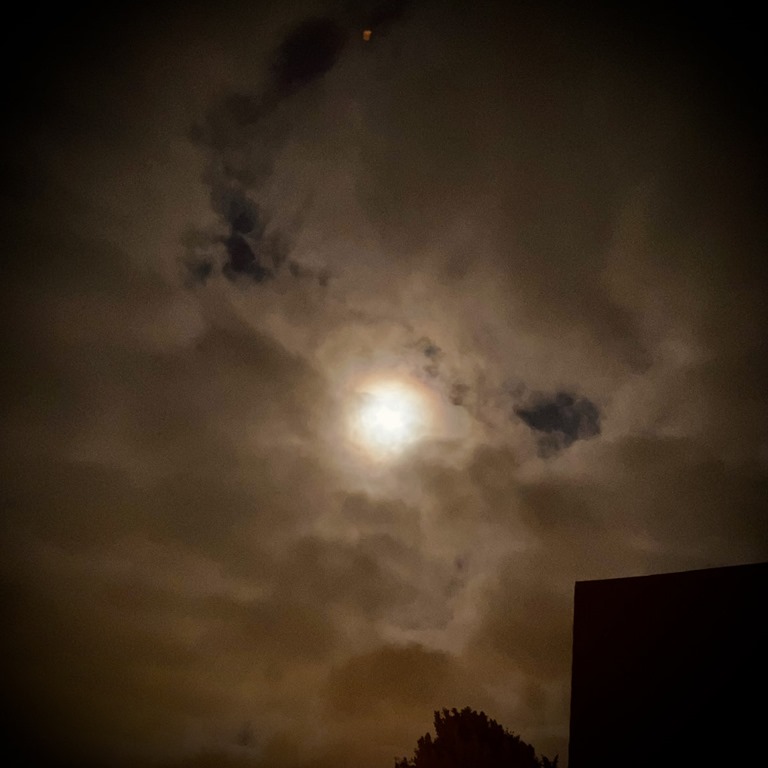
While there’s apparently no scientific evidence, there is plenty of anecdotal indication that people feel different on and around full moon. Werewolf mythology is but one example of the way the power of the moon seems to affect us, and since this satellite planet drives the Earth’s tides, it’s hardly surprising we also feel that we sense its force. There’s also something compelling, mesmerising, hypnotic, about a large, bright moon, or a moon with an aura, or displaying an unusual hue. This year’s worm moon, on 3rd March, was particularly unusual, emerging a fiery red from a total lunar eclipse, and perhaps some of this rare power filtered into The Sunken Land’s recordings here. While worm moon sessions may not represent an immense leap from demos 2026, released in February, there’s most definitely evidence of a gradual honing of the ‘bedsit doomgaze’ form here.
AA
AA
‘worm moon’ brings the heavy drone of Sunn O))) but with elements of melody rising out of the dense sonic swamp. These melodic details, in context, evoke the form of later Earth. It’s the kind of slow, deliberate guitar work that compels the listener to really hone in on the textures and tonality, the way the notes of a struck chord – thick with distortion and expanded with reverb – interact with one another.
The shorter ‘almost true’ is altogether lighter, more graceful, emphasising the ‘gaze’ aspect of the self-made genre tag. It’s still dense and underpinned with slow, droning distortion, but there’s a soft, almost ethereal hue around it, and the experience is ultimately uplifting, like the first signs of spring.
A couple of mates had picked this one out and suggested I might like it, and, as my diary was looking pretty sparse at the time, I thought ‘why not?’ Some brief scanning of releases led me to expect a night of electro-based post punk, some synth-pop of a darker persuasion. The reality was considerably darker than that, and pretty much straight-up goth, even if the majority of the crowd didn’t recognise it as such – by which I mean, they looked more like they’d be into Gary Numan than The Sisters of Mercy. So where are we at? Goth by stealth? Said crowd was an interesting mix, an almost even split of old sods, and lanky buggers young enough to be their kids – or mine, I suppose.
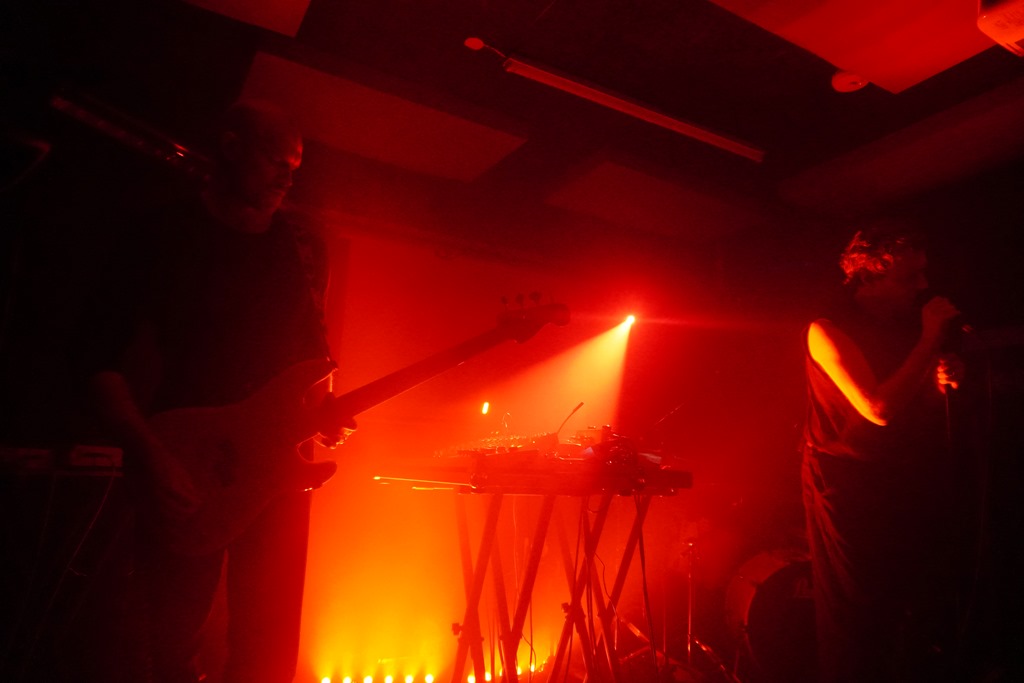
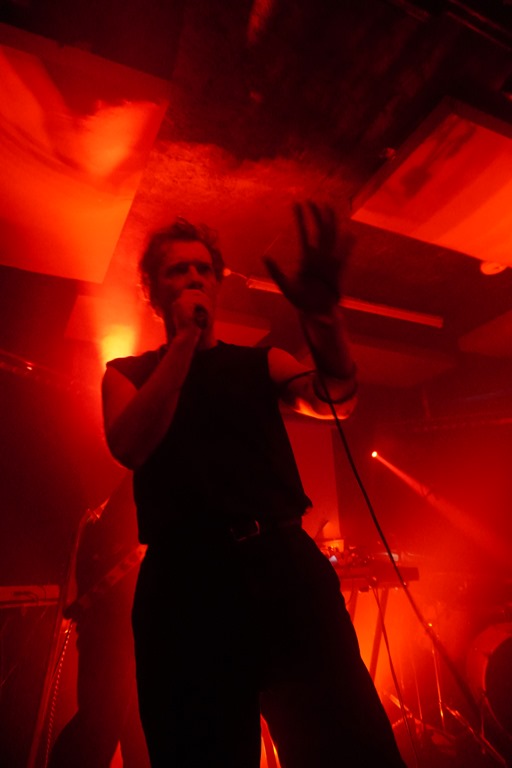
The Sick Man of Europe – raved about by a mate who’s more of an indie persuasion – are in some respects reminiscent of early Depeche Mode but darker, heavier, more industrial. They bring the pulsating repetition on Suicide, with a heavy leaning towards DAF. For the second song, they segue ‘Movement’ and ‘Obsolete’. The studio versions are tight slices of Krautrock, and nice enough. Live, everything is amped up and the result is something more like covers of ‘Ghostrider’ as performed by The Sisters of Mercy, or even Foetus. The flat baritone monotone of the studio recording takes on a new dimension live, too, at times reminiscent of the booming grave-and-gravel drawl of Chris Reed of Red Lorry Yellow Lorry. The sick singer spends considerable time charging back and forth in front of the stage and occasionally ventures further into the crowd. They take things up a good couple of notches live in comparison to the studio recordings, the clinical sterility converted to crackling energy. They’re tight, tense, and gothy as hell.
The Sick Man of Europe
The same is true of TVAM, an act I’d always taken as being a bit 6Music electro-indie. Again, the difference between their studio work and live show is the key here. The work of just one guy in the studio, the live act is transformative, with live drums and guitar. They play the new album, Ruins, in full and in sequence. It takes confidence in an album to do this, but it’s an album to have confidence in, without a weak track. The song titles and lyrics flash on the screen at the back of the stage in real time, with striking images projected during instrumental passages. In combination with the lighting and smoke, it makes for a strong visual performance. The sound, too, is fantastic, the swirling guitars hazy, the drums crisp and bright.
TVAM
On the bass-led ‘Real Life’ they perfectly replicate the drums from ‘Lucretia My Reflection’, and ‘Powder Blue’ is indisputably a dark pop gem with a dense shoegaze feel.
The final segment of the set piles into the depths of the back catalogue with relish, hitting us with ‘Porsche Majeure’ and ‘Double Lucifer’, before closing with ‘Total Immersion’, the last track from their 2021 debut Psychic Data.
TVAM
Oftentimes, studio-based projects can lose something in the translation to the live setting, but by taking a completely different approach to the format, TVAM show different aspects of the songs and imbue them with new depth and energy.
As a lineup, the two acts compliment one another well, and in both delivering punchy sets (Sick Man’s set was bang on half an hour, TVAM played for 45 minutes), they gave us an exhilarating night.
US dream-pop duo Magic Wands have released a brand new single, ‘Wishing Well’. With an insistent rhythm and swirling guitars, plus a vocal that adds to its hazy atmosphere, the song sounds like an immediate post-punk meets shoegaze classic.
“The lyric came to me when I was a guest of a guest at a wedding one summer,” explains vocalist Dexy Valentine. “There was an obvious sense of excitement at the event, but I didn’t really know anyone there so I snuck off outside and sat by a wishing well fountain and started writing on a napkin. When we came up with the music for this song I thought these words would fit perfectly.”
Co-written and produced by Dexy with her partner Chris Valentine, ‘Wishing Well’ is the title song of an EP scheduled for late April. It follows the January release of ‘Sacred Mirrors’, a collaborative single with Psychedelic Furs guitarist John Ashton.
Jeremy Moore – aka Zabus – continues his phenomenal creative run with the release of Avoidance Moon, another wildly inventive melding of myriad forms. And with Avoidance Moon, Moore pushes the established elements of the Zabus sound still further, cranking up the distortion and reverb to insane levels. It’s gothic, but it goes beyond. The theatricality is off the scale, but the feel is also very, very old school, and while it evokes the spirit of Dance Society and early X-Mal Deutschland and the like, it also calls to mind early Christian Death, and The Damned, with a bit of The Jesus and Mary Chain tossed into the blender for extra feedback spice.
The title track, which opens the album, is sparse and lo-fi, as quavering analogue synths hover their way through a crashing tube-crunched guitar, the gruff vocal and extraneous noise which runs in the background all bouncing around in a cavernous reverb with additional layers of murk. But something about it carries a certain, indefinable emotional resonance.
‘Theoretical Jesus’ brings reverb-soaked shoegaze and thunderous percussion – and splintering discord in the vein of A Place to Bury Strangers. Elsewhere, the heavy vibe with all the reverb is reminiscent of Modern Technology, perhaps because the baritone vocals share a common ground, too.
Avoidance Moon presents an uncompromising sonic swamp: on ‘Baited Idyll’, the thick, murky sound is cut through by the sharpest cymbal splashes, harsh treble clashes which strike like blades. ‘Punishment to Extinction’ melts together the warping wall of noise of My Bloody Valentine with the drama of Nick Cave: amidst the chaos, Moore casts his dark, theatrical incantations.
Avoidance Moon is a riot of late 70s / early 80s post punk, dark, attacking, dingy, lo-fi, analogue to the end. It’s likely too primitive for many ears, but it’s precisely the primitive nature of it all that appeals. So many acts pretend to draw inspiration from post-punk, but Zabuslives it. Avoidance Moon, then, is dense, suffocating, intense.
Context counts for a lot. My introduction to A.A. Williams was as support to The Sisters of Mercy at Leeds Academy in March 2020 – my penultimate live music outing before COVID lockdown, when things were already starting to feel a bit strange and scary. Perhaps it was the fact it’s not a great venue, prone to rather muddy sound, perhaps it was in part that creeping tension, or perhaps it was because I was so hyped for The Sisters, that I didn’t really get into A.A. Williams’ set, and thought it was merely ok. Perhaps it was a combination of all of these reasons. Subsequent listening has led me to conclude that I failed to fully appreciate the quality of the performance and the detail within the compositions. As such, I owed it to both myself and the artist to re-evaluate with fresh ears, and the inclusion of Spotlights on the bill provided no small additional incentive for this to be the occasion to do so.
Entering the venue – the now-legendary main room of The Brudenell – we get a playlist with Nine Inch Nails and Mudhoney and Nirvana and a bunch of gothy stuff by way of a greeting, and while it’s far from rammed five minutes after opening, the front row is fully occupied, predominantly by tall older men. Of course it is.
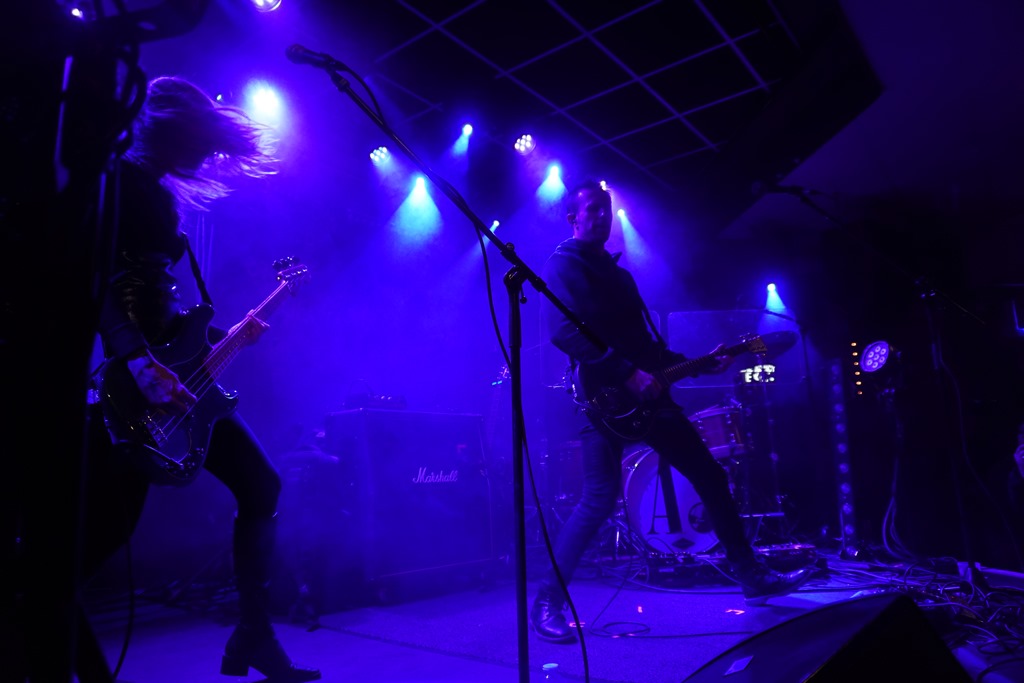
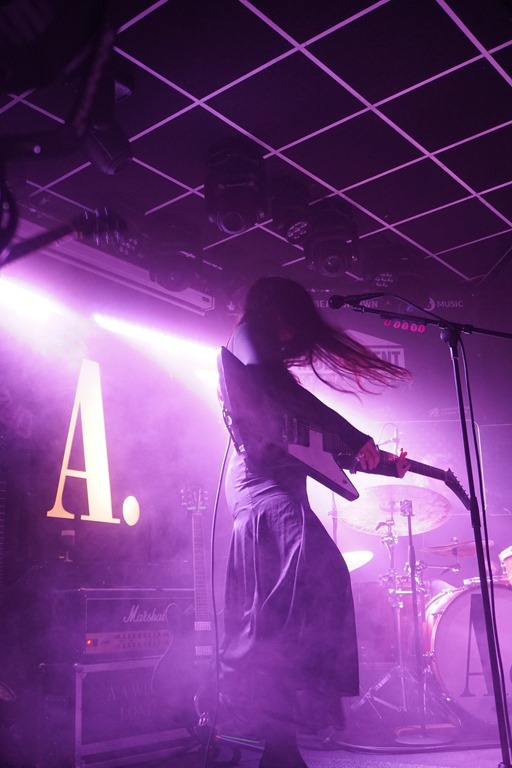
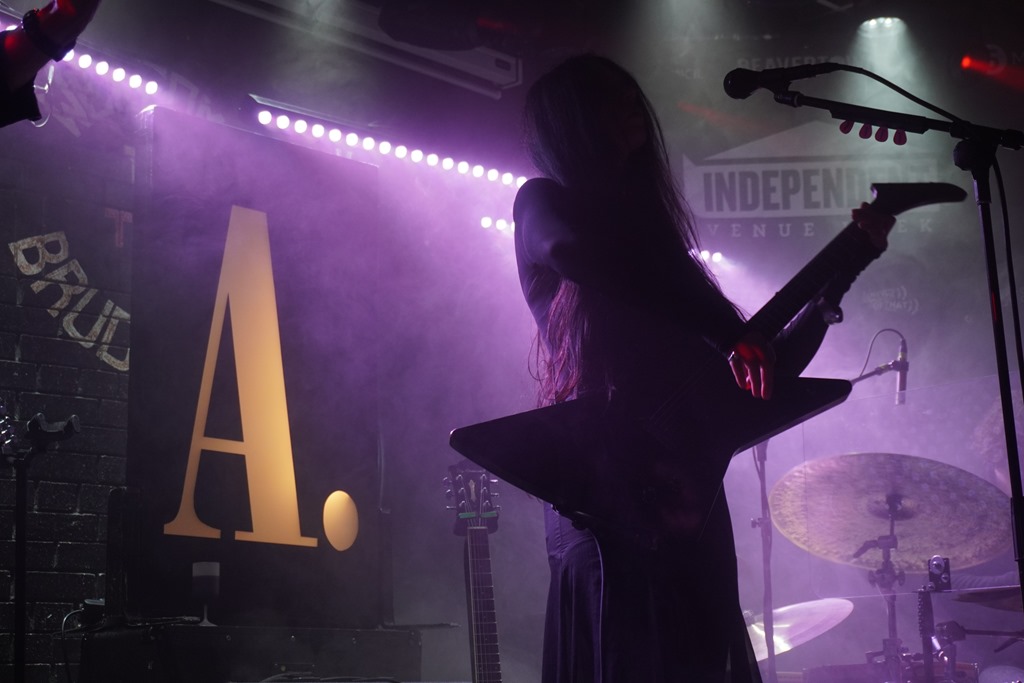
It’s one hell of a setup on stage, with the drum kit situated off to one side rather than centre back: this space is occupied by a Marshall four by twelve. There’s a lot of amplification up there, and a lot of pedals, but shrinking the stage further is enough lighting to illuminate a stage at least five times the size. The last time I saw this much lighting packed onto a small venue stage was when The Young Gods played at Fibbers in York circa 2005.
Spotlights may not be particularly well known here, but there are a couple going crackers down the front. And instead of plugging their most recent album, tonight’s set consists of debut Tidals in its entirety and in sequence as they celebrate ten years since its release. Although whatever they’d chosen to plug wouldn’t have made much difference at the merch table, as they reported that theirs hasn’t managed to make it across from mainland Europe. Talk about triumph in the face of adversity: in addition to the merch issue, they’ve had transport troubles due to extreme weather on this tour, and tonight, the drummer managed to break his snare – splitting the skin – during penultimate song of the set, ‘Joseph’. Thankfully, A.A. Williams’ drummer in on hand to lend his, and they complete the set with barely a break, closing with a blistering rendition of ‘Sunset Burial’ from Alchemy for the Dead.
Spotlights
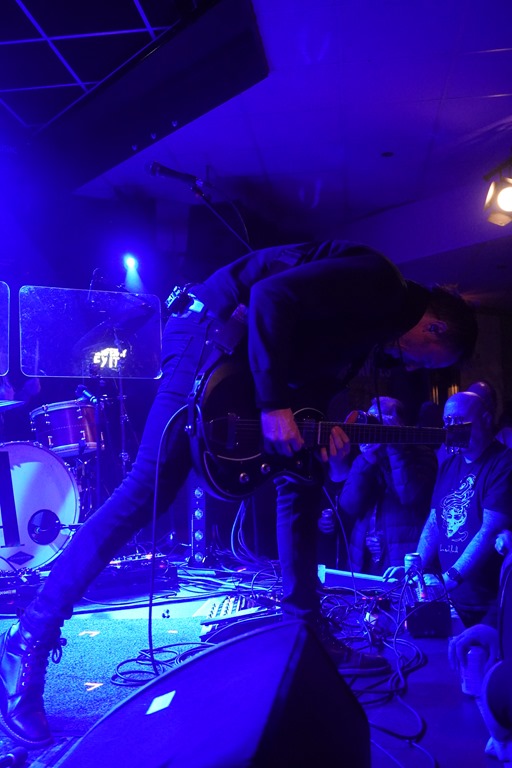
It’s a seismic set, dominated by ripping riffs and tearing power chords. Mario Quintero’s guitar sound is huge, and he manages to play some sinewy detailed lead work while simultaneously hammering out low-end riffery, which, when combined with Sarah’s chunky bass and some powerful percussion, they blast out a high-impact sound.
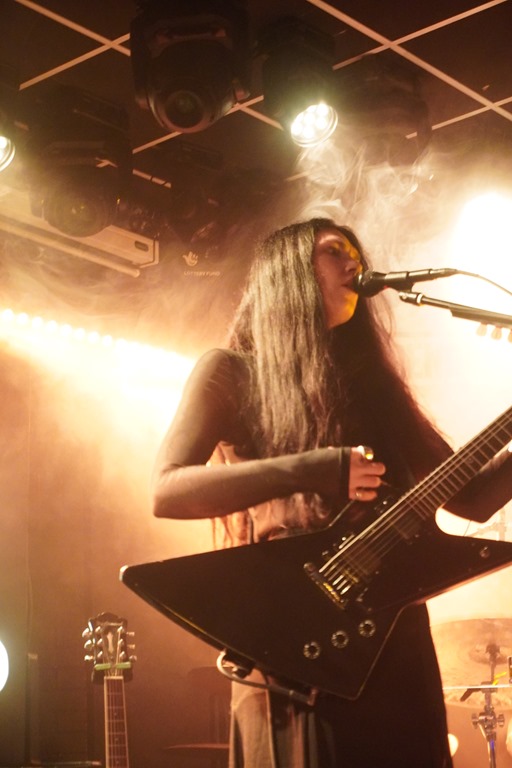
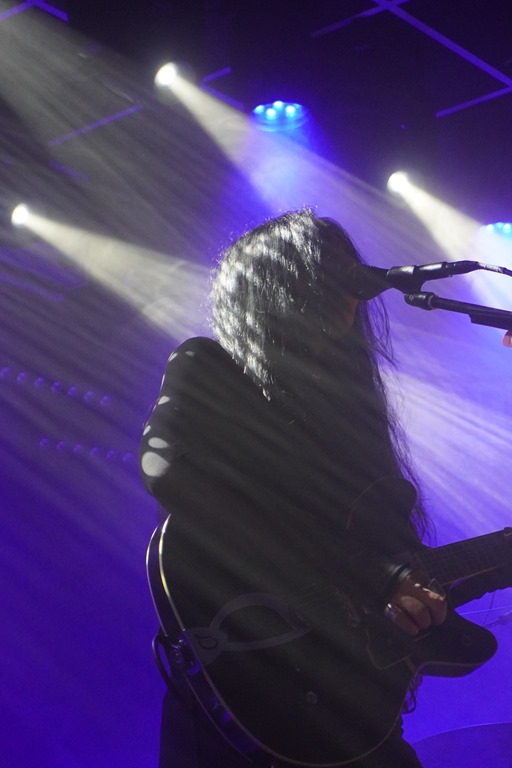
A.A. Williams’ performance tonight is faultless, every song played with precision, but also feeling. The sound is nothing short of exceptional – even by Brudenell standards – with both clarity and volume coming together to accentuate the deal and the dynamics. The interplay between the two guitars and steady, deliberate drumming is a joy to observe, and when the riffs kick in, boy, do they kick in.
A.A. Williams
There are some pauses while swapping and tuning guitars (Williams has a very fine array of pointy guitars), with no chat from band or audience. In the main, she lets the songs speak. Moreover, to contrast this with the abysmal chatfest that was Black Rebel Motorcycle Club at the Academy at the tail end of last year, the fact you could hear a pin drop is credit to the crowd for their respect, and the artist for holding the whole room captivated. And when she does engage with the audience, she reflects on her affinity with Leeds, and in particular The Brudenell, where she played her first UK show as part of Strange Forms festival. She’s appreciative of the audience, and they’re immensely appreciative of her and her band.
A.A. Williams
The lighting proves to be worth the effort too, and does make a difference to the feel of the night, and paired with stellar sound, the place feels three times the size.
As The Moon Rests and Forever Blue are represented about evenly here, with a handful of selections from elsewhere in her catalogue, notably ‘Control’ from her debut EP and standalone single ‘Splinter’. The closing pairing of ‘Melt’ and ‘Evaporate’ elevates things to yet another level. We witnessed something special tonight.
Legacy postpunk-shoegaze outfit Lowsunday has shared ‘Soft Capture’, with a new video by Jer Herring. This is the second single from the Low Sunday Ghost Machine – White EP, following ‘Love Language’. Released via Projekt Records and ranking second among Post-Punk.com’s Best EPs of 2025, this is the band’s first record of all-new material since 1999.
AA
Born in the mid-1990s within the local Pittsburgh scene, Lowsunday (initially known as Low Sunday Ghost Machine) emerged as a “retro-futurist” pioneer, blending darkwave and shoegaze long before the genres saw their modern revival. Their legacy was cemented with their debut album Low Sunday Ghost Machine and the 1999 masterpiece Elesgiem, both of which were re-released via Projekt Records over the past 18 months (for their 30th and 25th anniversaries, respectively).
The band dissolved, leaving behind a cult reputation for mercurial sounds and blistering guitar work that set the stage for subsequent generations of alternative artists. Following a nearly 25-year period of inactivity, the band resurfaced as a duo in 2025—consisting of original members Shane Sahene (vocals, guitar, synth, bass, drums) and Bobby Spell (bass, guitar, drums).
“With ‘Soft Capture’, we wanted to layer vintage synths over a droning bass line, topped with a wandering guitar melody. As the guitar descends, we felt it taking on a darker tone, but then it creates a bit of a silver lining as the melody climbs back up. We used the lead guitar feedback almost like a theremin, letting it melt through the background,” says Shane Sahene.
“Lyrically, we were thinking about the traps of life and the ways we often submit to things, but the song eventually circles around with an optimistic glimpse of having the opportunity to run away. We feel like the backing vocals on the chorus are what really bring that sense of strength and hope to a situation that might otherwise feel like a surrender.”
Serving as both a reflection and a resurgence, the White EP ushers in a welcome return, marked by superb production and a renewed creative clarity, bridging three decades of distinct sonic legacy with balanced doses of escapism, dreamlike sounds, drones and feedback. This first of a two new EPs planned this year, their crystalline shimmer, classic song structures and melodic hooks shows their atmospheric sound to be as timeless and relevant as ever.
The White EP is a natural expansion for Lowsunday, building upon guitar-driven atmospheres, synth textures, emotive vocals and drum beats. A confident return to form that explores darker yet more expansive sonic territory, they bring atmospheric noise and, at more delicate moments, a dream pop air of deeper melancholia. Distilling years of sonic exploration and inspiration, lyrically and sonically, classic post-punk rhythms and atmospheric layers merge to express raw and genuine emotion.
US dream-pop duo Magic Wands have released a brand new single entitled ‘Sacred Mirrors’. The song is a collaboration with guitarist John Ashton, best known as a member of the iconic post-punk rock group The Psychedelic Furs who played a key role in all seven of their album releases made between 1980 and 1991.
The group went on hiatus soon after and Ashton became a producer, working with Marianne Faithfull and The Sisters Of Mercy (he had also produced their classic 1982 single, ‘Alice’), but he remained with the Furs for another eight years following their reformation in 2000. He released the solo album Satellite Paradiso in 2016.
“I fell in love with Magic Wands via a friend who sent me some of their music,” states Ashton. “The songs immediately drew me in via the visions and emotions they imparted on my psyche. I was hooked and wanted more, finding it in songs like ‘Across The Water’ from their latest album, Cascades. To say I was inspired to write new music would be an understatement. I was recently interviewed for the Sticky Jazz podcast and mentioned that I had been listening to the new record, and it turned out the host was also a fan of the band and hooked me up! ‘Sacred Mirrors’ was inspired by their music and I am honoured to have been given the opportunity to collaborate with them on this.”
The feeling is mutual, with Magic Wands (Dexy and Chris Valentine) declaring that “we have always been fans of The Psychedelic Furs and John has a certain style of guitar playing that strikes its own emotional chord with us. We love his solo song ‘Invisible’, his production on ‘Alice’ by The Sisters of Mercy, and of course his incredible guitar work on Furs songs such as ‘Pretty in Pink’, ‘Dumb Waiters’, ‘Into You Like a Train’, ‘Heartbreak Beat’ and ‘Until She Comes’.”
Ashton sent an instrumental track already entitled ‘Sacred Mirrors’ to the band, who promptly added an additional guitar, keyboards, percussion and vocals, with Dexy adding lyrics and Chris then producing and mixing the finished song. “The song is based around John’s title but approached from a more spiritual perspective,” explains Dexy. “We are all sky gazers, so it includes imagery about the sky, sea, moon and stars. It’s a love song for outsiders about reflections and dreaming of endless possibilities. It has definitely inspired us to get back to writing from a lighter side rather than the shadow, which we dove deep into on both ‘Cascades’ and our ‘Switch’ album before that. We needed to be brought back to a more uplifting side of making music, and the DNA of John’s songwriting has helped us to do just that.”
What do we know about In A House Of Heartbeats? Personally, nothing, and I can’t be alone in that, so will draw on the band’s bio to provide some necessary insight by way of an introduction: ‘Emerging from the shadows of Essex’s underground scene, instrumental trio In A House Of Heartbeats have been quietly sculpting soundtracks for euphoric nightmares since 2022. Their music, steeped in atmosphere and cinematic tension, walks the line between dream and dread, an ever-shifting blend of post-rock, doom, goth, and shoegaze, filtered through inspirations that reach far beyond the musical world.
‘From arthouse cinema and silent film to folklore, myth, and the murky corners of the subconscious, the band construct deeply absorbing sonic “journeys” rather than conventional songs. It’s a style that encourages deep listening: passages unfold with deliberate patience, building from whispered ambience to tectonic weight, always leading the listener somewhere unexpected.’
They pack pretty much every musical aspect of their broad range into the album’s first track, the behemoth that is ‘In a Perpetual State of Wonder’. A hiss yields to a drone before a colossal riff and soaring lead guitar crash in on a surge of powerfully atmospheric post-metal portent… and that’s just the first minute and a half. Spindly gothy guitars weave spidery webs over rolling tribal beats before the next round of the riff. Towards the end, the pace picks up, and drags the listener headlong into a thrumming tremolo-driven blast that’s like a black metal My Bloody Valentine. I went for a seven-mile walk this morning, and it took me just over two hours but it was nowhere near as mentally and physically intense or exhausting as this eleven-minute blizzard of guitars.
Next up, ‘Cambion’, which first surfaced back in December 2024, is altogether more sedate, at least initially, with a chiming, almost folk-infused prog-flavoured intro creating a calmness before the inevitable storm which pounds in with a sustained post-rock crescendo before things get heavier… and heavier. The level of detail, the attention to texture and the frequent twists and turns make this feel like an entire album compressed into a single – albeit lengthy – track. Along the way, chunky bass rips and guitars chime and soar, and I find myself thinking I must be into the next track, but no.
The sample-laden post-rock drift of ‘Parasomniac’ (that would be someone who suffers from the effects of ‘a category of sleep disorders that involve abnormal movements, behaviours, emotions, perceptions, and dreams that occur while falling asleep, sleeping, between sleep stages, or during arousal from sleep’ (according to Wikipedia)) is reminiscent of Maybeshewill, and provides a welcome interlude between the epics before ‘Oneiromancy for Beginners’ lands with the gutsy punch of Andsoiwatchyoufromafar – surely one of the most remarkable and potent riff-driven acts to have emerged from the early noughties post-rock scene. This is a band bursting with ideas and bursting with energy.
The final two pieces, in combination, form a whole, as the Shakespeare-referencing titles suggest: ‘Drift into Sleep…’ bleeds into ‘…Perchance to Dream’, with its title casting a reference to Hamlet, to forge a twelve-minute opus that begins with a ticking clock and a sample from a guided meditation recording which is almost a carbon copy of a recording used for Cognitive Behavioural Therapy (CBT). It’s likely uncomfortable for anyone who’s been through it, and I find myself squirming through the juxtaposition of soothing, flat vocals and churning noise, but suspect that’s part of the objective here. It’s disorientating and challenging, the second part conjuring atmospheric distortion and endless space with ambient tones and bold sonic washes, before slowly strolling towards an immaculate conclusion, defined by a smooth, swirling climax.
Divination of Dreams certainly delivers on the promise of ‘an ever-shifting blend of post-rock, doom, goth, and shoegaze, filtered through inspirations that reach far beyond the musical world’, and it would be impossible to deny that the end result more than achieves the ambition. Everything about Divination of Dreams is immense, from its ambition to its overwhelming listening experience. It simply covers so much ground – and does so with a rare confidence and finesse. It’s a rare beast, and a spectacular work.
Having recently written on the retro qualities of Lowsunday’s latest release, the latest hot landing in my inbox is from another act which is preoccupied with a previous time – and who can blame them? I am painfully aware that old bastards like me constantly bemoan the shitness of the now while reminiscing about the golden era of our youth, and it’s no different from boomers still banging on about The Beatles and the music of the 60s and 70s as if time stopped when they hit thirty or whatever. There is a lot – a LOT – of exciting new music coming out right now, and much of it is pushing boundaries in unexpected directions. I for one will never cease to excited by this. But there is a significant amount of music emerging that draws its primary influences from the eighties and nineties, created by artists who simply cannot be drawn by nostalgia. Falling You are a perfect example.
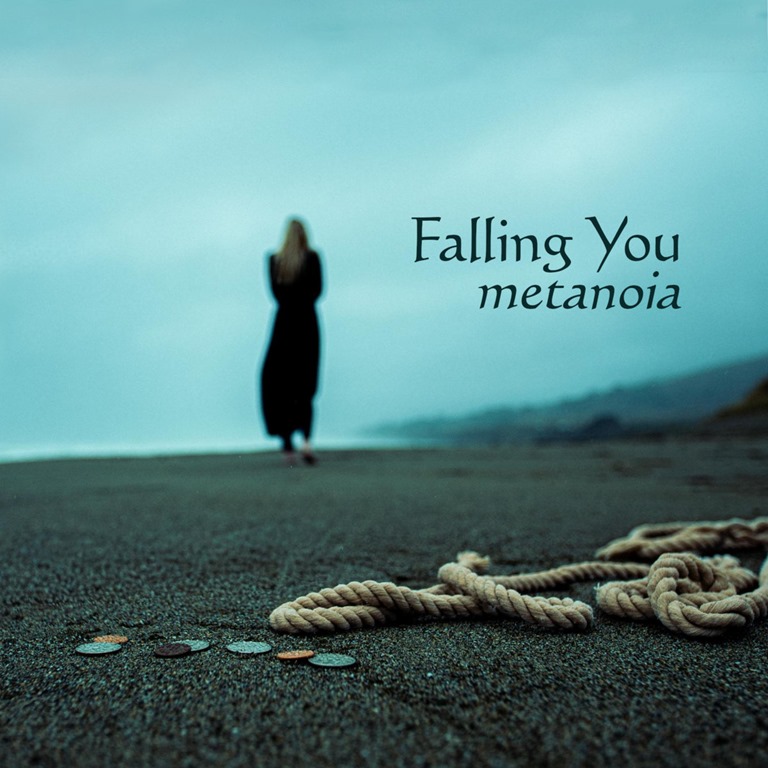
Metanoia is pitched as being for ‘fans of 1980s 4AD dreampop (This Mortal Coil, Dead Can Dance), ‘90s shoegaze (Slowdive, Lush), or the darkwave / ethereal / ambient-electronic releases of the Projekt label (Love Spirals Downwards, Android Lust). It’s quite a span, but the fact is that this is a release with its inspirational roots well in the past. It pains me to be reminded that 1995 is thirty years ago when it feels like maybe a decade. The cover art of previous releases very much state shoegaze / dreampop, and while this album accompanied by altogether moodier artwork, which may in part serve to reflect the album’s title, it’s nevertheless hazy and evocative at the same time. ‘Hazy and evocative’ would be a fair summary of the album itself, too, and the dreamy / shoegaze elements are countered by some really quite unsettling spells of rather murkier ambience.
It starts strong with the bold swell of steel-stung acoustic guitar and a strong vocal – I’m not talking about a Florene Welch lung-busting bellow, but a controlled and balanced performance that really carries some resonance, and it’s mastered clear and loud… and then things swerve into a more electronic, almost dancy territory. Immediately it’s clear that this is going to be less an album and more a journey, and ‘Demiurge (Momento Eorum)’ immediately affirms this with its spiritual incantations and sonorous, droning rumblings.
‘Alcyone’ is the first of the album’s ten-minute epics, and it uses the time well: that is to say, with shuffling drums, spacious synths and layers of lilting vocals, it’s very much distilled from the essence of The Cocteau Twins, and slowly unfurls with an ethereal grace. A delicately-spun pop song at heart, the extended end section tapers down to a softly droning organ.
While the atmosphere is very much downbeat, downtempo, understated, one thing which is notable is the album’s range: ‘Ari’s Song’ is built around a soft-edged cyclical bass motif, around which piano and synths swirl, mist-like, the drums way in the distance, and even as a disturbance grows toward the end, it’s so far-away sounding, and the song itself, beyond that ever-present bass, barely there, and the same is true of the dank, dark ambient echoes of ‘Inside the Whale’. If ‘Ariadne’ is another shimmering indie tune hazed with fractal electronic ripples, the second ten-minute epic, ‘They Give Me Flowers’ provides a suitable companion piece to ‘Alcyone’, swerving from a brooding country and folk-tinged song with hints of All About Eve, and the album’s final track, ‘Philomena’ effectively completes the triptych, pulsing along gently and dreamily before slowly tapering away to nothingness. It’s a fitting conclusion to an album which at times is so vaporous and vague, it’s barely there – which is precisely the design. But in between the hazy drifts and particle-like waftings, there are some beautifully atmospheric and utterly captivating songs with strong leanings towards the dreamy pop side of indie. In terms of achieving an artistic objective, Falling You have absolutely nailed it with Metanoia.
 Aural Aggravation