Posts Tagged ‘Review’

9th June 2025

Christopher Nosnibor

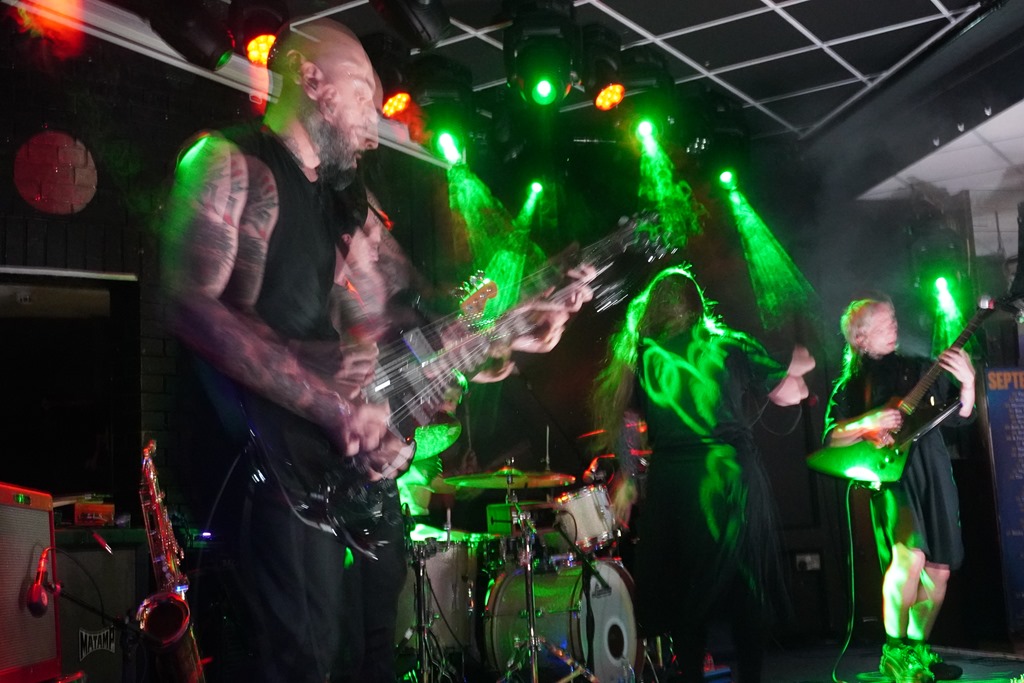
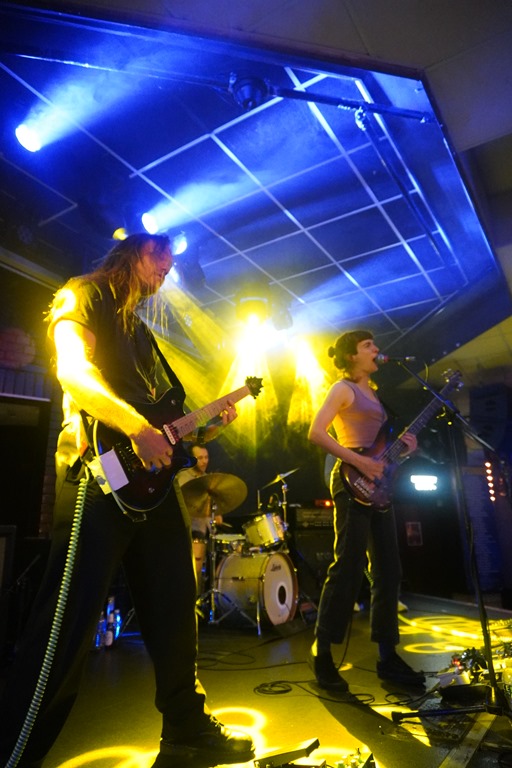
Sledges are described as ‘a four piece Alt-metal/Heavy-shoegaze band that blends genres like grunge, metal, shoegaze, emo/post-hardcore, and alternative to craft songs with catchy hooks and big riffs,’ and while this is true, it fails to convey the way the various elements melt into one another to conjure something quite special.

Take the first track, ‘Stumbling as I Fall’: the guitars bend and pixelate in a way that evokes the essence of My Bloody Valentine, but it’s grunged up and beefy, and at the same time the melodic vocals contrast with that thick overdrive, capturing the spirit and sound of ’94, and in particular, Smashing Pumpkins circa Siamese Dream. The title track is harder, heavier, with loping drums melded to a tight, chugging bass underpinning some hefty overdriven guitars that provide the backdrop for vocals that ae by turns breezy and gnarly, offering one of the most overtly metal moments on the EP. I find myself momentarily thinking of Troublegum by Therapy? – a classic example of solid tunes brimming with melody played with hard distortion and some raw aggression – but then Soundgarden also poke their way into my cognisance. If it sounds like I’m simply pulling bands out of the air, it’s very much not the case: Losing Pace simply has that much going on, although the fact that many of the touchstones I’ve referenced thus far are of a 90s vintage does also serve position the various elements which contribute to the Sledges sound.

‘Weightless’ is – ironically – pretty heavy, and it’s not (believe it or not) a criticism to stand it alongside Linkin Park, in that it brings nu-metal heft and a strong emotive hue to a song that’s both riffy and rich with a palpably sincere feeling of angst. It matters because this is no cheap stab at commercialism, and nor it is just another song that tries to alternative by hauling all of the tropes into the mix: there’s a sincerity to this which lends it an indefinable power, and it hits hard.

After a soft acoustic intro, ‘June is Better than July’ goes widescreen, a cinematic burst of post-rock, post-grunge, alt-rock riffcentric extravaganza. There’s a nagging sense that it’s a but emo, a bit ‘things we’re not supposed to like’… but bollocks to those strictures of convention. It’s pure quality, and that’s ultimately what it all boils down to.

Losing Pace was originally released as a four-track twelve-inch, but this new edition, which also marks its first digital release, offers a brace of bonus tracks, in the form of ‘Fading’ and ‘Letters’. The former is the weakest and most overtly emo song of the set, but it’s bathed in reverb and the guitars are bold and overdriven and grungy, and it’s impossible to deny that it’s well-executed. Rounding it off, bonus cut ‘Letters’ is both dreamy and dynamic, melding elements of early Ride and MBV and Chapterhouse with later exponents of shoegaze / nu-gaze like The Early Years as swirling guitars conjure cathedrals of sound around a pumping drum machine.

On Losing Pace, Sledges successfully combine classic and contemporary, and do so with an aptitude and energy, and a keen sense of dynamics. It’s quality all the way.

[bandcamp width=400 height=340 album=244179070 size=large bgcol=ffffff linkcol=0687f5 artwork=small]

AA

a3823762619_16

Panurus Productions – 2nd May 2025

Christopher Nosnibor

Northern noisemongers Belk are no strangers to the virtual pages of Aural Aggravation: I personally first caught them live as a duo back in 2021, when I remarked in my review that as fierce as they were, they might benefit from some bass. I could never have imagined just how much. These days, their sound is dominated by some juddering low-end that’s practically arsequake. It’s as if they thought ‘you want some bass, eh, bastard? Here’s some fookin’ bass. BOWWWWWWWMMMM’. They’ve certainly evolved over the last four years – but what that means, in real terms is that they’ve developed methods of making noise that’s even more nasty and gnarly and generally unkind to the eardrums. This is a good thing, and ‘Flayed’, the first of their two contributions to this split release is a beast. It has a definite and undeniable sense of swing to it, a swaggering groove that’s somewhat unexpected. But what is expected – and delivered – is a crashing riot of noise, a juddering wall of distortion, squalling, dirty guitars, drums blasting at a hundred miles an hour and guttural vocals half-submerged by the swirling chaos, with tempo changes galore and simply all hell happening at once inn explosive, brutal frenzy.

‘Cloak of Bile and Oil’ begins a little more gently – and for a moment I’m reminded of the intro to Fudge Tunnel’s ‘Hate Song’, which inevitably bursts into shards of incendiary sludge and squall – and sure enough, so does this, the extended intro giving the deluge of noise even more impact when it finally does arrive. They describe their style as ‘Blackened Leeds Hardcore’ and this must surely be a definitive example of what that means.

Casing are an unknown quantity, and their two contributions are brief – the longest piece is just over two minutes in duration. The sound they offer is certainly no less abrasive or disturbing. There’s nothing to indicate what the initialisms of the song titles actually mean, but the electronic excursion which is ‘L.U.A.N.L.B.’ begins with some rumbling dark ambience, soon rent with the wail of siren-like feedback, before a wall of harsh noise distortion swells like a tsunami and swallows everything. In contrast, ‘D.T.H.D.T.C.’ launches headlong into a gut-churning blast of manic grind, with a nauseating bass churn to rival that of Belk.

What it lacks in duration (the four tracks have a combined running time of less than eight minutes), this release more than makes up in devastating intensity. Mission accomplished.

AA

cover

Limited Edition 7" Dubplate / DL Blank Records – 13th June 2015

Christopher Nosnibor

Tobias Vethake aka Sicker Man has spent a quarter of a century doing things differently – differently from other artists, and differently in terms of his own sound and approach to making music.

As his bio points out, ‘as our world changed a lot during the last 25 years, so did his music. On his last release, KLOTZ WENZEL VETHAKE, the interaction with other musicians and the political dimension of a musical wake-up call became a main focus… The single „Gravy Train / Hollowed“ marks a new and fresh look at both, his musical history and present. It features Sicker Man’s love for dub, noise and electronic music as well his passion for classical composition and spiritual jazz… ‘Stop The Gravy Train / Hollowed’ feels like a collaboration of Moondog and The Bug’

It certainly does. For these two pieces, Sicker Man has enlisted saxophonist Matze Schinkopf, and

How many ideas is it possible to pack into four and a quarter minutes? With ‘Stop The Gravy Train’, Sicker Man manages more ideas per minute than it’s possible to even begin to count. The piece starts with a low, grinding bass and industrial hums, before the saxamaphones enter the mix, interweaving through and across one another. They trickle smoother, teasing with points and counterpoints, laid-back and mellow over the simmering rhythm section, the bass and the beats building currents beneath. Around the midpoint, the piece makes a change of trajectory, the gentle jazz giving way to something altogether more urgent and driving, locking into a robust groove with low saxophone punching rhythmically and in syncopation with the whip-cracking snare and palpating kick drum.

‘Hollowed’ is different again: a swampy surge of seething electronica, a morass of meshing noise – at least to begin, and then it melts into a rather pleasant swaying jazz work, a clip-clip beat nodding along nicely. Swells of noise bubble and surge, but don’t quite break through, and industrial grooves settle in while the saxes tootle off in different directions, hither and thither to brain-melting effect.

‘Genius’ is a word which is chronically overused and often severely misapplied. Is this a work of genius? Maybe not, but it’s got to be close. There’s no question that it’s wildly inventive, and unexpectedly listenable, while challenging every musical preconception.

AA

a1110512025_10

30th May 2025

Christopher Nosnibor

With mainstream music, all you have to do is stay tuned to prominent radio channels, watch TV, let Spotify recommend the next tune, and it lands in your lap. The further away from the mainstream you get, the more it becomes about keeping your ear to the ground, word of mouth, groups and forums – and occasionally, press releases and inboxing. Despite being a fan of a number of the acts involved, I discovered this one quite by fluke via a share in a Facebook group, which announced that ‘OMO DOOM , the Glasgow group who comprise members of Mogwai , The Twilight Sad , Desalvo , Areogramme and Stretchheads put out a new track this week, an intensely claustrophobic cover of a Head of David track – the brilliant late 80s UK Blast First act who everyone seems to have forgotten now’.

I’m perhaps one of the few who not only didn’t forget Head of David, but has a near-complete collection of their releases – and I can tell you it’s taken some years to assemble. While their first album – LP, released on Blast First in 1986, and later reissued as CD in 1990 isn’t too hard to find, and has a buzz around it on account of the fact that Justin Broadrick drummed with the band between leaving Napalm Death and forming Godflesh (although he didn’t actually play on any of their releases apart from their 1987 Peel Session, which features on the nigh-on impossible to find White Elephant compilation), their other releases are like rocking horse shit (as they used to say at record fairs in the 90s.

Their second LP, Dustbowl, which featured ‘Bugged’, was produced by Steve Albini and released in 1988. It’s a belter. While I snagged a vinyl copy in the 90s, I have never yet seen a CD copy in the wild, and it’s never been reissued, either. ‘Bugged’ also appeared on one of the 7” singles in ‘The Devil’s Jukebox’ Blast First 10-disc box set, and that’s hardly common or cheap either.

H.O.D.I.C.A. was a semi-official live album which captured Head of David playing at the ICA in London, delivering a purposefully unlistenable set with the explicit purpose of repelling EMI music execs who were sniffing around, and their final album, Seed State, released in 1991 lacked the same brutal force as its predecessors.

The reason for the history lesson is that they’re largely forgotten because their music is so hard to come by, and because Stephen R. Burroughs has pursued a very different musical trajectory subsequent to their demise, with both Tunnels of Ah and FRAG sounding nothing remotely like HoD.

But if you can hear Dustbowl, it’s aged well, a snarling mess of noise driven by pulverising drums and snarling, grinding bass that tears you in half. And this is where we resume the story, I suppose.

OMO DOOM’s version of ‘Bugged’ is slower, starker, more malevolent and menacing than the original which was ferocious in its unbridled brutality. Here, we get thick synths and punishing drum machines dominating the sound. The bassline is twisted around a way, and sounds for all the world like ‘Shirts’ by Blacklisters, and at around the two-minute mark is slumps into a low-frequency range that’s unsettling to the bowels as well as the ears. This sure as hell brings the dirt. The vocals are rabid. It’s gnarly, alright. Fans of Mogwai and The Twilight Sad and the late, lamented Aerogramme may be drawn to this, but probably won’t like it: it’s the work of a bunch of musicians trying something that’s nothing like their regular work, and it’s unfriendly and inaccessible and noisy and horrible… and of course, I absolutely love it. And maybe it could spearhead a Head of David Renaissance… We can hope.

AA

a2460593698_10

Magnetic Eye Records / Redux Records – 6th June 2025

Christopher Nosnibor

Magnetic Eye have released a few of these ‘Redux’ tribute albums now, each of which has come in two editions, and each of which has taken a different approach. Whereas the Meantime Helmet releases offered a standard and expanded version, for example, others have presented an album on one version and a ‘best of’ as a companion. And in all instances, they’ve managed to score some outstanding names as contributors. This time around, it’s the Ramones’ eponymous debut which is accompanied by a ‘best of’ set as a counterpart, and the project was ‘masterminded and curated by New York City and London-based Italian-Swiss audio engineer, sound designer, composer, multi-instrumentalist, and Grammy winner Marc Urselli’ – hence the titles.

Mondo Generator, Napalm Death, Ufomammut, Arthur Brown, David J, and Voivod are among the big-hitters featured here, but as I settle down with a cold pint of Oranjeboom, I contemplate the need for a Ramones tribute – or, more specifically, another one. There have been a few, perhaps most famously 2003’s We’re a Happy Family, which featured The Red Hot Chilli Peppers, Marilyn Manson, Green Day, Garbage, U2, Metallica, and The Pretenders, among others, and there are so many tribute acts out there, too, one has to ask ‘is this not overkill?’ Well, no, because that would be Motörhead, and what’s more, with a lower tier of ‘name’ contributors, it feels more authentic, somehow. I’m not saying U2 aren’t fans of The Ramones, but they feel like they’re on a par with the fans who bought a T-shirt in Primark and only discovered they were a band after the fact. Casuals, in other words.

Some might say that the debut album doubles as a ‘best of’, and there’s a case for that, given that every single song is a pure classic. Mondo Generator kick off the debut album covers set with a roaring ‘ONETWOTHREEFOUR’ before launching into ‘Blitzkreig Bop’, and it’s a faithful but fiery, fizzy rendition, the guitars like jet engines on what you could only describe as a proper punk blast.

Daníel Hjálmtýsson and Mortiis offer an altogether different take on ‘Beat on the Brat’ – slowed down, moody, gothic, a bit theatrical, a shade menacing, and yet somehow accentuating the pop currents which flow through this, and indeed, all Ramones songs. Boots Electric, with the help of none other than Wayne Kramer, push the pop to the forefront

Ufomammut bring the metal and convert the sub-two-minute surf-pop ‘Chain Saw’ into a six and-a-half minute grind that’s downtuned, dense, and dirty. It’s also absolutely brilliant in its execution. Napalm Death have enlisted Thurston Moore for their take on ‘Now I Wanna Sniff Some Glue’, which is a minute and a half of speaker-shredding thrash nihilism, and absolutely perfect.

The Ramones weren’t only punk progenitors, but purveyors of precise and often perfect pop songs, and this pair of albums represents the fullness of their influence (still not saying they. didn’t influence RHCP or U2., but…) Arthur Brown and The Berserker’s take on ‘I Don’t Wanna Walk Around With You’ is crazy, and absolutely perfect.

Voivod rope in JG Thirlwell for their hell-for-leather yet hooky as hell take on ‘Zero Zero UFO’ which opens the ‘best of’ set. And there are some corkers, with a slowed-down, heavy psyche yet oh-so-pop take on ‘Pet Sematary’ by Impostor Cult with Amy Tung Barry Smith being exemplary. So Hideous’ twangin’ take on ‘The KKK Took My Baby Away’ is one of the most radically different interpretations on the album, although Kayo Dot and Ihsahn push ‘Teenage Lobotomy’ in the most unexpected directions, while David J and Paul Wallfisch push ‘I Wanna Be Sedated’ to a soporific seven minutes. With a super-sparse arrangement, it sounds as if they’ve achieved their wish before entering the studio.

What these two albums illustrate, more than anything, is that The Ramones wrote superlative and truly classic songs, with earworms galore. And as tributes go, these albums do feel perfectly fitting.

AA

691820395539

Prophecy Productions – 6th June 2025

Christopher Nosnibor

Absence makes the hearty grow fonder, so the adage goes, and so it also goes that some acts return not only rejuvenated, but more prolific the second time around: this has certainly been true of a number of acts, ranging from Earth to The March Violets, and it seems that Austere are also finding a purple patch of creativity, with The Stillness of Dissolution being their third album in two years after a thirteen-year break – having only released two albums in their initial four-year career.

Older and wiser? Or perhaps older and feeling a greater sense of freedom in creative terms… it matters not, really. Here, the Australian duo, consisting of Mitchell Keepin (guitars, bass, keyboards, vocals), and Tim Yatras (drums, keyboards, vocals), we’re reminded that ‘their roots in early Norse black metal and its depressive Scandinavian offspring remain clearly audible’, and the album’s six lengthy tracks offer texture and detail, and darkness… much deep darkness.

Opening, ‘Dissolved Exile’ clocks in a little shy of eight minutes, and what’s striking us just how crisp the guitars sound, both the crunchy rhythm parks and the spindly lead, which takes off into an epic solo, propelled by double-pedal blasting drums. But something else stands out, too: as raspy and demonic as the vocals are, there’s a strong sense of groove to it, the chugging chords presenting a solid form and structure. ‘Redolent Foulness’, too, has an epic quality, and an almost neo-prog accessibility. There’s melody in the vocals, not to mention an abundance of dynamics and detail.

It would be easy to criticise Austere for pursuing a more commercial sound and a more ‘casual’ audience, but the simple fact is that they’ve got some crafted tunes here, and The Stillness of Dissolution showcases songwriting ability, rather than simply the ability to play fast while burying everything in muddy production. The Stillness of Dissolution is by no means a commercial album, or a pop album, but in melding genuine hooks to monster slugging riffs, Austere have forged an album that’s compelling, exciting, and yes, I’ll say it, catchy. Not in a pop sense, of course, but those juggernaut riffs just grab you: ‘Rusted Veins’ fully rocks out, and at nine and a half minutes, closer ‘Storm Within My Heart’ is a solid epic. Overused? Yeah, but have you got a better word? It begins atmospherically, before blasting in with explosive force, and with the snarling vocals buried beneath a frenzied blanket or fretwork, it’s the most overtly black metal cut on the album.

And what an album: it really is well-considered, crafted, detailed. ‘The Downfall’ borders on shoegaze and prog-metal, but there’s blistering rage in there, too. Metal tends to be underrated when it comes to texture and emotional range, but The Stillness of Dissolution brings it all by the truckload: ‘Time Awry’ bringing three songs in one, with a nagging lead guitar line that loops over a thunderous riff. This is an album which makes you feel – and its power is as immense as its stunning quality.

AA

450960

Not Applicable – 23rd May 2025

Christopher Nosnibor

For about five minutes, AI looked like it may provide some entertaining diversions in terms of creative potentials. It wasn’t so long ago that it produced glitchy, idiosyncratic writing and wild art that was so wrong it was hilarious, and lame synth-loop electronic music which had neither style nor substance. It didn’t look like the threat to humanity that dystopian sci-fi novels had portrayed.

But then more information began to emerge about how AI was ‘learning’ by essentially stealing from all available sources. AI is the worst plagiarist imaginable, and nothing is safe or sacred. Then there came the reports of the vast amounts of energy, and water, required to power it, and it started to look like AI will doom the planet by sapping its resources instead of going rogue and obliterating humanity. But then…AI evolved, and fast. In no time at all, people stopped having additional limbs and appendages, the writing transitioned beyond repetitious babble, and people have begun to use to AI chat as a substitute for expensive therapy, despite reports of rogue AI advocating suicide… and as its usage accelerates and it morphs into the nightmare of sci-fi dystopia we’d dismissed just a few months ago, so the use of energy and water increases exponentially. One way or another, it does now look very much like AI will finish us.

And so there’s a certain discomfort in approaching Put Emojis On My Grave by the spectacularly-monikered Ancient Psychic Triple Hyper Octopus, an album which is sold on the way it ‘boldly explores AI and improvisation on an album of freely improvised, experimental electroacoustic music’.

It features, as the press notes put it, ‘a new lineup of celebrated, British musicians’ (Alex Bonney (trumpet, bass recorder, Strohviol), Will Glaser (drums and percussion) and Isambard Khroustaliov, aka Sam Britton (electronics), and ‘ claims to forges ‘a new musical language’, with an album ‘which eschews traditional musical composition, seeks instead to “adopting the language of AI’s deep learning failures and glitches”, attempts to imagine how AI could make a positive contribution to the creative process’.

It’s hard to know how to really assimilate this. The six compositions which make up Put Emojis On My Grave are fine examples of exploratory jazz, with wandering trumpet tooting in meandering lines across clanking, clattering abstract percussion which sounds like cutlery and wind-chimes being knocked about while bleeps and bubbles interject seemingly at random. It has that avant-jazz, experimental, iprov feel which is in some ways quite familiar in its own strange way. That is to say, while it’s niche, the sonic experience is very much representative of a certain field. A field filled with jackrabbits, apparently.

‘Goats on Helium’ is bubbly, bibbly, scratchy, scrapy, wheezy, groany, a splatter and clatter of sounds piled up and colliding all over, and it gets pretty messy over its six and a half minutes. Warping drones and scratching, gargling abstract drones twist around deranged brass tootlings and crashing cymbals on ‘The Adiabatic Flux Differentials of the Id’, and I would challenge anyone to find a title that’s posier, more wankily intellectual than that this year. And while it’s a bit jazz-jizz in places, it’s certainly better than the title suggests.

This is, in my opinion, a fair summary of the album, a work which is concerned with space and time – not outer space, but inner space, the space which our minds explore in reflection like the clatter of 1,000,000 bongos, the space – or distance – between concept and execution, and virtual space, those our other selves occupy, both in the moment and, subsequently, leaving echoes and traces in infinite corners of the virtual world. It’s impossible to discern where the musicianship cedes to AI intervention here, which is certainly in its favour – and if Put Emojis On My Grave is used to train generative AI, then it could confuse it for a while, making for some interesting results. And Put Emojis On My Grave is certainly interesting.

AA

Ancient Psychic Triple Hyper Octopus – Put Emojis On My Grave cover 4000px

13th May 2025

Christopher Nosnibor

Papillon de Nuit, the ever-evolving, ever-shifting musical collective centred around the multi-talented composer, arranger, lyricist – not to mention promoter and musical / creative all-rounder – Stephen Kennedy, presents a sixth single in just a few short months, a run which began in December last year. And, true to form, ‘Ma’at’ is very different from each of the previous offerings.

Once again featuring the grand piano work of Karen Amanda O’Brien and Michalina Rudawska on cello, along with the return of Megan Richardson providing vocals alongside Kennedy’s, ‘Ma’at’ follows its predecessor, ‘Adriane’, as a song built around strong, dominant percussion and brooding strings. Where it departs is that what emerges from the bold, dramatic intro is a pretty straight-up dark pop song that’s not a million miles removed from later March Violets. It’s graceful, melodic – and I’ll even add catchy, comfortably withstanding repeat plays – and naturally, it’s laced with a delicate hue of wistfulness and melancholy.

AA

a1804204922_10

9th May 2025

Christopher Nosnibor

Sometimes, when a band has forged its sound with the assistance of quality producers, there’s a niggle of concern when they decide to go it alone. Why are they doing this? Why now? Have they become overconfident in their abilities?

Eva Sheldrake explains the decision: “We’ve worked with incredible producers, and we’ve taken so much from every experience, but with Get With Me, it all came together so naturally that we knew Jude had to produce it. We caught lightning in a bottle—the energy is real, it’s raw, and it’s straight from the heart. The song channels something a lot of women go through but don’t always get the space to talk about. Instead of letting it fester, we flipped it on its head and made it ours. It’s fierce, it’s defiant, and it’s exactly what Eville stands for.”

The fact that it was simply something that happened, that felt right, matters, and that’s significant. More significant, though, is the fact that there was simply no cause for concern, as they’ve absolutely mastered the sound they’re after here. The track dives in with the fattest, filthiest bass grind, and then the guitar is a dense wall of distortion, and then Eva’s vocals are sassy but keenly melodic, and there are layers of harmony in the mix and once again, they’ve mined solid gold. Balancing crunching juggernaut grungy / nu-metal riffery – something about both the sound and structure of the musical elements are reminiscent of Filter here – with a pop sensibility which comes through in the vocals, ‘Get With Me’ has got the lot.

And if the title suggests some kind of schmaltzy romantic allure, think again. This is Eville, and they are not to be fucked with. The mid-section brings all the grunt and threatening fists like a menacing bodyguard looming forward, before the full-throttle finish. The message of ‘Get With Me’ is really ‘get real’ – and it’s driven home hard , with brutal force. Yep, Eville have done it again….

AA

Photo 20-04-2025, 20 03 34

Bearsuit Records – 30th April 2025

Christopher Nosnibor

It’s been a couple years since we last heard new material from Harold Nono, enigmatic purveyor of weirdy electronica, and platformed by the go-to label for weirdy folky worldy electronica, Bearsuit Records. And Faro is suitably strange, and, well, Bearsuity.

It doesn’t start out so: ‘Raukar’ is primarily sedate, piano-led, sedate, strolling, and overall, feels quite calming, despite jangles and scrapes of dissonance whispering away in the background. As the ambience trickles its way into balmy abstraction, we feel a sense of discomfort, and while the expansive ‘Sketch for Faro’ is soothing, expansive, cinematic, and feels like it could easily be an excerpt from Jurassic Park or another sweeping passage from a big-budget family-friendly movie, there are undercurrents which are subtle but nevertheless discernible which add an element of ‘otherness’ to it, particularly the abstract, almost choral vocal which rises near the end.

An EP consisting of only four tracks, Faro is a brief document, but Nono brings together many elements within this succinct work. Besides, it’s not all about length, right? Faro is sonically rich, imaginative, and ambitious in scope and scale. It feels expansive, transporting the listener over huge landscapes of trees and hills and field and planes, and you kinda feel carried away on it all in a largely pleasant way, despite the niggles of tension which creep in. And during ‘The Hour of The Wolf’ everything begins to explode and expand like some kind of galactic simulation, and suddenly, from nowhere, there are beats are blasts of distortion and everything somehow crumbles, and as silence falls, you find yourself standing, dazed, amidst rubble and ruins wondering what just happened.

While many of the elements common to Nono’s work are present here, Faro does seem like something of a development, expending in the direction of 2023’s ‘Sketch for Strings’ and moving further from the more disjointed, collagey compositional forms of earlier works. It’s less overtly jarring, less conspicuously weird, but don’t for a second think that Nono has gone normal on us – because Faro is subtle in the way it unsettles, and the last couple of minutes completely rupture the atmosphere forged gently and carefully over the rest of the EP. And this is why it’s both classic Nono and quintessential Bearsuit – because whatever your expectations, it is certain to confound them.

AA

a0171664628_10