Posts Tagged ‘Post-Punk’

Christopher Nosnibor

A few weeks ago, before the start of a spoken word night, another performer approached me and opened with the line ‘these people hate you.’ She went on to explain the specifics of why they hate me, citing a piece that was – but wasn’t – about suicide that I performed in August, and how the ferocity of my sets in general were not appreciated at this particular night. I was taken aback, shaken, and rather wounded. My confidence was rattled. It took me some time and reflection to realise that not only did I not care, but was actually pleased – elated, even – that people could react so strongly to my work. After all, it’s not hate speech or anything nearly so insidious, and ultimately, if you’re pleasing all of the people all of the time, you’re not making art, but entertainment.

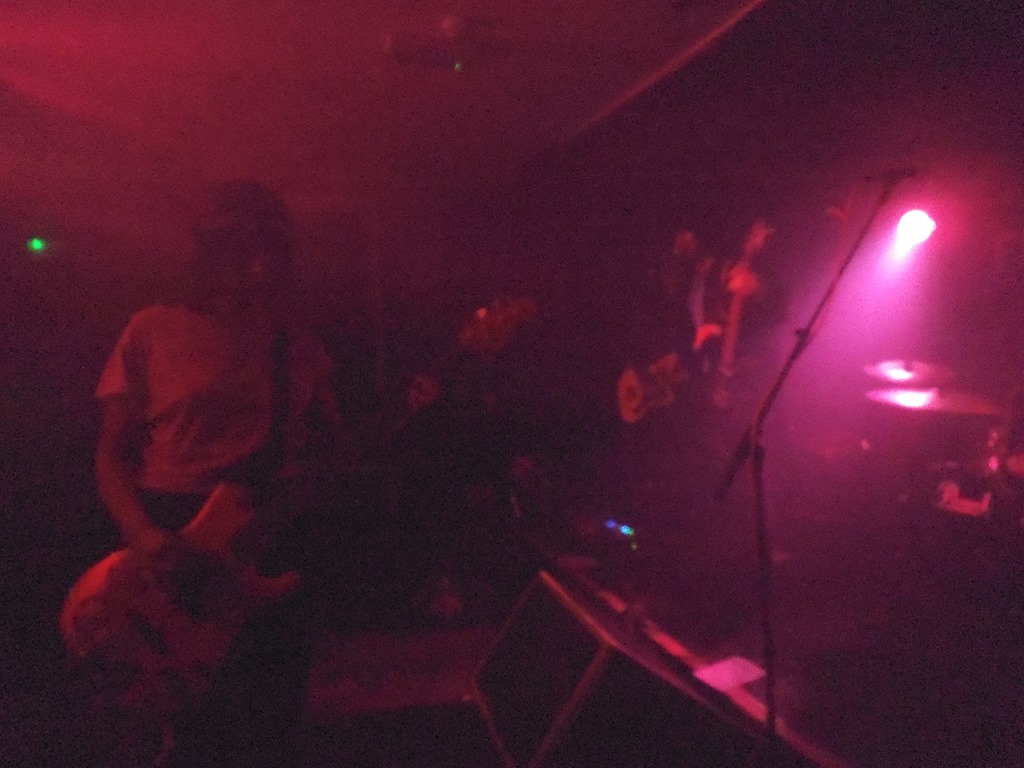
The reason this is relevant is because Arrows of Love make art. They refer to themselves as art-rock, but there’s nothing pretentious about them or their music. In person, they’re some of the friendliest, most approachable and generous people you could wish to meet. On stage, they’re as challenging a band as you’re likely to see – or half-see: tonight, they play in near-darkness to a depressingly small crowd, moving shadows cranking out a fearsome wall of angular noise that straddles grunge and goth-tinged post-punk. And they don’t care: if anything, they revel in the perversity and play as hard as ever.
DSCF2162

Arrows of Love

With more time than usual on account of the original co-headliners cancelling, they dig deep to deliver an attacking extended set which features the majority of the new album, Product. As well it should: while its predecessor, Everything’s Fucked was a snarling, sprawling squall of an album, Product is more focused, denser, more intense, and even more pissed off. The first song of the set is also the album’s opener and single cut ‘Signal,’ a sinewy slice of tension that explodes in every direction.

‘Desire’ is deep, dark, and brooding, and The Knife’ from the debut is deadlier than ever, with added guitar noise and played with a blistering ferocity at its searing climax. The grinding dirge that is ‘Restless Feeling’ invites comparisons to Swans circa 1983/84, and the jarring, grating sonic backdrop is rendered literal as Nuha swaps her bass for a plank of wood and coping saw, which she proceeds to gnaw away at while drums and bass shudder along at a glacial pace. It’s mighty, but hardly moshable.

DSC_0042[1]

Arrows of Love

Nimah would later tell me that he was tired and – on account of having to drive after the show – completely sober, but he still fires into it with unbridled fury, spitting the lyrics like they’re his last words as he’s being dragged off to his execution, and the band crackle with dark energy.

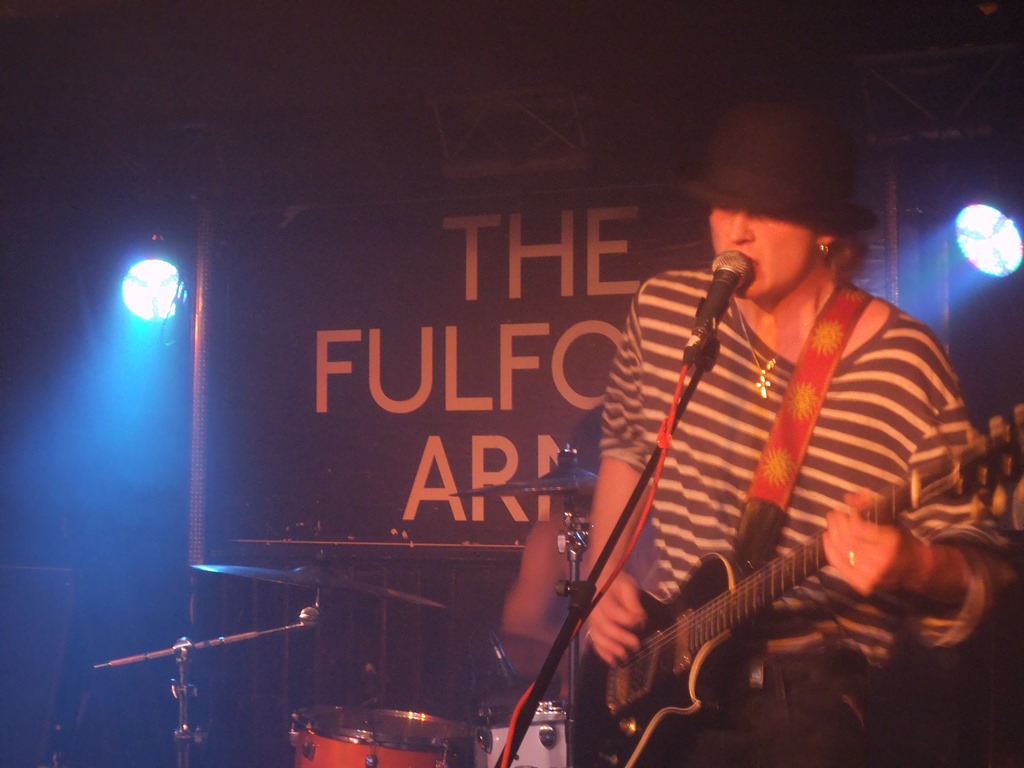
It’s this unstinting, uncompromising, total bloody-mindedness that makes Arrows of Love the band that they are, and as they churn out a juddering, sneering rendition of ‘Predictable’. The only thing predictable about the band is the intensity of the performance (as if to illustrate the point, guitarist Alex, who stepped in when Lyndsey left, is now Alice, who’s perhaps less flamboyant than her predecessors, but still cranks out a mean overdriven six-sting racket), and this highlights the contrast between them and the evening’s support act, Naked Six. The York duo kick out a fiery and energetic set of heavy, balls-out, stomping blues rock with big nods to Led Zep, and having seen them a handful of times, they’re incredibly solid and consistently entertaining. But it’s not art.
DSCF2142

Naked Six

Art is dangerous, risky, uncomfortable. With the roaring attack of ‘Toad’ and the tempestuous closer ‘Beast’, Arrows border on the unlistenable, presented in a style that borders on unwatchable, with no concessions to commerciality. There is something about the lack of illumination which renders them even more inaccessible, more untouchable tonight. If Arrows of Love’s latest album really is the ‘soundtrack to the impending societal collapse’, then bring it the fuck on if it means more shows like this.

ITN Corporation – 3rd November 2017

Christopher Nosnibor

In the Nursery – or ITN as they’re sometimes referred – have been in existence for some thirty-five years but the Sheffield act centred around core duo of brothers Klive and Nigel Humberstone have existed well beneath the radar for the duration of their career. This hasn’t prevented their music being featured on Game of Thrones, Interview with a Vampire, The Aviator, and Beowulf, amongst others, and 1961, which follows over two dozen previous albums after some six years’ silence, showcases a set with a cinematic quality which is ideally suited to TV and movie soundtracks.

While the album’s title and overarching theme is significant on a number of levels, not least of all it being the year of the birth of the Humbertstone brothers – as well as landmark historical events including the construction of the Berlin Wall – its sound exists out of time, and if it does betray a link to any period, it’s the 1980s. Post punk collides with orchestral grandeur across the album’s nine tracks, which explore a broad array of atmospheres and spaces, with judiciously placed samples and – occasionally – vocals bringing variety and range.

A stocky bass enveloped in eddying synths, cool and spacious dominate the marching beat of ‘Until Before After’, the album’s opener, which hints at the kind of brooding, atmospheric post-rock of early iLiKETRiANS. If the comparison seems dissonant in terms of time-frame, it’s testament to ITN’s ever-shifting sonic form and their endless capacity for evolution.

If the idea of a choir of soaring operatic vocals reminiscent of Karl Orff’s ‘O Fortuna’ atop a sweep of dramatic strings by what sounds like a full orchestra sounds ostentatious, the execution of ‘Torschlusspanik’ elevates is miles above pretention to true art.

Rippling pianos, soaring, graceful strings, chiming guitars and murky percussion all form the fabric of an intriguing album: ‘Grand Corridor’ conjures a claustrophobic intensity worthy of Joy Division, while the acoustic guitar led ‘Pacify’ has echoes of Bauhaus on Burning from the Inside and ‘Solaris’, with its pounding percussion and a bassline that’s pure Peter Hook, is a major standout.

There’s a lot going on, and it’s all good: 1961 is a spectacularly articulate album that never ceases to reveal new layers, new corners, new depths.

AAA

1961

I’m Not From London Records

Christopher Nosnibor

It’s a fucking miracle Arrows of Love are still here, let alone that they’ve managed to nail a second album. But then, to watch them play live, it often seems like a fucking miracle that they can make it to the end of a set. Everything about Arrows of Love, from day one, had had an air of precarity, teetering on the brink of implosion. Every song carries that same sense of danger. It’s their wild volatility that sets them as one of the most exciting bands of the last decade, but ultimately, it’s the songs that matter. They’ve always had songs: sprawling, messy, noisy, fucked up and perversely challenging songs, underpinned with some lean grooves.

Product has been a long time in coming and the line-up on this, their second album, is quite different from the one which recorded their debut. In the period between the delivery of aforementioned debut the nihilism-in-a-nutshell noisefest that was Everything’s Fucked (May 2014) Arrows of Love have evolved, and perhaps some of it’s a natural progression and some of its… not so much an increasing maturity as a refocusing of energy, and some if it’s a result of the personnel changes. One obvious shift is the absence of shared vocals: Lyndsey Critchley’s departure has certainly altered the dynamic of the band in that sense (bassist Nuha Ruby Ra’s vocal contributions are a lot less prominent, and she only leads on one track, the surprisingly sultry and almost tender ‘Come With Me’), and Product is a lot less direct and attacking than its overtly grunge-orientated predecessor.

That doesn’t mean that Product is any less confrontational or antagonistic, and the nihilism which drove Everything’s Fucked is apparent in the subtitle ‘Your Soundtrack To The Impending Societal Collapse.’ Moreover, the use of the definite article shows an absolute confidence in what lies ahead – Arrows of Love are certain we’re past the tipping point and freewheeling toward the end of the world as we know it. Product is certainly a darker, more claustrophobic affair than its predecessor, and finds Arrows exploring wider, deeper territory in the process.

‘Signal’ is dark, dense, disturbing, and desperate, and is heavily hung with a curtain of goth which drapes over the violent (post)punk energy. ‘Did you ever see this coming?’ Nemah challenges through a fuzz of distortion ‘Let the lunatics run the asylum,’ he spits, and we know that this isn’t the future he’s predicting, but a plain observation on the present. The tension builds into a squalling racket and the vocals reach fever pitch as the track reaches its explosive climax.

It feels like an eternity since ‘Predictable’ first aired on-line – and while the band articulate their ennui at the daily shit that is life in the 21st century, as a musical work it’s anything but predictable. The vocals transition from drawling boredom in the verse to screaming mania in the chorus, while the guitars lurch and swerve every which way.

Marking a change of pace and direction, ‘Desire’ is dark, brooding, stripped back, introspective. At near the six-minute mark, it’s a seething mess of emotions: Arrows of Love are a band who’ve always emanated a gritty sexuality, but this channels it in a very different way, and it’s not comfortable or snuggly.

‘Tidal’ is perhaps the most overtly ‘art-rock’ song on the album, as well as being the most classically ‘grunge’ composition, with its quiet / loud verse / chorus juxtaposition. At the same time it encapsulates the dual character of Product, and album that swings – quite effortlessly, and thus with maximum impact – between classic post-punk trappings and raging noise, with exploratory experimentalism informing the process.

‘Beast’, which premiered some months ago now, is a swampy, squalid mess of seething abrasion a throbbing mess of bass that sonically calls to mid Melvins in places but ultimately stands as the soundtrack to a riot. The shrieking ‘Toad’ is equally uncompromising, and ‘The Parts That Make the (W)hole’ comes on like a hybrid of The Fall, Shellac and The Cooper Temple Clause. ‘Restless Feeling’ captures the dark, dirgy doom of Swans circa 1984 and makes for one hell of a low ending to the album: if anything, it’s the sound of society after the collapse as its low-end swell builds to an all-consuming tsunami of noise.

Product bridges the gap between Bauhaus and Nirvana, but ultimately, any comparisons are but signposts to an album which is unique in its standing. Product avoids pretence and overblown portentousness: it doesn’t make lofty statement about the future, but instead stands as a painfully intense document of the present. If any album of the last five years articulates the dizzying, anxietised state of contemporary life, it’s Product.

AAA

AOL - Product

Warren Records

Christopher Nosnibor

Lumer follow up ‘Futile’ (which we bloody loved, and which was picked up by BBC Introducing and a host of other tastemakers even more influential than Aural Aggro) with another serrated slice of dark, angular post-punk. ‘Gruel’ is propelled by a bulbous bassline drenched in chorus and flange and distilling the essence of 1983 as represented by bands like The Danse Society and Xmal Deutschland, but with a violent, rabid edge, and the gothy overtones collide with the manic art-rock of Bauhaus circa In the Flat Field as well as heavy hints of 90s grunge with some explosive, driving guitar and crashing drums. 

The lead guitars are fractal, echo-heavy, sinewy. The frenzied, menacing, and borderline psychotic vocals are mashed by effects. There’s a claustrophobic tension that’s almost suffocating and an energy that positively crackles.

Lumar are shaping up to be one of the most exciting new bands around, and ‘Gruel’ has set the bar for future releases. Check the video here:

Lumer are on tour in the coming weeks, too. Dates are as follows:

Thursday 20th July – Fuel Café, Manchester
Friday 21st July – Rough Trade, Nottingham
Saturday 22nd July – Shacklewell Arms, London
Sunday 23rd July – Tramlines Festival, Sheffield

Saturday 5th August – BBC Introducing Stage, Humberside Street Sesh

Tuesday 8th August – Huw Stephens presents at The Social, London

Lumer - Gruel

23rd June 2017

Christopher Nosnibor

I’m a huge sucker for that strain of Joy Division / Cure inspired 21st century post-punk as exemplified by Interpol, White Lies and early Editors – at least when done well. And On the evidence of their previous releases, Leeds’ Tabloids do it well. Given that they formed in 2013 and have to date only an EP and single to their credit, their debut album has effectively been some four years in the making. In doing so, they’ve created a work that feels meticulously crafted, but by no means sterile or overworked.

It’s also a very ‘Leeds’ affair: produced by Lee Smith and Jamie Lockhart (The Cribs, Pulled Apart By Horses) and mastered by Tom Woodhead, formerly of ¡Forward, Russia!. Their input has certainly been sympathetic to the band’s objectives, and they’ve balanced crisp pop sensibilities with atmospheric, analoguey tones and a vintage 80s snare-led drum sound.

The inclusion of the previous single releases does nothing to diminish the sense of All The Things That You’ve Become standing as a coherent album, although there’s very much a ‘debut album’ feel to it on account of this.

‘Pedestal’ reduces a Smiths-inspired jangle to a minimalist jag of tension skewed across a thumping bassline with a nagging lead guitar line and a falsetto vocal providing the key hooks to a killer alt-pop tune.

‘Circle’ is a magnificent, emotionally-charged slow-burner, and one of the album’s standout tracks. Taking the tempo and the drive back, it’s one of those songs that bursts into a climactic finale at precisely the right point.

Ordinarily, basing an album’s merit, or even its context, within a framework of reference points either smacks of lazy journalism or is otherwise indicative of a band who are painfully derivative. But when you’re looking at something which is knowingly and purposefully steeped in heritage, the touchstones are essentially serve to define the work. When operating in a critical capacity, it’s not necessarily as reductive as noting ‘X sounds like Y’ so much as questioning how the material holds up against the all-important points of influence. It is, of course, emblematic of the nostalgia which dominates our present space. We want bands which remind us, if only in some vague, notional sense of the past.

If heavy hints of Depeche Mode echo through the dark, sparse and soulful ‘Cannibals’, The Cure make an obvious reference point for ‘Vessels’, not least of all in Lloyd Bradley’s pining vocal, but also its funk-tinged but also dark-hued bass groove, but then, I’m also reminded of The Associates and, more contemporarily, The Cinematics. Closer ‘Toothache’ is short, but powerful, and makes for a satisfying finish to a rounded, solid album.

Tabloids

With the release of their second album, PRODUCT – the follow up to 2014 debut Everything’s Fucked – scheduled for release on  21st July, one of our favourite bands on the planet, Arrows of Love serve up a second taster in the form of ‘Signal (Redux)’, which has been mastered, once again, by Shellac legend Bob Weston.

‘Signal (Redux)’ hints at a band expanding their sonic repertoire: it’s still an abrasive, jolting, grungy racket, but their nihilistic fury is sculpted with hints of Gang of Four with an elastic bassline and scarring, fractured guitar. It’s probably their best work to date, and augers well for the album. Get your lugs round ‘Signal (Redux)’ here:

ue” /]

The album will be available on Vinyl and CD across US/European territories on 21st July , which you can pre-order globally via www.pledgemusic.com/projects/arrowsoflove.


Arrows 1

Burn Church Press – 26th April 2017

Christopher Nosnibor

Just because I’ve spent the last decade whittling down my cassette collction from over 500 to fewer than 50 doesn’t mean that I don’t think the tape renaissance isn’t cool. It represents a return to the appreciation of tactile, physical media, as well as a format that has a certain fragility which adds to its appeal: the idea that the cassette was cheap, convenient but also potentially damageable and disposable means that it’s possible to enjoy something of an ambivalent or even conflicted relationship with cassettes, often on a tape-by-tape basis. The return of the cassette suggests bands are haring back to a bygone age when acts – before the advent of the CD-R – would sell tapes at their gigs. These were often bands too new or too skint or too unsigned to have any vinyl releases.

The title of the debut release by Newcastle post-punk band Lost on Me also reminds us of the pre-internet era when bands would cut a demo and send it around gig promoters and record labels the like in the hope of getting gigs and more exposure, or even a recording contract and the chance to record in a proper studio rather than on a beaten-up four-track borrowed from a mate.

‘Protection’ bursts from the speakers in a blizzard of fractal, interlooping guitars, a mass f chorus and delay, and one might be forgiven for an initial thought which incudes Editors by way of a reference point – I’m thinking forst album era, I’m thinking ‘Munich’ in particular. But then Martin Downing’s dense, dark baritone enters the mix, and its heavy timbre has far more ‘gothy’ connotations, calling to mind Chris Reed from Red Lorry Yellow Lorry.

‘Landslide’ is a chiming pop tune at heart with a nagging guitar line, but the throbbing bass and deep, growling vocal casts heavy shade across its sunny surface. Third track ‘Balance’ brings a sinewy tension and a density that, again, is reminiscent of the Lorries.

The stuttering bursts of drums propel the wistful, emotive closer, ‘New Beginnings’ into territories which bring together contrasting dynamics to good effect, and once more indicate that these guys have studied the darker (and often more drum machine driven) side of the early 80s alternative scene. The production also contributes to the effect in a major way, with deep, deep reverb all over everything and a slightly hazy, murky analogue veil hanging over the guitars, in particular the thick bass tones. It’s all in the details, and they’re certainly not lost on me.


Lost on Me - Demonstration

With Observed in a Dream, Norwegian purveyors of  psychedelic post-punk / shoegaze, Mayflower Madame, delivered one of our favourite albums of 2016. While their second album is unlikely to see the light until late 2017 or even early 2017, they’ve unveiled ‘Drown’ by way of a taster now. It’s by no means a mere stop gap: to say the signs are good for the next album would be an understatement. A whirl of echo-heavy gutars and even more echo-heavy baritone vocals, ‘Drown’ has an aching melacholy emotional pull. Watch the video and get your lugs around it here:


From Chester-based instrumental-electronic artist, Dom Sith, comes this dark goth-inspired tune to soundtrack people’s struggles with themselves.

It’s nothing to do with Allen Ginsberg. Of the inspiration for ‘Howl’, which takes sonic leads from the likes of NIN, The Haxan Cloak, and Burial, Dom comments: “I wanted to create something haunting, something that’d soundtrack those long nights alone, but not in a reassuring way, like how loneliness might sound, and how depression might sound, if it was heard…in the dark.”

We like NIN, The Haxan Cloak, and Burial, and we like this: get your lugs round it here:

Dom Sith

Hide & Seek Records – 21st April 2017

Christopher Nosnibor

This being a Post War Glamour Girls album, there’s a lot to chew on, and I’ve played Swan Songs on the bus to and from work most days for the last month and a half in an attempt to really let the songs embed and to unravel. It’s not because Post War Glamour Girls make albums which are difficult or lack immediacy, but because there’s just so much to extract, and each listening reveals more. I’m still discovering new details and dimensions in their 2014 debut, Pink Fur, and suddenly, here we are at album number three.

And with album number three, they’ve made it a clean sweep of awesomeness: not a case of third time lucky, but a straight hat-trick. Few bands can claim such a record, although Post War Glamour Girls are unlikely to gloat, or even reflect on this achievement: chances are by the time the album tour is under way, they’ll have filled the set with new material which may or may not feature on album number four.

Swan Songs is by far their most commercial and accessible album to date, but it would be a chronic error align that in any way to them selling out, and in many ways, it’s equally their knottiest, thorniest release thus far. Yes, they’re contradictory and contrary, and that’s precisely their appeal. And while they always sound uniquely like Post War Glamour Girls – there really isn’t a band going – or, indeed, previous – who sound quite like them, they’re spectacularly varied in their style, and you never know what to expect from album to album. This is music born from restless energy and a drive to create something new, to challenge the band and their fans in equal measure. The one thing that is seemingly guaranteed is the quality of the material.

Swan Songs is most certainly their most eclectic-sounding album yet. The overall tone of the album is altogether less down than its predecessor, Feeling Strange. The downcast, brow-beaten self-loathing is replaced by a roaring defiance, at least in part. And, of course, it has all the band’s trademark qualities, honed to a new level of sharpness.

The album’s opener, ‘Guiding Light’ comes on like a cross between Big Country and The Wedding Present circa ’92 with its spiralling celtic guitar motif and stadium-fulling chorus – before making a 90-degree swerve only Post War Glamour Girls could pull off, with James Smith veering off into one of his densely-packed rants. You only catch snippets of the lyrics, but in the space of a minute he’s here, there and everywhere, pulling in what appears to be a reference to Gang of Four and macroeconomics with a line about ‘guns before butter’.

‘Chipper’ is more common PWGG terrain, and finds Smith in brawlingly nihilistic form, howling, bleating and hollering over a murky backing of guitars that jangle and warp and bend as the driving rhythm section powers on relentlessly. At the middle eight, it heads off on another trajectory, Smith coming on like a brutalised hybrid of Mark E Smith and JG Thirlwell on top of Alice Scott’s icily calm backing vocals. If ever a band knew how to work contrasts, it’s Post War Glamour Girls.

Conjuring a brilliantly visual image while working a dubby post-punk seam, the more understated ‘Gull Rips a Worm’ marks something of a departure, with Smith revealing a more soulful side in his melodic vocal delivery. Meanwhile, ‘Big Trip’, which recently found its way onto Radio 1 thanks to a shout-out from fellow Leeds legends Pulled Apart by Horses, is a brilliantly gruff and darkly grounded paean to escapism. It might not quite rank with the time the uncensored version of Rage Against the Machine’s ‘Killing in the Name’ was spun at teatime on a Sunday during the Top 40, but it’s pretty subversive. It’s also indicative of the band’s mass-market potential, given the right exposure.

Awkward buggers that they are, the two sets I saw them perform following the release of Feeling Strange, showcased unreleased material in favour of either the latest album or their rapidly-expanding back-catalogue. These shows hinted squarely at a more direct pop sound, and while Swan Songs is a long way off this, being neither direct or upbeat and poppy, the second half of the album is the closest they’ve come to creating unadulterated pop in the studio.

‘Polyanna Cowgirl’, which featured on last year’s live album, is a big, reverby song that draws together elements of classic dreampop with vintage mid-80s postpunk and even more overtly charty music of the same era. Ah, such different times… And so, they manage to imbue the song with a certain nagging nostalgia, as well as a pining wistfulness. The hefty welter of drums and driving bass render it uniquely Post War Glamour Girls, but the multifaceted harmonies and chiming guitars, expansively produced, bring that cinematic slant to the finished product. The shimmering ‘Golden Time’ wafts and warps gently before ‘Sea of Rains’ drifts into I Like Trains territory, but Smith’s bleak lyrics render it a very different animal: ‘The lust you tried to drag from the soles of his shoes / is the worst excuse for loneliness I’ve ever had to use,’ he reflects, grimly.


The jarring, splintering, ‘Welfare by Prozac’ sees the band ploughing headlong into the Fall-like realms they stomp with aplomb, Smith duelling with Scott like vintage Mark E and Brix, a snarling, spitting inscrutability counterpointed by a melodic yet icy tone, while squalling guitars break over a thick, strolling bassline.

Now, I’m a huge sucker for a monster closing track. On past form, it seems Post War Glamour Girls are masters of the monster closing track (even if Feeling Strange perversely delivered said monster track as the penultimate song in the form of ‘Cannonball Villages) and Swan Songs proves no exception, with the seven-minute ‘Divine Decline’ building from nothing to a raging behemoth of a song. ‘Love and hate stem from the same cell,’ Smith croons, before the whole thing erupts. ‘All I ever wanted /as to be a better to better person / and I’m working on it constantly / working like a dawwwwwg!’ he growls. It’s a storming finale, and no mistake, as the band whip up a dense maelstrom of sound.

As is so often the case, Smith channels a vitriolic rage which one feels is largely directed toward himself. It’s a recurrent aspect of the album’s lyrical content: ‘My manners aren’t amazing / My poetry is pisspoor / My attitude’s an anathema,’ he snarls self-critically on ‘Chipper’. At the risk of too closely, or even mistakenly, aligning the art with the artist lyrics with lyricist and assuming the role or armchair analyst, one can’t help but wonder on the evidence his lyrics, coupled by his driving of the band’s relentless forward trajectory, if he isn’t fighting himself every moment of every day, and if Post War Glamour Girls aren’t some means of his justifying his existence to himself. If this is some kind of therapy, then – from a purely selfish perspective – our best hope is that it takes a good few more albums to purge himself yet, and that the title is more a reference to the conceptual contents of the album rather than an indication of the band’s final sign off. Because, not only is Swan Songs a killer album, but a cohesive and rich set which is the work of a band really hitting their stride and riding on the crest of a wave.*


Post War Glamour Girls - Swan Songs


*The success of this closing punchline is limited, not least of all on account of the fact that swans’ natural habitat is inland and on / by rivers, lakes, and ponds, and therefore unlikely to be tidal or otherwise, meaning that swans are rarely found in an environment where waves are common. But every review needs a punchline, right?