Posts Tagged ‘Environmentalism’

Humus Records – 6th November 2026

Christopher Nosnibor

You want noise rock with a fierce punk edge? Yes? Good. Coilguns are the band for you. No? Guess again. Everything We Love, We Destroy is a fierce blast of guitar-driven punk-infused noise, and you need to hear it. We’ve been plugging these guys for a while through their single releases – each one a ferocious blast of adrenaline, and now we finally have the album. And it doesn’t disappoint.

‘Imagine The Armed, Converge and METZ thrown into a blender and cranked up to eleven!’ says their bio. And, unusually, it’s not hyperbole. Everything We Love, We Destroy, is positively explosive, a succession of high-impact detonations. ‘NO POLISH. NO COMPROMISE. JUST PURE SONIC MAYHEM!’ they say: it’s a promise and a threat, and they deliver on both. But for all the mayhem, they cram in a superabundance of nagging guitar lines, and even some sharp hooks.

In the wake of the full-throttle post-hardcore blast of the title track, which fires in all directions, while underpinned by a thick, maxed-out bass, ‘Peace Trader’ arrives on a well-trodden path of lolloping drums and loud / quite dynamics. ‘Replication Crisis’ takes things up a good notch or three, a furious speaker-rattling sonic riot. As with the majority of the songs on the album, it’s tightly-structured, flipping through multiple segments, the switches coming from out of nowhere, but landing every time. Yes, it’s noisy, but it’s by no means without focus: in fact, Everything We Love, We Destroy demonstrates just how technically adept Coilguns are, and how inventive and imaginative their approach to songwriting is. every moment brings a new element of surprise, an unexpected twist, a sweet melodic breakdown, a brief ear-catching harmony.

While the lyrics aren’t always easy to make out, the song titles build around the theme of the album’s title – that is, environmental issues and human destruction of its own habitat, as well as the ever-evolving and increasingly challenging digital landscape in which we find ourselves. They’ve got plenty to go at. Everything We Love, We Destroy is a critical assessment of / anxietised spasm in the face of the crisis in which we find ourselves in the midst of.

You didn’t think an album with songs called ‘Forever Chemicals’ and ‘Platform Decay’ (the more polite and technical term for ‘enshittification’) was going to be celebrating any of these things, did you? ‘I can’t compute! I can’t compute!’ is the frenzied refrain in the latter, and by the band’s own admission, the album as written and recorded at pace only last month, and its raw, untempered energy is integral to what it’s about. The medium is indeed the message, to reference Marshall McLuhan. These are insane times, and it feels as if we’re in a spiralling freefall towards unspeakable catastrophe. It’s clear that Coilguns aren’t only aware of this, but are driven. As artists, there’s nothing within their capacity to slow this terrifying trajectory, and so the only way to deal and remain remotely sane is to live every day as if it could be your last, and channel that overwhelming panic into creating something, if only because putting it out there has therapeutic benefits.

‘Punisher Disclaimer’ is a frenetic, kinetic collision of noise-rock and post-hardcore, while the introspective acoustic song, ‘Days Before the War’, a mere minute and a half in duration, offers a rare respite at the album’s mid-point.

It’s that churning bass which again dominates the spindly, sinewy ‘Teach Ourselves’, which grows in intensity as it progresses towards its squalling finale. Holy fuck: it’s immense. ‘Carbon Magic’ goes headlong into knotty, noodly math-rock played at a hundred miles an hour before lurching into a megalithic riff which slays. But it also does so much more besides. The album’s last track, ‘Perfect Fit Content’ is a sprawling six-minute monster. They slow the pace and again, it’s rolling drums and chiming, angular guitar which mark the first section, then the pace accelerated, and by two minutes in, we’re dragged into the midst of a fully-swirling maelstrom, which in turn evolves into a proper chant-along chorus. And then it’s off again.

Everything We Love, We Destroy is one of those albums which has a wide range, and a lot of energy, and is not easy to place. It’s neither one thing nor the other. But it is the sound of the now, and the sound of a band wrestling with the complexities of these baffling, bewildering, brain-melting times. It’s a statement on the fucked-up world we live in, and the dissolving state of humanity, and it’s delivered with a raw honesty and passion which is utterly compelling.

AA

Andy_Ford_203290

Photo: Andy Ford

7th August 2026

Christopher Nosnibor

What do Depeche Mode, Pink Floyd and Roger Waters, and The Cure have in common? No? A bit stumped? Well they’re all listed as touchstones for the new solo EP from Greg Bullock, who’s perhaps better known as co-founder and one half of Cyborg Amok, purveyors of goth-infused synth-rock – although he his solo career has always coexisted alongside. The band’s name seems particularly salient in context of the recent news of AI’s exponential self-advancements: what was essentially science fiction just a couple of years ago is now the reality of the world in which we live. And it’s the reality of the world in which 26EP is firmly routed, exploring, as he puts it ‘ideas we may not always find comfort in: persecution, contamination, ignorance, and mortality’.

It’s true: few find comfort in any of those topics, and while the romanticism of death is a fairly popular and eternal trope in art through the centuries, few find much by way of warmth when confronted with issues of mortality in immediate proximity. In fact, it’s strange how even the most philosophical – or nihilistic, or tough-seeming – individuals who are brazen about death wilt at the loss of friend and relatives and are suddenly moved to proclaim that someone in their sixties or seventies was ‘of no age’ and ‘taken too young’. In short, death in the abstract is fine, but the actuality is something we can’t even bear to contemplate. Meanwhile, persecution, contamination, and ignorance provide the daily fuel for fiery exchanges on social media and inflammatory reports in the news media. It seems that in recent years, we’ve come to thrive on these very things which tear us apart, as individuals, and as a society. I suppose it comes down to the separation of the keyboard to the life experience, the chasm which yawns between concept and corporality.

‘In Other Words’ starts with a bassline reminiscent of The Cure circa Faith, before plunging into a dark gothy post-punk space, somewhere underground and airless. ‘The deeper the trench / The higher the climb’, he croons in a reverb-soaked baritone, dry, crunched, but ringing clear. It’s a lyric based in logic rather than one which provides a revelatory insight, and yet… and yet, we seem to have become so mired in distractions and misinformation and futile infighting, that simple, basic truths have been cast by the wayside, and in this context, this plain observation carries unexpected weight, particularly as we continue to dig ourselves ever deeper, not only increasingly entrenched in polarised views, but also in embracing AI and practices which accelerate climate change. We’re digging our own graves, here. The trench is approaching the depth of very depths of the oceans. And still we dig.

The folksy ‘Thirty Pieces’ is sparse and dark, despite some lilting instrumentation. Bullock’s rasping vocal lands between Leonard Cohen and recent releases by James Ray, while ‘I Ain’t Goin!’ presents a hybrid of early post-punk and electropop, with a primitive production aesthetic reminiscent of the era, a basic drum machine with a whip-crack snare dominating the mix.

The riff on ‘Blu-Green Beauty’ leans on ‘You Really Got me’ by The Kinks, but filtered through Dr Mix and the Remix as Bullock rails against climate change and paints a bleak yet somehow encouraging picture in which there is still choice: ‘You can close the curtains / You can close your eyes / You can kill everything / You can kill, blu-green beauty.’ Do we still have a choice? If so, for how long?

26EP is pretty bleak, but still contains glimmers of optimism. Where I’m sitting, the future is dark, so I hope he’s right.

AA

a0905385165_10

TWICE A MAN unveil a beautiful visualiser for ‘Desert Snow’, the first to be plucked as an advance single from the electronic environmentalists’ forthcoming album Reveries Before Silence. The Swedes’ new full-length has been chalked up for release on November 20, 2026.

Parallel to their new album, Twice A Man will also release a collection of rare tracks revolving around marine themes that have been gathered in a 48-page 2CD artbook under the title The Marine Trilogy on November 20, 2026

AA

Twice A Man comment: “The first single track, ‘Desert Snow’, is one of our musical footprints in a time marked by uncertainty, division, and change”, Karl Gasleben explains on behalf of the band collective. "This song reflects on the world we live in today while reminding us that hope and positive thinking can still be a path toward unity. As modern societies continue to challenge our sense of human connection, we need to find what brings us together rather than what drives us apart. If we can discover a common voice that leads us away from war, polarisation, and the climate crisis, there is still a future worth believing in. We want to be able to look our children in the eyes and speak about tomorrow with honesty, responsibility, and hope. ‘Desert Snow’ is our contribution to that conversation – a song that carries both reflection and faith in a better future.”

AA

Twice_a_Man_002_by_TaM

Swedish electronic environmentalists TWICE A MAN present the track ‘Birds Eye View’ as the first advance single taken from their forthcoming new full-length The Coloured Breeze Is a New Dimension. The highly anticipated album has been scheduled for release on June 13, 2025.

TWICE A MAN comment: “Overview can light sparks in the place where your roots are waiting”, guitarist and vocalist Dan Söderqvist writes on behalf of the band. “If you follow the time you can destroy the eradicating wheels of commerce. Don’t drown yourself in pretended sleep! There is a common knot that must be untied. Our thoughts are the light and nature sings our lullabies.”

AA

While the skies of the world are darkening, something powerful and resilient is pushing from below through the pungent springtime topsoil close to the City of Göteborg in Sweden. This sprout that is charged with organic and electric energy bears the name The Coloured Breeze Is a New Dimension. TWICE A MAN planted its seed with the song ‘Dahlia’, a ‘new’ track that was written to complement the compilation album Songs of Future Memories.

For three years, the Swedish dark electronic trio fertilised and nurtured the germ bud until it had taken firm root in their musical heritage and began to send offshoots to find new sonic spots beyond any previously built garden walls. The Coloured Breeze Is a New Dimension is an organic entity that creates something new by re-combining its musical DNA in various ways. As a result, its tracks blossom in many hues of electronic colours.

AA

2d66a5ec-f2dc-bcc8-8ff4-e2a237e11cc0

10th September 2018

James Wells

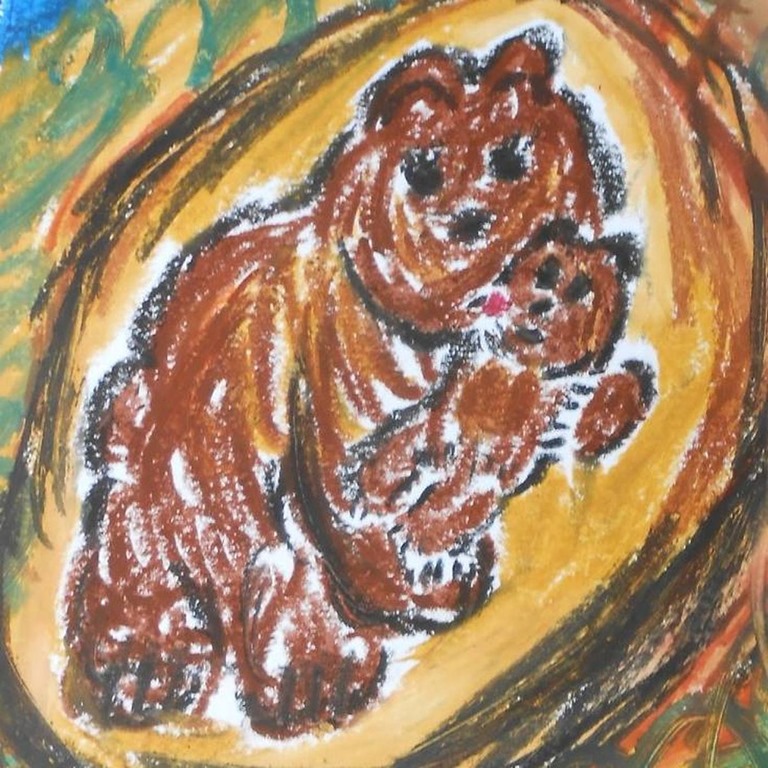
Sweden’s Noemie Nours promises ‘All-ages slo-fi lullabies, supporting a non ideological, vegan and drug-free lifestyle,’ and all of the proceeds from digital sales this, her third LP, will be donated to the charity Orphaned Wildlife. Such selfless acts are increasingly rare in a (rapidly changing) climate dominated by Brexit and right-wing, hardline capitalist ideology, while we still feel the repercussions of the last economic downturn which followed the sub-prime housing crisis of 2008-2009. For an artist to make art for the greater good rather than for gain is admirable, and Noemie Nours has made it her mission to do whatever she can to save the bears. Bears are her thing. As is slightly off-kilter folk music. And I’m not going to mock.

Following on from debut single ‘The Life of Bears’ and album Bear Meditations, her love of bears remains undiminished with As a Beare Doth Her Whelps.

The album’s seven songs are primarily constructed around picked acoustic guitar and vocals, and if the titles betray the thematic leanings of the lyrics or musical intent (‘Bearsplaining’, ‘Den’, ‘Brought into a Wilderness’, ‘Ursa Minor Forest’), there’s also something of a sparse primitivism about the songs, too. There’s an innocence and openness about Noemie Nours’ music that’s refreshing and utterly charming, while occasional passages of jagged fretwork and melodies which wander off the path of conventional key and notation are very much part of the appeal.

With its sparse arrangements, slow tempos, and overt lack of complication, you might say that it’s an album that’s very much about the ‘bear’ necessities.

AA

Noemie Nours – As a Bear Doth Her Whelps