20th November 2026
Christopher Nosnibor
The small market town of Harrogate in North Yorkshire has a reputation for being somewhat upmarket. Initially, it developed as a spa resort, and while only one of the spas remains operational as a spa (The Royal Spa is now home to a Wetherspoons, but remains a spectacular building), the town is also home to the original Betty’s Tearooms, and with its leafy spaces and generally genteel feel, attracts a fair few tourists and house prices are significantly above the national average. Hardly a place you’d expect to be a hotbed for extreme metal. But every band is local to somewhere, and so it is that Lithuanian / British black metal behemoths Miško Boba happen to hail from Harrogate.
They came to my attention late on in 2024, standing out by a mile among a bunch of metal and hardcore acts. It wasn’t just that they were technically the best band on the bill, or the fact they were the heaviest, but the sheer intensity of the performance blew me away. Having seen them a few times since, they have only got more intense and more powerful with each outing, and recent shows have witnessed the inclusion of new material in the sets. I wrote in July that ‘if it’s in any way representative of the forthcoming album, then their best is very much yet to come’.
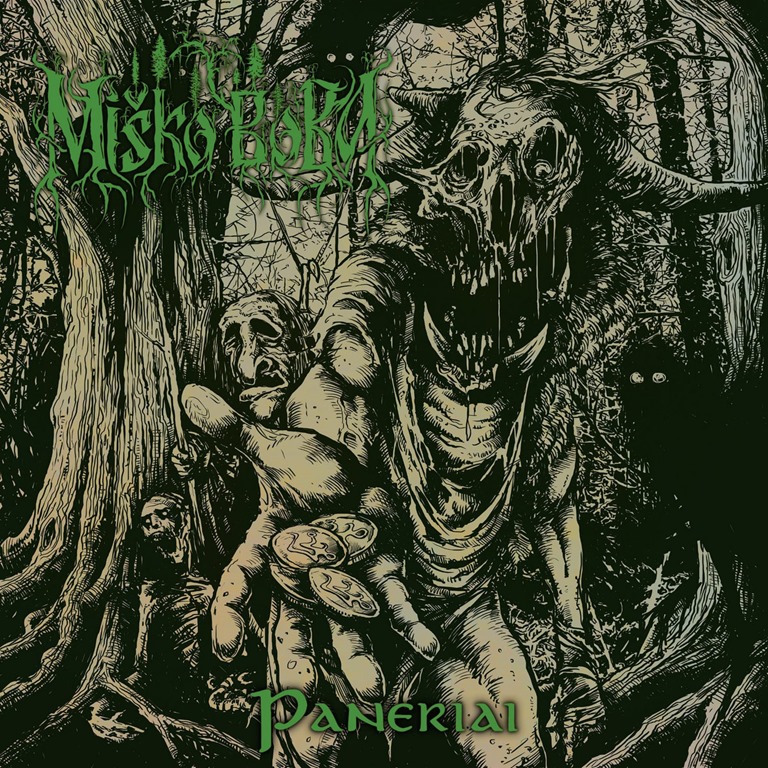
And now we have confirmation of this, with the arrival of second album, Paneriai. A brief history lesson is perhaps appropriate here: the title refers to Paneriai massacre (Lithuanian: Panerių žudynės), which saw the mass murder of around 100,000 people, mostly Jews, Poles, and Russians, by German SD and SS and the Lithuanian Ypatingasis būrys killing squads, during World War II and the Holocaust between July 1941 and August 1944. It took place near the railway station at Ponary (now Paneriai), a suburb of what is now Vilnius, Lithuania.
This is important, on numerous levels. We cannot progress towards a better future without learning from history, and much of this history is not widely taught. Yes, curricula do include The Second World War and the Holocaust, but the focus tends to be on the main concentration camps such as Auschwitz in Poland (where some 1.1 million were murdered). And yet not only are there still deniers of the holocaust, but there continues to be a swathe of resistance, particularly by Western governments, to the evidence that we’re witnessing a genocide being committed in Gaza.
I raise this because it’s what lies at the core of what Miško Boba are about: they’re not just another black metal band growling on about demons and satanic shit with condenser mic production values, but a band who really delve into the history and heritage of Lithuania, a band whose songs are rich in meaning and significance. This commitment extends to the lyrics, which are entirely in Lithuanian. Given that most black metal vocals are indecipherable, this is certainly no obstacle to appreciation of the album, and, from my somewhat scant linguistic knowledge, it seems that Lithuanian lends itself well to raw-throated, guttural growling. Kanopa’s vocals are scraped from the very bowels of hell and are pure fire and venom. And the production is shit-hot, too: the detail cuts through the murk.
There is texture to the guitar blizzard, and very few squealy notes and harmonics: Miško Boba very much focus on the riff over the extravagant fretwork and keep the solos in check. The drumming is by no means dominant – as is the genre norm – but it’s both audible and clear, instead of sounding like someone thudding around with a stone in a wet sock in the room next door. The guitar, too, has bite, and a treble cut that gives it a real sharp edge.
Paneriai presents six pieces, all around the five-and-a-half to six-minute mark in duration, and all incredibly detailed and relentless in their dark fury. ‘Žiema Paskutinė’ raises the curtain on the album in savage style, and it proves to be a gentle prelude to what follows. ‘Šimtas’ is savage, and there simply is no let-up.
‘Gabija Švies’ is perhaps the most ‘flowery’ and extravagant cut in terms of technical guitar work, but it transitions towards a driving riff-driven close, and the album’s final track, ‘Malda Gelmėms’ is the sound of a band going all out. Woah. This is something else: the pedal is to the metal and they piledrive into this monster with unbridled ferocity. It’s as black as back can go.
They say you shouldn’t judge a book by its cover. I would disagree, and Paneriai is a perfect example as to why: it sounds exactly like the artwork suggests (and no AI was used in its creation). It’s a dark, dark work, relentless in its ferocity, heavy both in sound and subject matter, and perfectly realised, taking black metal to the next level.
AA