Posts Tagged ‘Bauhaus’

2nd October 2025

Christopher Nosnibor

The context for Ashley Reaks’ sixteenth solo album – and his third in three years (not counting the compilation of demos released earlier this year) – is weighty. He has written openly and extensively of his health issues, while sharing images and commentary nocturnal wanderings, and these both inform At Night The World Belongs To Me, of which he writes:

The looming spectre of death and loss haunt the album: Reaks survived two major health scares and a misdiagnosed terminal illness over the last 18 months, experiences that inform the reflective, poetically gloomy lyrics, and the 4 am downtempo grooves. Adding to the sense of loss, guitarist and long-term collaborator Nick Dunne died suddenly at home just one week after completing his guitar parts for the record.

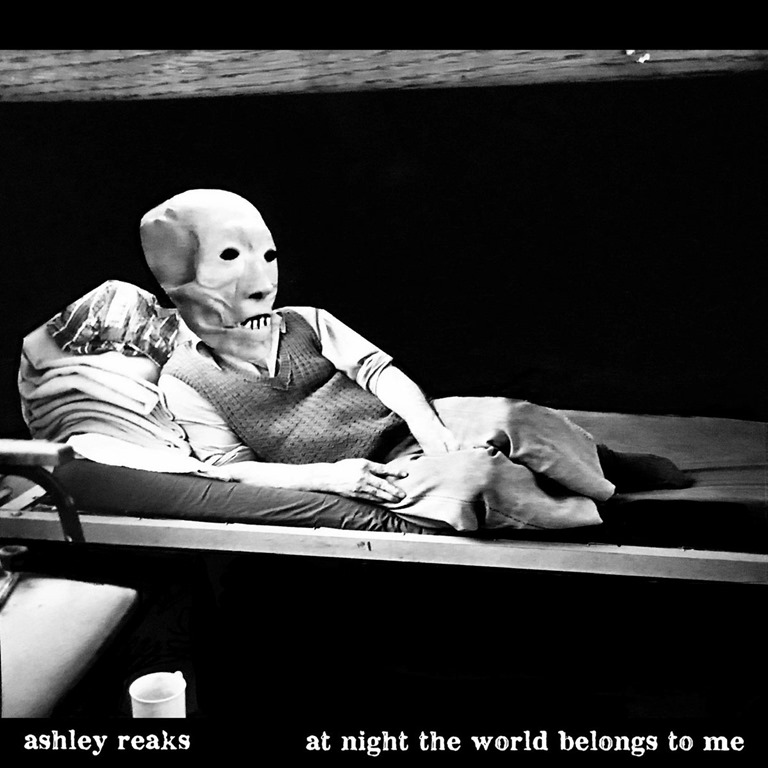
Through all of this, he has continued to collage and write prodigiously, but At Night The World Belongs To Me marks a distinct change of tone from its immediate predecessors, The Body Blow of Grief (2024) and Winter Crawls (2023). The usual elements are all present and correct – the sense of experimentalism, the collaging of genres, melding post-punk, jazz, and dub – but this feels darker, more introspective. The cover art, too, reflects this. While it has the same rather disturbing, grotesque strangeness of his usual work, the grim-looking figure in repose has connotations of ailment, frailty, even the deathbed.

The first track, ‘Playing Skittles With The Skulls and Bones’ has a bass groove that calls to mind The Cure’s early sound, melded to a rattling rhythm reminiscent of ‘Bela Lugiosi’s Dead’. The smooth sax that wanders in around the mid-point provides something of a stylistic contrast, but at the same time, it’s minor-key vibes keep the song as a whole contained within a bubble of reflection, evoking the stillness of night. I know, I’m sort of dancing about architecture here, but something about Reaks’ work prompts a multi-sensory response.

‘Rimmed With Yellow Haloes’ brings soaring post-rock guitars atop of an urgent ricochet of drumming and solid bass. On the fact of it, it’s almost poppy, but it soon shifts to take on a folksy aspect, while Reaks sings of death and funeral pyres, and the refrain, delivered with lilting, proggy overtones, ‘The Lord gave the day to the living, the night to the dead’. In context of the album’s title and theme, there is a tangibly haunting foreshadowing here, a suggestion that Reaks has not only accepted his mortality, but has assumed his place. It’s powerful, and deeply moving. Of course, Reaks can’t help but introduce incongruous elements, with some horns which are pure ska and some super whizzy 80s pop synths providing a pretty wild counterpoint to it all. It’s hard not to smile, because there’s an audacity to this approach to composition and arrangement – a lot of it simply shouldn’t work, but it does, and it’s uniquely Reaks.

The album’s shortest song, ‘Things Unseen’ is snappy, poppy, Bowie-esque, an amalgamation of post-punk and electropop, a standout which is succinct and tight, and consequently, the dark connotations of the bleak shuffle of ‘Life Forever Underground’ – a rippling synth-led tune – are rendered more profound. The sequencing of this album is such that the shifts between songs accentuate their individual impact.

‘Mask the face, unmask the soul…’ he sings softly on ‘Mask The Face’, which has a somewhat spacey Krautrock feel to it – before a guitar solo that worthy of Mark Knopfler emerges most unexpectedly. And as dark as things get here, Reaks never ceases to bring surprises. At Night The World Belongs To Me perfectly encapsulates the reason he’s so respected and critically acclaimed, but orbits light years outside the mainstream. In a world defined by an exponentially reducing capacity for sustained attention, Ashley Reaks makes music that requires real engagement, the musical equivalent of complex carbs and high fibre foods in a processed, white bread culture. But also, contemporary mainstream radio music favours short songs which cut straight to the chorus, where the hook has to land in the first twenty seconds. Here, we have eight songs, all but one of which are over five minutes long. They take their time, they’re expansive and exploratory, there’s atmosphere, there’s depth. And as ‘Eyeing Up The Sky’ tapers away on a buzzing drone, we’re left with much to chew on, much to consider.

AA
a2008509738_10

Saccharine Underground – 1st July 2025

Christopher Nosnibor

This one hell of a hybrid. Just when you think post-punk has been explored to the point at which it has been hollowed out, exhausted, and has only well-worn and instantly recognisable tropes to offer, along come Washington DC’s Zabus, purveyors of avant-garde post-punk with an EP which is something of a ‘best of’ with tracks from their two recent albums, Automatic Writhing (September 2024) and Floodplain Canticles (January 2025), plus a new track which paves the way for their next offering Whores of Holyrood (due in August).

With its immense, reverb-laden sound and expansive, drifting desert-like soundscape ‘Grafhysi Fyrir Alla’ makes four and a quarter minutes feel like a hypnotic span of double that duration. The shuffling bass and big, booming bass are pure dub. The guitar chimes and floats into the ether as everything swashes around in a huge echoic pool.

Of ‘Grafhysi Fyrir Alla’, lifted from last year’s Automatic Writhing, project founder and focal member Jeremy Moore says it’s about “the societal imposition of unobtainable standards of beauty, and our obsession with physical perfection at the expense of true happiness”. This is certainly not a case of style over substance, but a coming together of musical inventiveness with a level of intellect which is rare. “Psychopathologies like body dysmorphic disorder, at the extreme, can lead to a path of ruin, if most of your life is spent chasing a ghost—what you believe the world wants you to be. Death doesn’t discriminate. The end is always the same.”

This is some pretty heavy – and dark – philosophy on offer here, and it’s welcome: as much as there is much to be said for the benefits of the escapism music can offer, there’s equal solace to be found in art which articulates one’s own world view. And so it that that Zabus portray contemporary dystopia from a range of camera angles.

‘Orphalese’ is more uptempo and is decidedly cinematic with its broad-sweeping layers of synths driven by propulsive, rolling drums. There’s no verse / chorus structure, but instead a hypnotic expanse of sound, the aural equivalent of standing on a summit and looking out at a three-sixty horizon through a heat haze. It’s immersive, utterly absorbing, and transportative.

The first of the tracks lifted from Floodplain Canticles is the six-minute ‘Tearful Symmetries’, which is low and slow, Jeremy Moore’s reverb-drenched baritone croon approximating the late, great, Mark Lanegan against a dubby backdrop punctuated the clangs and scrapes of guitar drones and sculpted feedback. ‘This is the end….’ He reflects, but not with sadness or panic, but a sense of inevitability.

‘Golden-rot’ goes all out for the theatrically gothic experience: it’s as big on drama as it is on sound, as an insistent mechanised drum beat pounds away, cutting through a smog of murky guitar and thick, booming bass, and if I wasn’t already perspiring hard from the humidity and thirty-degree heat, this would make me sweat, with its tension and crackling energy.

And so we come to the title track, the first taste of Whores of Holyrood. It’s different again, although the cavernous reverb is a constant. This cut is a brooding piece that borders on country, once more evoking the spirit of Lanegan. It’s spacious, but its intensity brings an almost suffocating weight.

Shadow Genesis provides a perfect introduction to Zabus, and at the same time whets the appetite for what’s to come. And let me tell you, it’s something to get excited about.

Zabus - Shadow Genesis cover art

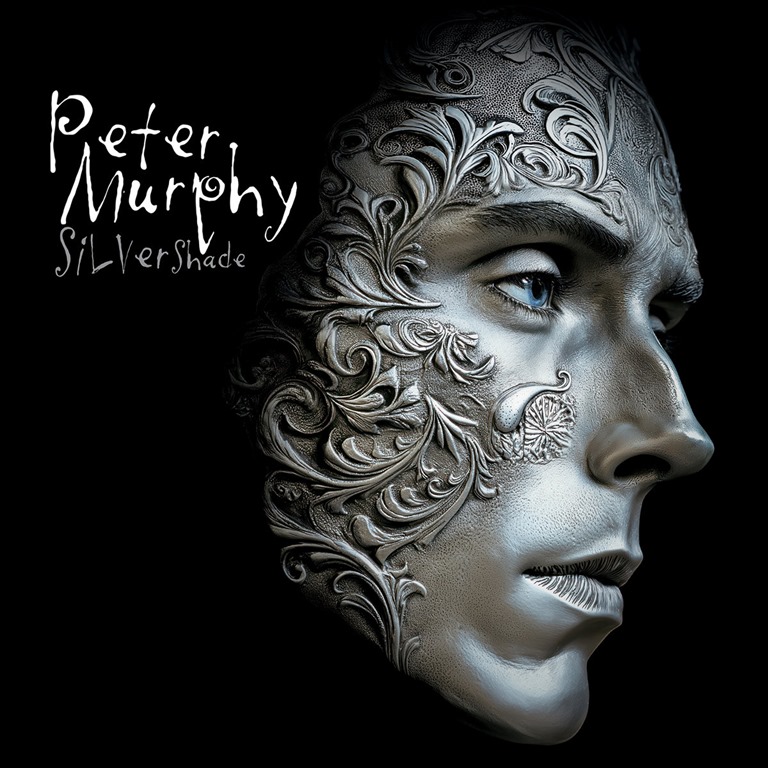
Peter Murphy – Silver Shade – Metropolis Records – 9th May 2025

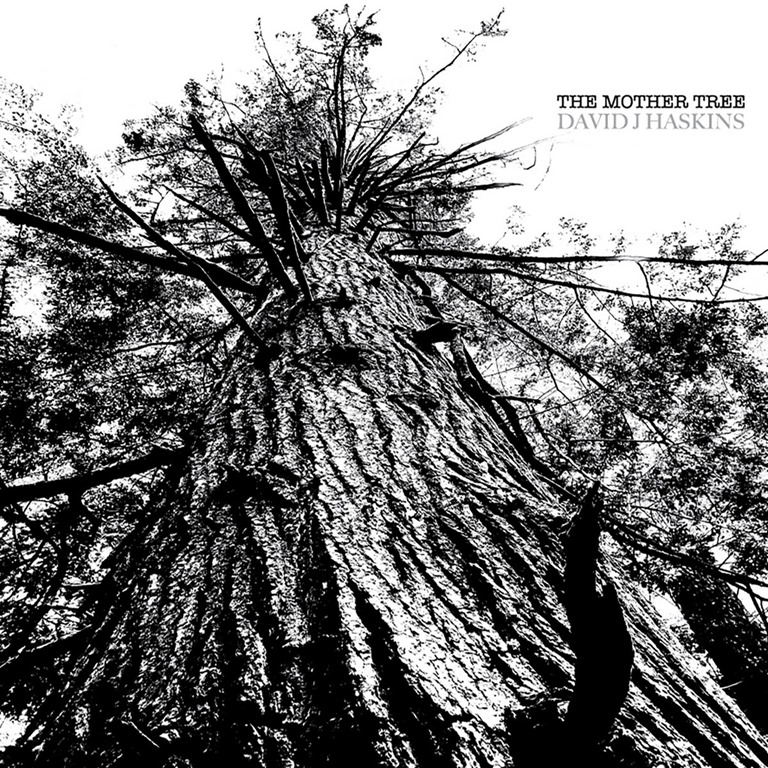
David J Haskins – The Mother Tree – Erototox Decodings – 6 June 2025

Christopher Nosniobor

It seems quite incredible that following a debut single which alone created a whole new genre, Bauhaus would release four definitive studio albums in just three years. The chemistry and creative crackle which existed between the four members was something special, and, judging by the 2008 reunion album Go Away White something that was very much of the moment.

While all four members remained active after the split in 1983, subjectively speaking, none of them have really replicated the same quality, or consistency, despite Love and Rockets – Daniel Ash, Kevin Haskins, and brother David J enjoying a degree of success with their more overtly pop-orientated rock sound.

The release of new albums by both Peter Murphy and David J within a month of each other affords an opportunity to observe just how different their respective creative trajectories have been, and also perhaps offers some insight into why Bauhaus reformations haven’t been entirely successful, with a 2022 tour of the US being cancelled, Murphy entering rehab, and the reunion ending.

Both of these albums are very much art-orientated, albeit approaching said art from almost diametric angles.

Murphy’s latest offering isn’t strictly a solo effort. Initially released as a standalone single, ‘Let the Flowers Grow’, which now closes the album as a ‘bonus track’, is a duet with Boy George, and much of the material on the album was co-written with Youth, who also produced it. Silver Shade contains twelve tracks and has a running time of fifty-nine minutes. As such, it’s a longish album, and the crisp 80s-sounding production, while suited to the material, dates it somewhat.

‘Swoon’ is classic Murphy in full-on Bowie mode, with a dash of Lou Reed and some grandiose electropop leanings. But if the bassline is lifted from The Sisters of Mercy’s ‘This Corrosion’, something about the swinging pop groove is actually closer to Springsteen’s ‘Dancing in the Dark’. You can clearly hear Bauhaus in all of this, but it’s predominantly in the vocals – perhaps not entirely surprisingly. And at five and a half minutes, it feels a bit laboured.

‘Hot Roy’ is Outside era Bowie crossed with Donna Summer’s ‘I Feel Love’ and The Associates. It’s poppy, it’s high drama, and it’s an early high point in an album that’s solid enough, but rarely spectacular. ‘The Artroom Wonder’ was an obvious single choice, but does sound like so many other things chucked into a blender, and elsewhere, the title track brings some dark glam vibes, and while it’s big on theatre, it’s not quite so big on substance, and feels rather predictable.

Predictable is not a word which can be applied to David J Haskins’ The Mother Tree, an album which is released in tandem with a book of poems, Rhapsody, Threnody & Prayer, both a tribute to his mother. As such, it’s a spoken word album with musical accompaniment, and, for context, it’s worth quoting that ‘David J’s decision to release these projects under his birth name, “Haskins,” (the name his brother Kevin used in both their bands together: Bauhaus and Love and Rockets) underscores their deep familial and emotional significance to him. He calls The Mother Tree, “my most personal work yet.”’ And that personal aspect rings out loud and clear, including as it does ‘profound reflections on life, love, loss, and touching tributes to late cultural icons and artists including Ian Curtis, Kurt Cobain, Jeff Buckley, Jack Kerouac and Mark Linkous.’ We feel and experience loss on different levels, and Haskins in no way suggests the loss of his mother is the same experience as the passing of a friend or an artist one admires: this is an exploration of the muti-faceted experience of loss and the way they all leave a different kind of void in one’s life.

The first piece – the title track – is a twenty-one minute piano-led meditation with subtle strings as the musical backdrop to a descriptive, linear narrative tale. There is a simplicity about it, not to mention an immediacy and directness. ‘this is a personal sacred story’, he says in the early stages of this patchwork of scenes which depict moments of his mother’s life. While the instrumentation is perhaps synonymous with high art, the words and their delivery are unpretentious, a flow of recollections and reminiscences, some harrowing, heart-rending, and all so real. Because life is often harrowing and heart-rending. ‘I miss your laugh’, he says openly, before effusing about perfect Sunday roasts. ‘Loved and lost’ is the succinct and poignant summary of the composition, and one which runs through the album as a whole. The other four tracks are substantially shorter, most around six minutes in duration, with almost folksy instrumentation and more contemplative spoken-word narratives, rich in little details which render them all the more vivid. There’s something almost unfiltered about it, and it feels so resonatingly human.

It sits at the opposite end of the spectrum from Murphy’s album: it’s art without artifice, a richly-woven tapestry where emotion is subtly laced through every moment.

These two albums may provide some indication of how the individual members brought specific traits to Bauhaus in the early years, and provide some measure of how they came to be increasingly divergent over time. Murphy’s album is clearly the more accessible, and will likely receive more coverage and acclaim, and reach a far wider audience, and be lauded and cherished by many. But for me, although The Mother Tree is a very different beast and challenging on a number of levels, it has a deeper resonance, and connects on a deeper level.

a3232846235_10a3601842447_10

Having issued ‘Let The Flowers Grow’ (a surprise duet with Boy George) as a standalone single in late 2024, original post-punk icon Peter Murphy followed it in mid-February with ‘Swoon’, a majestic slice of synth-punk/funk that also served as a perfect Valentine’s Day gift for his fans.

‘The Artroom Wonder’ is available as a brand new single from today (21st March), with Murphy explaining its genesis as “an echo from my 4th year at senior school. Daniel Ash [former Bauhaus bandmate] and I are listening to the mysterious 6th year cool intelligentsia that have gathered in the artroom. We have dared to enter their conclave, and the music coming from it is intriguing. We discover that the song being played is [David Bowie’s] ‘The Bewlay Brothers’, highly intelligent, mystical and sensual, with the singer’s voice as seductive as anyone I’d ever heard.”

  Justin Chancellor of Tool plays bass guitar on ‘The Artroom Wonder’, one of several guest musicians on Murphy’s new album Silver Shade, which is scheduled for release on 9th May 2025 via Metropolis Records on 2xLP (with colour variants), CD and digitally. Containing both ‘Swoon’ and ‘The Artroom Wonder’, the physical and Bandcamp digital formats will also include ‘Let The Flowers Grow’ as a bonus track. 

Produced by Youth (Pink Floyd, The Verve, Crowded House, as well as a member of Killing Joke, The Orb, The Firemen) at his studio in Spain, ‘Silver Shade’ is Murphy’s tenth studio album and a long-awaited follow-up to ‘Lion’, which the pair worked on together a decade ago. A symbiotic relationship born of artistic collaboration, Murphy states that “this new album is as powerful as any of my work to date.”

AA

a1451918186_10

ASTARI NITE is delighted to announce the release of their vivid & unapologetic new video for the track, ‘Unisex Games’.

The video and single for ‘Unisex Games’ can only best be described in the words of ASTARI NITE’s vocalist, Mychael: “’Unisex Games’ was written as a sort of tongue in cheek to the max song. I mean, relationships often find an invasive way of telling you how you’re going to spend your time whether you like it or not, right? So, make it worthwhile, have an imagination or get a hobby and try your luck at painting. For what it’s worth, anyone I’ve ever come across has helped define my unusual ways to this very day and for that, I will always be thankful.”

Regarding the music video for ‘Unisex Games’, Mychael goes on to say: “The start of the year was a f**king horror story. My therapist recommended doing something amusing and so I did. My bandmates met me at my hotel, and we played pretend for an hour or two making the ‘Unisex Games’ music video. There is a certain kind of magic that takes place when you can find comfort in the people you surround yourself with. Being obnoxiously silly comes naturally for the four of us. The happiness that is displayed in the video may help some people put a smile on their face for a moment during these chaotic times. This is why I chose to release the video a few weeks before the actual single that comes out on March 14th.”

Watch the video here:

AA

8c7513a5-68b3-d07b-5ecb-5be96bc78938

Intervention Arts

Christopher Nosnibor

While eponymous debuts are commonplace, apart from artists who name all of their albums eponymously, it also seems to be a thing for long-established bands to release a self-titled album well into their career, and, to my mind, it seems somewhat strange. Nevertheless, Killing Joke have in fact done both, and Interpol have also managed two eponymous albums (if you count album number five, the anagrammatic El Pintor). Have you run out of ideas or something?

The Awakening has been a thing for a good quarter century now, during which time Ashton Nyte has also released a number of solo albums, a brace of books, and been a constant feature in the lineup of industrial / goth collective Beauty in Chaos. He’s a busy man.

The twelve tracks on The Awakening represent something of a revisiting of the classic goth template, and in this context, the title makes perfect sense. It’s a return to the beginning, treading the ground where it all began, and feeling that spark once again: an awakening, indeed.

‘Shimmer’ creates the atmosphere with dolorous bell chimes and slow, deliberate, ceremonial percussion, before single cut ‘Mirror Midnight’ thumps in with a sturdy bass groove melded tight to a relentless, solid drum machine beat. Laced with delicate traces of brittle, chorus-laden guitar, it provides the backdrop to a crooning baritone vocal delivery. Lyrically, it’s rich in esoteric imagery and it’s classic goth – mid-80s in style, md-90s in production. And this is essentially The Awakening: it’s dark, brooding, espousing the doomed romanticism that was central to The Sister of Mercy’s genre-defining debut album, First and Last and Always.

‘Through the Veil’ goes epic, and if its arena aspirations seem somewhat removed from the claustrophobic confines of the first phase of goth, it likely owes something of a debt to Floodland, while the acoustic-led ‘Your Vampire’ evokes The Mission circa Children (I’m thinking ‘Heaven on Earth’, but perhaps a little less bombastic), although ‘Island in a Stream’ is an equally valid reference point.

‘Haunting’ – also a single – and an obvious choice, it has to be said, is a burly burst of muscle-flexing guitar propelled – again – by a throbbing bass and pumping drum beat, draped with cool Cure-esque synths, culminating in a climactic rush of a finale. ‘See You Fall’ stands out as another quintessential goth banger: the instrumentation again is reminiscent of early Mission songs, and the drumming, with its dominant snare is absolutely cut from the same cloth as The First Chapter, although Nyte’s vocal reminds me – quite happily – of Andrew Eldritch demoing vocals on ‘Garden of Delight’.

Things take a turn for the heavy – and the political – on ‘Fallout’. It’s a reminder that the music of the 80s emerged from a time of terror, a political lurch to the right, and living under the shadow of the bomb. And here we are again. We can never escape history: it simply repeats. And so, it stands to reason that music is also cyclical.

‘Not Here’ hints at Bauhaus, while the thunderous ‘Cabaret’ – which seems to take certain cues from ‘Dead Pop Stars’ by Altered Images and The Psychedelic Furs’ ‘Soap Commercial’ in terms of its spindly lead guitar line – is a modern goth classic.

The Awakening mines a seam of trad goth which straddles the first wave and the 90s revival, or second wave – which is precisely the starting point of The Awakening. This album feels rather like time travel, in the best possible sense, and, in context, it’s less a case of homage as revisitation and renewal.

AA

AA

The Awakening 1 - photo by Ashton Nyte

33.3 Music Collective – 5th February 2025

Christopher Nosnibor

It doesn’t seem like five minutes since Beauty in Chaos emerged with their debut album, and here, in the blink of an eye, we are looking at a twenty-nine track ‘reimagined’ version of the fourth album from this ever-expanding collective, curated by Michael Ciravolo (formerly of Human Drama and Gene Loves Jezebel. I’m not even going to start on the roll-call of personnel who have featured on these releases: I’d still be going by the time I’d finished listening to all twenty-nine tracks.

It’s certainly quite an expansion on the original eight songs which made up Dancing with Angels, which notably featured Wayne Hussey and Ashton Nyte among its guest vocalists. There is, as one might anticipate, an abundance of remixes – no fewer than five versions of ‘Holy Ground’, for example, and four of ‘Hollow’. Some are better than others, some are pretty radical, others less so, with the standard examples of slapping a big beat and some effects tossed into the mix with variable results, but Combichrist and Bellwether Syndicate are noteworthy for their contributions.

The ’almost acoustic version’ of ‘Made of Rain’ stands out not only by virtue of not being a remix, but also being a really good take on the song. But the selling point here are the songs which didn’t appear on the original album, which appear right at the very end of the monumental track-listing.

Their take on T-Rex’s ‘Children of the Revolution’ harks back to the early 90s when Al Jurgensen was arguably at his peak and dropping leftfield covers of ‘Lay Lady Lay’ and ‘Da Ya Think I’m Sexy?’, accompanied as it is by a video which finds the band performing behind a mesh fence, as Ministry did while touring Psalm 69 (as much for their safety as for effect). It also calls to mind the club scene in The Hunger where Bauhaus play ‘Bela Lugosi’s Dead’, and I don’t doubt that this is also intentional: Bauhaus – and Bowie – can both be heard waving influence through Beauty in Chaos’ songs. “The revolution will be televised”, Al announces through a loudhailer, and well, if you’ve seen any news in the last fortnight, you’ll know this to be a fact. However, the issue isn’t that anyone’s being fooled here, but that no-one seems willing or able to stop it: just as the world watched on as Israel perpetuated genocide on the Palestinians in Gaza, so it gawps, motionless, as Trump and Musk undertake a coup, and not just making a grab for absolute control over the United States, but world domination. It’s absolutely fucking terrifying – unlike this recording. It’s a solid enough cover, but perhaps lacks the bite and heft it deserves, being more straight-up than cranked-up.

‘Open Your Eyes’, originally by Lords of the New Church, also feels apposite – indeed, lyrically, it’s never been more relevant, and while this cover, again, is almost entirely faithful to the original and is accompanied by a video clearly shot during the same session as ‘Children of the Revolution’, it hits home to wrap up the album in fine style.

AA

AA

Atomic Disc 4 Panel Wallet 2 Pocket

ant-zen – 12th February 2024

Christopher Nosnibor

First – the format! So much is being made of the vinyl renaissance right now, and much as I love vinyl, it’s hard to be entirely comfortable with this comeback, in this form. Back in the 90s, when CDs were in the ascendence, I often bought vinyl because it was cheaper: I could pick up an LP for £7.50 when a new-release CD was £11. I still have the receipts in my vinyl copies of PJ Harvey’s Rid of Me and Pandemonium by Killing Joke, among other treasures. Now, vinyl is a luxury item. Even a standard LP is around £25, and many are pressed on two pieces of heavyweight vinyl and cost closer to £40, or more if released on Record Store Day. This isn’t right. It’s not honouring the format, it’s another example of exploitation.

But this is rather different, and altogether cooler on so many levels: ant-zen have brought us this release by Kojoohar & Frank Ursus in the form of a 7” EP, with two tracks on each side. You can’t blame them for the price tag given production costs, but the unique hand-printed inlays, etc., at least make each copy unique and make this release a million miles removed from the capitalist conveyor belt.

The thing that matters here is that this release is completely suited to this retro format: a 10” or LP release would have been extravagant, indulgent, and frankly, ill-keeping.

It’s worth quoting the liner note for the back-story here, too: ‘The spark that ignited this collaboration came from a conversation between KOJOOHAR and FRANK URSUS – aka Te/DIS – about the kojoohar album that has just been released at the time and about angst pop and its position in the music scene. talking about new tracks kojoohar was working on, the decision was made to start a collaboration.’

And so we’re presented with Frost Drought, which they describe as ‘a 4-track ep that offers edgy angst pop with analog, gripping synthesizer sounds, metallic rhythms and enigmatic melodies, complementing by frank ursus’ vocals… music and lyrics of FROST DROUGHT describe a world of isolation, mistrust, alienation and the individual’s distance from itself. left alone in the dark…’

Entering the ‘debris field’, we’re presented with dark synths, groaning, whining, whistling, and a slow-tempo-echo-heavy beat. If the baritone vocal is distinctly from the gothier end of post-punk, the instrumentation is equal parts post-punk and ultra-stark, bleak hip-hop. ‘never compromise’ pushes into stark, dark, electro territory, in the realm of mid-80s Depeche Mode. Ursus’ vocals are commanding, but so dark, and the music is so claustrophobic as to be suffocating. ‘never compromise’ sounds like a manifesto, and whipping snares sounds crack and reverberate in an alienating fog of synth, and with hints of Depeche Mode’s ‘Little 15’, it’s as bleak as hell, too. ‘threshold’ is dark and boldly theatrical, like Bauhaus battling it out in the studio with Gary Numan.

There’s no light here: this is dark and it feels like a dragging weight on your chest, on your heart. Drawing on early 80s electro but adding the clinicality of contemporary production – and a dash of Nine Inch Nails – Frost Drought is a challenging work, thick, dense, and intense, it’s a heavy listen, and one that’s incredibly intense.

AA

a3285530151_10

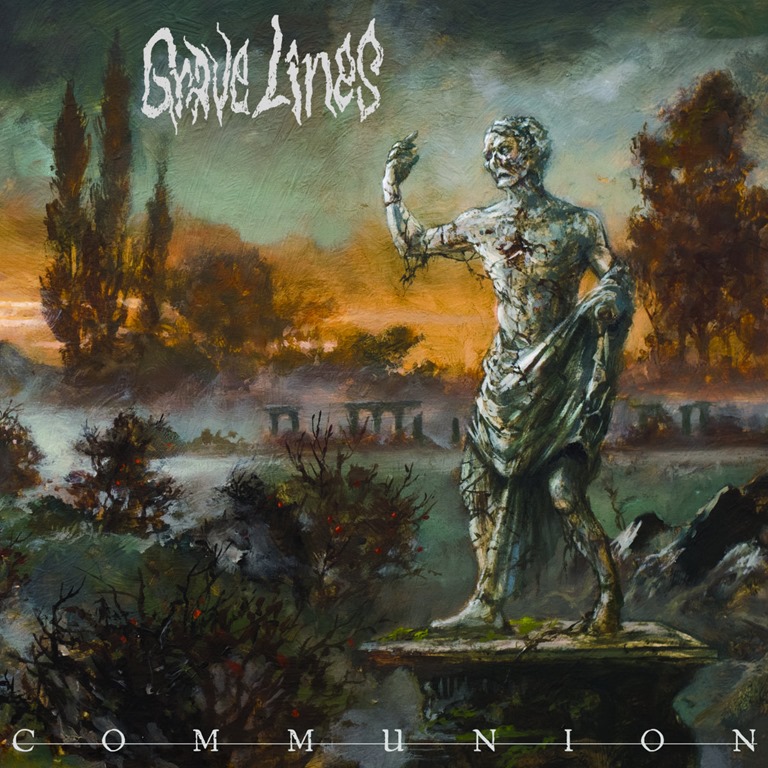
Two albums in and London’s Grave Lines, purveyors of ‘heavy gloom’ have already carved a unique niche in the myriad spheres of heavy music. Their first album Welcome To Nothing set the tone for their distinct take on doom metal, which was broadened even further with album two Fed Into The Nihilist Engine. An epic feast of hard ‘n’ heavy riffs coupled with brooding sadness interspersed with thoughtful transcendent moments of introspection.

Never a band to rely solely on trotting out those ‘doom metal’ tropes, the band began to weave in gothic and experimental elements into their music, to delve deeper into the dark shadows of the psyche.

Now with their third album Communion Grave Lines continue their exploration into the ugliness of the human condition, at the same time becoming a band that truly defies any pigeonhole.

Continuing to hone and evolve their collective vision and aided by the masterful production of Andy Hawkins at The Nave Studios, Communion sees Grave Lines creep further into the various corners of their sound.

In a nutshell Communion is a violent descent of bile-soaked intensity spiralling between filth laden swagger, and fragile mournful lament. The album delves into the internal aloneness of existence and the failings of the human connection.

Owing as much to Bauhaus and Killing Joke as it does to Black Sabbath or Neurosis, there are moments of gut wrenching doomed up heaviness and bellowing noise rock, contrasting with ambient gothic passages and a thoughtful melancholy, to a create a powerful new chapter in their ceaseless journey through the gloom. Listen to first single ‘Carcini’ now:

AA

a4278953279_10

Santa Rosa-based alternative pop artist Darwin presents his new single ‘Unkind Lover’, which features David J (Love and Rockets, Bauhaus) on harmonica, Dustin Heald on guitar noise and ambience, and producer/collaborator Julian Shah-Tayler (a.k.a. The Singularity). 

Darwin (full name Darwin Meiners) makes alternative pop with a dark, electronic feel. While rooted in the 80s, his music straddles several genres simultaneously, assimilating new ideas, processes and instrumentation into his work.

A beautifully eerie tune, this was inspired by the writing of Dani Burlison (particularly ‘Shark Week’, which is included in her book of short stories ‘Some Places Worth Leaving’).  
‘I was asked to make the music for a spoken word video written by my friend, Dani Burlison.  She had recently released a book of short stories called ‘Some Places Worth Leaving’.  I love adding music to film and was especially moved given Dani’s talent.  The short story is called ‘Shark Week’ and features a character known only as the Unkind Lover.  When I saw the final video, it struck me that it would be exciting to develop the music into a song," says Darwin. 

After getting Dani’s permission, the first person I contacted was Julian Shah-Tayler and told him the plan.  It was an inspiring song to work on sonically, but also writing in character – which I’ve grown to love.  My friend Dustin Heald is a master at getting his guitar to make wonderful noise.  He was enlisted to do just that.  The final piece was the addition of David J (Bauhaus, Love & Rockets) on harmonica.  Having been in a band with him for many years (David J & The Gentleman Thieves), I had gotten used to the sound of that instrument and I knew he would be perfect to put that final touch on it."
This new offering follows Darwin’s latest single ‘Dance Alone’, a synthtastic explosion of energy attesting to the strength of human spirit with a fun self-isolation-inspired video directed by Linda Strawberry, featuring dance clips sent in by people sheltering in place. 

Watch the video here:

AA

Darwin - Unkind Lover (cover artwork)