Archive for the ‘Singles and EPs’ Category

24th May 2020

Christopher Nosnibor

Like many artists during life in lockdown, Foldhead has been enjoying a spell of enormous creativity. Well, enjoying may not be quite the word: immersion in work for therapeutic purposes is as much a necessity as a joy, and moreover, as his recent spate of output highlights, zanntone is a highly political animal, and some recent events have sparked an ire that can only be purged through noise.

Skegdeath, released in March, served up an obliterative wall of noise against hundreds of thousands who reportedly descended on Skegness beach on Saturday 21st, the final days before official lockdown landed, against advice on social distancing. The Guardian ran a headline quoting a local dentist who said that it was ‘a disaster waiting to happen.’ It did happen, of course, and it didn’t wait long.

But that didn’t stop the government’s top advisor from doing the precise opposite of staying at home, saving lives, and protecting the NHS by driving his child, in the company of his wife who was suffering symptoms of Covid-19 some 260 miles from London to Durham to stay on his parents’ property, and taking a 60-mile round trip to Barnard Castle to check his eyesight was ok to make the journey home once they’d all recovered, despite having been barely able to walk the day before. He called it ‘reasonable’ and parental responsibility; half the country called it bullshit.

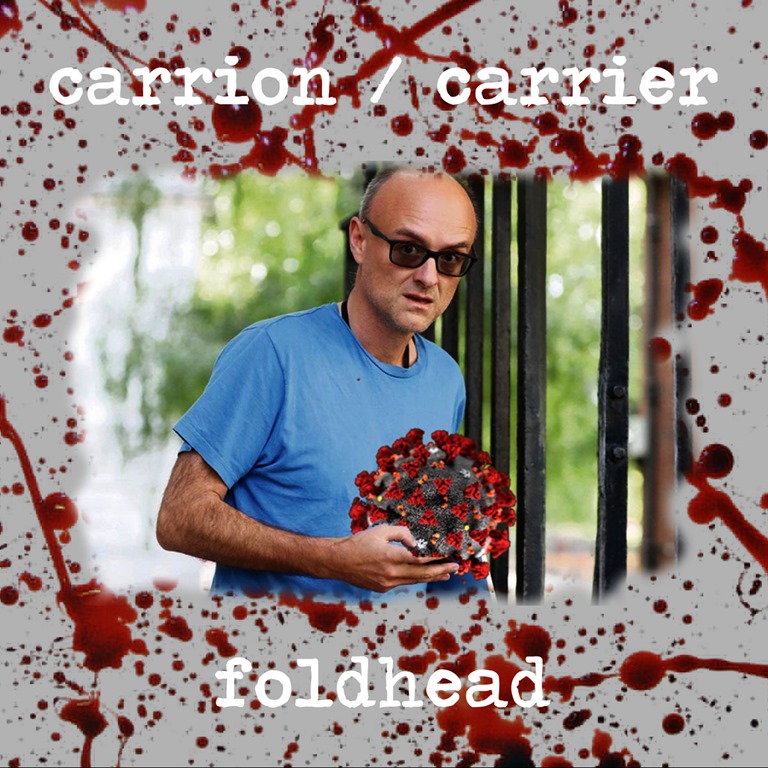
Foldhead refers to this punchy two-tracker, which would make for a neat 7” single at any other time as ‘A reaction to a piece of shit I will not sully my vocal chords by naming’, although the cover art leaves us in no doubt.

‘Carrion / Carrier’ marks one of Foldhead’s most brutal sonic assaults, five minutes of squalling, head-shredding electrical noise, with infinite layers of static and feedback and more noise on top. You can almost imagine him turning knobs so hard as to almost napping them off, and jamming down pedals and circuitry with brute force in order to channel the fury. Because nothing inspires rage like deceit and hypocrisy, apart from when that deceit and hypocrisy is so brazen and comes from a place of such self-confidence and superiority.

‘Poundshop Gollum’ is a howling, braying racket, somewhere between feedback and the anguished sounds of a dying heifer or maybe an elephant, against a backdrop of metal being crushed in a wrecker’s yard. There are fleeting moments that carry echoes of the most twisted, abstract jazz, but above all, it’s the sound of torture.

Amidst all of the outpourings of anger on social media, and even in the mainstream media, this release perhaps makes the strongest and clearest statement of all: because there are no words. The language of sound is the most articulate.

AA
a0792839942_10

1st May 2020

Christopher Nosnibor

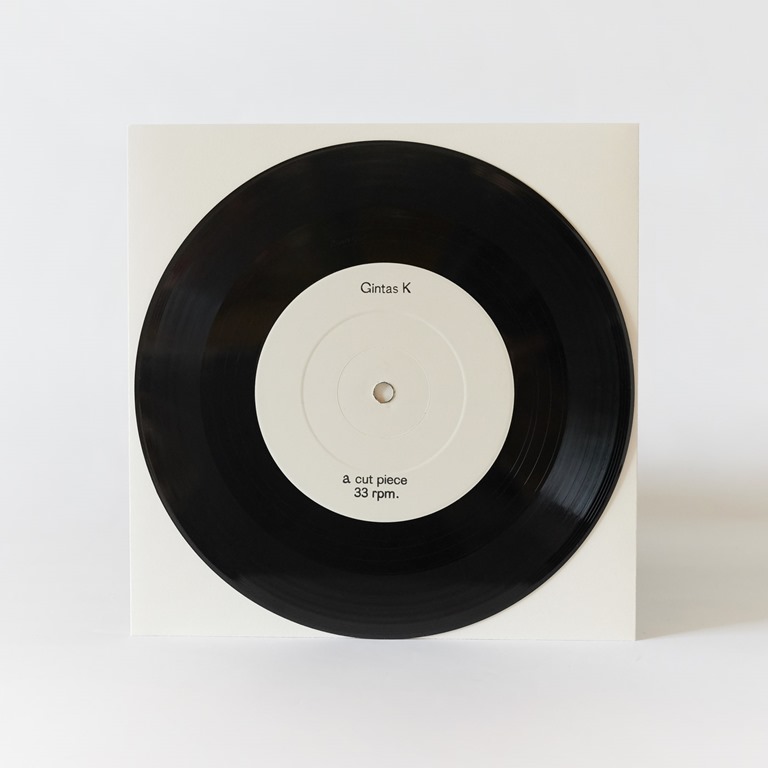
For some years now, I’ve followed Gintas K’s career with interest, for the simple fact that his work is, well, interesting, not to mention varied. This latest release is quite different from anything previous: a 7” single containing the audio, this is ostensibly a multimedia work, which finds the record packaged with a magazine, and was produced in collaboration with Visvaldas Morkevičius as an independent publishing project.

Morkevičius is a Lithuanian photographer, and the print aspect of the release comprises a series of photographs, which are the result of the artist’s visual anthropology research. K’s contribution is that of a soundtrack, as the accompanying blurb explains: ‘7” vinyl performance was made by Gintas K during the process of Visvaldas Morkevicius photographing and was added to Portraitzine as to fulfill the atmosphere in which photographs was made.’

It may be that the audio works better with the visuals, in that it fills out the understanding of both the listener and the watcher, but as a standalone work, Gintas’ two untitled works function successfully in their own right.

The sounds on side A – ‘Cut Piece’ are spare, strange, squelchy, bloopy, gloopy, fractal, disjointed, whistling, bleepy, hyperdigital. There are immense spaces between the sounds, meaning that when thumps, thuds and bangs arrive, they do with maximum impact: more than one I found myself physically jolting n my seat, having been lulled by a digital babble and spells of near-silence.

Side B, featuring the shorter ‘Uncut piece’ is mega-minimal: drips and blips punctuate three-and-a-half minutes of not a lot. And yet that not-a-lot is important: it focuses the attention, and reattenuates the listener’s attention on sound and the spaces in between. It slips and fades to nothing.

I find myself staring into space, barely aware that the ‘music’ has ended. If the ‘music’ ever really began. It’s hard to feel any real emotional or psychological connection with these snippets. But that is not their function. And ultimately, it works, and that’s the objective here.

AA

cover

Christopher Nosnibor

It’s no secret: I fucking love cheese. To the extent that it’s the single foodstuff that prevents me from being vegan, and to the extent that if I had to live on any one type of food, it would be cheese. Forget pudding, gimme the cheeseboard. In fact, scrap starters and mains, just give me all the cheese. My 4-tier wedding cake consisted of a wheel each of Brie, Stilton, Cornish Yarg, and a truckle of mature cheddar. So I kinda feel that Chronic Johnny’s debut single is a song that should appeal, regardless of actual content.

Harrogate may not be an obvious place to spawn a ‘wild noiserock trio’ like Chronic Johnny, but on reflection, it makes sense: it’s a lovely, leafy, middle-class market town close to York. What could possibly spur a bunch of guys to make angular, guitar-driven racket, the sound of anger and frustration in a setting like this? Well, precisely a setting like this. There’s always something to rebel against, always a reason to feel disenfranchised. And always a reason to make noise.

And Chronic Johnny make a cracking noise of a decidedly 90s alternative vintage, all spiky, overdriven guitars that jerk and jolt, and peppered with a substantial dash of rockabilly / surf spice, not least of all in the manic, yelping vocals. It’s such a frenetic, hybridized racket that comparisons are pretty pointless; it’s more that this furiously dirty din, driven by a growling, busy bassline, draws together the essence of a period in time, and drags it, squalling and brawling into the present. It’s gnarly, and it kicks ass.

Cruel Nature – CN133

Christopher Nosnibor

It’s not often demo tapes get a ‘proper’ release. Then again, it’s not often you actually get demo tapes these days: cassettes may be making something of a comeback on the underground, but you’re more likely to get a demo recorded on mobiles with the tracks assembled using some smart software than on a four track. I remember my old Fostex X-18 seeming incredibly compact back in ’92. Less true of the X55, but with its double-speed spooling and advanced mixing capability, it was more like having a proper studio on your desk. How times have changed.

But when it comes to black metal, low-grade production is integral to the aesthetic. It’s supposed to be impenetrably murky, the songs emerging from a booming condenser mic recording overloaded with volume, crackle, and hiss.

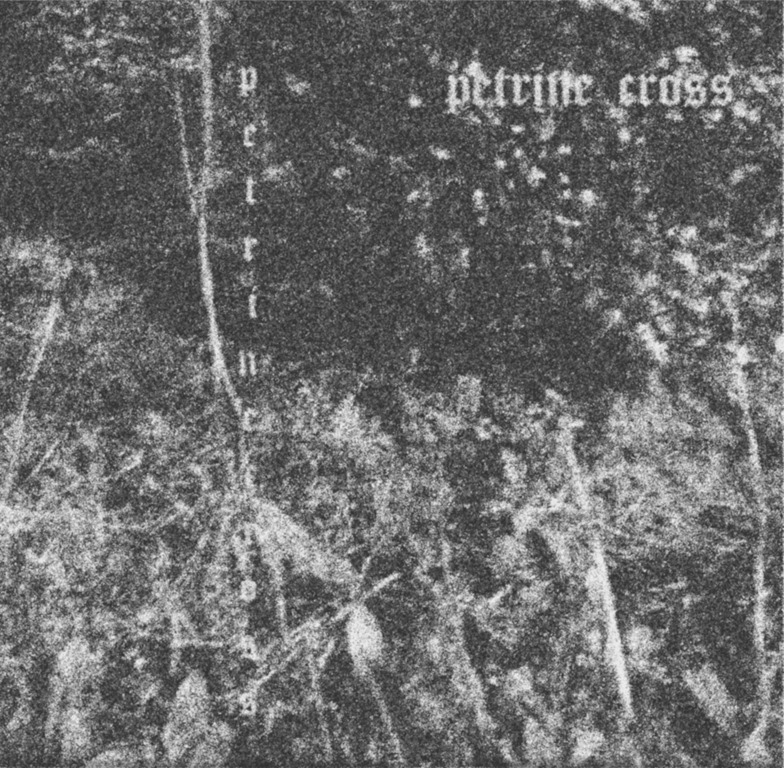
I was fortunate to catch Petrine Cross virtually live at a Heinous Whining streaming event the other week, and it was devastating: I was blown away by the dark intensity of the performance, and this release confirm this was no one-off or a case of me being carried away with too many cans in my atempt to recreate the gig experience at home.

A solo project for Esmé Louise Newman of emotionally-charged black metal duo Penance Stare (and her resumé is pretty impressive too), Petrine Cross is pitched as ‘Thought-provoking raw ambient black metal, inspired through solitude and literature, that hits hard in all its oppressive glory.’

‘Charred Skirts and Deathmask’ could be read one of a number of was, but it begins with a soft-edged undulating drone, which continues throughout its eight-plus-minute duration beneath a crushing deluge of punishing guitar noise. There are no discernible chords, no clear structure, just a full-on deluge of sludge. There are some vocals in there somewhere, too, I think. I don’t need the details, and that’s perhaps as well, as they’re obfuscated by a dense wall of undifferentiated sound that’s all in the mid and lower ranges.

I’m listening by candlelight and screen glare, and it seems appropriate as the snarling blast of ‘I Beneath a Rougher Sea’ tears from the speakers, a muffled, murky blast of a cyclical chord sequence, overloading with distortion. It takes some time for any form to emerge from the searing sonic wall, and when it does, it’s vague, melting in its blisteringly intense grind.

The recordings may be primitive, but I’m not sure they would necessarily benefit from a more luxurious, layered studio treatment. The context is key: this is black metal – albeit in a stripped-back, ambient form – and doesn’t require polish. These recordings are cavernously dark and dredge the depths of the soul. Search deep.

AA

cover

Christopher Nosnibor

Here in Britain, sophomore is such a music journo word: because of the structure of our education system, it simply doesn’t occur in any other context. The fact the same is true in Australia perhaps makes it an odd choice of name for an Australian band, but one suspects there’s a degree of knowingness around this, paired with the fact that the band is essentially a second project for noisy alt-rock duo Mannequin Death Squad, which sees Elly and Dan joined by Vanessa and Shelly in a quest to pursue a slightly more indie / pop direction.

‘Social Distancing’ is, as you might expect, another in a blizzard of recordings inspired by current events – or, indeed, non-events, as the days melt into one another – but does stand out as being particularly good. Maybe I’m biased; maybe it just resonates: it’s not the virus that’s putting me in a psychological spin, but news and social media, through which the landscape changes by the hour.

‘I can’t breathe / with all this information thrown at me’, are the opening lines, and it pretty much encapsulates the experience a connected digital society in which everyone has an opinion and data overload is more of a syndrome than something theoretical. I feel that communication with even me closest friends is becoming increasingly difficult as we all become zombified by bewilderment.

From a quiet, picked guitar intro, in classic grunge style, it breaks into a big, guitar-driven chorus, but the guitars chime rather than drive, and the vocal harmonies are so sweet as they advise ‘don’t listen to the radio /don’t listen to those TV shows’. I’ve been feeling the pain of government disinformation a lot lately, and much as keeping informed is useful, I’m beginning to question the validity of the exercise. But the real crux comes near the midpoint on the refrain ‘and the lonely get lonelier’ and it lands hard. Because it’s true. We all feel isolated to varying degrees, because we are, literally, in isolation – but some are more isolated than others.

Stuck indoors with your family may be tense and torturous, and only having text or Skype or similar may be a woefully weak substitute for human contact, but what about those without any of these things? The sentiment is touching, and it’s also a belting tune, that ultimately lands like The Pixies doing anthemic.

AA

a3183615244_10

4th May 2020

Christopher Nosnibor

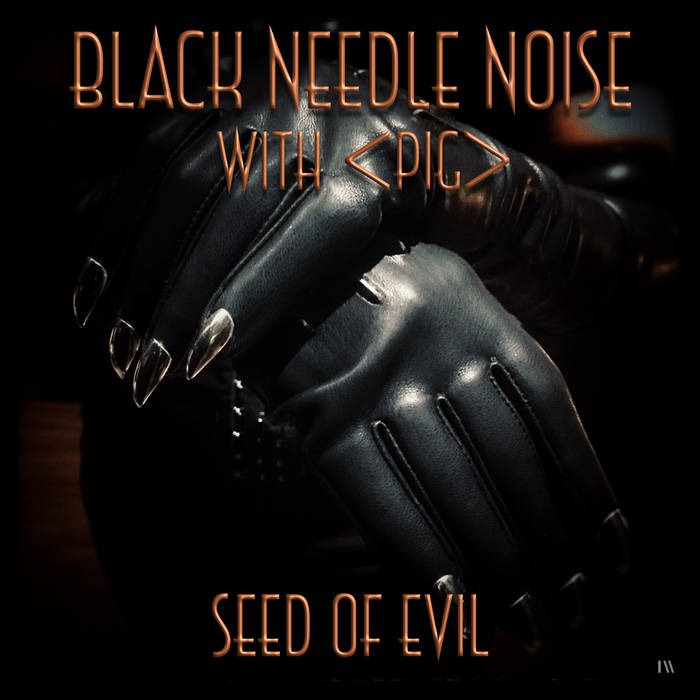
Having just completed a major tour with 3Teeth, which found Raymond Watts and co performing live in the UK for only the third time in their 30+ year career, PIG announced a new EP for release in June. And then, seemingly from out of nowhere, this landed at zero notice – a collaboration with John Fryer, who the press release reminds us is a ‘legendary producer and artist in his own right’ (and there is no escaping the fact his resumé is beyond incredible), the form of ‘the latest offering from his Black Needle Noise project.’

When it comes to both BNN and PIG, ‘industrial’ feels too limiting a term for artists who’ve expanded the territory with a rare imagination, not to mention a sense of grandeur, equally matched by a certain postmodern knowingness, humour even, particularly in the case of PIG.

For all the US and mainland European leaning of the genre, it’s perhaps the Englishness of these two artists which sets them apart and makes them stand out. It’s difficult to pinpoint, but it’s a factor.

‘Seed of Evil’ is a proper technoindustrial banger that’s reminiscent of Nine Inch Nails circa ‘92 and, er, PIG from around the same – the time when they toured supporting NIN on their Downward Spiral tour. It’s all in that distorted digital snare sound that sound like ‘Reptile’, the bubbling bass synth, the, cyclical repetition.

Even its very title revels in cliché and its seedy to the core, as Watts delivers a quintessentially grimy vocal, part gasp and part growl, over a gut-trembling synth bass, and it all explodes into a stomping chorus. In short, it’s got the lot. Get down.

AA

AA

a2272207802_16

5th June 2020

Christopher Nosnibor

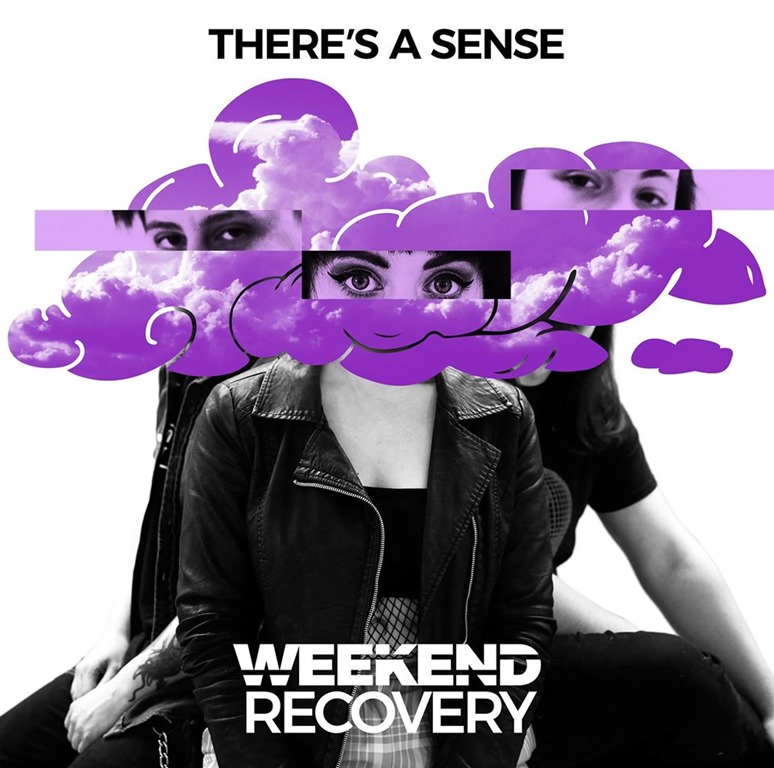
I’ll spare you the retreading of old ground here, but Weekend Recovery’s evolution is one I’ve personally charted over the last few years, and debut album Get What You Came For confirmed their full transition from slick melodic alt-rock act to purveyors of fiery grunge / punk. They never lost their focus on melody, for all that, and ‘There’s A Sense’, which gives a second taste of album number two, False Friends pitches the melody very much to the fore.

‘There’s A Sense’ is ostensibly a three-minute pop tune. The guitars are a choppy, trebly, and provide a spiky backdrop to Lori’s buoyant, almost bubblegum vocals that bounce along so, so easily.

‘Tell my friends I’m coming down / and I can’t promise I’ll be back around’ she sings in the breaks when it all slows for a moment. Those slumps are relatable, and for all the bouncy and immediate tuuuuune that this blast of ebullient popness gives us, the truth is that there’s always darkness beneath the surface.

Weekend Recovery continue to expand their range, and deserve to one day rule the world.

94262001_1628072650665466_2864891298379202560_o

15th April 2020

Christopher Nosnibor

Argonaut offshoot Videostore have swiftly established themselves as a DIY act who can kick out solid tunes in no time at all, and as having embraced the immediacy of the technology at their disposal to write, record, and release tunes in the space of a week.

Under life on lockdown, many bands are taking to the net to pump new output direct to fans, but Videostore, having already adopted the model, are ahead of the curve, and their latest single, ‘Building Breaking’ is exemplary: a buoyant blast of overdriven guitars that fizz in choppy bursts over a vintage drum machine, it’s the pinnacle of punk.

The cover at reminds me of various scenes I’d observe on my walk to work up until a month ago: regeneration gentrification; so often change for change’s sake, collapsing new buildings. I made it something of a project to photograph all the cranes and diggers, scaffolding, tarpaulin and holes. I intend to actually use them for something one day. Meanwhile, Videostore have tied this image into a commentary on the constant state of flux that’s come to define out cityscapes with a constant programme of demolition and (re)construction… but for what end?

The accompanying home-shot-video is simple but effective, and the fact they pack some sweet harmonies and a neat hook into just 54 seconds is beyond impressive.

AA

AA

a0360849039_10

Blang Records – 28th February 2020

It’s a strong title, and that’s a fact. There’s a vividness, a visuality, and a physicality to it that gives it a rare impact. Turns out that this single – the title track from their upcoming album – which is pitched as ‘a furious reverb-drenched and darkly caustic song lamenting a culture of hate and envy that has led to the dehumanisation of refugees, and the disturbing rise of the far-right’, is very much everything that captures the zeitgeist.

It’s got all the edge, and it’s nailed to a stomping single-string riff and goth/glam drum beat and a textural rhythm guitar that’s pure Bauhaus. It dismantles all the anguish of life lived under late-period capitalism and in the all-consuming machine that is social media, the fact money dominates every corner of our lives and the way the need to pay the mortgage saps your soul and steals your life.

Combining nihilism and fury and welding it to a post-punk angularity, ‘Crush My Chest With Your Hate’ has bags of edge, and exists in the same space as Arrows of Love – and with the pricking tension of this release, The Reverse give me the same kind of buzz. Ones to watch.

Christopher Nosnibor

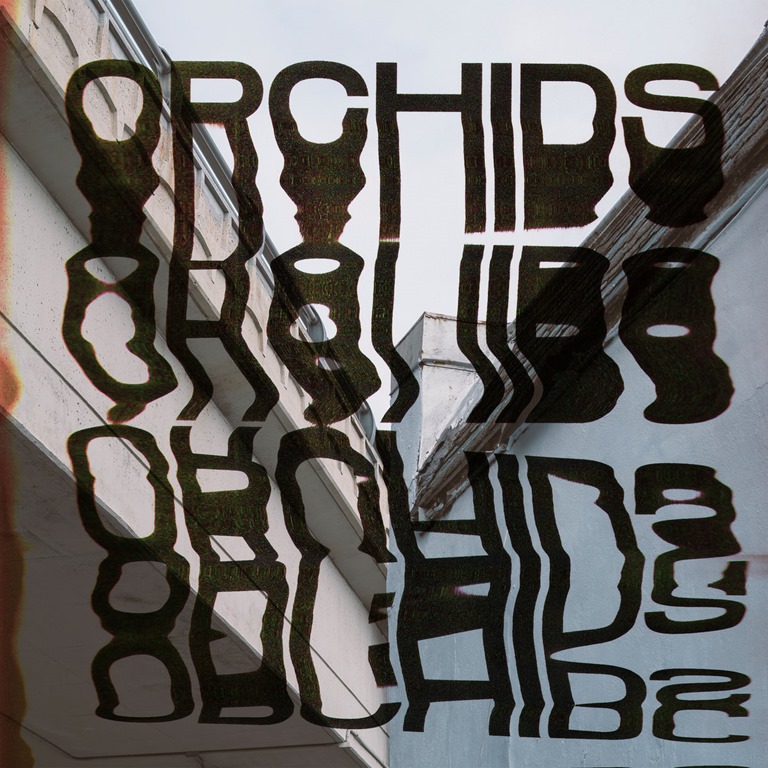
Word-fads come and go, and I’m as guilty as the next music journo hack-merchant of repetition and overuse, but I’ll make no apologies here, since this 7” revisits the early 90s zeitgeist with a breathtaking accuracy. Yes, I used both ‘zeitgeist’ and ‘breathtaking’ and I hate myself for both. But what I don’t hate is this release by Orchids.

This is a blizzard blur of vintage shoegaze noise, with ‘Dead Keys’ abrim with angling guitar and epic reverb and all the FX, with the result being a melt-together of early Ride and The Charlatans with latter-day exponents of psych-tinged shoegaze like The Early Years.

They whip up some blistering walls of noise across the two tracks here, while also delving into some spaces of motoric indie as guitars burst all around.

‘Another Day’ follows a similar template, a motoric beat and thudding bass groove underpinning a repetitive guitar line that rattles away in a wash of reverb, and it plugs away at that thing that it does for a hypnotic four and three-quarter minutes, to hypnotic effect.

AA

Orchids