Archive for the ‘Reviews’ Category

Christopher Nosnibor

It doesn’t get much more goth than a gig in a graveyard. Through the wrought iron gates, the approach to the chapel, the venue for tonight’s performance, is set either side and as far as the eye can see with headstones. Fulford cemetery is immense. The chapel is an appropriately imposing building: designed by James Pigott Pritchett and completed in 1838, it’s a grand neoclassical structure and considered possibly one of the greatest cemetery chapels in the country, with huge doric columns outside, while its interior, white with gilt trimmed faux-pillars which only accentuate the incredibly high ceiling is spectacular to behold.

The room – a neat oblong – is packed out with a broad array of people, but there’s a strong showing of what I’d call Whitby goths, that is to say, the kind who dress to impress rather than your biker jacket and boots type. There’s a lot of lace, silk, and taffeta to be seen, meaning that for once I feel rather less conspicuous sporting a knee-length velvet coat. But equally, the audience is notable for its broad spectrum and diverse demographic, and while details of the event in advance had been purposefully scant, there is clearly a keen interest for something different, and not specifically in York. There are people who have travelled to be here tonight.

The bar, such as it is, is offering red and white wine, bottles of Stella, and Coke, and taking a seat toward the back – the front ten rows were full and by the time the lights go down, leaving the space illuminated by mellow candlelight, the seats are pretty much all occupied. It’s pleasing to see, especially knowing that this event coincides with the annual nighttime walk for cancer, and a metal gig not five minutes up the road.

First, we were treated to some operatic vocal accompanied by piano. It’s not only exquisitely performed, but it’s absolutely perfect for the setting. And in this moment, it becomes crystal clear that this is going to be an event like no other. To describe it as an evening of culture would be to downplay all of the other music events and spoken word nights and more on offer, but when it comes to high culture, there’s most certainly a gap – but the greatest gap is in events which bridge the divide between your regular gig and a night at the theatre or the opera or a night at the proms. This, however, is a superbly curated event which achieves precisely that.

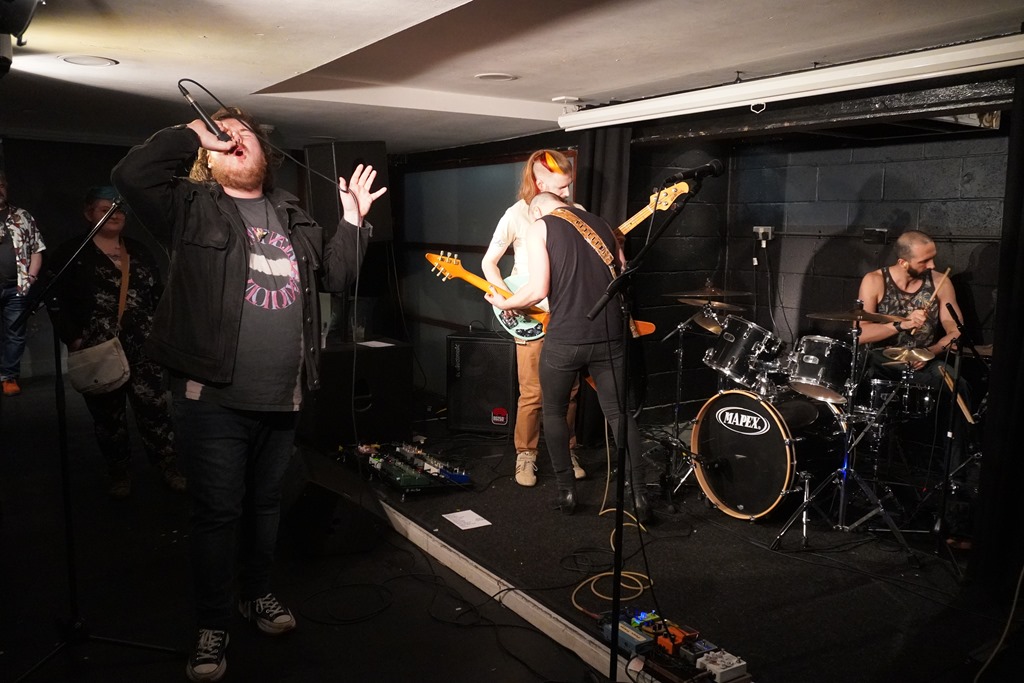
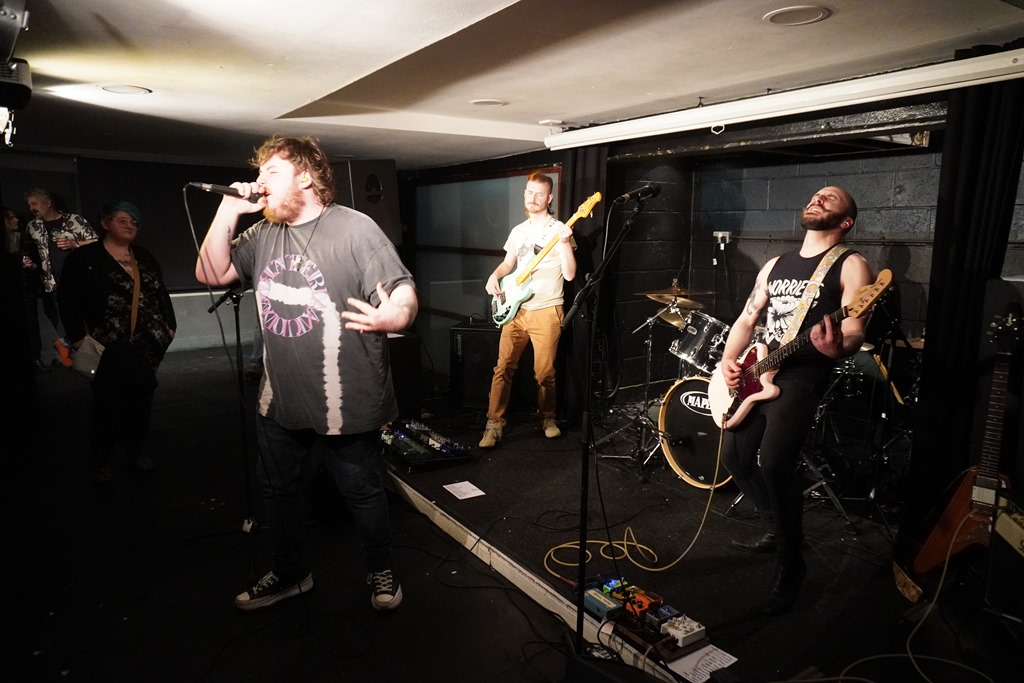
Immediately after this introduction, host and co-ordinator Stephen Kennedy leads an ensemble consisting of bass guitar and percussion through a set of three songs, starting with a brace of deep cuts from Fields of the Nephilim’s catalogue, with ‘Celebrate’, and then ‘Requiem’ from Mourning Sun, with the trio joined for the second two songs of their set by a cellist who remains on stage to play a solo set after. Kennedy’s vocal is strong, and he really does a remarkable job of reproducing Carl McCoy’s gravel-heavy growl.

DSC00069

After a handful of cello instrumentals, Kennedy returns to the stage – although technically it’s the floor, but wonderfully lit – to provide vocal accompaniment to her graceful strings.

The switches between performers are near-instantaneous, with no announcements as to who’s who and no-one informing us who they are. There is a programme available at the merch table, but in a way, the individual credits feel of little import: this is very much a collective work, an ambitiously grand collaboration, striving to create a unique experience of an ever-shifting sonic smorgasbord. Individual names and egos are put aside in the name of this being Gothic Moth. There’s harp – moving – and powerful, and an emotive vocal while makes for a stirring performance, which is rapturously received, a solo acoustic-guitar led performance with folk-hued vocals, before the first half of the evening is rounded off with a piano and tenor recital, Benjamin Staniforth’s impressive voice matched only by his impressively voluminous leather trews.

DSC00093

If the second half offered more of the same, with some of the performers getting a second set, it also gave us a while lot more. During a longer harp and voice set, the rendition of Metallica’s ‘Nothing Else Matters’ was a clear standout of the night, but then again, Iryna Muha’s Ukrainian folk performance, with acoustic guitar – with some effects to really fill out the sound – and hurdy-gurdy was mesmerising, and was equally well received.

DSC00094DSC00108

After a clarinet interlude from a man in a hat and long coat (there are a fair few of those this evening) who turns out to be Ian Karlheinz Taylor from Skeletal Family, Taylor moves to the keyboard and the full band return for a magnificent and moving rendition of The Mission’s ‘Sweet Bird of Passage’ followed by ‘Island in a Stream’. Close your eyes and it could be Wayne Hussey dinging: Kennedy, it seems, is truly a vocal chameleon, bringing the night to a close with a remarkably close approximation of Ian Curtis on an impressive version of Joy Division’s ‘Atmosphere’ – something this event had in copious amounts.

DSC00121

Stephen Kennedy needs to take a bow: this, the first Gothic Moth event, was an incredibly ambitious coming together of a staggeringly eclectic range of artists, and many of those collaborating hadn’t even met one another until the day. This is unquestionably testament to their individual and collective talent, but also to Kennedy’s aptitude as a curator in bringing them together. Everything about this evening was stunning, and it’s pleasing to see future events are already being booked, filling a niche few knew even existed.

Cruel Nature Records – 27th September 2024

Christopher Nosnibor

The scene of microlabels will always give you something absent from the mainstream. I mean it’ll give you many things, but I’m talking about variety. We live in the strangest of times. Postmodernism brought simultaneously the homogenisation of mainstream culture and the evermore extreme fragmentation of everything outside the mainstream. And example of that fragmentation is the existence of Cruel Nature Records, who operate by releasing albums digitally and on cassette in small quantities. Further, the second album by Deep Fade, is typical, released in an edition of forty copies. It’s better to know your audience and operate on a sustainable model of what you can realistically sell, of course, but do take a moment to digest the numbers and the margins and all the rest here. It’s clear that this is a label run for love rather than profit.

The sad aspect of this cultural fragmentation is that so much art worthy of a wider, if not mainstream, audience simply doesn’t get the opportunity. Not that Deep Fade have mainstream potential, by any means. As evidenced on the seven tracks – or eight, depending on format – tracks on Further, Deep Fade are just too weird and lo-fi for the mainstream to accommodate them. They simply don’t conform to a single genre, and with tracks running well over eight minutes and often running beyond the ten-minute mark, they’re not likely to receive much radio airplay either.

Opener ‘Tidal’ is exemplary. Somewhere during the course of its nine minutes it transitions from being minimal bedroom pop to glitchy computer bleepage to a devastating blast of messed-up noise. Yet through it all, Amanda Votta’s vocals remain calm and smooth as she breathily weaved her way through the sludge. The twelve-minute title track veers hard into wild Americana, a mess of country and blues and slide guitar, before tapering into fuzzed-out drone guitar reminiscent of latter-day Earth. Amidst trudging drone guitar, thick with distortion, it’s hard not to feel the lo-fi pull.

We’re immensely proud to present an exclusive premier of the video for the mighty ‘Tidal’:

AA

‘Surge’ arrives on a raw metallic blast before yielding to a spacious echo-soaked guitar drift and some dense, grating abstractions. Texture and detail are to the fore on this layered set of compositions are by no means easy to navigate.

As the band explain, ‘The album, influenced by Neil Young and Einstürzende Neubauten, was recorded across various locations including St. John’s, Providence, Liverpool, and Edinburgh. Environmental elements play a significant role, with guitars recorded during a nor’easter and vocals captured at lighthouses, incorporating natural sounds like wind and bird calls… Toronto’s Church of the Holy Trinity and the Cowboy Junkies’ The Trinity Sessions also influenced the album’s sound, adding to its atmospheric and melancholic feel.’

Atmospheric and melancholic it is, although many of the aforementioned touchstones aren’t easy to extrapolate from the mix. Nevertheless, and you feel your stomach enter a slow churn, which is exacerbated by the low-gear drones which sound like low-circling jets – there have been a lot of those lately and the air is filled with paranoia and mounting dread right now. Further, however not only provides a sonic landscape that matches this mood, but runs far deeper into the psyche.

The acoustic ‘Little Bird’ scratches and scrapes over a fret-buzzing acoustic guitar. The fifteen-minute ‘Heartword is simply a mammoth-length surge of everything, occasionally breaking down to piano and deep tectonic grinds.

It’s fitting that Deep Fade should call their second album Further, because this is where they take things. At times it’s terrifying and at times it’s immense.

The lyrics are as breathtaking as the crushing bass on ‘Wake Me’, and the sparse arrangement of closer ‘Fixed and Faded’, with its breathy, folky vocal and crunchy overdriven guitar which drones, echoes, and sculpts magnificent spares from feedback and sustain, brings a sense of finality and offers much to digest.

The digital version includes an additional track, another monumental epic in the form of the eleven-minute ‘Hawk’, a work of haunting, spectral acoustic country: it’s one hell of a bonus worthy of what is inarguably, one hell of an album.

AA

a1741881484_10

Reptilian Records – 4th October 2024

Christopher Nosnibor

It’s remarkable how quickly the future can become past. Take the Wikipedia entry for God Bullies for example. It closes with the statement ‘God Bullies are slotted to record a new album at Steve Albini’s Electrical Audio this April set for a September 2024 release on Reptilian Records followed by touring In the US and Europe.’

The album recording happened, and here it is, but Steve Albini isn’t – just a month after the recording of this album, and the week of the release of the latest – and now last – Shellac album. Life has a habit of throwing unpleasant surprises – something I have first-hand experience of in the most devastating of ways.

It’s been quite the year for long-dormant bands crashing in with new releases, and certainly not only Shellac – the Jesus Lizard recently dropped their first album in twenty-six years, which is staggering. And it’s a belter, as, indeed, was Shellac’s To All Trains. God Bullies certainly sit in the same bracket, as purveyors of noise rock in the 90s and aligned to classic labels Amphetamine Reptile and Alternative Tentacles. Active between 1986 and 1995, they reconvened in 2010 for the Amphetamine Reptile Records’ 25th Anniversary concert.

But that was fourteen years ago, and it would remiss to ignore the fact as part of a balanced review that there’s some dispute over this release, because, as we know, bands have a habit of falling out, and it’s widely documented how there have simultaneously been two versions of Fleetwood Mac, of Hawkwind, among others.

Bassist Mike Corso, who runs the God Bullies website explains that ‘Mike Hard and his long time band “Thrall” have chosen to illegally co-opt the God Bullies Trademark in an effort exploit its legacy in hopes of fulfilling their delusional dreams of hitting it big. And the truly sick fact is that on numerous occasions they’ve held out that they are doing it in the name and spirit of our fallen comrade, David Livingstone… Mike Hard and his band Thrall have recently recorded a CD and plan on fraudulently release it calling it the God Bullies. A little back story here. The fact of the matter is that in 2002 the actual God Bullies (Adam Berg drums, Mike Corso Bass, Mike Hard Singer, David Livingstone guitar) have had a 10 song CD with all the drum and bass tracks recorded. All that was needed was for Livingstone and Hard to do guitar and vocal tracks to complete the project. You will see numerous times mentioned about completing that album. While finishing that album was mentioned many times, completing the God Bullies album was evidently never a top priority for either Livingstone or Hard.’

And so it seems we have two different perspectives on the ‘real’ God Bullies. It’s true that this is not the album the band recorded the bones of in 2002 that never made it over the finish line. But As Above, So Below certainly does feature vocalist and founder member Mike Hard, but not bassist and founder member Mike Corso. And guitarist David Livingstone sadly died in February of last year, an event which was always going to make any subsequent activity… not quite the same. Corso says it’s not a God Bullies album… but it’s here as a God Bullies album, and, well, it sounds like one. That is to say, it’s gnarly, mangled dirty noise-rock that is quintessentially of the sound of Amphetamine Reptile and Touch ‘n’ Go in the 90s, which saw God Bullies sitting alongside a host of bands including the Jesus Lizard, Tar, Guzzard and countless others who have largely been forgotten by the majority.

Sidestepping any interpersonal wranglings between (former) band members, on its own merits, As Above, So Below is a cracker. It’s a raging, roaring tempest of noise, blurred, slurred, dingy, dirty, and vaguely demented and delirious. The riffs rage and tear savagely, and As Above, So Below is a brutal, scuzzy blast of raucous noise and rabid, manic vocals.

‘Help’ is a twisted classic and finds Hard yelling and hollering like a man possessed, while ‘You Never Know’ is more brooding and overtly contemporary goth. ‘Love’ sounds like the kind of love that will likely end in strangulation, with a hookline of ‘You call this love?’ hollered over a larynx-vibrating bass snarl. In fact, everything snarls and grinds on every track.

No doubt fans will be riotously divided on this release, and that’s understandable. But objectively, As Above, So Below works as a classic example of the ferocity of God Bullies. It may not quite be the comeback album it’s been pitched as, featuring as it does more members of Thrall than it does original God Bullies, and I’ll leave it for the band and fans to fight that one out. Sidestepping all of the stuff, As Above, So Below is a brawling dingy blast of noise and it kicks some serious ass.

AA

a3399313706_10

Discus Music – 27th September 2024

Christopher Nosnibor

One way to tell an avant-garde musical work from its title alone is when the title provides a quite precise statement relating to its compositional nature. And so it is that this collaborative set of songs by Keir Cooper and Eleanor Westbrook are structured around guitar and voice.

‘Willow Tree – A Dialogue’ takes the interesting form of – perhaps not surprisingly – a dialogue of sorts, in which Westbrook’s adopts two contrasting modes of delivery, with a spectacular operatic aria juxtaposed with a spoken-word interrogation as a counterpoint. The effect is closer to a simultaneous internal monologue running across the song itself rather than a dialogue in the conventional sense. Meanwhile, the delicately picked neoclassical guitar is subject to interruption by clunks and distortion and occasional whirs and bleeps and the operatic vocal strays off kilter and the dream which drifted in twists and flickers with darker shades: not pronounced enough to be truly nightmarish, but unsettling.

The pair continue to explore the contrasts of melody and disharmony as Westbrook squeaks, squawks, trills, and purrs an infinite array of vocal gymnastics and Cooper’s guitar work, which chimes and treads delicately from folk to flamenco via classical streams, stamps on its own beauty with sudden and unexpected stops and stutters and forays into wrongness with stray notes and dissonance.

‘Superstar’ strays into the space which soundtracks a sense of derangement, the territory where things make no sense, and that place of incomprehension instils an unsettling confusion that borders on anxiety. ‘Modern Translation’ follows a similar trajectory: it’s a piece of magical neoclassical chamber music that’s twisted as if performed in an auditory hall of mirrors. Everything is wrong: something that should be soothing and beautiful is warped in a that it becomes unheimlich, eerie.

It’s hard to locate a touchstone or reference point for this: perhaps there are elements of later Scott Walker present, blended with hints of The Ex with its more avant-jazz leanings. One can only muse as to how they came to create this work: despite its clear foundations in the realms of classical and opera, Star Quality ventures so far from this path that it often bears little resemblance to any given style. The pieces evidently do have quite detailed and complex structures, as there’s nothing haphazard or uncoordinated about the way the two play together, but it’s impossible to decipher them from an outside perspective.

There’s a grand yet ethereal theatricality to ‘Bordering the Afterworld’, and ‘O’ soars and swoops and squeaks and whoops its way theatrically – and somewhat crazily – across some sprightly, if vaguely gothic-sounding guitar picking that suddenly, from nowhere, begins to buzz and thump. ‘The Time I Gave Up the Stage’ draws the curtain on an incredibly curious and as far off the wall as is imaginable.

Star Quality clearly has theatrical inspirations and aspirations, but shows two artists who are more interested in exploring their outer limits than taking the limelight in a mainstream setting – and for that, I applaud them.

AA

a1210959813_10

Kalamine Records – 14th September 2024

Christopher Nosnibor

Whether it be solo works ranging from ambience to classical, or collaborations running the full gamut in the electronic field, Deborah Fialkiewicz’s output in recent years has been nothing short of prodigious, and spanning as many forms as her work does, there is never a dull moment. This latest work, under the POOCH moniker, in collaboration with Dan Dolby (Bassist in Mastiff, Noisemonger in Catafalque and Sulphur Nurse) is no exception. It offers a set of eight dark, stark electronic compositions which owe a considerable debt to early industrial and electronic works, bringing a combination of dark atmospherics and nagging beats. Although entirely instrumental, we’re in the kind of territory occupied by the likes of Cabaret Voltaire, Test Dept, and Chris and Cosey’s Trance.

As an opener, ‘Hades’ is as dark and subterranean as the title would suggest, a bleak, murky pulsation squelching around and leading the listener down, down, down. It serves as something of a primer, a mood-setter, but doesn’t fully prepare one for the altogether steelier, starker, more rhythmic and percussion-driven pieces which follow.

The title track pairs a dense, dirty bass with clattering, metallic percussion which assails the mind like a concerted assault with the contents of a cutlery drawer, and it bashes away relentlessly for four and a half minutes straight. On paper, it might not sound much, but as an experience, it’s pretty hard-hitting. Built around short, clipped repetitions, it creates a suffocatingly claustrophobic aural space. The word ‘pooch’ evokes a cuddly companion, something friendly, but there’s nothing cuddly or friendly about this, a listening experience closer to being whipped with a chain than fussing a canine buddy.

Each composition bears a one-word title (‘GameBoy’ being a forced blend-word (it doesn’t really qualify as a portmanteau) in order to maintain the theme. Funtime bit-tunes are bent with glitches and warping drifts of darkness here, before things begin to slide further into beat-orientated minimal techno.

The steady beat which dominates and defined the spartan ‘Quazar’ is almost soporific: the track assumes something of a background position as it clicks along nonchalantly, with a low, unshifting drone hovering just around the level of register. Nothing happens. It doesn’t need to. And while the thunder which heralds the arrival of ‘Midnite’ might initially serve as an alert, the piece soon melts into abstraction. The final track, ‘Stimpy’ may be missing Ren, but hits hard, built around a strong, thudding beat and looped electronic undulations.

For all of its cuddly connotations, Pooch is a pretty dark album. To my mind – and it could be to my mind alone – music which is heavily beat-orientated and instrumental feels impersonal somehow, and I find it somewhat disorientating, disconnecting, alien. And so it is that the pounding beats of Pooch leave me feeling somewhat dazed, detached, even dizzy. But it’s impossible to deny the detail, the quality of the execution, or the fact that this is an outstanding work.

AA

cover

Christopher Nosnibor

Well, this one landed unexpectedly. It’s a welcome arrival, although taking a second hit of material from Uniform’s latest and quite possibly most brutal and challenging album to date does feel like an exercise in Masochism. It’s also a superb example of alternative marketing, landing this alternative version of American Standard less than a month after the album’s release, on digital and tape formats.

Context, from Uniform’s bandcamp: ‘A companion piece to American Standard, Nightmare City is essentially the same record devoid of the rock elements. By removing the presence of traditional instruments, the synths, lap steel, and pianos that sit beneath the surface of the proper album are allowed room to breathe and speak for themselves. The end result straddles the worlds of Basic Channel influenced dub, Tangerine Dream inspired soundscapes, and brutal death industrial.’

It’s a bold move, befitting of Uniform, a band who have relentlessly pushed themselves to explore ever-wider horizons, switching from their original drum-machine driven raw industrial noise to adopting live drumming, undertaking a number of collaborative projects with the likes of The Body and Boris, and especially befitting of this album, where Michael Berdan tore away the last vestiges of artistic separation to rip off his skin and purge the rawest emotions stemming from his dealing with Bulimia.

Nightmare City is another step towards stripping away the layers and presenting the naked self. ‘The bedrock of American Standard stands upon the Nightmare City. It’s not the happiest of all places, but understanding the landscape yields its own rewards,’ they write alongside the Bandcamp release.

One thing about being in a band – even if there are only two of you – is that there’s somewhere to hide, somewhere to transfer the focus. Hell, even performing solo, if there’s noise, there’s something take shelter behind. I’ve always thought that solo acoustic and spoken word performers were the bravest: there is simply no place to hide, and nothing to blur or mask any fuck-ups. Nightmare City isn’t quite solo acoustic, but it is seriously minimal.

Removing the ‘rock’ elements to reveal the bare bones of the songs shows the inner workings of Uniform, and they’re unexpected, to say the least. One would expect them to build up from the elements of drums bass, guitar. But this leads us on a different journey.

Punishing riffs and pulverising percussion, rather than supple layers and swirling instrumental ambience. As the band put it, ‘Although the finished product stands as a culmination of cohesive sounds, the individual threads that weave songs together often provide necessary nuance and exposition all of their own. Each isolated stem might be part of a greater story, but the whole cannot stand as intended without a complex series of seemingly disparate elements.’

Hearing the swirl of these ‘seemingly disparate elements’ feels like hearing the ghost in the machine, a haunting, eerie, ethereal echo, which barely seems to correspond with the structured framework of the final versions of the songs. One might almost consider this a palimpsest, an album beneath the album, submerged by process of layering and erasure. The tracks are – and I shouldn’t be surprised, but still I find I am – completely unrecognisable. Instead of being the punishing beast the album version is, ‘American Standard’ sounds more like one of the epic instrumental segments of recent SWANS works. There’s a muffled thud like a heartbeat on ‘This is Not a Prayer’ which possesses something of a womb-like quality, while ‘Clemency’ feels like a moment caught between heaven and hell, soundtracking the struggle of being pulled between the two in some purgatorial space as ceremonial drums hammer out a doomy passageway and spluttering vocals spew raw anguish.

In common with American Standard is the darkness which looms large, the tension, the suffocating gloom, the discomfort which dominates, and hearing this spectral echo of the album brings a fresh understanding and appreciation of the process and the depth of layering and everything that goes into their material. ‘Permanent Embrace’, too, sounds both like an ascent to the light and a sepulchral sigh, a funereal scene in which the grave suddenly opens like a sinkhole sucking everything down into the bowels of the earth.

Nightmare City is appropriately titled: it is a truly hellish, tortuous listening experience – but at the same time quite remarkable. Uniform, in their quest to do something different, to push themselves and in refusing to conform to genre conventions, continually find new ways to articulate the pain of the human condition.

AA

a1449843444_10

24th May 2024

Christopher Nosnibor

Welcome… to The Royal Ritual! I simply felt the urge to open with that. It felt necessary, if only to me. But if you can’t please yourself…

In my case it’s something of a belated welcome, having been aware of the act and its founder, David Lawrie for quite some time, but having only recently come around to the actual music, with my introduction being their recent show in York. There’s something to be said for hearing a band live first, without knowing the songs, rather than the other way around: if they can grab you in that twenty minutes or half an hour, when you’re not necessarily primed to absorb songs and details, then there’s a strong chance they’ve won a fan, provided the recordings are up to scratch.

Where The Royal Ritual really stand out live is with the use of live guitar, which brings the benefit of not only an immediacy and human aspect to the predominantly digital music, but an additional body on stage, which creates not only a visual balance but a greater sense of movement.

Recorded, these elements are less essential, and the songs here are clearly the product of extreme focus and a meticulous attention to detail. When I wrote in my review of the York show that The Royal Ritual sound ‘produced’, I observed that ‘their approach to production owes more to the methods of Trent Reznor as pioneered in the early 90s on Broken and The Downward Spiral, balancing gritty live guitars with synths and fucked-up distortion and harnessing their tempestuousness in a way that creates a balanced yet abrasive sound.’ And so it is on record, also.

Pleasure Hides Your Needs is The Royal Ritual’s second full-length release, following MARTYRS in 2022. A lot has happened, and much has changed since then, and the project, born in lockdown, has evolved significantly – as have many of us. Life is different now: that’s a fact.

We learn that ‘Pleasure Hides Your Needs sees David contemplate his own life and experiences, adopting a distinctive, more personal tone than the expansive and outgoing approach of MARTYRS: “Pleasure Hides Your Needs is much more introspective when compared to the social and political commentary of MARTYRS,” says David. “For me, it is about the closing of three distinct chapters of my life. Finding the common threads through each of those chapters in order to represent them sonically, and in a consistent way, was a really interesting challenge – if at times quite emotionally exhausting.”

Life is exhausting, in every way, but there’s a tense energy to Pleasure Hides Your Needs. It builds from the instrumental intro piece, ‘Shadow Self’, where crashing waves erupt from soft ripples, dark rumbles and inaudible muttering contrast with chimes, before ‘Vantage Point’ opens a broad sonic vista paired with a solid kick drum beat. Just as it’s leaning into the proggier end of alternative rock, a gritty guitar kicks in and the mood immediately turns darker.

‘Fifteen 14’ lands as an unexpectedly pop tune, with a solid chorus, which softens the arrival of the album’s nine-and-a-half-minute centrepiece, ‘Sinner Gambler Fugitive’, which really does run the gamut for range, a sonic and emotional rollercoaster. It’s ‘Modes of Violence; that goes full industrial, with a metallic smash of a snare and snarling bass providing the backdrop or Lawrie’s wrought vocal as he wrestles with a veritable tempest of emotion, before he hollows himself on the bleak, minimal title track.

The album as a whole is more geared toward tension than release, always simmering but rarely bursting the floodgates. Muted isn’t the word: it’s more a case of clenching tightly to maintain a grip of control for fear of what may erupt otherwise.

Pleasure Hides Your Needs is dark and exploratory, but still eminently listenable. As The Royal Ritual evolves its sounds and expands its horizons, there remains much potential to explore myriad paths in the future, and recent touring will likely serve to open new avenues of exploration.

AA

a0879761406_10

Room40 – 20th September 2024

Christopher Nosnibor

Autumn is something of a difficult season to assimilate. As much as it can be filled with beautiful shades as the leaves turn and the sunlight takes on a softer hue, there can often be a hint of melancholy in the cooler air and darker evenings. Some may yearn for the heat of summer, but more than that is the reminder that we’re on a transition toward winter, and the passing of another year. The passing of time is something which creeps up on all of us with an inexorable inevitability, and while you’re busy living life – or, likely, battling just to keep on going through it – time slips by, and your twenties slide into your thirties slide into your forties… people, places, jobs all come and go. Go where? And what have you got to show for it?

As one of the most dismal summers in a long time – not to mention the coldest in six years – draws a close to the wettest eighteen months or so since records began here in the UK, where it’s felt like eighteen months of October, the arrival of the 15th Anniversary Edition of A Colour For Autumn is nothing if not timely. Anniversaries inevitably give pause for thought, inspiring reflecting on the time of the actual event, and the intervening period. And with in his reflections on A Colour For Autumn, and its context, Lawrence English makes some powerful observations:

‘Climate change, as a lived experience and not merely as a ‘possibility’, suddenly came into focus with reports flooding in about the climatic dynamics since the turn of the century and events like the Black Saturday fires here in Australia. It felt like, and continues to feel like, seasonality as some predictable measure of our world is relegated to the ‘before’ times. This record is not about these climatic shifts however, more a recognition of how we have used patterns and predictability to guide us over the centuries and perhaps a realisation that the way forward is not the path we have known historically.

‘Listening back to the record with fresh ears, a process made completely delightful by Stephan Mathieu who has carefully remastered it, I am struck by how minimal some of the structures were. There are moments that strike me as uncharacteristically patient and even generous, allowing one element to hold without interference. I’m grateful to still feel a deep connection to this edition and to the people and places that helped shape it.’

‘Droplet’ seems to start midway through: there is no intro, no fade-in, no slow-build. We find ourselves landing in the midst of a long swell of ethereal sound, a chorus of spectral voices drifting in vapour and carried on clouds. Sometimes, ambience carries something of greater depth than is readily apparent. More than a medium to meditation, a conduit to contemplation, seemingly formless, abstract sound resonates on a subconscious level with and unexpected force. Over the course of almost seven minutes, the track drifts and twists and a squall of dissonance and a whistle of feedback builds in the background.

Just as the pieces merge into one another, so the titles of some of the tracks link together to form phrases, albeit with only vague meanings: ‘The Prelude To’ leads into ‘The Surface of Everything’. Elsewhere, English departs the surface and transports the listener high above the atmosphere in ‘Galaxies of Dust’. You almost feel as if you’re floating, detached from everything, even time, hanging in suspension.

Much of the sound on A Colour For Autumn takes the form of hums and drones, and while gentle and delicate, there’s an ever-present discomfort, something just beyond perception, on the edge of the senses, which unsettles, nags and gnaws. It’s this uncertainty, this element of disquiet, which makes A Colour For Autumn such an enthralling and evocative listening experience.

AA

a2415743988_10

20th September 2024

Christopher Nosnibor

2024 is the year of Pythies, the musical project of Parisienne grunge fan Lise.L. While the Internet age has enabled countless acts to leap from bedroom conception to releases in a matter of weeks, she’s been rather more measured in her approach, and having decided at the end of 2022 ‘to form a new musical project lead only by women, which included influences of the grunge culture of the 90s (L7, 7 Year Bitch, Babes in Toyland, Hole) and her taste for witchcraft’, debuting with an EP in May 2023, 2024 has seen the emergence of a couple of singles ahead of this EP release.

I will admit that I’m still coming to terms with this new model. In the 80s, 90s, and even 00s, you would either release a single or an EP. But digital has changed everything. Historically, whether it was a single or an EP, there would be physical formats, and a single or EP would both receive a release on 7” or 12” and a CD. Now, making a track available on Bandcamp ahead of the full EP’s release counts as a ‘single’, as does putting out a video for a song on YouTube.

Disillusion lands firmly on a personal level, then, because it’s hard not to feel disillusioned with the state of the industry, and, often, the state of music, period, and this EP’s five tracks articulate the sentiment with precision. But… acts like Pythies do bring hope, not to mention a real alternative to the mediocre, mass-produced, autotuned slop which dominates not only the charts but mainstream culture as a while.

There’s something wonderfully raw and exciting about this EP, blasting off with ‘Blondinette’, fast-fingered bassline that boasts some nifty runs racing hither and thither beneath a driving, gritty guitar, which does nothing fancy, but crunches hard, propelled by some energetic drumming and a fuckload of attitude.

The punning ‘I Pithie You’ is gentler and more melodic in the verses, but exploits the classic grunge quiet / loud dynamic with a ripping chorus. And did I mention attitude? Yeah, I know, but it needs emphasising: Pythies distils a blend of anger and nonchalance, while sonically they encapsulate the spirit of ’78 as much as ’92, and the title track positively roars.

Closing off with goth-punk tinged single cut ‘Toy’, Disillusion leaves you feeling exhilarated, excited: there’s nothing better than hearing a band channelling all the frustration, all the rage, all the angst into tight bursts of guitar-driven energy, and Pythies do it so, so well.

AA

Pythies cover EP crédits Orane Auvray

Thanatosis Produktion – 30th August 2024

Christopher Nosnibor

Reconnecting with Microtub via their new album takes me back: a year or two into doing this reviewing thing, I began to find myself with access to a whole array of experimental music the likes of which I never knew existed, as released on labels like Editions Mego and Room40. Revelation is an understatement. It was the opening of the doors to a whole new world – a world where albums would contain a single track of ten to twenty minutes on each side, or otherwise a raft off really short snippets of what sounded like digital code, or… well, anything.

I thought I’d heard it all, having explored Metal Machine Music and picked up a stack of grindcore releases where a 7” EP packed in anything up to a dozen tracks and still had more playoff than a three-minute pop single. Pah. I knew nothing, and my tastes were so, so narrow.

Suddenly, my eyes were opened to new vistas, and I even learned that I didn’t actually hate all things jazz, and I lapped up all of these crazily inventive exploratory releases. Among them, Microtub stood out because I was simply blown away – and also somewhat amused – by the very idea of a microtonal tuba. What even is that? What does it look like, and who came up with the idea? And how on earth were there three players off this instrument who managed to find one another and come together to form a creative unit?

I still don’t have all of the answers to these questions, but Thin Peaks is the sixth album by Robin Hayward (UK/DE), Peder Simonsen (NO), and Martin Taxt (NO), and it contains five pieces: the four comparatively short compositions, ‘Andersabo’ (parts 1-4), which occupy side A, and the seventeen-minute title track which fills side B.

As ever with such works, the process is both interesting and integral when it comes to appreciating its evolution and final emergence, as well as the timespan from conception to release:

‘Initially developed during an artist residency in Andersabo, Sweden, the two pieces ‘Andersabo’ and ‘Thin Peaks’ underwent several adaptations before being recorded in 2022. The pieces draw on the acoustic phenomena of half-valve combinations, creating distinctive timbres and harmonic spectra based on the unique half-valve signature of each tuba. Whilst ‘Thin Peaks’ hockets between the pitches arising from a single half-valve combination, each of the four movements of ‘Andersabo’ results from a different half-valve combination, sometimes resulting in surprisingly consonant harmonies.’

A fair bit of this sounds quite technical to me, but technical knowledge and ability isn’t essential when it comes to listening – it may help, but I suspect many ‘technical’ musicians would find the way in which they use their extreme technical skills to create sound which doesn’t necessarily confirm to many people’s concept of ‘music’. The pieces on Thin Peaks are droney, often a shade atonal, a little dissonant, and almost completely without structure when compared to either conventionally-shaped rock, pop, etc., or even jazz or classical. There are no crescendos, no hooks, no… no nothing to grab a hold into. It’s a whole other realm when it comes to conceptions of what constitutes music. It isn’t an easy in. Abstraction is simply not part of musical convention or what our brains are generally attenuated to process. But if you can open your ears and enter this other sonic realm, it can be enriching in the most unexpected of ways.

Thin Peaks is intriguing, its sparse arrangements and contrasting tones acting simultaneously like a scarification and soothing of the faculties. Breathe slow, and go with the flow…

AA

THT35 front