Archive for the ‘Reviews’ Category

22nd November 2025

Christopher Nosnibor

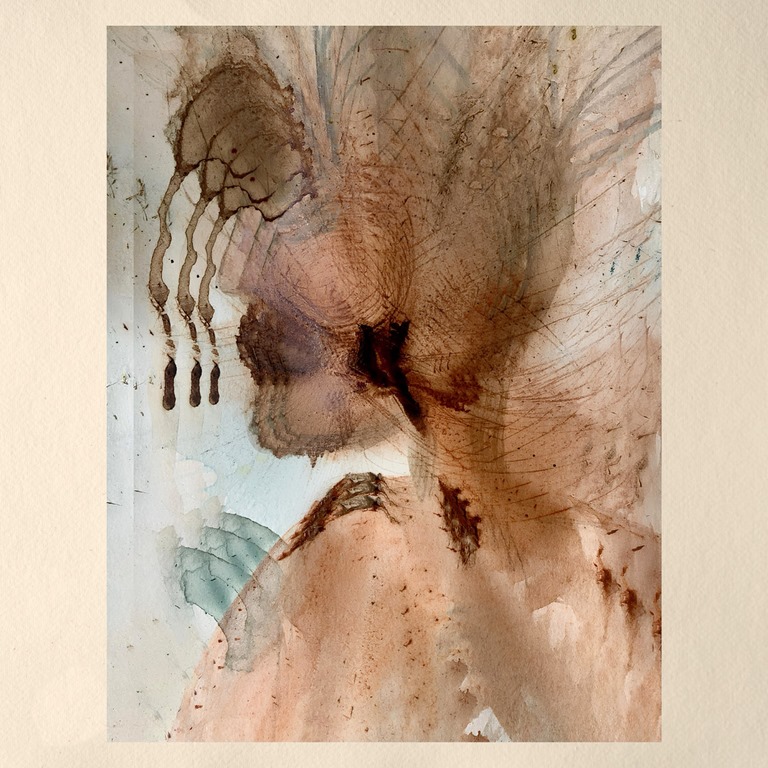
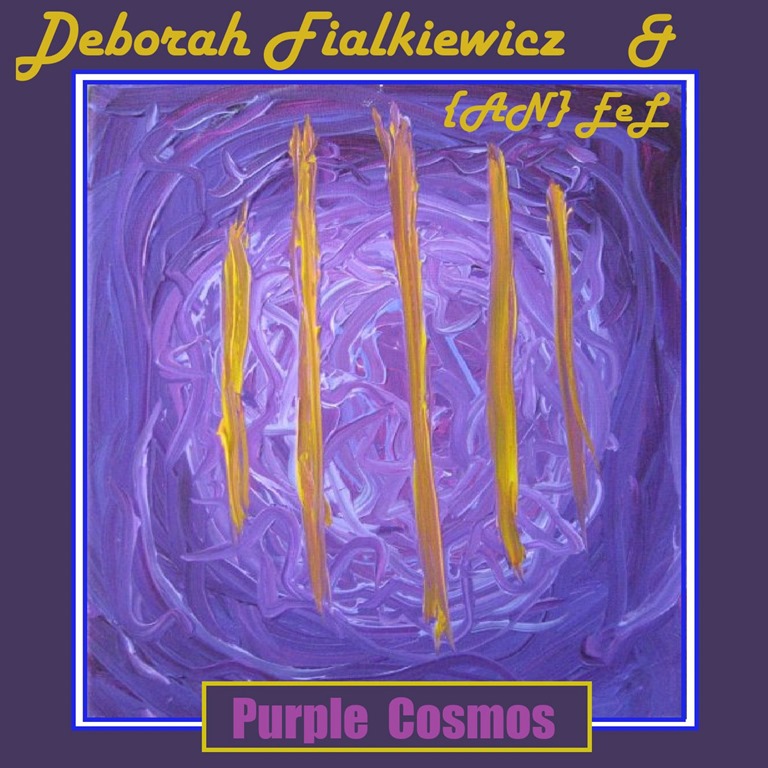
The second collaborative release of the year by Deborah Fialkiewicz & {AN} EeL (aka Neal D. Redke) lands amidst a blizzard of output from two musicians who are both insanely prolific – by which I mean prolific on a scale which isn’t far off Merzbow or Kenji Siratori: they each release more frequently than the average person has time to listen to it. I don’t in any way consider myself to be an average person – and we’ll not go there – but writing about music means that having something play in the background while I do other stuff, like changing the cat litter or whatever, isn’t always something I fancy, and certainly isn’t my way of hearing a release for the first time. Ok, so this is not how, say, my daughter, who’s fourteen, or her generation, or even some of my peers take in new music, but my formative experience of new music involved sitting down and setting a new album to spin and giving to my undivided attention for its entire duration. Sometimes twice in succession, or more on a weekend.

Attention, in 2025, is, it would seem, in short supply. And yet, flying in the face of this, albums with long tracks seem to be becoming increasingly more common. Perhaps it’s a sign of artistic rebellion. Perhaps it’s that artists feel a need to reclaim the focus and concentration associated with longer works. Whatever the reason, it’s welcome, and Purple Cosmos contains three compositions spanning a solid half an hour.

This is a thoughtful, delicate trilogy of compositions, which build from hush to tumultuous tempests of sound incorporating powerful space rock and progressive elements within their protracted ambient forms.

‘The Floating Monk’ is centred primarily around a thick, earthy drone that has the texture of soil, and it’s enmeshed with dark layers of serrated tones and thunderous rumblings. It’s dark and it’s dense, and it’s uncomfortable. The rest of the album doesn’t offer much by way of light relief.

Yes, the title track strays more toward bleepy electronic experimentalism –a different kind of space rock, if you will – and the final track combines wailing synth overload with some persistent beats… but first and foremost this is an unashamedly experimental work.

Purple Cosmos is a work which reflects a rare attention to detail, and it possesses a certain persuasive relentless in its marrying of dark noise, analogue undulations, and insistent beats. There’s more than a hint of Throbbing Gristle about it, and perhaps a dash of Factory Floor. It gets inside your head, and at the same time enwraps your entire being with its otherworldliness. It sure is a far-out groove.

AA
a2147012585_10

zeitkratzer productions – 21st November 2025

Christopher Nosnibor

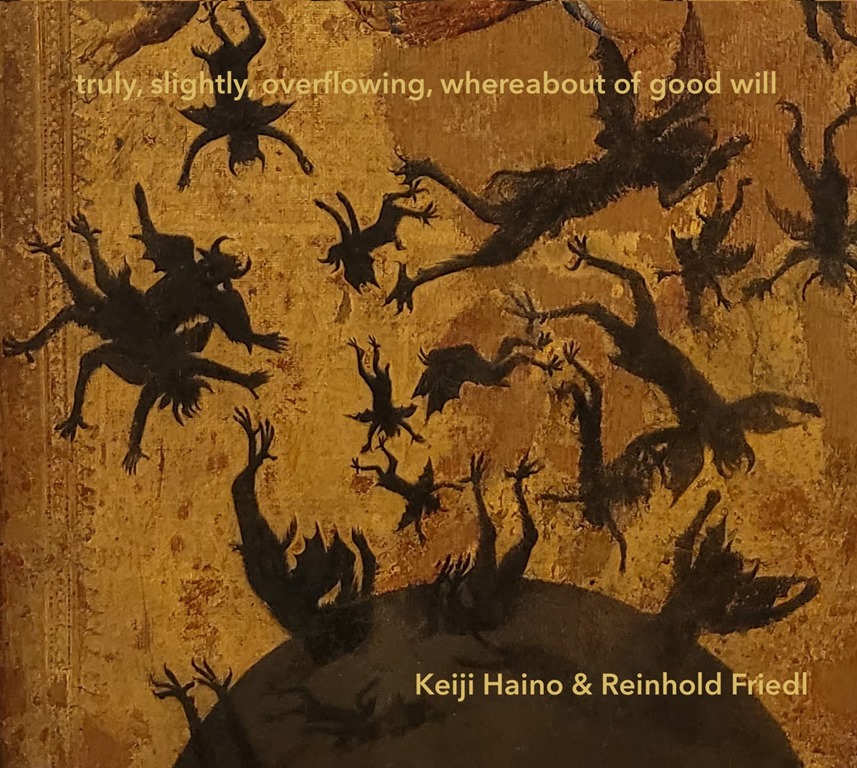
This is by no means the first time these legends of the experimental world have come together, and one would hope it won’t be the last either. Reinhold Friedl, leader of the Zeitkratzer collective and master of the prepared piano, as pioneered by John Cage, has built a staggering body of work through the years, taking into account Zeitkratzer releases, solo works, and almost countless collaborations. Of those many collaborations, this latest one is indeed strong and ambitious.

There’s something unsettling about the sound of laboured breathing and strangled whispers – and not just because they’re the domain of horror movies. Something in the human mindset makes us fearful of these sounds. Perhaps there’s the notion that a certain type of breathing is the sound of panic, and hearing it triggers a panic response. And so it is that against jangles and creaks and wispy, wraith-like drones and hovering hums, conjured by Friedl, Haino gasps and chokes and hums mystically through the thirteen-minute abstract journey that is the appropriately-titled ‘strange fruits’.

‘wild harvest’ eighteen minutes of exploratory dark ambience and abstraction. It starts quietly, a soft haze of static – and then very swiftly gets weird. Haino’s vocals rapidly transition from a plaintive mewling to satanic snarlings, while Friedl tinkles and scrapes like he’s tinkering away on an egg-slicer. But then there’s a slam of keys like psychotic demanding attention, and Haino violently switches between gasps and rasps like he’s being strangled by a poltergeist, chthonic grumbles, and tortured howls like he’s having his fingernails torn out while on the rack. The eerie metallic scrapes which set the teeth on edge are one thing, and Friedl masterfully builds a wall of discomfort, the sound of post-industrial collapse. It’s the sound of rust, of degeneration, rain-sodden sci-fi dystopia, and in itself it’s bleak, harrowing. But Haino’s contribution amplifies the discomfort, gargling and gurgling like nothing recognisable as human. It’s hard to place and hard to describe as anything but the sound of suffering. And we reel at such sounds: something biological, instinctive, primal, kicks from the inside and tells us this is not good. How we react is varied – some rush to aid, others cringe and curl – but ultimately, it’s something which affects us, it’s something we feel in a way which isn’t readily articulable. But however we react, the paint of others, it hurts us (and if it doesn’t, you’re clearly defective as a human being). As much to the point, however, is that this is challenging listening: discordant tinklings and guttural retchings are not pleasant or easy on the ear, and later, it trips into wailing psychosis and derangement. Again, we struggle when confronted with psychotic gibbering and incomprehensible raving, because we simply don’t understand, and many look upon those experiencing metal disturbance with distain, but this is, in truth – an often unspoken truth – born from a fear that they’re only a slide away from being there.

But regardless of and individual prejudices and fears, the fact remains that this is disturbing, weird, and does not correspond with out normal way of interacting with the world.

‘true, sightly fly’, the track which provides at least half of the album’s title, is a twenty-three-minute monster of a track. It’s on the CD and digital edition, and included as a digital download by way of a bonus with the vinyl edition, which feels like a shame, but then the cost of adding a second disc would likely be prohibitive both in terms of productions costs and sales. How times have changed from the late 80s and early 90s when vinyl was a budget option compared to a CD, when an album cost £7:50 against the cost of a CD being £11.99 or so. But it does feel like vinyl afficionados are being somewhat short-changed with only two of the three tracks, particularly given the fact that ‘true, sightly fly’ is arguably the belt of the set.

On ‘true, sightly fly’, Haino and Friedl plunge into the deepest, darkest, most unsettling depths, gasping, throat wrenching, slithering, churning noise unsettling the stomach writhing and churning, unsettled with beastly gasps rushing onto your nervous, trepidatious face.

This… is not fun and it’s certainly not entertainment. truly, slightly, overflowing, whereabout of good will is not fun: it’s uncomfortable, unsettling, and at times deranged, demented. Inarticulable is, sadly, a reasonable description; I am out of words, and this is weird – but good.

AA

a0384773058_10

Mortality Tables – 17th October 2025

Christopher Nosnibor

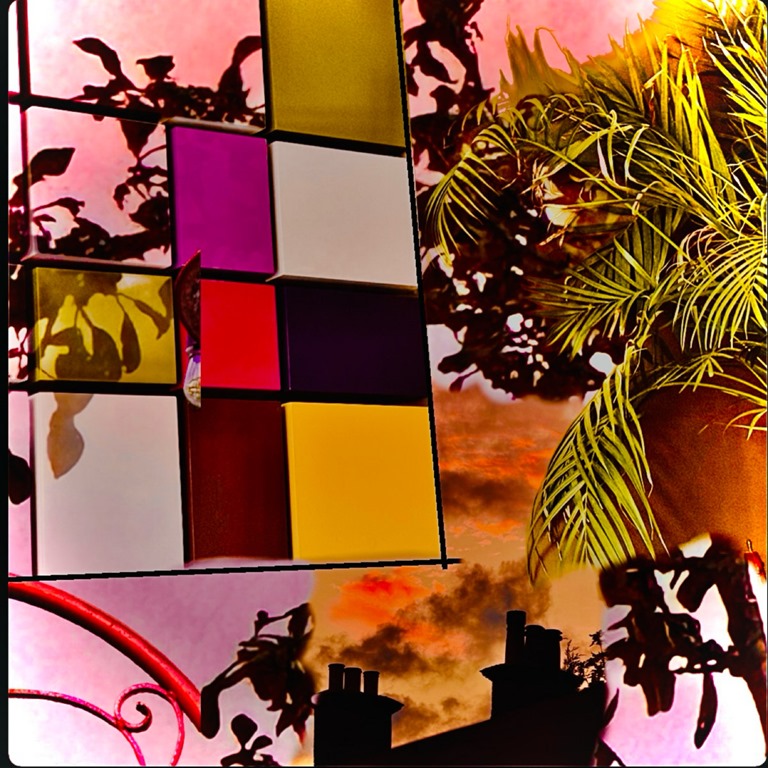
Among their ever-expanding catalogue, Mortality Tables have put out a number of releases which are essentially singles or EPs, with this being one of them: with a running time of just over eleven and a half minutes, this single longform composition is only marginally longer than its title, but its creator, Michael Evill, has condensed a considerable amount of material and experience into this space.

As he writes, ‘I have created a movement which includes the last breaths of my beloved dog Watson. It also includes the last time I recorded with my most talented and wonderful best friend Gustaf in 2001, which I have slowed down so I (and you) can spend more time with him. There are the sounds of new stars being born – my own interpretation and ones ripped off from NASA through this modern internet connection we all have. Surely we own the stars still?

‘We have Aztecs having fun with drums. These were recorded live in Mexico, sadly not from the 14th century before we invaded. We have the hourglass from our kitchen, which Mat inspired me to sample. This was the first idea of this piece and everything else fell in to place very quickly as it’s been swimming in the back of my mind for a while.’

Clearly, some of these elements have deep emotional significance for Michael, but this isn’t conveyed – at least not overtly or explicitly – in the work itself. It’s a collage-type sonic stew, where all of the myriad elements bubble and roil together to form a dense soup, in which none of the flavours are distinct, but in combination, what he serves up is unique, and provided much to chew on. That this protracted food-orientated metaphor may not be entirely coherent is apposite, but should by no means be considered a criticism.

As Evill goes on to write, ‘this was the beginning, and I didn’t spend much time thinking about it and just coalesced those ideas.’ Sometimes, when seeking to articulate life experience, it doesn’t serve to overthink it. Life rarely happens that way: life is what happens when you’re busy thinking and planning. And just as our experiences aren’t strictly linear, neither are our thoughts and recollections. Indeed, our thoughts and memories trip over one another in an endless jumble of perpetual confusion, and the more life we live, the more time we spend accumulating experience – and absorbing books, films, TV, online media, overheard conversations and dreams, the more everything becomes intertwined, overlayed, building to a constant mental babble.

William Burrroughs utilised the cut-up technique specifically to bring writing closer to real life, contending that ‘life is a cut-up… every time you walk down the street, your stream of consciousness is cut by random factors… take a walk down a city street… you have seen half a person cut in two by a car, bits and pieces of street signs and advertisements, reflections from shop windows – a montage of fragments.’

This encapsulates the artist’s quest: to create something which conveys the thoughts in one’s head, to recreate in some tangible form the intangible nebulous inner life, if only to help to make sense of it for oneself.

‘Even Though It Was The Blink Of An Eye’ is a woozy, disorientating churn of noise, which is, at times, dizzying, unsettling, nausea-inducing. But then again, at other times, it’s gentle, even melodic, reflective, contemplative. There are some passages where it’s all of these things all at once. It very much does feel like a scan of the artist’s memory banks, the human brain equivalent of skipping through the RAM files and pulling items seemingly at random. It does feel somewhat strange, even awkward, being granted access in such a way, but at the same time, it feels like ‘Even Though It Was The Blink Of An Eye’ is more than an insight into the mind of one individual, but an exploration of the human psyche.

AA

a0518044244_10

Room40 / A Guide To Saints – 7th November 2025

Christopher Nosnibor

Free time? What’s that? Who actually has free time anymore? Something seems to have gone awry. Every technological advance promises more leisure time: from the industrial revolution to the advent of AI, the promise has always been that increased productivity through automation would give us more free time. So where the fuck is it? I don’t know anyone who isn’t constantly chasing their tail, running just to stand still, who doesn’t feel like they’re losing the plot or on the brink of burnout simply because the demands of working and running a household is close to unmanageable, and making ends meet is a major challenge… and the stress suffered as a consequence. N

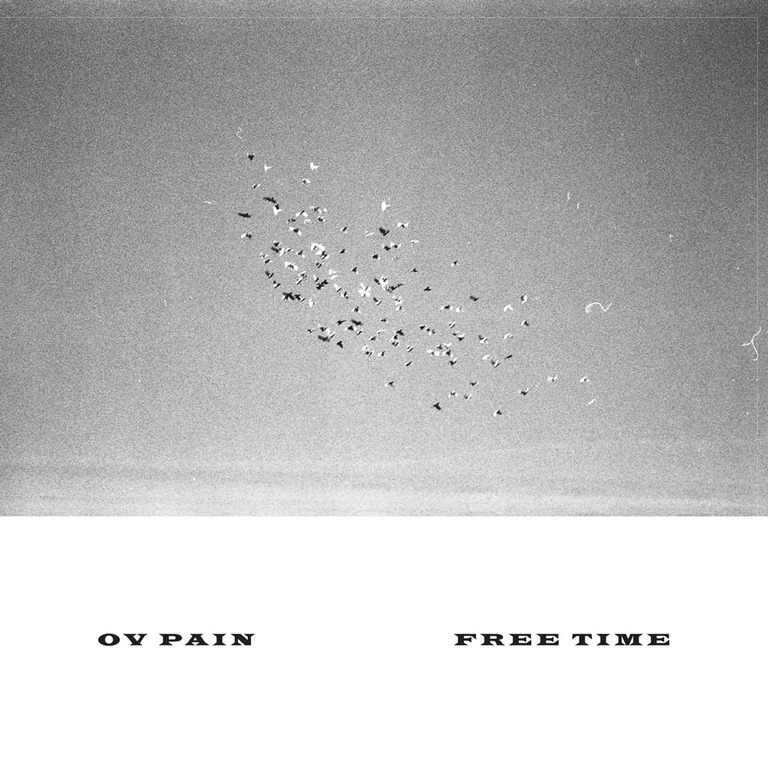
Ov Pain – the experimental duo consisting of Renee Barrance and Tim Player seemingly scraped and made time to record this album, a set of live improvisations (saving the time required to write and rehearse compositions), whereby, as Tim explains, ‘We recorded four different synthesizers – two apiece – straight into a computer pulled from a skip.’ This is how you do it when there’s no free time and no spare money. Although not explicitly detailed in Tim’s commentary, these factors are quite apparently central to the album’s creation, and by no means unique to Ov Pain. There’s a reason many acts peter out when the members reach a certain point in life: jobs and families mean that creative pursuits require some serious drive to maintain.

Tim adds, ‘One thing that is important to us is the immediacy and economy with which it was made and how that immediacy and economy becomes the thing itself.’

For all of its expansive soundscapes and layered, textural sensations, there is very much a sense of immediacy to Free Time. But, by the same token, for an album recorded quickly, it certain makes the most of time, in terms of space. There are long periods of time where little happens, where drones simply… drone on. The sounds slip and slide in and out, interweaving, meshing, separating, and transitioning organically, but not without phases of discord and dissonance.

The first track, ‘Fascia’ – with a monolithic running time of nearly eleven minutes – is a tormenting, tremoring, elongated organ drone, soon embellished with quavering layers of synth which warps and wavers, .it; s like watching a light which initially stands still but suddenly begins to zip around all over. It sits somewhere between ambient and extreme prog, with some intricate motifs cascading over that monotonous, eternal hum. Towards the end, the density and distortion begin to build, making for a climactic finale.

‘Slouching Toward Erewhon’ tosses in a neat literary allusion while bringing a sense of bewilderment and abstraction to proceedings, before ‘Comparative Advantage’ slowly pulses and trills, then crackles and buzzes, a thick surging swell of noise which is uneasy on the ear. And yet, the seconds of silence in the middle of the track are more uncomfortable… at least until the throbbing distortion bursts in atop stains of feedback and whirring static.

It may have been building for some time, but this is one of those evolving sets which after a time, you suddenly come to appreciate has expanded, and gone from a fairly easy drift to a heavy-duty drone assault.

Over the course of the album’s seven pieces, Ov Pain really do push the limits of their comparatively limited instrumentation. ‘Slander’ is a squalling, eardrum-damaging blast of gnarly treble that borders on extreme electronica, a straight-up assault on the ears and the mind. It hits all the harder because there is no let-up, and the frequencies are harsh and the sounds serrated. Around the mid-point, it goes darker, gritter, more abrasive, making for a punishing six minutes. Further layer of distortion and screaming noise enter the fray. It’s not quite Merzbow, but it’s by no means accessible. The final track, ‘Pusillanimous’ presents seven minutes of slow-pulsating ambience, and is altogether more tranquil to begin with, but before long, there are thick bursts of distortion and overdrive, and low rumbles heave and grind in ways which tug at the intestines. I feel my skin crawl at the tension.

Free Time is an album of surprises, and, more often than not of discomfort. It’s the sound of our times.

AA

AA

a2380798111_10

Sinners Music – 1st October 2025

Christopher Nosnibor

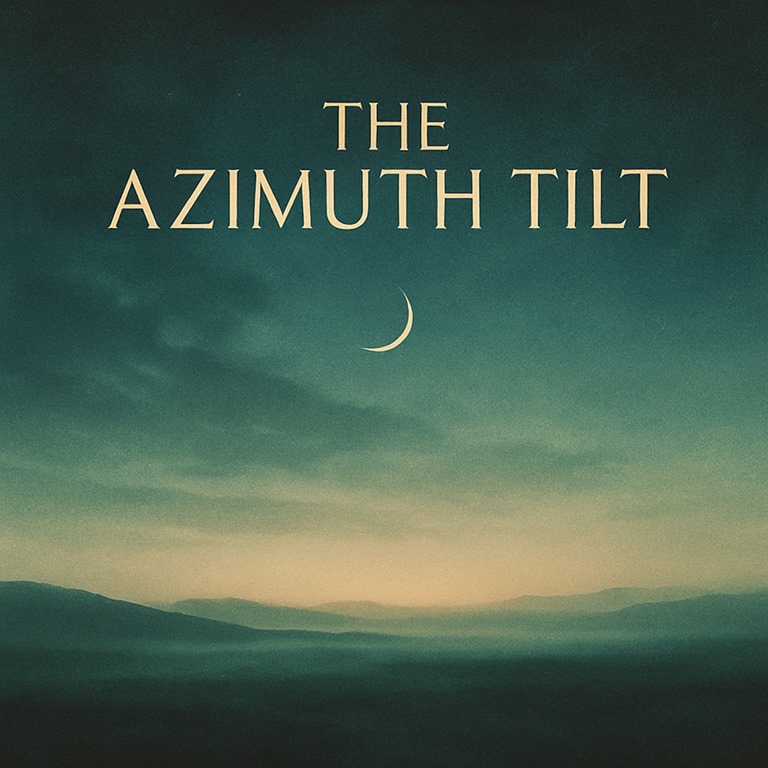
Sinners Music – the label established by electronic music maestro and one-time music shop owner, Ian J Cole, continues to offer up new music that’s interesting and unusual. There are some context where ‘interesting’ is somewhat dismissive, diminishing, and people of a certain age will remember snooker legend Steve Davis being given the nickname of Steve ‘Interesting’ Davis ironically… although the double irony emerged that he was genuinely interesting, as his work with The Utopia Strong abundantly attests. Here, my use of ‘interesting’ is neither ironic nor dismissive: it’s meant sincerely, as there is no specific ‘house’ style or overt genre specificity evident. This is one of the reasons why boutique microlabels can be worth following – you never know quite what you’re going to get from them, but you can guarantee if won’t be ordinary. And this release by no means ordinary.

As for The Azimuth Tilt, their bio informs us that this is the work of ‘a solo ambient electronic project exploring the liminal spaces between sound, memory, and landscape. With a name drawn from the alignment of a real to reel tape head, the project orients itself toward the unseen—subtle shifts in perception, emotional resonance, and the hidden geometries of the natural world… Blending atmospheric textures, glacial rhythms, and immersive sound design.’ There are no clues as to who this is the project of, but it matters not, and in fact, the less we know, the better. This is the joy of abstract ambient works: all you need is the sound, and all you need from the sound is to let it drift, to carry you away. And this is what Alignment does.

On a certain level, it does very little. On another, it is a quintessential deep ambient album. Alignment features just six compositions, but has a running time of some fifty-seven minutes. The soundscapes which define it are sonically rich, with soft, drifting, cloudlike contrails merging with lower drones and contrails. In combination, filling the entire sonic spectrum, Alignment does a lot.

From nowhere, halfway through ‘An Unqualified Person’, a raucous sax breaks out.

And the layers build. Against scrawling spacious drift, it’s quite a contrast. And then there’s some subtle piano intervention, and from hereon in, the piano and sax alternate in leading. It’s nice… and not in a turtle-neck top kind of way. It’s nice but… a little strange. But ‘The Exquisite Space’ crackles and swirls abstractedly, with some supple motifs rippling and intertwining with a mellow mood exploration which arrives at more sax. Always more sax.

This seems to be a dictum The Azimuth Tilt are happy to follow, although it’s melted into the echo-soaked atmospherics of the final track, ‘And the Band Played On’. Alignment is not a dark album, but it’s one which feels unsettled, uncomfortable, unsure of its destination – and whatever it may be, the journey is worth the exploration.

AA

a0054555481_10

Christopher Nosnibor

Benefits exploded onto the scene not long after lockdown – and I mean exploded, an atomic detonation of rage. The essence of the setup was pretty simple: angry sociopolitical spoken word delivered with blistering vitriol, backed by a blinding wall of noise. The result could reasonably be described as something in between Whitehouse and Sleaford Mods, but the fact is that from day one, Benefits created their own niche. The live shows were jaw-dropping, and the debut album, Nails captured that raw energy with a rare precision.

The arrival of second album, Constant Noise marked a necessary departure – sonically mellower, far more beat-orientated, a lot less shouty, angry-sounding. My first impression was that it was decent, more produced, but still packed some sting in the lyrics., and will be hard to top in terms of the number of mentions of dogshit in albums of the 2020s. But it’s a fair reflection of post-lockdown Britain: dogs have proliferated exponentially, and concordantly so has the volume of dogshit – and, just as bad, bags of dogshit tied and dropped, piled next to or on top of bins, and hung in trees. What kind of twat does that? A selfish one is the only answer. But as for the album, I kinda let it sit for a while. But over time, with more – and more – listens, the album’s depths reveal themselves. Constant Noise is every bit as angry as Nails, and if anything, the more moderate, tempered delivery hits harder. It just takes a little bit longer to reveal its depths and quality. But how would this translate live, especially now they’ve been stripped back to the founding duo of Kingsley Hall and Robbie Major?

DSC05075

Benefits

Before we would get to find out, there was the equally intriguing support. The Eighties Matchbox B-Line Disaster are one of those acts who may have only attained cult status during their time together, but it’s one which has expanded since their demise. They were always a band destined to implode, as was apparent when I witnessed a particularly fractious gig here in York circa 2007. But this was always a band which had derangement and volatility wired into their makeup. Guy McKnight formed DSM IV in 2018, and they’re an altogether different proposition, trading in gothy electro with some tidy guitar textures woven into the fabric of the songs, and Guy seems altogether more settled. It’s all relative, of course, and he ventures into the crowd on numerous occasions, and at one point around the middle of the set, tosses mic stand over, drops the mic and busts some tai chi moves. It’s a solid set, both compelling and entertaining, and they’ve got some tunes, too.

DSC04943DSC04962DSC05008

The DSM IV

Benefits don’t really have a great many tunes in the conventional sense. Choruses and hooks aren’t the primary focus of their compositions. Hall’s words range from reflective and ponderous to outright roaring rage, the backing spanning sprawling barrages of obliterative noise to quite chilled dance grooves. But at this volume, and when delivered with this much passion, there’s nothing chilled about this live show.

Here, I find myself returning to the topic of seeing an act you’ve seen before and been blown away by, and going to see them again in the hope of replicating that first time – only it’s a weak hope, because the first time has the element of surprise which is unlikely to be repeated. Yes, a band may be consistently awesome, but that first bombshell experience, that initial high… very few bands have the capacity to have that impact more than once. Benefits, however, hit even harder on this outing than any before.

DSC05025DSC05084

Benefits

There was word online that their current tour was as brutal as any they’d ever done. Having seen them three times previously, and never with the same lineup, it seemed like that claim might be a bit of a stretch, particularly without a live drummer. But synthetic beats have a way of bludgeoning and cracking in a way that live drums don’t always, and when paired with gut-churning low-frequencies and ear-bleeding top-end noise, the sonic impact of what blasts from the PA is positively immolating.

DSC05085

Benefits

Kingsley gets most of the chat out of the way at the start, with a bit at the end: in between, they power through a relentless set uninterrupted. And relentless it is, and not just sonically: with the sole lighting consisting of blinding white strobes for the entire duration of the hour-and-twenty-minute set, the stark, uncompromising nature of the music and lyrics is amplified. They put every ounce of energy into the show, Hall positively streaming with perspiration by a third of the way through. And we feel the passion; the whole room is buzzing and aglow with a sense of unity through a shared experience of catharsis. These are shit times. Dark times, bleak and scary times, domestically and globally. Benefits capture the zeitgeist, and rail against those who will one day be proven to have stood on the wrong side of history – the right-wing, flag-shagging, pro-Brexit, racist, xenophobic, hatemongering, exploitative, manipulative capitalist shits and their supporters and enablers – articulating thoughts and feelings with a unique precision and an intensity which is positively nuclear. The experience is nothing short of mind-blowing.

Christopher Nosnibor

Live music should carry a warning over its addictive properties. Witnessing a band playing a set so good that you’re buzzing for hours, even days afterwards is a unique high, and one that sets a seed of a desperate need to replicate that experience.

I’ve seen a lot of live music since I started going to gigs over thirty years ago, but the number of acts who have ignited that sense of fervent excitement is limited. I’ve seen many, many amazing shows, but few have blown me away to the extent they’ve felt in some way transformative. Dead Space Chamber Music are one of those few, and I left the Cemetery Chapel in York a few months back feeling dazed and exhilarated, my ears whistling despite having worn earplugs. I simply had to see them again, in the hope to experience that same sense of rapture.

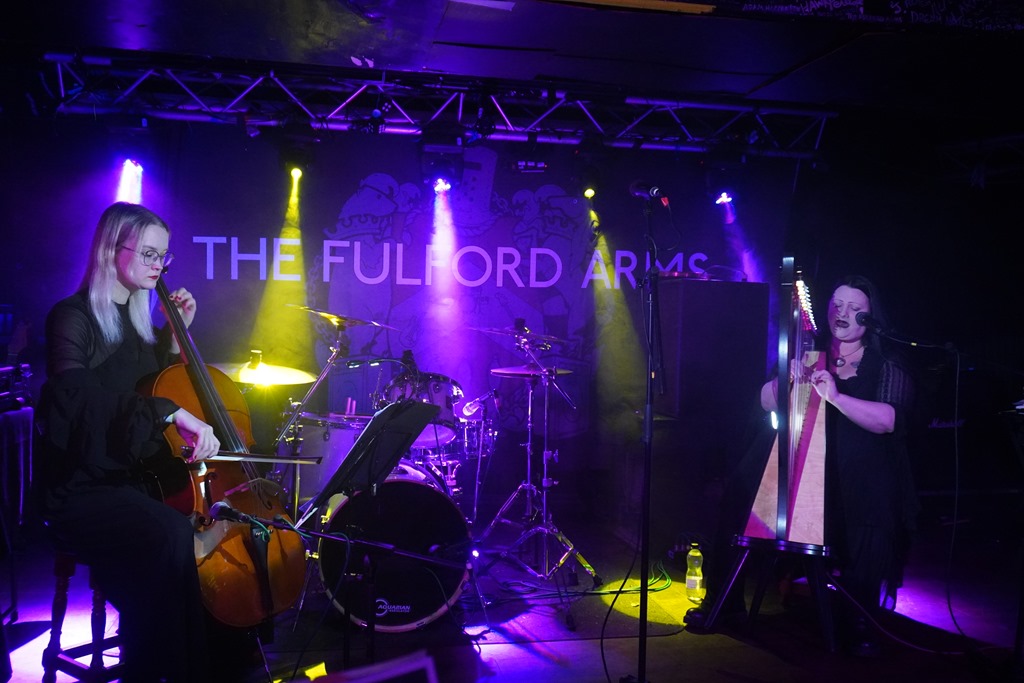
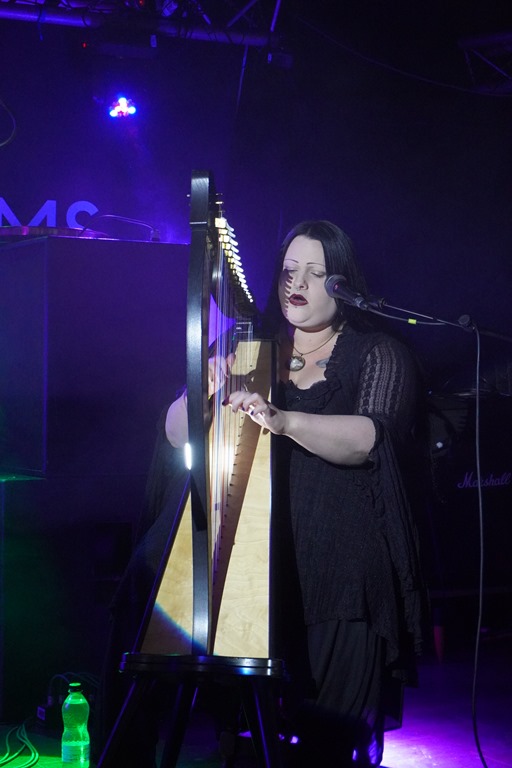
Eldermother – consisting of Clare de Lune on harp and vocals and Michalina Rudawska on cello – have no shortage of musical pedigree, and a superabundance of talent which they showcase with their minimal neoclassical works, a mix of covers and original material. They open with Radiohead’s ‘Street Spirit (Fade Out)’ led by harp and with Clare’s soaring vocals, and it’s one of those performances that make the hair stand up on back of your neck with its haunting atmosphere. There’s a rendition of WB Yeats’ poem ‘The Stolen Child’, a work rich with imagery inspired by wild nature and imbued with emotion and drama. The execution is magnificent, and the originals are similarly graceful and majestic. ‘Hurt’ may not be by any stretch representative of Trent Reznor’s career, but it certainly showcases his capacity for powerfully emotive songwriting, and if it’s the song which forms his legacy, it’s all to the good. Yes, Eldermother play a semi-operatic version of ‘Hurt’ with harp and dark, brooding cello, and… woah. It’s almost too much, especially this early in the evening. I find myself dabbing a tear and grateful for the low lighting.

DSC04790DSC04787DSC04785

Eldermother

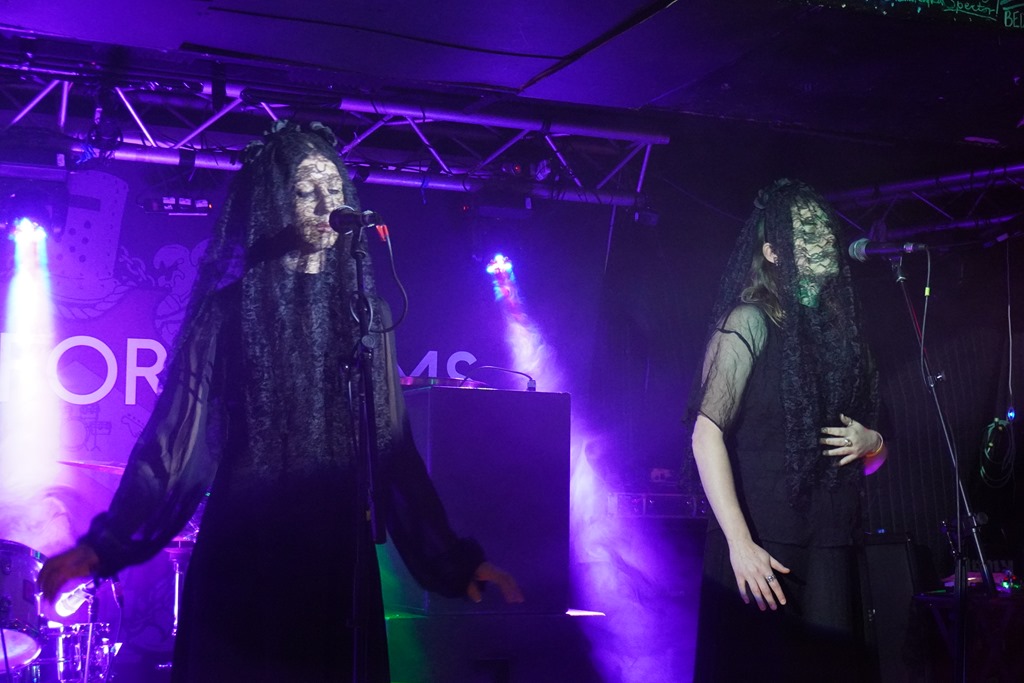
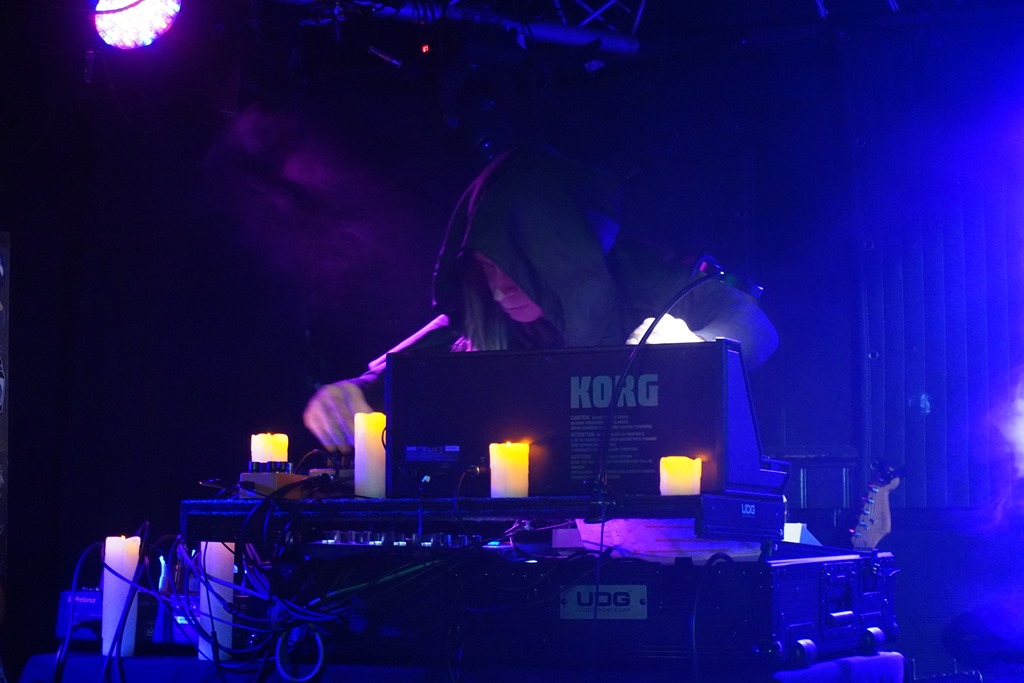
Lunar Cult Club – featuring Doug Gordon, aka Futures We Lost – as the provider of the instrumental machinations, take the theatricality up several notches to deliver a set of otherworldly cold, cold, darkest electro with glacial synths and funereal forms. The bank of synths swirl and grind, muddy beats thud and pop from amidst a dense sonic fog. Sonically, they’re impressive – in the main, the arrangements are sparse, and overtly analogue in form – but visually, they’re something else. Theirs is a highly theatrical stage show, and this significantly heightens the impact of the songs. The two singers, dressed all in black and with faces obscured by long, black lace veils – Corpse Bride chic, as my notes say – sway and move their arms in an unnerving fashion, as if reanimated, exhumed. I’m reminded of Zola Jesus and of Ladytron, and I’m mesmerised by their facsimile of a Pet Sematary Human League with its spellbinding marionette choreography. The final song, ‘No-Ones Here to Save Her’ is as dark as it gets: the vocals merge and take us to another realm entirely.

DSC04800DSC04804

Lunar Cult Club

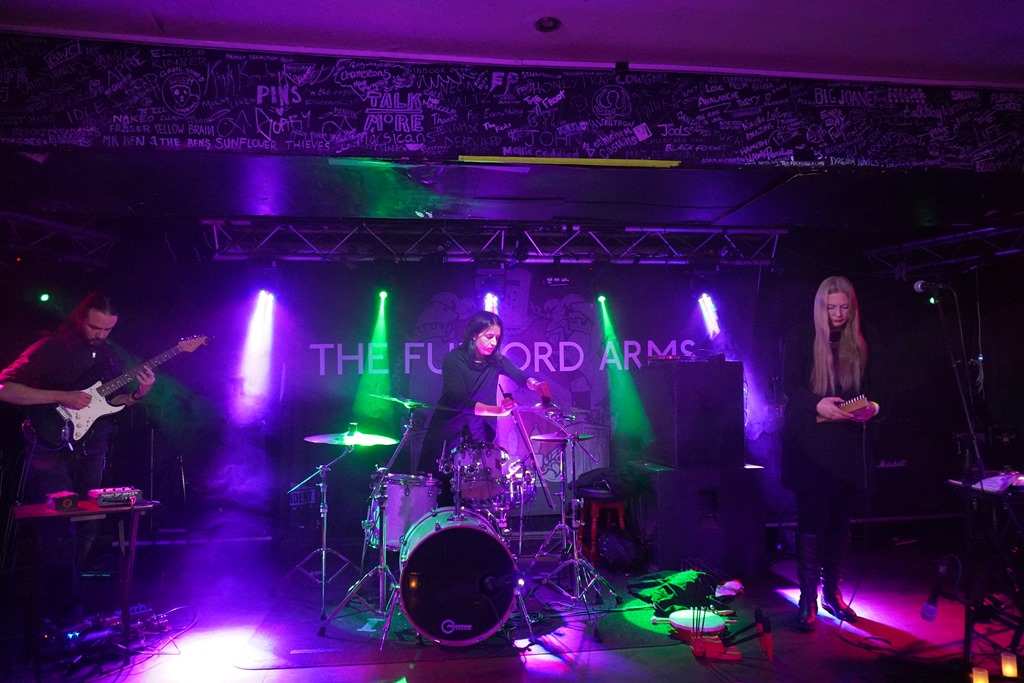
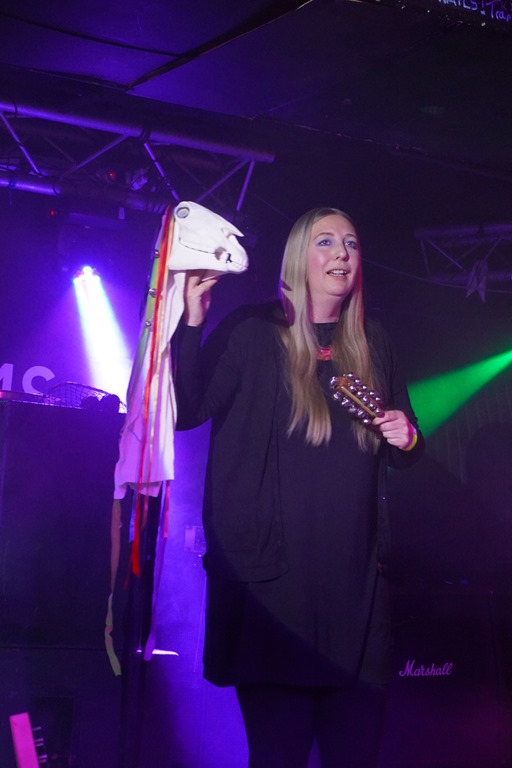
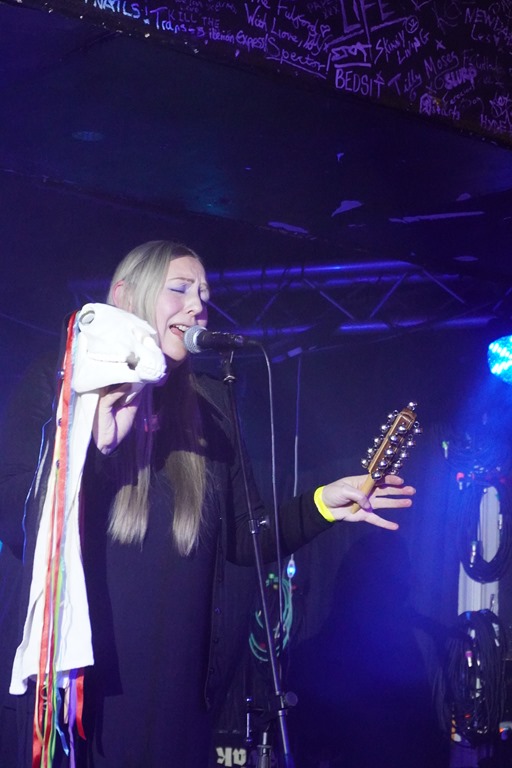
I’m still floating in a state of mild delirium when Dead Space Chamber Music take to the stage. The atmosphere is thick, tense, hushed… awed. Something about the trio’s presence alone makes you sit up, lean in, eyes wide, ears pricked. There’s a lot of detail here. Their focus is gripping by way of spectacle, and their set is designed as a linear work which evolves and transitions over its duration, in a way which calls to mind when Sunn O))) toured Monoliths and Dimensions, whereby, over the course of the set, Attila Csihar transformed into a tree. There are props and costume embellishments, mostly on the part of Ellen Southern, who performs vocals and various percussion elements and a strange stringed instrument: she brings much drama and theatricality, delivered with a sense of self-possession and deep spirituality which is utterly entrancing.

DSC04839DSC04852

Dead Space Music Orchestra

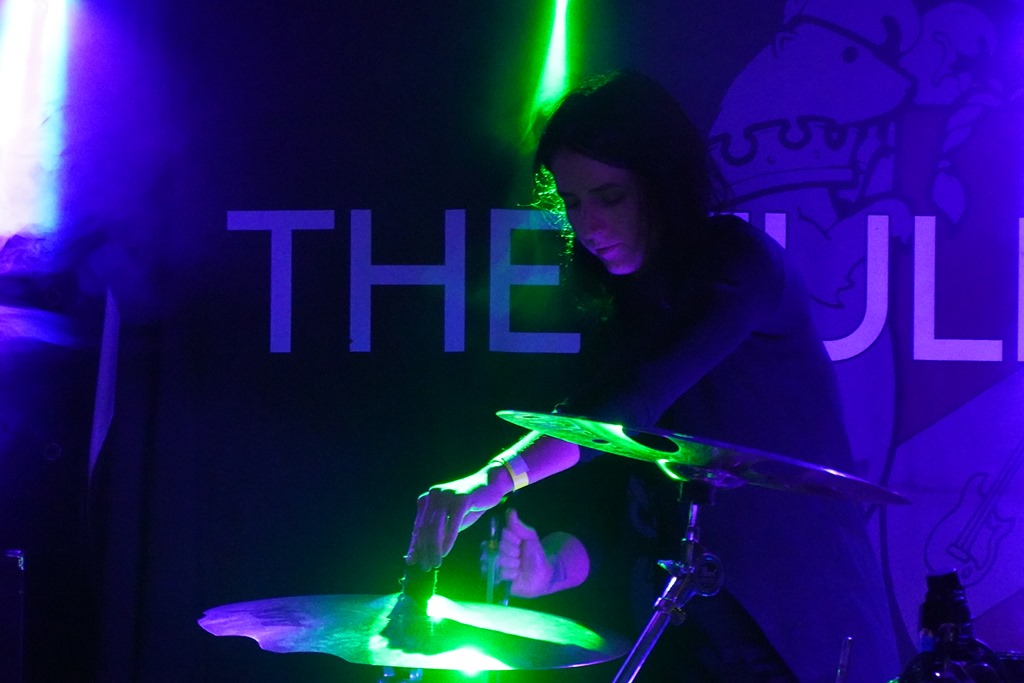
They’re so quiet you can hear matchsticks dropping into a tray. But the fact that these things are audible, amidst cavernous reverb and sepulchral echoes, is a measure of the clarity of the sound and the band’s attention to detail. Ekaterina Samarkina is impressive in the sheer versatility and nuanced approach she takes to the percussion which is truly pivotal to the performance. Her work is so detailed, subtle, the sound so bright and crisp, as she slowly scrapes the edges of her cymbals with a bow. Lurking in the background, Tom Bush – on guitar – plays with restraint, sculpting shapes and textures rather than playing conventional chords and melodies. In combination, they conjure a rarefied atmosphere.

DSC04867DSC04886DSC04906

Dead Space Chamber Music

But towards the end of the set, as if from nowhere, emerge huge cathedrals of sound. The last time around, I compared their climactic crescendos to Swans, and having seen Swans just over a week ago, I very much stand by the parallel called then. And this is not volume for volume’s sake: this is about catharsis, about escape. Dead Space Chamber Music make music which is immense, transcendental. And when they go all-out for the sustained crescendo of the finale, it’s not because of a bank of pedals or a host of gear: they simply play harder, throwing themselves behind their instruments, and full-throttle intensity. It may not be as loud as on that previous outing, or perhaps it’s simply because I’m expecting it, but they nevertheless raise the roof, and fill the space with expansive layers of sound on sound.

The three acts very much compliment one another, making for an event which is more than merely a gig, more than three bands playing some songs: this is an occasion, steeped in theatre and art, performed with a sense of ritual. The experience is all-encompassing, immersive, enveloping; it takes you out of life and suspends time for its duration. It will take some time to return to reality.

Cruel Nature Records – 28th November 2025

Christopher Nosnibor

November always feels like plunging into an abyss. It’s the month when , after the clocks change on the last weekend of October, the darkness encroaches at an exponential pace, while, simultaneously, the weather deteriorates and temperatures suddenly drop. I struggle with November, and I’m by no means alone in this – but the darkness and muffling cold brings with it a blanket of isolation, too.

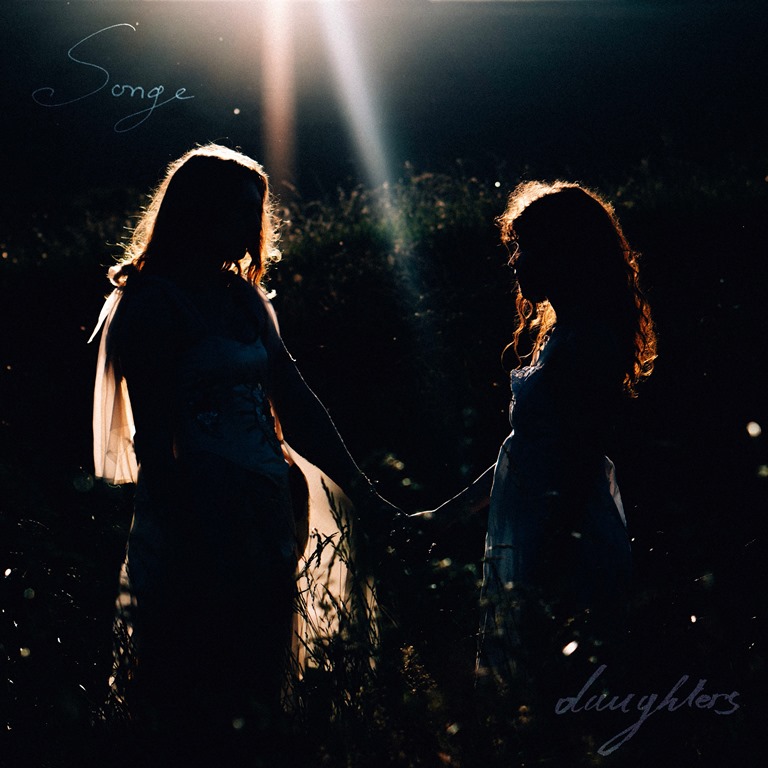
Listening to the debut album proper by Songe in this context makes for a heavy experience. And it’s the context that counts here, because in reality, Daughters is largely calm and spacious rather than dark and oppressive.

The Anglo-French duo consisting of Gaëlle Croguennec and Phoebe Bentham formed in 2023 ‘upon stumbling on a lonely church piano’, and, we learn that ‘Songe explores what it means to live in a postmodern world that feels rooted in destruction’.

This resonates. Right now, it feels as if the world is on a collision course. The so-called ‘great pause’ of the pandemic seems more, in hindsight, as if it was a time during which tensions built and nations pent up rage ready to unleash the moment the opportunity arose. Some of this a matter of perception and distortion, but the bare fact is that the last COVID restrictions were lifted here in the UK on 21 February 2022, and Russia invaded Ukraine three days later. The pandemic, for many, felt apocalyptic. It wasn’t simply the deaths, the fear, but the impact of the restrictions, which didn’t suddenly dissipate the moment those restrictions lifted. The end of restrictions felt like a deep-sea diver coming up for air, the aftereffects akin to the case of the bends. While we were recovering our breath and dealing with the cramps, Russia invaded Ukraine, and from thereon in it’s felt like an endless succession of disasters, storms, and then – then – the annihilation of Gaza.

Musically, Daughters – on which the duo deliver a set of ‘vibrant and experimental soundscapes using a variety of e-pianos, pedals and theremin, pairing a traditional playing style with bit-crushed granular delays to create a soaring top line met with ethereal vocals’ – is by no means dark, bleak, or depressing. In fact, quite the opposite is true. It’s a delightful set of compositions.

But sometimes, the more graceful, delicate, uplifting the music, the harder it hits. And on Daughters, Songe reach some dark and hard-to-reach places. From the most innocuous beginnings, the epic, nine-minute ‘Warmer, Hotter’ swells to a surge of discordant churn beneath soaring, ethereal vocals. The piano-led ‘Ashes’ borders on neoclassical in its delivery, and is rich in brooding atmosphere. ‘Heol’ begins with distorted, discordant harmonics, with frequencies which torment the inner ear. Gradually, through a foment of frothing frequences and fizzing tones, bubbling undercurrents rise. Haunting vocals rise through the mist, the haze, the dense and indefinable drift. It’s ethereal, spiritual, bewildering in terms of meaning.

Waves crash and splash before soft, rippling piano takes the lead on penultimate track, ‘Eveil’. It’s graceful, majestic, emotive – but not in a way which directly or obviously speaks of the album’s subject or context. The vocals are magnificent, but the words impenetrable. It works because of this, rather than in spite of it. It’s slow, subtle, powerful.

It’s not until the final composition, ‘Wraith’, that we feel the emotive power of a droning organ, paired with saddest of strings, that we really feel the depth and emotion al resonance of Daughters. As it fades in a brief reverberation, I find myself feeling sad. No, not sad: bereft. This is an album that takes time to take effect, to soak in. It deserves time to reflect.that time.

AA

AA

cover

New Heavy Sounds – 7th November 2025

Christopher Nosnibor

Cold in Berlin have come a long way over the course of fifteen years and now – after a six-year wait – five albums. Give Me Walls was sharp, defined by an angular post-punk sound which crackled with nihilistic fury. You wouldn’t exactly say they’ve mellowed over time, but they’ve become heavier, darker, and have evolved the ways in which they articulate themselves, musically, and lyrically.

January 2024 saw the release of the EP The Body is the Wound, which introduced the thematics of a new and significant project, and indicated where they were heading, and came with references to an album to follow later in the year. The year came and went, and here we are, at the dark end of 2025. But as lead single ‘Hangman’s Daughter’ and follow-up ‘The Stranger’ foreshadowed, Wounds was worth the wait. Perfection takes time, and that’s what Cold in Berlin have delivered here.

But more than that, this is an album which wrestles with difficult stuff. As the band explain, “Wounds is a series of songs about the different ways people live with and process ‘the wounds’ of their lives… A strange celebration of that formative pain we have all experienced in some way. The loss and joy of survival – the celebration of finding others like us, the gift of knowing life comes after fire.” For all the noise of how we need to talk more about mental health, the fact of the matter is that it’s really just that. There is still real stigmatisation surrounding the subject in real terms, with reactions to attempts at open dialogue tending to range from diminishment, to dismissal, to awkwardness and paralysis before moving on with an embarrassed cough. And yes, I’ve learned this from painful experience. Raise the subject of mental health, anxiety, and dealing with bereavement while adjusting to life as a single parent with a teenage daughter… it’s amazing how many people go quiet, how many friends seemingly vaporize. The simple fact is that the majority of people are afraid to touch on dark topics, to venture to dark places. They can’t handle it, and so… these are my personal wounds, and why this album reaches parts other albums don’t get close to.

It’s ‘Hangman’s Daughter’ that raises the curtain on the dark drama which will infold over the course of nine songs. The big riffery that’s become their signature – and nowhere more apparent on predecessor, 2019’s Rituals of Surrender – is very much present, but there’s a lot happening here, in terms of detail and dynamics and arrangement, with pulsating electronics which owe considerably more to Krautrock than glacial gothy / post punk traditions prominent in the mix, and some thunderous drumming (which does belong more to the post-punk lineage) and some spindly lead guitar work that’s classic trad goth – and at the same time, the song’s imagery leans more toward folk-horror. It’s a potent mix which sets the tone – and standard – for a phenomenally powerful album.

Piling straight in hard and rather faster, ’12 Crosses’ is another showcase of stylistic eclecticism: the tense, cyclical guitar straddles post-punk and noise rock, and creates a claustrophobic, airless atmosphere – then, seemingly from nowhere, there’s brass, which, in context, introduces something of a post-rock feel, which is a sharp contrast with the spiky, Siouxsie-like stylings of the song’s second half. It’s fierce, but there’s more than straight attack.

A mere two songs and ten minutes in, and I find myself reeling by just how much they’ve packed in, in terms of range and depth, and the attention to detail is superlative.

‘Messiah Crawling’ provides… not respite as such, but some headspace to be carried along by a thick, doomy, Sabbathesque riff. ‘They Reign’ marks a change of pace, bringing down the tempo and volume, leading by a more narrative lyrical form. After a slow-build, rolling drums and swathes of synth conjure a cinematic sonic expanse which is transportative. It makes you feel, on a spiritual, perhaps even primal level. Landing mid-album, ‘The Stranger’ is rather sparser and it’s the synths which take the lead on this shimmering prog-pop cut, which grows and twists as it progresses towards a surging climax. Final song, ‘Wicked Wounds’ is nagging, and somehow antagonistic and more overtly punk in its delivery

Throughout, Maya’s vocals are powerful, commanding, but equally, rich and emotive. Not only has she never sounded better, but never more suited to the music her vocals are paired with, running the gamut of emotions from anguish and torment to reflective and vulnerable.

With Wounds, Cold in Berlin have stepped up to another level – and in every aspect. It didn’t seem possible they could keep getting better… but here, they’ve surpassed expectations, and once again exploded beyond the walls of genre to deliver an album which is something else.

AA

Wounds_Cover_3000x3000