Archive for the ‘Albums’ Category

Panurus Productions – 15th July 2022

Christopher Nosnibor

In a world where there’s so little that you can rely on, knowing that there are some labels that can be taken as a measure of quality provides a much-needed reassurance that not absolutely everything is shit. Panurus is one of those labels, along with Cruel Nature, Bearsuit, and Human Worth, that provides an unwritten guarantee that if they’re releasing it, it’s worth hearing. And what’s particularly pleasing with all of these labels is that they’re not genre-specific. Human Worth may lean toward guitar-driven noise, while Bearsuit favour genre-straddling avant-gardism, but ultimately, these little labels put out stuff that they like and find interesting, and this is healthy, in that it provides a platform for a diverse range or acts and fans to connect.

Trauma Bond’s The Violence Of Spring is in fact a reissue, having been originally released by Digital Destruction in the US just over a year ago, in a limited run of twenty-five hand-stamped pink neon tapes. Panurus have retained the original design, but rotated the image to replicate the band’s own digital release, which makes more sense when you study the flows off blood down the face. It’s not a pretty over, but it does very much provide a fair visual representation of the ‘raging grindcore/powerviolence/noise onslaught’ it houses.

As their biography summarises, ‘Trauma Bond is the conception of Eloise Chong-Gargette & Tom Mitchell – blending a shared love of violence, noise and metal to concoct a visceral exploration of aggression’. I mean, who doesn’t love violence, right? I am being sarcastic and, indeed facetious, and should perhaps reiterate here that both makers and fans of the most brutal music tend to be among the gentlest, most docile people I’ve encountered. The music is the outlet for everything they aren’t in the every day. With the exception of Marilyn Manson and Genesis P. Orridge, it’s the bland indie types who are more likely to be the real scumbags, and likewise their fans. This is the long way of saying that there’s violence, and there’s violence.

The original notes pitch ‘a furious onslaught of razor-sharp, disorienting grind; that darts between blasting intensity, to dirge, to industrial noise, and back again before you’ve realised what you’ve been hit by.’ And that’s exactly what The Violence Of Spring delivers, packing nine brutal sonic assaults into twenty minutes.

It all begins with an ominous roll of thunderous rumbling, the fifty-seven-second ‘O.C.B.’ building a tension and suspense that’s devastated with the explosive treblefest of ‘the title track, where everything piledrives in at a hundred miles an hour, from the flurry of guitars, the machine-gun drumming and screamy vocals, and from hereon in there’s not much let-up. There are samples galore – seemingly of panic-stricken crowds and people in streets where accidents, explosions, and shootings have just taken place. And The Violence Of Spring is simultaneously a drive-by and a hit-and-run that concludes with a suicide bombing.

They swing into black metal on ‘Total Fermentation’, and this is a dank brew, unfiltered and thick with sediment, and headcrackingly potent, while on ‘Daddy Do’, it’s more barking, guttural grindcore than anything else, and fuck me, it’s savage. One of the album’s two longer tracks, ‘Double Denim Dissociative Disorder’ which runs past the four minute mark against the usual minute and a half, is a grating wall of distortion, a churning landslide of sludge that slowly sinks into a spent crackle. Sandwiched between this and the finale, the overloaded tempo-shifting blast of demonic fury that is ‘Syndrome Imposter’ is ‘Little One’, a pained blast of metal anguish that’s delivered with remarkable and unexpected clarify, particularly in the vocals.

Nothing about The Violence Of Spring is gentle, but it hits all the harder on account of its comparative range. Yes, it’s all metal, but The Violence Of Spring is all the metal.

AA

cover

Xtra Mile Recordings – 8th July 2022

Christopher Nosnibor

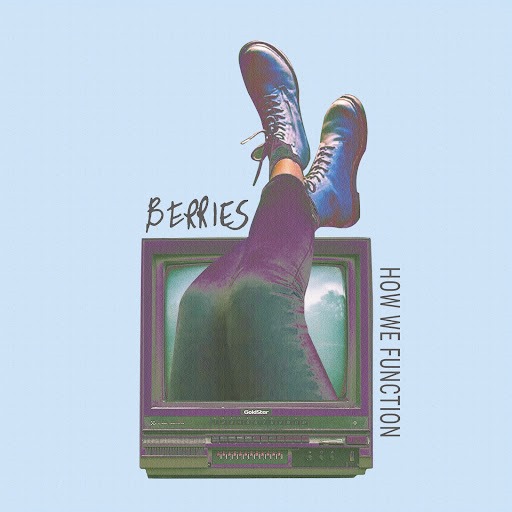
She sang it! She sang it! Yes, the hook to the album’s opening song, ‘We are Machines’ is ‘We are machines / it’s how we function’. Simple pleasures and all that. But there are many pleasures packed into this album’s forty minutes.

Having been showcasing BERRIES tunes since the time of their second EP back in 2017, the arrival of their full-length debut is a cause of excitement. And the anticipation is justified, with a tight set of songs that don’t disappoint.

What’s promised is an album ‘rammed with taut, angular guitar lines and packing a gritty, garage-grunge punch’, and that’s what’s delivered. None of the songs are over four minutes in duration, but they each contain so much action, so much traction, so much movement, each takes time to unravel the tightly-woven, knotted, intermingled noodly jumbles of guitar lines. There’s a lot of taut, tense jangling and angling going on here, as they cut across the mathy aspects of the guitar lines and the spiky post-punk chop of Gang of Four, and they marry it all together with strong melodic vocals.

The tension is appropriate for an album that tackles themes of mental health, feeling overlooked and sexism ‘with a searing honesty and intensity’ to present, as the put it, a collection of songs about “growth, strength and rising above all of the negativity and noise”.

There isn’t a duff track to be found here. Yes, the singles are obvious choices and standouts, not least of all the gutsy ‘Haze’, which is more or less representative of the album as a whole with its bold , grungy guitars and dynamic construction, exploding into the chorus after an understated verse, but then ‘Discreetly’ really pushes things hard, and rocks more overtly than much of the album with a monster chorus and driving riff – and frenzied guitar solo – and packs it all into two and a half minutes. ‘Fabricate’ calls to mind Kenny Loggins’ ‘Dangerzone’, and is propelled by a thick, gritty bass, while the guitars stop and start and stutter, and ‘Basic Tables’ starts with some tightly interweaving, stop/spart guitar work before breaking into a breezy chorus.

What BERRIES achieve is a perfect balance of passion and personal honesty, with sass and a pop sensibility. That means that How We Function feels sincere, as it is, but isn’t lecturesome or lugubrious. It doesn’t sugar-coat difficult emotional matters, but isn’t whiney or woeful. How We Function is an album of empowerment, of determination. The songs are both instant grabs and growers, and with this much energy, it’s exciting, not just the first time, but again and again.

AA

thumbnail_unnamed-447

Preston Capes – PCT001 – 1st July 2022

Christopher Nosnibor

The Front & Follow label may have reverted to mothballed status (at least for the time being), but that doesn’t mean that Justin Watson is doing nothing these days, despite the title of the latest release from three-way collective The Incidental Crack, who we’ve been following – and covering – for some time here at Aural Aggravation. For this outing, they’ve found a new home on newly-established cassette label – and these seem to be springing up all over now – Preston Capes (and I’m guessing no relation to Geoff).

As the notes explain, ‘The Incidental Crack began with Rob [Spencer] recording himself wandering around in the woods and finding a ‘cave’ – Justin put some weird noises to it, and then Simon joined in. The rest is history. The Incidental Crack are joined again by Dolly Dolly / David Yates on this album.’ Indeed, however much The Incidental Crack may evolve, they remain fundamentally unchanged, their albums assemblages of random field recordings and strangeness melted and melded into awkwardly-shaped sonic sculptures that unsettle the mind and by turns ease and tense the body.

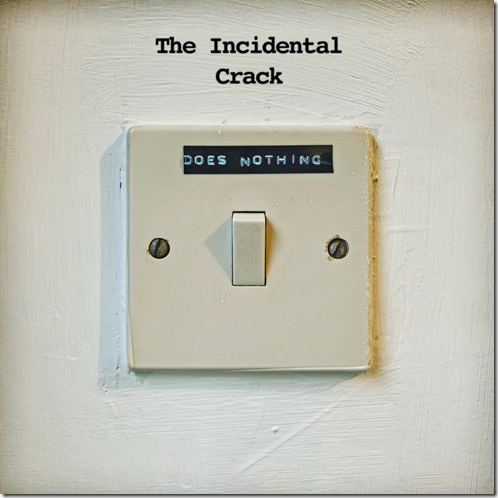
The Incidental Crack Does Nothing follows the two albums they released in 2021, the second of which, Detail, was a challenging and expansive work, and this very much continues in the same vein.

With The Incidental Crack, it very much feels as if anything goes, and reflecting on the name of the collective, this seems entirely appropriate. What their works represent is a crack, a fissure, in time, in continuity. Their methodology may not be specifically influenced by William Burroughs and Brion Gysin’s cut-ups, but are, very much, open to, of not specifically channelling and incorporating, the assimilation of random elements, and have a collage aspect to their construction.

‘Shitload of Rocks’ is comparatively airy, and serves as a brief introductory passage before the dank, gloomy ambience of ‘The Worst Party’. It’s a dark, ominous piece that hovers and hums, echoes, clanks, and rumbles on for a quarter of an hour; it’s cold, clammy, and unsettling. But is it the worst party ever? While it does sound like hiding in a cave while an armed search party charged with the task of your erasure stomp around in adjacent tunnels off in the distance, I don’t actually hear any people, laughing drunkenly or loving the sound of their own voices while holding court with tedious anecdotes, so I don’t think so.

‘Hair falling from our bodies clogs up the sewers,’ we learn as a clattering beat clacks in and rattles away on the industrial chop-up churn of ‘Hair’, featuring Dolly Dolly, who’s clearly no sheep. It’s the album’s most percussive cut, the monotone spoken-word narrative somewhat surreal, and looping eighties synths bubble in around the midpoint, although it’s probably too weird for the Stranger Things retro adopters.

‘Couch Advantage’ is the album’s second longer piece, a sinuous, clattering workout almost nine minutes in duration. It’s minimal, yet somehow, there’s enough stuff going on as to render it all a blur: is that jazz drumming, a groove of sorts off in the distance? Or is it simply some clattering chaos, the sound of bacon sizzling? What is going on? And following the brief interlude that is ‘Belting’, the final piece, the ten-minute ‘Photography’ with more lyrical abstraction from Dolly Dolly depicting random fragmentary images against a backdrop of clicking sparks and evolving, supple sweeps of drifting clouds of sound. It’s all incidental, every second of it: fleeting, ephemeral – and in the cracks, is where it happens. As they open wider, you peer in, and observe. There is movement. There is life. Because life is what happens between the events, among the random incidents and accidents.

The Incidental Crack Does Nothing may be confusing, bewildering, difficult to grasp – but it is, without doubt, a slice of life. You can do with that what you will.

AA

cover

Misanthropic Agenda – 20th June 2022

Christopher Nosnibor

I’ll admit, I was struck by the name when this landed in my inbox. Success! With an insane number of submission emails day, I don’t even open most, let alone play the albums attached. But then I learned that PWIS is Nathalie Dreier – who’s interesting for her visual work as well as her audio – and Dave Phillips, who’s To Death I covered last year – which deepened my intrigue. And it’s one hell of a cover, too.

Meaning What Exactly? is quite a different proposition – from pretty much anything, in truth. Presenting four lengthy compositions, it’s fundamentally an electronic album, but it’s far more than that, or anything. The title is a challenge, a query, a – what I keep hearing as a phrase in my corporate dayjob – a ‘provocation’. It comes down to ‘exactly’. The word is weighted; even without explicit emphasis, it feels emphasised, vaguely stroppy even. The addition is the lexical equivalent of a hand on hip, a raised eyebrow, a scowl, a sneer of condescension to a worker from another department who has no facts. ‘Yeah, do your research, bitch’, is what it says.

And who really knows what it means, or what anything means? Exactly. And what this album means – exactly – I can’t quite fathom. The titles conflict with the contents, at least, based on my lived experience, on my reception. They say it’s a ‘dialogue mixing treated field recordings with organic acoustics and digital sources, brought together in long trance-inducing sessions of meticulous audio de/construction and philosophical debate’. But how much of that is apparent in the end product? Well, that’ debatable.

‘Pangolin’ is otherworldly eerie: a booming drum echoes out through a shifting reverberation of spine-shaking synths. It doesn’t readily evoke aardvark-like creatures, apart from perhaps in the final minute or so when Drier’s monotone vocals are replaced by snuffling barking sounds. It’s weird, but then, what did you expect? I don’t know what I expected, if I’m honest, but probably not this. This is dark, disorientating, disturbed and disturbing, and even more challenging for the absence of context. Meaning is the end product of intent, of purpose, and there’s no clear indication of where this is coming from, meaning we’re left to face the strange with no guidance.

A grinding bass and muffled, muttering voices, whispering about fish all build to a hellish tumult of murmurs and doom-sodden low range hums and thrums, and nothing feels right. It’s awkward, and unsettling. You – certainly I – don’t really tune into the words delivered by Drier in her suffocating spoken word passages, not out of disregard or disrespect, but because all of it comes together to create a claustrophobic listening experience. Meaning What Exactly? is not an album you sit and dissect, or sit and comfortably disassemble or analyse. I find myself, instead, contemplating the meaning of meaning.

‘Us vs Us’ plunges into deeper, darker territories, with a grinding, driving bass worthy of Earth, propelled by thunderous sensurround drumming, with purgatorial howls echoing all around. It’s heavy, harrowing, and it’s that simple, tribal drum style that defines and dominates the eerie eleven-minute closer, ‘The House is Black’. The house is black and the atmosphere is bleak: the vocals are mangled and distorted and play out against a murky, fragmented, fractured backing, to unsettling effect. The beats are sparse, subdued, distant, yet taut, crashing blasts and ricochets. You make it want to stop. The clock is ticking. Your chest tightens. The nerve rise, jangling, fearful. It’s like walking through a graveyard at night, knowing there’s someone lese shuffling around nearby. Make it stop, make it stop!

A crackle, a crunch. What is this, exactly? Perverts in White Shirts don’t only excavate darker domains, but scour and gouge their way into the darker, deeper territories where tension pulls tight and tighter still. It’s the sound of trauma, of suffocation. Meaning it feels like a direct passage to the depths, meaning it’s dark, uncomfortable, like it’s almost unbearable at times. Meaning it’s good.

AA

a2108573613_10

Cruel Nature Records – 24th June 2022

Christopher Nosnibor

Hot on the heels of second album Can’t Be Arsed, Cruel Nature have repackaged the eponymous debut from the Manchester makers of ‘kitchen sink punk for the 21st century with a whole side’s worth of remixes from both previous releases – including two pretty radical reworkings of snarling single cut ‘Brain Driver’.

First, to revisit the debut – it’s a primitive, noisy document of disaffection. Adam Stone’s drawling, sneering vocal style is vintage punk, less about holding a tune as conveying attitude, and from the off they set the tone with the seven-minute ‘Food Chain’. A thick, dirty bass grinds out just a couple of notes over a plodding drum while Stone vomits vitriol. If ever a track encapsulated the monotonous drudgery of existing in Boris Johnson’s Britain, this is it. Most of the songs churn away for around seven minutes, but if you’re wondering just how far a band can push low, slow, trudging bass repeating the same simple motif atop a plodding beat, then the answer lies in ‘Half Priced Chickens’ – and the answer is just shy of fourteen minutes. This quarter-hour slog is a gloomy, dark, monotonous trudge: the kick drum sounds like a wet lump of wood, and the sneering shoutiness is replaced by a blank monotone spoken word, and in combination, they create an oppressive sonic fug. The scenes depicted are mundane. Words drift in and out – mobility scooters, office, boyfriend, cough mixture, cheese pasty – and these objects assume bleak resonance as you ask yourself, ‘is this it? Is this life?’ and the answer is there, slumped, devoid of energy, eyelids half closed: yes, this is life. And this is as good as it gets. And it’s fucking endless. Until it ends, in a swampy morass of slow decayed distortion and noise.

The final track, ‘Bunker’ locks into an uptempo groove, but while the drums rattle and bounce away, the mood remains tense, equal parts The Fall and Uniform. As the track progresses, so the anguish builds, and the effect is cumulative Stone hollers roughly about world war as feedback wails and the bass and drums just batter on, and on. Same old, same old…

There’s nothing pretty about Pound Land – the band or the album – and this is a good thing: they deal with the gritty reality of living in shit times. Pound Land articulates the languorous torpor of demotivation, of waking daily to feel the aching anguish of being beaten by life, every minute of every day. Sonically, it’s a long, long way from early Swans, but the density and oppression are very much shared aspects.

By the end of the five tracks, you’re absolutely harrowed and drained.

The remixes are a nice addition, though. The Ruffians on the Train Remix of ‘Brain Driver’ ventures into swampy, almost avant-jazz / trip-hop territory, before kicking into gnarly space-rock swirl. The drums are crisp but overloading, while the bass is pure punishment. Where remixes for most other bands are either dancier or more ambient or whatever, this set – with three of the six from R.O.D., these are primarily exercises in accentuating the gnarliness of the originals, with everything simply sounding even heavier, more crushing.

Pound Land is the real soundtrack to the now. They may have to change their name to Tenner Land before the year’s out the way things are going, so you’d be wise to bag this while you can, and hunker down before things get really tough…

AA

cover

Christopher Nosnibor

Steve Kendra has probably received as many words praising his work as anyone to have been covered here at Aural Aggravation, but the chances are, it’s gone unnoticed, since he’s rarely, if ever mentioned directly or by name. As the rhythm guitarist in York’s premier purveyors of psychedelic drone, Soma Crew, his contribution is something I’ve long admired. Like drummer Nick Clambake, Kendra’s brilliance lies in his humbleness, and his appreciation that the sum is always greater than the parts. A great rhythm section sticks to rhythm and keeps it together. Sounds simple, but it’s much harder in reality. It requires great concentration for a start. And it takes humility too not want to step into the spotlight in one way or another. But this is precisely why he’s the perfect player for Soma Crew, content to keep his head down, face obscured by the peak of his cap, and bludgeon away at two or three chords for six or seven minutes.

Just as he’s the quiet one of the band – not that they’re really big talkers most of the time – he’s quietly been working on his own material as Kendroid. It’s essentially a solo vehicle, but with input from as handful of people well known in York music circles, not least of all instrumental and production assistance from Dave Keegan, and to date he’s recorded and released two full-length albums, The Last Love Song on Earth (2019) and Poetry Love & Romance (2021) – so while these aren’t- hot-off-the-press new releases, it’s never too late to catch up. In fact, the whole promo build-up of a clutch of singles and videos in the run-up to an album’s release and then the explosion of reviews in the weeks and months around it, I get, but it does create a false sense of there being a certain window for new releases. The reality is that albums have a slow diffusion, and more often than not, people discover albums and artists months, years, even decades, after their emergence.

Kendra’s route to being a musician has been far from conventional: the man didn’t even pick up a guitar till he turned 40, and is by no means a muso. I have a lot of respect for that, and have found that oftentimes, technical education is a limiter to creativity. Steve can’t read tab and doesn’t know music theory – and consequently, isn’t hampered by conventions.

The chronology of the material is chewy: most of the songs on the second album were written before those on the first, and the second album is more of a lockdown exercise to document/ purge the journey that preceded The Last Love Song.

The Last Love Song on Earth presents a pretty eclectic set, spanning low-key blues and reminiscent of Mark Wynn before he went punky/shouty and went off to support Sleaford Mods (Married to the Rain’), to Soma Crew-esque space rock workouts that toss in dashes of Stereolab and Pulp (‘Mexican Heart’), and songs that incorporate elements of both, along with an experimental twist, with the swampy ‘Incel’ and brooding grind of ‘Deam Lover’ that has hints of Suicide in the mix contributing to the diversity that draws in The Doors to Mark Lanegan.

Poetry Love & Romance is quite a different animal, and while recorded in lockdown, it’s not – unusually – a lockdown album, packed with the anxieties of forced captivity or separation. But it is, in another way, a definitive lockdown album, in that its recording is one whereby the sound and production is determined by limitations, being largely acoustic – although Dave Keegan again features in a musical capacity, as well as engineering, mixing, and mastering.

We’re straight in with an easy country swing, with acoustic guitar and simple drum machine for the title track, and it sets the style for the album as a whole, which is mellow, sparse laid back, and pretty country. These are songs that paint pictures, sketches of scenes, some faded and tinged with the distance of time and reflection, and it’s quite touching at times.

Poetry Love & Romance does feel like something of a stopgap, but who wasn’t waiting for life to restart in some way the last couple odd years?

It’ll be interesting to see what Steve does next, but what he’s done thus far is interesting, and a clear step away from his guitaring day-job, and a such, it’s a bold move that’s yielded some great results.

June 2022 – Ten Foot Records

Christopher Nosnibor

Most bands start out splurging output and slow down over the course of their career. Percy aren’t most bands, and over the last decade have accelerated their output. And also, contrary to the common trajectory, instead of mellowing, they’ve got angrier, gutsier, ragier. Monorail really does find them at the top of their game, bursting with zeal and brimming with vitriol, kicking arse like never before.

‘Chunks’, premiered at their recent York show supporting Percy slams in hard and angular, landing between Grotesque era Fall and Truman’s Water. Jagged, jarring, it’s a full-throttle it’s an instant headache. ‘We’re all just chunks in gravy’, Colin Howard snarls and sneers, and it’s punchy – a very different kind of throbbing gristle. There’s no let up as they pile into the scorching ‘I.C.U.’ and it’s immediately clear that Percy have hit a new level.

They haven’t changed fundamentally: they’ve always been sociopolitical, and they’ve always cranked out driving riffs with a choppy, discordant edge, accentuated by Howard’s Mark E Smith influenced slightly nasal sprechgesang, and there’s a clear continuity that’s run from their self-released 2013 debut album, A Selection of Salted Snacks, through their debut album proper, Sleepers Wake on the esteemed Mook label and 2020’s Seaside Donkeys, which featured the Brexit demolition anthem, ‘Will of the People’.

Monorial isn’t so much about evolution or progression as it is about hitting that sweet spot – which really isn’t so sweet. In other words, their two years out from gigging during a tumultuous time socially and politically has seen them really hone their frustrations into their most attacking material yet. Same style, same form, just harder, faster, more pissed off. It’s not only their best work to date, but it’s absolutely essential listening, especially for those who still reminisce about John Peel and the golden age of indie, because these guys are everything you could want and Monorail has future cult classic written all over it.

AA

Percy-2

Rocket Recordings – 10th June 2022

Christopher Nosnibor

International Treasure is the second album from the ‘collaborative collision’ of Steve Davis, Kavus Torabi, and Mike York. And, of course, much has – and will – be made of the Steve Davis factor: he may have kept his musical interests largely under wraps during the lengthy heyday of his snooker career, but the fact is that he’s long been a fan and supporter of ‘interesting; music, and this is a musical unit that stands on the strength of its work – and its work is (utopia) strong.

As the accompanying notes explain about the origins of International Treasure, ‘All three musicians here found themselves operating outside of their comfort zones – Torabi’s purchase of a guzheng (a Chinese plucked zither) led to Shepherdess’s lambent allure and York’s spectacular and evolving array of pipes and wind instruments contributed just as much as his ruthless editing. Davis meanwhile, whose speciality lies in rich tapestries of modular electronics, sums up their relationship in characteristically self-effacing fashion: “I see myself as a strong midfielder, or a centre back. Kavus and Mike are like the Lionel Messi or Ronaldo of the equation, and I’m setting situations up for them”.

Davis’ application of an extended football analogy is amusing in context, and one suspects it’s an intentional slice of drollery. The music itself is not amusing – as in, there are no chuckles to be found here – but instead is intensely focused, with magnificent results. There’s a tangible sense of an intuition flowing between the three of them on this album as the sounds ebb and flow and weave and quaver, the elongated drones and meandering organs melting together like a stream of butter.

There are some odd samples – probably animal, rather than vegetable or mineral – flow together into a soft mass, with no hard boundaries, no distinct edges… ‘Shepherdess’ is spacious, meditative, but shifts over time to emerge as a more pulse-based modular synth work, and ‘Disaster 2’ brings all of the various elements together perfectly, as well as bringing together ambient, post-rock, and folk. It’s a beautiful and uplifting experience, and one which acknowledges the pains, trials, and tribulations of life, how it may not be possible to function all day every day.

There’s something soothing, even soporific, about the slow, mellifluous tones that drift together smoothly, seemingly effortlessly, to coalesce into some form, however cloud-like and abstract, to create International Treasure. Even when deep, resonant notes hang like the slow decay of a chimed gong, as on the title track, the darkness is always tempered, by light.

It’s not ambient and it’s not Krautrock – but International Treasure finds the three musicians drawing on elements of both to conjure something magical, something mystical. The final track, ‘Castalia’ is a calypso party party, and if it at first feels somewhat at odds with the rest of the album, it’s worth bearing in mind that the album exists at all because the players are keen to explore different terrains and territories. And explore they do: International Treasure mines many seams, and excavates a wealth of listening pleasure.

AA

525397

3rd June 2022

Christopher Nosnibor

My partner in power electronics, the man behind the white noise aspect of the ‘white noised and shouting’ equation that is …(something) ruined, Paul Thingumy (he has more pseudonyms and variant monikers than the devil himself, or even JG Thirlwell), has gone and self-released another EP. Well, less of an EP than an LP: it may only contain four tracks, but with a duration of almost an hour, it’s a very long play.

Residing in Mirfield, Kirklees, West Yorkshire – or, objectively, the arse-end of nowhere, where trains are infrequent and tend not to visit after 9pm – is probably very like any other Little Britain backwater with a Tory MP. And it’s so often from our immediate environs we draw our inspiration, as the album’s title indicates. For reasons I can’t fathom, the title reminds me of Peter York’s strange book Dictators’ Homes and some TV show I can’t quite recall – probably because I never watched it – about celebrity pads. Or perhaps I’m confusing it with Pimp My Ride or some other wank. Because it all blurs, and fast. Mirfield Pads is blurry, but in a different way: everything melts together to create an ambient wash.

In something of a departure from much of Paul’s previous work – and there’s a lot of it – Mirfield Pads is surprisingly mellow, melodic, accessible. There’s a hypnotic Krautrock vibe about the shuffling oscillations, with sampled vocal snippets buried low in the mix in places. It’s an overtly synth work with a vintage leaning that’s strongly rooted in the late 70s and early 80s. If there’s a debt to Kraftwerk here with elements of Mike Oldfield and Harold Faltermeyer, then equally, Mirfield Pads is Paul’s nod to Tangerine Dream, perhaps in part spurred by the recent passing of Klaus Schulze. You wouldn’t necessarily call it a tribute, but an inspiration, almost certainly.

Tapering tones interweave and turn, glistening, fractal, kaleidoscopic, like beams of light dancing on an illuminated surface, dancing lightly across a millpond or flickering on a wall. Not a lot happens, and it doesn’t need to: the sounds turn slowly on an axis that exists in a space of its own.

‘Crystal Airfield’ – a title that evokes the spirit of JG Ballard – hits the numerical sweet spot of 23:23, and with additional guitar work courtesy of Neil Campbell, longtime collaborator and one half of another project, Early Hominids, it’s a richly atmospheric piece that rounds off the experience nicely in a wash of elongated droning feedback paired with bubbling analogue sounds.

It’s the attention to detail, to the vibe and sensation that really makes Mirfield Pads intriguing. It feels more like a document from a past time more than a nostalgia piece, and this is a good thing, because nostalgia has become dreary and weary very quickly indeed – probably because the smell of cash is so unappealing.

AA

a3443859683_10

Human Worth – 3rd June 2022

Christopher Nosnibor

Because being in several awesome bands simply isn’t enough for some people, various members of Lump Hammer, Lovely Wife, Penance Stare, Möbius, Plague Rider have another band, the soft-sounding Friend. They’re practically a scene unto themselves, and you can pretty much guarantee that anything noisy emerging from Newcastle will feature one or more of James Watts, Tim Croft, and Skylar Gill – to the extent that the involvement of any one of them is essentially an assurance of quality. Putting the stamp on that assurance is the fact that Friend’s debut is being released by Human Worth, the London label that has, in a very short time, racked up an outstanding roster of new and established acts, all of a noisy persuasion, without a single weak release in their rapidly-expanding catalogue. And Friend’s Champion is a worthy addition.

It’s a proper gnarly take on the classic power trio format with driving riffs dominating from the opening bars. ‘International Top Bloke’ crunches in and batters away hard with a simple, cyclical riff reminiscent of Blacklisters; Tim’s guitar is so dense and dirty it sounds like guitar and bass all in one, while Gil’s drumming is megalith-solid, pounding away, nothing fancy, just all the heavy. And there, low in the mix, Watts gargles and gurgles tormentedly, sounding as if he’s being throttled by Satan’s very own flaming hands. As guttural growlers go, he is exceptional when it comes to channelling all shades of anguish by means of throat alone. But for all that, there’s a flicker of joy – or, perhaps more accurately, a cathartic release – which emanates from Champion.

The pitch is that they’re ‘pulling from influences ranging from Soundgarden, Smashing Pumpkins and Failure to Old Man Gloom, Floor and The Abominable Iron Sloth’ and while on paper it may seem an incongruous combination, in practise, it not only makes sense, but absolutely works.

‘The Beast’ is appropriately titled, for it is, indeed, an absolute beast. It begins with unexpected delicacy, a brittle, chorus-tinged guitar picked is as much The Cure as it is ‘Black Hole Sun’, but then the drums and distortion pile in and it’s a huge, throbbing surge of overloading sound that threatens to damage the speakers.

Whatever Geoffrey’s done, it must be pretty bad, as they rear through five minutes of bludgeoning brutality. There are some gritty, cyclical riffs reminiscent of Bleach-era Nirvana beneath it all, but the production is so dark and dirty the end result is wonderfully nasty sludge metal, then there’s ‘Dungeon Master’ that sounds like… well, it sounds like downtuned grinding hell. Not so much Sunn O))) as a total eclipse. Watts’ vocals aren’t the focal point: they’re another instrument (of torture) in the band’s arsenal or aural abrasion. If ‘Wellness’ seems to offer some light, some respite, it’s a pale, sick sense of hope that glimmers as Watts sounds like he’s writing through his last moments of torturous, gut-ripping pain.

The last two tracks – the eight-minute ‘Uncle Tommy’ and ten-minute ‘A Reminder’ combine to deliver a devastating finale. They’re so much more than heavy noise, too, with texture, tone, gradual builds and even moments that feel truly uplifting – even if they are blown away by bulldozing distortion. The former is a surprising blues / glam stomp, while the latter feels like an album’s worth of riffs of heavy metal thunder packed into a single track. It’s not only intense, but finds Watt’s deliver some audible lyrics, albeit briefly.

The word ‘friend’ may connote comfort, company, companionship, even cuddliness, and while the band offer none of these things, Champion does offer a kind of awkward solace through monster riffery and outpourings of angst. An album worthy of its title: proper champion.

AA

a2621977682_10