Archive for the ‘Albums’ Category

Neurot Recordings – 16th May 2025

Christopher Nosnibor

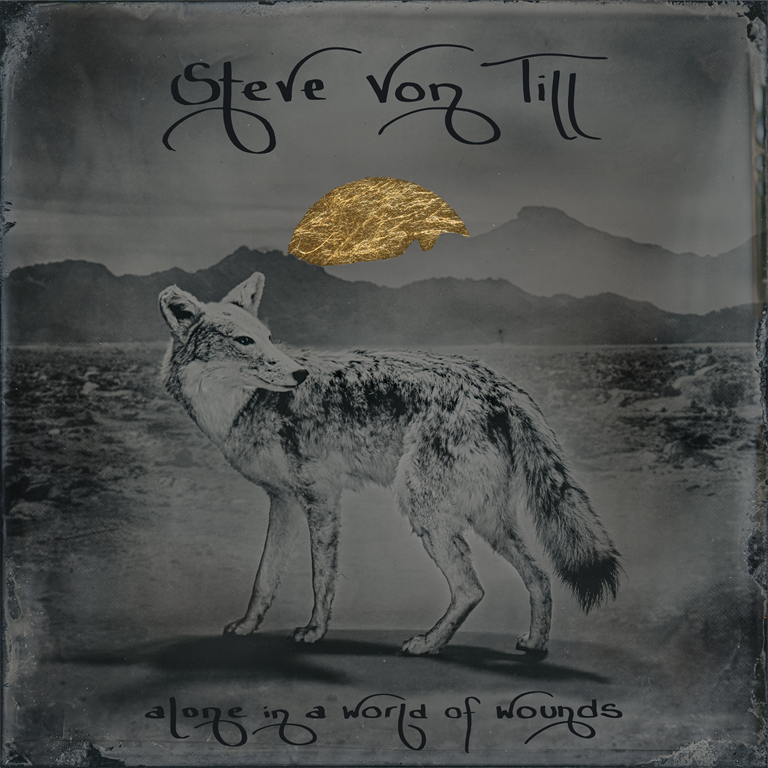
Steve Von Till doesn’t really require any introduction or preamble: the chances are, if you’re reading this, you’re already aware of his work, and if not as a solo artist, then as the guitarist / vocalist with Neurosis, active between 1985 and 2019. As much as Neurosis were labelled a post-metal band, they very much forged their own sound, which has, to an extent, become the house style of Neurot Records.

Von Till’s solo works may lean more toward folk and the gentler side of that style, but nevertheless have significant heft, and Alone in a World of Wounds – his seventh solo album, the follow-up to No Wilderness Deep Enough (2020) is no exception (he’s been busy in the intervening years with a trilogy of Harvestman albums, all released in 2024). The heft here comes from a sense of gravitas, rather than volume and distortion, and continues the softer trajectory of its predecessor, an album ‘initially inspired by the harmonic resonance of piano and synths and his long-standing love of ambient music’.

‘The Corpse Road’ sees Von Till croak and croon in a fashion that could me taken for Mark Lanegan in a blind test, against a sparse backdrop of strings which swell and swoon, heavy with sadness and gloom. There is a sense of times past, not just fading memories and bygone days, but a sense of the creak of wood and worn clothing of harder but simpler times. I find myself unexpectedly transported to a walk my daughter and I undertook from Ambleside to Grasmere in the Lake District a year or so back, via the ‘Coffin Route’. It was winding, and wet, and uneven, not to mention long, and it’s billed as a ‘strenuous’ walk, while still suitable for tourists: as the rain battered the hood of my anorak, I found myself contemplating what it must have been like hauling an actual coffin along that four-mile stretch without the benefit of modern hiking gear. Life must have been tough. Von Till taps into the essence of these past times, and a sense of the elemental.

The mood remains lugubrious on ‘Watch Them Fade’, a song redolent with sadness and reflection, weighted down with the reminder that mortality affects us all and is never far. Despite the fact that life’s only certainty is its expiration, we continue to shy away from the topic. While Alone in a World of Wounds does not confront mortality and death head-on, it’s there at every turn. “Keep on diggin’… dig a little deeper” he implores on ‘Horizons Undone’, and while there are psychological connotations here, it’s hard to ignore images of graves.

The eight-minute ‘Calling Down the Darkness’ is a super-sparse piano-led slow-burner, and confounds any expectation for a surging finish by remaining low-key and minimal to the end, ad something about it is so, so achingly sad.

‘The Dawning of the Day (Insomnia)’ is a brief spoken-word interlude with a moody piano accompaniment, while paves the way – or perhaps scatters woodchips – for the arrival of the swirling atmospheric start of ‘Old Bent Pine’, another song which revels in the forces of nature, before the six-minute ‘River of no Return’ flows toward the finish. It has hints of Slowdive about it. Moreover, its superficial ominousness reminds us that rivers only flow in one direction, and as with rivers, so with life: there is no return, no replay, no turning back. there is no undoing mistakes, only not repeating them.

‘Alone in a World of Wounds’ may be a largely acoustic album, but it is still heavy – really heavy – emotionally more than sonically – and consequently not an easy one to process. It would be impossible to deny the album’s quality. But the weight, the sadness…

AA

AA

450947

23rd May 2025

Christopher Nosnibor

It seems that Ava Rabiat can turn her hand to practically anything: in Gdańsk and based in Berlin, her work spans sound, experimental electronic music, visual arts, production and costume design for film and theatre. Elektro Erotyk stands as her debut album, and is the first instalment of a projected trilogy

We learn from the notes which accompany the release that ‘In her artistic process, fleeting thoughts and inner sensation transform into sonic reality, creating a space for interaction – a communication beyond conventional language.’

‘AVA’s texts oscillate between self-dissolution and physical intensity. She maps the boundaries of the self, explores extreme states and the longing for connection—directly, without detours, in raw immediacy. She deconstructs sound and reshapes it until it resonates with her physical experience.

‘Polish, AVA’s mother tongue, serves as the primary language throughout the album—a deliberate choice to explore her origins and emotional vernacular. The melodic qualities and sonic characteristics of spoken Polish become instruments themselves, with words valued as much for their sound as for their meaning. Breath becomes an instrument connecting inner and outer worlds.

‘True to its title, Elektro Erotyk embraces the erotic dimension of composition—found in the unity of mind and body, in moments of excitement and elation, and in intimate contact with one’s own self. The erotic emerges not merely as a sexual force but as a deep life energy—a creative power that drives artistic expression.’

She breathes and whispers, and speaks in low tones – sometimes her voice tracked multiple times – over a curious conglomeration of sounds of unplaceable origin. Clanks thuds and chimes, ominous hums and subtle, almost subsonic undulations. ‘Toi at Moi’ certainly has a sultry, erotic overtone, not to mention an almost dubby vibe, but there’s an undertone of something dark and hidden, too. A droning organ wavers its way through ‘Cofnij Czas’, accompanied by a simple bassline which wanders about hesitantly. Ava croons, soulful and seductive, over an increasingly tense and eerie oscillation, while elsewhere gloopy synths and backwards tapes stutter and jolt amidst collage-like layers of sound and fractured fragments of vocal. “There is still hope”, she murmurs on ‘Fool’s Fire’. “Hope… hope… hope…” With each repetition, this assertion feels less convincing.

Everything is swathed in cavernous echo, and everything feels vaguely surreal, dream-like, with glitches and flickers behind curtains and withdrawing into dark shadows as if making their presence known but without wanting to be fully seen. As such, an air of mystery hangs over Elektro Erotyk, each scene viewed only through fleeting glimpses, hints, allusions. It’s an intriguing set of pieces. Sometimes unsettling, often strange, Elektro Erotyk is always compelling.

AA

FUU012 art

Sister 9 Recordings – 9th May 2025

Christopher Nosnibor

Since showcasing single cut ‘Discretion’ last month, I’ve been totally gripped by this new EP by Italian post-punk electro duo Kill Your Boyfriend.

There’s something about the consistent use of one-word titles that adds punch. The complete catalogue of Foetus albums is a strong case in point: Hole, Nail, Gash Blow… Four letters, forming a single syllable, prove to be powerfully evocative, even when there is no context – or perhaps more so because there is no context.

The titles of the six songs on here are rather less abstract, more descriptive, but still strong and evocative in isolation: ‘Ego’, ‘Obsession’, ‘Apathy’… words with emotional connotations, words which plug straight into the beating heart of the human condition. And, just as ‘Discretion’ threatened, Disco Kills is a full-on sonic kicking that registers blows from every direction.

It’s all about that throbbing, hard-hitting rhythm section, and once again, I feel compelled to sing in praise of the drum machine. Much-maligned and still contentious when used in a ‘rock’ context, the relentless thud and crash of programmed percussion can be so compelling – hypnotic, yes, but also in the way it registers in a purely physical way, the toppy snare explosion sending shockwaves through the nervous system while setting eardrums quivering. From Suicide to Uniform via Metal Urbain, The Sisters of Mercy and Big Black, there’s a rich lineage of bands for whom a drum machine used well – and at an appropriate level in the mix – absolutely defines the sound. It doesn’t work for a lot of rock acts because they’re more about having a certain flexibility, but for absolutely smashing the senses with precision timekeeping, drum machines really come into their own, especially when solid, four-square basslines which follow the beats with equal precision are involved.

And so it is that for all the mesh of treble and distortion, Kill Your Boyfriend structure these songs around a punishing rhythm section. No fancy fills or extravagant bass runs – just hammering, solid grooves, which underscore all the rest. I say ‘all the rest’ as if it’s somehow lesser. It isn’t, not by a long shot. ‘Obsession’ would be dancefloor-friendly – to the point you could imagine people turning and clapping in time with the crispy snap of the vintage Akai snare sound, were it not for its dark, distorted vocal. ‘Apathy’ a bubbling dance banger that’s twisted by some dissonant chord changes and an echo-soaked shouty vocal, the end result sounding like The Prodigy remixing Alien Sex Fiend. Apathetic it is not: a Hi-NRG banger with a dark, serrated edge, it is.

They do trancey / shoegaze / synthwavey lightness on ‘Illusion’, which offers an unexpected – and unexpectedly welcome – pause for breath. But although it pulls back on the breakneck pace and abrasion of the tracks which both precede and succeed it, ‘Illusion’ is still dense, richly textured, and overtly beat-driven, with a thick, churning bass lurking beneath. It just doesn’t drive as hard or as aggressively, with an altogether gentler vocal delivery, and it builds tension with twisty guitars with strong echoes of the sound of 1984. Yes, it’s a bit gothy, and it sits well, and all of this means that the thick, buzzy, echoey electrogoth stomp of ‘Discretion’ hits even harder after the lull, highlighting just what an absolute beast it is. And make no mistake: it’s a pumping, pulverising dark disco monster. It’s brashy, it’s trashy, not so much a car crash as a flaming, petrol-tank-exploding pileup with Sheep on Drugs, Selfish Cunt, KMFDM, and Sigue Sigue Sputnik. It’s an instant adrenaline spike, a rush of pure exhilaration.

‘Youth’ begins darkly but offer something more buoyant as a bookend to the EP, like an electro Sex Pistols, it echoes and bounced its way in a rush to the end. It does feel like a rather flimsy add-on, but works in terms of bringing things down again to wrap it up.

Disco Kills is solid and fierce from beginning to end – and while it’s predominantly electronic in its instrumentation, it’s also very much rock, and it’s pure punk all the way.

AA

052932

Peter Murphy – Silver Shade – Metropolis Records – 9th May 2025

David J Haskins – The Mother Tree – Erototox Decodings – 6 June 2025

Christopher Nosniobor

It seems quite incredible that following a debut single which alone created a whole new genre, Bauhaus would release four definitive studio albums in just three years. The chemistry and creative crackle which existed between the four members was something special, and, judging by the 2008 reunion album Go Away White something that was very much of the moment.

While all four members remained active after the split in 1983, subjectively speaking, none of them have really replicated the same quality, or consistency, despite Love and Rockets – Daniel Ash, Kevin Haskins, and brother David J enjoying a degree of success with their more overtly pop-orientated rock sound.

The release of new albums by both Peter Murphy and David J within a month of each other affords an opportunity to observe just how different their respective creative trajectories have been, and also perhaps offers some insight into why Bauhaus reformations haven’t been entirely successful, with a 2022 tour of the US being cancelled, Murphy entering rehab, and the reunion ending.

Both of these albums are very much art-orientated, albeit approaching said art from almost diametric angles.

Murphy’s latest offering isn’t strictly a solo effort. Initially released as a standalone single, ‘Let the Flowers Grow’, which now closes the album as a ‘bonus track’, is a duet with Boy George, and much of the material on the album was co-written with Youth, who also produced it. Silver Shade contains twelve tracks and has a running time of fifty-nine minutes. As such, it’s a longish album, and the crisp 80s-sounding production, while suited to the material, dates it somewhat.

‘Swoon’ is classic Murphy in full-on Bowie mode, with a dash of Lou Reed and some grandiose electropop leanings. But if the bassline is lifted from The Sisters of Mercy’s ‘This Corrosion’, something about the swinging pop groove is actually closer to Springsteen’s ‘Dancing in the Dark’. You can clearly hear Bauhaus in all of this, but it’s predominantly in the vocals – perhaps not entirely surprisingly. And at five and a half minutes, it feels a bit laboured.

‘Hot Roy’ is Outside era Bowie crossed with Donna Summer’s ‘I Feel Love’ and The Associates. It’s poppy, it’s high drama, and it’s an early high point in an album that’s solid enough, but rarely spectacular. ‘The Artroom Wonder’ was an obvious single choice, but does sound like so many other things chucked into a blender, and elsewhere, the title track brings some dark glam vibes, and while it’s big on theatre, it’s not quite so big on substance, and feels rather predictable.

Predictable is not a word which can be applied to David J Haskins’ The Mother Tree, an album which is released in tandem with a book of poems, Rhapsody, Threnody & Prayer, both a tribute to his mother. As such, it’s a spoken word album with musical accompaniment, and, for context, it’s worth quoting that ‘David J’s decision to release these projects under his birth name, “Haskins,” (the name his brother Kevin used in both their bands together: Bauhaus and Love and Rockets) underscores their deep familial and emotional significance to him. He calls The Mother Tree, “my most personal work yet.”’ And that personal aspect rings out loud and clear, including as it does ‘profound reflections on life, love, loss, and touching tributes to late cultural icons and artists including Ian Curtis, Kurt Cobain, Jeff Buckley, Jack Kerouac and Mark Linkous.’ We feel and experience loss on different levels, and Haskins in no way suggests the loss of his mother is the same experience as the passing of a friend or an artist one admires: this is an exploration of the muti-faceted experience of loss and the way they all leave a different kind of void in one’s life.

The first piece – the title track – is a twenty-one minute piano-led meditation with subtle strings as the musical backdrop to a descriptive, linear narrative tale. There is a simplicity about it, not to mention an immediacy and directness. ‘this is a personal sacred story’, he says in the early stages of this patchwork of scenes which depict moments of his mother’s life. While the instrumentation is perhaps synonymous with high art, the words and their delivery are unpretentious, a flow of recollections and reminiscences, some harrowing, heart-rending, and all so real. Because life is often harrowing and heart-rending. ‘I miss your laugh’, he says openly, before effusing about perfect Sunday roasts. ‘Loved and lost’ is the succinct and poignant summary of the composition, and one which runs through the album as a whole. The other four tracks are substantially shorter, most around six minutes in duration, with almost folksy instrumentation and more contemplative spoken-word narratives, rich in little details which render them all the more vivid. There’s something almost unfiltered about it, and it feels so resonatingly human.

It sits at the opposite end of the spectrum from Murphy’s album: it’s art without artifice, a richly-woven tapestry where emotion is subtly laced through every moment.

These two albums may provide some indication of how the individual members brought specific traits to Bauhaus in the early years, and provide some measure of how they came to be increasingly divergent over time. Murphy’s album is clearly the more accessible, and will likely receive more coverage and acclaim, and reach a far wider audience, and be lauded and cherished by many. But for me, although The Mother Tree is a very different beast and challenging on a number of levels, it has a deeper resonance, and connects on a deeper level.

a3232846235_10a3601842447_10

Room40 – 9th May 2025

Christopher Nosnibor

Merzbow is an artist who requires little to no introduction, and one with a catalogue so immense – with in excess of five hundred releases credited – it’s beyond daunting for not only a beginner, but even a keen noise-lover. This is the reasons I personally own very few releases, and have only picked up a few incidentally along the way.

As Masami Akita approaches seventy, and Merzbow marks forty-five years of noise, this output shows little sign of abating, but it does seem an appropriate time to reflect on some previous releases which may be considered either ‘classic’ or ‘pivotal’. 1994s Venereology has been receiving some retrospective coverage of late, revered largely on account of its reputation for being the loudest, harshest thing ever, ever.

But here we have a reissue of The Prosperity Of Vice, The Misfortune Of Virtue, released a couple of years later, a much lesser-known work, but still during what’s broadly considered to be the golden era of the 90s, and, as the accompanying notes suggest, it’s ‘one of a series of unique editions from his vast catalogue that reveals a side of his practice often under represented.’

During the late 1980s and into the 1990s, Masami Akita was sometimes working on film and theatre music. In this space he created a series of recordings that capture the full scope of his sound worlds.

Given the nature of these settings, his compositional approaches were varied, seeking to create both intensely crushing walls of sound and more spatial, and at times rhythmic, pieces that plot out an approach to sound making which atomises his universe of sound, and uncovered the singular detail that is often consumed in the whole.

The Prosperity Of Vice, The Misfortune Of Virtue is the soundtrack to the theatre piece Akutoku no Sakae/Bitoku no Fuko by Romantica. Based on Marquis de Sades’s Historie de Juliette ou les Prosperités du vice & Les Infortunes de la vertu, this recording was originally released with limited distribution and remains one of the lesser available Merzbow recordings.

Completely remastered and contains an additional cut from those original sessions, this reissue of The Prosperity Of Vice, The Misfortune Of Virtue presents nineteen blasts of noise and rumbling and shrieking, scraping discord and dissonance. Many of the pieces are brief – a couple of minutes or so – and there is so much texture and tonal rage here, its sonic vision is remarkable. To many, of course, it will just ne noise – horrible, nasty, uncoordinated noise. But listen closer, and there is a lot happening here. The noise is, indeed, nasty, and the output is, brain-blasting chaos, for sure. But what these untitled pieces showcase is an intense focus and an attention to detail which is so much more than brutal noise. The Prosperity Of Vice, The Misfortune Of Virtue is, comparatively speaking, not that harsh – although when it is harsh, it’s absolutely next-level brutal with shards of treble exploding in walls of ear-shredding punishment. It contains a lot of clattering and crashing, like bin lids being dropped, and cyclical, thrumming rhythmic pulsations. There are tweets and flutters, bird-like chirrups flittering above cement-mixer churning grind with gnawing low-end and splintering treble, overloading grind and would oscillations.

The Prosperity Of Vice, The Misfortune Of Virtue is the sound of a man pushing all the buttons and turning all the dials at once and seeing just how far he can tweak them. There are moments of minimalism, of slow, stuttering beats, of mere crackles, passages one might even describe as ambient – a word not commonly associated with Merzbow. But the way in which The Prosperity Of Vice, The Misfortune Of Virtue explores these dynamics, and contains quieter more delicate segments, not to mention some bleepy electronica that borders on beat-free dance in places, is remarkable: while so much noise is simply repellent to anyone who isn’t attuned to it, The Prosperity Of Vice, The Misfortune Of Virtue offers engagement and offers openings to listeners with a broader interest in experimental music.

Eclectic is the word: we hear a chamver orchestra at the same time we hear strings being bent out of shape and what sounds like a Theremin in distress. While a fire alarm squawks in the background. This is everything including the kitchen sink. Imaginative and experimental, it’s noise with infinite dimensions.

AA

RM4195 front

Mortality Tables – 25th April 2025

Christopher Nosnibor

The twenty-eighth instalment of the truly epic project by the Mortality Tables label, now in its third season, whereby artists respond to ‘Recordings of places, people, objects, moments in time, environments and quotidian events [which] are shared with a range of artists working across different disciplines’, and where ‘Those artists are free to respond to the recordings in any way they like’ is one of the shorter ones, consisting of just the one track, with a running time of just over eight and a half minutes.

For this work, the source recording was ‘made by Mat Smith at SkyForce, Flambards amusement park, Helston, Cornwall on 16th August 2021.’

I don’t envy him gathering this, and in his shoes, returning home with some audio would be a significant victory as something salvaged from a day of personal hell. But there is more to this – a tale of dilapidation and of capitalism in decline.

There’s a certain grim fasciation in following the history of theme park rides. Rollercoasters have a habit of being relocated, renamed, repurposed, even reborn in the wake of accidents. The Beast at Alton Towers was tweaked and relaunched as The New Beast, and was later shipped to Mexico , where it became Divertidoi, and it then made its way to Columbia.

A bit of delving tells us that SkyForce ‘operated at Pleasure Island Family Theme Park from 2003 until the closure of the park in 2016 under the name Pendulus’, and reopened at Flambards in 2017. Then, according to coasterpedia.net. ‘on 5 June 2024, Flambards announced that Sky Force, along with Hornet, Sky Swinger, and Thunderbolt, had closed and would be removed… On 22 August 2024, Flambards announced that the decision to remove Sky Force was reversed as they were able to replace the main motor. Sky Force reopened after this. Just little over two months later, Sky Force closed with the park as Flambards Theme Park announced that the park would permanently close on November 4, 2024…The ride is now currently listed for sale after the park’s closure.’ And shit: once again I’ve spent in excess of an hour delving down rabbit-holes while reviewing just a few minutes of music.

But this.. this is a slice of history. But no, there are layers to this, too: it’s a reinterpretation of a slice of history. This is how history forms and reforms and mutates as events are subject to endless critiques and commentaries. There is no irrefutable truth, no one concrete history… although there are verifiable facts, a topic which is worthy of a deep interrogation elsewhere.

Skyrocketing is perhaps not the rush its context may seem to offer, but a gently bubbling electronic piece that has a soft, bubbling analogue vibe. It has that vintage synth feel and evokes Kraftwerk , rippling and wafting, skipping and drifting., sometimes occasionally skippering and twittering, before the pulsing beats, stuttering, erratic, pulse and punch us that it’s time to wake up. And it is. Wake up to all the shit. Don’t think that just because a work is mellow that isn’t strong – because this is both.

AA

a3441020986_10

Ipecac Recordings – 9th May 2025

Christopher Nosnibor

mclusky was one of those bands which built a cult following without ever really breaking through in the period they were active, in the period which spanned from 1996-2005. None of the greats are ever appreciated in their time, of course. Their albums would fetch premium prices second-hand, in the years after they called it a day, and my local Oxfam had prohibitively-priced copies of a couple of them for a while, which got progressively more tired and shelf-worn. With Future of the Left, Andrew Falkous found a wider audience while still doing much of the same, but as loved as they became, there was always a sense among fans that ‘they’re bloody brilliant… but they’re not mclusky’.

Of course, nostalgia has a large part to play here, and it’s almost inevitable that practically no second or subsequent band, however popular or successful, will experience the same affection as their forebears, unless, perhaps, they’re The Foo Fighters, in which case that affection is misplaced anyway.

mclusky flirted with occasional comebacks, while Falkous would release solo work as Christian Fitness. But, somewhat unexpectedly, the Wikipedia note on Mcluskyism (2006) that ‘This compilation is, without doubt, the final chapter in Mclusky’s nine-year saga, as Falkous informs in the Mcluskyism liner notes, “that’s it, then. No farewell tour… no premature deaths (at time of writing), no live DVDs…”’ First, there was the EP unpopular parts of a pig in 2023, and now, here we have it: their first full-length album in a full two decades. What has happened? I really don’t know, but seemingly from nowhere, a stack of bands from the Jesus Lizard to Red Lorry Yellow Lorry, have re-emerged with their first new albums in twenty years or more, and they’ve not been some second-rate, tepid late- (or even post-) career cash-ins, but up there with the best of their work.

‘Is it any good?’ people will be asking. ‘Is it as good as the old stuff?’ Anyone who has heard lead single, ‘way of the exploding dickhead’ will probably already be thinking that the answer to both of these questions is in the affirmative, and they would be right. the world is still here and so are we is indeed up there. As they put it, ‘it was important not to cos-play the past but also not to flubbity-flub over everything like a gang of big stupid flubs.’ Yeah,. There’s definitely no flubbing, or flab here. This is lean and full-on, and sheer quality.

It’s ‘unpopular parts of a pig’ which launches the album in a scratchy blast of cutty treble, a skewe(re)d tumult of stop / start angular punk which is frantic and irreverent, compressing elements of Nirvana and Shellac and Butthole Surfers, Dead Kennedys, and the Jesus Lizard into a manic two minutes and twenty-one seconds.

It was often the case, especially in the 70s, 80s, and 90s – before streaming, essentially, but while record company exploitation and the industry gravy train was racing at a seemingly unstoppable pace – that the singles, which would lure you in to buy an album, were the only decent songs on it, and you’d feel pretty bummed and short-changed at having forked out £7.50 for an LP or cassette – unless if had been one of your bonus purchases through Britannia Music – when you might as well have just paid 99p for the 7” and not bothered with the album. This may still be the case in some instances, now that the album format is supposedly dead in the world of the mainstream, where people only stream the songs they know already as part of the playlist they’ll loop for weeks, but beyond the mainstream, it feels like the album is stronger than ever, and acts are committed to making albums which are 100% quality from beginning to end. This certainly rings true for the world is still here and so are we.

Of the album’s thirteen songs, only three are over three minutes in duration, and it feels like there’ve compressed and distilled everything to achieve peak intensity. The bass is absolutely immense, a thunderous boom that dominates the sound, leaving room for Falkous’ guitar to wander and explore sinewy tripwire picked lead parts and discordant textures.

‘people person’ also released as a single, lands with a swagger and showcases a gutsy bass-led groove, while also highlighting the sarcastic, ironical humour and misanthropy that’s integral to both mclusky and FOTL: bursting with pithy one-liners and sharp commentary, it’s everything that makes them so loved and so bloody great. Elsewhere, the more overtly mathy ‘not all the steeplejacks’ channels the spirit of Shellac rather nicely.

the world is still here and so are we is gritty, unpretty, full-throttle, and fiery. It’s a racket. And yes, it’s fucking mint.

AA

Print

Kranky – 2nd May 2025

Christopher Nosnibor

Landscapes, in all their forms, have always been significant in the inspiration for loscil works. Scott Morgan is an artist who seems sensitive to his surroundings, and also responsive to them when it comes to the creative process.

This is true of many artists, of course, and any artist who isn’t in some way influenced by their surroundings and the things which happen around them are… largely incomprehensible to me on a personal level. It simply seems unnatural to create art in a void, detached from experience. I’m not advocating that all art should be grounded in the here and now, or even in reality, but even the most imaginative of scenarios require an element of grounding in order to be credible. The most wildly-imagined sci-fi and fantasy only work when there’s a demonstration of an understanding of human character, or how dialogue works, and so on.

The misty, murky shadings of the cover are replicated in sonic form on ‘Arrhythmia’, the first of the album’s nine compositions. Where are indecipherable whispers eddying behind the piano notes, which gradually blur into a watercolour wash, and a slow pulsing tide slowly rises, only to fall and resurface and fall again.

Interweaving layers create an aural latticework on ‘Bell Flame’, the different tempos of the rippling waves merge together effortlessly to create a shimmering, ever-shifting fabric that’s soft, almost translucent. These supple, subtle ambient works are far from abstract, although their forms are vague to distinguish, and single release ‘Candling’, it so proves, is exemplary of the album’s finely-balanced layerings and contrasts.

With ‘Sparks’ preceding ‘Ash Clouds’, one might be tempted to perceive some form of narrative, or at least a linearity in their pairing: the two six-minute pieces drift invisibly from one to the next, although ‘Ash Clouds’ is heavier, darker, an elongated drone providing one of the album’s moodiest, most oppressive pieces. ‘Flutter’ is appropriately titles, and warps and bends in a somewhat disorientating, disconcerting fashion, creating an effect not dissimilar from the room-spin of inebriation, while the title track concludes the album with a lot of very little, as long, low droning notes hang heavy. It’s pure desolation, and yet… there is something which rises upwards other than smoke and flame – a gasping breath and the sound of a thousand souls transported in vapour.

There are beats on this album, but they’re almost subliminal, a heartbeat underneath the mix, and provide a sense of orientation like fence posts visible through fog or low cloud on a barren moor. More often than not, though, the rhythms come from the interactions between the different elements as they meet and then separate once again. The abstract nature of the work somehow compels the listener to not only fill the blank spaces with their own sensory and emotional input, but also to visualise in the mind’s eye what they may look like. As such, Lake Fire, while largely tranquil, sedate, and even soothing in parts, is stimulating, and to more than just the ears.

AA

a2277207601_10

4th April 2025

Christopher Nosnibor

I miss Fawn Spots. I didn’t especially like them at first – musically, they were lo-fi, energetic, and thrilling, but they came across as bratty, even a shade twatty, at times, notably in my recollection as coming across as somewhat ‘off’ and disparaging when supporting The Twilight Sad at The Duchess in York. I miss The Duchess, too. I suppose, like Fawn Spots at the time, it had its faults: the pillars weren’t great for views at times and the sound was often a bit crap, but it brought some top-notch touring bands to York, with The Fall, and The Psychedelic Furs’ DV8 performance being clear standouts.

But I came to feel an affection for Fawn Spots: they evolved, in every respect – from a raw, messy two-piece cranking out some frantic racket, to a proper band, with some proper songs – although not too polished. They never got so slick as to lose their edge. It’s easy to take bands who are always out on the local circuit for granted, and it’s only when they move on – whether it’s because they call it a day, or move on beyond the local scene – that their significance on a personal level becomes apparent. You go from seeing them every other week either headlining or supporting a bigger-name touring band and it all being so much ‘yeah, whatever, cool, but this is the sixth time this year, and it’s only May’ to suddenly, they’re absent.

After a clutch of indie and self-released EPs and bits, and some touring, and with the release of their critically-lauded debut LP From Safer Place in 2015 on Critical Heights, which received coverage from Record Collector and Louder than War Fawn Spots seemed to be on the brink of something. And then… they vanished, and we forgot about them because we were busy with our lives and all the other bands we were listening to, and all the rest.

This posthumously-released album has been lurking in the vaults for some time. As they write – and at the same time highlighting their wildly eclectic influences – ‘A few months after recording this album the band ceased to exist… The product of a period of obsession with Arab Strap, Angels of Light, Lungfish and the song ‘Don’t Dream It’s Over’ by Crowded House.’

I love Angels of Light, but don’t love nostalgia: however, while cooking the other day, I flipped to the 80s music day on the Smithsonian channel, and heard ‘Don’t Dream It’s Over’ – a song I own on 7” – for the first time in ages, and was reminded just how good it is. It’s not the first thing that comes to mind listening to the fuzzing, buzzing guitar blast of Ersatz.

‘Fortunes’ is a bit Fugazi, a bit Girls Against Boys, gritty, driving, sturdy, while ‘Blossoms’ is dynamic, textured in the way Nirvana pushed soft and chiming vs max overdrive.

The album has energy, that’s for sure. It also has some dense riffs and some keen melodies. Some are keener than others, it’s true, and the hollering ‘Daylight Runner’ feels a bit emo with a dash of mathiness. The same could be said of ‘Strangers’ but the early Dinosaur Jr vibe rescues it., while ‘Faint House’ has the post-punk-with-a-commercial-edge feel of White Lies. Quite liking White Lies, and bearing in mind the timing and context, I have no issues with this, but a decade on, I can comprehend why some may be rather less enthused.

Listening to these songs now, I feel I’d have appreciated them more contemporaneously. Buzz does count for something, it seems, as does being in the moment. If they’d sustained their momentum, if they’d remained current… things would likely have been very different. And perhaps some sounds do date, until nostalgia resurrects them. What goes around comes around, but sometimes it takes time.

Winding the clock back, the songs on Ersatz are well-realised, and played with real energy. But this an album that is, essentially, of its time. It’s not so much that its dated, as that is just feels… not entirely confluent with the zeitgeist of 2025, not entirely gripping in the sense that you need to check your back yard to feel safe.

Had it been released in 2015, and given the right press push and media uptake – because. let’s be honest, leading horses to water is only part of the equation when it comes to getting new bands heard – Ersatz could have propelled Fawn Spots to the next level – not because it was their best work, but their most accessible, and their most zeitgeisty work. And it has hooks: the post-punky ‘No Source’ is bold and guitary, but catchy, too.

Ersatz is now a historical document. It feels anachronistic, and doesn’t really sit anywhere in 2025. But it reminds us not only of how things were, but what could have been… and how we miss Fawn Spots.

AA

a3148452959_10

9th April 2025

Christopher Nosnibor

With his latest offering, Gintas K promises a work of ‘ambience, electroacoustical micromelodies and noise played and record live without overdub.’ That he is so relentlessly active is perhaps one of the reasons its possible for him to create such wild improvised works on a first-take basis – which in turns means it’s possible to crank out new releases at such a staggering rate.

The first of the seven sequentially-numbered pieces is eleven and a half minutes in duration, and begins as a barely audible drip, a tiny trickling sound at the fringe of perception. Instantly I find myself on edge: it’s a sound I’ve become increasingly and acutely aware of in recent days, as the shower in my bathroom – only an internal stud wall away from my office where I listen and write – has progressed from a slow and infrequent drip to a full, continuous dribble, a nagging, torturous sound which has led me to place the shower head in the bath in order to mute it. There’s something of a liquid, and sometimes foamy, frothy sound to many of Gintas’ works, and Atmosphera begins with all the promise of being another one of these. And, indeed, as the drip and trickle increases in rate to become a gurgling stream, there is a sense of growing volume – in terms of liquid, rather than sonically. But a sparse piano rings out over the babbling stream, and as the piece progresses, creaks and bleeps and bumps and strange warps in the very fabric of time and space disrupt the flow. And yet, as the abstract interruptions and distractions become increasingly frequent and ever-more alien, sometimes extending to washes of fizzing distortion, and even fill-on frenzies of chaotic noise, echoing drips and splashes, like water falling from above into the lake at the bottom of a heigh-vaulted cavern, and reverberating piano notes remain at the core of this bewildering sonic collage.

There is a certain sense of evolution as the pieces run into one another: by Atmosphera #3, there is a sense of ambience blended with dissonance, and slow pulsations merge with the brooding and often melancholic piano lines, and these elements certainly contrast with the organic yet equally turbulent, almost artificial grunts and gurgles. Atmosphera #5 is the sound of lasers set to stun, with robotic squawks and a relentless whistle of feedback that hits right at the tinnitus pitch and congeal into concoction of wrongness, like a stew with a bunch of ingredients that should never be combined.

The album winds down gradually, sparse piano notes and a soft trickling liquid flow slowly descending, falling, and fading away…

Something about listening to Atmosfera is like watching a large fish tank. Just as the fish flit blithely and without any attention to the world beyond their own, darting here and there without any predictable linear path, so Atmosfera doesn’t follow a linear flow – and is all the better for it.

AA

a2258515655_10