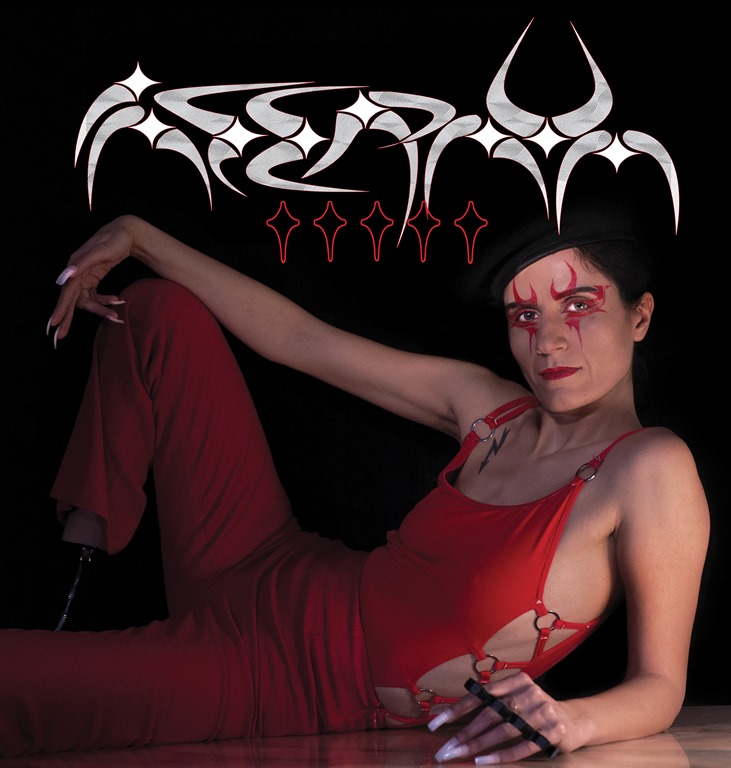
ƒauna’s style is billed as ‘dystopian avant pop’, and her second album is a magnificent mosaic of alienation. Vintage drum machine sounds click and pop out spartan rhythms, overwhich bibbling synths loop and ripple.
The press release emphasises the album’s dominant themes – facing down an uncertain future, dissecting new digital identities, the importance of political activism – and points to the fact that Infernum is very much an album of our times. But so much of the album’s intrigue lies in its juxtapositional positioning, its straddling of contemporary and retro. This also applies in absolution to the sonic makeup of the album.
The first track, ‘Primus’ has ƒauna outline – in a detached robotic voice – the circumstances surrounding the making of the album. It’s a perfect encapsulation of the album as a whole, a work of retro-futurism which may or may not be autobiographical. It’s a mistake to synthesis the artist and the art, and this of course connects with the issues of identity – in particular virtual and digital identities. Who is ever truly themselves on-line, in public, in company? In any context, identity is a construct, and ƒauna explores the layers of construction here.
Supposedly emerging from ‘a dark crossroads between conceptual pop, downtempo hip-hop, and the euphoria of the club’, these influences manifest primarily in sparse electro compositions which resonate with the kind of tape-looping experimentalism of the underground of the late 70s and early 80s. The structures and overall production are sparse, the compositions perversely disjointed, deliberately angular, with .
Then again, the rolling synth swell of ‘Death Fly’ and bouncy insistence of ‘Lonely at the Top’ are crisp pop, distilled down and refined to its purest, most immediate from, while elsewhere, ‘Went Home Got Lost’ pushes more overtly contemporary dance-orientated tropes to quirky but affecting effect.
It’s an analogue take on an analogous representation of postmodernism: the collision of past, present, and future, with no clear distinction between the boundaries. And watching those boundaries dissolve with every clipped, synthetic beat is fascinating, and in some strange way, quietly exhilarating.
English intergenerational duo Noisepicker are one of the new generation of two-piece acts who sound like full bands. Not by virtue of any trickery, but because they whack everything up full tilt and rock hard. Peace Off sounds like a band, albeit one with the guitars and drums dominating the mix.
There are so many shades, but for Noisepicker, it’s a spectrum of subtle blues that colours their lumbering, riffy racket. The songs are heavy, raw, the lyrics dark. It may mark something of a stylistic shift for Earl of Mars and former Lord of Putrefaction Harry Armstrong, but he still pours all the anger into it, his thick-throated vocal roar the perfect vehicle for this kind of heavy, heavy scuzzed-out stoner blues metal.
Pulverizing, slow, heavy discord worthy of Swans circa 1984 swiftly yields to swaggering heavy rock on opener ‘No Man Lies Blameless, which thunders away with the grainy grungy heft of Black Sabbath as filtered through Melvins. It sets the tone, and the tempo: Peace Off very much favours weight and groove over pace, the riffs big and gutsy (although when they do pick up the face, as on ‘O What Mercy Sorrow Brings’, they really do drive hard and fast.
‘A Taste of My Dying’ is the grittiest, grainiest blues, dark and dirty and slowed to a crawl. Under any other circumstances, you’d be thinking about grime and sweat, but at this low, low tempo, it’s more of a case of Led Zep on Temazepam. Armstrong gargles and spits the words to ‘He Knew it Would All End in Tears’ against a roar of guitars and crashing drums: there’s nothing fancy about Kieran Murphy’s style, and that’s a virtue, as the songs are focused in a fashion that delivers optimal force.
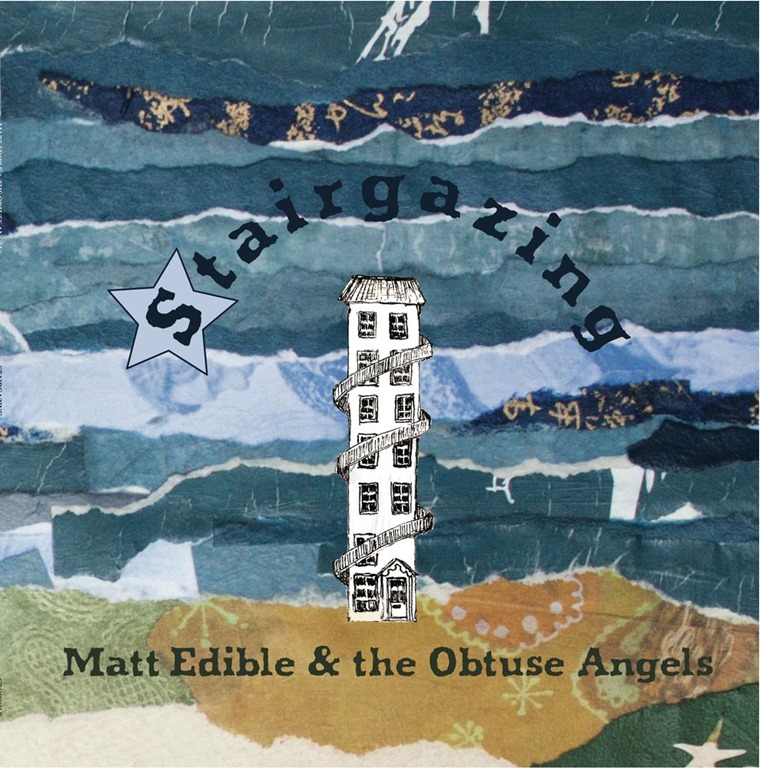
Having – what feels like an eternity ago – raved about The Holy Orders, I find myself with front man Matt Edible’s sort-of solo album. It’s a fair bit less fiery and more introspective than his work with the band (who recently made their live return and look like getting their shit together again before too long) – to re point that it’s largely mellow and melodic, and draws on laid-back 70s rock for its stylistic touchstones. It’s also quite poppy in places. This isn’t a criticism, but an observation…and unexpected. But then, I’m unfamiliar with Matt’s original musical vehicle, Edible 5ft Smiths, who apparently made ‘one and a half of the greatest undiscovered albums of the noughties before burning up in a small blaze of glory’, and of which the music on this album represents something of a continuation of a trajectory.
‘Advent Beard’ surfaced on-line a couple of years, and as Christmas-themed breakup tunes delivered with roustabout energy and a certain ragged charm. Hearing it in the context of an album, in mid-May when I’m sweltering in some quite unseasonal heat and feeling hayfevery feels a bit incongruous. But on reflection, it’s a song about the sentiment rather than the season, and while Stairgazing isn’t a wet, sentimental album, it is fairly reflective and introspective and – dare I say it – emotional in its tone and content.
The title track is a frenzied fury of angular guitars and vocals that are the sound of a man at every last one of his limits. And then it comes on a bit Dinosaur Jr, which is even better. Elsewhere, ‘Nightclubbing’ (not a cover of either David Essex or Iggy Pop) is a light, folksy-indie effort, and the sparse, piano-led ‘The Healing’, which ventures into post-rock grandeur, with its multi-layered vocals and epic, proggy instrumental play-out, offers another facet of Edible’s songwriting skills.
It’s Matt’s voice that really makes it, perhaps more than the material itself. The man has range, effortlessly moving between gritty and grungy, and soaring sort-of falsetto. In part comparable to James Dean Bradfield in tone and timbre, Edible simply has a great voice: affecting, versatile, listenable and affecting in all the right places,
Stairgazing doesn’t have the rock ‘n’ roll punch of anything by The Holy Orders, but that isn’t grounds for criticism: Matt Edible as delivered a solid and entertaining album that’s quite different, and all the better for it.
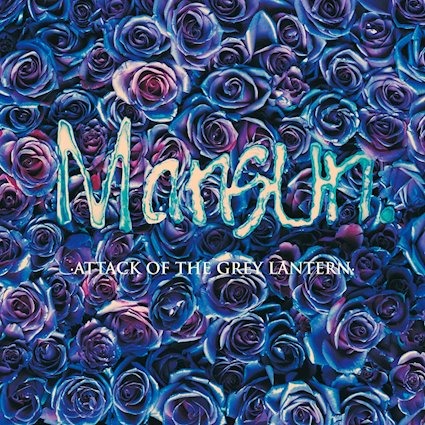
Mansun’s Six stands as one of my favourite albums of all time. It came at a particular time of life and in an era where anything remotely proggy was so out of vogue that it was amazing a major label would even release it. While not nearly as outré by comparison, it’s predecessor and the band’s debut, Attack of the Grey Lantern was a long way out of step with the rest of the indie / Britpop scene. It probably achieved success – and a reputation which has endured remarkably, as this reissue which marks its twenty-first anniversary attests – because of its idiosyncratic nature, rather than in spite of it. Its hitting the top of the charts seems as remarkable now as it did then: it’s a mixed-bag mish-mash of ideas, an oddball half-attempt at a concept album that collects a bunch of singles / EP lead tracks with material that was penned specifically for the all-important debut album. It shouldn’t work. It should never have worked.
It perhaps goes without saying, but I’ll say it anyway: this is very much one for the fans, and lovely as it is, does come with a whiff of cash-in, especially as it’s not even the first reissue the album’s been subject to. You may be forgiven for thinking the 2010 3-disc ‘collector’s edition’, which gathered all of the B-sides from the various attendant EPs and a bundle of acoustic versions, etc., had it more than covered, especially in the wake of the 2004 3-disc retrospective Kleptomania did a fair job of gathering EP B-sides and rarities alongside the material tat had been in development for the band’s fourth album, which was abandoned prior to completion.
Having kept Six on (albeit infrequent) rotation over the last (mumble) years (being inundated with material for review means I often struggle to find time to listen to my own collection. This has, over time, created a strange separation between music for work and music for pleasure, despite the fact the two very often become one and the same. I would also add that not only have I developed an unquenchable thirst for the new, but my difficult relationship with notions of nostalgia often keeps me away from the albums I played the grooves off in my more formative years, not necessarily because they’re painful or even because they’ve dated, but because they’ve become so ingrained in my psyche, I don’t actually need to hear them for them to be floating around in my head on spontaneous recall), I only revisited Attack of the Grey Lantern a few months back for the first time in a good five years.
From the bond-inspired string intro to ‘The Chad Who Loved Me’ through the brash indie-pop of ‘Egg-Shaped Fred’ to the instant classic that was ‘Wide Open Space’, it still stands up as a great album. The aching, soaring strings and unusual arrangements set something of a template, and if the rolling piano and orchestral layers of ‘Dark Mavis’ sound somewhat cliché in 2018, it’s important to remember that songs simply didn’t sound like this in 97 – and in terms of execution, they remain leagues above of those who attempted to emulate them. It was all in the extraneous and sometimes quite unusual details, the quirks and kinks that Mansun showed themselves to be different.
Did it need remastering? Listening to an MP3 promo doesn’t reveal a world of difference from the original. And that’s ok: there wasn’t anything wrong with the original. It just means that the remastered aspect is perhaps less of a purchase incentive than the additional unreleased material.
The demos are interesting: the drum-machine led version of ‘Dark Mavis’, which borders on goth stands as one of the most ‘in progress’ recordings, although many aren’t radically different from the final versions beyond being a bit rougher. As for the radio sessions… going back to the band’s October 95 Peel session proves informative, and contextualises the ban’s evolution, as well as demonstrating just how rapidly they developed from brash, bratty indie into a different kind of beast altogether. Draper’s at his most nasal and whoopy on ‘Skin Up Pin Up’ and melodic signatures which would resurface in later songs are evident here. Songs like ‘Naked Twister’ are delivered in classic session style – recorded quickly, they’re less polished but more direct than their official studio counterparts. And then there’s the fourth disc, the DVD…
With 21 years elapsed, the timing feels right, and seeing Paul Draper’s solo return being positively received, there’s a sense that the Mansun revival is well under way, and deservedly so. This, however, is unlikely to win any new converts: the mere cost and overwhelming volume of material on a four-disc version of an album is simply beyond the casually interested or the passing fan. Whether it’s satisfying a need or milking the existing fan-base I wouldn’t like to say, but as reissues go, this one is at least comprehensive and well-assembled.
Just as I don’t really do jazz, I don’t much do country, either. But for every rule – or perhaps more of a broad, general guideline – there necessarily has to be an exception. So here I am, sipping hot black coffee having just ejected an album by Marc Sarrazy and Laurent Rochelle, which goes way over the limit on the jazzometer and has left me shaking my head and thinking there’s just no way I can review that objectively, and looking at a plain white paper sleeve stamped with six song titles under the header ‘J.O.M.F BLOOM’.
The biographical commentary that ‘the band is moving more slowly these days, with core members Tom Greenwood and Michael Whittaker living in the more rural corners f Northern California’ is perhaps an understatement: Bloom was a full three years in the making. But it’s not just its evolution that was gradual: compositionally, too, the pieces are slow-growing and sparse. The quietly picked guitar notes resonate outwards as woodwind trills over the hills on the instrumental intro piece, ‘Pipe’ It’s kinda quiet, sort of ambient. A sudden swell of noise ends abruptly to make way for the sedate country ramblings of ‘Radiating’. If you dig downbeat country tines that drag on for over eight minutes, this is going to do it for you bigtime. If you don’t… It’s laid back to the point of horizontal, the lyrics drawled rather than sung, and as such decipherable only in snippets.
But while this is very much a country album, it’s anything but conventional or straight ahead overall. ‘Wreck’ is slow-building, initially just guitar and Greenwood’s cracked croon. But before long, a tumult of crashing cymbals, overloading electric guitar feedback and straining saxophone create a glorious cacophony. Wild brass and woodwind shriek and squeal all over the raucous stomp of ‘Strike’. A sort of country/blues heart pulses beneath the chaotic racket that pummels in all directions and drives toward the horizon of abstraction. ‘Wildgeese’ brings dolorous trudging before the lo-fi plod of ‘Golden Bees’ thuds its way to the album’s conclusion in a muddy haze of echo.
On Bloom, Jackie-O Motherfucker fuse the mellowest, most downcast of country with the most awkward jazz dirges, which drone and wheeze and scrape at divergent angles across the linear country compositions. It may be country at its core, but it’s a whole lot more.
A single, repetitive beat rings out for what feels like an eternity. With nothing else to focus on, the mind begins to conjure deceptions: is it entirely consistent in tempo and timbre? Or are some beats vaguely out of step by an infinitesimal fraction of second? Are some strikes harder or softer than others? A sparse chord rises up, slowly, then stops abruptly. The beat goes on. Another chord swells…. Repeats, disappearing the same way as the first. Then just as something threatens to build, the beat stops. The notes drift, without form, direction, or guidance. Eventually, just as tension and a certain confusion begins to mount, everything comes together: the rhythmic thud, the strings, the soft ambience and the faint strains feedback, combine to create a resolution. Unsteady, somehow incomplete, but a resolution. And so it is that ‘Neither Flesh not Fleshless’ sets the tone for At the Still Point of the Turning World.
The album takes its title from T.S. Eliot’s ‘Burnt Norton’, the first of his Four Quartets sequence:
IV
Time and the bell have buried the day,
The black cloud carries the sun away.
Will the sunflower turn to us, will the clematis
Stray down, bend to us; tendril and spray
Clutch and cling?
Chill
Fingers of yew be curled
Down on us? After the kingfisher’s wing
Has answered light to light, and is silent, the light is still
At the still point of the turning world.
This collaborative work is preoccupied with time and how we experience it, and the accompanying blurb observes how the two artists were very much working both with and against one another in the creative process – which seems an apt analogy for the human relationship with time itself. On the one hand, it’s simply a concept, and an intangible: and yet we see and feel it, in the short and long terms: there is no escaping time, and no-one ever fought time and emerged triumphant. The still point is but the blink of an eye, and the turning is endless despite its invisibility. These are the irreconcilable and dichotomous tensions which inform the sonic push-and-pull Gama and Fernandes explore and exploit in these compositions, which are simultaneously smooth but turbulent.
‘The Patterns is Movement’ is a slow swell and glide of sombre strings pitched against a desolate but mournfully graceful piano: the form is vague, but there is something rather post-rock about the brooding disquiet. It segues into unsettling, rumbling industrial clanking way off at a distance. The haunting clangs of metal are cold, without comfort. I’m pulled back into the mindset of the worker: the ghosts of heavy labour still haunt the structures of the tertiary industries which now dominate the western world. The final coupling of the sparse and altogether lighter ‘Lucid Stillness’ and ‘Shaft of Sunlight’ pitch the album to a calmer, more redemptive close.
While much of the movement within the compositions on this album is slow, and often somewhat non-linear and marks a trajectory that’s divergent, indirect and non-evolutionary, there is, nevertheless, an indisputable sense of movement that’s perpetual.
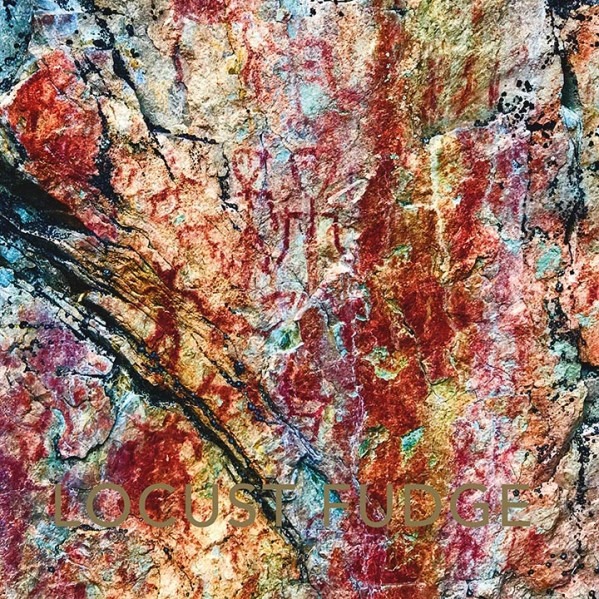
My first thought on hearing the opening bars of the album’s first track, ‘Light & Grace’ is ‘wow, this sounds just like Dinosaur Jr!’ My second thought, on the vocals starting is ‘No way, this really sounds like Dinosaur Jr!’ Sure enough, J. Mascis is listed among the long list of collaborators on this, the first Locus Fudge album in 20 years. Mascis has nothing if not a unique signature sound, often aped but never replicated. The track in question rumbles along for over eleven minutes, the singing soon giving up for the guitar solo to do the talking. Less characteristic of Dinosaur Jr is the way in which the solo comes to battle against a rising tide of extraneous noise, and the song itself finally collapses to a churn of dark ambience and feedback. As it happens, large chunks of Oscillations sound very Dinosaur Jr, and the overall vibe is very much late 80s / early 90s US alternative rock.
This is also very much the sphere to which Locust Fudge belong: their two previous albums, Flush and Royal Flush, released in 1993 and 1995 respectively, were released on Glitterhouse and saw the German duo aligned to the grunge movement. The EP, Business Express (1996), saw them push into more electro/industrial/krautrock territories, and even include overt elements of drum’n’bass in the mix. Those records are almost impossible to find now and the YouTube uploads of the tracks aren’t available in the UK. There’s something strange about the idea of being unable to access something on-line now. Whatever happened to the global village? Marshall McLuhan and Quentin Fiore pitched the global village as the territory of electronic media; with territorial divisions over music rights, it feels much more like a map of war than a plan for peace.
Oscillation reminds of simpler times – but more than that, seems to belong there. It’s not merely a nostalgia work, but a heartfelt return. You can’t exactly criticise a work for being ‘derivative’ when the bulk of the artists it’s derivative of feature.
‘Hormones’ slips into the easy but wonky country vibes of Pavement, while the motoric groove of ‘No Defense’ has some gloriously skewed guitar work. And then…. then there’s a wild frenzy of discordant jazz all over the middle eight. The big sax break on ‘Something’s Wrong’ comes on like The Psychedelic Furs, over a big, crackling valve guitar buzz, a melody reminiscent of Dinosaur Jr’s ‘Turnip Farm’, and lyrics that appear to present a process of self-dismemberment.
It’s a great album – not of its time, but of its spawning era. And now I’m off to revisit You’re Living All Over Me. Just because.
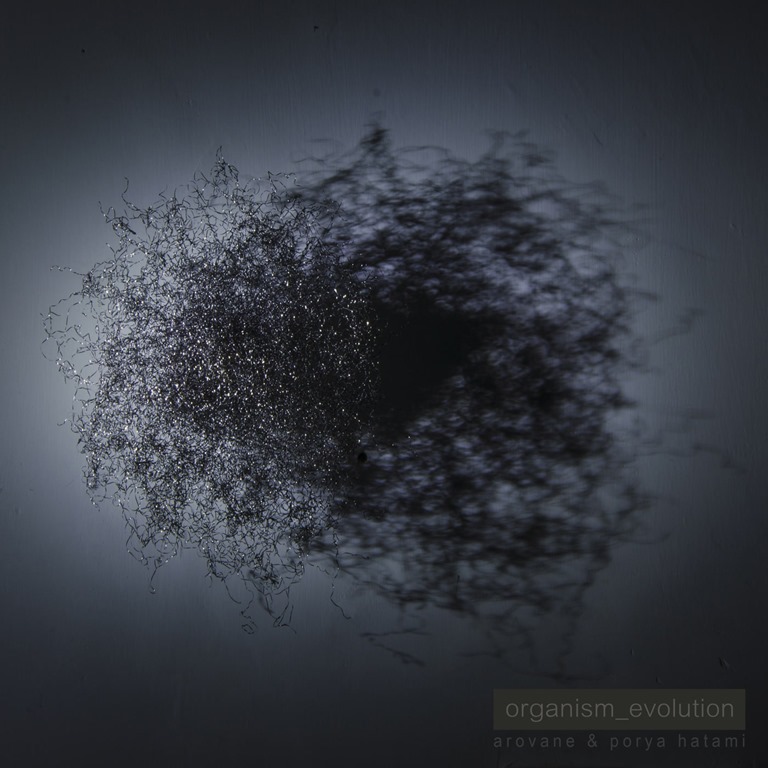
The title is, in many respects, self-explanatory: the successor to last year’s Organism, organism_evolution finds the collaborative pairing of Arovane (the recording alias of Berlinbased electronic artist Uwe Zahn) and Porys Hatami, who, I gather, is a prime mover on the Iranian electronic underground.
The 23 pieces which comprise organism_evolution – and whether or not this number is coincidental or confluent with the 23 enigma is perhaps an extensive aside too far – are sparse, elliptical sliver of minimalist electronica. The rhythms are cyclical, emergent, rather than overtly beat-driven: there’s little to nothing immediately identifiable as percussive.
With the exception of a brace of expansive, seven-minute sprawlers, the pieces are brief, largely sub-two-minute snippets and fragments, which range from undulating swampy miasmas of amorphous, undefined ambient smog, to clicky, crackly sketches of dissonant arrhythmia. Slow, bulbous pulses, gurgles and spiralling buzzes, woody knocks and hushed, wispy undulations weave fractal patterns. It’s a collection of intangibles, sounds in ever-shifting states and perpetual transition, the forms conforming to no distinct shape or structure.
The pieces aren’t only brief, but adopt a microscopic focus – the accompanying blurb lists among the processes involved in the album’s formulation ‘modular and granular synthesis, spectral processing, resonator/modal synthesis’. The technicalities of synthesiser work are beyond my ken: ultimately, I’m interested in the output rather than the input, and its effects as a listening experience.
At times, the experience is discomfiting, the eerie atmospherics creating unsettling disharmony as ominous low notes hover, hum and scrape against jittering skitters of treble that set the teeth on edge. The extreme use of stereo in places creates an immersive – if disorientating – three-dimensionality. But for all of the perpetual movement and the speed of the sonic transitions – sounds and ideas pass before they’ve even registered, giving organism_evolution an air or ephemerality – the overall effect is one of a work which flows.
The press release provides previous little detail about the release, or the artist, beyond a brief summary of his broad interdisciplinary pursuits which include dance, theatre, live electronics improvisations and audiovisual performances and installations. It’s quite an expansion on his biography last time I encountered his work, back in 2011, when he simply described himself as a ‘sound artist’. That was when he released the ambient-orientated exploration usure.paysage.
Transfert/Futur is a long way from ambient. Heavy on the synths, it’s a beaty work that packs some considerable attack amidst the airy pulses and breezy blossoms of effervescence. It contains two tracks, the first of which, ‘transfert (299 792 458 m/s)’ is the audio element of a touring sound/light installation from 2017. On CD, it’s simply sound without the light, and clearly, the interactive and multisensory aspect of the project is nowhere near fully represented. Nevertheless, musically, it works. Over the course of some eighteen minutes, Bernier builds the atmosphere but above all, builds the beats. Scratchy, stuttering, synthetic, exploding in all directions, the rhythms pop and thrum, marching surges halting abruptly to change direction before powering forwards once more embarking on a propellant trajectory. The surround synths glide, pop and bubble, but mostly click and bleep and elongate, morphing and stretching longways, occasionally plunging into expansive, oceanic depths and venturing into eerie subaquatic territories. With so many false starts, false ends, twists, turns and unpredictable stammers, it’s anything but linear.
The second composition, ‘synthèse (299 792 458 m/s)’ has no such obvious context attached, but again is centred around warping synths and woozy bass tones wrapped around bold beats. Over the course of twelve minutes, it swerves from oblique bleeps and minimalist electronic squiggles and arabesques, via slow-building crescendos, to passages approximating straight-ahead dance music that you can actually get down to. As the track progresses, its form gradually dissolves. The soundscape is increasingly rent with bleeps and whispers and tranquillity always gives way to tension after a few uncountable bars. Microbeats and circuit spasms come to dominate the swell of hyperenergetic electrodes in synaptic collapse. Finally, nothing is left but a quivering whistle which slowly decays to nothing.
What does it all mean? Probably precious little. Transfert / Futur is about the journey, and the algorithms, rather than the meaning. It’s not a journey that traverses from A to B, but burrows its way into its own unique space.
The title sounds like a Radio 4 quiz, or perhaps some selections for ‘Call my Bluff’. The accompanying blurb outlines how the album consists of three nonsensical musical conversations between Malaysian nylon guitar player Goh Lee Kwang and Norwegian bass player Christian Meaas Svendson, and describes it as ‘the story of the first encounter between two different mindsets, nationalities and generations trying – and totally failing at – making any sensible dialogue with their respective musical languages.
Success and failure are relative, of course, and one may contend that there’s no success like failure. It’s in the disconnect between artistic vision and the material realisation that unexpected creative outcomes emerge. The three pieces – I would probably hesitate to describe them as ‘compositions’ given that they are, in effect, haphazard jumbles of notes played over and across one another – are indeed sonic babble. But it’s still just freeform jazz to my ears. And for once, this isn’t a complaint or criticism.
The description reminds me of those days when every conversation feels like a misfire, and you miscommunicate with everyone you encounter. Try as you might, you never connect as intended. A jovial quip lands as an insult, a reply to a simple question leaves your interlocutor nonplussed and you realise you’ve misunderstood or misspoken, or otherwise just gabbled a stream of random bollocks for no apparent reason. You question whether the fault lies with you, or the world at large. You burn with shame. You want to hide away, an avoid people for a while. I say ‘you’; I mean me, of course, and as usual.
It takes a certain – nay, special – ability to separate and absorb any shame or embarrassment to place a document of those misfires and disconnects out into the public arena with the free admission of failure. But then again, failure in intent does not necessarily equate to artistic failure. And the disjointed, discordant jumble of notes on the three pieces – respectively entitled ‘Gibberish’, ‘Balderdash’, and ‘Drivel’ are entertaining and stand as art in the sense that they document a collaborative creative process.
At the heart of Gibberish, Balderdash and Drivel is an exploration of language, and the apparent obstacle of linguistic disparity. I’d long assumed -and believed – that the language of sound transcended linguistic boundaries. But on delving into the development of this skewed collaboration, I realise that while this may be broadly true, it is not a universal truth, and am reminded that context counts for a lot.
But the language itself matters. Dialogue doesn’t have to have explicit meaning or linear cohesion to convey something. It’s as much about interpretation as intention: the receiver / listener will inevitably bring their own perspective and one man’s throwaway nonsense is another’s serious art. The accompanying pencil for the owner to draw their own art into the blank white cover is a nice touch, which adds to the interactivity. The listener is inevitably – and incontrovertibly -implicated in the process, and this inclusion only serves to accentuate this point.
And for all its self-effacing flippancy, Gibberish, Balderdash and Drivel stands as a work of art. The very word selection is telling. In dismissing its very own existence as lesser, it does so using elevated language, indicative of an advanced and expanded vocabulary, while also adhering to the rule of threes. This is not by any means an illiterate work. Quite the contrary, in fact: Gibberish, Balderdash and Drivel is a celebratory work.



 Aural Aggravation