Posts Tagged ‘Review’

Mortality Tables – 7th June 2024

Christopher Nosnibor

Mortality Tables have continued to release titles from their ‘Life Files’ series at a remarkable rate, with instalments 18 and 19 landing in May, and hot on their proverbial heels, this, number 20, in the first week of June.

The premise remains consistent, namely ‘Recordings of places, people, objects, moments in time, environments and quotidian events [which] are shared with a range of artists working across different disciplines. Those artists are free to respond to the recordings in any way they like. And so, as ever, the field recordings, courtesy of Mortality Tables main man Mat Smith provide the foundation and inspiration.

Killiegrew Monument is a peculiar thing. Located in Falmouth, and intended as a memorial to the last surviving member of the Cornish family, the monument is a sharp obelisk constructed in 1738. It looks altogether more contemporary, and ultimately anomalous with its surroundings. And one might say that this release is similarly anomalous. I can imagine that beholding this curious construction would inspire an array or reactions. But why the fuck would you play a stone monument with a sharp stone? Is that really one of the responses you’d likely have to coming face to face with such a construction? Well, perhaps, if you’re possessed of an avant-garde mindset, whereby instead of reflecting on the origins of The Wind in the Willows, you find yourself contemplating ways of making unusual noises.

Once again, when it comes to the ‘Life Files’ series on Mortality Tables, we don’t know what the source materials actually sound like.

‘Killigrew Monument Played With A Sharp Stone (Part One)’ is an odd sound work: there’s chatter and ambient drift and scratches and shuffles and scrapes, but what on earth is going on? Seagulls wheeling and cawing – and on those squawks the sound echoes and reverberates, and the collage of sound collides with a strange rendition of ‘One, two, three four five, once I caught a fish alive’.

There’s lots of processed echo and cawing gulls at the start of ‘Killigrew Monument Played With A Sharp Stone (Part Two)’, as well, and it does, in some respects, sound like someone crooning abstractly into a child’s echo mic just to see how it sounds. The longer of the two pieces, at almost thirteen minutes in duration, it creates a deeply strange and disorientating atmosphere, which is likely evocative of this curious monument, which stands out of time and out of keeping with its surroundings as a testament to human folly, and, ultimately to vanity.

Too abstract to be ‘songs’, too much happening to be ‘ambient’, the result is a haunting and somewhat disorientating soundwork of a rare quality.

AA

a4230686863_10

Bearsuit Records – 31st May 2024

Christopher Nosnibor

There was a time – not so long ago – when I would come home from work and struggle to nudge the front door open with my shoulder for the mountain of CDs that had been dropped through my letterbox, along with the occasional ‘sorry we missed you’ card telling me I had a parcel at the depot awaiting collection or to arrange redelivery, and more often than not it would be some vinyl, and all of it promo material for review. I had a box – which was initially a shoebox, but later replaced with something larger – which was my ‘to-review’ box, after the pile kept falling over once it reached an unsustainable height. It was a storage nightmare, and I still have boxes containing quite literally thousands of promo CDs with press releases folded up with them, in boxes in the walk-in cupboard and the end of my office, which is, in truth, too stuffed with boxes of CDs to squeeze more than a toe into, rather than actually walk in.

Working in an office as I did then – rather than at home – I would take a bundle of CDs in a jiffy in my bag, and sit and listen to them as I worked. It beat enduring the often moronic drone of the people around me, and I’d tap out notes which I’d email home to myself to flesh out into full reviews in the evening.

My working method has changed rather since then, and while still working the dayjob, I’ve barely set foot in an office other than the one in the back bedroom of my house since lockdown. I haven’t received stacks of CDs in the post for a similar length of time, if not longer. For all of practical issues around the stacks of CDs, I do kinda miss it, and this is one of the reasons I always get a thrill at the arrival of a disc in the mail from Dave Hillary, who runs Bearsuit Records. The other, and not insignificant reason I always get a thrill at the arrival of a disc in the mail from Dave is that I’m eager to discover what mad genius work the label’s releasing next. I enjoy slipping the disc in the external CD drive I have attached to my laptop and soaking in the strangeness that spills from my speakers: I’m never disappointed.

I love the fact that I still get CDs in the mail, with promo cards and handwritten notes and so on, from Bearsuit, not just because of the joy of the physicality and the personal touch, but because it’s emblematic of the label as an entity. It does what it does, regardless of whatever else is happening, and it releases music the likes of which you simply won’t find anywhere else.

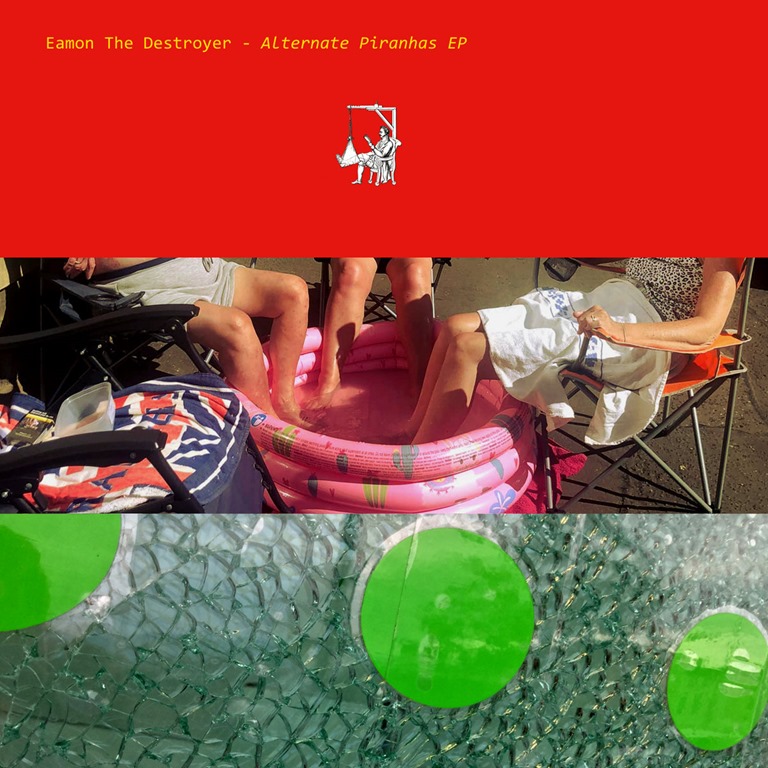
Eamon the Destroyer is a classic case in point. Another typically enigmatic artist in the Bearsuit tradition, Eamon the Destroyer has enjoyed a great run of releases to date. Debut album A Small Blue Car was a work of fuzzy, minimalist , downtempo brilliance. A sad, introspective work, it was unexpectedly touching for something so overtly odd, and follow-up We’ll Be Piranhas pushed further into forging songs that straddled the dreamlike and the nightmarish, a disorientating, discombobulating work that delved deep into the psyche in a way that felt like invisible fingers creeping inside the cranium and directly massaging the brain.

And now we come to the more or less obligatory counterpart release. Instead of the standard and expected remix EP, Alternative Piranhas gives us outtakes alternative takes of tracks from the album. A cynical voice might ask why they didn’t make the album cut, but there are myriad valid reasons: an album need to cohere and sometimes even the best tunes don’t fit with the flow, and similarly, the mood of one take or mix may in fact be better objectively, but not quite sit with the context.

And so it is with the five tracks here. All five appeared on We’ll Be Piranhas. While exactly the same length as its album counterpart, ‘A Pewter Wolf’ presents a quite different mix: the organ is much more boomy, more ‘churchy’ than on the album version, while the guitar sounds, almost buried on the album blurred and hazed out low in the mix, are more up-front and gritty here.

The version of ‘Rope’ on Alternate Piranhas seems to be in a different key, and is much grainer, murkier and messier than the more polished album take, and it’s more abrasive, more aggressive, with the vocals more up-front, and the result is that I found myself hearing thee song anew and soaking in the anger which permeates it, less obviously on the other version, tempered by the more mellow mix.

Overall, the versions on Alternate Piranhas are rougher, less ‘produced’, and it’s not difficult to discern why the versions chosen for the album were the ones they were. The album worked as a cohesive set, with an even, smoothed-out sound – well, in context – but Alternative Piranhas provides an insight into the process, which is never more apparent than on ‘The Choirmaster’. It’s not radically different… but it is different, while the alternative take of ‘My Stars’ is half the length of thee album and feels like a sketched-out demo. But again, it possesses qualities absent from the album version, just as the album version has elements which are absent here, including another five minutes of sound.

Alternate Piranhas feels more overtly rock than its progenitor, and perhaps it is, but above all, it’s a source of enjoyment to revisit these songs from a different perspective.

AA

a4099667252_10

The Record Machine – 12th April 2024

Christopher Nosnibor

The latest single, ‘Forget About You’, from ‘nouveau post-punk troubadours’ Monta At Odds’ is pitched as ‘a dark-natured opus about resisting attraction, especially when the bound proves hazardous.’

The trio, consisting of Mikal on vocals, Krysztof wielding the baritone guitar, and founding member Dedric polymathing on all other sonics are aiming for a ‘danceable mixture of eras past and present to match this raw but crisp sound.’

It’s very much of the school of neo-new wave / post-punk from circa 2004-2006 – think of Editors breaking through, Interpol’s Antics, and the likes of The Organ, and The Cinematics – particularly The Cinematics, in fact – with the electro element of She Wants Revenge’s debut. It’s post-punk with that clear contemporary slant, and a heavy dose of New Order’s buoyancy and accessibility. There’s shade around ‘Forget About You’, but a lot of sunlight and vibrancy, too: the crisp, clean, vaguely brittle guitars positively jangle against a thumping disco beat, and the melancholy is cut through with eyes cast to bright blue skies and a forward-facing optimism.

It’s only while writing this that the fact 2004 was twenty years ago has begun to register. What goes around comes around, of course, but twenty years is a generation, broadly – it seems, in my ever-lengthening experience – and the time it takes for kids to start picking up their parents’ record (or CD or whatever) collections and start drawing influence and inspiration. I say ‘or whatever’ because I do worry about the future. I worry less about styles rolling round in a repetitive cycle than what music will be coming through another twenty years from now. How is it going to go when it comes to teens raiding their parents’ Spotify playlists and finding nothing but Ed Sheeran, Taylor Swift, and, er, does anyone listen to anyone else? Of course I’m dramatizing slightly, but the point is that so much of the mainstream has become focused on quite literally a handful of artists – and what will be their legacy? Does Sam Smith capture an element of the zeitgeist beyond his identity? What does Dua Lipa speak of, and who does she speak to? A part of the problem is that where we used to have shows like Top of The Pops, The Tube, The Roxy, The Chart Show (with its alternative charts and other segments) and the Top 40 on Radio 1 (followed by something rather more alternative), the charts were pretty open and it was possible for stuff that wasn’t slick major-label sonic wallpaper to chart. This meant that it was possible to encounter something different without having to go to great lengths to seek it out. Now what do you do? Where do you go? How do people source music beyond the endless pumping of algorithms?

‘Forget About You’ hits me with a sense of nostalgia I had not anticipated, and which isn’t welcome: for some, nostalgia brings golden-tinged fuzziness and a warmth, an uplifting sensation. For me, it’s more like the sand tricking down in a sand timer, a slow-sapping pull in the guts, a seeping sadness. 2004 was twenty years ago. Less ‘yay, good times’ and more ‘fuck, I’m that much closer to death and twenty years have evaporated with depressingly little to show.’

Nostalgia isn’t a defining element of ‘Forget About You’: that’s simply something I bring to the table, highlighting the way that reception and perception colour the way an individual responds to music. It’s uptempo and catchy, bouncy even, and ultimately danceable, and neatly balances darkness and pop.

AA

681414

Skoghall Recordings – 5th April 2024

Christopher Nosnibor

I don’t really know too much about this release. It came my way via one inbox or another, with a download, but no cover art, no press release. And for some reason, I had expected it to be longer. But it’s a Skoghall release, and features Dave Procter (Legion of Swine, Dale prudent, Wharf Street Galaxy Band, etc ad infinitum) and some mates.

We’re looking at a couple of tracks, both short of five minutes. Nothing wrong with that – there’s a lot to be said for keeping things simple, and keeping things concise. Do I need the backstory, an essay on the contributors and their backgrounds? No, no I don’t. No-one does, really.

I do feel we’ve become altogether excessively invested in the wrong details in recent years. Time was when an act could release a record, it would be reviewed on its merits, or it’d slip under the radar and all we’d have would be the music. There would often be no mention of who did what on the record., and there would of course be no website, no source by which to obtain details of personnel or a bio. Nowadays, journos – people like me, although I don’t consider myself a music journalist by any means – get picked up on the slightest inaccuracy, we get asked to change spellings and correct who played bass, amend the cover art and the release date… This is not right. The press’ purpose is to independently proffer opinion, to critique, and where facts are missing, perhaps plug the gaps with assumptions, why not? While reviews are a part of the promotional cycle, it’s important – at least for me – to be apart from it all. In short, press is not PR, and should on no way feel obliged to give frothingly enthusiastic reviews simply because they’ve received an advance copy.

I digress, and admit that I tend to provide positive coverage of the releases which come my way which I like, rather than slapping down the releases I’m less keen on. When you get fifty or more submissions a day, you can afford to be selective, and besides, life is short and I’m not going to spend mine squandering energy on stuff I have no interest in.

I have a strong interest in this, though.

What’s on offer are two slices of minimalist electropop with a keen late seventies / early eighties feel. A single droning note hangs throughout the first track and a drum machine clips and clops away recreating the sound of early Young Marble Giants – only here, Procter drones and stutters a blank, low vocal delivery, half-robotic, half crooning, and drifting astray in a swamp of reverb.

The (virtual) flipside is dronier, noisier, a serrated-edged grating drone providing the backdrop to a challenging piece where a clanking percussion saws away and Procter rants -away in the background, again, immersed in reverb and low in the mix – about control and its uses and abuses. Now you’ve got control… what are you going to do with it? He asks, antagonistically.

The answer, well, it depends on who you’re asking. Power is a difficult thing, and – so hark back to an early SWANS track, what we see is power for power’s sake – use and abuse, but more of the latter. Show me – when was power last used for benevolence? I don’t want to be dragged down in this now, and there is plenty of mainstream outrage in circulation, so let’s get back to the release.

It’s succinct, it’s tense, it’s uncomfortable. Bring on ‘Two’.

AA

a4206158382_10

Mille Plateaux – 22nd March 2024

Christopher Nosnibor

What’s often fascinating to me as someone who writes about music quite extensively, is to observe the avenues other writers explore, particularly when engaging with music that’s ambient, obscure, or otherwise difficult to take a hold of and to pin down. This fascination is amplified when the music, either by its inherent nature, or by virtue of explanatory words from the artist, has a foundations in a theoretical or conceptual context.

Achim Szepanski has been tasked with a challenge when it comes to the notes to accompany

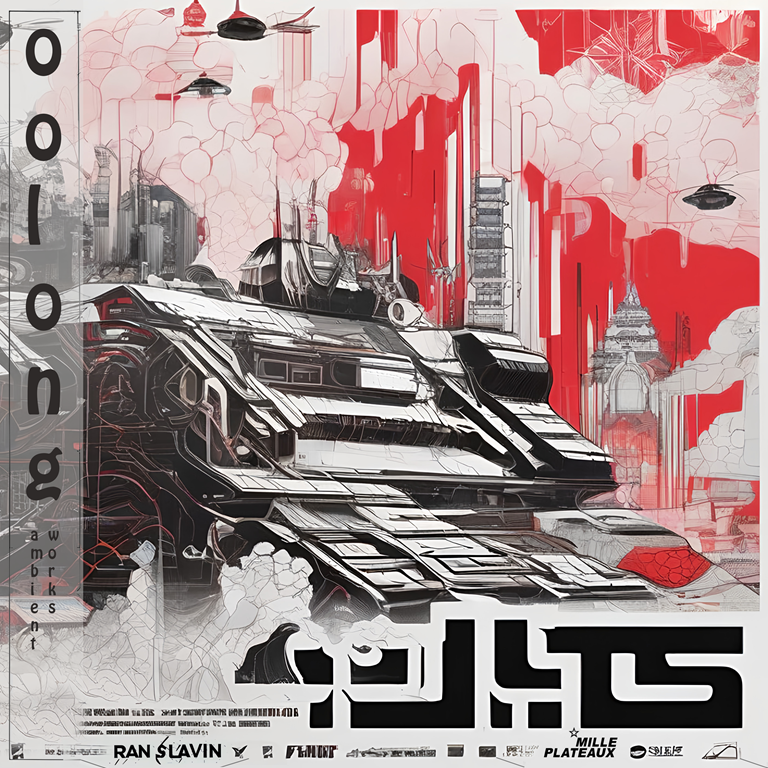
Oolong: Ambient Works, which is the 17th studio album from multi disciplinary artist Ran Slavin, which is pitched as ‘a 74 min drone-ambient-minimal-symphonic infused LP that takes after various teas in the far east.’ To heighten the experience, each track is accompanied by ‘a slow and atmospheric visual journey shot by RS in East Asia and the total can be experienced in total and joined as an immersive 74 minute journey.’

Szepanski helpfully explains the layered meanings in the translations of the word ‘oolong’, and expounds the complex interconnections of tea and dragons through a filter of Felix Guattari (which isn’t entirely surprising, given the label releasing it). He grapples with ‘the minimalist concept of tea architecture’ and the way in which ‘Not only the centripetal, but also the centrifugal orientation of the sound is imaginary.’

While the visuals clearly form an integral pat of the project overall, I shall preserve my focus exclusively on the audio release, and in advance of this draw the distinction between audio created to provide a soundtrack, and visuals created to accompany an audio work, because while Szepanski discusses at length the relationship between the visuals and the tea path and the simultaneous limitations placed on the work by the visuals and their capacity to enhance the experience, Oolong: Ambient Works is an audio release or an ambient persuasion, as the title suggests.

The seventy-four minutes is divided into eight individual pieces, with titles such as ‘Grand Jasmin’ and ‘Assam Jungle; as well as others which are less overtly tea-derived, like the first composition, ‘Time Regained’. It’s fifteen minutes of slow-simmering ambience, the levels of which fluctuate and catch, the glitches rupturing the smooth surface of the soft sonic fabric.

Szepanski makes an important point when he writes ‘It is impossible to know exactly what the individual sounds signify. Sometimes it might be the intention to hear the sounds of nature. But it’s not a question of identifying its source and its effect.’ And so we come to what is, for me, the crux of the ambient listening experience, whereby the source of the sounds is far less significant than what the listener hears. Not even what I hear as a listener, although I can only speak and interpret for myself, and the beauty of this experience is that however much Slavin strives to imbue this work with meaning, it cannot be imposed. Slow pulses bring a rhythmic element to this otherwise abstract piece, which is deeply calming, but occasional warps jolt the listener from their state of tranquillity like a prod.

‘Butterfly of Ninh Binh’ flits by with crackles and scratches by way of disturbance, and the introduction of static and ersatz surface noise to recordings is a curious one, as something which only became a feature with the advent off digital audio. Those who have come to vinyl since the renaissance are less likely to relate, since vinyl is now a plush commodity and not something people leavy lying around or use as a coaster or whatever as was commonplace in the sixties, seventies, eighties. But such interference is integral here: Slavin’s approach to ambience on Oolong is subtly different, and introduces just enough dissonance and discomfort for it to be not entirely comfortable.

The ten-minute ‘Ruby Ceylan’ is soft and ripping repetitive and hypnotic, but something – perhaps the abstract moans, perhaps something else – is just off.

Iroh, in Avatar: The Last Airbender, is a keen advocate of the calming properties of Jasmine tea, and I get a far stronger Jasmine connection from this – the original animates series, that is – than from ‘Grand Jasmin’ here – the album’s shortest track is subtle and soothing, but also marks a change of texture with a thumping beat which echoes away hard and fast beneath its slow-swelling outer layers.

‘Himalayan Flower’ unfurls slowly and with pronounced percussion, before the ten-minute ‘Summer Monsoon’ brings the album’s conclusion. A slow, mesmeric, soporific cloud of ambience passing by, with occasional clangs and abstract interruptions which echo through the drift, this is a real; eyelid-drooper which suggests it’s time to sleep, or time for a coffee.

AA

MP69_front

Mortality Tables – 8th March 2024

Christopher Nosnibor

Mortality Tables once again bring us a release that’s deeply immersed in the spirit of the avant-garde, and about setting defined parameters within which a project must function. When it comes to such things, it’s not about dictating restrictions, but about providing focus. Not all artists like to work to guidelines, although a prompt can open infinite possibilities for interpretation, and as such, there’s creative potential in working in such a way. And so it is that, as the accompanying notes explain, ‘Central Park: A Picture-In-Sounds is a site-specific performance piece, for one or more performers aged between ten and 95 years old. It is a tribute to the multi-disciplinary work of Charles Ives that will be published in 2024.’ We go on to learn that ‘To execute the piece, each performer will refer to a map of Central Park divided into areas representing the life expectancies listed in an 1874 US insurance industry mortality table. Each performer will identify an area of the Park corresponding to their life expectancy in 1874 and make a field recording lasting precisely eight minutes and thirty seconds.’

These are some highly specific instructions, but, once there, what performers are essentially looking at is eight and a half minutes to express as they feel appropriate, and of course, here, the possibilities are near-limitless. How one responds to a setting, a time, a space is, after all, a purely personal thing. Just as no two people’s lived experiences are the same, so no two responses will be identical.

This is a document of Mat Smith’s second performance, recorded on. 9 February 2024, at 16:13.

His own commentary is illuminating, and merits citation here, for context:

‘I was 47 years old when I performed ‘Central Park: A Picture-In-Sounds’ for the second time. Although I was a year older, when I looked at the life expectancies table and cross-referenced that with my divided Central Park map, it indicated that I should once again perform the piece near Strawberry Fields… The character of a place is in a continual state of mutability, and that was evident when I began the piece. It was a different season, the trees were barren and sleeping, snowdrops were springing up everywhere, and there were significantly more people in the park than the day I performed the piece in June the previous year. A carpet of dry leaves covered the area I set myself up in, crispy underfoot, waiting to crumble into dust.’

He recounts how ‘Someone at the John Lennon memorial began singing. Somewhere near the path, a street musician with what sounded like an amplified violin began playing a rendition of ‘Jingle Bells’, even though Christmas was retreating rapidly into the past. In between, he would play a plaintive wistful little coda that seemed so at odds with the relatively gleeful ‘Jingle Bells’. Often, his playing is accompanied by the harsh ringing bells of bikes as they whizz along the bike paths…’

His narrative creates a vivid – and moving – picture of the scene. It’s easy to think of these kind of performances taking place either with some sort of ‘arrangement’ and a cluster of observers who are ‘in the know’ gathered as witnesses, or in seclusion; it’s not so obvious to consider the actuality of creating sonic art in a public space, and all of the randomness and happenstance which that entails.

However, Central Park: A Picture In Sounds (Performance #2) captures this perfectly. The combination of the breeze and traffic creates a constant roar in the background. Birds chirp in abundance – far more than one might associate with February, at least here in England – and dogs yap and bark constantly. You can’t move for bloody dogs anywhere, in parks in fields, post-pandemic, it seems as if there are more dogs than people. But for all the ambience, all the thronging noise – and this really does remind that even quiet spaces really aren’t in large cities, with blaring radios and chatter and that constant roar – this is mostly eight and a half minutes of ‘Jingle Bells’ being played on a fiddle. In February. Bloody buskers.

But, as a snapshot field recording, Central Park: A Picture In Sounds (Performance #2), is absolutely alive, buzzing, bustling, busy – a slice of life.

AA

a3856078691_10

26th February 2024

Christopher Nosnibor

Having recently had his early punk rock recordings reissues, Stewart Home makes a new foray into the recorded medium, this time with a rather more experimental collaboration with JIz. Delivering a spoken word list of ‘problematic memorials’ (as the title suggests) with some additional commentary, in a fashion not dissimilar from The Justified Ancients of Mu Mu’s ‘It’s Grim Up North’, across three variants with backing that ranges from swampy experimental noise to minimal avant-jazz, Home leads us on a tour of London taking in sights that most people don’t realise have unsavoury connotations and commemorate people and events which probably ought to be damned rather than celebrated.

The long history of slavery throughout the British Empire has – belatedly – become subject to more open discourse in recent years, but our current government, who seem determined to resurrect the spirit of the empire through jingoism and xenophobia and a completely false reimagining of history as a way of selling Brexit as a win, are averse to such discourse, branding anything and everything from the Army to the National Trust as ‘woke’ – as if being woke is a bad thing.

For the most part, the sense of ‘Britishness’ which is increasingly only a sense of ‘Englishness’ in our ever-more isolated and impoverished part of a small island on the edge of Europe – geographically, and sinking off the coast of Europe politically – is born of ignorance. Stubborn, belligerent ignorance, but ignorance nonetheless. And out of such ignorance arise pathetic, futile culture wars.

Home has so far managed to slide his antagonistic sociopolitical position under the radar in recent years – in contrast to his controversy-piquing earlier years when he was churning out pastiche works about skinheads and riots and anarchy. What happened? Perhaps in developing his approach to be more subtle, Home achieved even greater subversion by being able to continue his mission without interference. Whatever the reason, here we have Problematic Memorials. Call it woke, call it what you like, but it needs to be heard. And beyond the message, it’s a top-notch spoken word / experimental music crossover collaboration, so go get your lugs round it.

AA

a2330344121_10

7CD Box-set PNL Records/Audiographic Records – 9th February 2024

Christopher Nosnibor

It may be a way off Throbbing Gristle’s 24 Hours box set or Kenji Siratori’s 12-disc Merzbomb set, but seven hour-long CDs culled from live recordings from a 16-date tour of Japan in 2019 is a huge, huge thing to be faced with. It’s extravagant, indulgent, and frankly excessive, but a boon for fans – at least the really hardcore ones with an obsessive bent.

This is, of course, a document – and a painstakingly detailed one that that. One may question the need to release recordings of almost half the dates of a single tour, but but when improvisational artists play, no two sets are alike, so there was never any danger that this would feature seven discs with the same set played as a carbon copy. But what’s more, this particular tour was noteworthy for introducing new collaborations with legendary Japanese musicians: Akira Sakata (reeds/voice), Masahiko Satoh (piano), and Yuji Takahashi (piano).

As the accompanying notes outline, ‘The group is known for its creative intensity, that constructs and deconstructs material with utmost freedom and spontaneity, and which has been documented on 11 albums since its inception. The addition of such incredible musicians from Japan only heightens the kinetic nature of their playing and the speed in the exchange of musical ideas documented with this collection.’ And this box set, limited to 500 copies – which while not massive, isn’t exactly a tiny run, and as such indicates the kind of fan-base they have, not only in terms of size but also devotion – is being released to coincide with their next tour of Japan.

Each disc features a set performed by a different permutation of players, bookended by sets by Paal Nilssen-Love / Ken Vandermark, with all the variants of the duo with the addition of one to three Japanese collaborators covered across the span of the seven discs.

Each disc is split differently, demonstrating just how different each set was. The first couple of discs, featuring Paal Nilssen-Love / Ken Vandermark and Paal Nilssen-Love / Yuji Takahashi / Ken Vandermark respectively, documents the performance on 4 December 2019 and contain a couple of pieces running for around half an hour and a couple more which run to the ten to fifteen-minute region. The next night’s performance couldn’t be more different, with the first two moments running for forty and thirty minutes respectively, followed by a further nineteen-minute behemoth.

I say it couldn’t be more different, but of course, all four sets are built around some epic jazz workouts which aren’t always easy on the ear – in fact, quite the opposite, as anyone familiar with the work around the Paal Nilssen-Love axis would reasonably expect.

Japan 2019, then, contains a lot of wandering, often straining, discordant, and manic sax, which runs every whichway atop thunderous arrhythmic percussion that clatters and thumps its way stutteringly, yet confidently, all over the place.

My appreciation of this type of brainbending jazzery has evolved over the last few years from a baseline of zero to quite digging its bold adventurousness and stubborn refusal to be shaped into anything remotely structured or normal, pushed outward by an immense respect for the way improv performers are capable of bouncing off one another with such intuition that they sound incredibly well-rehearsed. That’s real musicianship. But it doesn’t mean that it’s listenable all the time, or even half the time. And then there’s the fact that this release is seven discs: that’s around seven hours, or a full working day – of warped sax work and percussion which rattles and clatters all over and it’s still difficult to process, to contextualise. At times, it’s a frothing frenzy of energy; at other times, we hear the performers pull things back and create not only a space that’s broad, but allows for a leisurely stroll around the sonic geometry of their interplay, and as such facilitates broad exploration.

There’s simply so much of this that it’s easy to get lost and disorientated in the labyrinthine tunnels which twist and turn endlessly.

Ultimately, a Paal Nilssen-Love & Ken Vandermark album is the jazz equivalent of an absolute riot – and with this one spanning seven discs, it’s more of a war than a battle, and perhaps best digested in smaller doses.

AA

a3844906089_10

12th January 2024

Christopher Nosnibor

Sometimes, a song has the capacity to make you feel different. I find this happens most often when it’s least expected. ‘Coming Good’, the debut release by Learn to Surf came particularly unexpected. It’s certainly not my usual kind of thing – but there’s just something about that melancholic, reverby picked guitar and the washes of rippling chords cascading down over the top, and there’s a nuanced complexity in the relationship between this, and the layered harmonies, which are imbued with a carefree dappled-haze chilledness with a twist of wistful pining that’s hard to really put a finger on.

Because all music is now a vast nexus of intertext and influence, unravelling or otherwise attempting to frame songs – and bands – in a clear and specific context is nigh on impossible, not least of all because so much context comes from within, from one’s own spheres of reference, and as culture has become increasingly fragmented, so our experiences and references lose the sense of universality they once would have had. Time was, when there were only four, or five, TV channels, the entire nation was glued to the same show at the same time, and the following day, everyone would be talking about that episode, even if it was only EastEnders. This was a time when the main way to access music was via the radio, and if you wanted to hear anything beyond the charts or the classics, you needed to tune into John Peel, or Annie Nightingale after the Top 40 on a Sunday night. How times have changed!

I digress, but for a purpose, insomuch as the more disparate our experiences and reference points become, the less relatable and relevant they become to anyone who doesn’t live inside your head. I spent an age wondering what it was about ‘Coming Good’ that sounded familiar, before eventually concluding that it was ‘Gentle is Her Touch’ by Post war Glamour Girls, and the Alt-country / Americana act Sons of Bill on their Cure-influenced last album Oh God, Ma’am. It would likely be more useful for a broader audience to draw comparisons to Ride, and note the jangly indie psychedelic aspects of what is an absolutely marvellous, goosebump-inducing song with ‘classic’ vibes radiating from it in every direction.

Neurot Recordings – 23rd February 2024

Christopher Nosnibor

The band’s website contains, if not exactly a manifesto, an eye cast over the world in which we find ourselves here in the early weeks of 2024: ‘Human singularity, a third world war, scorching deserts, rising seas – it’s all coming for us. The slow grind is already in motion, pushing concrete, bodies, Teslas, skyscrapers, shacks, banks and bitcoin into a collective abyss. Piles of discarded trash will inherit the earth. It’s anyone’s guess as to what happens next. Is this the end of the world? Who knows. Who cares? Stand by with the rest of us and watch it burn. We’re all guiltless. We’re all blameless.’

Here, then, we come to learn the origin of the band’s name, a grim, grimacing irony condensed into a single word. This articulates the sense of pit-of-the-gut despondency we should all feel when we look around us. The drivers to take to the roads in their SUVs to drive five minutes up the road for the school run because it’s raining doing their bit to ensure it’s going to rain a hell of a lot more; the moneyed who jet off for their annual skiing holidays who bemoan the lack of snow without for a second considering the fact that they’re the reason there’s no snow, may be small-scale compared to Shell declaring profits which are double the UK’s climate funding and being pressured to can their ‘green’ strategies in order to siphon off even more for their shareholders, but the point is, we could all do better, much better, but simply none of us is truly willing to sacrifice comfort and consumerism for a future they can’t comprehend.

The accompanying press release delivers a similarly positive pitch, telling how ‘Guiltless creates apocalyptic soundscapes in their imaginings of the surreal return to proto-human civilisation, as well as what life might be like for the survivors of the next mass extinction event on Thorns.’ Prepare to be harrowed, people, prepare to be harrowed. But also, prepare to take a look in the mirror: do you need to buy products from Nestle and Unilever? Do you have to shop at Tesco and Amazon, or are their local business you can buy from? How about loose fruit and veg instead of packed in plastic? And do you actually need that thing, the latest phone model, the delivery from McDonald’s? It’s a tough one: the majority of people who are most driven towards such basic convenience choices are on the lowest wages and are the ones generating the wealth for the rich cunts who will happily watch the earth burn rather than pay tax. You might think they’d grow a conscience for the future their children will find themselves in, but they’re banking on shipping off to Mars before the half of the world that isn’t incinerated is under water. Hey, they can probably take a few polar bears and pandas along, too.

Thorns is twenty-four minutes of hellish bleakness. It’s an EP to play when you’re in the mood for basking in bone-breaking blackness. ‘Devour Collide’ begins deceptively gently, a hum of extraneous noise which is overtaken by some gentle guitar and an understated bass, propelled by rolling toms – then forty-six seconds in, everything slams in, hard and heavy, the distortion rages and the snare crashes like a tectonic event. The riffage grinds to a crawl and churns it way to crushing lows, while Josh Graham’s raw, ravaged vocals sound as if his larynx has been scorched by fire and pollution. It makes for an utterly punishing six-and-a-half minutes, and sets the tone for a truly monstrous set.

It’s a thick blast of flanged guitar which powers in on a wave of thunderous drums on ‘All We Destroy’. It’s a criminally underrated and underused effect, and one which is far more versatile than is perhaps appreciated, with the capacity to create brittle metallic tones with quite the old-school goth vibe as well as sweeping swirls – and it’s a bold ‘whoosh’ which yields to a thick, sludgy grind, as dense and heavy as a mudslide. ‘Dead-Eye’ delivers repeated punches to the gut with its lurching, lumbering low-end tumult, jarring, sinewy guitars and clattering, slow, slow, slow drumming reminiscent of early Swans, but with a doomy metal aspect. It makes for a long and challenging five-and-a-half minutes, which leaves you drained, physically and mentally, weak in the limbs and gasping for air in the wake of its devastating intensity.

The EP’s closer, ‘In Radiant Glow’ starts slow and low, and as such, it’s vibe is classic Neurot. And then, just around a minute in, BOOM! Everything slams in and hits like a tsunami. It’s utterly punishing – and rightly so.

It’s perhaps fair to say that everything is fucked. As I write, the UK government is adamant that it’s bombing of Yemen and a growing number of countries in the Middle East is ‘not an escalation’, while continuing to give support to Israel’s ‘right to defend itself’ against Hamas. No-one would reasonably deny any state’s right to defend itself, but can anyone really justify 25,000 deaths and rising daily as ‘proportionate’ or ‘defence’? Meanwhile, Russia continues to pound Ukraine, and shareholders in weapons manufacturers like BAE Systems are making a killing from all the killing. Well, might as well make as much as you can while you can, eh?

And so, here we are. Twenty, twenty-five years ago, you’d have been labelled an apocalyptic nutter for stressing out over the future and over climate change. Sadly, big business and cunts like Trump and his supporters still will, raving about the ills of wind farms and favouring fracking and nuclear power instead. Even when Venice becomes the new Atlantis, they’ll still be saying the same. But there’s no escaping now that we are fucked. Guiltless know it and they’re not here too win anyone over or to change anything, because they recognise that it’s too late and it’s all utterly futile. Thorns is a dark document which faces the grim reality. Its purpose is not to offer solace, but simply solidarity for those who also realise that we’re on a one-way road to oblivion.

AA

527031