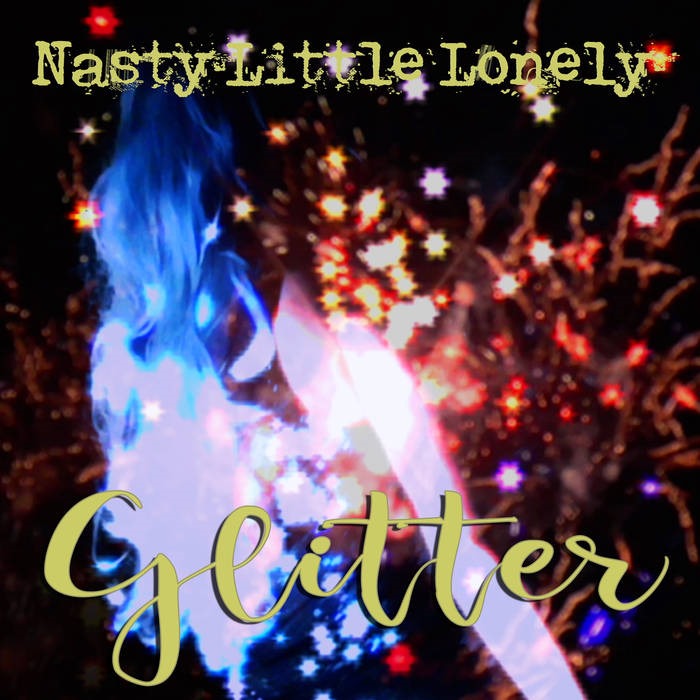
The second in their series of singles for Loner Noise, ‘Glitter’ finds Bristolian purveyors of post-punk / industrial racket mining a full-on grunge seam. And Christ, do they bring the weight on this outing. A thunderous, churning riff, as dark as hell and twice as dense, provides the backdrop to Charlie Beddoes’ angst-filled reverb-drenched vocal.
‘Glitter’ is pitched as ‘an introspective and poetic take on the mental strains of being a performer, with the moments of exhilaration on stage often coming at the cost of a great deal of stress and in some cases depression, ruminating on whether the highs would be as powerful without the lows’.
Lyrically, it’s introspective, but sonically, it throws it all out there, and slams it down, hard. And then kicks it around a bit. While Nasty Little Lonely have always had attack, ‘Glitter’ is perhaps one of their hardest, heftiest, and most unforgiving cuts to date. While instrumentally they’ve never been soft, the melodic vocal elements common to their previous outings are relegated in favour of all-out abrasion here. And it’s absolutely bloody storming.
This all sounds very complicated, both in terms of concept and execution. This is the first in a series of releases which contain remixes of tracks from the album Madame E, by Mirco Magnani and Ernesto Tomasini. So far, so straightforward. Madame E is ‘a free reinterpretation of Georges Bataille’s short novel Madame Edwarda (publ. in France 1941), in which Eroticism, Religion and Death are interlaced.’ Bataille is by no means an easy read. And while I’m yet to hear Madame E, ‘Plaisir’, at least in its remixed form, is by no means an easy listen.
Pink and white noise and strains of feedback which register in the range of bat-hearing jostle against jolting ruptures of panoramic bass frequencies and irregular, thumping, electronic beats. It pulsates and throbs and bristles and jars. With soaring, semi-operatic falsetto vocals drifting over the ever-swelling electro-industrial grind, it comes on like a deranged and super-intense hybrid of Scott Walker and Whitehouse. Maybe that could be a future project, by way of a counterpart to Walker’s collaboration with Sunn O))). Or maybe tis already fulfils that ultra-niche gap in the market.
So where’s the complication? Well, this release is credited to Ken Karter, the remixer, for a start, despite it containing music originally composed by Mirco Magnani and Ernesto Tomasini. So, this release is the first in a series which sits under the banner of MADAME E. Rèintérprétations et Remixes, which will be released periodically as one-sided 12” singles in limited editions of 10 – which is barely a test pressing – and digitally. These are designed to ‘include different points of view from artists somehow close to the album’s topics and atmospheres’. And after the last remix taken from the album, the whole remix series will be published as an album titled MADAME E. Rèintérprétations et Remixes.
I’m not entirely sure of the purpose of the individual digital releases, but that’s a question of economics and practicality. This is clearly less about practicality and convention than it’s about art.
It’s a release which invites meandering dissections and deep, analytical appraisal. It’s a release which likely deserves it, too. But there’s a time and a place, and a work so deeply invested in intertext and context. We’re in the realms of critical theory and reader reception, with a work which purposefully challenges its own place and function. But when high art meets populist electro tropes, anything goes. And with this, anything goes.
There’s something seriously awry with my promo download of the album. The tracks won’t play any audio, and instead flit by as if scrolling, searching through a menu on fast-forward. It’s a disorientating experience, and frustrating. But my curiosity I piqued, and so I feel compelled to piece together a review from the sources I can access, starting with the album’s BandCamp page on the label website.
The genesis and evolution of this collaborate project is described in the most factual of terms in the accompanying blurb.
To start AMT and Tarab exchanged materials and objects. AMT exchanged a single sound sculpture for Tarab’s collection of small objects. This material exchange led to activity. AMT manually manipulated, Tarab also, but more often than not he placed the sculpture in situations and let them work on it. Once again exchanges took place, this time of audio material. Elements where then selected and arranged and further rearranged; some left untouched and some where [sic] transformed.
I know little about either act, beyond the sketchy bios which accompany the release. On the evidence of the contents of this curious split album, Artificial Memory Trace – a project by Slavek Kwi, a sound-artist, composer and researcher interested in the phenomena of perception as the fundamental determinant of relations with reality – create fragments of sound, with seemingly random bumps and scrapes and whistles and near-mic distortions and whatever snippets come to hand tossed together to make bumpy, jumpy sonic rides. Very brief, bumpy, jumpy sonic rides at that: the seven AMT contributions to this release are under the minute mark, but what they lack in duration is countered by their intensity. They don’t make for easy or smooth listening.
Tarab’s seven pieces are lengthier and present a very different approach to composition and arrangement. Scuffling shuffling scrapes and thumps congeal to render soundscapes that couldn’t possibly sit within the ‘ambient’ bracket. It’s altogether too jarring, the intrusions unexpected and sometimes surprising. You can’t settle to this, you can’t mellow out or relax. If fact, this is a sonic experience that provokes twitchy, tetchy reactions. It’s not music to ‘like’ but to appreciate artistically. Its challenge is its strength.
None of this is to pitch one act against the other as being more ‘evolved’: if anything, their contrasting styles and near-duality is integral to the appreciation of this release.
How seriously should it be taken? Probably quite seriously. Nothing about Obex intimates an explicitly light-hearted release, an album geared towards ‘fun’. And yet amidst the dark, ponderous clanks and rumbles, something about Obex suggests an entertaining aspect, and also hints that this is art for the love of art over and above any grander narrative. And, context / no context, this is an interesting, textured work, rich in texture and dynamics.
There’s something uniquely enjoyable about watching a band develop from their most formative stages to become the act they aspired to be, and showed the potential to be. I first encountered Seep Away on a bill of noisy shit around Christmas in 2015, soon after they came into existence.
They describe their sound as ‘raw and punkish,’ and not that ‘there’s not too much melody, a lot of anger and a tonne of noise’. Their performance was ragged, and it was clear they were very much in development, both musically and as an act. But the sheer passion and raw energy they poured into that set was something else. They would stop and gasp for breath between songs, having played each one like it was the last song they would ever play.
Over the course of the next two years, they didn’t just get better, they got awesome. Tighter, louder, harder, harsher. Jay Sillence swiftly evolved into one of the most compelling front men you could hope to see: fearlessly in your face, anarchic and unpredictable, and it was clear watching them play that they were loving every minute.
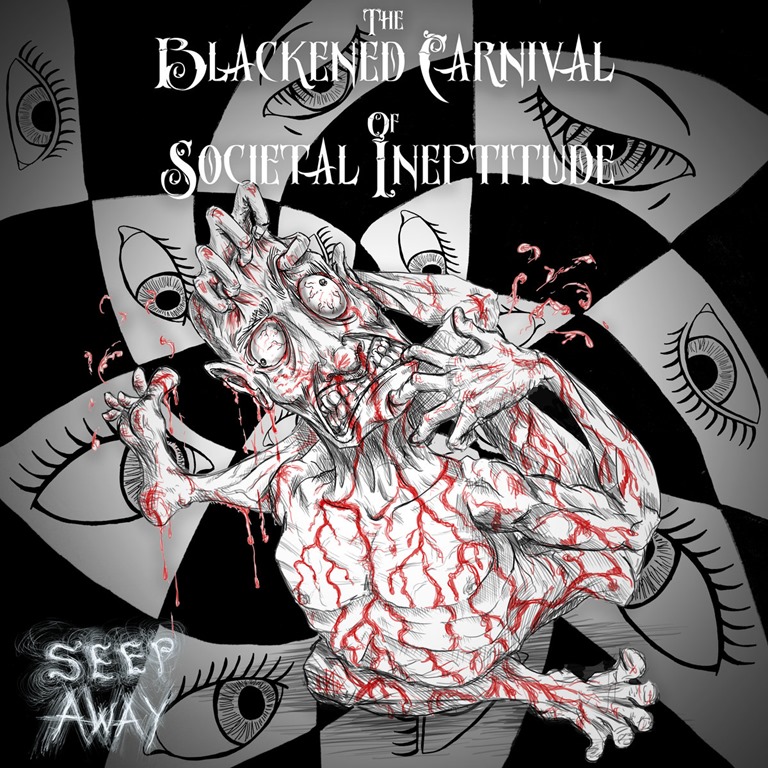
It’s therefore sad that The Blackened Carnival of Societal Ineptitude is a parting gesture. But it’s also a cause for elation that they’re signing off with a collection of songs that encapsulate the sound – not to mention the brutal, ferocious, energy of those later live shows. Circumstance and geography may be behind the band’s demise, but better that than acrimony or creative collapse, and they’re departing on a high. The Blackened Carnival of Societal Ineptitude contains eight tracks and clocks in at around twenty-two minutes and condenses all elements of the essence of Seep Away into that.
‘Rot’ is all about the churning, pulverizing riffage, the ribcage-rattling bass and snarling vocal attack. For dingy, murky, metal-done-dirty, it’s up here with Fudge Tunnel at their best. Single cut ‘Matchstick Man’ throbs and rages. Their rendition of Ol’ Dirty Bastard’s Shimmy Shimmy Ya’ has long been alive favourite, and the studio version captures the spirit of their interpretation perfectly. You’ll be leaping round the house hollering ‘baby I like it rrrrrrrrrrroooooaaaaawwwwww!’ for a week after hearing it just once.
The album’s second cover, a take on Minnie Riperton’s ‘Loving You’ sees Sillence come on full Marilyn Manson, and they ratchet up the sneering sleaze to eleven. It’s a showy, metallic-grinding wheeze, brimming with sadistic malice. It’s also a sackful of deliciously manic and suitably irreverent fun.
‘Joie de Vivre’ returns to the snarling, churning, grunt and chug of the heavy grindy / metal / hardcore amalgam that defines the band’s sound, and it’s hard-edged and gnarly in the best possible way. It packs in all of the band’s intensity and full-throttle attack into under four minutes (and is the longest track here).
Closing the album (EP. whatever) in quirky and irreverent style, ‘The Awkward Handjob’ is a piece of silly fairground japery about, er, wanking, of course. It’s fitting that of any band, Seep Away should end their all-too-brief career with a toss-off track about tossing off.
Instead of bemoaning unfulfilled potential or mourning their departure, we should focus on the positive: Seep Away have delivered a blinder of a set here.
I need to work a better filing system for my to-review albums. As it stands, it’s literally a pile, with new deliveries being tossed on top of the pile or otherwise littering the floor next to my desk. The chaotic disorder doesn’t sit comfortably with my innate sense of order and organisation, but the pile has a life of its own. Logically, new arrivals should go to the bottom of the pile, but lifting the pile, precarious as it is, is a risky operation. The teetering stack reached a height and degree of instability this morning that lifting the disc and accompanying press release from the top caused the whole thing to slide in several directions at once. Gathering the strewn and scattered discs and press releases, many of which had become separated from one another, I happened upon The Broken Glass. This seems to be something of a recurring theme, with Miguel Frisconi’s Standing Breakage standing out as a work centred around the exploitation and exploration of a cracked glass bowl. Rather later, I located the press release, too.
The pieces on The Broken Glass aren’t nearly as haphazard as my filing, but there’s a loose and spontaneous, improvised feel to much of the album, whether the composition is a sparse (dis)arrangement of electro / acoustic instruments (‘The Broken Glass v1’) or rippling, rhythmically pulsating electronica (‘The Broken Glass v2). There is a strong sense of variation and variety between the two complimentary yet highly contrasting versions – so much so that it’s difficult to discern how it’s the same piece performed differently. On the face of it, their commonality lies in the organic incorporation of Asférico’s field recordings and the subtle washes of sound.
The album’s third and final track (a CD-only bonus), ‘Sonidos del Subconsciente II’ (‘Sounds of the Subconscious II’) is different again, and has a running time of some forty minutes. An exploratory piece which evolves gradually and naturally, it begins with what sounds like the sound of the wind, a hushed and distant rumble. way off, distant machines clank and grind, the sound of heavy industry blown many miles on the breeze Brooding string notes creep in. The low tones surge and grow and build… and then there is silence. Abrupt, unexpected and unexplained silence. It simply arrives after nine minutes. The disc is still playing. Straining my ears for the faintest hint of sound above the whirring of the CD player and my hard-drive. I stop typing, so as to listen for sounds buried by the clatter of keys. But no: there is nothing.
Is this the sound of my subconscious? How long do I resist skipping the track forward thirty seconds, a minute? Why does the silence unsettle me so? Suddenly, I’m called to leave the room. On returning, the track is at the fourteen-minute mark, and there is sound. I skip back to discover where sound resumes I turn up the volume, to discover that there had been no silence, only extreme quiet. I go back to the beginning.
And from the so-quiet calm slowly, almost imperceptibly builds a funnelling storm of noise, a howling gale of tempestuous noise, amidst which crashing explosions of metallic noise, like sheet steel against sheet steel, reverberate. And the volume and intensity continues to grow and swell, to a level that’s difficult to bare. It’s no longer mere sounds, but a physical force. It’s all-encompassing, and I find myself cowering as though on a small boat in the middle of a violent storm, while the only land is an erupting volcano.
And yes, sometimes my subconscious does sound like this: a raging barrage of relentless, surging noise, amorphous, indistinct, it’s abrasive and it hurts. Not so much the sound of breaking glass, but sound to break the psyche.
York-based hardcore punk band and Aural Aggro favourites today announces its death with a new free-to-download eight-track album, The Blackened Carnival Of Societal Ineptitude (which has already clinched the AA album title of the year award), on December 20, 2017.
Of the record’s development, drummer, Dom Smith comments, “This is a dedication to all of the bands we’ve played with, and all the people who have supported us through our existence.”
He adds: “Life is bleak, loads of terrifying, dark shit happens with brief moments of pure and absolute wonder, and then you die. Thank you, and goodnight.”
Fast and furious isn’t in it. But the enigmatic and secretive Friendship are from Japan, and when it comes to extreme music, Japan really leads the field. And if Hatred seems an odd title for an album by a band called Friendship, then the equation really should be turned on its head: for a band this brutal, abrasive and gnarly to be called Friendship is simply perverse. There’s nothing friendly about them, and song titles like ‘Rejected’, ‘Regicide’, Corrupt’, ‘Tortures’, ‘Grief’, and ‘Execution’ don’t exactly send hugs in abundance either.
Of the album’s twelve tracks, only two extend beyond the three-minute mark, and half are sub two minutes. Holy fuck, this is fast and hard and nasty. It begins with feedback and immediately plunges into the dingiest, gnarliest, darkest metal noise going. The drums are pounded so fast it sounds like a pneumatic drill. Everything else is just a blurred barrage of insane, intense noise. There are riffs, but they’re brief, and churningly cyclical. The rest is all squall. And it’s a furious, punishing grind.
If friendship it is, it’s an abusive one which shows no regard for the wellbeing or mental health of those concerned. But as far as hatred is concerned, this album is all aspects of pure loathing distilled to the most potent concentrate.
Listening to Hatred is like having your soul torn from the heart of your being and ground to a pulp before your eyes, while your eyes are being pricked with hot pins. Aurally, it’s torture in its own right.
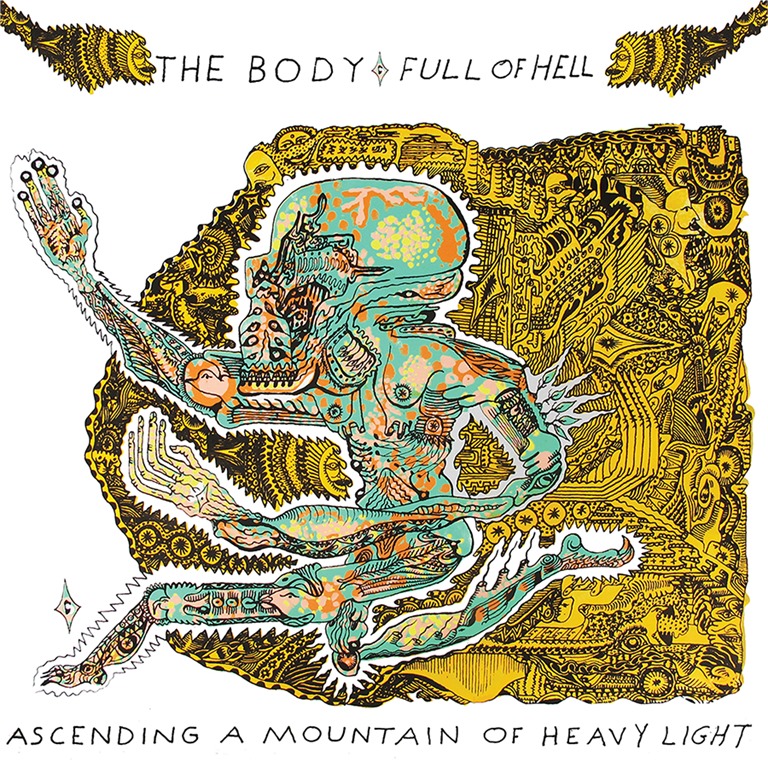
The second collaborative album between The Body and Full of Hell, which collides with the earth like a meteor, and a mere 18 months after its predecessor, and just six months after Full of Hell’s full-tilt annihilation that was Trumpeting Ecstasy, it’s every bit as unremitting and remorselessly heavy as anything previous. It’s the sound of two uncompromising bands finding compromise by amplifying one another to the nth degree, meaning that Ascending a Mountain of Heavy Light is fucking intense, fucking heavy, and yes, even more fucking intense.
The accompanying blurb forewarns that ‘samples, synth, saxophone, and a drum orchestra all throb, and sputter, coagulating under the weight of the two bands. Programmed drum patterns and loops taking cues from hip hop are bent and twisted throughout, flawlessly emboldening the distortion drenched guitars and howling vocals.’ And did I mention that it’s intense?
Beyond the first few seconds of skittering synth oscillations, there is no light on the opening track, ‘Light Penetrates’. The crushing power chords land at tectonic pace, while the vocals – an impenetrable scream of anguish – are nothing more than a primal scream of pain. And then the jazz shit beaks loose, with horns squealing like tortured pigs bleeding in all directions.
There’s nothing pretty about this, but occasionally, from amidst the screeding walls of amorphous racket emerge full-throttle stoppers, like the pounding ‘Earth is a Cage’. Elsewhere, ‘Didn’t the Night End’ is a snarling, grinding, bowel-shaking racket of surging waves of noise that simply hurt. It’s the kind of snarling, grinding, bowel-shaking racket that makes you want to lie on the floor and curl up into a foetal position. It makes you want to die, and it certainly makes you long for the night – and the noise – to end, as it assails the senses from every angle.
The drum intro is nabbed from oh, so many tracks – a simple four-four thump of a drum machine bass – before everything explodes in a tempest of screaming industrial-metal fury. Early Pitchshifter come to mind, at least in the drum programming, but this is something altogether more psychotic in its unbridled fury, and in its amalgamation of paired-back hip-hop and industrial metal, all crackling with overloading distortion, ‘Master’s Story’ invited comparisons to the innovations of Godflesh – at least until it goes all crushing doom halfway through.
As with anything produced by either band, either independently or collaboratively, Ascending a Mountain of Heavy Light is not music for pleasure, and large chunks are little short of anti-music, blistering walls of sonic brutality built on discord with the most challenging of tones and frequencies explored to the max.
It’s a fucking miracle Arrows of Love are still here, let alone that they’ve managed to nail a second album. But then, to watch them play live, it often seems like a fucking miracle that they can make it to the end of a set. Everything about Arrows of Love, from day one, had had an air of precarity, teetering on the brink of implosion. Every song carries that same sense of danger. It’s their wild volatility that sets them as one of the most exciting bands of the last decade, but ultimately, it’s the songs that matter. They’ve always had songs: sprawling, messy, noisy, fucked up and perversely challenging songs, underpinned with some lean grooves.
Product has been a long time in coming and the line-up on this, their second album, is quite different from the one which recorded their debut. In the period between the delivery of aforementioned debut the nihilism-in-a-nutshell noisefest that was Everything’s Fucked (May 2014) Arrows of Love have evolved, and perhaps some of it’s a natural progression and some of its… not so much an increasing maturity as a refocusing of energy, and some if it’s a result of the personnel changes. One obvious shift is the absence of shared vocals: Lyndsey Critchley’s departure has certainly altered the dynamic of the band in that sense (bassist Nuha Ruby Ra’s vocal contributions are a lot less prominent, and she only leads on one track, the surprisingly sultry and almost tender ‘Come With Me’), and Product is a lot less direct and attacking than its overtly grunge-orientated predecessor.
That doesn’t mean that Product is any less confrontational or antagonistic, and the nihilism which drove Everything’s Fucked is apparent in the subtitle ‘Your Soundtrack To The Impending Societal Collapse.’ Moreover, the use of the definite article shows an absolute confidence in what lies ahead – Arrows of Love are certain we’re past the tipping point and freewheeling toward the end of the world as we know it. Product is certainly a darker, more claustrophobic affair than its predecessor, and finds Arrows exploring wider, deeper territory in the process.
‘Signal’ is dark, dense, disturbing, and desperate, and is heavily hung with a curtain of goth which drapes over the violent (post)punk energy. ‘Did you ever see this coming?’ Nemah challenges through a fuzz of distortion ‘Let the lunatics run the asylum,’ he spits, and we know that this isn’t the future he’s predicting, but a plain observation on the present. The tension builds into a squalling racket and the vocals reach fever pitch as the track reaches its explosive climax.
It feels like an eternity since ‘Predictable’ first aired on-line – and while the band articulate their ennui at the daily shit that is life in the 21st century, as a musical work it’s anything but predictable. The vocals transition from drawling boredom in the verse to screaming mania in the chorus, while the guitars lurch and swerve every which way.
Marking a change of pace and direction, ‘Desire’ is dark, brooding, stripped back, introspective. At near the six-minute mark, it’s a seething mess of emotions: Arrows of Love are a band who’ve always emanated a gritty sexuality, but this channels it in a very different way, and it’s not comfortable or snuggly.
‘Tidal’ is perhaps the most overtly ‘art-rock’ song on the album, as well as being the most classically ‘grunge’ composition, with its quiet / loud verse / chorus juxtaposition. At the same time it encapsulates the dual character of Product, and album that swings – quite effortlessly, and thus with maximum impact – between classic post-punk trappings and raging noise, with exploratory experimentalism informing the process.
‘Beast’, which premiered some months ago now, is a swampy, squalid mess of seething abrasion a throbbing mess of bass that sonically calls to mid Melvins in places but ultimately stands as the soundtrack to a riot. The shrieking ‘Toad’ is equally uncompromising, and ‘The Parts That Make the (W)hole’ comes on like a hybrid of The Fall, Shellac and The Cooper Temple Clause. ‘Restless Feeling’ captures the dark, dirgy doom of Swans circa 1984 and makes for one hell of a low ending to the album: if anything, it’s the sound of society after the collapse as its low-end swell builds to an all-consuming tsunami of noise.
Product bridges the gap between Bauhaus and Nirvana, but ultimately, any comparisons are but signposts to an album which is unique in its standing. Product avoids pretence and overblown portentousness: it doesn’t make lofty statement about the future, but instead stands as a painfully intense document of the present. If any album of the last five years articulates the dizzying, anxietised state of contemporary life, it’s Product.
Now, I’ve been digging Nasty Little Lonely for a while. Clearly, this is because I’m a music reviewer who gets to hear about everything in advance and I’m infinitely cool because of it.
But seriously, I was introduced to these noisemongerous mofos three years ago, by means of their Bad Jack & Other Stories EP. And they’ve only continued to get better – by which I mean more intense and visceral – ever since.
‘Ugly Vitamin’ is a seething, squalid eruption of-guitar-driven derangement that calls to mind not only Hole at their best, but also the sneering ferocity of Lydia Lunch the rather more psychotic Queen Adreena. It writhes into the skull and penetrates hard. A choppy, chunky bass and hammering rhythm drives through squalling, treble-smash guitar and Charlie Beddoes does sweet but dangerous on the vocal front. You don’t want to fuck with NLL, that’s for sure: but you do need them in your life.






 Aural Aggravation